To Win Elections, Conservatives Need to Win in Schools

What happened?

Why do conservative candidates lose elections?

That is the question Mark Bauerlein of Emory University asked in Friday’s Public Discourse.

Bauerlein finds the answer not in demographics or policy prescriptions, but in college and high-school curricula.  The revolution in teaching of the past forty years, he says, means that conservative candidates lack the intellectual heft and agility necessary to win.  Bauerlein modifies a Thatcher motto: “First you win the schools, then you win the government.”

Governor Romney, Bauerlein argues, exemplified the problem.  Romney’s famous blunder about “47%” of the electorate was a lost opportunity, Bauerlein thinks, to introduce a new generation of voters to true conservative principles.  Romney did not explain the central conservative principles of thrift, independence, and liberty that could have made his point.

The real remedy, Bauerlein insists, is not in new polls or smoother candidates.  The long-term conservative remedy will be to take advantage of the profound conservatism at the heart of American culture.  If young people receive a better education in the American tradition, they will be both more receptive to and more articulate about those conservative American principles.

“The lesson is this:” Bauerlein tells us,

Conservative candidates must possess, among other attributes, a conservative tradition in their heads, not just political principles, but great thinkers and artists of them, too. . . .

The best way, perhaps the only consistent one, to plant conservative writings and art in the formation of politicians is through the high school and college curriculum. There, individuals have the space to absorb them as common intellectual equipment, as regular facets of the world, not as political positions. . . .

What they encounter and how it is presented determine what they think is important. If English and history courses don’t include Brave New World and Fahrenheit 451 (an anti-political correctness novel) alongside multiculturalist fiction of the 2000s, if they don’t add David Horowitz’s Radical Son to celebrations of the 1960s counterculture, if James Madison doesn’t precede Malcolm X, then the conservative tradition has no place in the accepted body of cultural literacy. If The Scarlet Letter is taught as an indictment of sexual oppression in a Puritan community, not as a complicated tale in which the community has a valid claim upon Hester’s desires, then social conservatism is reinforced as an uptight, obsolete imposition.

This is to recognize the curriculum as an authorizing process. What makes it onto the syllabus has legitimacy, and the angle the teacher takes upon the materials tends to stick. If conservative donors wish to back winning candidates, to cultivate politicians who can deflect sallies of biased reporters and liberal counterparts with intelligent and informed convictions, they must reach conservative politicians not only in election years, but at impressionable ages, too.

The good news for conservatives, Bauerlein writes, is that many schools have already begun to implement this kind of strategy.  They teach conservative ideas not only in short-term intellectual boot camps, but as part of a thoughtful tradition that includes all the best thinkers from across the intellectual spectrum.

What could this look like?  According to Bauerlein, it could mimic the success of liberal efforts such as the Ford Foundation’s funding of centers for Women’s Studies.  That field went from zero to influential in a decade, thanks in part to such funding. Bauerlein thinks it’s time for conservatives to do the same.


Required Reading: Greg Forster and the Hundred Years’ War

At the Witherspoon Institute’s Public Discourse this morning, Greg Forster introduced a three-part series inquiring into the changing relationship between evangelicals and politics in the United States over the past century.  The series, Evangelicals and Politics: The Hundred Years’ War, promises to examine the tense relationship between conservative evangelicals and political life.

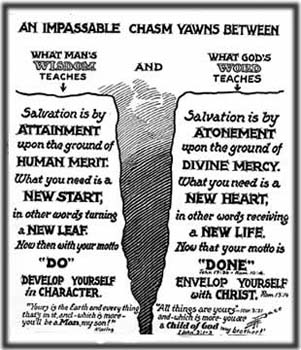
An Impassible Chasm

From EJ Pace, Christian Cartoons, 1922

Forster is deeply sympathetic to the cultural claims of conservative evangelical Protestants.  Though he would likely dispute the label, he writes about what I call Fundamentalist America from deep inside its boundaries.  He works and has worked for a variety of conservative foundations, including the Kern Family Foundation and the Friedman Foundation for Educational Choice.  He has written about the Joy of Calvinism and argued in favor of the marketization of schooling.

In this series, he asserts that evangelical political activism has been a force for good throughout the twentieth century.  “Good citizens,” he notes,
“don’t stand by while their nation is threatened, and evangelical political activity has accomplished much good. Although the rising tide of moral disorder has not been reversed, its progress has been halted in many respects, and forces of renewal are gathering. All of this was made possible largely by evangelical efforts.”

But Forster does not simply present the History of Heroic Fundamentalists.  He takes conservative evangelicals to task for misunderstanding the implications of the Great Schism, the split among Protestants around the turn of the twentieth century between “modernists” and “fundamentalists.”  In Forster’s words:

“Before the schism, America had a longstanding social consensus on how to reconcile religious freedom with public morals: the state would legislate based on the moral consensus of society, but keep its hands off directly confessional issues and try to steer clear of inhibiting diverse religious exercise. Meanwhile, beyond the bounds of state power, America’s leading institutions would be predominantly defined by and loyal to the Protestant view of the world. This strong yet informal Protestant cultural authority would keep the citizenry moral, so the coercive power of the state could be mostly kept out of moral formation in the interests of religious freedom.

“The Protestant schism was the decisive factor that ended the old social order. To be sure, a variety of other factors were already weakening it; for example, the injustices imposed upon Catholics and Jews were becoming steadily harder to ignore. However, the schism destroyed the framework of the social order from within. Protestantism could no longer serve as a moral center of society once no one could say with any confidence what “Protestantism” was.

“But evangelical leaders misunderstood the nature of the threat. They didn’t seem to grasp that the schism had destroyed America’s Protestant cultural consensus. They spoke and acted as though it was still basically sound in the country at large, and was only being challenged by a cabal of liberal secularists who were hijacking America’s culturally leading institutions (especially denominational bodies and universities). In short, they thought of the crisis more in terms of apostasy by a relatively narrow set of leaders than a true schism of the church.

“Because of this misunderstanding, evangelicals turned to politics as a tool for mobilizing social power and cultural influence to wage their battle against the liberal secularists. They expected that politics would give them the power they needed, because elections are based on majority rule and America was still basically a Protestant country.”

Forster’s analysis fits.  In some key “fundamentalist” political battles, conservatives hoped to mobilize the power of the state to support their cultural power.  As I argue in my book Fundamentalism and Education in the Scopes Era, (coming soon in paperback, pre-order now!) 1920s fundamentalists were successful when they mobilized a broad spectrum of Protestant support.  They were less so when they fought against liberal Protestantism.  So, for instance, when they disputed the teaching of evolution in public schools, liberals successfully castigated them as hillbillies and anti-intellectuals.  But when they pressed for laws mandating Bible reading in public schools, they met far less resistance.

I’m looking forward to the rest of Forster’s series.
