FROM THE ARCHIVES: AL Take Manhattan

What do conservative activists want out of education?  Like progressive thinkers, most conservatives have historically hoped for more than just classroom solutions to educational problems.  Like progressives, the conservatives I’ve studied have imagined “education” as a broad-ranging, all-encompassing process for young people.
Coming soon...

Coming soon…

As I clean up my files for my upcoming book, I’ve rediscovered lots of archival documents and images that I couldn’t include.  Today, I’d like to share some of the material from the American Legion’s educational activism in the 1930s.  Like other conservatives, the leaders of the AL argued for an educational policy that encompassed far more than school reform.  Activists in the AL wanted to provide a wholesome intellectual and social atmosphere for young people in order to save them from the clutches of subversives, progressives, and anti-Americans.

American Legion activists in the 1930s thought that education could provide a wholesome moral defense against socialist and communist subversion.  Time after time, AL leaders exhorted local posts to engage in a range of activities to provide wholesome and patriotic activities for young people.  This included classroom work, but also ranged far beyond.

As the AL’s Americanism Handbook put it in 1930,

While the communist organizes his young pioneers, his youth movement in colleges, and so forth, let us do some organizing.  Let us organize Boy Scout troops, ROTC units and boys’ baseball teams, if you please.  Let us win and hold the confidence of our boys through such work.  While the communist scatters literature among the youth of the land to teach it disrespect for parental authority, let us preach the doctrine of love of parents and love of home.  While the communist ridicules the ethics of religion, let us teach its beauty and comfort and hope.  While the communist preaches its cowardly philosophy of dissipating the fruits of labor and capital, let us strive to inculcate the manly principles of energy, ambition and thrift in the hearts of our people.  While the communist, in the guise of the professional pacifist, spreads his doctrine to palsy the arm of our national defense, let us keep our people informed on matters pertaining to the need and necessity of national defense.
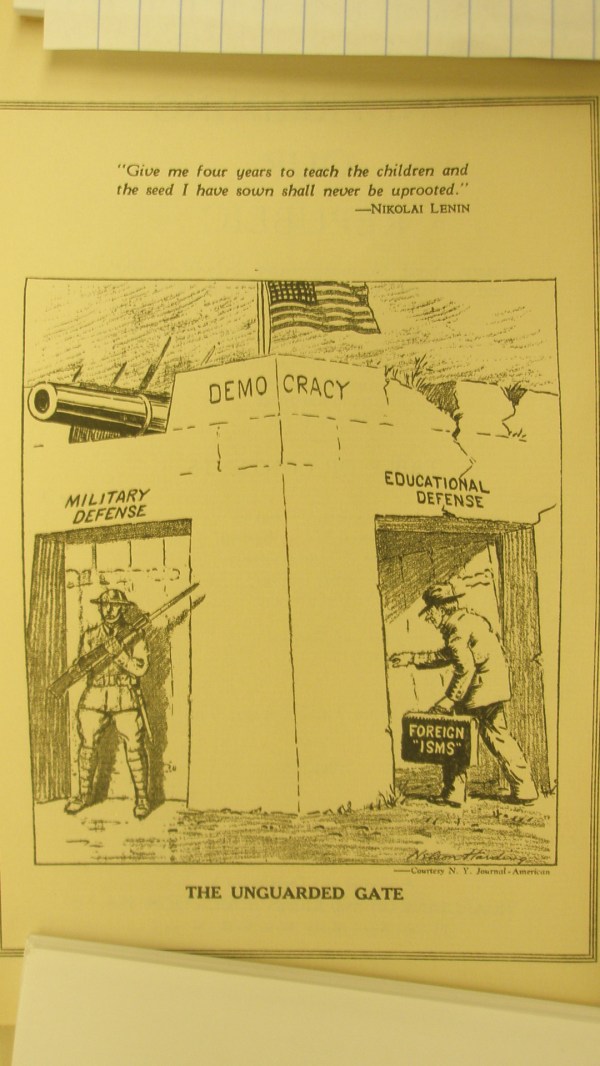
From a 1941 AL pamphlet

From a 1941 AL pamphlet. The original appeared in a Hearst publication.

The most active educational leader in the Legion during the 1930s was the AL’s Director of the National Americanism Commission, Homer Chaillaux.  In a suggested speech Chaillaux sent out to AL leaders around the country, he spelled out the AL’s broad educational philosophy.

First of all, the AL worked to fight subversion in the classroom.  As Chaillaux put it,

It is a well known fact that un-American groups, radical pacifists, communists and others operating under more or less misleading nom de plumes, are using the schoolrooms throughout the nation for the dissemination of their poisonous propaganda.  Therefore, we believe that it is only right and proper that organizations interested and engaged in the promotion of Americanism should be permitted to go into the classrooms with activities designed to build up a greater love and appreciation for the sacrifices made by our forefathers and for our form of government, and for the things which have made possible the growth of our nation.

But this was not only a schoolroom campaign.  Chaillaux described the wide-ranging activities carried on by the AL: ROTC programs, Boy Scouts, baseball leagues and other sports leagues, oratorical contests, essay contests, and Sons of the American Legion clubs.  In all its “Youth Activities,” Chaillaux explained, “the Legion seeks to coordinate the mind and the muscle through a group of activities designed to build physical and mental alertness.”

Chaillaux asked,

Does the Junior Baseball program aid in any way in counteracting communism and other un-American activities?  That question has been asked a number of times.  And the best answer, I believe, is found in a clipping taken from the “Gazette,” Gastonia, North Carolina, under date of July 31, 1934.  We quote the clipping herewith:

‘We in Gaston County know from four or five years experience what a valuable and beneficial movement this baseball program has been.  It had its beginning in Gaston County in the summer of 1929, the summer that the communist uprising had put Gaston County so unfavorably before the public.  Seeds of unrest and bitter partisanship had been planted here that spring by the agitators from the slums of New York and the classic halls of certain New York universities.  We had just gone through the sickening and humiliating trial of the gangsters accused of killing the chief of police here: The county was torn to pieces.

‘Along came this Junior Baseball, enlisted the boys from the textile settlement of the county and there began a movement which has been of the most wholesome influence in the county.  It has been the best insurance against a recurrence of similar troubles in the county.  These boys are learning how to be square and clean shooters, fair and above board in their play and in their dealings with each other and with their superiors.  From the Legionnaires who are sponsoring the movement, they are learning principles of Americanism that they will never learn from books.’

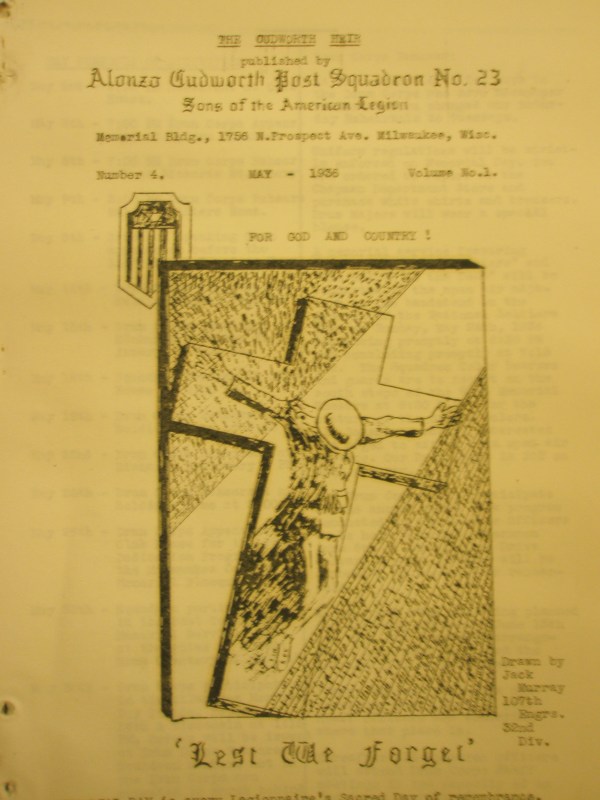
Local posts embraced these efforts.  And though it may seem heavy-handed and dictatorial, it seems as if many young people really did enjoy these subversion-fighting activities.  During my research, I spent some time in the files of one Joseph Hrdlick, an active member of an AL post in Milwaukee.  Lucky for me, Hrdlick kept copies of some of the youth activities in which his post engaged.  In Hrdlick’s papers, we find examples of a magazine the local Sons of the American Legion post produced during the 1930s.  We also see mementoes from activities such as the SOTAL marching band.  In this case, the Milwaukee boys marched all the way to New York City, a town not often revered among anti-communist activists.

It’s always hard to distill how the average person felt about these activities, but at least Mr. Hrdlick seemed sincere and enthusiastic in his efforts to help his young SOTAL minions.
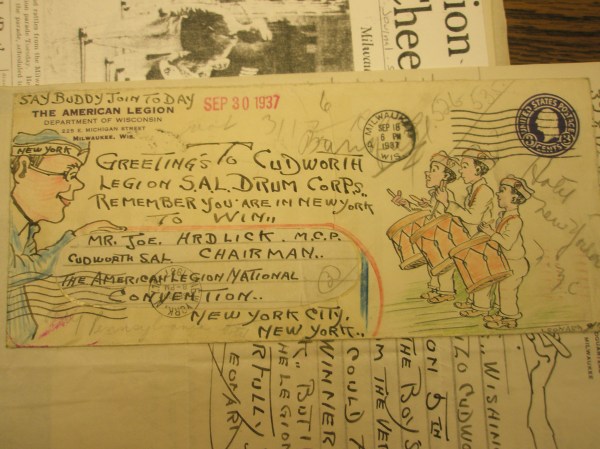
If they can make it there...

If they can make it there…

A SOTAL newsletter
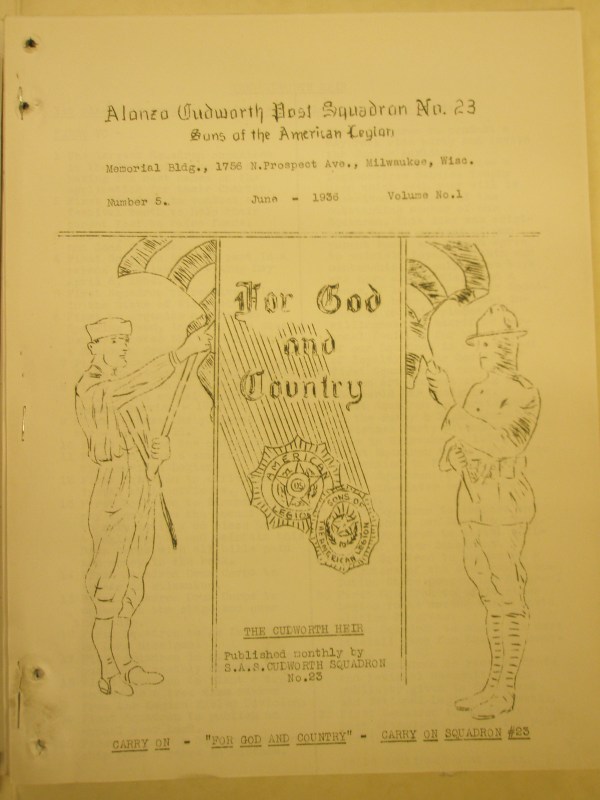
A SOTAL newsletter


A SOTAL newsletter

…another newsletter cover

Other AL archives from the 1930s contain similar gems.  In the Historical Society Archive in Madison, a hundred miles or so west of the Milwaukee collection, I found some examples of student work in AL-sponsored essay contests from the 1930s.

One winner from 1939, in her essay “What America Means to Me,” wrote these stirring words,

Just to look upon the map of America gives me a thrill! . . . America is a free country.  It is a haven for political refugees who could not find the freedom they desired in their homeland. . . . America is a land of opportunity, and yet—as there are in every country—there are those who will criticize and tear down our ideals and laws.  Their’s [sic] is a destructive criticism; hindering, instead of helping, our lawmakers.

This rhetoric sounds like precisely the sort of anti-subversive, patriotic, engaged attitude that the AL hoped to sponsor in young people nationwide.  Again and again, AL activists worked to reform the education of America’s youth.  They looked hard at classrooms, textbooks, and teachers.  But they didn’t stop there.  Like all sorts of educational reformers, these conservative activists worried about the end product of education.  Of course, they weren’t the only ones.  As I argue in my upcoming book, this sort of conservative activism formed a complex tradition throughout the twentieth century.

But in every case–whether it was the American Legion, the Daughters of the American Revolution, Pro America, the World’s Christian Fundamentals Association, or any of the dozens of local groups and individuals that campaigned for more conservative education in the twentieth century–the archives included far more fascinating tidbits than I could include in the three hundred pages I had to work with.

As I keep cleaning up my files, I’ll post other archival gems that didn’t make the final cut…

Can We Tell Students the Truth about Truth?

HT: DL

I don’t know what to think.  For almost a hundred years, creationists and other conservatives have complained that mainstream science—often symbolized by the idea of evolution—threatened their children’s faith.  For just as long, leading scientists have insisted that there was nothing religious about real science.  But a recent chat with physicist Carlo Rovelli makes me wonder.

First, some premises:

1.) Public schools should not be teaching religious ideas to children.  Schools may and should teach ABOUT religions, but public schools should not attempt to push students toward or away from any faith.

2.) Public schools must offer students the best available scholarship.  In science class, this means students must learn the modern evolutionary synthesis.

3.) Secondary-school education–in the USA, that means high schools and middle schools–should train students to think in ways familiar to the scholarly disciplines.  So, in history class, we follow Stanford’s Sam Wineburg in hoping to teach students to engage in the “unnatural act” of thinking like a historian.  The same should be true in other disciplines.  Students should be learning basic principles of mathematical thinking, literary thinking, and scientific thinking.

So here’s our dilemma.  For a while now, conservative creationists have complained that public schools are teaching evolution as a religion.  Nonsense, mainstream scientists have responded.

Because, of course, if evolution were a religion, it should not be taught in public schools.  It could be taught ABOUT, but not taught as something towards which students ought to be pushed.

But as trenchant observers have observed, there are indeed some religious aspects of mainstream scientific belief.  Or, to put it more precisely, there are important ways in which the attitudes of mainstream scientists clash with certain conservative theological beliefs.  As my favorite atheist observer of American creationism Jason Rosenhouse argued, traditional Christians are correct in thinking that evolutionary ideas pose a drastic theological threat.

And today we come across more fuel for this dilemma.  In a recent interview in Scientific American, physicist Carlo Rovelli seconds the notion that mainstream science is–as much as it is anything–a skeptical attitude toward absolute truth.  As Dr. Rovelli put it,

I have no idea what “absolute truth” means. I think that science is the attitude of those who find funny the people saying they know something is absolute truth.  Science is the awareness that our knowledge is constantly uncertain.

Tell me the absolute truth: Do these glasses make my face look fat?

Dr. Rovelli, Tell me the absolute truth…

I don’t need to be up on the latest in quantum physics to see how such an attitude could be problematic for the conservative parents of American school children.  If such children were being taught the basic principles of mainstream science, and if those principles coincided with Rovelli’s attitude, then conservative parents might indeed have cause for complaint.

A family wouldn’t need to be any sort of creationist to take issue, either.  Anyone who takes their Judaism or Christianity seriously might be chagrined to find their children coming home from school and telling them, “I find it funny when people say they know something is absolute truth.”

The Movie that Will Save Our Children

A Florida lawmaker has offered a new definition of a summer must-see movie.  According to the Hollywood Reporter, State Senator Alan Hays has promised a bill that would force all public high-schools and middle-schools to screen Dinesh D’Souza’s America: Imagine the World without Her.

As I’ve argued elsewhere, D’Souza’s film seems to be another conservative exercise in shadow-boxing.  The film assumes that American history teachers are pushing an ideologically inspired hatred against the United States.  Historically, that just hasn’t been the case.  As I argue in my upcoming book, conservatives have exerted outsized influence over the kinds of history their kids learn in public school for decades.  The notion that schools have been taken over by a scheming cabal of sneaky progressive educators and historians just doesn’t match the historical record.

Nevertheless, it is a notion that resonates strongly with conservatives.  As Senator Hays put it,

I’ve looked at history books and talked to history teachers and the message the students are getting is very different from what is in the movie.  It’s dishonest and insulting. The students need to see the truth without political favoritism.

Ironically, Senator Hays’ plans might just prove the case.  As the Hollywood Reporter points out, Hays’ bill might actually pass, given the political landscape in Florida.  If it did, or even if it made a strong showing, it would demonstrate the continuing influence of conservative activism on public education.


School Is Not the Place for Education

What does it mean to be educated?  This morning at The Imaginative Conservative, Steven Jonathan Rummelsburg blasts public schools for punting on this central question.

Rummelsburg relates his long quest to dig into the basic philosophy of public education.  No one he’s asked, he tells us, is able to answer the simple question: What is an education?

Rummelsburg, a veteran public-school teacher himself, asked public-school teachers, students, and administrators.  Most of the respondents, according to Rummelsburg, hemmed and hawed with answers about mastering standards and earning a diploma.  One math teacher, he tells us, paraphrased Steve Forbes.  What is an education?  This teacher answered, “Replacing an empty mind with an open one.”

When he asked his county superintendent’s office, he got a list of four points:

  1. You will get as many definitions of education as the number of people you ask.

  2. To be educated means to have learned enough language and math to be a good citizen.

  3. It is not about the subject being taught, but what the teacher does with her audience. It is all about the student teacher relationship and what she can get them to do.

  4. That is the answer today, the answer tomorrow will be different.

[I assume this was Rummelsburg interpretation of the superintendent’s office’s answers.  The language sounds a little too frank to come from a public official.]

What should the answer have been?  Rummelsburg wants teachers and schools to hew closer to GK Chesterton’s definition of education.  Education must not be thought of as a simple thing, but as a “method.”  It should be a transmission of all that is best in our culture.  The only way to do that properly, Rummelsburg concludes, is to separate out the unfairly conjoined notions of “school” and “education.”

As he concludes,

It is a terrible crime to hand the formation of our children over to an enormous class of uneducated teachers, yet that is what we have done. As it stands, there is nothing redeemable about the public schools or the lies they instil in our children. . . . Let us take our children back and assume our responsibility as their first teachers and teach them as they ought to be taught.

Certainly, Rummelsburg’s argument that today’s public schools have utterly lost their way resonates with intellectuals on both the cultural right and left. And I have a deep sympathy for his insider’s critique of public education. I work with many public-school teachers and administrators, and nothing makes me more pessimistic about our public schools than the number of teachers who choose to homeschool their own children.

But is Rummelsburg’s method sensible? If we can’t get an adequate philosophical definition of education from teachers and school administrators, does that mean that schools are not educating students?

Would this work for other institutions? For example, if I asked everyone who worked in my local supermarket to explain “the market,” would I get a coherent answer? An answer that captured the essence of social and economic exchange? Probably not. But does that mean that my supermarket is not functioning as a market?


Registration Is Open!

You are invited.

In a few weeks, Binghamton University’s Graduate School of Education will be hosting a terrific event.  Documentarian Trey Kay will be sharing his new radio documentary, “The Long Game: Texas’ Ongoing Battle for the Direction of the Classroom.”  You probably remember Trey from his award-winning documentary about the textbook battle in West Virginia, 1974-1975.  In his new work, Trey explores the themes so close to the hearts of ILYBYGTH.  Should schools teach creationism?  Should they teach sex?  If so, how?  And what sorts of history should public-school students learn?  Should students be taught that America is awesome?  Or that the United States has some skeletons in its closet?  There has been no place more interesting than Texas to see these politics in action.

long game

After the listening session, Trey will offer a few comments.  He’ll be joined by the world-famous historian Jonathan Zimmerman of NYU.  ILYBYGTH readers will likely know about Zimmerman’s books, including especially his seminal work Whose America.  In addition, BU faculty member Matt McConn will say a few words.  McConn is new to New York, fresh from a long career as a teacher and school administrator in Houston.

There will even be cookies.

So please come on down if you’re in the Upstate area.  It will take place on Thursday, February 27, at 6 PM, in room G-008 in Academic Building A, on the beautiful main campus of Binghamton University.

We’d love to have you.  The event is free and open to all, but registration is required.  To register, please go to the BU registration site.

The Most Important Thing Anyone’s Ever Said

What is the most important line in the history of American education?  Something from Ben Franklin?[1]  Frederick Douglass?[2]  Horace Mann?[3]  John Dewey?[4]

According to Bruce Frohnen in the recent pages of The Imaginative Conservative, that honor goes instead to Annette Kirk.  Her line from the 1980s, Frohnen argues, offers traditionalist conservatives and anyone who cares about real education the only thread of hope in the blasted and devastated landscape of American public education.

Conservative intellectuals have long taken a dim view of the state of American education.  Frohnen opens his recent jeremiad with a nod to the terrible state of today’s schools.  “Can public education in the United States be saved?” Frohnen asks.

Given the stranglehold of teachers’ unions over school districts and state legislatures, the constant meddling of an ideologically motivated federal Education Department, the sheer weight of bureaucracy, and the commitment to mediocrity? Perhaps not.

But traditionalists such as Frohnen are not the only ones who tend to throw the school baby out with the modern bathwater.  Leftist historian Michael Katz, for instance, opened a new era of revisionist educational historiography in 1968 with his assertion that schooling in the United States has always been “conservative, racist, and bureaucratic.”[5]  Also from the left, Marxist economists Samuel Bowles and Herbert Gintis denounced American public education in 1976 as a tool of the economic elite.   Libertarian historian Joel Spring famously denounced the cookie-cutter domineering of “The Sorting Machine.”

Frohnen agrees with these folks about the terrible state of public education in the USA.  But it’s hard to imagine Professors Katz, Spring, Bowles, or Gintis agreeing with Frohnen about school’s saving grace.  According to Frohnen, the only glimmer of hope in the last generation has been a line inserted by Annette Kirk into the 1983 blockbuster report A Nation at Risk.

You history nerds out there might think that Frohnen is referring to some of the most famous lines of that report.  Every survey of American educational history, for instance, talks about the reports catchy warning about a “rising tide of mediocrity.”  Most surveys, too, note the apocalyptic edge to the report’s conclusion.  “If an unfriendly foreign power,” the report noted, “had attempted to impose on America the mediocre educational performance that exists today, we might well have viewed it as an act of war.”  Ouch!  Take that, teachers’ unions!

But those memorable lines were not the ones to which Frohnen referred.  No, the most saving line of the report, Frohnen argues, was one inserted by the true conservative Annette Kirk.  In Frohnen’s words, Kirk made sure that the report included the principle that “parents are the first and primary educators of their children.”

Thanks to this perspicacious inclusion, American education has been saved from the worst strangleholds of state-dominated educracy.  Parents in the United States, Frohnen points out, still have the freedom to free their children from the school system entirely.  Homeschooling offers such parents their last best hope of seeing their children truly educated.


[1] “Genius without education is like silver in the mine.”

[5] Michael Katz, The Irony of Early School Reform: Educational Innovation in Mid-Nineteenth-Century Massachusetts (Cambridge, MA: Harvard University Press, 1968), 3.

Public Schools and the Culture of Death

Do public schools disregard the sanctity of life?

That’s the charge recently from Answers In Genesis’ Ken Ham.  Ham responded to an article in which a public-school textbook author wondered about when life begins.  Ham’s argument can tell us a few things about religion, creationism, and public schooling.

Ham, arguably America’s leading young-earth creationism advocate, argued that Dr. Ricki Lewis failed to promote a Biblical vision of the beginnings of life.  Lewis argued that science could not offer a simple explanation of the point at which life began.

As she wrote,

that is a question not only of biology, but of philosophy, politics, psychology, religion, technology, and emotions. . . . textbooks list the characteristics of life, leaving interpretation to the reader.

Dr. Lewis offered seventeen common interpretations of the beginnings of life, from pre-conception to birth to puberty.  In her opinion, the best answer was somewhere in the middle.  Life became life, she thought, at roughly week 22 of pregnancy, the point at which most babies can survive outside the mothers’ wombs.

Ham disagreed.  “Sadly,” he argued,

Dr. Lewis’s conclusion is false. She reaches it using human reasoning rather than the Word of God, and that’s likely how biology writers and teachers across the country are instructing their students to determine when life begins. No wonder so many think that abortion is not killing a human being—or really murdering a human being!

For those of us who follow the educational culture-wars from the sidelines, Ham’s argument can tell us a few things.  First of all, it helps us understand that many creationists care about more than just evolution.  They have much broader religious visions for schooling.  Second, it shows us that many religious conservatives have already given up hope for public schooling.

For those new to the creationism/evolution scene, it may seem surprising that a young-earth creationist such as Ken Ham would be interested in issues such as abortion and the beginnings of life.  But Ham and other creationists are first and foremost conservative evangelical Protestants.  Creationism may be the issue for which they garner the most attention, but other issues such as gay marriage and abortion remain of central interest.

Also, Ham’s post shows the attitude shared by many religious conservatives about public schooling.  Ham takes it as a given that public schooling is fraught with perils to faith.  He opens his argument by reminding readers that public schools have been traveling down a dangerous road for some time.  As he puts it,

One of the major trends many of us have witnessed over the years has been the way God has basically been thrown out of the public education system, including secular colleges and universities. Students often have to contend with teaching that is contradictory to God’s Word—especially when it comes to the origin of the universe.

Abortion, climate change, evolution, gay marriage…all are of central interest to conservative activists.  And, most important for these pages, all issues in which schooling and education will continue to play a central role.


Battle Map!

Where have Americans fought over public schooling?

The libertarian Cato Institute has put together a clickable Battle Map to help readers locate educational controversies.  Readers can search by state, by year, or by the type of conflict.  The Cato folks broke down school battles into such categories as curriculum, freedom of expression, gender equity, human origins, moral values, racial/ethnic diversity, reading material, religion, and sexual diversity.

Of course, the folks at Cato aren’t just providing a nerdy public service for those of us interested in studying cultural controversies.  The point of this exercise, from Cato’s perspective, is to prove that public education “divides [people], forcing them into conflict over whose values and histories will be taught, and whose basic rights will be upheld . . . or trampled.”

To this outsider, Cato’s argument seems a little strained.  After all, just because many family dinners turn into shouting matches, does that prove that dinner is a bad thing?


Bible Bullying and the Borders of Fiction

Is the Bible nonfiction?  Can public-school teachers call it fiction?  More important, can a teacher poke fun at a student who considers the Bible nonfiction?

Those questions are at the heart of a new lawsuit from Temecula, California.

According to The Christian Post, a middle-school teacher asked students to bring in a nonfiction book to read.  When one student pulled out a Bible, the teacher objected.  Worst of all, according to The Post, the teacher ridiculed the student for considering the book nonfiction.

An activist legal group, Advocates for Faith and Freedom, has sued the school district.  The Christian legal group wants the school district to add teachers to its bullying policy.

According to AFF President Robert Tyler, the teacher’s actions in this case represent just the tip of the anti-Christian iceberg.

In an interview with the Christian News Network, Tyler denounced public-school teachers’ tendency to bully Christian students.  “These days,” Tyler said,

there is no shortage of bullying against Christian students by teachers.  If a teacher were to take the same tone and tactic against a homosexual student based on the student’s sexual orientation, the teacher would be subjected to serious and significant discipline. But for some reason, these teachers feel that they have the ability to engage in this type of hostility and attempt to humiliate Christian students.

The exact boundaries of religious expression for public-school students have long been tricky to figure out.  Can self-funded cheerleaders display Bible messages at public-school football games?  Can students wear religious t-shirts?

But this case raises different questions, too.  Can teachers be bullies?  Can school districts use their existing anti-bullying policies to discipline teachers?

It seems like a difficult proposition.  After all, teachers in most schools have an explicit duty to manage the behavior of their students.  It would be bullying, in many cases, for one student to make another student quiet down.  But if a teacher makes a student quiet down, isn’t that just classroom management?

Couldn’t the Advocates for Faith and Freedom make a simpler argument?  Teachers certainly should not belittle students for their religious beliefs.  Why should the school district have to call it “bullying?”

Racism Doesn’t Pay

What would this look like in the United States?

A story in today’s New York Times describes the court case against Japan’s Zaitokukai, in which the far-right group had to pay a hefty fine for shouting its racist ideology at a Japanese school.

Image Source: Wikipedia

Image Source: Wikipedia

The school apparently served young people of Korean ethnicity.  The far-right group protested outside the school, calling the children “spies and cockroaches.”

Is this sort of Asian race-baiting translatable?

In other words, what would this sort of racism look like in the United States?

Unfortunately, it is all too easy to see the woeful results of structural racism in America’s schools.  Schools are still often segregated by race.  Those with mostly African American students often lack the resources of schools for mostly white students.  And the educational legacy of white supremacy has often been part of America’s official educational policies, as historians such as David Blight have argued.

Even granting all that, however, I have a hard time imagining this sort of vicious race-baiting in any American city.  Maybe I’m naïve, but I can’t picture any group these days picketing a majority-African American school and shouting racial epithets.  Would the equivalent be something like the infamous Westboro Baptist Church rallies?  Even those, however, cling not to America’s racist past, but rather to an extremist religious vision.  I say again, I can’t imagine any large group shouting racist taunts at African American children.

Is this another case where my suburban liberal upbringing has left me painfully unaware of the realities of American schooling?