Source: KNUE
Can they or can’t they?
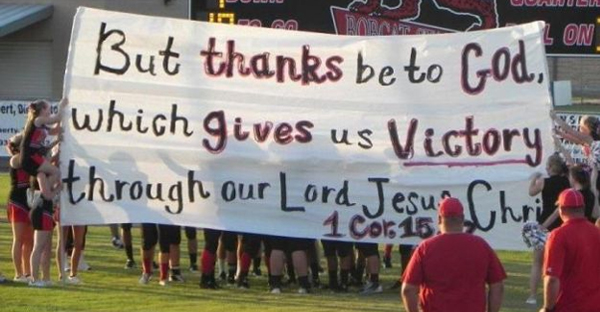
No one seems too sure of the situation in Kountze, Texas. In this town of around 2,000, high-school cheerleaders have attracted attention for their religious banners at school football games.
In late September, the district superintendent banned the explicitly Christian banners, under pressure from the Wisconsin-based Freedom from Religion Foundation.
The cheerleaders sued. The latest decision has been that the cheerleaders can continue to display the banners while the wheels of Constitutional justice grind along.
The case demonstrates the ferocious complexity of school-prayer rules and traditions. The cheerleaders seem entirely oblivious to the Constitutional issues. In interviews, they tend to hurt their own legal case by stating such things as “It’s our religion and we want to portray that.” Or this gem about the complainants, “They can be offended, because that’s their right.”
There is not much doubt of the facts of the case. The banners are obviously and designedly Christian. They bear such Biblical phrases as the following:
“I can do all things through Christ which strengthens! Phil 4:13.”
“If God is for us, who can be against us? Romans 8:31.”
“But thanks be to God which gives us Victory through our Lord Jesus Christ. 1 Cor 15:57.”
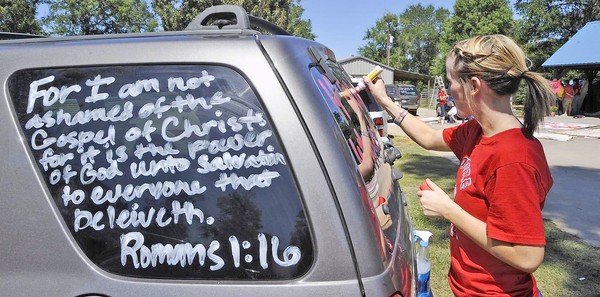
Image Source: Los Angeles Times
The SCOTUS precedents in this sort of case are fairly clear. The most obvious precedent is Santa Fe v. Doe (2000), the famous football-game-prayer case. In that case, the Court ruled that a prayer at a high school football game, even when led by students, implies school endorsement of religion.
Lawyers in this case are keenly aware of the precedent. The cheerleaders’ lawyers, therefore, emphasize the fact that this cheer group is not a school-sponsored organization. They have no coach, they have no school-provided budget. In essence, the cheerleaders claim that theirs is purely private speech. If so, they would have a strong case for passing Constitutional muster. Their lawyers have also cited the SCOTUS precedent of Tinker v. Des Moines, in which student protest-armbands against the Vietnam War were ruled protected free speech.
The school district has made the predictable counter-argument. The cheer team, the district has argued, represents the school at a public function. Cheerleaders must sign a “cheerleaders’ constitution,” which includes a pledge to represent the school well. As district attorney Tom Brandt argued, “This is government speech. It’s on public property. The cheerleaders represent the school.”
This case also demonstrates the fact that public schooling in America is fractured into what political scientists Michael Berkman and Eric Plutzer have called “Ten Thousand Democracies.” Regardless of SCOTUS decisions or state education policy, local school districts often support policies that represent the majority views of local communities. Arguments in favor of such policies are usually framed in terms of the will of the majority. As one of the cheerleaders insisted, “so far there hasn’t been any opposition to what we’re doing. Nothing but support.” Such has been the case for much of the history of religion in public schools. Local schools tend to endorse and embody local traditions. Many of those traditions, like explicitly Christian prayer at football games, seem to imply an official endorsement of a particular religion.
It has often required outside intervention to draw attention to these continuing traditions. In this case, that pressure came from Madison, Wisconsin, and the Freedom from Religion Foundation.
And school prayer has often, as in this case, proven to be enormously popular. In this case, Texas Attorney General Greg Abbott has publicly supported the cheerleaders. And the Facebook page set up in their support looks ready to top the 50,000 friends mark.
So, whether or not the Kountze cheerleaders can or can’t lead prayers at football games, they are. Whether or not they will be allowed to continue will likely hinge on whether or not their activities are seen as school-sponsored, or private.



 I Love You but You're Going to Hell