Cheering for Jesus in a Public School

Source: KNUE

Can they or can’t they?

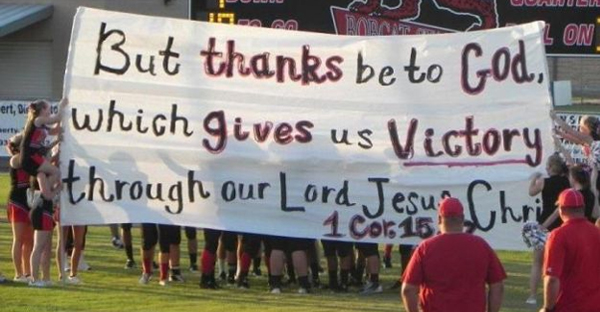
No one seems too sure of the situation in Kountze, Texas.  In this town of around 2,000, high-school cheerleaders have attracted attention for their religious banners at school football games.

In late September, the district superintendent banned the explicitly Christian banners, under pressure from the Wisconsin-based Freedom from Religion Foundation.

The cheerleaders sued.  The latest decision has been that the cheerleaders can continue to display the banners while the wheels of Constitutional justice grind along.

The case demonstrates the ferocious complexity of school-prayer rules and traditions.  The cheerleaders seem entirely oblivious to the Constitutional issues.  In interviews, they tend to hurt their own legal case by stating such things as “It’s our religion and we want to portray that.”  Or this gem about the complainants, “They can be offended, because that’s their right.”

There is not much doubt of the facts of the case.  The banners are obviously and designedly Christian.  They bear such Biblical phrases as the following:

“I can do all things through Christ which strengthens! Phil 4:13.”

“If God is for us, who can be against us? Romans 8:31.”

“But thanks be to God which gives us Victory through our Lord Jesus Christ. 1 Cor 15:57.”
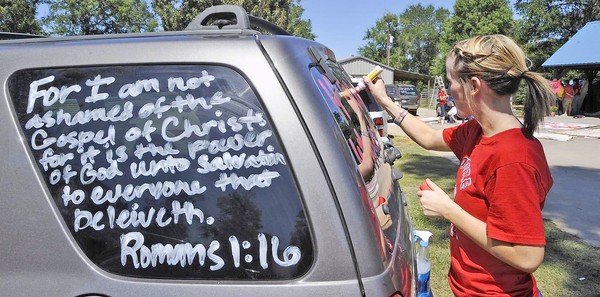
Image Source: Los Angeles Times

The SCOTUS precedents in this sort of case are fairly clear.  The most obvious precedent is Santa Fe v. Doe (2000), the famous football-game-prayer case.  In that case, the Court ruled that a prayer at a high school football game, even when led by students, implies school endorsement of religion.

Lawyers in this case are keenly aware of the precedent.  The cheerleaders’ lawyers, therefore, emphasize the fact that this cheer group is not a school-sponsored organization.  They have no coach, they have no school-provided budget.  In essence, the cheerleaders claim that theirs is purely private speech.  If so, they would have a strong case for passing Constitutional muster.  Their lawyers have also cited the SCOTUS precedent of Tinker v. Des Moines, in which student protest-armbands against the Vietnam War were ruled protected free speech.

The school district has made the predictable counter-argument.  The cheer team, the district has argued, represents the school at a public function.  Cheerleaders must sign a “cheerleaders’ constitution,” which includes a pledge to represent the school well.  As district attorney Tom Brandt argued, “This is government speech. It’s on public property. The cheerleaders represent the school.”

This case also demonstrates the fact that public schooling in America is fractured into what political scientists Michael Berkman and Eric Plutzer have called “Ten Thousand Democracies.”   Regardless of SCOTUS decisions or state education policy, local school districts often support policies that represent the majority views of local communities.  Arguments in favor of such policies are usually framed in terms of the will of the majority.  As one of the cheerleaders insisted, “so far there hasn’t been any opposition to what we’re doing. Nothing but support.”  Such has been the case for much of the history of religion in public schools.  Local schools tend to endorse and embody local traditions.  Many of those traditions, like explicitly Christian prayer at football games, seem to imply an official endorsement of a particular religion.

It has often required outside intervention to draw attention to these continuing traditions.  In this case, that pressure came from Madison, Wisconsin, and the Freedom from Religion Foundation.

And school prayer has often, as in this case, proven to be enormously popular.  In this case, Texas Attorney General Greg Abbott has publicly supported the cheerleaders.  And the Facebook page set up in their support looks ready to top the 50,000 friends mark.

So, whether or not the Kountze cheerleaders can or can’t lead prayers at football games, they are.  Whether or not they will be allowed to continue will likely hinge on whether or not their activities are seen as school-sponsored, or private.
Rhee and Jesus in Public Schools

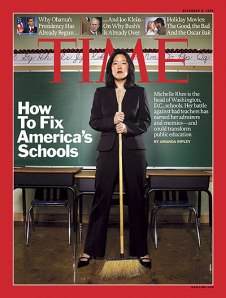
Michelle Rhee wants to get Jesus involved in fixing America’s public schools.

Image Source: Time Magazine

Rhee, the former chancellor of DC schools, has long been the darling of conservatives.  Her anti-union, market-based approaches to fixing public education have won her plaudits as America’s best hope for reforming sclerotic public education systems.

Along the way, Rhee has become the bete noire of educational thinkers such as Diane Ravitch.

Most of the Rhee talk has centered around conservative shibboleths such as vouchers, union-busting, and market-based reforms.

Recently, however, Rhee organized a meeting of religious leaders in Atlanta to discuss the possible roles of religion in reforming public schools.

Rhee’s willingness to talk with folks who want more religion in public schools may signal her broader willingness to engage with the traditional ‘other half’ of conservative school reform.

Among conservatives, free-market ideas and religious traditionalism have long rubbed alongside one another in any discussion of fixing public education.

Now Rhee seems eager to cross that bridge, too.

CATCH-ing Up and Opting Out

ILYBYGTH reported yesterday on a new pilot program in New York City high schools.  The program, Connecting Adolescents to Comprehensive Health, or CATCH, will expand the district’s condom-distribution program to include birth control pills and “morning-after” pills.

This morning, we read Catholic League President Bill Donohue’s denunciation of this “imperial edict” in an interview in the Christian Post.  “Whenever it comes to sensitive issues such as sexuality, the government must  always play an ancillary role to that of parents,” Donohue told the CP. “The provision  that parents can opt out smacks of governmental arrogance and must be resisted:  the government has no business eclipsing parental rights.”

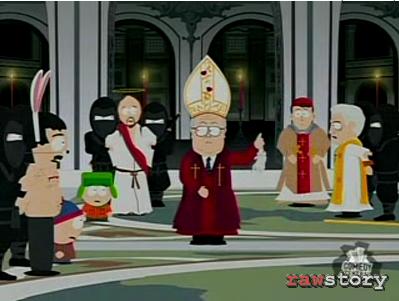
Bill Donohue as the Wild-Eyed Pope on South Park’s “Fantastic Easter Special”

I am usually no fan of

Bill Donohue.  I find myself siding more often with the South Park send-up of his public-morality campaigns.  But in this case, I find his criticism of CATCH more compelling than the lame defense offered by Chanel Caraway of the NYC Board of Health.  Since only 1-2% of parents had opted out of the program, Caraway told ABC News, “this suggests that parents are OK with the service being available to their children.”

Again, please don’t misunderstand.  I support the CATCH program and its goals.  I would want my daughter to be able to get free condoms and contraceptives at school if she couldn’t get them elsewhere.

However, Caraway’s opt-out argument demonstrates a frightening ignorance of America’s educational history.  In prominent cases such as Engel v. Vitale (1962) and Abington Township School District v. Schempp (1963), the US Supreme Court specifically concluded that “opt-out” provisions do not adequately respect families’ and children’s rights to be free of religious coercion.

As Justice Clark argued in his majority decision in Schempp, “Nor are these required exercises mitigated by the fact that individual students may absent themselves upon parental request, for that fact furnishes no defense to a claim of unconstitutionality under the Establishment Clause.”

I understand that this is a very different case.  Clark referred to the unconstitutionality of school-sponsored prayer.  It did not matter whether or not parents could opt out if the program defied Constitutional freedoms.  However, issues of sexuality are intimately connected to religious values for many students and families.  Could not a Bill Donohue argue that such state-imposed sexuality–even with an opt-out provision–denied some students their Constitutional right to free exercise of religion?  To assume that an opt-out clause defuses any potential complaint from conservative religious families seems ignorant at best, and, as Donohue put it, “imperial” at worst.

In the News: Missouri Voters Pass School Prayer Amendment

This just in: Missouri voters overwhelmingly approved Amendment 2.  OzarksFirst reports that the Constitutional Amendment received over 80% support yesterday at the polls.

Those who’ve been following this story know that the amendment is largely symbolic.  It guarantees people in Missouri the right to pray in public–especially including public schools–as long as their prayers do not bother anyone else.  This right has already been established by the US Supreme Court.  The kinds of school prayer deemed unconstitutional by SCOTUS in the 1960s were those imposed by the state and led by a teacher or school official.  The right of students to pray on their own has never been constitutionally threatened.

However, politicians and activists have long insisted that SCOTUS kicked God out of public schools.  This amendment is meant as a sort of line in the sand.  Fundamentalist Missouri wants to make it clear that students may pray in public schools.  Some voters have surely been traumatized by horror stories of students being suspended for Christian statements.  Teachers such as Bradley Johnson in California have claimed persecution when they have not been allowed to display religious messages in their public-school classrooms.

These sorts of highly publicized skirmishes inspired Missouri’s move.  As the sponsor of the amendment Mike McGhee explained in a National Public Radio story ,

“We are a religious country, and we want to take our country back, and we want to pray to God, and we can gather around the flagpole and say something to Jesus in our minds and in our hearts and it’s going to be okay.”

As everyone knows, in culture-war battles, symbolism matters.  Political moves like Missouri’s Amendment 2 help marshal the sides, force people to declare for one or the other.  In Missouri, this has meant, for instance, the public support of Catholic bishops for the amendment.  As McGhee argued, Fundamentalist America feels a powerful need to “take our country back.”

Can students now pray in Missouri’s public schools?  Yes.  Could they have before this constitutional amendment?  Yes.  But that doesn’t mean the amendment isn’t important.  To observers like those at ILYBYGTH, votes like the one yesterday in Missouri demonstrate the continuing power of Fundamentalist America.

In the News: Missouri Voters Will Vote on School-Prayer Amendment

Fundamentalist America wants its children to feel comfortable praying in public schools.  Since the US Supreme Court’s 1963 Schempp verdict, many religious conservatives have complained that God has been kicked out of public schools.

As Steven Green’s recent book has described, the historical reality is more complicated.  And, as I have argued elsewhere, to understand these questions, we can’t start in the 1960s, we need to look at the battles of the 1920s.

But that does not stop some conservatives from pressing the issue.  In a recent wrinkle, Missouri State Legislature Representative Mike McGhee has succeeded in presenting a Constitutional amendment to the voters of Missouri.  On August 7th, voters will have see the following questions on a special ballot:

“Shall the Missouri Constitution be amended to ensure:

• That the right of Missouri citizens to express their religious beliefs shall not be infringed; 

• That school children have the right to pray and acknowledge God voluntarily in their schools; and

• That all public schools shall display the Bill of Rights of the United States Constitution.”

Opponents note with considerable justification that this amendment will not actually do anything.  Speaking to the Joplin Globe, an official of the state school administration insisted students already have the right to pray.  And C.J. Huff, superintendent of Joplin schools, told the Globe,

“If it passes, it isn’t really going to make a difference in our schools. Students already have rights for volunteer prayer in school. It happens. I think the misperception is that it (prayer) doesn’t happen (in schools).”

But to the amendment’s supporters, the symbolism is intensely important.  As Representative Jeff Grisamore told OzarksFirst,

“This (legislation) is one of the most important pieces of legislation…that we will pass this year, because it is fundamental to protecting the rights of Missourians to pray and express their faith and at the same time, protect Missourians from being coerced or compelled in a way that would violate their faith.”

Missouri politicians seem keenly aware of this symbolic importance.  According to the Lebanon Daily Record, the proposed amendment passed unanimously in the state Senate and triumphed 126-30 in the state House. 

The constitutional issue seems fairly clear.  This amendment, if successful, will clarify a right that public school students already enjoy.  The big question is the political issue.  Clearly, the elected representatives of the great State of Missouri find the bill politically invulnerable.  Will the voters of Missouri agree?

The Bible in America: Thunderbolt, Part III: What Thunderbolt?

As we’ve discussed here lately, some fundamentalists harp on the Schempp and Engel Supreme Court decisions of 1962 and 1963 as the time God was kicked out of public schools.

Some of the reasons for this go beyond the obvious.  First of all, although the 1963 case took the name of Abington Township School District v. Schempp, it was actually a joinder decision with a case brought by the prominent atheist Madalyn Murray O’Hair.  The Schempp family were religious Unitarians.  Murray (later Murray O’Hair) was an outspoken and aggressive atheist.  Partly as a result, the Schempp case took on overtones of a fight of religion vs. atheism.  It took on overtones, in Fundamentalist America, of a last-ditch defense of God.

Such perceived high stakes led to a perception of a profound loss for Fundamentalist America.  As we’ve argued here recently, conservative evangelical Protestants reacted with profound dismay and disillusionment to the court’s 1963 decision.  A Moody Monthly poll in 1964 ranked the decision as the most important social or political event of the year, more important than the church bombings in Birmingham, Alabama.  Presbyterian fundamentalist leader Carl McIntire asked, after more than a decade of struggle to pass a Constitutional prayer amendment, “Why aren’t Christians standing where it counts and saying, ‘I’m for America and I’m for the Bible?’”

But what did the 1962 and 1963 decisions actually do?  What effects did they have in America’s public schools?

In the aftermath of the Schempp decision, a pair of political scientists—Kenneth Dolbeare and Phillipp Hammond—studied the effects.  They first consulted survey data.  Not surprisingly, they discovered that the Schempp and Engel decisions had led to a precipitous drop in the amount of school-sponsored religious activity that went on in public schools.  More precisely, they found that the decisions had led public school leaders to report a sharp drop.  About two-thirds of school districts reported that they stopped school-sponsored devotions.  Teachers reported a sharp decline.  Sixty percent reported that they had lead classroom prayers before the decisions, while only 28% admitted they still led such prayers.

Of course, even these large declines meant that many teachers and school districts continued to lead prayers and Bible readings.  But even that stubborn minority was isolated.  Most of such holdouts were in the South.  Reports from the West—where such in-school religious practice had often already been banned—and from the Plains and Northeast gave a much different picture.  In those regions, survey responses indicated nearly full compliance with the Supreme Court decisions.

We must remember that the South at this time was roiling with anti-Brown sentiment.  The white power structure had nearly unanimously agreed to resist school desegregation in spite of the 1954 Supreme Court ruling.  Many agreed with Alabama Governor George Wallace, who had declared in 1963, “I don’t care what they say in Washington.  We are going to keep right on beating the Bible in the public schools of Alabama.  I wouldn’t be surprised if they sent troops into the classrooms and arrested little boys and girls who read the Bible and pray.”

In such a climate, school leaders in the former Confederacy had a much easier time publicly renouncing the Supreme Court’s ban on school-sponsored prayer.  Indeed, it may have been political suicide for many of them to publicly support the Court.

Outside the South, however, most survey respondents claimed they had stopped teacher-led prayers and Bible readings.  But when Hammond and Dolbeare examined those schools and classrooms more closely, they found that even outside the South, teacher-led prayer and Bible reading went on just as they had before the decisions.  In other words, teachers and school administrators outside the South told surveyors that they had stopped leading religious devotions in their public schools.  They knew that such practices had been prohibited.  But when the classroom doors were closed, they continued to pray and read from the Bible with their students.

Most remarkable, in Dolbeare and Hammond’s opinion, was the fact that throughout the communities they studied in the Midwest, everyone knew what was going on and no one complained.  As long as state-level school administrators could claim that they did not know of any teacher-led devotions, the devotions themselves went on undisturbed.  Teachers led prayers in their classrooms.  School building principals led prayers at school ceremonies.  Bible verses adorned graduation speeches and school hallways.  According to Hammond and Dolbeare, most of the people involved were aware of the Supreme Court’s ruling.  Yet they continued to engage in exactly the sorts of practice the Court had ruled against.

Fast forward to the twenty-first century, and we see a much different picture.  Regional variations in racial desegregation in schools have often flip-flopped, with the most segregated school districts now in places such as New York City, Detroit, and Milwaukee, Wisconsin.  Similarly, in spite of a relatively recent New York Times article that assumed school-sponsored religious practices had been shunted to “some corners of the country, especially in the rural South,” even a casual observer of the news will see that battles over the proper role of religion in public schools continue all over the country.

For example, we noted recently a remarkable law passed recently in New Hampshire, hardly an outpost of the “rural South.”  This law mandated that parents could request alternate textbooks or curricular materials for any reason.  In theory, this could mean that strict vegetarian parents could object to books that portrayed meat-eating in a flattering light.  The intent of the law, however, was clearly to protect the faith of evangelical Protestant children.  The push for the law began when one family objected to the Jesus-bashing of author Barbara Ehrenreich.

Or the continuing case of Bradley Johnson.  Johnson insisted on putting religion-friendly placards on his classroom wall.  His stubborn activism can only be called “Southern” if we include “Southern” California.  And while San Diego is technically one corner of the country, it is hardly an isolated outpost of ‘hillbilly’ culture.

Just as it was for Dolbeare and Hammond in the 1960s, it is nearly impossible for us to know what really goes on in most public-school classrooms.  Cases like Johnson’s don’t tell us much about what most teachers are doing.  As Dolbeare and Hammond concluded, one of the main reasons for the continuing practices of teacher-led prayers and Bible readings was that everyone involved hoped to avoid any controversy.  Parents did not want to stand out as anti-prayer.  Teachers did not want to appear to denigrate religion.  School administrators did not want to crack down on what many perceived to be wholesome traditional American practices.

These days, it is difficult to predict just what practices might pass for non-controversial in America’s public schools.  Local traditions—even down to the level of individual schools and neighborhoods—trump Supreme Court decisions or New York Times reporters’ assumptions.

For conservatives, this means that traditional practices such as prayer or Bible reading might continue in public schools, as long as there has never been a local complaint against the practice.  It also means that conservative activists such as Bradley Johnson might mount a counter-revolution in any part of the country.

For many such activists, public schools have taken on an aura of secular fortresses.  In the rhetoric of many conservatives, public schools are the headquarters of Jesus-bashing, evolution-teaching, sex-teaching, drug-selling liberals.  A more careful look, like what Dolbeare and Hammond did forty years ago, would likely present a much more traditional, religion-friendly picture of life inside those public-school walls.