Sex Ed and the Diseased Children of the Revolution

HT: KC

What do Americans want their children to learn about sex?  Throughout history, two conservative authors recently argued,[*] most Americans have wanted children to learn the values of abstinence and purity.  Only the 1960s sexual revolution turned perversion and license into mainstream public-school how-to lessons.

The essay, by National Abstinence Education Association President Valerie Huber and Cedarville University psychology professor Michael Firmin, appeared in the recent issue of the peer-reviewed journal International Journal of Educational Reform.  For those of us who are interested in understanding conservatism in education, this article offers a chance to see conservative thinking in action.

There are a few odd copy errors.  Prominent education historian Milton Gaither, for example, is called “Milton Caither.”  But far more interesting than these flaws are the interpretative implications of the authors’ historical vision.

Before I describe them, though, I should point out my own biases.  I have a difficult time understanding conservative opposition to comprehensive sex education.  In my upcoming book about the twentieth-century career of educational conservatism, I describe such opposition, especially in my chapter about the 1970s.  But I still have a hard time understanding it.  To me, it seems like simple common sense that schools should provide thorough, accurate information about sex to young people.  Public schools should not moralize about sex, but whether or not students choose to have sex, they should know about the facts of life.  With the huge public-health implications of pregnancy and sexually transmitted diseases, it seems to me a simple matter of common sense that schools should teach everyone about sex.

However, as I’ve struggled to understand conservative opposition to comprehensive sex ed in public schools, I feel I’ve gained some insight.  Though I want public schools to teach kids all the facts and let the kids and their families determine the morality involved, I can sympathize with conservatives who feel that such an approach tips the discussion too far in the “pro-sex” direction.  I consider the following analogy: if your spouse were traveling on business, would you make sure he or she had condoms along in case s/he decided to have sex while s/he was gone?  That doesn’t make much sense.  Or this one: could a teacher tell students, “If you’re planning on robbing a bank, here are some ways to do it safely?”  In other words, if a behavior is obviously morally unacceptable, we shouldn’t teach young people how to do it safely.  We shouldn’t imply that we condone such immorality by helping children (or spouses) do it without consequence.  Some conservatives think that pre-marital sex is precisely this sort of immoral behavior.  Such conservatives insist that by telling young people about sex in a morally neutral fashion, we suggest that premarital sex is okay.

Huber’s and Firmin’s history of sex ed portrays an American people deeply convinced that sex is best saved for marriage.  Only perverts and revolutionaries challenged that notion.

For instance, the first prominent “pro-sex” campaigner Huber and Firmin describe is Margaret Sanger.  In the 1920s, the authors note, Sanger advocated birth control as a way to empower women and to limit the numbers of undesirable births.  Sanger’s recreational approach to sex was “radical,” the authors contend, but it became an “early influence” on sex ed in schools.

In the 1940s and 1950s, Alfred Kinsey took the study of sex to new extremes, according to Huber and Firmin.  Kinsey studied the sexual practices of a “nonrepresentative proportion of sex offenders and participants in the homosexual bathhouse community,” the authors contend.  Kinsey proffered his witches’ brew of demented sexual proclivity as unbiased research, including outlandish claims that infants had orgasms.  As did Margaret Sanger, Kinsey laid the foundations for a morality of “sexual experimentation,” according to Huber and Firmin.

It was not until the 1960s, however, that such radical notions about sex and sex education became mainstream.  The sexual revolution of that decade, Huber and Firmin argue, “turned America’s moral sensibility on its head.”  During the late 1960s and early 1970s, a new culture of sex education took America by storm, midwived by the “[l]ong hair, open-air sexual orgies, drugs, student rebellions, Vietnam, and racial tensions” of the period.

By the 1980s, luckily, “innovative organizations” had organized a sensible and effective “counterrevolution.”  These groups promoted the American tradition of sex education as abstinence-only education.  Only such education combined information about sex with the moral underpinnings that young people need.

Today, according to Huber and Firmin, most Americans agree with an abstinence-only approach to sex-ed in public schools.  Though the “public relations” efforts of “pro-sex” groups such as Planned Parenthood have had some success, the authors note that “the majority of parents, regardless of race or political party, strongly endors[e] all the major themes presented in an abstinence education class.”  As evidence, they cite a 2012 survey from the National Abstinence Education Foundation.

As I’ve argued in the pages of Teachers College Record, conservative activists have an intense interest in educational history.  It makes sense.  Whoever controls the history can make policy recommendations that claim to be in synch with American tradition.  In this case, Valerie Huber and Michael Firmin give us a history in which Americans want their children to learn the values of abstinence and purity.  Throughout the generations, some radicals such as Sanger and Kinsey have strummed a minor chord of recreational sex and gleeful perversion.  Only with the irresponsible sexual revolution of the 1960s, though, did such attitudes enter public schools in any significant number.  Thanks to the work of earnest abstinence-only “counterrevolutionaries,” however, America’s schools have hope.  Today’s schoolchildren, these conservative authors argue, can learn the real tradition of American sex ed.

——————————————————————————————————————————-

[*] The article does not seem to be available without a subscription.  For those with access to a decent library, here’s the citation to help you find the full article: Huber, Valerie J., and Michael W. Firmin. “A history of sex education in the United States since 1900.” International Journal of Educational Reform 23.1 (2014): 25+.


Learning Purity

Where do young Christian girls learn that they are supposed to be sexually pure?  A photographer recently claimed that it was something girls wanted, something not imposed on them by their families.

As usual, your trusty editor at ILYBYGTH is behind the times.  Apparently, this series of purity-ball photographs by Swedish photographer David Magnusson attracted a good deal of attention several weeks ago.  At these balls, girls dress up in elaborate gowns, dance with their fathers, and finally pledge sexual abstinence.

Purity

Not surprisingly, bloggers and journalists reacted with some predictable outrage to this combination of precocious sexuality, gender coercion, and daddy-ism.  For instance, Tom Hawking called the photos “weird” and “terrifying.”  “It’s hard to know where to start with this:” Hawking wrote,

the notion of sex as “impurity,” the fact that it’s all daughters and no sons, the idea of dressing a preteen girl in something that looks awfully like a wedding dress.

The photographer presented himself as an intrigued outsider.  At first, Magnusson said, he thought these purity balls would be nothing more than another American tragedy.  As he remembered, “I imagined American fathers terrified of anything that might hurt their daughters’ or their family’s honor.” But as he learned more about them, he came to a new understanding. The balls represented something initiated often by the daughters themselves. As Magnusson put it,

It was also often the girls themselves that had taken the initiative to attend the balls. They had made their decisions out of their own conviction and faith, in many cases with fathers who didn’t know what a Purity Ball was before first being invited by their daughters.

As we’ve wrestled with before at ILYBYGTH, purity culture can have educational consequences. Some argue that purity culture encourages a culture of sexual victimization on the campuses of conservative Christian colleges.

PurityBut Magnusson’s claim raises new questions. If, as he asserts, girls don’t learn about purity balls from their families, where do they learn about them? More importantly, where do girls learn that they want to take part in this sort of ceremony? We should be skeptical about Magnusson’s claim that girls themselves chose freely to take part in these ceremonies. That sort of “choice” can involve all sorts of subtle and not-so-subtle influence from parents and others. But it seems plausible that some girls embrace these ideas. And it seems plausible that some girls lead their fathers to this event, not vice versa.

If that’s the case, we need to wonder where girls got the idea. Certainly, some schools teach abstinence-only education curricula that promote a “purity” notion of proper femininity. And independent curricular programs such as True Love Waits have had success in reaching young people as parachurch organizations.

As always, these questions demonstrate the infinitely complicated nature of education. It is difficult to imagine a tradition like purity balls succeeding unless young people had been taught to embrace such a thing. Who taught them? And how?


C’est la Guerre…La Guerre Culturale

We hear it from time to time.  Scientists claim that only America suffers from widespread creationism.  Hip liberals fume that only America puts prudes and fogies in political office.  America’s culture wars seem to be uniquely American.  Or are they?

We read in The Economist about a recent education culture-war in France that seems as American as apple pie.  It seems France—the land of laid-back attitudes about sex and uptight attitudes about food—has more in common with the US of A than some people might like to admit.

The recent flap follows the American pattern.  A new curriculum has riled cultural conservatives.  The new school materials, ABCD of Equality, hoped to instill ideas of gender equality in young people at a young age.  Books in the series, including “Jean Has Two Mummies” and “Daddy Wears a Dress,” hoped to teach students that gender and sexuality do not need hard-and-fast boundaries.  As often happens in this country’s culture-war politics, the book that sparked the most outrage was not even officially part of the curriculum, but rather part of a list of suggested additional picture-books on an affiliated website.  That book, “Everybody Naked!” showed page after page of, well, just what the title suggests.

Everybody Naked!

Everybody Naked!

In France, according to the Economist essay, a coalition of cultural conservatives objected.  Objections to the book series unite Catholic and Muslim traditionalists.  One conservative activist warned that such books represent a government attempt to “re-educate our children,” to make them doubt their religion and experiment with their gender and sexuality.  In clear echoes of West Virginia, conservatives called for a school boycott until the books were removed.  And, just as Patricia Polacco’s books have put mild-mannered librarians on the front lines of America’s culture wars, French conservatives have applied pressure on libraries to remove the offensive titles.

Of course, no two culture wars are exactly the same.  I doubt, for example, that any American sex educator would even suggest “Everybody Naked” for America’s elementary schools.  But in its broad contours, the kerfuffle in France demonstrates the international nature of culture-war politics.


Sad Sex Ed

Want to keep young people from having sex?  Then make them watch what happens to girls who have babies.  Instead of purity campaigns or bland information sessions, perhaps a relentless display of sex, drugs, ‘n’ rock & roll might do the trick.

Economists Melissa Kearney of the University of Maryland and Phillip Levine of Wellesley College recently published the results of their study of MTV and teen pregnancy.  I’m too cheap to buy the paper, but it seems they found a 5.7% reduction in teen pregnancy among girls who watched MTV’s 16 and Pregnant and Teen Mom shows.  Also interesting, it appears that viewers of the shows became more avid consumers of health information about birth control and abortion.

Now, this is obviously not the sort of moral sex ed many conservative school activists prefer.  For many social conservatives, the idea of sex ed as an information service to allow safe and pregnancy-free sex for teens is abhorrent.  Real sex ed, for many conservatives, would mean teaching young people to learn about the morality of carnality.  As Rich Lowry concluded in the pages of National Review, these MTV shows still elevate some of their teen moms to “the tawdry satisfactions of minor celebrityhood.”

More important, this study does not suggest that teen viewers behaved any more morally after watching the show.  But from a public-health perspective, the relentless unpleasantness of life for the show’s teen moms seems to discourage a significant number of teens from following in their footsteps.

And some public-health sex ed advocates are celebrating.  According to Boston.com, Sarah Brown, CEO of the National Campaign to Prevent Teen and Unplanned Pregnancy, called the study a confirmation of the information approach.  “One of the nation’s great success stories,” Brown said in a public statement,

has been the historic declines in teen pregnancy. MTV and other media outlets have undoubtedly increased attention to the risks and reality of teen pregnancy and parenthood and, as this research shows, have likely played a role in the nation’s remarkable progress.

“Rent” and Culture-War Cowards

A brave stand for traditional conservative values?  Or a petty dictator afraid of a changing world?

The recent decision of a high-school principal in Connecticut to ban the musical Rent will be called both of these things.  But there’s a better and simpler accusation: The principal is acting out of predictable culture-war cowardice.

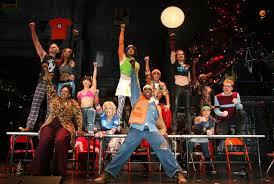
As reported by the New York Times, Marc Guarino of Trumbull High School in Trumbull, Connecticut suddenly announced that the school’s drama club would not be allowed to put on a showing of Rent.  The popular musical deals with themes of drug use, HIV, and homosexuality.  To be sure, this is a cleaned-up high-school version, with the profanity removed and one sexually explicit song taken out.  But Principal Guarino still thought it was too racy for his school.

Power to the High Kickers!

Power to the High Kickers!

He’s not the only one to do so.  The play has been yanked from other high schools around the nation.

Predictably, administrators like Guarino have been accused of homophobia and head-in-the-sand obscurantism.  The world is changing, critics charge, and young people need to be aware of real-world issues like those presented by the musical.

So far, Guarino’s not talking.  So his decision might really be due to a belief that young people need to be protected from the world of singing, dancing, drug-using sex-havers.

But there’s a depressingly obvious explanation that is much more likely.  Guarino and the Trumbull school board are probably simply offering a public-school administrator’s knee-jerk response to anything that might raise the tiniest hint of controversy.  More than bad test scores, more than teen hijinx, school administrators fear becoming the center of a fight.  Because savvy administrators know that they will be the losers.

In my new book (coming soon to a bookstore near you!), I look at the most famous school controversies of the twentieth century.  In case after case, no matter what the fight is about, administrators lose.  In 1950, Pasadena’s superintendent got blamed for changing educational patterns.  In 1974, Charleston, West Virginia’s superintendent got blamed for new textbooks.

When a culture-war fight breaks out in schools, no matter what the topic, school administrators are the first casualty.

As a result, principals and other administrators develop keep political antennae.  If any book, teacher, or musical threatens to introduce a whiff of controversy into their schools or districts, most administrators ban it outright.  They want to stop any fight before it starts.

The response to Rent by Susan Collins, a school superintendent in West Virginia, demonstrates this reflexive culture-war caution.  A few years ago, she described her feeling to the New York Times.  “Our high school shows,” she explained,

are so important to our community — we have alumni who come back, we bus in children for them — and I didn’t see ‘Rent’ working here. . . . But look, I know we can’t stick our heads in the sand, I know drugs are out there, I know children are having babies at 12, I know teens are having sex and always must have safe sex. But I don’t know if we need ‘Rent.’

When a drama-club teacher proposed the show for Collins’ district, it only took her one viewing of the DVD to make a quick decision: No way.  She worried that her “back in the woods” community would not take kindly to this sort of on-stage sexiness.

She wasn’t against it.  But she wasn’t willing to stand up and shove it in the face of her community, either.

More than culture warriors, public school administrators often take this role of culture-war avoiders.

Though their book got the most attention for its survey of evolution education, political scientists Michael Berkman and Eric Plutzer made a broader point about schooling and culture wars.  Teachers, they argued, are best understood as “street-level bureaucrats.”  In teaching controversial issues, teachers tend to reflect the middle-of-the-road values of their communities.

The bland CYA politics of principals like Trumbull’s Guarino reflect this same sort of deliberate centrism.  Is Rent bad for kids?  Conservatives might say yes; progressives might say no.

But school controversy on any sort of culture-war issue is definitely bad for the career of any public-school administrator.


Help! My Teacher’s a Girl Now!

Do young children need to be protected from transgender teachers?

Ryan T. Anderson thinks so.  And in his argument, he joins a long conservative tradition of insisting on special culture-war protections for children.

Anderson, a prominent voice in the anti-gay-marriage coalition, argued recently in the pages of the National Review that transgender teachers would force young people to wrestle prematurely with issues of sexuality and gender identity.

His argument came in the context of his opposition to the Employment Non-Discrimination Act (ENDA), a bill that would make it illegal for some employers to discriminate against gay or transgender people.

In Anderson’s opinion, this is not the latest civil-rights bill.  Sexual identity and gender identity, Anderson argues, are self-identified and self-defined, unlike race.

Perhaps most compelling, Anderson thinks, this bill might force elementary schools to employ men who used to be women, or women who used to be men.  It would force children, Anderson says, to know too much too soon.

As he put it,

Issues of sex and gender identity are psychologically, morally, and politically fraught. But we all ought to agree that young children should be protected from having to sort through such questions before an age-appropriate introduction. ENDA, however, would prevent employers from protecting children from adult debates about sex and gender identity by barring employers from making certain decisions about transgendered employees.

Although ENDA includes some exemptions for religious education, it provides no protection for students in other schools who could be prematurely exposed to questions about sex and gender if, for example, a male teacher returned to school identifying as a woman.

Anderson’s argument about age-exemptions for culture-war issues echoes a traditional theme among educational conservatives.  On the issue of evolution, for example, many conservative intellectuals of the first generation of fundamentalists argued that evolution could fairly be taught, but only at the college level.

As I argued in my 1920s book, this seemingly moderate view was held by some of the most vituperative anti-evolutionists.

William Jennings Bryan, for example, the Bible-believing man-of-the-people who stood up for the Bible at the Scopes Trial, repeatedly insisted that evolution should be taught, but with proper regard for the intellectual maturity of students.  In colleges, it should be taught as an influential theory about the origins of life.  But in primary grades, students must not be taught that evolution was the simple and only truth.

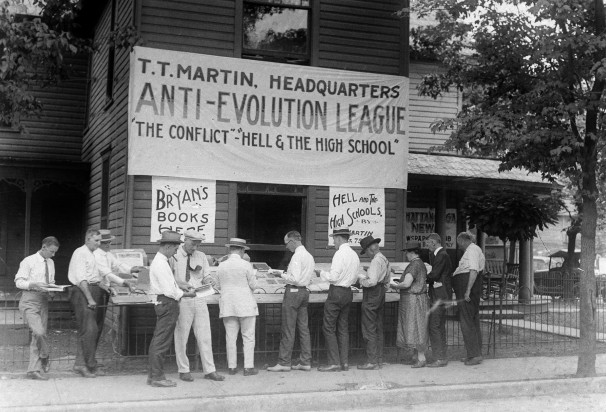
Even the hot-headed polemicist T. T. Martin, author of the relentless Hell and the High Schools, didn’t insist that evolution must be utterly banned from all schools.  In a 1923 speech, Martin suggested a new set of “graded books, from primary to university.”  These books could introduce evolutionary ideas gradually, until at last for the most mature students the books would present “fairly and honestly both sides of the Evolution issue.”

Martin's Booth at the Scopes Trial, 1925

As Anderson’s recent argument about transgender teachers makes clear, the notion that young people in school must enjoy special protection from threatening ideas still has punch in today’s culture-war debates.  Conservatives have long insisted that children must be protected from premature exposure to issues of sex and origins.


What Color Are Your Fundamentalists?

Who are the “fundamentalists” who hope to keep America’s public schools religious?

Some of us may picture a Saddleback-type white suburban evangelical, driving around in a Biblically-sized SUV, worrying in equal measure about sin and soccer.

New!  School Prayer Barbie!

New! School Prayer Barbie!

But as Peter Berger reminds us this morning on The American Interest, that image of conservative evangelicalism might represent the past more than the future.

Berger notes the dramatic effects of immigration on the nature of American Christianity.  New immigrants tend to be Christian, and their Christianity tends to lean conservative.  As Berger concludes,

Both in their theology and religious practice, non-Western Christians are more conservative. Their worldview is strongly supernaturalist: The spiritual world, both benign and sinister, is very close—the Holy Spirit, the Virgin and the saints, miracles of healing—but also the devil and other malevolent spirits. This supernaturalism is strongest in the Pentecostal and charismatic movements, but it is also very visible in Catholic and mainline Protestant churches. But non-Western Christians are also more conservative in their moral convictions—very little sympathy here for the feminism, let alone the agenda of the gay movement, that has become so prominent in mainline Protestantism in America—and, I suspect, would be more prominent in American Catholicism, were it not for surveillance and intervention from Rome.

The implication of all this is simple and exceedingly important: Immigration will strengthen the conservative forces in American Christianity.

In the future, the fight over religion in America’s public schools may have a very different tone.  Instead of a ring of white conservative suburbs around every ethnically diverse urban core, we may see a shift to immigrant-led demands for more vibrant religion in schools.  Instead of whitebread traditionalism resisting a multicultural liberalism, we might have an ethnically diverse group of conservatives battling to keep morals pure in public education.

What Went Wrong with America’s Schools?

Hell in a lunchbox. 

That’s where America’s public schools have headed, according to a recent essay by the Southern Baptist Theological Seminary’s President R. Albert Mohler Jr.

President Mohler makes an historical argument for the shocking, dangerous decline in American public education.  Does his case pass historical muster?

As I’ve argued in an essay in Teachers College Record (subscription required, but summary available), this historical argument about public education has been a mainstay of conservative thinking for at least fifty years.  Different conservative intellectuals have come up with different timelines and key events to explain the demise of high-quality, morally trustworthy public education.

Mohler echoes this intellectual tradition.

He argues that public schools began as locally controlled entities.  Beginning roughly a century ago, however, “progressive” reformers attempted an ideological coup.  Such folks, led by John Dewey, openly proclaimed their intention to turn schools into secular indoctrination camps.

Luckily, Mohler believes, such plans did not accomplish much until the second half of the twentieth century.  At that point, however, most schools were “radically transformed,” separated “from their communities and families.”

The results, Mohler warns, have been sobering:

Those who set educational policy are now overwhelmingly committed to a radically naturalistic and evolutionistic worldview that sees the schools as engines of social revolution. The classrooms are being transformed rapidly into laboratories for ideological experimentation and indoctrination. The great engines for Americanization are now forces for the radicalization of everything from human sexuality to postmodern understandings of truth and the meaning of texts. Compulsory sex education, the creation of “comprehensive health clinics,” revisionist understandings of American history, Darwinian understandings of science and humanity, and a host of other ideological developments now shape the norm in the public school experience. If these developments have not come to your local school, they almost surely will soon.

Is Mohler’s diagnosis correct?  Does his historical analysis match the record?

In this historians’ opinion, Mohler is guilty of cherry-picking and over-emphasizing.  It is demonstrably true that in the early twentieth century an array of school activists and intellectuals, clustered together under the amoebic heading of educational “progressivism” did try to implement wholesale changes in the nature of American public education.  It is also true that the US Supreme Court made decisions in the 1960s that could have revolutionary implications for the religious nature of public education.  Even more, it is true that leading organizations such as the National Education Association call for school policies that might dismay stalwart conservative Protestants. 

But contrary to Dr. Mohler’s conclusions, such historical facts do not add up to a public school system that “entered a Brave New World from which no retreat now seems possible.”

Historians have examined each of these important trends in American public education.  Arthur Zilversmit, for example, looked at the implementation of “progressive” education policies in the middle of the twentieth century.  In spite of earnest, well-funded efforts to revolutionize schooling, Zilversmit found, schools remained largely the same.  Why?  Zilversmit, sympathetic to the “progressive” project, blamed Americans’ “strange, emotional attachment to traditional schooling patterns.” 

How about the claim that the Supreme Court kicked God out of the public schools?  It is true that in 1962 and 1963 SCOTUS banned school-led mandatory Bible reading and prayer.  But as political scientists Kenneth Dolbeare and Phillip Hammond found to their surprise, most communities that prayed before the SCOTUS rulings continued to pray in public schools after them.  

Similarly, political scientists Michael Berkman and Eric Plutzer have argued that local school districts continue to function as local bureaucracies.  These “Ten Thousand Democracies,” according to Berkman and Plutzer, remain responsive to local demands and local values.     

This is bad news for President Mohler’s alarmist argument, but very good news for religious conservatives in the United States.  Most of America’s public schools remain closely connected to majority impulses in their local community.  Concerning hot-button culture-war issues such as prayer, evolution, and sex ed—not to mention broader notions such as school discipline, drug use, promiscuity, and general manners—local communities still control their local public schools. 

This local influence helps explain some stubborn trends that have long frustrated progressives like me.  Why, we ask, is evolution taught only spottily?  Why can’t public-school children learn honest, practical information about sex?  Why are public schools still home to coercive prayer practices?

These are all tough questions. 

But Dr. Mohler’s jeremiad raises even tougher ones:  If American public schools are so very conservative, why do conservative intellectuals deny it so forcefully?  Why don’t America’s conservative intellectuals trumpet the continuing traditionalism of American public education?


The Age of Pedophilia

Are we all Jerry Sanduskys?

That’s the accusation made recently by Anthony Esolen.

Pedophilia, Esolen charges, is not limited to the horrifying cases of the Sanduskys of the world.  Rather, we engage in pedophilia whenever we subordinate the welfare of children to the sexual gratification of adults.

In this logic, divorce is nothing but a socially acceptable form of pedophilia.  Having children outside of wedlock is pedophilia.  Worst of all are the “creeps” at Planned Parenthood (Esolen calls them “Planned Predators”) who teach young children a debased vision of sex.  These “pedophiles of the soul,” Esolen accuses, cruelly introduce

children to the delights of meaningless sex, with cartoons of talking penises and vaginas, of a girl bending over with a mirror to inspect her anus, or a boy in his bedroom abusing himself.

What is that, Esolen asks, if not pedophilia of the worst sort?  Indeed, such “credentialed spiritual pederasts” use the same strategy as old-fashioned child rapists.  They work to separate children from the influence of their parents.  In their sexually aggressive ideology, Esolen writes,

Parents are the enemy. The parents are kept in the dark. The parents are too benighted to know what is best. The parents—even such sporadically responsible parents as our generation has produced—wouldn’t know about how happy it is to be sexually free.

As Esolen must have intended, such accusations are profoundly disturbing.  There is nothing more heinous than real child molesters.  It seems to me to breach the bounds of public civility to accuse the sex-educators at Planned Parenthood of acting like nothing more than “the old man down the street, wheezing and giggling, who likes to show little kids pictures of people masturbating[.]”

But if Esolen’s extreme anger represents the feelings of a broad body of the American public, it certainly helps us understand why sex education has had such a troubled career in America’s public schools.  Indeed, as historians such as Jeffrey Moran have argued, sex ed has often been received with the violence and outrage that Esolen’s essay predicts.

Such outrage makes more sense if we understand the way Esolen hopes to redefine pedophilia.


A Christian Teen Army in Public Schools

“High school Christian teens, Join Us!”

That is the call of a new video promoted by the evangelical Christian group Reach America.

In the video, teenagers ask a series of provocative questions, such as the following:

Why can’t I pray in school?  Why do I have to check my religion at the door?  Why can’t I write about God in my school papers?  Why do I have to tolerate people cursing my God, but I’m not allowed to talk about God and my faith? Why are they taking God out of my history books? Why do they teach every other theory in science besides creation?  Why am I called names because I believe in marriage the way God designed it?

Like many conservative evangelical educational activists, Gary Brown, founder of Reach America, believes that public schools have lost their way.  Beginning with the prayer and Bible SCOTUS decisions in 1962 and 1963, Brown insists, God has been systematically frozen out of schools.  Christian students have been targeted for bullying, indoctrination, and harassment.  Every part of public education is a threat, from pornographic sex education to mandatory dating.

Brown’s answer has been a call for youth engagement.  In the recent video, Reach America teens warn, “People who do not love our God have stolen our country. . . . We are an army.  Christ is our commander. . . . We are in a war for the hearts and souls of our generation.  And we know it.”

This culture-war army can be directed, Reach America promises, by programs such as its new Educational Partnership.  From its headquarters in northern Idaho, Reach America wants to organize a non-school school.  At this “partnership,” students will come to this non-school school every day, September through June.  In the mornings, they will work on academic work.  That work, though, will not come from the non-school, but rather from parent-directed online education or homeschool assignments.  In the afternoons, students will work on the “four Cs:” Christ-Centered Counter-Culture.

So how is this school not a school?  Parents pay tuition.  Students study there.  The program even offers “P.E. and electives.”  Do the Browns avoid calling this a school to avoid legal hassles?  It certainly looks that way.

How big is the program?  Not too big.  According to Brown, twenty-three students are enrolled for the current non-school year.  My guess is that Reach America will attract the attention of scribblers like me with the culture-war rhetoric of this video, but will soon encounter the difficulties that plague every Christian school, even non-school ones.

In any case, the message of the teens’ video is clear.  The way to prevent bullying is to fight back.  As they declare, “America will be one nation under God, again.”