Sexting: Sex Ed’s Cutting Edge?

How would you feel if your teenage children received sexually explicit sexual text messages?  How would you feel if they received them from the City of New York?

Ruthie Dean recounts her experiences with the new program for Christianity Today.  As part of its aggressive public campaign against teen pregnancy, the City of New York operates a texting service.

Most coverage of this program has focused on the posters.  These posters have emphasized the financial cost of teen pregnancy.  But every poster also includes a number to text in order to find out more.

Image Source: New York City Human Resources Administration

Image Source: New York City Human Resources Administration

Dean tried it.

Dean describes receiving a series of explicit text messages, describing the fictional story of two teenagers who got pregnant accidentally.  The texts ask teens to answer questions about sex and pregnancy, including questions such as “What should you say to a guy if he says: ‘I don’t like wearing a condom’? Text your reply.”

Dean argues that the text approach makes some sense.  If teens will only read texts, then why not send out important sex information that way?  Other critics of the program have focused on the questionable tactic of public shaming as a way to decrease teen pregnancy.  Dean laments the text program itself.  Not only does it seem glitchy—some of Dean’s questions went unanswered—but the notion that the important and sensitive topic of sex can be handled in brief informational bursts seems inhuman and inhumane.

What do conservatives think of this approach to sex ed?  Most conservative commentary has focused on the poster campaign.

Writing in the conservative City Journal, Heather MacDonald called the campaign “gutsy.”  Like the commentators on Fox News, MacDonald applauded Mayor Bloomberg for his willingness to take on the liberal establishment.  Though Planned Parenthood attacked the ads for “stigmatizing” teen pregnancy, MacDonald wrote, the posters only publicized “incontrovertible facts that social science has known for decades but that professors and politicians have not dared inject into the public sphere.”

But what about the texting program?  Conservative pundits might praise the posters for their willingness to offend liberal sentiment.  But do conservatives really approve of sexually explicit text messages sent directly to teen phones?  That does not seem to match the history of conservative opposition to sex ed in America’s public schools.

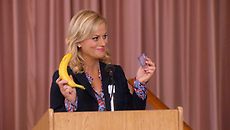
Condoms on Bananas, or, Why Culture Warriors Aren’t Funny

Parks and Rec’s Leslie Knope Sheaths the Banana

I disagree with Russell Moore on many things.  But I do agree with the heart of Moore’s recent argument in the pages of Christianity Today.

Moore commented on a recent episode of the sitcom Parks and Recreation.  I didn’t see the show.  But according to Moore, the plotline concerned an outbreak of sexually transmitted infections among residents at a small-town nursing home.  Moore argued that the show engaged in the worst kind of smug culture-war preaching.

Moore’s accusations ring true.  Many self-professed “liberals” engage in the kind of liberal fundamentalism that Moore describes on the show.  In Moore’s words,

“the show intended to reinforce a view already held by the people to whom they were talking. Those who already deride abstinence education could nod their heads in affirmation, ridicule the morons who oppose good common sense, and feel much better about their moral and intellectual superiority to the Neanderthals out there.”

I support comprehensive sex education in public schools.  But as Moore points out, lots of people disagree.  And lots of those people are smart, caring, informed, and engaged.  At best, the kind of self-satisfied mockery that he describes on Parks and Rec sounds ineffective.  As Moore charges, “few people are going to have minds changed by seeing their viewpoints caricatured.”  At worst, this kind of preaching to the choir deepens our culture-war divisions and leaves us all more bitter, angry, and, in the end, ignorant about the real conflict.

As we battle over issues such as sex ed, prayer in schools, and creationism, we need to keep in mind that those with whom we disagree may have legitimate reasons for their positions.  Moore takes conservative evangelicals to task for often forgetting this message.  As Moore argues,

“Sexual liberation ideology is deadly, but we aren’t preaching to those in bondage to it if we simply repeat slogans. In order to see the true wickedness of sexual liberation, we must ask why it’s appealing, and why deceptive arguments can seem plausible. Only when we speak to the conscience can we get to where people are, as we all once were, hiding from God.

“Darwinism can’t explain the meaning and purpose of the universe or of humanity. But when we simply laugh and say, “My grandpa wasn’t a chimpanzee,” we aren’t taking seriously the claims of our opponents. In fact, we’re not speaking to them at all, just to ourselves.

“When unbelievers hear a canned, caricatured argument, they recognize exactly what I recognized when I listened to the moralizing of the Parks and Rec script: They’re not trying to convince me, or even to talk to me. They just want to soothe the psychologies of their partisans.”

Moore’s central point remains powerful even if we don’t agree about the nature of Darwinism or sex ed.  When we talk about the cultural truths at the heart of our education system, we need to remember that those with whom we disagree deserve respect.  True liberalism is not the pat preachiness of Leslie Knope.  Rather, it requires a much more difficult cultural argument that disagrees without deriding its opponents.

Sex as Religion in America’s Public Schools

Try this one on for size: Religious conservatives are fighting to keep America’s public schools free from religion.  And they have been doing so for a long time.

Here’s the catch: the religion they want excluded is the awkwardly named faith of “sexualityism.”  The campaign by some conservative intellectuals to ban this newly identified theology joins a long history of conservative attempts to reframe secular, liberal, “progressive” ideology.  Such ideas as the relativism of value systems and the virtues of commitment-free sex, these conservative argue, are actually theological ideas.  As such, the conservative argument goes, the fabled wall of separation between church and state requires that they be kept far away from public schools.

For example, writing recently for the conservative journal Public Discourse, Greg Pfundstein denounced a new sex policy in New York City schools.  As we’ve noted here, the Connecting Adolescents to Comprehensive Health (CATCH) program offers contraception to public-school students without parental notification.  The program recently expanded to include “morning-after” pills, in addition to condoms and birth-control pills.

Pfundstein insisted that this program made no sense from a public-health perspective.  Instead, Pfundstein argued, “This is the work of religious fanatics, and their religion is sexualityism.”

At the core of programs such as CATCH, Pfundstein concluded, is nothing less than a “theocracy of the sexual emancipation of children.”

The strategy of identifying secular ideology in public schools as a religion has a storied history among conservatives.  In the 1920s, as I argue in my 1920s book, much of the anti-evolution fervor among religious conservatives resulted from the identification of evolutionary ideas as profoundly religious.  In this case, conservatives argued that evolution was merely atheism in disguise.

More recently, beginning in the 1970s, conservatives attacked public-school ideology as “secular humanism.”  Conservative writers, intellectuals, and activists insisted that public-school curricula embodied the religion of secular humanism, and, as such, violated the First Amendment ban on state-supported religion in public schools.

Perhaps the political high-water mark for this strategy came on May 12, 1976.  US Representative John Conlan of Arizona successfully amended a bill about the financing of higher education to include a denunciation of secular humanism.  As Conlan argued on the floor of the House,

“there is a significant current in education to teach children that there are no values, there is no right, there is no wrong, that everything is relative, and it all depends upon situational ethics.  This is the heart of the First Secular Humanist Manifesto of 1933 and the [13533] Second Secular Humanist Manifesto of 1973.

            “What we are really saying is that much of the social problems that are being dealt with in the schools came from the premise that there are no moral or religious principles.  What I am saying is that since we cannot teach and will not fund those grants and programs to develop the Judaic-Christian ethical concepts, then it seems to me fair that those curriculums opposed to Judaic-Christian concepts should also not be funded.  That is all we are asking.      

            “I have in my hand here the recently published Humanist Magazine article which brags that ‘humanism is alive and thriving in secondary schools.’  But we could go on and on documenting the case of what is happening in our schools.” (Source: Congressional Record, May 12, 1976, pg. 13532-13533)

This argument has had some success in courtrooms.  Most famously, the plaintiffs in Mozert v. Hawkins County (1987) had initial success with their claims.  Though a federal circuit court eventually disagreed, early hearings supported the Mozerts’ claim that textbooks in public schools ought not teach ideas that promoted “secular humanism.”

Could this strategy change the argument about sex-ed in public schools?  Could it shift the debate from talk of public health to talk of public religion?

If the history of conservative attempts to ban “secular humanism” is any guide, the answer is likely no.  In Mozert v. Hawkins County, for instance, federal judges eventually ruled that the Mozerts’ did not have a significant claim to have been harmed.  In essence, the judges disagreed that “secular humanism” represented a state-sponsored religion.

The same will likely be true with the awkwardly named “sexualityism.”  The religious nature of teaching sexuality seems plausible, but courts and public opinion will likely continue to see the public-health benefits of sex ed outweighing the religious objections of conservatives.

“If You’re Planning to Have Sex…”

What should schools be teaching America’s young people about sex?  This is a question that has snarled culture-war arguments about public education for decades.  Sex ed proponents often insist that they can teach a morally neutral approach—just the facts.  This attitude is ridiculously oversimplified.  There is and can be no morally neutral approach to a subject that is so intimately wrapped up in religion and ethics.

Let me be clear at the outset: I personally believe public schools should teach a comprehensive curriculum in sexuality that includes discussions about both the mechanics and morals of sex.  But the common argument that sex ed can be done in a morally neutral fashion relies on a woefully naïve self-understanding.

This liberal tradition begins with a powerful argument in favor of public-school sex ed.  Many sex ed proponents make the strong case that sex is a potentially deadly game.  Since kids are going to do it, they need information to stay safe and avoid unintentional pregnancies.  With the prevalence of HIV and possible pregnancy, the argument goes, this is literally a life-or-death situation.  Refusing to educate young people about sex in a frank and open manner would be a nearly criminal malfeasance on the part of responsible public-school educators.  Yet due to dunderheaded conservative opposition, many sex educators feel, this vital information is often censored.

Perhaps the most famous example of this position was the beleaguered Mary Calderone.  As historian Jeff Moran described in Teaching Sex: The Shaping of Adolescence in the 20th Century, Calderone headed SIECUS, the Sex (later Sexuality) Information and Education Council of the United States beginning in 1963.  The stated goal of the organization, in gendered 1960s language, was “to establish man’s sexuality as a health entity.”  Calderone wanted sex to be understood as a positive thing.  “We must block our habit of considering sex as a ‘problem’ to be ‘controlled’,” she wrote in 1963.  Rather, Calderone argued, “Emphasis must be on sex as a vital life force to be utilized.”  In spite of the reputation Calderone gained as a wild-eyed sex maniac, Calderone remained relatively old fashioned.  She believed sex ed should encourage the ultimate goal of healthy marriages, for instance.  The SIECUS plan insisted it took a “moral-neutrality” approach.  It promised to deluge students with information, not preaching, about sex and sexuality.

Like that of SIECUS in the 1960s, the rationale of sex-ed advocates in subsequent decades has often gone as follows: sex educators in public schools do not encourage young people to have sex.  They merely suggest that if students are going to have sex, they must have the knowledge to do it safely.

For instance, as Laura Sessions Stepp has argued in recent days about a New York City program to provide the “morning after” pill to public-school students without parental consent, merely making information and even contraception available to young people does not encourage sex.

Whatever scientific evidence may suggest, however, proponents of sex ed in public schools often utterly misunderstand the thinking of religious conservatives.  It is difficult for those of us who support public-school sex ed to wrap our minds around the conservative position.  But if we are going to have respectful, productive discussions about sex ed, we must make the effort.

In short, for many religious conservatives, sex ed can never be a neutral message.  Having an adult, perhaps a teacher, stand in front of a group of young people and say, “If you’re going to have sex, here are some ways to do it safely,” suggests that having sex is a legitimate and respectable option for young people.  It encourages young people, some religious conservatives think, to think of themselves as people who might be having sex.

How can we make sense of this conservative position?  We might start with a few analogies.
For example, imagine a parallel situation in Family and Consumer Science, the class formerly known as Home Ec.  Imagine a teacher planned to inform students about the importance of kitchen hygiene.  “If you’re planning on making a ham-and-cheese sandwich,” the teacher might say, “here are some ways to do it safely.”

It is not difficult for us to imagine that a student from a Jewish background might not want to make a ham-and-cheese.  And, with our understanding of the goals and nature of public education, we can agree that such a student should never be forced to make a sandwich that breaks his or her religious rules.  Such a student could make something else.  Or he could be exempted from the class.  No big deal.  Simply because we do not share the student’s understanding of what may be offensive, we do not force the student to abandon that understanding.

In cases such as this, we should remember the words of former Chief Justice of the US Supreme Court Warren Burger.  In Thomas v. Review Board (1981), Chief Justice Burger argued that those who are not compelled by religious rules are not the ones who should decide whether or not those rules are reasonable.  “It is not for us to say,” Burger argued, “that the line [Thomas] drew was an unreasonable one.”

Granted, the case was not about public schools, or sex ed, but the principle remains important.  It is not the role of those who are not offended to declare whether or not certain ideas are offensive.

Perhaps another way to understand this case might be to imagine some permutations.  Consider, for example, how we would feel if a teacher told a class, “Now class, if you’re thinking about killing someone, here are some ways to do it safely.”  Clearly, when we agree that behaviors are beyond the bounds of morality, we agree that public-school teachers ought not be suggesting safe ways for students to engage in them.

That may be the position of religious conservatives.  If an action is entirely beyond the bounds of morality, the notion that young people need to be taught how to do it safely makes utterly no sense.  Simply broaching the topic implies that sex would be a legitimate choice for young people, a position their religion explicitly forbids.

So how can public schools provide information without offending conservative religious families?  It will make a start to understand the complaints of conservative parents as legitimate.  Just as we would not question a Jewish student’s aversion to making a ham-and-cheese, so we should not attack a religious student’s aversion to hearing about safer ways to have sex.  For many sex-ed liberals, myself included, this is a difficult pill to swallow.  It feels as if we are allowing some families to stick their heads in the sand, to restrict their children from hearing vitally important safety information.  Nevertheless, if we honestly respect the home cultures of students from conservative homes, we must allow them to draw the lines between offensive and acceptable.  We can never insist that our understanding of “morally neutral” must be accepted by those who disagree.




What Do Missourians REALLY Want?

Everyone interested in what we’re calling Fundamentalist America should be following Missouri’s Amendment 2.  The debate about the nature of religion in public schools and institutions gets right to the heart of many culture-war controversies.  But it appears that the amendment might pack a much heavier culture-war punch than it seems to.

There are plenty of places to go to catch up on the story.  ILYBYGTH has introduced the upcoming vote, discussed the results, and noted Catholic Bishops’ support for Amendment 2.  The St. Louis Post-Dispatch offered a very helpful introduction in late July.  For anyone interested in the viewpoint of amendment supporters, a Baptist congregation in Odessa published an hour-long video of Representative Mike McGhee explaining his vision for the amendment, frankly and openly.

For those who don’t like clicking on stuff, here’s the story in a nutshell:  On August 7, 2012, Missouri voters overwhelmingly (83%) approved an amendment to their state constitution.  The amendment was promoted as a school-prayer amendment.  Supporters such as legislative sponsor Mike McGhee called it a clarification of the rights of religious people to pray in public, so long as their prayers did not disturb others.  McGhee claimed that such rights are often disrespected.   Opponents such as Americans United for Separation of Church and State insisted it was at best unnecessary, since such rights are already protected in the US Constitution.  At worst, opponents insist, this amendment threatens to undermine the barrier between church and state.

Given a closer look, however, this amendment does much more than clarify students’ rights to pray in public schools.  It does that, but the amended Constitution now includes two other rights for students.  These new rights go far, far beyond protecting the rights of public schoolchildren to pray quietly.  The new rights satisfy the long-standing desires of important constituencies in Fundamentalist America.  For all parents who have worried that their children might be taught unwholesome moral, sexual, or religious lessons in public schools, the Missouri Constitution now offers an easy escape route.

The first added phrase, “students may express their beliefs about religion in written and oral assignments free from discrimination based on the religious content of their work,” opens the door for conservative families to include their beliefs in all parts of the school curriculum.  For example, creationist parents and students could now use their beliefs to answer questions about evolution.  This has long been a sticking point for creationists.  Consider the words of Avis Hill, a pastor from Kanawha County, West Virginia.  Hill rose to national prominence in 1974 when assumed a leadership role in a controversy over adopted textbooks.

From Trey Kay, “The Great Textbook War”

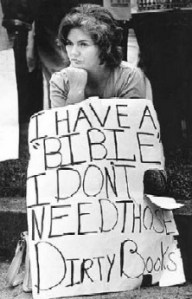
Hill told interviewers that his daughter was given a failing grade for her report on evolution.  According to the Reverend Hill, the young Miss Hill, fifth grader, told her teacher, “‘Mrs. So-and-So’—whose name I’ll not use—‘I’ll not give that report, and I’ll not read that book in class.’  She said, ‘I have a book I will read,’ and she opened her Bible—and I did not coach her because it didn’t bother me that much at that time—she opened her Bible, and she began in Genesis 1, ‘In the beginning God—‘ and the teacher failed her.” [Interviewed by James Moffett, included in Moffett’s Storm in the Mountains (Southern Illinois University Press, 1988), pg. 90].

This sentiment echoes throughout Fundamentalist America.  Fear that students will be forced to learn evolution, or about the use of condoms, or about the moral ambiguities of modern life have long dominated conservative rhetoric about public education.  Missouri’s new Constitution fixes that perceived problem.

The second telling phrase in the new Constitution underlines the point.  “No student,” the amendment reads, “shall be compelled to perform or participate in academic assignments or educational presentations that violate his or her religious beliefs.”  The implications are clear.  Sex ed, evolution ed, “situation ethics,” all have loomed large in the imagination of Fundamentalist America for generations.  This amendment guarantees that no student shall be forced to learn about such things.

Missouri’s amendment is not the only place to find this sentiment in political action.  New Hampshire’s state legislature recently passed a very similar law.  As I argue in my 1920s book,  conservatives have struggled to protect conservative religious students from public-school curricula since the 1920s.  In the last generation, the fight in Hawkins County, Tennessee, might have generated the most attention.   In that case, conservative religious parents ultimately lost their lawsuit against the school board.  Parents had claimed that anti-religious messages in school textbooks forced their children to learn messages inimical to their religious beliefs.  In 1987, the US Court of Appeals for the Sixth Circuit disagreed.

Lawmakers in New Hampshire and now voters in Missouri found a way around this legal precedent.  However, it is not clear that Missouri voters knew just what they were voting for.  Consider the wording of the ballot measure:

“Shall the Missouri Constitution be amended to ensure:

“That the right of Missouri citizens to express their religious beliefs shall not be infringed;

“That school children have the right to pray and acknowledge God voluntarily in their schools; and

“That all public schools shall display the Bill of Rights of the United States Constitution.

“It is estimated this proposal will result in little or no costs or savings for state and local governmental entities.

“Fair Ballot Language:

“A “yes” vote will amend the Missouri Constitution to provide that neither the state nor political subdivisions shall establish any official religion. The amendment further provides that a citizen’s right to express their religious beliefs regardless of their religion shall not be infringed and that the right to worship includes prayer in private or public settings, on government premises, on public property, and in all public schools. The amendment also requires public schools to display the Bill of Rights of the United States Constitution.

“A “no” vote will not change the current constitutional provisions protecting freedom of religion.

“If passed, this measure will have no impact on taxes.”

No mention of creationism, sex ed, condoms in schools, or other implications.  Nothing about guaranteeing students the right to opt out of any instruction they deem pernicious.  The ballot measure emphasized the amendment as a clarification of students’ rights to pray.  Yet the amendment itself makes the other meanings crystal clear.

Missouri voters approved the amendment by overwhelming margins.  But it appears that the implications of that ‘yes’ vote might not have been entirely apparent.  So what DO Missouri voters want?