
Vouchers. Charters. Conservatives these days like to offer “market” solutions to school problems. In the pre-run-up to the 2016 presidential contest, Florida Senator Marco Rubio is offering a market fix for college students: Sell shares in yourself.
Of course, not every conservative is a free-marketeer. “Traditionalist” conservatives (for good examples, check out the Imaginative Conservative or the American Conservative) decry the dehumanizing effect of ruthless commodification. But there has been a long tradition in these United States of tying traditional values to an apotheosis of the free market.
In education, the most influential voice for marketization has been the late Milton Friedman. As he remembered in the 1980s, when he started advocating vouchers, it was “far out of the mainstream.” But by the twenty-first century, such market ideas had become dominant. Parents should all have the right to choose the right school for their children, Friedman insisted. The only reason they could not, he wrote, was because self-interested teachers’ unions had seized control of education and forced an “excess of conformity.”
Rubio’s plan expands on this principle. In a recent talk organized by the National Journal, Rubio worried that the “American dream” of college education has become unaffordable for many. The danger, Rubio warns, is an increasing opportunity gap between those who have advanced education and those who do not. His plan will help narrow that gap by making it possible for everyone to go to college. Our “new economy,” he says, is still working with a higher-ed system built for the “old economy.”
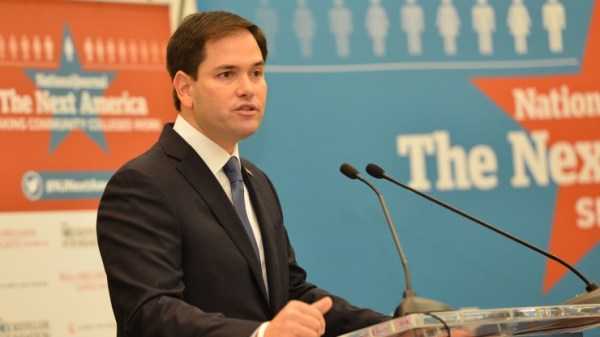
Sell yourselves, students…
Tuition costs have shot up far faster than the rest of the economy. Students from less-affluent backgrounds have been forced out of college, or saddled with impossibly huge debt burdens. Colleges are getting fat on these hefty tuition bills, largely financed by federal student loans. And, according to Senator Rubio, many “high-skilled, high-paying industries suffer from a shortage of labor.”
His solution? Among other ideas, Rubio wants students to sell shares in themselves. Instead of borrowing a fixed amount, students could promise investors, say, four percent of their earnings for ten years after graduation. Students might end up paying far more than they borrowed. Or they might pay less. But that is all part of the promise and peril of the market.
As Rubio notes, this will pusher higher education in “practical” directions. It will push students to pursue “the right degree, geared toward the right industry.” Not a lot of investors will jump at the chance to invest in a philosophy major. But students in “engineering, health services and education,” Rubio thinks, will be a good bet.
There are plenty of conservatives, I think, who would be aghast at this marketization plan. The purpose of education, many conservatives insist, is to humanize.
Rubio’s brand of conservatism is different. He wants to let the market work its magic.



 I Love You but You're Going to Hell