Fundamentalist Colleges Save Lives

Maybe they were right. One of the hallmarks of conservative evangelical colleges has always been a clampdown on student behavior. The goal was to protect student morals, but a side benefit seems to have been protecting student health. A new study finds…surprise, surprise…that smoking pot and binge drinking lead to more risky sex among undergrads.

A hundred years ago, conservative evangelical Protestants reeled from the horror stories oozing out of America’s elite colleges. Fundamentalist preachers warned their flocks that colleges in the 1910s no longer protected students’ faith or morals. As a result, fundamentalists founded their own network of rigidly conservative schools. In addition to fundamentalist theology, all of these colleges adopted draconian rules for students: No smoking, no dancing, no drinking…and certainly no unmarried sex.
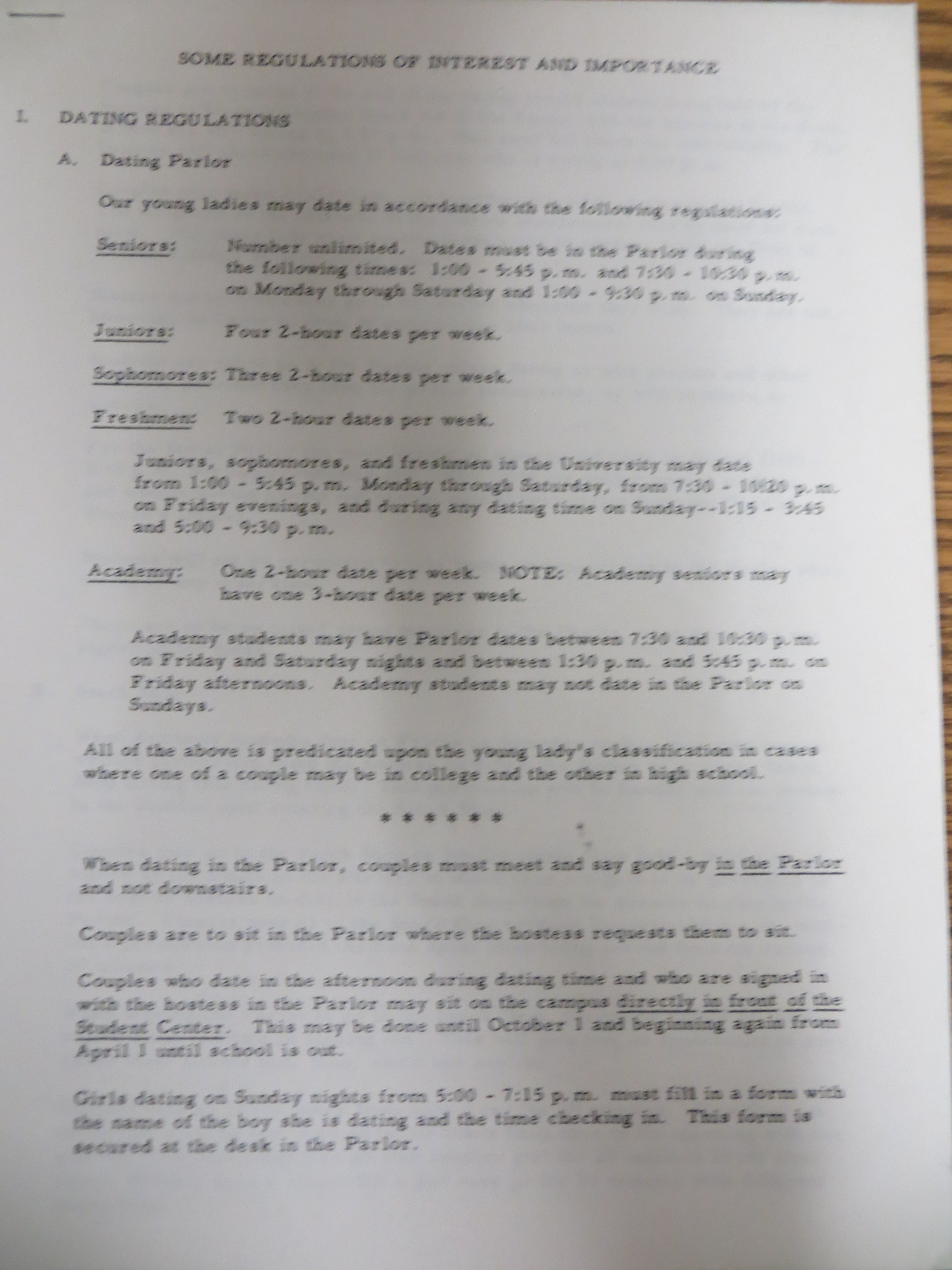
The view from 1931, Bob  Jones-style.

The view from 1931, Bob Jones-style.

As I work on my new book about the history of these schools, I’m struggling to make sense of these ubiquitous student rules. It’s easy enough to find the paper trail in the archives. At Bob Jones College, for example, founder Bob Jones Sr. placed the burden of avoiding sex on women.

Jones explained his thinking in an open letter from the 1920s:

The Bob Jones College discourages extravagance in dress AND INSISTS UPON MODESTY.

We request our girls to wear simple dresses in classes. We have a laundry where these dresses can be laundered.

The girls in the Bob Jones College voted to wear their dresses two inches below the knee cap. This is short enough for style and long enough for decency.

The girls in the Bob Jones College last year had the reputation of being the most attractive group of girls in the country, and as a whole, they dressed very simply.

There is one regulation which we wish our girls to thoroughly understand. WE DO NOT ALLOW OUR GIRLS TO WEAR EACH OTHERS CLOTHES. The only exception is in the case of sisters.

Bob Jones College was not alone in the effort to control sex by controlling women. One student who attended Wheaton College in the 1920s remembered a similarly strict regime of sexual policing. “Well,” this former student remembered in a 1984 interview,

The control was rather tight. Of course, that was in those days when . . . when the separation of the sexes was very strict, and the . . . the regulations were . . . dress regulations and so forth were quite strict.

Did students find ways to get around these rules? Of course. It’s harder to find, but as I delve into the archives of these colleges I find examples of students being punished for drinking, smoking, attending movies, and, of course, hooking up. One student at Bob Jones College was caught climbing out of his girlfriend’s dorm window at midnight. He said they had been praying together. A student at Wheaton remembered his roommate speaking to his girlfriend through a system of prison wall-taps.

All in all, though, the draconian system of student rules meant a different campus experience than at non-fundamentalist colleges. Over the years, the rules have loosened up, but they remain more restrictive than at other schools.

What has been the result? On the one hand, the system of sexual policing seems to pushed sex on campus into dangerous and degrading directions. Bob Jones University, for example, admitted its terrible and terrifying record of ignoring and even tacitly encouraging sexual abuse and victimization.

But we can’t help but think that stricter rules against drugs and alcohol must do something to protect students, as well. Don’t get me wrong: I’m no apologist for evangelical universities. I’m not evangelical myself; I don’t work at an evangelical college; I don’t dream of a school in which students don’t use drugs or have sex.

However, there seems to be demonstrable evidence that drinking and using drugs leads to risky behaviors. The researchers at Oregon State found direct connections between smoking pot, binge drinking, and unhealthy sexual practices. Students who used more drugs on any given day were more likely to have sex without a condom, for example.

The stricter rules about drugs and sex at evangelical colleges were put in place to protect student morals, not their health. As I’ve argued before, if we want to understand conservative attitudes about sex, we need to shift out of the medical mindset. However, perhaps there has been a positive side-effect.

I would love to see a study like this in which researchers looked at student behavior at a variety of schools. Did school rules against booze and sex discourage risky behaviors? Or did the added illicitness simply push students to take more risks?
Can a College Be Christian?

After Ben Carson’s stupid and hateful comment that the USA should not have a Muslim president, Baylor theologian Roger Olson noted that we really could not have a Christian president, either. In my current work about evangelical colleges, I’m struggling to define what it meant to be Christian at school, too. It raises an ancient question: Can an other-worldly religion (successfully) run worldly institutions?

Olson noted that the only sincere evangelical to sit in the Oval Office in recent decades has been Jimmy Carter. And Carter, Olson argued, was a terrible president. Not by accident, either, but because he was an honest-to-goodness Christian. As Olson put it,

I am not cynical, but neither am I naïve. America is no longer a true democracy; it is run by corporations and the super-rich elite. Occasionally they don’t get their way, but, for the most part, they do. One reason they do not seem to is that they do not agree among themselves about everything. So, sometimes, a president, a senator, a congressman, has to choose between them in decision-making. But, in the end, the policy remains that “What’s good for business is good for America” even when what’s good for business is bad for the working poor (to say nothing of the destitute).

No, given how modern nation states work, I do not think a real Christian, a true disciple of Jesus Christ who seeks to put first the kingdom of God and God’s righteousness, can be president of the United States or any modern nation state.

The deeper question of belief and institutional necessity is one I’m wrestling with these days. As I write my new book about the history of evangelical higher education, I find myself struggling to offer a satisfactory definition of what it has meant to be a fundamentalist. It’s a question that has bedeviled historians (and fundamentalists) for a good long while, so I feel I’m in good company.

For good reasons, historians have insisted that we need a fairly narrow definition of fundamentalism. In his great book Revive Us Again, Joel Carpenter argued, “more generic usage obscures more than it illumines” (page 4). Carpenter was leery of commentators who slapped a “fundamentalist” label on any and all conservatives or conservative Protestants. As he argued,

Labelling movements, sects, and traditions such as the Pentecostals, Mennonites, Seventh-day Adventists, Missouri Synod Lutherans, Jehovah’s Witnesses, Churches of Christ, black Baptists, Mormons, Southern Baptists, and holiness Wesleyans as fundamentalists belittles their great diversity and violates their unique identities (4).

If we need a straightforward definition for those reasons, Matthew Sutton’s recent definition of fundamentalism as “radical apocalyptic evangelicalism” will do the trick. Certainly, fundamentalist theology was defined by its vision of end-times as well as by the centrality of those apocalyptic visions to the movement.

But such definitions don’t seem to match the ways fundamentalism has been defined in its leading institutions. At the colleges I’m studying—schools such as Wheaton College, Bob Jones University, Bryan College, Biola University, The King’s College, and similar schools—there’s more to the school than just theology.

When these schools called themselves “fundamentalist” (and they DID, even relatively liberal schools such as Wheaton), they meant more than theology. They meant more than just “radical apocalyptic evangelicalism.” They meant more than just “not-Mennonite-or-Pentecostal.”

Defining fundamentalism as it was used in fundamentalist institutions is a trickier issue than simply defining fundamentalist theology. By and large, when schools talked about themselves as “fundamentalist,” they meant that the professors and administration all signed on to fundamentalist theology. But they also meant that the students would have a vaguely conservative atmosphere in which to study. No smoking, no dancing, no etc. They also meant that students would be controlled and guided in their life choices. And they also meant that students would be more likely to socialize with similarly fundamentalist friends and future spouses.

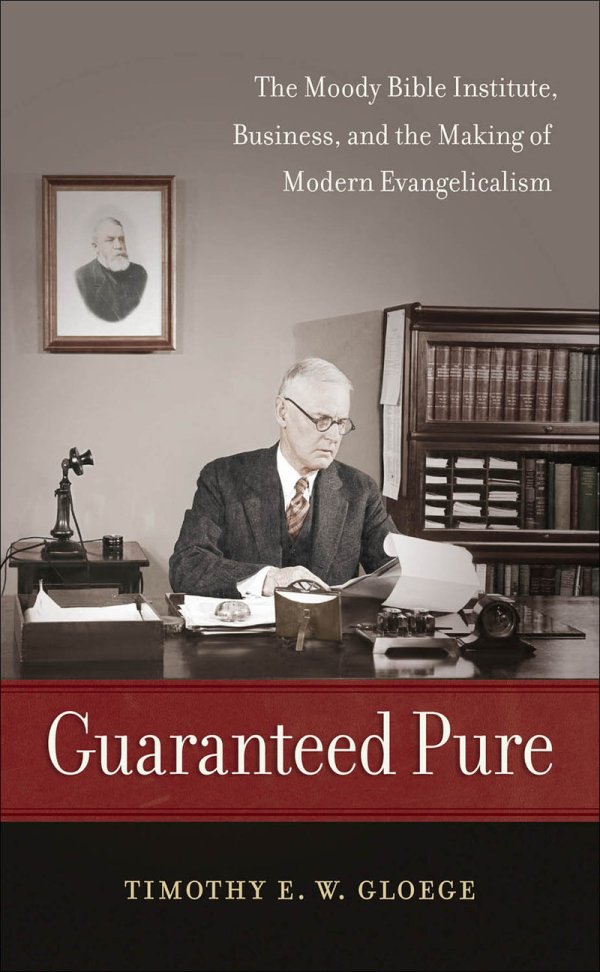
I’m not sure how to define that kind of fundamentalism. I like the way historian Timothy Gloege has done it in his new book about the Moody Bible Institute. Gloege focuses on what he calls the “corporate evangelical framework” that guided MBI since its founding in the 19th century.

What did fundamentalism mean in Chicago?

What did fundamentalism mean in Chicago?

As Gloege argues, at a school like MBI, fundamentalism was more than a set of “manifestos and theological propositions.” Rather, it worked as a set of “unexamined first principles—as common sense.” Fundamentalism, Gloege writes, is better understood as a certain “grammar” than as a list of religious beliefs.

That kind of definition seems closer to the ways it was used in the schools I’m studying.

Roger E. Olson argues that it will be impossible for any sincere evangelical Christian to be president. There are simply too many worldly factors that violate the otherworldly morality of Christianity. Similarly, evangelical colleges have not defined themselves merely along theological lines. They couldn’t. Instead, they have defined what it has meant to be a “fundamentalist” based on a range of factors. Of course, they care about student religious belief. But they also care about student fashions, patriotism, diets, and social lives. And such things were usually considered a central part of making a school authentically “fundamentalist.”

Can a college be Christian? In the sense that Roger E. Olson is asking, I guess not. Just as every president has to violate evangelical morality, so every institution of higher education has to consider a range of non-religious factors in order to survive.

The Crack Appears at Christian Colleges

It wasn’t hard to predict, but I’m surprised it has come so quickly.

World Magazine reported recently that a potential split had developed among the members of the Council for Christian Colleges and Universities. Two schools, it seems, have liberalized their policies about homosexual employees. Will this lead to a break in the CCCU? If so, it might be the last blow for a network that started with big ambitions.

SAGLRROILYBYGTH will know that I hardly ever get anything right. It is famously difficult for historians to use the past to predict the future. But in my current research, I see time and again that issues such as homosexuality have divided the family of evangelical colleges and university. It was not very hard to see that the recent SCOTUS decision about same-sex marriage would lead to a split among evangelical schools.

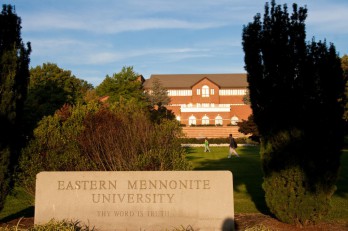
eastern mennonite university

A founding member of the CCC upsets the applecart…

Exactly three months ago in these pages, I put two and two together: the Supreme Court decision in favor of same-sex marriages would present evangelical schools with a terrible dilemma.

Sure enough, Goshen College and Eastern Mennonite University recently announced their plans to hire non-celibate homosexual faculty. They do not necessarily want to leave the CCCU, though. Leaders of the CCCU network are wondering: Will this lead to a split? Will member schools be forced to choose between a homosexual-friendly evangelical network and a traditional gay-is-not-okay one?

Unfortunately, the history of the CCCU offers little help on that question. In its early days as the Christian College Consortium, the network had some grandiose dreams. Some leaders, such as Hudson Armerding of Wheaton College, fantasized about a multi-campus evangelical university. The dream was to concentrate resources in order to keep up with secular colleges.

As far back as the 1950s, some evangelical college leaders toyed with this idea of a California-style mega-versity. Some schools, Armerding hoped, could offer more intense engineering programs. Others might focus on missionary preparation or languages. Yet others could host pre-med degrees. All of them would contribute toward a central graduate campus, too.

In this way, the future CCCU would remain orthodox in religion, yet be able to compete with big public and rich private universities.

As Armerding put it in a confidential letter to his fellow school leaders in 1955,

Each particular college would offer the same undergraduate instruction for the first two years and then would offer a limited number of majors for the final two undergraduate years and graduate studies leading to the doctorate. . . . There would be the possibility of mobilizing the entire evangelical community to support the proposed Christian university, challenging their loyalties through familiar and accepted institutions to which this constituency had already committed itself. Hence the continuing support of the university would be relatively assured. The geographic distribution would make possible a nation-wide impact upon the social and cultural life of the nation and would facilitate the educating of students who might otherwise be unable to travel to one central location.

Speaking from Gordon College near Boston, President James Forrester wrote in 1961 to evangelical intellectual leader Carl F. Henry to support the idea:

I have wondered if a beginning might not be made toward the consolidation of some of the evangelical effort at the undergraduate level on such a campus as ours. This could be done under a federated scheme similar to Oxford, Cambridge, the University of Toronto, Claremont College, and other associated programs. I think particularly of King’s and Barrington and wonder if some person who transcends the entrenched interest of our three schools, could bring together in conference key personnel for a discussion of this possibility. I do find that the limited assets available to Christian higher education in the area are divided among Wheaton, King’s, Barrington, and Gordon. All of us struggle with capital problems and operating deficits. . . . I am also conscious that with such a fractured effort as we now represent, we are no match for the consolidated interests of educators committed to the philosophical position of a naturalistic humanism in the university field. I also feel that this could be the natural groundwork from which could be extended ultimately your magnificent concept of a great Christian university.

It didn’t work out that way. In practice, the CCCU became a loose association of schools. So loose, in fact, that no one seems really sure what will happen now. Member colleges pledge vaguely

To advance the cause of Christ-centered higher education and to help our institutions transform lives by faithfully relating scholarship and service to biblical truth.

Can they do that if they welcome non-celibate homosexual faculty and staff? Or do those schools need to go elsewhere? If they do, how many of the 181 member schools will they pull with them?

From grand 1950s dreams of a powerful and aggressive evangelical multiversity, it seems evangelical colleges will be split yet again into smaller and smaller organizations.

Faculty Fudge Factors at Creationist Colleges

Ding! There it is again—the sound of another evangelical professor being ousted for harboring evolution-friendly ideas.  Some of us outsiders might think that evangelical colleges would slowly become more relaxed about evolution as time went on.  As this case shows, we’d be wrong.  The history of the past century has demonstrated that many evangelical colleges have grown MORE uptight, not less, about proving their creationist credentials.

In this case, the school is Bethel College in Indiana and the professor is Jim Stump. As Karl Giberson described recently, the flap at this Bethel [n.b., there are about one bajillion Bethel Colleges out there and it’s easy for outsiders to mix them up] echoes the trends of the past hundred years: Time and again, creationist colleges have sought to tighten both the image and reality of unshakeable creationist orthodoxy among their faculty.

Stump removal...

Stump removal…

As I’m uncovering as I work on my new book, this pattern has been the dominant theme at conservative evangelical colleges since the 1920s.

Beginning in the 1920s and repeated every generation, schools have tightened the requirements on their faculty. In every generation, some professors have sought to follow a middle path—exploring the science of evolution while remaining firmly committed to their religion. In every generation, nervous college administrators have sought to prove to the creationist community that their school will not tolerate any such thing.

In the 1920s, most schools agreed on ironclad faculty creeds. The hope was that these creeds would prevent faculty from becoming too friendly to evolutionary thinking. At flagship Wheaton College in Illinois, for instance, the trustees in 1926 adopted a creed that all faculty, staff, and administration had to sign annually. They included the following statement:


4. We believe that man was created in the image of God; that he sinned, and thereby incurred, not only physical death, but also that spiritual death which is separation from God; and that all human beings are born with a sinful nature, and in the case of those who reach moral responsibility become sinners in thought, word and deed.

At the time, this statement was thought to define the proper “fundamentalist” attitude toward creation. In 1960, however, a conference about evolution and creationism on Wheaton’s campus attracted ferocious criticism from the more stalwart creationists among the fundamentalist/evangelical community. Too many of the assembled theologians and scientists, critics thought, embraced the principle of evolution.

Among Wheaton’s faculty, zoologist Russell Mixter came in for the fiercest criticism. In spite of his protestations to the contrary, Mixter was accused of teaching and preaching evolution in his classes. In order to calm the storm, Wheaton’s administration altered its faculty creed. At the end of 1961, the school agreed to add the following item:

By Article IV of its ‘standards of faith,’ Wheaton College is committed to the Biblical teaching that man was created by a direct act of God and not from previously existing forms of life; and that all men are descended from the historical Adam and Eve, first parents of the entire human race.

The pattern continues today. At schools such as Bryan College and Northwest Nazarene University, creeds are tightened and faculty are ousted in order to preserve an impeccable reputation for creationism. Time and again, the sticking point has been the historicity of Adam & Eve. It is not enough, evangelical communities insist, for faculty vaguely to endorse the idea of a God-directed creation. Especially when it comes to the origins of humanity, some evangelicals require a belief in a real, literal origin in two real, literal people.

According to Karl Giberson, the folks at Bethel College in Indiana have taken this tradition one step further. Under pressure from the sponsoring denomination, the Missionary Church, Bethel now requires faculty to advocate its firm position on the historicity of Adam & Eve. In the past, at Bethel as at other evangelical colleges, faculty members could sign their annual statements of faith even if they thought that such statements did not require them to disavow mainstream evolutionary science. This policy hopes to push faculty members into a tighter relationship with the denomination’s official position on evolution.

Furthermore, from now on Bethel faculty are not allowed to take leadership positions in organizations that disagree on this point. As BioLogos leader Deborah Haarsma argued, Bethel’s new policy puts evangelical scholars like Jim Stump in a very difficult position. Stump has served as the content manager for BioLogos, an organization that embraces “evolutionary creationism.” The new Bethel policy, in effect, forced Stump to choose between the two organizations.

As the sophisticated and good-looking regular readers of I Love You but You’re Going to Hell (SAGLRROILYBYGTH) are well aware, I am a fan of the BioLogos approach. I’m no evangelical, but I think the way forward in our continuing evolution/creation battles is for both sides to agree to the science of evolution and the freedom of religious belief. As I argue in my upcoming book Teaching Evolution in a Creation Nation (due to hit shelves in February 2016), secular folks like me need to recognize the right of religious dissenters to disbelieve the claims of evolution, even as religious folks need to recognize the duty of public schools to teach evolution as the best available science.

But as I argue in my other upcoming book, schools like Bethel are also in a difficult position. In order to maintain intellectual credibility, they must embrace changing norms of academic excellence. But in order to maintain religious credibility, they must conspicuously root out any whiff of compromise. Not on every issue, but on issues such as evolution and same-sex marriage that seem to make up the foundations of their faiths.

As a result, over the course of the past ninety years, many evangelical colleges–including the relatively “liberal” ones–have made their policies more rigid when it comes to faculty beliefs about human origins.  The recent news from Mishawaka is only the latest attempt by an evangelical college to remove faculty fudge factors.

Is THIS the Future for Christian Colleges?

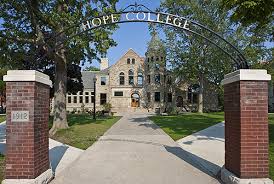
Now what do we do? That is the question plaguing conservative college administrators nationwide. Since the Supreme Court decision in favor of same-sex marriages, many evangelical schools have wondered if they will have to change the way they do things. In Michigan, Hope College has announced its accommodation with the ruling. Will other Christian colleges do the same thing?

The gateway to the future?

The gateway to the future?

As the Sophisticated and Good-Looking Regular Readers of I Love You but You’re Going to Hell (SAGLRROILYBYGTH) are well aware, questions of homosexuality and same-sex marriage have long bedeviled evangelical colleges. For non-evangelicals, it might come as a surprise to hear that the issue is contentious. After all, at most evangelical schools, the official doctrine clearly and resolutely condemns homosexual activity.

Yet at all sorts of schools, the campus community is much more welcoming. At Gordon College recently, the president’s reminder that the school officially bans “homosexual practice” brought furious protests from students and faculty. Even at the far more conservative Liberty University, faculty members do not always take the harsh tone we progressives might expect.

As our Supreme Court decided the constitutionality of state bans on same-sex marriage, many evangelicals fretted that their decision would trash traditional rules on their campuses.

At Hope College in Michigan—a school in the Reformed Church tradition—the leadership and campus has experienced similar turbulence on the issues of homosexuality. In 2010, for example, the administration provoked protests when it banned the film Milk. More recently, the campus has welcomed homosexual student organizations, though the administration has continued to endorse the Reformed position on homosexuality.

In its most recent announcement, the school’s leaders have declared their intention to abide by the SCOTUS decision. From now on, same-sex married partners of college employees will be eligible for the same benefits as heterosexual partners. The administration again affirmed its respect for the Reformed Church’s official doctrine that homosexuality is a sin. That does not mean, however, that the school will contravene the law.

Is this the path other schools will follow? Unlike pluralist colleges, evangelical schools face intense pressure to stay true to traditional beliefs and norms. As Professor Michael Hamilton wrote in his study of Wheaton College,

The paradigm that has dominated Wheaton through the century holds that colleges, more than any other type of institution, are highly susceptible to change, and that change can only move in one direction—from orthodoxy toward apostasy. . . . The very process of change, no matter how slow and benign it may seem at first, will always move the college in a secular direction, inevitably gathering momentum and becoming unstoppable, ending only when secularization is complete.

Hope College may find itself the front line for this debate within the Reformed Church in America. The church as a whole has gone back and forth for decades about the proper Christian reaction to homosexuality. Is it better to embrace the sinner? Or to drive out the sin? Conservatives within the RCA will doubtless take this announcement as proof that Hope has gone soft. Progressives will celebrate it as a small step towards equity.

Other evangelical schools will face similar scrutiny. If they openly welcome homosexual students, faculty, and staff, they will be subject to withering condemnation from conservatives. If they don’t, however, they’ll risk being sidelined, branded as anti-gay bigots.

Who Cares about Adam?

I don’t get it. Even after all these years studying conservative Christianity and creationism, I still don’t really get it. I mean, I understand the logic and history, but I have a hard time making sense of the ferocious emotion that goes into debates over the existence of an historical Adam & Eve. An author interview in Christianity Today outlines some of the tricky questions involved.

Who cares?

Who cares?

But first, a primer for those like me on the outside looking in: The debate over the historicity of Adam & Eve has a long history in conservative evangelical Protestantism. For us outsiders, making sense of this issue will go a long way toward helping us understand the theological underpinnings for young-earth creationist belief. Without making sense of this theology, it can be easy for mainstream scientists and observers to conclude mistakenly that young-earth creationism is nothing but some kind of cult of personality, a quirk of history.

At least since the 1960s (of course it is an ancient belief, but in 1960 it gained popularity among conservative American evangelicals as a vital theological notion central to orthodox belief), conservative evangelicals have insisted that the obvious meaning of Genesis is that God created two first humans in the Garden of Eden. These two, Adam & Eve, became the progenitors of the entire human race. Theologically, creationists have insisted, our belief in an historical Adam & Eve underpins our trust in the Bible. As Simon Turpin of young-earth ministry Answers In Genesis expressed it,

The debate over whether Adam was historical is ultimately a debate over whether we trust what the Scriptures clearly teach. If we cannot be certain of the beginning, then why would we be certain about what the Scriptures teach elsewhere? The uncertainty of truth is rampant in our culture partly due to the influence of post-modernism which is why many believe the issue over Adam’s historicity is unimportant.

For many creationists, believing the plain truth of the creation story in Genesis means believing in the trustworthiness of Jesus Christ. As Andrew Snelling of the Institute for Creation Research explained,

It is impossible to reject the historicity of the book of Genesis without repudiating the authority of the entire Bible. If Genesis is not true, then neither are the testimonies of those prophets and apostles who believed it was true.

Of course, for mainstream scientists, the notion that human genetic diversity came from only two original humans does not fit the evidence. In order to have today’s genomic sequence, I’m told, humanity must have begun with thousands of original humans.

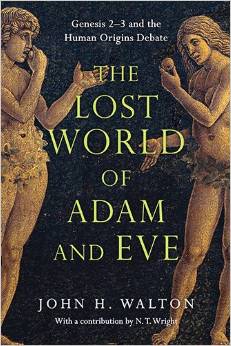
John Walton of Wheaton College explains to Christianity Today why evangelicals can accept this science while still remaining true to a conservative reading of Scripture. In his new book, The Lost World of Adam & Eve, Walton argues that Adam & Eve can be read as the “priests” of early humanity, not the only two first humans.

Again, for those of us outside of conservative evangelicalism, the controversial nature of such claims can be hard to figure. Recently, theologian Peter Enns was booted from Westminster Theological Seminary for advocating similar ideas. Walton explains in this interview why it is possible to respect the authority of the Bible while still reading Genesis in a way that is not contrary to modern science. Walton insists that

You can affirm a historical Adam, but that doesn’t have quite the implications for biological human origins that are often assumed.

The key, Walton argues, lies in reading Genesis as the original readers would have. To them, Walton says, creation would be more about how the world of Adam & Eve was “ordered,” not just how it was “manufactured.” We can understand Adam as both a real person, a real creation, and as an “archetype” for humanity. Though there may have been other early humans, Walton explains, Adam & Eve served as the ones in God’s sacred space.

Why do such ideas matter? Again, for folks like me trying to understand conservative Protestantism from the outside, it can be difficult to make sense of the ferociously controversial nature of such arguments.

Yet they are at the heart of conservative evangelical Protestantism. As I argued in my 1920s book, conservative evangelicals have never agreed on the proper relationship of Genesis to either modernist theology or science. From J. Gresham Machen in the 1920s to Harold Lindsell in the 1970s, conservative intellectuals battled to affirm the notion that any compromise is deadly to faith.

And as I’m finding in my current research, these battles have long sent shock waves through the world of conservative higher education. Recently, Bryan College has firmed up its insistence that faculty members affirm their belief in an historical Adam & Eve. In 1961, Wheaton College did the same thing.

And fundamentalists are not the only ones who will spring to repudiate theories like Walton’s. Leading atheist pundits, too, agree that Genesis requires an historical Adam & Eve. Jerry Coyne, for example, laments the apologism of folks like Walton. Of course, Coyne does not want people to reject mainstream science in favor of a belief in an historical Adam. Rather, he hopes people will simply accept the obvious conclusion that the Bible is a book of myths.

If all of these whirling debates make your head hurt, join the club. For those of us outside the circle of evangelical Protestantism, it can be very difficult to understand the ferocious feelings at play in the Adam debate. But that ferocity lies at the heart of evangelical belief. Historically, any attempt to rationalize our reading of the Bible, any attempt to explain away the most obvious interpretation of Scripture in favor of one that accords with modern science, any effort to bring our faith into harmony with science…all have been seen as the beginnings of apostasy.

For evangelical readers, Adam & Eve matter. For those of us trying to understand conservative Christianity, this complicated debate will be a good place to start. Why would professors lose jobs over it? Why would Christianity Today dedicate a major article to this interview with John Walton? Why will Walton’s position provoke such furious responses?

Fundamentalism and the Modern University

Are evangelical colleges modern? Or, with their insistence that knowledge has its roots in God’s Holy Word, are they somehow trapped in medieval ideas about knowledge and the purposes of higher education? The answer is more complicated than it might seem at first.

As the sophisticated and good-looking regular readers of ILYBYGTH (SAGLRROILYBYGTH) are sick of hearing, I’m hard at work on my book about evangelical higher ed. In the twentieth century, Protestant fundamentalists opened or transformed a network of colleges dedicated to protecting fundamentalist faith. If students are led astray at mainstream secular colleges, the thinking went, fundamentalists needed their own schools to teach each new generation of Christians how to be educated and evangelical.

As part of my reading list, I’m deep in Roger Geiger’s new book, The History of American Higher Education (Princeton University Press, 2015). I’m writing a full review for Teachers College Record and I’ll be sure to post links to that review when it comes out.

Are fundamentalists colleges modern? Or are they trapped in the 1600s?

Are fundamentalist colleges modern? Or are they trapped in the 1600s?

In the meantime, though, Professor Geiger’s survey of the first colleges raises some tricky questions for fundamentalist higher education. As with so many early American institutions, colleges such as Harvard and Yale represented the tail end of medieval traditions, just as they were changing into recognizably modern ways of thinking.

Conservative evangelicals like to point out that America’s leading colleges were often founded as religious schools. It’s true. Harvard and Yale were both intended, first and foremost, to defend orthodox Puritanism. Not only were they ferociously religious, but they envisioned their role in a radically non-modern way. Instead of serving as an institution that encouraged new thinking, Harvard and Yale in the 1600s and early 1700s both saw their role as passing along established truth. As Prof. Geiger puts it, in the early decades, “The corpus of knowledge transmitted at Harvard College was considered fixed, and inquiry after new knowledge was beyond imagining.”

Orthodoxy at these early schools was defended with a rigor that would make twentieth-century fundamentalists proud. Harvard’s first president, for example, was ousted for theological reasons. President Henry Dunster came to believe that infant baptism was not a scriptural practice. As a result, the General Court summarily got rid of him. In their words, no one could lead a college if they “manifested themselves unsound in the faith.”

Both Harvard and Yale made explicit their goals. In early years, Yale explained its primary religious mission:

Every student shall consider the main end of his study to wit to know God in Jesus Christ and answerably to lead a Godly sober life.

It was not much different at Harvard:

the main end of [a student’s] life and studies is, to know God and Jesus Christ which is eternal life, Joh. 17.3

In all these aspects, life at Harvard and Yale between the 1630s and 1720s seems remarkably similar to life at fundamentalist colleges in the early twentieth century. For schools such as Wheaton College, Bob Jones College, Bible Institute of Los Angeles, or Gordon College, these Puritan echoes resounded loudly. At all these fundamentalist schools, leaders insisted that the first goal was to help students understand themselves as Christians. The first intellectual challenge was to study seemingly distinct bodies of knowledge to see the hidden connections put in place by God.

In this way, then, it seems as if fundamentalist colleges—even those more liberal schools that eventually abandoned the “fundamentalist” label—hearken back to a pre-modern vision of higher education.

We have to be careful, though, before we assume too much. In other important ways, twentieth century dissenting religious colleges participated fully in the central intellectual tradition of modern higher education.

According to Professor Geiger, colonial higher education went through a revolutionary change in the 1720s-1740s. During that period, endowed professorships at Harvard gave some faculty members the independence to pursue new forms of knowledge. These professors began to incorporate the ideas of new thinkers such as Isaac Newton and John Locke.

The radical change came not only from the newness of the ideas, but from the notion that the college or university should be the place to explore such new ideas. As Professor Geiger puts it,

The significance and prestige of Newtonian science altered college teaching by introducing the experimental lecture employing apparatus, creating a demand for specialized professors and establishing the expectation that the curriculum should incorporate new knowledge.

A fundamental characteristic of the modern university emerged in the decades before the American Revolution. College, more than any other institution, came to be seen as the province of cutting-edge thinking. As Professor Geiger points out, even before Ben Franklin made his famous experiments with lightning, John Winthrop at Harvard used his endowed Hollis Chair funding to purchase equipment that would allow him to demonstrate the properties of electricity.

Just as the fundamentalist colleges of the twentieth century clung to the pre-modern notion that universities ought to pass along established truths, those same fundamentalist schools fully participated in the modern notion that universities ought to explore new truths.

An evangelical scientist, for example, such as Russell Mixter at Wheaton College in the 1950s, believed that no amount of human investigating could overturn the truths of Scripture. But Mixter (and others like him) also saw himself as an intellectual specialist, a scientist exploring the outer boundaries of biology to discover new things about God’s creation.

Are fundamentalist and evangelical colleges modern? In this sense, they certainly are. The faculty at twentieth- and twenty-first century conservative colleges are divided into academic disciplines. Each of them is expected to carry out research in his or her field. The definition of those fields may be different from the ones at secular institutions, but the fundamentally modern notion of research remains central.

At the same time, though, by envisioning themselves as the guardians of students’ faiths, fundamentalist colleges hearken back to the pre-modern roots of the Ivy League. As Professor Geiger argues about 17th century Puritan higher education, “the deeper purpose of the college course and the overriding preoccupation of the institutions were to demonstrate the truth of Christianity.”

Today’s evangelical colleges would agree.

A February for Fundamentalism

Don’t dilly-dally. You’ve only got three weeks left to pick out your outfit. It’ll need to look sharp, because you’re invited to a talk on February 23rd, on the scenic campus of Binghamton University.

All joking aside, all Binghamton-area folks are heartily invited to come hear me share some of my current research as part of the university’s spring 2015 speaker series. In this talk, I’ll discuss the ways conservative evangelical colleges helped define what it meant to be a “fundamentalist” in the 1930s.

bju bannerI’ll tell stories from three very different places: The Denver Bible Institute, Wheaton College, and Bob Jones College. Each of them had a very different idea of what it meant to be fundamentalist, as well as a different idea of who had the right to decide.

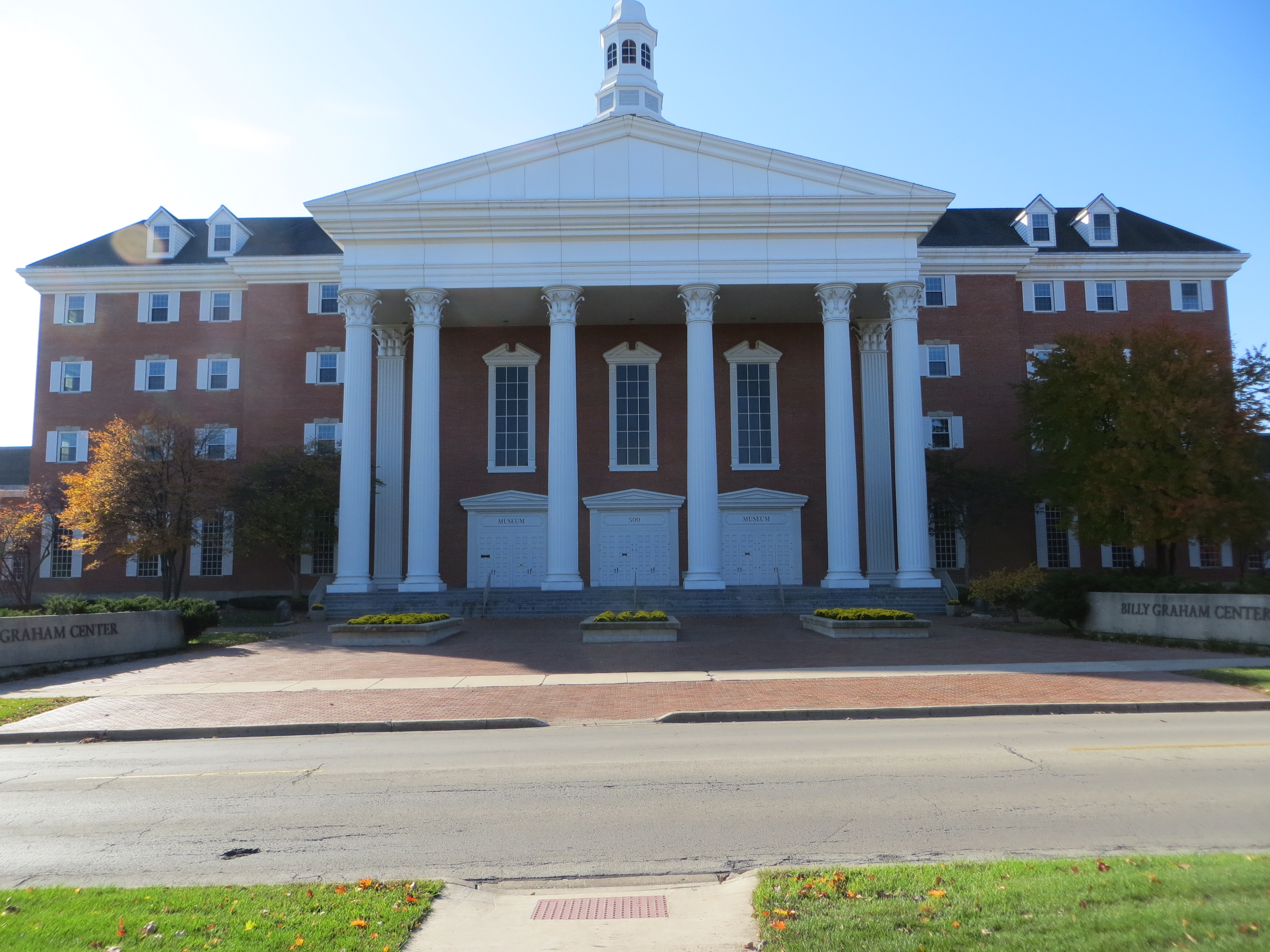
At DBI, supreme leader Clifton Fowler ran into hot water in the early 1930s as his faculty and church split. Fowler was accused of holding non-fundamentalist ideas about sex, leadership, and Scripture. To heal the rift, Fowler appealed to fundamentalist leaders nationwide to conduct an investigation.Billy Graham Center 2

At Wheaton, meanwhile, President J. Oliver Buswell was tossed out for a range of offenses, including Buswell’s leadership of a Presbyterian faction as well as Buswell’s moderate ideas about creationism.

Down at Bob Jones College (not Bob Jones University until the 1940s), founder Bob Jones Sr. engaged in a very different sort of definition. When faculty members got too chummy with students, when they played jazz records and mocked Jones’s uptight attitude toward modern culture, Jones gave them the boot. At Bob Jones College, fundamentalism meant what the founder said it meant.

DBISignIn each case, we can see the ways institutions wrestled with the tricky question of definition. At a small school like DBI, the leader had to ask famous fundamentalists to give him a fundamentalist seal of approval. At Bob Jones College, on the other hand, leaders imposed a more top-down idiosyncratic definition. At Wheaton, fundamentalism did not have room for the sort of bare-knuckle denominational wrangling that Buswell considered the heart and soul of fundamentalism.

These stories have it all: sex, jazz, and Presbyterianism. So come on down to Binghamton University at four o’clock on February 23rd. We’re meeting in the conference room of the Institute for Advanced Study in the Humanities, on the first floor of the Library Tower.

The event is free and open to all; no registration is required.

Homeschooling: A Scheme to Take Over America

What do Sarah Palin, Gordon College, and Christian homeschoolers have in common? According to evangelical-turned-atheist Frank Schaeffer, they are all “still fighting a religious war against their own country.” I’m no homeschooler or Palin fan, but Schaeffer’s accusations just don’t hold up to historical scrutiny.

Schaeffer’s most recent broadside appeared in Salon. In his article, Schaeffer blasted a wide range of “far-right” institutions. When parents choose to pull their kids out of public schools to indoctrinate them at home, Schaeffer charged, it amounts to nothing less than “virtual civil war carried on by other means.” As Schaeffer put it,

the evangelical schools and home school movement were, by design, founded to undermine a secular and free vision of America and replace it by stealth with a form of theocracy.

According to Schaeffer, this nefarious plot spreads beyond the anti-democratic practice of homeschooling. The “far-right,” Schaeffer insists, turns women into submissive breeding mares. The Right has opened its own colleges and universities as part of its plan to take over civil society. Jerry Falwell himself, Schaeffer relates, explained his reasons for opening Liberty Law School. “Frank,” Falwell confided, “we’re going to train a new generation of judges to change America!”

Is the sky really falling?

Is the sky really falling?

Inspired by the apocalyptic rhetoric of wild-eyed prophets such as Rousas Rushdoony, and marshalled by irresponsible self-aggrandizers such as Sarah Palin, the Christian Right will not stop until it has taken over. Conservative religious folks, Schaeffer insists, want nothing less than to impose a rigid theocracy on the United States. They will not be content until they have dictated the morals and mores of their neighbors as well as those of their children.

Are Schaeffer’s charges fair?

Certainly, he has the right to boast of his insider connections. His father, the late Francis Schaeffer, really did inspire a fair bit of the social philosophy of today’s conservative evangelicals. Schaeffer Senior articulated in the 1970s and 1980s the notion that US culture had been infiltrated by a sneaky “secular humanist” worldview. In order to properly live as Christians, then, Schaeffer Senior advocated a wide-ranging rejection of modern social mores. Perhaps most important for day-to-day culture-war politics, Schaeffer Senior along with C. Everett Koop denounced abortion rights as equivalent to murder.

At times, Frank Schaeffer seems blinded by his own imagined influence. In this Salon article, for example, he shamelessly name-drops his connections to writers such as Rousas Rushdoony and Mary Pride. He claims to have been “instrumental” in bringing together the New Christian Right in the 1970s and 1980s.

Such unpleasantness aside, however, do Schaeffer’s charges stick? Are Christian homeschooling and evangelical higher education part of a long-ranging plot to undermine American traditions of pluralism and tolerance?

Short answer: No.

Before I offer a few examples of the ways Schaeffer’s breathless expose doesn’t match reality, let me explain my background for those who are new to ILYBYGTH. I am no apologist for fundamentalist Christianity. I’m no fundamentalist, not even a former fundamentalist. When it comes down to it, I will fight hard against fundamentalist-friendly school rules about prayer or sex ed. I don’t homeschool my kid. I don’t attend or teach at an evangelical college. I’m only a mild-mannered historian, with the sole goal of deflating hysterical culture-war accusations.

With that in mind, let’s take a closer look at some of Schaeffer’s claims.

First, is Christian homeschooling really as sinister as he claims? Schaeffer suggests that homeschoolers have been inspired by the work of leaders such as Mary Pride and Nancy Leigh DeMoss. The point of homeschooling, Schaeffer charges, is to train girls and women to submit to fathers and husbands, to glory in their second-class role as child-bearers and house-keepers.

There are indeed homeschoolers who adopt these notions. But anyone who follows the work of historian Milton Gaither can tell you that the world of homeschooling—even the more limited world of conservative evangelical homeschooling—is a kaleidoscope of missions, strategies, and techniques. I don’t doubt that some Christian parents hope to impose a rigid patriarchal vision on their children. What falls apart, though, when looked at carefully, is the notion that these folks are somehow the “real” reason behind Christian homeschooling. What falls apart are accusations that Christian homeschoolers are some sort of monolithic force scheming to take over the rest of our society. In reality, Christian homeschoolers are a remarkably fractious bunch.

Second, what about Rousas Rushdoony? As Schaeffer correctly points out, Rushdoony was the intellectual force behind “Reconstructionist” theology. In short, Rushdoony believed that Christians should impose true Christian morality on all of society, including Old-Testament-inspired laws about sex and conduct. In reality, though, the direct influence of Rushdoony’s social ideas has been rather limited. As scholars such as Michael J. McVicar have argued, Rushdoony has had far more influence on liberal pundits than on the conservative rank-and-file.

Next, are evangelical colleges really training a generation of conservative culture warriors? As I conduct the research for my next book, I’m struck by the ways evangelical colleges have been battlegrounds more than training centers. In other words, evangelical colleges and universities have had a hard time figuring out what they are doing. They are hardly in the business of cranking out thousands of mindless drones to push right-wing culture-war agendas.

For one thing, evangelical colleges have usually insisted on maintaining intellectual respectability in the eyes of non-evangelical scholars. Even such anti-accreditation schools as Bob Jones University have used outside measures such as the Graduate Record Examination to prove their academic bona fides. As historian Michael S. Hamilton noted in his brilliant study of Wheaton College, this desire prompted Wheaton in the 1930s to invite outside evaluators such as John Dale Russell of the University of Chicago to suggest changes at the “Fundamentalist Harvard.” This need for intellectual legitimacy in the eyes of mainstream intellectuals has continually pulled fundamentalist schools closer to the mainstream. Such colleges—even staunchly “unusual” ones like Bob Jones—have been much more similar to mainstream colleges than folks like Schaeffer admit.

Schaeffer uses Gordon College in Massachusetts as an example of the ways Christian colleges train new generations of young people to see the US government as evil. But as I found in my recent trip to the Gordon College archives, the community at Gordon has always been divided about the purposes of higher education. Back in the 1960s, Gordon College students held protests, sit-ins, and “sleep-ins” to change Gordon’s policies and attitudes. As one student put it during a 1968 protest, “we want to be treated like real college students.” How did the evangelical administration respond? By commending the students’ commitment to “activism over apathy.” To my ears, that does not sound like a brutal and all-encompassing mind-control approach.

The world of conservative evangelicalism, of “fundamentalism,” is one of continuous divisive tension. There is no fundamentalist conspiracy of the sort Schaeffer describes. Or, to be more specific, there are such conspiracies, but there are so many of them, and they disagree with one another so ferociously, that the threat Schaeffer warns us about is more fiction than fact.

Does Christian homeschooling really serve as a first step in a long-ranging scheme to take over America? Only in the fevered imaginings of former fundamentalists such as Frank Schaeffer.

Gay + Christian = Celibate: A Long Tradition

What is a gay conservative Christian to do? With plenty of justification, many Americans think that conservative Catholics and evangelicals are anti-gay. A recent article in the Washington Post suggests that homosexual Christians have found a new answer to this conundrum, though those in the know know that there’s nothing new about it.

Michelle Boorstein’s article discusses the spiritual path of bloggers such as Eve Tushnet, whom Boorstein describes as a leader of a

small but growing movement of celibate gay Christians who find it easier than before to be out of the closet in their traditional churches because they’re celibate.

When Tushnet converted to Catholicism, Boorstein describes, she felt as if she were the first gay Christian to choose celibacy. To be fair, neither Boorstein nor Tushnet claims this is brand new.  It is “easier” to be openly gay, Boorstein writes.  But not easy.  As the article discusses, such a decision opens one up to attacks from both sides. Some conservatives hope that God can “heal” homosexuals. Such folks want homosexual Christians to abjure their homosexual identities. From the other side, some gay activists argue that choosing celibacy is a terrible option, a truckling to anti-gay animus among conservatives.

What the article doesn’t examine is the long history of this question among conservative evangelicals. As one might expect, issues of sexuality and sexual attraction have long played a central role at America’s network of conservative evangelical colleges. What should young people do if they feel sexually attracted to their own gender? What should loving Christians tell them in college classes and counseling sessions? In my current round of archival research into the history of these schools, I’m seeing a long tradition of the answer “discovered” by folks such as Tushnet: Gay conservatives can remain true to their religious beliefs and true to their sexual attractions by committing to lifelong celibacy.

Certainly, as Boorstein notes, the language has changed, as have public attitudes. In the past, conservatives did not claim their homosexuality as openly or as proudly. But this does not mean that the celibacy “solution” is at all a new one.

In the 1930s, for example, among the troubles at the Denver Bible Institute was the leader’s insistence that all relationships be “continent.” This leader, Clifton Fowler, was accused of homosexual attractions. Indeed, he was accused of active homosexual sexual relationships. His solution was to insist that all married relationships—apparently all potentially sexual relationships—remain celibate. In that case, the facts were obscured by conflicting accusations on all sides. It seems clear, however, that the celibate “solution” to the perceived dilemma of homosexual attraction among Protestant fundamentalists is nearly as old as American fundamentalism itself.

In a later generation, the language used to discuss homosexuality and celibacy grew slightly more frank, while remaining just as harshly anti-gay. In 1951, a student at Biola College (now Biola University) promised counselors that he would remain celibate. As I read the record, this promise was taken at the time as a satisfactory and traditional “solution” to the problem of gay fundamentalism. Take, for example, the following explanation he offered to his dean:

as to the matter [i.e., homosexuality] that has been at the root of all my grief, I am positive that I am cured. The perverted urge will probably come upon me many times in the future but now that I know giving in to it has cost me all that I held dear, I am certain that I will be enabled to grasp the strength of the Lord to withstand.

Back in 1951, it seems, as in the late 1930s, among these conservative Christians, celibacy seemed an appropriate and acceptable solution to homosexual attractions. The student here did not suggest that being “cured” of homosexuality meant becoming heterosexual. Rather, all he promised was the ability to “withstand” what he called his “perverted urge.”

Continuing into the 1970s, leaders at evangelical schools seemed open to the idea that celibacy could be an acceptable evangelical answer for homosexuals. For instance, in a 1977 interview with Wheaton College’s student newspaper, Wheaton President Hudson Armerding offered this response:

The church should respond in love toward those with homosexuality [sic] tendencies and in humility seek to assist such persons to maintain and develop a life-style that is in obedience to the Word of God.

Armerding did not insist that evangelical homosexuals be “cured” of their sexual identity. Rather, he simply demanded that they find a “life-style”—presumably including celibacy—that went with Armerding’s understanding of God’s Word.

From the 1930s to the 1970s, then, evangelical homosexuals could remain both evangelical and homosexual by living celibate lives. Nor does the notion of celibate homosexuality seem particularly revelatory to evangelical collegians today. Julie Rodgers currently works at Wheaton College as an openly gay celibate Christian. She helps counsel students about sexual issues, among other things.

Certainly, the language these days has changed. Rodgers, for example, openly describes herself as gay. The gay celibate student at Biola College in 1951, in stark contrast, was driven to extremes in his attempt to hide his gay identity. Back in the 1930s, Clifton Fowler never admitted to any homosexual attractions, though there seems ample evidence of it.

Nevertheless, for those in the know, there is nothing new among conservative evangelicals and fundamentalists about the celibate “solution” to homosexual attractions.