Here’s Why Public Schools Will Never Eliminate Creationism

If the spotlight-loving science pundit Lawrence Krauss really thinks public schools can eliminate creationism in one generation, he’s off his rocker. But he’s in good company. Through the years, all sorts of writers and activists have made grandiose plans to use public schools for one sweeping reform or another. Unfortunately for them, that’s just not how America’s schools work.
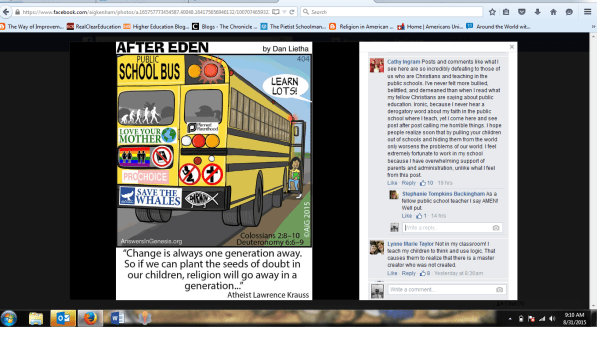
The original bus from hell...

The original bus from hell…

To be fair, in the Krauss quotation pirated here by the young-earth creationist ministry Answers In Genesis, Krauss does not say that this will be a school thing. He only says that we can teach our kids—in general—to be skeptical. Clearly, in the conservative creationist imagination of the folks at AIG, this teaching will take place in the public schools.

This AIG cartoon illustrates the many ideological trends that they think are taught in the public schools. Evolution, homosexuality, abortion, . . . all these ideas are poured down the throats of innocent young Christians in public schools. Furthermore, AIG thinks, Christian belief and practice are banned and ridiculed.*

In culture-war battles like this, both sides made sweeping and incorrect assumptions about public schooling. If the schools teach good science, Krauss and his allies assume, then creationism can soon be eliminated. If the schools teach good religion, AIG thinks, then children will go to heaven, protected from evolution and other skepticism-promoting notions.

As I argue in my recent book, these assumptions are hard-wired into our culture-war thinking. Both progressives and conservatives tend to assume that the proper school reform will create the proper society.

In the 1930s, for instance, at the progressive citadel of Teachers College, Columbia University, Professor George Counts electified his progressive audiences with his challenge. Public schools teachers had only to “dare,” Counts charged, and the schools could “build a new social order.”

Decades later, conservative gadflies Mel and Norma Gabler repeated these same assumptions. Conservative parents, the Gablers warned, must watch carefully the goings-on in their local public schools. “The basic issue is simple,” they wrote.

Which principles will shape the minds of our children? Those which uphold family, morality, freedom, individuality, and free enterprise; or whose which advocate atheism, evolution, secularism, and a collectivism in which an elite governs and regulates religion, parenthood, education, property, and the lifestyle of all members of society?

Professor Counts would not likely have agreed with the Gablers on much. But he would have agreed that the ideas dominating public schools matter. If the wrong ideas leach into the schools, then society will lurch in dangerous directions.

These days, both Professor Krauss and the creationists at AIG seem to have inherited these same assumptions. However, as this screenshot from AIG’s facebook feed demonstrates, public school classrooms are far more complicated places than any of our school activists have allowed. No matter what standards we write about science or religion, public schools will continue to function in ways that represent the wishes of their local community. No matter how daring they are, a few progressive teachers do not have the power to build a new social order.

Similarly, we cannot use schools to eliminate creationism. If we want people to think scientifically, then we need to wage a much broader campaign. We need to convince parents and children that modern evolutionary science is the only game in town.

Because even if we wanted to, we could never ram through any sort of school rule that would be followed universally. Even if public schools officially adhere to state standards that embrace modern evolutionary science, schools themselves will vary from town to town, even from classroom to classroom. The only way to change schools in toto is to change society in toto.

Chicken and egg.

As we see in this facebook interchange, one evangelical teacher claims she teaches with the “overwhelming support of parents and administration.” Another says she teaches her children in public schools to recognize the logical necessity of a creator.

These facebook comments are not anomalies. According to political scientists Michael Berkman and Eric Plutzer, about 13% of public high-school biology teachers explicitly teach creationism. Another 60% teach some form of evolution mixed with intelligent design and creationism.
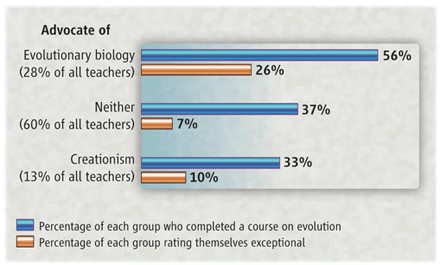
Not teaching the controversy, avoiding the controversy

Not teaching the controversy, avoiding the controversy

Why do so many teachers teach creationism? Because they believe it and their communities believe it. As Berkman and Plutzer argue, teachers tend to embrace the ideas of their local communities. In spite of the alarmism of the folks at AIG, public schools just aren’t well enough organized to push any sort of agenda. Public schools will never eliminate creationism. They just can’t.

SAGLRROILYBYGTH are sick of hearing it, but I’ll say it again: Schools don’t change society; schools reflect society.

*(Bonus points if you can explain why AIG is against saving the whales!)
Creationism Then & Now

Do you read Ted Davis? For folks interested in the creation/evolution debates, Professor Davis has long produced essential historical analyses of the various voices of creationism in all their befuddling complexity. I was reading one of Professor Davis’ essays on the Biologos Forum recently and it raised some perennial questions: Can we compare the dissenting science of today’s creationists to the scientific ideas of long ago? Can today’s creationists claim a long legacy of prestigious scientific antecedents?

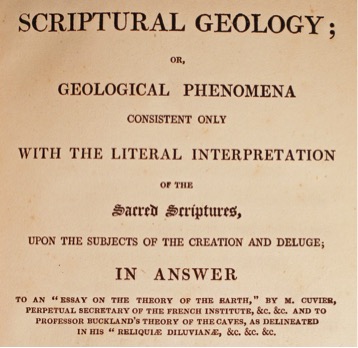
Cutting-edge creation science, c. 1827

Cutting-edge creation science, c. 1827

Davis is writing these days about science and creationism in antebellum America. In this post, he explains the school of “Scriptural Geology” that attracted religious scientists in the early 1800s. Scholars such as Princeton Seminary’s Samuel Miller and Anglican minister George Bugg rebutted new(ish) ideas of an ancient earth.

Professor Davis pointed out the remarkable similarities of their 19th-century arguments with the 21st-century arguments of today’s young-earth creationists. As Davis put it,

Readers familiar with Henry Morris or Ken Ham will find many of their ideas, expressed in substantially the same ways and for the same reasons, in the pages of Bugg’s book.

Now, Professor Davis would be the last person to ignore historical context or to misunderstand the historical changes that have wracked the world of creationist scientists. Yet his comparison to the Scriptural Geologists to Answers in Genesis or the Institute for Creation Research points out the radical changes that have taken place in the realms of creationism and science.

In the 1820s, discussions of the age of the earth still had some fading legitimacy among mainstream scientists. Even as late as the 1920s, when American politicians such as William Jennings Bryan insisted that “Darwinism” was losing scientific prestige, their claims made some sense. In the 1920s, for example, mainstream scientists had not yet cobbled together the modern evolutionary synthesis. They had not yet figured out how to reconcile the mechanism of natural selection with the maintenance of beneficial mutations.

As I describe in my upcoming book, mainstream science has changed enormously over the course of the twentieth century. Positions that made some scientific sense in 1827, or 1927, lost those claims as the 20th century progressed.

As an obvious result, there yawns an enormous gulf between the work of George Bugg and that of Ken Ham or Henry Morris. Today’s young-earth creationists are forced to take the role of utter scientific outsiders. They are forced to dismiss the entirety of mainstream evolutionary science as deluded.

Of course, as Professor Davis explains, earlier “creationists” such as Miller and Bugg also felt like scientific outsiders. But their position was radically different. Saying nearly the exact same thing, as always, can mean very different things, depending on when one says them.

NASA Puts Creationists to Work!

Forget about creationism in public schools for a minute. Is it true that the US Government hires young-earth creationist scientists? Can it be true that leading scientific agencies such as NASA employ people who believe that the universe was created within the past 10,000 years?

All in a day's work?

All in a day’s work?

In the past, we’ve heard of government geologists who hold to young-earth creationist beliefs. But today we see a claim by young-earth impresario Ken Ham that NASA employs “many” creationist scientists. Is it true?

Ken Ham, the force behind leading young-earth ministry Answers In Genesis, wants to be clear. He is not talking about folks like John Glenn. Glenn, world-famous astronaut and sometime Senator, recently attested to a more moderate vision of creationism. Apparently, sixteen years ago, Glenn had claimed, “to look out at this kind of creation out here and not believe in God is to me impossible.” Recently, he offered a slightly different explanation of his creationist beliefs. “I don’t see,” Glenn attested,

that I’m any less religious by the fact that I can appreciate the fact that science just records that we change with evolution and time, and that’s a fact. It doesn’t mean it’s less wondrous and it doesn’t mean that there can’t be some power greater than any of us that has been behind and is behind whatever is going on.

Teach evolution, Glenn insisted. There’s no reason we can’t do that in our public schools without hurting children’s religious belief.

Not so fast, Ham warned. If we accept the premises of deep time and evolution, we have to call God a liar, and we have to ignore reams of scientific evidence that points to a newer creation.

Luckily, Ham reports, the labs of NASA are freighted with true creationist scientists. When he gave a talk to the “Bible Club” at NASA’s Goddard Space Flight Center in 1994, Ham says, he was “thrilled to meet many scientists who were also biblical creationists!”

Now, maybe it’s my secular bias, but I have a hard time believing that NASA really employs a sizeable population of young-earth creationists. In the past, I’ve defended the notion that young-earth creationists are not necessarily “ignorant,” as so many secular people like to claim. We have scads of evidence that smart people can be trained in scientific careers and hold to a belief that the universe is fairly new.

But Ham’s claim that NASA is teeming with young-earth creationists seems to be a different case. In the day-to-day work of NASA—a work I admit I know nothing about—it would seem difficult to reconcile a belief in a newish universe with basic assumptions about space exploration.

The claim seems to put Mr. Ham in a difficult position. If NASA really does employ “many” creationist scientists, then NASA can’t fairly be accused of anti-creationist prejudice. But Answers In Genesis insists that mainstream scientists are uniformly blinded to the truths of creationist science by willful prejudice.

On the other hand, if NASA doesn’t really employ “many” creationist scientists, then Ham’s claim doesn’t stand up. He mentioned one of NASA’s creationist scientists by name, one Bill Daniels. If it’s the same person, Bill C. Daniels of New Smyrna Beach, Florida worked as a “project equipment manager” for NASA, according to Daniels’ obituary. Is it possible that NASA’s Bible Club was full of employees who did not have to engage with the scientific paradoxes of young-earth belief in an organization dedicated to exploring an ancient universe?

Yearnin’ for the Good Ol’ (Earth) Days

How old is the planet? For some creationists, it may seem like an ancient bit of Christian orthodoxy that God created the whole thing less than ten thousand years ago. But we see more proof today that the idea of a young earth is a relatively novel idea among conservative Christians.

Anyone who has done their homework knows the story. As historian Ronald L. Numbers outlined in his definitive book The Creationists, most conservative Christians believed in an ancient earth until the 1960s. Even in the hottest days of anti-evolution controversy in the 1920s, fundamentalist leaders usually felt no need to believe in a young earth.

As 1920s fundamentalist leader William Bell Riley put it in 1927, there was not

an intelligent fundamentalist who claims that the earth was made six thousand years ago; and the Bible never taught any such thing.

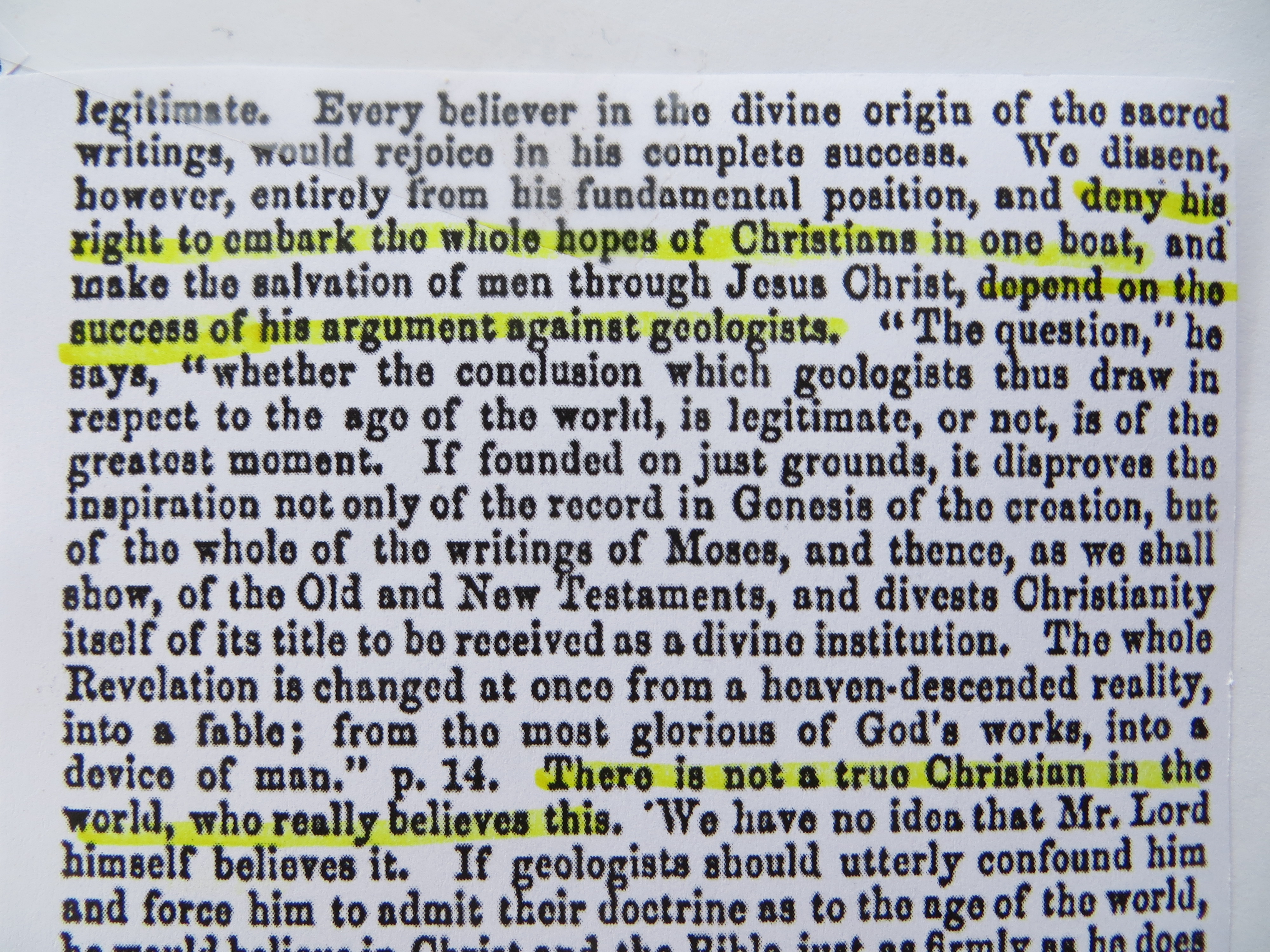
As I make my way through Bradley Gundlach’s excellent book Process & Providence, I came across a similar example from the 1800s. Back then, Princeton Seminary was the redoubt of thinking creationists. In 1856, the school’s journal offered a short review of a new book by David N. Lord, Geognosy, or the Facts and Principles of Geology against Theories.

In his long book, Lord argued that mid-nineteenth-century geologists often missed the boat. Such foolish pseudo-scientists, Lord wrote, mistook the boundaries of their own science and slid into both scientific and theological error when they suggested that the earth must have existed for millions of years.

Antique appreciation...

Antique appreciation…

Today’s conservative creationists might think that any self-respecting creationist would applaud Lord’s work. And the guardians of orthodoxy at Princeton did, to an extent. They described Lord’s goal as “elevated and holy.” His conclusions, however, did not sit well with the Old Princetonians.

In a way that might be surprising to today’s young-earth creationist crowd, the theologians at Princeton assailed Lord’s attempt to defend Scripture by attacking emerging geological science. Why? Not because they doubted the inerrant nature of the Bible. No, the Princetonians instead refused to allow their religion to be bound and hampered by any possible scientific discovery.

They “dissent,” the reviewers wrote, from Lord’s

Fundamental position, and deny his right to embark the whole hopes of Christians in one boat, and make the salvation of men through Jesus Christ, depend on the success of his argument against geologists.

Lord had argued that the new geology threatened to disprove Genesis. It was imperative, Lord wrote, for thinking Christians to disprove geology instead. Balderdash, huffed the Princetonians: “There is not a true Christian in the world, who really believes this.”Good old days 2 PRIME

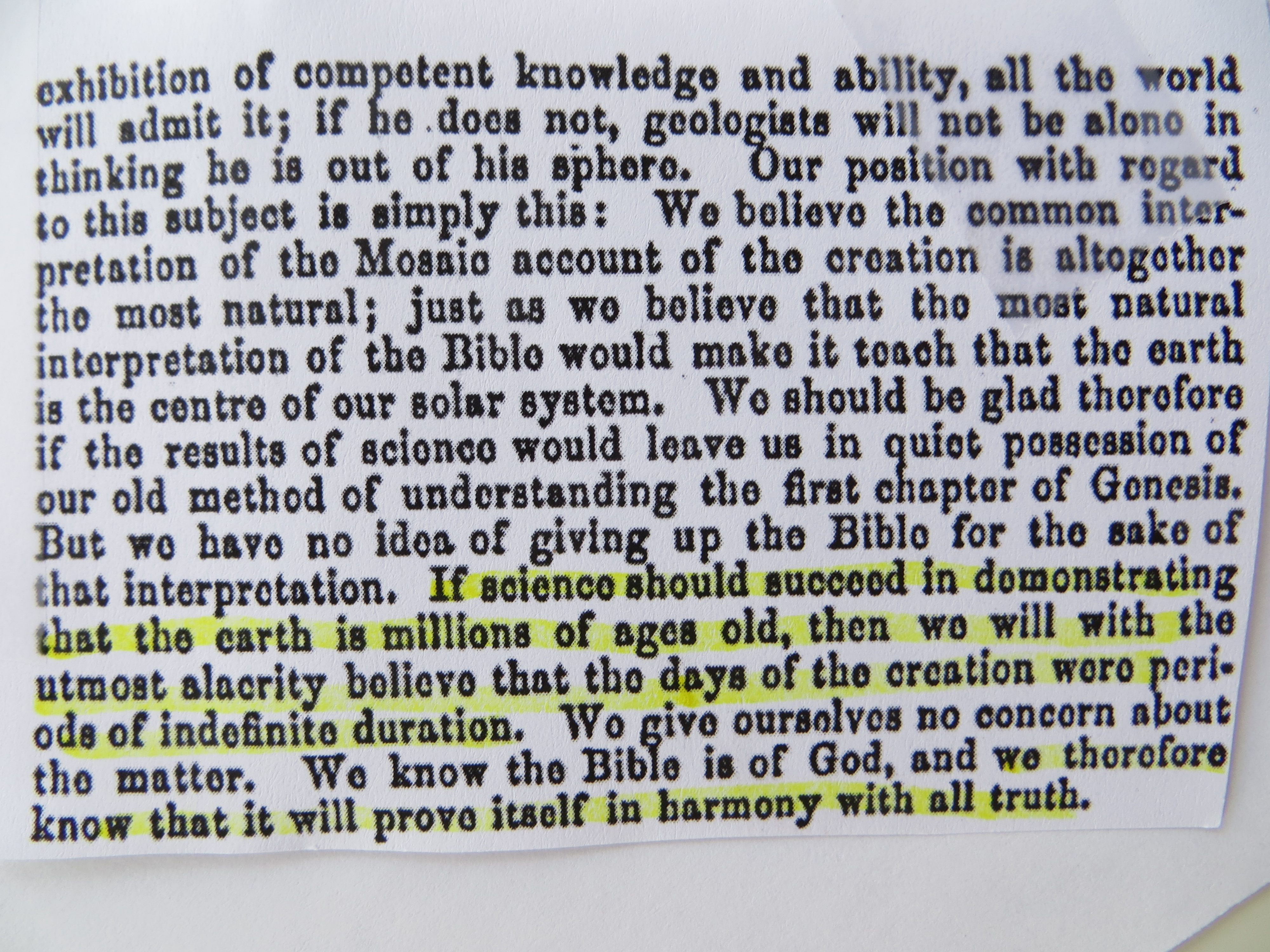
Instead, the old-earth creationists at Princeton insisted that creation was an established fact, whichever way the scientific winds might blow. “If science,” they concluded,

Should succeed in demonstrating that the earth is millions of ages old, then we will with the utmost alacrity believe that the days of the creation were periods of indefinite duration.

Who Cares about Adam?

I don’t get it. Even after all these years studying conservative Christianity and creationism, I still don’t really get it. I mean, I understand the logic and history, but I have a hard time making sense of the ferocious emotion that goes into debates over the existence of an historical Adam & Eve. An author interview in Christianity Today outlines some of the tricky questions involved.

Who cares?

Who cares?

But first, a primer for those like me on the outside looking in: The debate over the historicity of Adam & Eve has a long history in conservative evangelical Protestantism. For us outsiders, making sense of this issue will go a long way toward helping us understand the theological underpinnings for young-earth creationist belief. Without making sense of this theology, it can be easy for mainstream scientists and observers to conclude mistakenly that young-earth creationism is nothing but some kind of cult of personality, a quirk of history.

At least since the 1960s (of course it is an ancient belief, but in 1960 it gained popularity among conservative American evangelicals as a vital theological notion central to orthodox belief), conservative evangelicals have insisted that the obvious meaning of Genesis is that God created two first humans in the Garden of Eden. These two, Adam & Eve, became the progenitors of the entire human race. Theologically, creationists have insisted, our belief in an historical Adam & Eve underpins our trust in the Bible. As Simon Turpin of young-earth ministry Answers In Genesis expressed it,

The debate over whether Adam was historical is ultimately a debate over whether we trust what the Scriptures clearly teach. If we cannot be certain of the beginning, then why would we be certain about what the Scriptures teach elsewhere? The uncertainty of truth is rampant in our culture partly due to the influence of post-modernism which is why many believe the issue over Adam’s historicity is unimportant.

For many creationists, believing the plain truth of the creation story in Genesis means believing in the trustworthiness of Jesus Christ. As Andrew Snelling of the Institute for Creation Research explained,

It is impossible to reject the historicity of the book of Genesis without repudiating the authority of the entire Bible. If Genesis is not true, then neither are the testimonies of those prophets and apostles who believed it was true.

Of course, for mainstream scientists, the notion that human genetic diversity came from only two original humans does not fit the evidence. In order to have today’s genomic sequence, I’m told, humanity must have begun with thousands of original humans.

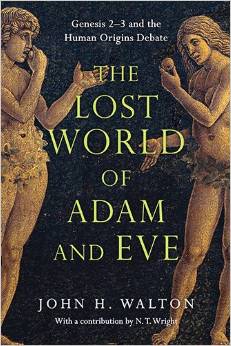
John Walton of Wheaton College explains to Christianity Today why evangelicals can accept this science while still remaining true to a conservative reading of Scripture. In his new book, The Lost World of Adam & Eve, Walton argues that Adam & Eve can be read as the “priests” of early humanity, not the only two first humans.

Again, for those of us outside of conservative evangelicalism, the controversial nature of such claims can be hard to figure. Recently, theologian Peter Enns was booted from Westminster Theological Seminary for advocating similar ideas. Walton explains in this interview why it is possible to respect the authority of the Bible while still reading Genesis in a way that is not contrary to modern science. Walton insists that

You can affirm a historical Adam, but that doesn’t have quite the implications for biological human origins that are often assumed.

The key, Walton argues, lies in reading Genesis as the original readers would have. To them, Walton says, creation would be more about how the world of Adam & Eve was “ordered,” not just how it was “manufactured.” We can understand Adam as both a real person, a real creation, and as an “archetype” for humanity. Though there may have been other early humans, Walton explains, Adam & Eve served as the ones in God’s sacred space.

Why do such ideas matter? Again, for folks like me trying to understand conservative Protestantism from the outside, it can be difficult to make sense of the ferociously controversial nature of such arguments.

Yet they are at the heart of conservative evangelical Protestantism. As I argued in my 1920s book, conservative evangelicals have never agreed on the proper relationship of Genesis to either modernist theology or science. From J. Gresham Machen in the 1920s to Harold Lindsell in the 1970s, conservative intellectuals battled to affirm the notion that any compromise is deadly to faith.

And as I’m finding in my current research, these battles have long sent shock waves through the world of conservative higher education. Recently, Bryan College has firmed up its insistence that faculty members affirm their belief in an historical Adam & Eve. In 1961, Wheaton College did the same thing.

And fundamentalists are not the only ones who will spring to repudiate theories like Walton’s. Leading atheist pundits, too, agree that Genesis requires an historical Adam & Eve. Jerry Coyne, for example, laments the apologism of folks like Walton. Of course, Coyne does not want people to reject mainstream science in favor of a belief in an historical Adam. Rather, he hopes people will simply accept the obvious conclusion that the Bible is a book of myths.

If all of these whirling debates make your head hurt, join the club. For those of us outside the circle of evangelical Protestantism, it can be very difficult to understand the ferocious feelings at play in the Adam debate. But that ferocity lies at the heart of evangelical belief. Historically, any attempt to rationalize our reading of the Bible, any attempt to explain away the most obvious interpretation of Scripture in favor of one that accords with modern science, any effort to bring our faith into harmony with science…all have been seen as the beginnings of apostasy.

For evangelical readers, Adam & Eve matter. For those of us trying to understand conservative Christianity, this complicated debate will be a good place to start. Why would professors lose jobs over it? Why would Christianity Today dedicate a major article to this interview with John Walton? Why will Walton’s position provoke such furious responses?

Christian School Causes Student to Abandon Creationism

How can parents make sure their children don’t lose their faiths? Enrolling them in religious school is not enough. As a recent story from the BioLogos Forum makes clear, education ranges far beyond schooling. Too many hasty critics, religious and secular alike, have assumed that we can control education by controlling schooling. It’s just not that simple.

This Christian learned to embrace evolution, but not in school...

This Christian learned to embrace evolution, but not in school…

In the pages of the BioLogos Forum, college sophomore Garrett Crawford shared his educational story. Crawford was raised in a conservative evangelical household. He went to a Christian school, one that presumably hoped to shield Crawford’s faith from secularism. While at that school, Crawford relates, he grew curious about the scientific evidence for evolution. After a lot of reading and study, Crawford concluded that he could no longer believe in young-earth creationism. After a lot more reading and study, Crawford concluded that Christian faith does not require a belief in a young earth. It is entirely theologically legitimate, he decided, to accept the science of evolution.

In Crawford’s case, his education took him in directions his school never intended.

Such stories shouldn’t surprise us. After all, with just a moment or two of reflection, we can all think of ways that our “education” has differed from our “schooling.” Yet in all of our tumultuous educational culture wars, pundits rush to make sweeping claims about education based on scanty evidence from schools.

We’ve seen this recently in the pages of the New York Times, when philosopher Justin McBrayer declared–based on data that was not just slim, but positively anorexic–that Our Schools Were Training Amoral Monsters.

Among conservative Christians, too, this tradition of school-bashing has a long history.  In the 1970s, for example, fundamentalist school leader A.A. “Buzz” Baker decried the tendency of many conservative Christians to rush into school-founding for the wrong reasons. In his book The Successful Christian School (1979) Baker warned that too many parents and pastors rushed to open new schools because they thought

Public education has failed! It is failing to provide a good academic education while exposing our children to a godless, secular-humanistic approach to life.

Leading young-earth creationists have long assumed that the best way to protect their children’s faith is by attending creationism-friendly schools. Ken Ham, for example, argued that Christian colleges and universities can lead students astray from true faith when they abandon young-earth thinking. As he put it,

the real issue concerns Christian colleges, universities, and seminaries that break away from the authority of Scripture in Genesis—held to by the majority of scholars up through the Reformation—and teach students that God’s Word doesn’t mean what it says. That’s what makes students doubt the truthfulness of the Bible as a whole, and can be a major reason many of them walk away from the Christian (not “creationist”) faith, as we see happening in our culture today.

From the other side, many secular or liberal critics insist that fundamentalist schools are nothing but indoctrination factories. As friend of ILYBYGTH (FOILYBYGTH) Jonny Scaramanga told the BBC, his fundamentalist schooling experiences were nothing short of “horrendous.” During his sojourn in a fundamentalist school, Scaramanga remembers, he did nothing but recite back theological nostrums. The school was so socially crippling, Scaramanga relates, for the rest of his life he was “always playing catch up.”

Scaramanga’s own case, however, shows that schooling of any sort is only one part of a person’s education. Scaramanga himself has now become a leading voice in the anti-fundamentalist education scene. Like Garrett Crawford, Scaramanga’s education took him in directions that his schooling never intended.

The take-away? Of course we should all care about the way schools operate. Better schools will help produce better educations for all students. At the same time, though, we all need to remind ourselves that formal schooling makes up only one slice—sometimes a small slice—of a person’s education.

How many of us, after all, can say that we came out the way our schools intended?

Evil and a Young Earth

It’s one of the oldest and toughest questions for monotheists. If God is all-powerful, and the world has evil in it, then God is responsible for that evil. Creationist leader Ken Ham recently argued that only a young-earth attitude can explain away this problem of theodicy.

Ham was reacting to a viral video of Irish comedian Stephen Fry. (Youtube has since taken the video down due to copyright claims.) In the interview, Fry blasted God as evil, capricious, and flat-out monstrous. “Because,” Fry explained,

the God who created this universe, if it was created by God, is quite clearly a maniac, utter maniac. Totally selfish. We have to spend our life on our knees thanking him?! What kind of god would do that?

Of course, theologians and atheists have wrestled with this challenge for centuries. Ham, the well-known leader of Answers In Genesis, explained recently that other forms of creationism could not handle the challenge.

Intelligent Design, Ham argued, fails because it argues only for a vague creator. If there is only a bland, inexact creator, then Fry’s challenge is correct. He, or She, or It, must have created everything, including evil.

Other creationists just don't get it...

Other creationists just don’t get it…

Evolutionary creationism, too, can’t handle evil, according to Ham. The sort of creationism embraced by the BioLogos folks stumbles in the face of Fry’s challenge, Ham says. “If God did use millions of years of evolutionary processes,” Ham wrote,

then He is responsible for all the death, suffering, disease, extinction, pain, cancer, and other evils in this world.

Only a young-earth approach gives a satisfying account of the origins of evil. In Genesis, as Ham reads it, God’s original creation was evil-free. Only when the sinful choices of Adam & Eve introduced evil into the world did things go awry.

For this to make sense, Ham says, we need a real, literal Adam & Eve. We need to take God at His Word. Otherwise, jokers like Fry have the last laugh.

Asking the Right Questions about Creationism

Is America a “creation nation?” Or have polls tended to inflate the numbers of creationists out there? In an effort to give a more nuanced answer to these questions, BioLogos has published Jonathan Hill’s survey results. Hill offers some powerful insights into central questions:

  • How many Americans really believe in creationism, evolution, or some mix?
  • Who cares the most about it?
  • Who cares at all?
  • And, most important, what factors go into making someone a creationist or an evolution supporter?

You may have seen this report referred to in Emma Green’s recent Atlantic article. Until now, however, you wouldn’t have been able to read the report for yourself. Green’s article had the provocative title “You Can’t Educate People into Believing in Evolution.” True enough, but that’s not news to readers and contributors to ILYBYGTH. Those who take time to read what’s out there about creationism know that creationism is not simply a lack of knowledge about evolution. Rather, creationism is better understood as part of a religious identity.

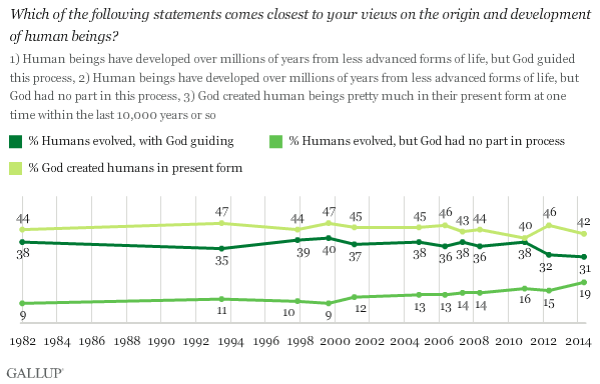
Professor Hill was funded by a BioLogos grant to conduct a large representative survey in the USA. He found that the typical Gallup polls seem to distort the numbers. In those repeated Gallup polls, respondents have three options: (1) humans evolved guided by God, (2) humans evolved on their own, and (3) humans were created within about 10,000 years. In those polls, since the 1980s about 40-45% of respondents have chosen the “young-earth creationist” answer (3). Somewhere between 9-19% have selected the “atheistic evolution” answer (2), and the rest chose number one, the theistic evolution model.

Gallup Questions and Answers

Gallup Questions and Answers

As even the Gallup folks would likely agree, these positions are not very subtle. They don’t allow respondents to explain or describe their own beliefs. Rather, they push people to pick one of three limited options. Professor Hill’s survey allowed people to say they were unsure. It also asked respondents to address different aspects of these beliefs separately. Finally, Hill asked Americans to say how certain they were about their beliefs.

Not surprisingly, those questions yielded very different results. When people can respond to different aspects of creationism differently, they tend to be more nuanced in their responses. For example, in Professor Hill’s survey, only eight percent of people affirmed their belief in both six literal days of creation and the recent creation of humanity.

When taken together, Hill found that 37% of respondents were “creationists,” 16% were “theistic evolutionists,” and 9% were “atheistic evolutionists.” The rest held mixed beliefs or were unsure. When you limit these numbers to those who said they were “very” or “absolutely certain” of their views, then only 29% of respondents were creationists, 8% were theistic evolutionists, and only 6% were atheistic evolutionists.

Also intriguing, only those who hold creationist or atheistic evolutionist beliefs tend to be sure they are correct. They also tend to think it matters to be correct. About three-quarters of creationists said they were sure about their beliefs, and about two-thirds of them said that it mattered a great deal. Among atheistic evolutionists, about 70% were sure of their beliefs, and about half thought it mattered a good deal. In contrast, among those who were unsure about humanity’s origins, only about one quarter thought it mattered a great deal.

In our continuing sniping at one another over the issues of creation and evolution, these numbers themselves matter a great deal. Since large numbers of Americans don’t know about these issues and don’t really care, the debates quickly become dominated by those on either end who feel confident about their own beliefs and who feel sure that it is important to be correct on these questions. We might see a debate between Science Guy Bill Nye and creationist impresario Ken Ham, but we won’t be as likely to see a round-table discussion between people in the middle.

Professor Hill’s survey also buttresses another conclusion popular here at ILYBYGTH: creationism and evolution are not mainly about what you know. Rather, they are questions about who you are. People do not simply pick creationism or evolution out of a neutral grab-bag of ideas. Creationists do not tend to abandon creationism in large numbers when they learn the ideas of evolution. Rather, creationism and atheistic evolution both seem most prevalent among people with recognizable clusters of identity markers. As Professor Hill concluded,

The most important takeaway here is that individual theological beliefs, practices, and identities are important, but they only become a reliable pathway to creationism or atheistic evolutionism when paired with certain contexts or certain other social identities. These positions are not free-floating ideas that individuals snatch from the air after considering all the alternatives; rather, they are found in certain social locations, and they become most plausible when shared with others (especially for creationists).

Read the results for yourself. There’s far more in the report than we can discuss here. For example, the survey raises a host of questions that we want to know more about:

  • Why are atheistic evolutionists so white?
  • Is certainty more important than knowledge?
  • How can we motivate those who don’t really care about creationism to get more involved in public policy debates?

Is This the Creationist Conspiracy?

Anti-creationists have warned about it for generations: Creationists are joining forces to sweep away reason and science. A growing conspiracy of dunces threatens to upend centuries of progress. But a recent tiff between leading American creationists demonstrates just how fractured and divided creationists really are.  And it demonstrates the ways hysterical anti-creationism may do more harm than good.

The threats of a creationist conspiracy go back to the roots of America’s evolution/creation culture wars. In his 1927 book, The War on Modern Science, Maynard Shipley warned that the fundamentalist “forces of obscurantism” threatened to overthrow real learning. As Shipley put it,

The armies of ignorance are being organized, literally by the millions, for a combined political assault on modern science.

Ever since, science writers have warned of this impending threat. Isaac Asimov, for instance, warned in 1981 of the “threat of creationism.” Such unified anti-scientists, Asimov believed, had made great strides toward setting up “the full groundwork . . . for legally enforced ignorance and totalitarian thought control.” Like Shipley, Asimov noted that not all religious people are creationists, but also like Shipley, Asimov failed to notice the differences between creationists. The only religious people one could trust, Asimov wrote, were those “who think of the Bible as a source of spiritual truth and accept much of it as symbolically rather than literally true.”

What Asimov missed was the crucial fact that many creationists DO endorse real science; many folks who think of the Bible as more than just symbolic also accept the ideas of an ancient earth and human evolution.

This is more than just a quibble. When leading scientists and science pundits lump together all creationists as “armies of ignorance,” they needlessly abandon and heedlessly insult potential allies in creation/evolution debates. When science writers such as Jerry Coyne attack all religious discussion as “accommodationism,” they unnecessarily alienate creationists who want to teach more and better evolution.

A recent interchange between leading creationists demonstrates the way international creationism really works. Creationism in practice is not a horde of Bible-believing fanatics, relentlessly unified on the age of the earth and the origins of humanity. In practice, rather, creationism is a splintered and fractious impulse, fighting internal foes more viciously than external ones.

The “evolutionary creationist” Deborah Haarsma, leader of BioLogos, recently reached out to young-earth creationist leader Ken Ham of Answers In Genesis. Haarsma was “troubled” by Ham’s angry polemic about a third creationist, Hugh Ross of the old-earth Reasons to Believe.

We all have our differences, Dr. Haarsma said. But why can’t we come together over our shared Biblical faith? About our shared concern that young people are leaving the church? Why can’t we at least sit down together for a cordial dinner and talk over our differences?

Ken Ham publicly rebuffed Haarsma’s efforts. Ham agreed that his animus toward Ross was not at all personal. As Ham explained, “I don’t consider Dr. Ross a personal enemy . . . he is actually a pleasant person.” But Ross was also an “enemy of biblical authority.” And Haarsma was no better. “People like Dr. Haarsma,” Ham wrote,

make it sound like they have such a high view of the Bible, whereas in reality, she has a low view of Scripture and a high view of man’s fallible beliefs about origins!

There will be no dinner. There will be no grand alliance of creationists. Instead, we see the ways some creationists will tend to isolate themselves into smaller and smaller like-minded communities.

This story spreads beyond the borders of the United States. As historian Ronald Numbers described in The Creationists, in the mid-1980s the minister of education in Turkey wrote to the San-Diego based Institute for Creation Research. Turkey’s schools, the minister wrote, needed to “eliminate the secular-based, evolution-only teaching dominant in their schools and replace it with a curriculum teaching the two models, evolution and creation, fairly” (pg. 421). And Islamic creationism, much of it based in Turkey, has thrived. However, Numbers concluded, “the partnership between the equally uncompromising Christian and Muslim fundamentalists remained understandably unstable” (425). Numbers cited the rhetoric of American creationist leader Henry Morris: “Mohammed is dead and Jesus is alive!” As Numbers noted acerbically, such talk was “hardly calculated to win Muslim friends” (425).

There will be predictable tensions between different types of creationists. Though some conservative religious voices will work to spread evolutionary theory among evangelicals, others will focus on what Ken Ham called “rebuilding a wall” (Nehemiah 6:1-3).

Folks like me who want to see more and better evolution education will be wise to reach out to those conservative religious folks who also believe in evolution. Instead of copying the tactics of Ken Ham, as Jerry Coyne is prone to do, science promoters should embrace allies and make friends. Instead of shrieking about the “armies of ignorance,” science promoters will do well to look closer at the creationist population. There are plenty of friends there.

Bryan College and the Grey Lady

Bryan College is in the news again. A recent New York Times article describes the hullabaloo over creationism and college creeds. But here’s the problem: journalist Alan Blinder seems all too willing to cast today’s struggles as only warmed-over reiterations of the 1925 Scopes trial. That doesn’t do justice to the history nor does it help today’s readers understand the kaleidoscopic world of evangelical higher education.

ILYBYGTH readers will remember that Bryan has been back-and-forth on the issue of Adam and Eve. The school has always been friendly to young-earth creationism. But President Stephen Livesay pushed through a clarification of the school’s traditional creed. From here on out, faculty members must affirm their belief in a literal, historic Adam and Eve. Most recently, the college has been sued by two faculty members who have refused to sign the clarified statement of faith.

I’m glad to see that journalist Alan Blinder has paid some attention to the controversy in the pages of the New York Times. But I can’t help but complain about Blinder’s framing of today’s story. For instance, Blinder calls today’s fight a “similar debate” to the 1925 Scopes trial. He says, “The continuing debate at Bryan College and beyond is a reminder of how divisive the issues of the Scopes trial still are…”

I’m not complaining because Blinder does not name the two professors who are actually suing Bryan—Stephen Barnett and Steven DeGeorge. I’m not complaining because Blinder focuses instead on Brian Eisenback, who had become controversial due to his evolutionary creationism.

No, I’m complaining because this sort of coverage implies that the issue at hand is the teaching of evolution or the teaching of creationism. I’m complaining because so many writers—not just Blinder—feel a need to call every new example of evolution/creation controversy “Scopes II” or something similar.

It would be entirely plausible, I think, for a casual reader to walk away from Blinder’s article thinking that Bryan College is becoming a religious school that teaches creationism, when it used to be a more secular school that taught evolution. It would also be plausible for readers to think that the issue at Bryan College today is the same issue that motivated the Scopes trial so many years ago. Both of these are woefully misleading implications.

First of all, Bryan College is now and has always been a friendly environment for young-earth creationism. Until recently, Bryan hosted the Center for Origins Research and Education. This center was lead in turn by prominent YEC intellectuals such as Kurt Wise and Todd Wood. Today’s controversy at Bryan College is decidedly not between a “creationist” mindset and a “secular” one. Today’s controversy is between a pluralist sort of big-tent creationism and a stricter young-earth-only vision. The school may be tightening its definition of acceptable sorts of creationism, but that is a very different thing than imposing creationism on a pluralist school.

Also, the controversy in 1925 was about whether or not evolution could be banned from public schools. As I argued in my 1920s book and in my upcoming Other School Reformers, due to such controversies, many conservative Christians founded schools like Bryan College. But today’s debate is vastly different. The debate today is over what sort of creationism counts as creationism at a private evangelical college.

Just because it brings journalists from New York down to Dayton again, there is no need to imply that this is somehow a return engagement for Clarence Darrow, H.L. Mencken, William Jennings Bryan, and John Scopes. What we’re seeing today is worlds apart from what Dayton saw in 1925.