Conservatives: Shut Up and Love the Common Core

What are conservatives to make of the Common Core State Standards?  As we’ve seen, some conservatives hate them.  Some don’t mind them.  Today we see a plea for conservatives to embrace the new standards as the best hope to fulfill long-held conservative school dreams.

In the Burkean pages of The Imaginative Conservative, Kevin T. Brady and Stephen M. Klugewicz argue that the new standards hold promise.   Forget threats that the new standards are a new federal power grab.  Forget worries that the new standards will water down our cultural heritage.  Forget predictions that school children will be forced to memorize Maoist proverbs.

Take a closer look, Brady and Klugewicz write, and conservatives will see plenty to like about the new standards.  The suggested readings include conservative favorites such as TS Eliot, Patrick Henry, GK Chesterton, and none other than Ronald Reagan.

Though some on the political Right have created a “straw man” out of the new standards, Brady and Klugewicz argue that the standards will actually serve to weaken the power of the political Left.  After all, the authors say, “teachers and educational bureaucracies already tend to lean Left.”  Too many teachers are woefully ignorant of true history and traditional literature.  The new standards will force such ideologically slanted teachers to explore the real cultural heritage of Euro-American civilization.

For instance, in order for a teacher to teach students Martin Luther King Jr.’s “Letter from Birmingham Jail,” teachers will need to connect with their heritage.  “In order for [teachers] to understand what King is writing about,” the authors contend,

teachers need to know who the 8thcentury B.C. Hebrew prophets were. They need to know a little about Paul of Tarsus, the Macedonian call, Socrates, Augustine, Thomas Aquinas, Shadrach, Meshach, Abednego, Roman persecutions, the Boston Tea Party, Hungarian freedom fighters, Jesus, Elijah Muhammad, Amos, Martin Luther, John Bunyan, Lincoln, Jefferson, and T.S. Eliot to understand King’s meaning. King spoke to an audience of clergymen and to many others who shared a common educated culture. If teachers do not know these references, they cannot teach this landmark document accurately. Moreover, teachers in Catholic schools are free to ignore the exemplars entirely and use Christian/Catholic texts: Thomas á Kempis, Thomas More, even papal encyclicals. Such a text-based approach ought to please conservatives, who have complained about the trend of “deconstructing” texts and promoting the idea that it is how the student “feels” about a text that is important, not what the text actually says.

We must note that one of the authors seems to have more than academic interest in the success of the new standards.  Kevin Brady owns a company that sells Common-Core aligned materials to schools.  The success of the Common Core will help his own wallet.  That said, the notion that all of America’s schoolchildren should learn a common core of knowledge does have long roots among American conservative educational thinkers.  Long before ED Hirsch, prominent conservative reformers such as Max Rafferty insisted that the way to fix American education is to give every student and every teacher a healthy dose of a common core of cultural knowledge.  And a generation before Rafferty’s leadership, curmudgeonly conservative Albert Jay Nock insisted that real learning should include the “Great Tradition” of learning first and foremost.

For almost a century, then, conservative thinkers and activists have yearned for a common core for America’s school children.  Is the Common Core the fulfillment of these conservative dreams?

 

Join ILYBYGTH for the Debate

You know you’re going to watch the debate tomorrow between young-earth creationist Ken Ham and science popularizer Bill Nye.  So why not join us as we live-blog throughout the event?

It will be streamed live at 7 PM New York time and will be found at debatelive.org.

We will offer live commentary and invite readers’ comments as the debate moves along.

We’ll be especially interested to see what sorts of arguments each speaker will bring out.  As we’ve discussed before, this debate might have the effect of imposing a limited definition on the meanings of “creationism.”  But will it?  Watch it with us and let’s see.

Registration Is Open!

You are invited.

In a few weeks, Binghamton University’s Graduate School of Education will be hosting a terrific event.  Documentarian Trey Kay will be sharing his new radio documentary, “The Long Game: Texas’ Ongoing Battle for the Direction of the Classroom.”  You probably remember Trey from his award-winning documentary about the textbook battle in West Virginia, 1974-1975.  In his new work, Trey explores the themes so close to the hearts of ILYBYGTH.  Should schools teach creationism?  Should they teach sex?  If so, how?  And what sorts of history should public-school students learn?  Should students be taught that America is awesome?  Or that the United States has some skeletons in its closet?  There has been no place more interesting than Texas to see these politics in action.

long game

After the listening session, Trey will offer a few comments.  He’ll be joined by the world-famous historian Jonathan Zimmerman of NYU.  ILYBYGTH readers will likely know about Zimmerman’s books, including especially his seminal work Whose America.  In addition, BU faculty member Matt McConn will say a few words.  McConn is new to New York, fresh from a long career as a teacher and school administrator in Houston.

There will even be cookies.

So please come on down if you’re in the Upstate area.  It will take place on Thursday, February 27, at 6 PM, in room G-008 in Academic Building A, on the beautiful main campus of Binghamton University.

We’d love to have you.  The event is free and open to all, but registration is required.  To register, please go to the BU registration site.

Charter Schools SHOULD Be Religious

H/T CS, JS, TK

Thanks to alert colleagues, I’ve been following the great series of articles in Slate about creationism and charter schools.  Most recently, we find a map of charter schools that seem to be teaching creationism.  According to this survey by Chris Kirk, plenty of tax-funded charter schools across the nation are teaching creationism.

But is there anything wrong with charter schools teaching creationism?

Don’t get me wrong: I think all students should learn the best science, even if they go to non-tax-funded schools or homeschools.  That should not be a legal requirement, but rather simply a goal for common education and citizenship.  In traditional public schools, we should demand a rigorously pluralist ethos.  No student from any religion or non-religion (or race, or gender identity, or etc.) should ever feel squeezed out due to his or her background.  And I don’t dispute Kirk’s accusation in this Slate piece that lots of charter schools are likely teaching creationism.  As Kirk puts it,

If you live in any of these states, there’s a good chance your tax money is helping to convince some hapless students that evolution (the basis of all modern biological science, supported by everything we know about geology, genetics, paleontology, and other fields) is some sort of highly contested scientific hypothesis as credible as “God did it.”

But let’s step back a moment and examine the real legal, educational, and constitutional issues here.  Let’s not forget that charter schools were created in order to offer more authentic diversity of educational models.  Should that diversity not include religious diversity?

According to a note in the Yale Law Journal a few years back, the proper line between religion and publicly funded charter schools is not as clear cut as journalists and policy-makers often assume.  In that 2008 piece, Benjamin Siracusa Hillman argues that charter schools ought to be allowed or even encouraged to include religious practices and beliefs.

Recent US Supreme Court decisions, Hillman argues (see esp. page 576), support a notion that school districts may legitimately include religious schools without violating the famous 1970 “Lemon Test.”  If a state or school district has a secular purpose in setting up schools—including even religious schools—those schools are more likely to pass constitutional muster.  The goal must not be to serve only one sort of religion.  Nor must school districts hope to exclude non-religious students, or students from other religious backgrounds.  Religious schools may fit into a broad charter school/voucher school network, the Court has suggested, as long as the first purpose is to improve education for all.

Hillman also analyzes the decision of a Michigan court in which parents sued a charter school for cramming religion into their publicly funded school.  The school, according to this federal court ruling, did no wrong in including religion, since it did not force students to engage in religious practice or adopt religious beliefs.

So can publicly funded charter schools teach creationism?  Or, even more provocatively, SHOULD charter school networks work to include schools that teach creationism?

The recent string of Slate articles implies that such practice ought to raise alarm bells.  But if we view creationism as an expression of a religious belief, it seems the rule is not quite so cut-and-dried.  Public school districts have much more leeway to include religious schools than many people seem to think.  Such ignorance can be politically useful.  For example, no one will mobilize to fight against teaching that might be perfectly legal and even desirable.  But some sections of our chattering classes might have better luck with breathless exposes of religion in publicly funded schools.


Creation Debate Update: Squeezing Out the Middle

Forget the Super Bowl.  Next Tuesday, February 4th, at 7 PM New York time, we’ll all be watching the debate between young-earth creationist Ken Ham and science popularizer Bill Nye.  It looks as if Nye and Ham agree on their goals: squeezing out the middle.  Both debaters want to draw attention to young-earth creationism, and their agreement threatens to exacerbate the divide between evolution and creationism.

The debate host, Answers In Genesis’ Creation Museum, will be streaming the action live for all of us to see.

Ken Ham has suggested that the debate might be a perfect learning opportunity for teachers and students in public school science classes.  From Ham’s point of view, this debate might be a chance to reach students who might not otherwise be aware that mainstream evolutionary science is full of holes.

Bill Nye, too, has explained his reasons for engaging in this debate.  In these pages and elsewhere, evolution-education mavens have wondered if this debate only legitimizes the dead science of the young-earth creationists.  As “The Science Guy” explained, “I don’t think I’m going to win Mr. Ham over.”

So why debate?  Nye says, “I want to show people that this belief is still among us. . . . It finds its way onto school boards in the United States. . . . I’m not going in as a scientist as such . . . I’m going in as a reasonable man.”

So it seems both debaters have the same goal.  Both men want to make people aware of the claims of young-earth creationism.  From Ham’s perspective, such awareness will help keep smart young Christians from leaving the faith.  From Nye’s point of view, if people know what creationism is, they will help fight against it politically.

With such agreement, it seems likely both debaters might succeed.  This debate might elevate the profile of young-earth creationism.  One casualty, it seems, will be other visions of creationism.  Ken Ham’s brand of young-earth creationism, after all, is only one extreme form.  Many religious people believe that humans and life were created at some point by God.  But they do not believe that they must discard the findings of modern science.  The folks at BioLogos, for example, insist that fervent Biblical Christianity can go hand-in-hand with mainstream evolutionary science.  And “old-earth” creationists such as Hugh Ross agree that God did it all, but they don’t insist that he did it only 6,000 years ago.

If this debate succeeds—at least according to the goals of both Ken Ham and Bill Nye—those “other” creationist belief systems will likely get squeezed even further out of the conversation.  That’s a shame.  Too many observers already equate “creationism” with young-earth creationism.  It may make for more lively debates, but it makes for less productive and civil conversations.


Faith & Physics, Part III

ILYBYGTH is happy to continue our series of guest posts from Anna.  In her first post, Anna described her shift from creation science to mainstream science.  In her second, she described her early education in the world of conservative Christian fundamentalism.  Anna blogs about her experiences leaving the fundamentalist subculture at Signs You Are a Sheltered Evangelical.  She holds an M.Sc. degree in Astroparticle Physics and currently lives in Virginia with her fiance Chelsey and a cat named Cat.  Good news: She has recently been accepted into a PhD program in physics at a top research university in the United States. 

Why is Creationism so appealing?

Last installment, I spent some time discussing my Creationist curriculum.  Through five years, I learned science alongside Young Earth Creation apologetics.  No small amount of time was spent on discussing the evidence for young earth, explaining the Grand Canyon as a result of a global flood, reinterpreting the geological record, and more.  Over and over, it was repeated and reassured that Creationism was a viable theory based on the evidence alone.  Yes, the Bible made assertions regarding the origin of the world, but all of the text books and apologists emphasized that the theory could stand on its own merits and that even atheists should be able to see the evidence and agree to it.

And yet, when it came down to it, the evidence was truly secondary.  On some level, I think that the most devoted creation “experts” still realize that Young Earth might not stand up to honest scrutiny.  This is why almost the entire YEC battle is fought for children.  Creationists have already lost in the arena of mainstream science.  They can’t influence people there.  But children are easy to influence.  Children are much more trusting.  And if they start kids with these theories early, perhaps they can build walls around them that will keep them there.

And they did.  There were walls built around our minds to ensure that we never wandered too far from the correct doctrine.  Creation apologists were very clear: even if you find yourself doubting the evidence for 6-day creation… even if you realize that secular science has the more compelling arguments… you CAN’T change your beliefs.  You can’t, because the creation story in the Bible is the Word of God, while evolutionary science is the word of men.  To question a literal interpretation of Genesis is to question God himself.

For a young conservative Christian homeschooler, this is the ultimate threat.  While most YEC advocates do not claim that salvation is dependent on disregarding modern science, this is hardly much better.  Conservative Christian culture can be surprisingly cut-throat, and demonstrating a lack of faith in God can be paramount to social and spiritual suicide.  Such people were a by-word among my creationist peers… the “lesser” Christians that would probably lose their faith if they were allowed to go to college.

Indeed, this argument was ultimately more compelling to me than all the evidence that was offered for a global flood, the evidence for “design”, or the convoluted explanations of how the universe could have been created 6000 years ago despite the fact that distant galaxies are visible from earth.  Sure, I absorbed all that information and I believed it.  But I quickly realized that my evidence probably looked puny compared to the vast amounts of data and research in evolutionary biology and cosmology.  But I refused to back down, because I was a Good Christian.  I would not trust flawed humans over God.  I would not cave in to scientific “persecution.”  I would not believe, no matter how much evidence I was given, because to do so, would be to spit in the face of my savior.  The guilt and the fear kept me securely in the Creationist’s camp.

Now, being sheltered and homeschooled probably made me especially susceptible to this sort of fear and guilt.  But I am certain that I am not alone in my experiences.  The fact that YEC apologists place so much evidence on this argument leads me to believe that this fear and guilt is quite intentional.  It is the surest way to make sure that their school of thought survives the opposing evidence.  If you can’t make your case with facts, make it with fear.

To be fair, I’ve seen a little bit of these sorts of tactics used against Creationists in mainstream science communities.  For example, I can’t agree with the claim that “a Creationist cannot contribute to science” and the shame and guilt tactics that this statement employs makes me very uncomfortable.  It echoes a lot of the indoctrination I received from Creationists.  I do think that being a young earth believer limits the contributions that you can make to science, but there are many, many fields of research that do not require a background in evolutionary biology and as such, these sorts of blanket statements are deceptive at best.

All the same, I cannot fault scientists for being openly frustrated with science deniers.  No theory should have to be shored up with threats of spiritual damage and guilt over betraying a deity.  The thought is almost laughable.  However, until secular scientists begin to appreciate how influential these arguments can be, they cannot fully understand why young earth creation has such appeal to many… and why it can control even very intelligent and learned people.  Many people do not deny science because they are ignorant or stupid, but because they feel like they have no other choice.

But there’s an up-side to this.  We can change.  And those who accept science can help.  Unfortunately, the attitudes that many people display towards science deniers is not helpful.  In the next installment, I’ll try to delve a little into some of my interactions with some of my secular peers and explain which ones helped me on my journey and which ones set me back.

I Know Who Will Win the Super Bowl

Call Vegas.  Bet the farm.  We know for sure who will win in this weekend’s Super Bowl.

First a note for readers outside the United States or for those ensconced in thick protective layers of nerd: The Super Bowl is a contest between football teams.  It is typically a hugely popular TV and social event.

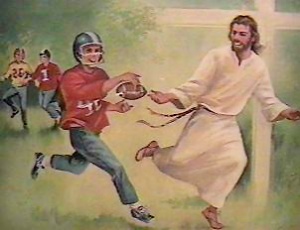
The winner this year has been proclaimed in advance.  No matter what happens on the chilly field, the winner will be… Jesus!

Image Source: The Biblical World

Image Source: The Biblical World

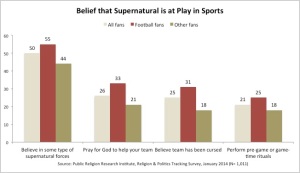
That’s right: no matter how the game goes, Americans tell pollsters they believe that Jesus will determine the outcome.  At least according to a recent report from the Public Religion Research Institute, a majority of Americans think that “some type of supernatural forces” will decide who wins the big game on Sunday.  More than a quarter of fans say they pray to God to help their team win.  And roughly a quarter of fans think their team has been cursed at one time or another.

Image Source: Public Religion Research Institute

Image Source: Public Religion Research Institute

Shocking?  Not really.  It seems to be just another piece of evidence that Americans are enormously religious.  And another warning to out-of-touch academics that their understanding of a liberal, secular society is woefully out of step with social realities.


Evolution Is Racist

Evolution is racist, says thinking-man’s conservative Rod Dreher.

But before we anti-creationists pull out our handy refutations of the Darwin-Hitler smear, take another look at Dreher’s real argument.

Dreher is no knee-jerk creationist.  He wants public schools to teach evolutionary science.  For that matter, he wants ALL schools to teach evolutionary science.  He explicitly rejects the simplistic equation of “Darwin” with “racism.”

But Dreher yet objects to the ways liberals hasten to conflate creationism with anti-scientism.  Too many liberals, Dreher argues, pick and choose from their scientific principles.  Just as do creationists, liberals begin with the notion of “forbidden knowledge,” of facts that may or may not be true, but in any case are too dangerous to be widely shared.

For Dreher, the implications of Darwinian natural selection are just such ideas.  Too often, the facts of genetic variation among humans have led all-too-fallible humans to a sinister conclusion.  As Dreher explains,

I flat-out don’t trust our species to handle the knowledge of human biodiversity without turning it into an ideology of dehumanization, racism, and at worst, genocide. Put another way, I am hostile to this kind of thing not because I believe it’s probably false, but because I believe a lot of it is probably true — and we have shown that we, by our natures, can’t handle this kind of truth.

The point, for Dreher, is not the crude creationist mantra that evolutionism leads directly to Hitler.  The point, rather, is that capital-s “Science” has and will be misused to justify humanity’s darkest impulses, just as Religion can be so misused.  Dreher’s point, as I understand it, is that those anti-creationists who smugly wave the flag of Science to discredit religious opposition unwittingly expose themselves as shamefully ignorant of the real issue.  As Dreher concludes,

liberals who love to put the Darwin fish on their cars and rail against fundagelicals who want to teach Creationism in public schools should be honest with themselves and admit that they don’t really want to teach Science and nothing but either. Their enthusiasm for just-the-facts science typically stops the moment science tramples upon one of their sacred principles.

Evolutionary theory may not be racist, in a simple sense.  But Dreher gives us an important reminder that any idea can be misused as a smear to discredit one’s opposition.


Introducing: Shelfies!

What’s on your shelf?  What do you read to help you figure out questions about conservatism and American education?

I Love You But You’re Going to Hell is happy to introduce a new feature: Shelfies.  Readers are invited to send pictures of their bookshelves with annotations.  You can send them to the editor: alaats@binghamton.edu  Make sure the titles are legible.

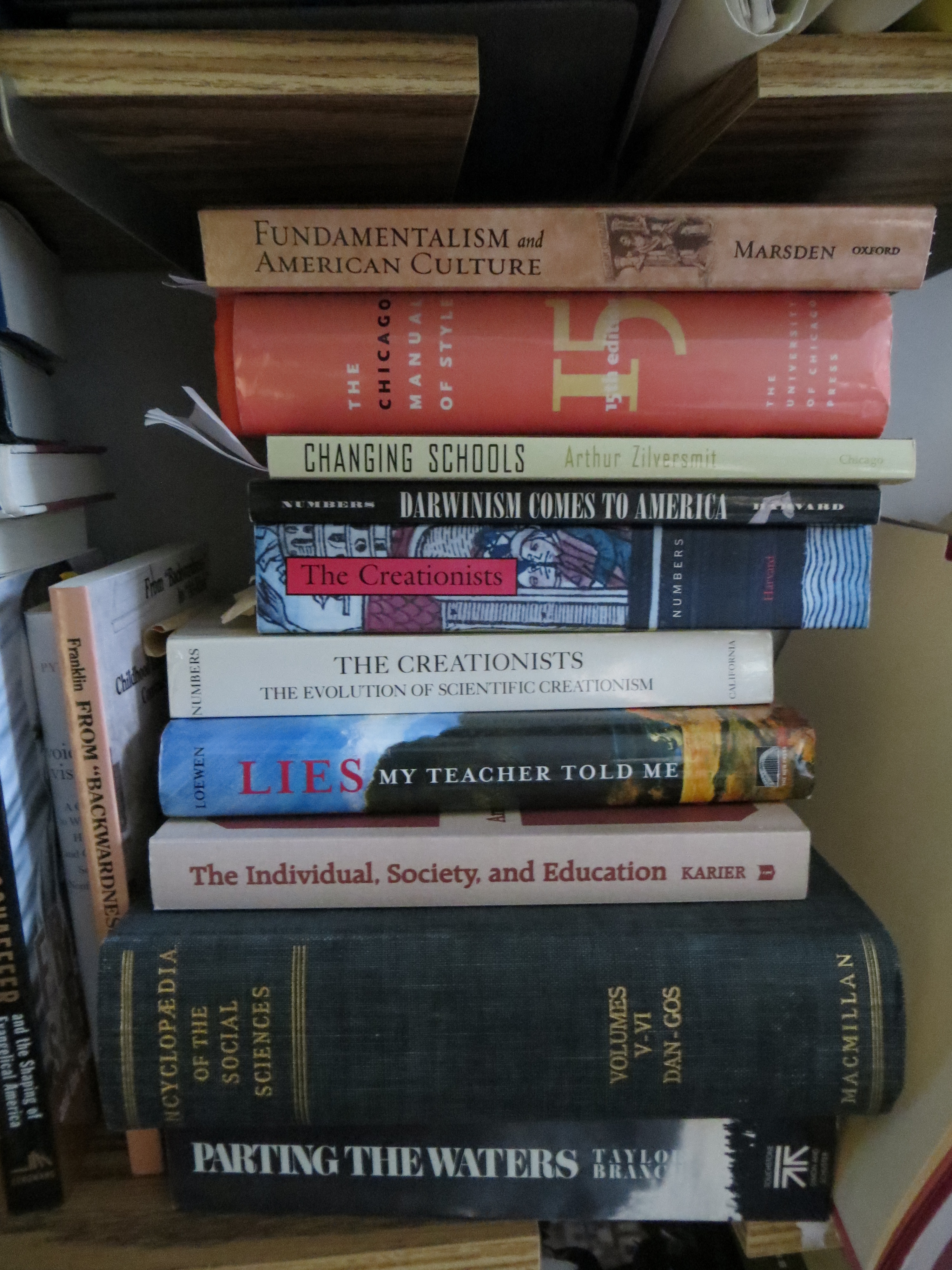
Here’s a shelfie from our editor’s office:

What's on your shelf?

What’s on your shelf?

This is one of my go-to piles in my current work.  Here’s the breakdown:

1.) George Marsden’s Fundamentalism & American Culture.  It was this book (in an earlier edition) that first got me interested in the culture and activism of conservative evangelical Protestants.

2.) Arthur Zilversmit’s Changing Schools.  I refer to this book regularly.  It looks at the slippery nature of “progressivism” in American schools in the crucial period of 1930-1960.

3, 4, & 5.) The Ron Numbers Collection: Ron was my mentor in grad school at Wisconsin.  His work on creationism has been the bedrock reference for my historical research.

6.) James Loewen, Lies My Teacher Told Me.  I use this book regularly with my students who are going into history education.  Loewen’s tone is always a little too strident for my tastes, but this book is always good for those who are thinking about teaching history for a living.

7.) Clarence Karier, The Individual, Society, and Education.  This is a good book.  Not enough people seem to read it these days.  Karier looks somewhat idiosyncratically at the long history of education in the United States.

8.) Encyclopedia of the Social Sciences, 1935.  In this volume, historian Richard Niebuhr (brother of theologian Reinhold) offers an early and skewed definition of “fundamentalism.”  Niebuhr concluded, without much evidence, that fundamentalism was a rural phenomenon, an outgrowth of ignorance and isolation.  Though this definition doesn’t match the historical record, it proved enormously influential.  For decades, non-evangelical scholars accepted Niebuhr’s slanted definition without demur.

9.) Taylor Branch’s Parting the Waters. This well-known civil-rights history is there because I needed something to cover the gap in my bookshelves.  I can’t say I’ve ever read it, though I’ve always meant to.

So how bout it?  Send in some shelfies, tell us about what you’re reading.

The Most Important Thing Anyone’s Ever Said

What is the most important line in the history of American education?  Something from Ben Franklin?[1]  Frederick Douglass?[2]  Horace Mann?[3]  John Dewey?[4]

According to Bruce Frohnen in the recent pages of The Imaginative Conservative, that honor goes instead to Annette Kirk.  Her line from the 1980s, Frohnen argues, offers traditionalist conservatives and anyone who cares about real education the only thread of hope in the blasted and devastated landscape of American public education.

Conservative intellectuals have long taken a dim view of the state of American education.  Frohnen opens his recent jeremiad with a nod to the terrible state of today’s schools.  “Can public education in the United States be saved?” Frohnen asks.

Given the stranglehold of teachers’ unions over school districts and state legislatures, the constant meddling of an ideologically motivated federal Education Department, the sheer weight of bureaucracy, and the commitment to mediocrity? Perhaps not.

But traditionalists such as Frohnen are not the only ones who tend to throw the school baby out with the modern bathwater.  Leftist historian Michael Katz, for instance, opened a new era of revisionist educational historiography in 1968 with his assertion that schooling in the United States has always been “conservative, racist, and bureaucratic.”[5]  Also from the left, Marxist economists Samuel Bowles and Herbert Gintis denounced American public education in 1976 as a tool of the economic elite.   Libertarian historian Joel Spring famously denounced the cookie-cutter domineering of “The Sorting Machine.”

Frohnen agrees with these folks about the terrible state of public education in the USA.  But it’s hard to imagine Professors Katz, Spring, Bowles, or Gintis agreeing with Frohnen about school’s saving grace.  According to Frohnen, the only glimmer of hope in the last generation has been a line inserted by Annette Kirk into the 1983 blockbuster report A Nation at Risk.

You history nerds out there might think that Frohnen is referring to some of the most famous lines of that report.  Every survey of American educational history, for instance, talks about the reports catchy warning about a “rising tide of mediocrity.”  Most surveys, too, note the apocalyptic edge to the report’s conclusion.  “If an unfriendly foreign power,” the report noted, “had attempted to impose on America the mediocre educational performance that exists today, we might well have viewed it as an act of war.”  Ouch!  Take that, teachers’ unions!

But those memorable lines were not the ones to which Frohnen referred.  No, the most saving line of the report, Frohnen argues, was one inserted by the true conservative Annette Kirk.  In Frohnen’s words, Kirk made sure that the report included the principle that “parents are the first and primary educators of their children.”

Thanks to this perspicacious inclusion, American education has been saved from the worst strangleholds of state-dominated educracy.  Parents in the United States, Frohnen points out, still have the freedom to free their children from the school system entirely.  Homeschooling offers such parents their last best hope of seeing their children truly educated.


[1] “Genius without education is like silver in the mine.”

[5] Michael Katz, The Irony of Early School Reform: Educational Innovation in Mid-Nineteenth-Century Massachusetts (Cambridge, MA: Harvard University Press, 1968), 3.