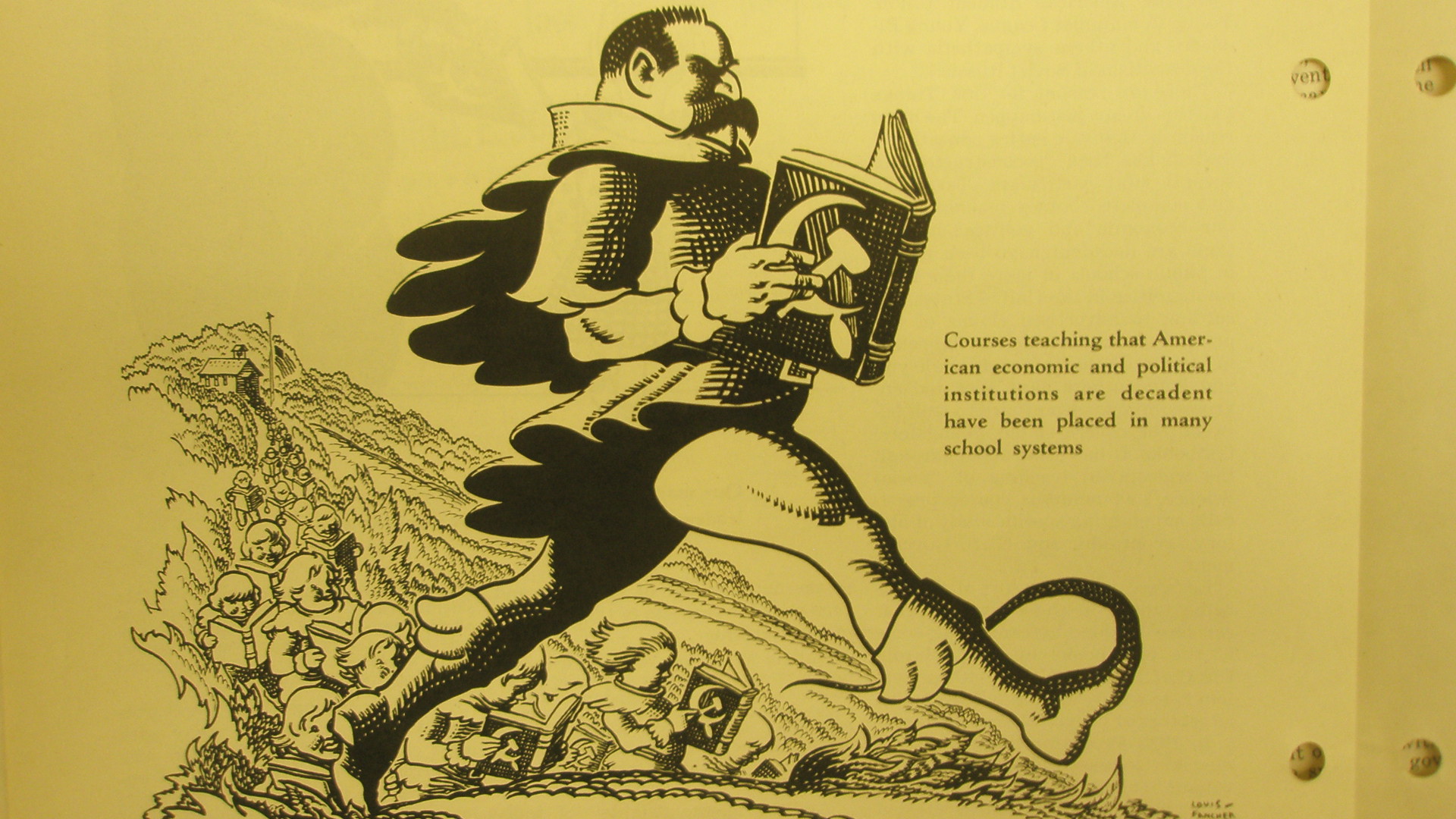
FROM THE ARCHIVES: Fundamentalism vs. Communism, c. 1949

In the twenty-first century, it can be difficult to remember the menace once posed to Fundamentalist America by communism.  Of course, it was not only Fundamentalist Americans, but most Americans, who shared a strong anti-communism, at least since the 1930s.  As historian Ellen Schrecker has argued, anti-communism WAS Americanism.

It is too easy to limit our understanding of anti-communism to a narrow campaign against one political group.  In Fundamentalist America, the fight against communism took on a broad array of meanings.  “Communism” itself came to include a vast spectrum of purportedly anti-American ideas, including anti-theism, progressive education, declining manners, anti-capitalism, disrespect for tradition, and so on.  Not surprisingly, the fight against communism came to include such notions as support for more public religion.  It often included support for traditional families and social relationships.  It also included a fight for more traditional teaching, both in content and in method.

To cite just one example, as President General Anne Minor of the staunchly anti-communist Daughters of the American Revolution insisted in 1923, Americans “want no teachers who say there are two sides to every question.”  Teachers must teach a strict patriotic traditionalism.  They must tell their students the correct answer, with the correct social values, every time.  Those “progressive” teachers who waffle and squirm, who infect their students with a crippling moral relativism, would eventually create a generation of insipid, unpatriotic Americans unable to defend against the menace of communism.

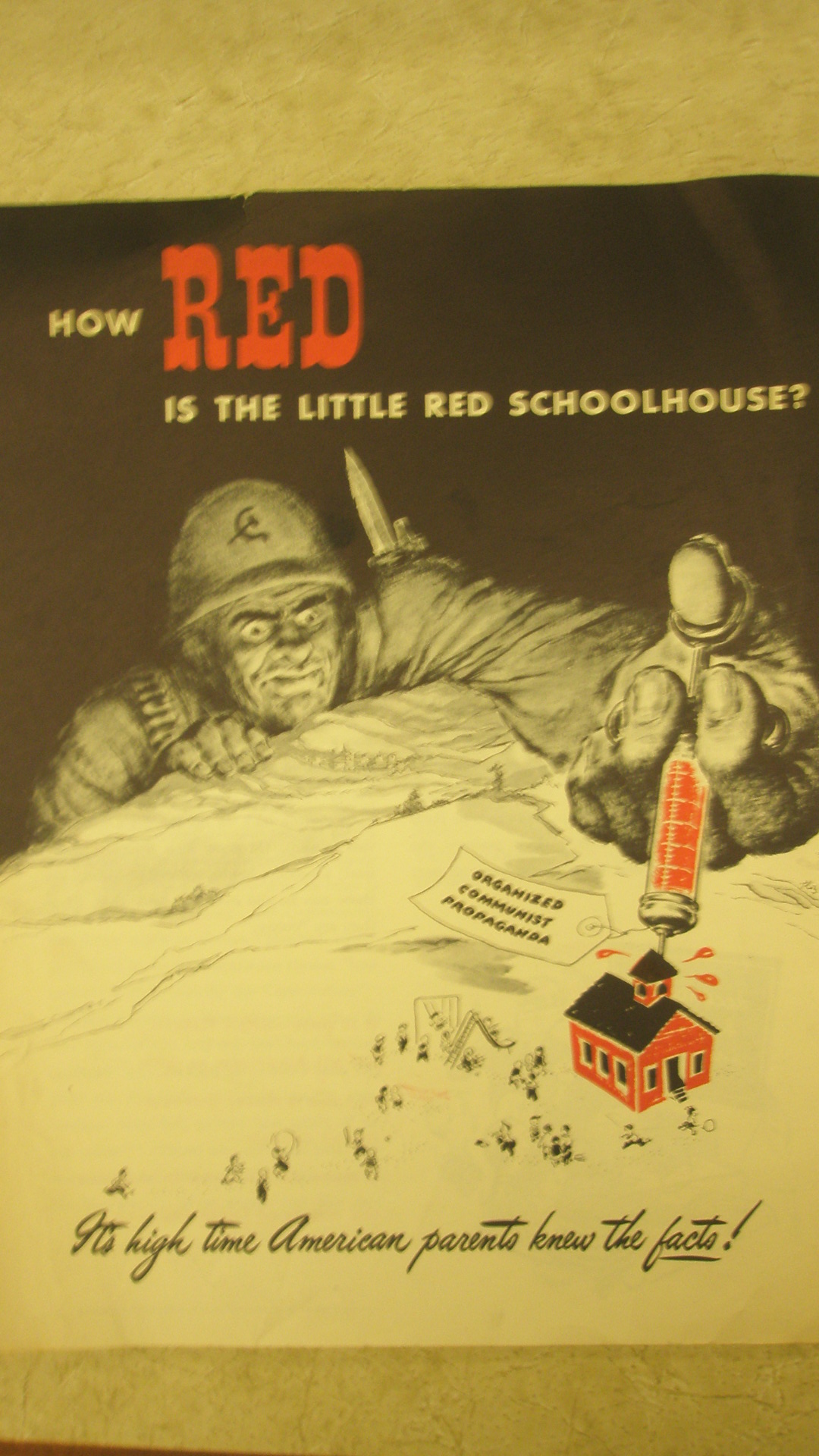
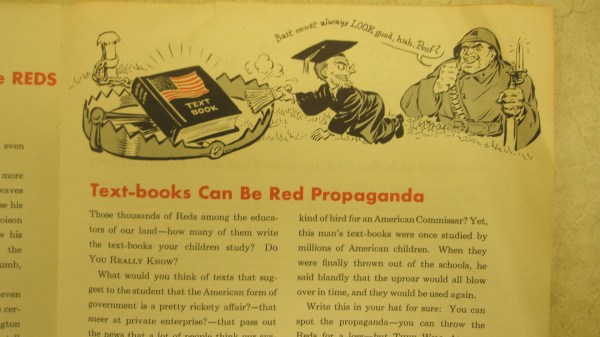
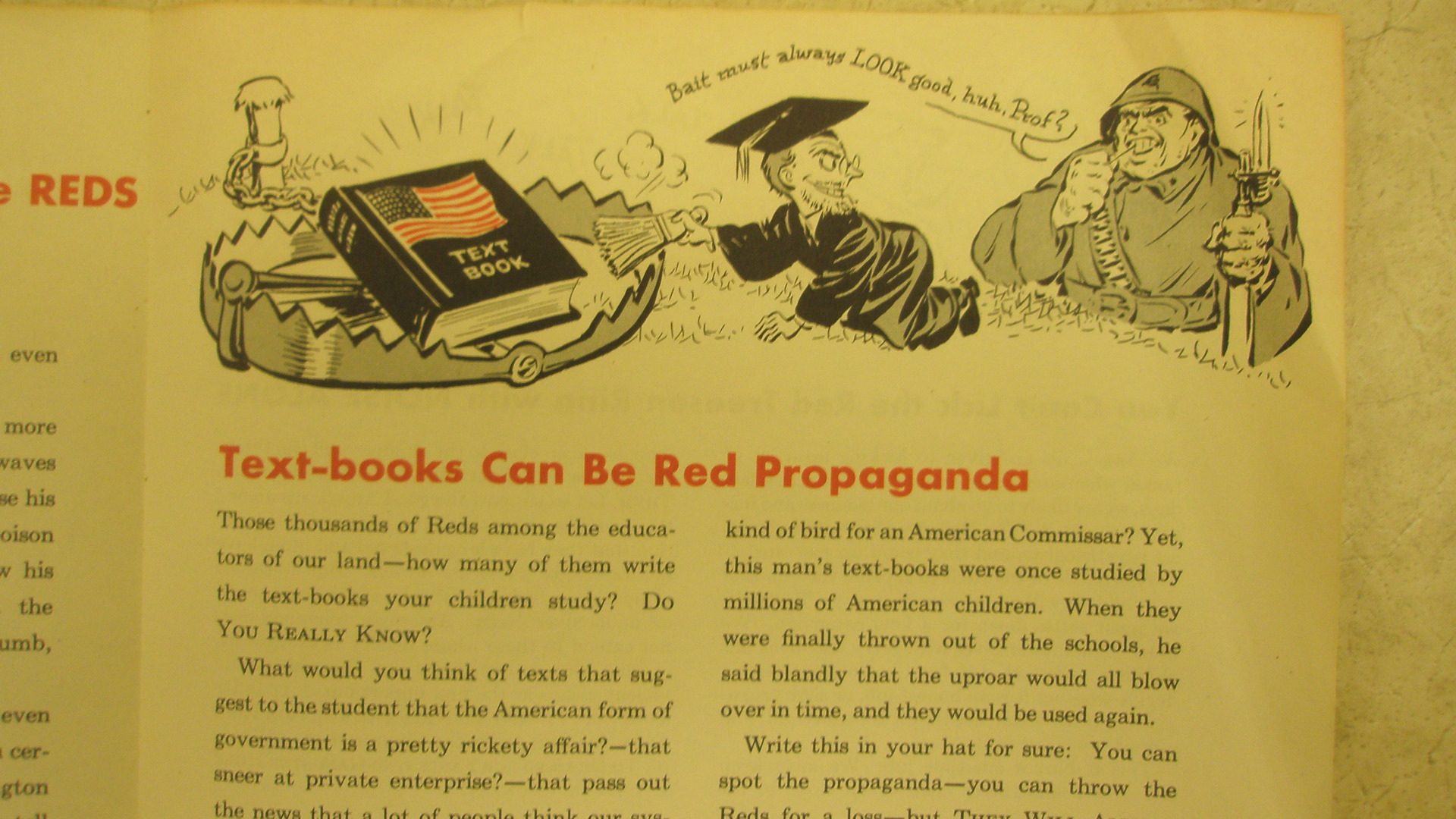
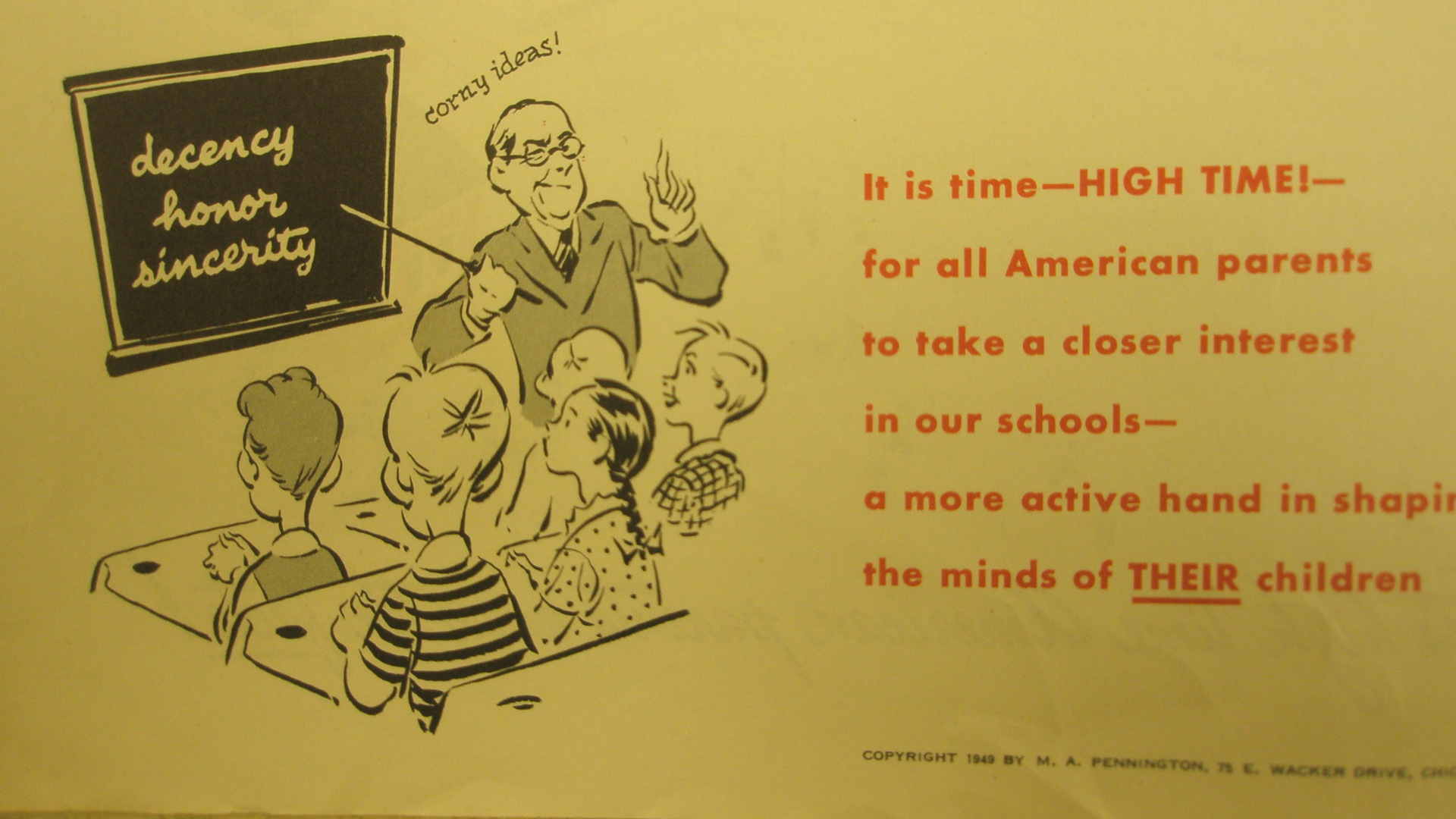
As always, a picture is worth a thousand words.  In this case, I’ll share some cartoons from an anti-communist pamphlet from 1949.  These cartoons demonstrate one common ideological thread in Cold War Fundamentalist America.  At the time, activists like the one who published this brochure felt that Communism threatened a two-pronged attack.  The danger included a military menace from Soviet Russia.  But it also meant internal subversion by dupes who did the work of the Red Army.  Intentionally or not, such subversive activity helped to weaken the resolve of America, making a communist takeover that much easier.

Further Reading: Ellen Schrecker, Many Are the Crimes: McCarthyism in America (Princeton: Princeton University Press, 1998); Jonathan Zimmerman, Small Wonder: The Little Red Schoolhouse in History and Memory (New Haven: Yale University Press, 2009).

This one shows the vast sweep of cultural ideology folded into the fight against communism. Not only must patriots fight communism, they must also fight to uphold traditional values.

Parents squeezing the “Red” out of textbooks.

As historian Jonathan Zimmerman has argued, the image of the “Little Red Schoolhouse” has long been a potent political symbol. In this cover image, the cartoonist makes a connection common in Cold-War anti-communism. “Reds” worked hard to subvert the Red Schoolhouse.

The scheming, bearded academic has long been an object of suspicion in Fundamentalist America. Here, he does the work of the Red Army.

Confessions of an Outsider in Fundamentalist America

Several people have asked me lately to clarify my position.  If I’m not trying to boost fundamentalism, and I’m not trying to fight against it, why bother with this blog?  I appreciate the question, so I’ll take a stab at an explanation.

Blog readers tend to come from a few different camps.  Some are refugees from Fundamentalist America (or Australia, or Canada, or UK).  That is, they grew up in conservative religious families and have been estranged from that tradition.  Others are residents and defenders of Fundamentalist America.  A few are resolute anti-fundamentalists.

I fit into none of those categories.  I grew up in a mostly secular, culturally liberal family.  We lived in the northern suburbs of Boston, where it was easy to assume that fundamentalism belonged only in Footloose.

I’ll have Bacon with mine.

Once I moved out of that bubble, I found myself working and living with people who shared a profound cultural conservatism, very different from the kind of culture I grew up with.  Most of them were not the monsters I had expected.  By the time I started teaching high school, I had some encounters with cultural conservatives that left a sour taste in my mouth.  I began my academic career as a historian interested in populist movements.  I had hoped to study nineteenth- and twentieth-century popular insurgencies.  I was particularly interested in the strength of conservative popular insurgencies.  When I started my PhD work at the University of Wisconsin, I felt that the conservative folks that I had lived and worked with had not been adequately studied.  Once I read more deeply from recent academic history, I realized that such historians had, indeed, spent a good deal of time examining the conservative popular tradition.  I decided to join that group.

I was particularly interested in educational history, for a couple of reasons.  First of all, I was influenced by both the work and the personality of Bill Reese.  Reese had studied grass-roots educational insurgencies.  His work showed me that the best place to study cultural conflict was in educational history.  The field combined all the interesting parts of political history, cultural history, religious history, and intellectual history.  After all, it was—and is—in the schools that the cultural fat hits the fire, so to speak.  The nature of morality, the boundaries of legitimate knowledge, the fundamental premises of religion and culture…all these issues are often only articulated in the public sphere when they need to be adjudicated in public schools.

Once I decided to study educational history, I looked for an important educational movement or group that had not been studied by academic historians.  The Protestant fundamentalists of the 1920s seemed like such a group.  Once Ron Numbers–historian of science and medicine, the world’s leading academic authority on scientific creationism, and an all-around great guy–agreed to work with me, my research path was clear.

Years later, after I have published and spoken a good deal about such conservative religious folks, I found that one question kept coming up, especially among my academic audiences.  Some members of such audiences always wondered why so much educational policy was “still” dictated by cultural conservatives.  Prayers in school, creationism, “heritage” history; all these seemed to come as a surprise to many members of my academic audiences.

Like me, many of the members of those audiences had lived most of their lives in very sheltered, very liberal, very secular environments.  They often shared a disturbing combination of profound ignorance with utter arrogance.  They thought that all of America did or should share their cultural beliefs.  And they believed this while considering themselves open-minded and committed to welcoming a diversity of cultural voices.

I found myself deeply embarrassed for such people, especially because I shared the same background.  Before I began exploring the educational, intellectual, cultural, and religious histories of conservatism, I assumed—without examining my own assumptions—that Fundamentalist America represented only a cultural backwater, destined to dry out and disappear as our society evolved.

Perhaps an example will clarify.  After one talk I gave about anti-evolution activism in the 1920s, one audience member raised a hand and asked, “What is the matter with these people?”  The rest of the audience giggled and nodded.  I have since come to know the person who asked that question.  She is delightful.  She cares deeply about other people.  She is a prominent education researcher and well-known scholar in her field.  She has dedicated her professional life, and much of her personal life, to making public education more accommodating for people with physical disabilities.  She would be horrified to be accused of bigotry, closedmindness, or prejudice.

Yet when she heard my talk about the intellectual background of anti-evolutionism, she did not think twice about dismissing all such people—nearly half of American adults—as “these people.”

It is for people like her that I write this blog.  My mission, if that’s not too lofty a term, is to introduce Fundamentalist America to people who are ignorant about it.  Part of that means demonstrating the popularity and strength of conservative religious ideas in American public life.  Part of it means explaining the reasons why intelligent, well-meaning people may embrace notions such as young-earth creationism and an inerrant Bible as a primary authority in making political decisions.

None of this means I agree with such positions.  I don’t.  But I would like to join those who try to build understanding between opposing cultural visions.  Like Jonathan Haidt, I believe that many of our cultural battles could be less bloody.  One way to make them so is to make sure each side understands the other.  As someone who comes from outside the borders of Fundamentalist America, but spends much of my time exploring the history and culture of Fundamentalist America, I believe I can be of use in explaining FA to other outsiders.

Will this solve all our disagreements?  Of course not.  But I believe it will be better to understand and even sympathize with our opponents’ positions, even if we must eventually respectfully disagree.

The Bible in America: Thunderbolt, Part III: What Thunderbolt?

As we’ve discussed here lately, some fundamentalists harp on the Schempp and Engel Supreme Court decisions of 1962 and 1963 as the time God was kicked out of public schools.

Some of the reasons for this go beyond the obvious.  First of all, although the 1963 case took the name of Abington Township School District v. Schempp, it was actually a joinder decision with a case brought by the prominent atheist Madalyn Murray O’Hair.  The Schempp family were religious Unitarians.  Murray (later Murray O’Hair) was an outspoken and aggressive atheist.  Partly as a result, the Schempp case took on overtones of a fight of religion vs. atheism.  It took on overtones, in Fundamentalist America, of a last-ditch defense of God.

Such perceived high stakes led to a perception of a profound loss for Fundamentalist America.  As we’ve argued here recently, conservative evangelical Protestants reacted with profound dismay and disillusionment to the court’s 1963 decision.  A Moody Monthly poll in 1964 ranked the decision as the most important social or political event of the year, more important than the church bombings in Birmingham, Alabama.  Presbyterian fundamentalist leader Carl McIntire asked, after more than a decade of struggle to pass a Constitutional prayer amendment, “Why aren’t Christians standing where it counts and saying, ‘I’m for America and I’m for the Bible?’”

But what did the 1962 and 1963 decisions actually do?  What effects did they have in America’s public schools?

In the aftermath of the Schempp decision, a pair of political scientists—Kenneth Dolbeare and Phillipp Hammond—studied the effects.  They first consulted survey data.  Not surprisingly, they discovered that the Schempp and Engel decisions had led to a precipitous drop in the amount of school-sponsored religious activity that went on in public schools.  More precisely, they found that the decisions had led public school leaders to report a sharp drop.  About two-thirds of school districts reported that they stopped school-sponsored devotions.  Teachers reported a sharp decline.  Sixty percent reported that they had lead classroom prayers before the decisions, while only 28% admitted they still led such prayers.

Of course, even these large declines meant that many teachers and school districts continued to lead prayers and Bible readings.  But even that stubborn minority was isolated.  Most of such holdouts were in the South.  Reports from the West—where such in-school religious practice had often already been banned—and from the Plains and Northeast gave a much different picture.  In those regions, survey responses indicated nearly full compliance with the Supreme Court decisions.

We must remember that the South at this time was roiling with anti-Brown sentiment.  The white power structure had nearly unanimously agreed to resist school desegregation in spite of the 1954 Supreme Court ruling.  Many agreed with Alabama Governor George Wallace, who had declared in 1963, “I don’t care what they say in Washington.  We are going to keep right on beating the Bible in the public schools of Alabama.  I wouldn’t be surprised if they sent troops into the classrooms and arrested little boys and girls who read the Bible and pray.”

In such a climate, school leaders in the former Confederacy had a much easier time publicly renouncing the Supreme Court’s ban on school-sponsored prayer.  Indeed, it may have been political suicide for many of them to publicly support the Court.

Outside the South, however, most survey respondents claimed they had stopped teacher-led prayers and Bible readings.  But when Hammond and Dolbeare examined those schools and classrooms more closely, they found that even outside the South, teacher-led prayer and Bible reading went on just as they had before the decisions.  In other words, teachers and school administrators outside the South told surveyors that they had stopped leading religious devotions in their public schools.  They knew that such practices had been prohibited.  But when the classroom doors were closed, they continued to pray and read from the Bible with their students.

Most remarkable, in Dolbeare and Hammond’s opinion, was the fact that throughout the communities they studied in the Midwest, everyone knew what was going on and no one complained.  As long as state-level school administrators could claim that they did not know of any teacher-led devotions, the devotions themselves went on undisturbed.  Teachers led prayers in their classrooms.  School building principals led prayers at school ceremonies.  Bible verses adorned graduation speeches and school hallways.  According to Hammond and Dolbeare, most of the people involved were aware of the Supreme Court’s ruling.  Yet they continued to engage in exactly the sorts of practice the Court had ruled against.

Fast forward to the twenty-first century, and we see a much different picture.  Regional variations in racial desegregation in schools have often flip-flopped, with the most segregated school districts now in places such as New York City, Detroit, and Milwaukee, Wisconsin.  Similarly, in spite of a relatively recent New York Times article that assumed school-sponsored religious practices had been shunted to “some corners of the country, especially in the rural South,” even a casual observer of the news will see that battles over the proper role of religion in public schools continue all over the country.

For example, we noted recently a remarkable law passed recently in New Hampshire, hardly an outpost of the “rural South.”  This law mandated that parents could request alternate textbooks or curricular materials for any reason.  In theory, this could mean that strict vegetarian parents could object to books that portrayed meat-eating in a flattering light.  The intent of the law, however, was clearly to protect the faith of evangelical Protestant children.  The push for the law began when one family objected to the Jesus-bashing of author Barbara Ehrenreich.

Or the continuing case of Bradley Johnson.  Johnson insisted on putting religion-friendly placards on his classroom wall.  His stubborn activism can only be called “Southern” if we include “Southern” California.  And while San Diego is technically one corner of the country, it is hardly an isolated outpost of ‘hillbilly’ culture.

Just as it was for Dolbeare and Hammond in the 1960s, it is nearly impossible for us to know what really goes on in most public-school classrooms.  Cases like Johnson’s don’t tell us much about what most teachers are doing.  As Dolbeare and Hammond concluded, one of the main reasons for the continuing practices of teacher-led prayers and Bible readings was that everyone involved hoped to avoid any controversy.  Parents did not want to stand out as anti-prayer.  Teachers did not want to appear to denigrate religion.  School administrators did not want to crack down on what many perceived to be wholesome traditional American practices.

These days, it is difficult to predict just what practices might pass for non-controversial in America’s public schools.  Local traditions—even down to the level of individual schools and neighborhoods—trump Supreme Court decisions or New York Times reporters’ assumptions.

For conservatives, this means that traditional practices such as prayer or Bible reading might continue in public schools, as long as there has never been a local complaint against the practice.  It also means that conservative activists such as Bradley Johnson might mount a counter-revolution in any part of the country.

For many such activists, public schools have taken on an aura of secular fortresses.  In the rhetoric of many conservatives, public schools are the headquarters of Jesus-bashing, evolution-teaching, sex-teaching, drug-selling liberals.  A more careful look, like what Dolbeare and Hammond did forty years ago, would likely present a much more traditional, religion-friendly picture of life inside those public-school walls.

Berger on the Pentecostal Elephant in the Room

Peter Berger at American Interest has offered this week a helpful reminder about the importance of understanding Pentecostalism.  Berger’s article reminds us of a few looming intellectual traps that anyone hoping to understand Fundamentalist America must avoid.  The first is that conservative religion in America is some sort of monolith.  Far from it.  The first generation of Protestant fundamentalists that I’ve studied vehemently disputed the legitimacy of the Pentecostal style.  One typical fundamentalist writer in the early 1920s dismissed Pentecostalism as a kind of “hysterical fanaticism,” arguing that “Disorderly confusion in the assembly is not of God.”   Another agreed: “Usually people carried away by this movement are of a nervous, mystical, hysterical temperament, such as are considered a bit queer.”

Historian Grant Wacker has called this division the “Travail of a Broken Family.”  As Berger notes, even among the Pentecostal tradition there are a variety of sub-traditions.  As a generalization, though, Pentecostals emphasize an immediate connection with, and a baptism by, the Holy Spirit.  Pentecostal worship can be characterized by distinctive physical manifestations among worshippers, including “jerking,” laughing, or glossolalia (“speaking in tongues”).  The faith has also long been known for its emphasis on divine healing.  But beyond those headline-grabbing outward signs, Pentecostal faiths are also focused on a very “fundamentalist” reading of the Bible.  And although Pentecostals can be less noticably political than their evangelical cousins, they often have equally conservative political and cultural beliefs.

Berger’s article also reminds us of the danger of dismissing any intellectual tradition much different from our own.  As Berger notes,

I think that even today the notion of Pentecostal scholarship, especially if undertaken by scholars who are themselves Pentecostals, must strike many people as an oxymoron. Evangelicals in general are still widely regarded as backwoods provincials, like those described with contempt by H.L. Mencken in his reports on the 1925 “monkey trial” in Dayton, Tennessee—or, in the profoundly revealing 2008 comment by Barack Obama about folk in small towns (revealing, that is, about him, not about the people he was talking about): “They get bitter, they cling to guns or religion or antipathy to people who aren’t like them.” These stereotypes were never empirically correct, and now are grossly incorrect. What has been happening in recent decades is the emergence of an increasingly sophisticated Evangelical intelligentsia, some of it based in a network of Evangelical academic institutions, publishing houses and journals, some (more interesting) infiltrating secular elite academia. Pentecostals are still lagging behind other Evangelicals in this development, but they have started to move in the same direction in America and elsewhere.

I would add that another disturbing part of this tendency to ignore the intellectual aspect of Pentecostalism is its heavy load of racial and class prejudice.  In the United States, Pentecostal churches have long been popular among low-income folks from ethnic minorities, especially Latinos and African Americans.  If those of us outside of conservative religion dismiss all emotive, traditional worship as mere snake-handling, we risk misunderstanding the cultural experiences of huge numbers of people who don’t have a lot of money or a lot of cultural clout.  This is the sort of misunderstanding that fuels the bitterness of America’s culture wars.  When activists on each side wholly misunderstand one another, the amount of wiggle room for compromise and mutual respect vanishes.  Berger’s article reminds us of the importance of approaching different cultural traditions with a healthy dose of humility and open-mindedness.

Atheists Assemble!

Alfredo Garcia at Religion & Politics offered a report recently from Reason Rally 2012.  The rally welcomed 10,000 non-theists to the national mall to celebrate and recognize freedom from God.  As Garcia notes,

life remains hard for non-theists in the United States. There is, of course, the cultural stigma—of being nontheistic in a nation where more than 90 percent of people believe in a higher power. There is only one openly atheist member of Congress, Rep. Peter Stark from California (who had a video appearance at the Reason Rally). Atheists are viewed more negatively than any other U.S. religious group, with less than half of Americans (45 percent) holding a favorable opinion of them. It can be a lonely existence. With no single umbrella organization to bring non-theists together, individuals can feel isolated, compounded by the fact that the various non-theist organizations are often fragmented in their approaches.

There are a couple of lessons here for those of us trying to understand Fundamentalist America.  The first is that conservative religious folks tend to over-emphasize the power and influence of atheism.  Bogeys like Madalyn Murray O’Hair, Robert Ingersoll, and the American Humanist Association have been used by generations of fundamentalist activists as warnings of the growing power of anti-God “forces.”

Second, we can see that the real divide in America’s culture wars isn’t between conservative religious people and atheism.  The atheist side is a small percentage.  The real contenders are between conservative and liberal religious people.  The central issues are between contending visions of the role of religion in public life.  In this fight, atheism punches far above its weight.  That is, many religious people in America support the notion that the public square must be resolutely secular.

Finally, as Garcia insightfully notes, though small, the atheist community has long struggled with the stereotype of the aggressive iconoclast:

It’s the image of the atheist out to pick a fight, the unbeliever who is constantly seeking the next debate. As [Paul] Fidalgo from CFI [Center for Inquiry] put it, O’Hair was an “extremely polarizing” figure who “gained visibility for American Atheists but may have been integral in forming the image of atheism in the U.S. as arrogant.”

And, indeed, as Garcia reports, the reliable Richard Dawkins told the assembled crowd that they must go forth to “ridicule and show contempt” for religious people.  Perhaps the menace of atheism–from the viewpoint of Fundamentalist America–comes from this aggressive, arrogant, in-your-face sort of attitude more than from any sense of growing political clout.

Homeschooling and Fundamentalist America

As we’ve noted here before, there are many voices in Fundamentalist America who insist public schools are rotten.  One option for parents that has become increasingly popular since the 1980s has been homeschooling.

There’s still a lot we don’t know about homeschooling.  First of all, though it has become associated in many people’s minds with conservative religion, we don’t really know why parents choose to do it.  That is, we don’t know how many of the homeschoolers out there are motivated to do so by a fundamentalist religious or cultural distrust of the dominant ideology of public schooling.  After all, since the 1960s there has been a small but vocal minority of homeschoolers from the cultural left, too.

We also don’t know much about the success of homeschooling.  Do kids learn?  If so, would they learn just as well in traditional schools?  In other words, is it homeschooling that helps kids learn better?  Or is it the fact that they are talented students from homes with involved, active parents–just the type of student who would tend to do well in a public school, too?

Just as with any contested cultural issue, it’s hard to know where to turn for reliable research in these areas.  Many homeschoolers hope to prove that their method is equal to or superior to traditional schooling.  Many public-school advocates want to show that homeschooling is not an acceptable alternative.  We have to look at any “research” promoted by either side with a good deal of skepticism.

This is why we’ve noted with interest a couple of reviews that came across our screens lately.  The first is by Brian D. Ray of the National Home Education Research Institute.  There’s no doubt that Ray is partisan.  His organization promotes the legal rights of homeschoolers.  And he doesn’t hide his delight at the implications of the study he’s reviewing.  The study, by Sandra Martin-Chang, Odette N. Gould, and Reanne E. Meuse, (Martin-Chang, Sandra; Gould, Odette N.; Meuse, Reanne E. (2011, May 30). The impact of schooling on academic achievement: Evidence from homeschooled and traditionally schooled students. Canadian Journal of Behavioural Science/Revue canadienne des sciences du comportement, pp. 1–8) compared students from 37 homeschool families with 37 traditional ones.  The sample size was small, as Ray concedes.  The researchers found that students from “structured” homeschool environments did significantly better on academic achievement than their public-school counterparts.  Students from “unstructured” homeschools tended to do worse.  The most interesting part of this study results from the researchers’ attempt to control for other factors.  That is, they chose families that were similar in all variables except for type of schooling.  In other words, they tried to solve the question of whether homeschoolers performed better because they had other family advantages besides homeschooling.  Of course, as Ray and the study’s authors all acknowledge, this result does not prove much.  The kinds of testing done to ascertain academic performance tend to reward those students who experience “structured” teaching, whether at a homeschool or a public school.

The second review comes from the leading academic historian of homeschooling in America, Milton Gaither.  Gaither teaches at Messiah College in Pennsylvania and blogs about the latest finds in homeschooling at Homeschooling Research Notes.  He noted recently the publication of a rare longitudinal study of homeschoolers.  This study by Linda Hanna of West Chester University in Pennsylvania (Linda G. Hanna, “Homeschooling Education: Longitudinal Study of Methods, Materials, and Curricula” in Education and Urban Society 20, no. 10 (2012): 1-23) looked at hundreds of homeschooling families in 1998, then again in 2008.  Hanna’s results offer some interesting hints about the perennial homeschooling questions.  For example, Hanna finds that an overwhelmingly large percentage of families in her study seem to choose homeschooling due to conservative religion and culture.  Also, the number of families choosing to stick with homeschooling all the way through secondary school increased significantly over the course of one decade.  The most obvious explanation for this change seems to be the rise of computers and internet access during that time.  When more families had better online access to educational resources, more chose to keep their kids at home for middle- and high-school, too.

As always, these kinds of studies leave us wanting more.  We’d like to see larger sample sizes, longer studies, more exhaustive research methods.  But these studies and others like them help make the case that homeschooling is a legitimate alternative to public schools.  For those of us trying to understand Fundamentalist America, this can tell us a couple of things.  First of all, we can acknowledge that those conservative religious folks who choose homeschooling might be making an educationally superior choice.  Second, we can see that some of the hostile stereotypes about Fundamentalist America just don’t hold water.  Just because parents are conservative and deeply religious doesn’t mean they are not willing to embrace alternative cultural institutions.  Many conservative folks jumped headlong into a very experimental form of alternative schooling when they thought public schools were not doing the job.

FROM THE ARCHIVES: Fundamentalist Pied Pipers

I’m up to my eyeballs in my book manuscript about conservative educational activism in the 20th century.  There are plenty of recurring themes.  Just like every other sort of activist, conservatives return again and again to images or ideas that work.  On a recent research trip I found another example of a common theme among educational conservatives: the Pied Piper.  For decades, conservatives have warned of Pied Pipers leading children out of their schoolhouses and into damnation.  The specific tune might change.  Sometimes, it is the dangerous sound of evolution.  At other times, it is communism, or atheism, or lack of Bible awareness.  I’ll include a few of the most striking images here.  Enjoy!

EJ Pace, Christian Cartoons, 1922

I thought the cartoon above captured the spirit of the 1920s Protestant fundamentalist school campaigns so well that I used it as the cover of my first book.  It comes from a wonderful book of cartoons by the evangelical artist EJ Pace.

EJ Pace, 1931

This is another gem from EJ Pace.  This one appeared in the newsletter of the Evangelical Theological College, a seminary new in the 1920s.  It later became the Dallas Theological Seminary, a leading training school for conservative Protestant ministers.  Of course, there’s not an actual Pied Piper here, but I’m including it because it has the same theme of students being led from their school (you can see it way in the background) down to the chasm of unbelief in God.  The cartoon was an advertisement for a Bible campaign that never really got off the ground.  The plan was to deliver 1,000,000 Bibles to college students so that they might better resist the intellectual and spiritual dangers of higher education.

From “Our ‘Reconstructed’ Educational System,” Nation’s Business, April, 1940

Here we see a different sort of Pied Piper.  Instead of evolution or the lack of Bibles, the threat here is communistic school textbooks.  Stalin as Piper is able to lead the students out of their little red schoolhouse down a dangerous path.  In this use of the Pied Piper theme, the danger comes from improper, un-American teaching.  But the basic message is the same.

I imagine there are lots of Pied Piper cartoons floating around out there for all different sorts of educational ideas.  The idea that improper education–whatever that might mean–is leading our young people down a dangerous path is too obvious to be restricted only to patriotic or religious conservatives.  However, I don’t know if any other cartoon could possibly match the excitement of seeing Stalin in tights and pointy-toed shoes.

Bible Cheats!

Ah, the irony!

One of the interesting parts of managing this blog is watching the search terms that direct people here.  It is not too Big-Brother-y, but I can scroll through the list of terms that people have Googled.

Most of them are no surprise.  Lots of people Google themselves.  Embarrassing, but understandable.

And lots of people who end up on I Love You But You’re Going to Hell also Google terms such as “traditionalist education,” “Bible in schools,” “anti-evolution,” and so on.  Makes sense.

But there’s another common search term that could help English teachers.  Having taught high-school English for several years myself, I remember that teaching the concept of “irony” was always difficult.  It only got harder when Alanis Morrissette butchered the concept with her pop song “Isn’t It Ironic.”   

Thanks to SMS, this should link to the video now. –AL

But now I’ve found a new illustrative example of “irony.”  Among the many common search terms that direct people to ILYBYGTH, one of the top phrases is “What the Bible Means to Me Essay.”

I’m no cynic.  But having taught middle- and high-school for ten years, I can smell a cheat.  In a lot of cases, plagiarism made sense.  For instance, as a US History teacher, I came to expect some students in our Prohibition unit to offer up plagiarized essays in favor of the legalization of marijuana.  It was still cheating, of course, but it made sense.  Fit the profile.

How much sadder is it to have students trying to rip off an essay on “What the Bible Means to Me?”

Required Reading: RJ Snell and a NEW New Christian Right

“Isn’t a ‘Fundamentalist intellectual’ an oxymoron?”

People ask me that question a lot.  There are lots of ILYBYGTH readers out there who are intrigued, but baffled, by the culture of conservative Christianity in America.  Like me, these are mostly folks who came from secular or liberal backgrounds.  Like me, most of these people just don’t have an intuitive grasp of the culture of conservative Christianity in America.

And a lot of those folks (still) assume a connection between conservative Christianity and intellectual sterility.  They tend to agree with Richard Dawkins’ 1989 statement, that if you meet someone who doesn’t believe evolution, that person must be “ignorant, stupid or insane (or wicked, but I’d rather not consider that).”  In this case, some secular or liberal people who don’t understand Fundamentalist America assume that any conservative Christians must be like Dawkins’ creationists.  In this understanding, the very definition of conservative Christianity means accepting a bunch of outdated ideas hook, line, and sinker.

In this vision of Fundamentalist America, conservative Christianity appears like a threatening monolith, a Borg-like* force that insists on transforming America into a goose-stepping echo box.

One of the first steps toward understanding what we’re calling Fundamentalist America is to understand the limits of that stereotype.  If we want to understand FA, we might start by trying to get a sense of the complexity of it.

A recent article by RJ Snell at Front Porch Republic will help.  In “Thoughts toward a New Religious Right,” Snell criticizes the impulse among some conservative Christian political activists to embrace an ethos of individualism too eagerly.

Snell writes,

We’re accustomed to thinking that the greater a being, the less it requires from others, the more it is self-sufficient, but this is only partially true. Shellfish have no friends, while humans need friends to thrive, and this is a mark of our grandeur, not our inadequacy.  

Snell critiqued the last generation of Christian activists for slipping too easily into the myth of the rugged individualist.  In their eagerness to combat an aggressive idea of collectivism, conservative Christians leaped precipitously into its opposite.  In doing so, Snell argues, conservative Christians forgot the central lessons of their own faith.

We outsiders who are hoping to understand the thinking of conservative religion in America could do well to begin with essays like Snell’s.  It is easy to think we understand the meanings of Fundamentalist America once we grasp a few high-profile ideas.  But if we really want to understand, we need to dig into the many different ideas and thinkers that make up its kaleidoscopic vision.

*Nerd alert.

The Bible in America: Thunderbolt, Part II: Schempp

If we listen to the voices of Fundamentalist America, we might conclude that public schools in America are terrible places to be.  Twenty years ago, John Morris of the Institute for Creation Research warned that public schools had become “aggressively anti-Christian.”  The problems, Morris declared, went beyond the obvious:

Open drug sales and use, ethnic gang wars, and student/teacher violence are easily recognized problems, but how about the more subtle attempts at “values clarification,” or the encouragement of experimentation in “sex education” classes, or the inclusion of homosexuality as a legitimate lifestyle, or easy access to abortions through school clinics.

Other conservative Christian activists agree.  Thirty years ago, Jerry Combee wrote,

the public schools have grown into jungles where, of no surprise to Christian educators, the old Satanic nature ‘as a roaring lion, walketh about, seeking whom he may devour’ (I Peter 5:8).  Students do well to stay alive, much less learn.

More recently, activists involved in the Exodus Mandate have warned that public schools “are no more reformable than Soviet collective farms. . . . Conservative school reformers are a lot like Civil War reenactors who specialize in Pickett’s Charge.  They never take the high ground; they never really win.”

This staggering decline in the quality of public schools began, many conservatives insist, when the US Supreme Court kicked God out of schools in 1962 and 1963.  In 1962, as we’ve seen, the court decreed that states could not impose a non-sectarian prayer in public schools.  More devastating to many conservative Christians, in 1963 the court ruled in the decision Abington Township School District v. Schempp that even Bible reading and the Lord’s Prayer had no legitimate place in those schools.

Despite what many outsiders might think, the world of conservative evangelical Protestantism in America is truly kaleidoscopic, to borrow the phrase of religious historian Timothy L. Smith.  Different schools of thought among Bible believers disagree vehemently on questions of politics, culture, and theology.  Ask twenty “fundamentalists” what the Bible means and you’ll get at least twenty different answers.  Yet when it came to the Schempp decision, a variety of voices from around this diverse world all agreed.  This decision meant not only that God had been kicked out of public schools, but that Christianity itself had been kicked out of American public life.

For instance, in the immediate aftermath of the Schempp decision, separatist Presbyterian fundamentalist Carl McIntire still hoped that concerted political action might overturn it.  McIntire helped organize “Project America” to press politicians to adopt a Constitutional amendment in favor of prayer and Bible reading in public schools.  At first, McIntire repeatedly stressed his feeling that huge majorities of Americans would support such an amendment.  After a bitter political fight, however, McIntire acknowledged that it was hopeless.  Writers in McIntire’s Christian Beacon began to emphasize the notion that their beliefs made them a beleaguered minority in American life.  In 1965 one writer warned that America was “moving farther and farther from its Christian heritage.”  Another predicted that soon mainstream Americans would resort to “repression, restriction, harassment, and then outright persecution . . . in secular opposition to Christian witness.”

Other evangelical voices made similar about-faces in the aftermath of Schempp.  Baptist fundamentalist publisher John R. Rice reflected that the relationship between evangelical faith and public schooling had changed drastically.  He recounted for his readers how things had been radically different in the not-too-distant past:

Once when I was engaged in revival services in the Second Presbyterian Church in Chattanooga, Tennessee, I was invited to speak in every high school in the city and in the principal grade schools, both white and colored, and was gladly received.  The only people offended were those involved in the few elementary schools where I could not come for lack of time. 

Such halcyon days, however, had been destroyed by the cowardly Supreme Court.  Worst of all, Rice concluded, the court seemed to have the support of “the public sentiment.”

This sense of a drastic and sudden shift in the relationship between evangelical belief and public life was widely shared among all different sorts of conservative evangelical Protestants in the aftermath of Schempp.  One writer in the Moody Bible Institute’s Moody Monthly, for example, concluded that evangelicals must retreat to play the role of God’s “witnesses and lights in a dark place” in mainstream American culture.

Similarly, the intellectuals at Christianity Today articulated their shock and dismay of the implications of Schempp. At first, the editors believed that America’s “devout masses” still supported school prayer.  As did other evangelicals, however, they concluded bitterly that “In the schools secularization has triumphed.”  Instead of relying on devout masses, the editors soon hoped only to energize the “believing remnant” in America to support Bible-reading and prayer in public schools.

As we’ll see in future posts, the Schempp decision might not have had the drastic impact many of these writers assumed at the time.  Nevertheless, the degree of unanimity among a wide variety of conservative evangelical Protestants is remarkable.  From separatist fundamentalists to more ecumenical neo-evangelicals, prominent voices all agreed that this momentous decision had done more than just kicked God out of public schools.  In their opinions, Schempp had forced a sudden recalculation of the role of Bible believers in all of American public life.

Coming soon: Thunderbolt, Part III: What thunderbolt?