Common Core = Christian Core

What is an evangelical Christian to do?

The prolific Karen Swallow Prior recently argued that evangelicals ought to embrace the emerging Common Core State Standards (CCSS).

The CCSS have been attacked and defended by both progressives and conservatives.  They have been called both totalitarian and liberating, intrusive and effective.

Conservatives are divided.  Some say the Common Core is the least-bad planOthers warn of “control by Obama administration left-wing bureaucrats.”

Not so fast, Prior wrote. She attended a workshop with Core Mastermind David Coleman, and came away convinced that the standards have promise to improve literacy skills in the USA.  Especially as Bible-centered Christians, Prior argues, evangelicals need to get behind this effort.

After all, Prior insisted, “no one more than evangelicals can appreciate the importance to a people and a culture of the ability to read, and read well—or the devastating effects of being unable to do so.”


An Atheist and a Fundamentalist Walk into a Bar…

Can skeptics and believers talk civilly to one another? Can creationists and mainstream scientists ever have a constructive dialogue?

Most of the time, the best efforts at culture-war mediation leave everyone only more bitter and more convinced of the “extremism” and “irrationality” of the other side.

Thanks to coverage from the Texas Freedom Network, we recently caught up with an illuminating intellectual exchange between a leading creationist advocate and a witty, informed science skeptic.  Neither one seems to have been “converted” by the argument, but the civil yet heated discussion demonstrated the possibilities of creation-evolution dialogue.

Steven Novella, president of the New England Skeptics Society, interviewed Texas creation activist Don McLeroy last month.  You can hear the full interview on the Skeptics’ Guide to the Universe podcast.  Also fascinating, you can follow the post-interview back-and-forth on Novella’s NeurologicaBlog.

As we’ve argued here before, trying to understand Don McLeroy is a great way to begin making sense of conservatism in American education more broadly.  As the chairman of the Texas State Board of Education in 2010, McLeroy spearheaded a campaign to overhaul Texas’ influential textbook guidelines.  In that fight, McLeroy cared about more than evolution.  He also promoted an emphasis on such disparate themes as the Christianity of the founding fathers, the beneficence of the National Rifle Association, and the civic value of country music.

In the May 8, 2013 interview, Novella and his colleagues asked mainly about McLeroy’s position on evolution education.

During the interview, McLeroy makes his case for teaching the scientific alternatives to mainstream evolution theory.  As Novella and his associates point out, McLeroy carefully avoids making a case for teaching creationism or any religious ideas in public schools. Instead, McLeroy consistently advocates only for teaching the scientific criticisms of evolutionary theory.  Most of the discussion consists of a back-and-forth on the merits and weight of those criticisms.

Are there enough real scientific challenges to evolutionary theory to merit their inclusion in public-school science curricula?

One of the most intriguing points of the exchange was McLeroy’s insistence that religious thinkers are free to be more open-minded about the scientific claims of evolution.  Since religious intellectuals are open to the idea of both materialistic and supernatural explanations, McLeroy claimed, they have greater ability to weigh the evidence. This argument did not sit well with Novella and his colleagues.

Another fascinating discussion resulted from McLeroy’s defense of his anti-expert position.  During the 2010 school fight in Texas, as captured so movingly in Scott Thurman’s Revisionaries documentary, McLeroy argued that educators needed to seize control from “experts.”  Novella and his associates explained to McLeroy why this claim seemed preposterous to them.  Why should science curricula ignore the thinking of mainstream scientists—the real experts—and instead follow the inclinations of one dentist from Texas?

I was surprised to hear McLeroy’s willingness to waffle.  As I’ve argued before, McLeroy’s indictment of “experts” has a storied history, of which Novella and his colleagues seemed unaware.  For many anti-evolution activists, indeed for many conservative educational activists on a range of issues, the baleful influence of educational experts has long been assumed.  The recent trashing of CSCOPE in Texas demonstrated only the most recent emergence of this anti-expert sentiment.  I wished Dr. McLeroy had tried to articulate some of this broader anti-expert tradition.

More important than the details of the transcript, however, was the tone of the interview and post-interview exchange.  Neither Novella nor McLeroy apologized for their beliefs.  Neither held back from pointed and fundamental criticisms of the other, though as guest McLeroy tended to be more polite.  Yet the two sides managed to speak politely to one another.  McLeroy called Novella a “scholar and a gentleman.”

For his part, Novella called McLeroy

an exemplary guest. He stayed polite throughout, and did not bristle even when directly confronted on his position. He also did something I find extremely rare in such interviews – occasionally acknowledging a point on the other side or a weakness in his own position. He also had clearly made a genuine effort to read pro-evolution material and criticisms of his position.

I came away with the impression that he is genuinely trying to understand the creation/evolution debate and to rely on only valid arguments.

Did either side walk away from this exchange converted?  Definitely not.  But was the exchange worthwhile?  Certainly yes, for several reasons.

First of all, for interested observers, this back-and-forth gave both sides a chance to make their own arguments.  Readers and listeners can see what intelligent advocates might say on some basic stumpers of the creation/evolution debate.

Second, in any tense culture-war standoff, elaborate courtesy and face-to-face meetings help defuse the tendency to demonize the opposition.  For evolution believers like me, the contours of the debate change when I hear a friendly, seemingly well-intentioned leader of the creationist cause, if only to prove that both sides can include people of good will.


Can Public Schools Be a “Mission Field” without the “Mission?”

Can Christian evangelicals do their thing in public schools?  Does the Constitution allow public schools to be used as a “mission field” for Christian service work?

Religion writer Tom Krattenmaker offered some thoughts yesterday about Christian missionaries offering service to local public schools.  But can their best intentions get past the fraught relationship between conservative evangelicals and the wall of separation between church and state?

Krattenmaker describes the work of Nicole Baker Fulgham, former Teach for America leader and author of Educating All God’s Children.

Fulgham and other young evangelicals hope to improve public education.  They argue that Christians can serve the poor and needy in their communities by making public schools better.  Such mission work, Fulgham argues, can leave out the proselytization and stick to the nuts-and-bolts issues of keeping the lights on and the hallways clean.

As Krattenmaker describes,

Fulgham and her work exemplify a new kind of evangelical engagement with public schools that is dedicated solely to helping kids rather than arguing over school prayer, evangelism, and other culture war flash points.

Krattenmaker thinks the approach has promise.  He describes efforts in which evangelical congregations “adopt” local public schools, cleaning up the grounds, providing free clothing to students, and generally making the school a better place without preaching or Bible thumping.

Krattenmaker admits that these are small, isolated efforts, but he has hopes this kind of thing can turn the culture-war tide.  As he argues, “These [evangelical volunteers] are people with whom nonreligious progressives and liberal people of faith can form partnerships and coalitions for the common good.”

Can it work?  Can Fulgham’s vision of servant leadership really thrive in public schools?

Logically, perhaps.  But given the history of conservative evangelical Christians and America’s public schools, my hunch is that suspicion will trump hope.

One problem is that Krattenmaker misunderstands or misrepresents the relationship between conservative evangelical Protestants and public schools.  Krattenmaker argues that evangelicals have abandoned public schools due to worries about secularism, sex ed, and evolution.

Some evangelicals have, but as a group evangelicals have never given up on reaching students for Christ in public schools.  And most “nonreligious progressives and liberal people of faith,” I’m guessing, will have longer memories than Krattenmaker recognizes.

In this century, to cite just one example, Marc Fey of the conservative Focus on the Family declared that public schools represent “one of the greatest mission fields in our country today.”[1]

Fey wanted to get Christians into public schools, too, but with the explicit intention of reaching students for Jesus.

This evangelical attitude toward public education has a long and powerful tradition.  Consider these words from a 1980s school-evangelism training manual from the evangelical group Youth For Christ:

There it looms—a huge, humming, hostile high school.  Hundreds, thousands of students, a professional corps of teachers and administrators, all busily turning the wheels of secular education.

To you, it’s a mission field.  It has masses of kids who need spiritual help, even though most of them don’t know it.  You and the Lord have decided to invade that field through the strategy called Campus Life.[2]

Youth For Christ’s public-school evangelism targeted public schools since the 1950s. As one participant remembered from an outreach project in suburban Chicago in the late 1960s,

There were 55 kids jammed into the classroom. We divided up into six groups.  They were desperately asking God, ‘Please use our lives.  Please, God, give me guts enough to talk to kids in the hall.’

They went out with this enthusiasm.  I can remember in speech class kids standing up and saying, ‘The greatest thrill in my life was when I accepted Jesus Christ as my own personal Saviour.’  I can remember Bruce’s brother standing up (his knees were beating a bass drum solo) and saying, ‘You know I have a pretty good police record with some of you kids in this room, but I want you to know that Christ has changed my life and it’s different now.’[3]

For teen evangelists like this, public schools represented an opportunity for service, as well. But that service was tied to the traditional evangelical goal of, well, evangelism.  And such explicitly evangelistic efforts will run into furious opposition in many American public schools.

Does this history mean that Fulgham’s service approach won’t work?  Not necessarily.  What it does mean, however, is that Christian evangelists who hope to get into public schools to help students will face hostility and skepticism from those outside the evangelical community.

Krattenmaker assumes too glibly that non-evangelicals will happily let bygones be bygones. I’m not so sure. 

There are few creatures more averse to controversy than public-school administrators.  Some may be willing to open their school doors to willing servants of any background.  But I imagine the history of public-school evangelism will prove a poison pill to outreach programs like the ones Krattenmaker describes. 


[1] Marc Fey, review of Reclaim Your School, Pacific Justice Institute website, http://www.pacificjustice.org/reclaim-your-school.html; <accessed 11 June 2013>.

[2] Campus Life Operations Manual, Third Edition (Wheaton, IL: Youth for Christ USA, 1988), 19.77.

[3] Quoted in James Hefley, God Goes to High School (Waco, TX: Word Books, 1970), 125.

Valedictorian Prays at Graduation

May a high-school student pray at a public-school graduation?  No, at least not according to the US Supreme Court. 

But CAN a student do it?  Sure.  This week, valedictorian Roy Costner IV dramatically tore up his pre-approved speech and recited the Lord’s Prayer instead. 

As reported by a local TV station, the school district in Liberty, South Carolina had been feeling pressure from the American Civil Liberties Union to hew closer to the Constitutional line in the town’s attitude toward public religion.  They had warned Costner to keep his valedictory speech secular.  But Costner decided to flout their warnings.  According to Christian News, Costner recited his prayer as a protest against the school district’s recent decision to ban prayer at other official events. 

Many of the townspeople approved.  By the end of his prayer, the crowd’s cheers had grown loud enough to drown out Costner.  A few people interviewed by the local TV station also supported Costner’s decision.  “It was pretty impressive,” local man Brian Hoover noted.  “I thought the guy had a lot of nerve.”

Another local man agreed.  Logan Gibson told the reporter, “I think it took a lot of courage to do that and people were proud that he stood up for what he believed in.”

Apocalyptic Academics: Conservatives and the Myth of Outrageous Schools

There it is again!

Today we find yet another example of conservative commentators lambasting the outrageousness of public education.  This firmly ensconced tradition of school-bashing doesn’t make much sense to me.  I would think conservatives would want to promote public education in America as one field in which conservative ideas and ideals have taken firm control.

Today’s example comes from the pages of Public Discourse, in an essay by Professor William Jeynes.  The opening paragraph highlights the terrible activism of public schools:

An inquisitive elementary school student asked his teacher, “Is it wrong to steal?” The teacher replied, “I don’t know. What do you think?” This incident in a major midwestern public school alarmed thousands of parents, and reminded myriad others why they value religious private schools: these schools are usually guided by a moral compass for academics and behavior that public schools patently do not offer.

This notion of vaguely outrageous teaching in America’s vaguely described public schools is a dominant theme of conservative talk about public schooling.

Browsers of conservative media hear about high-school students strip-searched during exams, or teachers rewarded for “stomping” on the American flag.

In all these stories, public schools and their teachers loom as out-of-control dictators, blasting away at traditional morality, patriotism, religion, and common sense.

Nor is this theme a new one among conservative pundits.

In the 1980s, for example, commentator Sam Blumenfeld warned readers that “the neighborhood school is controlled by a national educational and bureaucratic hierarchy completely insulated from local community pressures and answerable only to itself.”[1]

In the 1970s, US Representative John Conlan (R-AZ) worked hard to control what went on in public schools.  Debating House Bill 12851 in May, 1976, Conlan advised,

I think one of the things that perhaps the gentleman from Michigan is not aware of is that there is a significant current in education to teach children that there are no values, there is no right, there is no wrong, that everything is relative, and it all depends upon situational ethics.[2]

As I argued in my 1920s book, conservatives in that decade also insisted on the terrifyingly amoral or immoral dominance of public schools.  For instance, one well-funded insurgent group, the Bible Crusaders, warned that public schools had been taken over by a conspiratorial sect determined “to secretly and persistently work to overthrow the fundamentals of the Christian religion in this country.”[3]

In all these tellings, schools and teachers represent insidious threats to traditional values.  As with Professor Jeynes’ recent warning, a single example, often vague or imprecise, is used as proof of the continuing trend of public schools nationwide. For some reason, conservatives have long tended to exaggerate the perniciousness of public schools.

Of course, this is not only a conservative tendency.  Progressives, too, often hyperventilate over isolated examples of conservative influence in schooling.  As we noted recently, for instance, the specter of creationism often looms much larger in the progressive imagination than it does in actual schools.

In the face of such assertions of apocalyptic academics in public schools, more careful scholarship demonstrates that most teaching fits in with local community values.  Political scientists Michael Berkman and Eric Plutzer have noted that most teachers’ values match those of their school and district.[4]

Of course, there always are and always have been some teachers who flout local values.  But such events are newsworthy precisely because they are unusual.  In general, most teachers prefer to avoid controversy.  Most teachers, like most people, try to fit in.  The notion that teachers and schools are out to demolish the values of their students just doesn’t match experience.

Yet conservatives will presumably continue to trumpet examples of outrageous public-school teaching.  To a non-conservative like me, this does not make sense.  I would think conservatives would rather exaggerate the conservative nature of most public education.  These days, talk about public schooling is dominated by demonstrably conservative themes: privatization, competition, and union-bashing, to name a few.

Wouldn’t it make better strategic sense for conservatives to claim all of these as victories?


[1] Samuel L. Blumenfeld, Is Public Education Necessary?  (Old Greenwich, CT: Devin-Adair, 1981), 4.

[2] Congressional Record, May 12, 1976, pg. 13532.

[3] “The Bible Crusader’s Challenge,” Christian Fundamentals in School and Church 8 (April-June 1926): 53.

[4] Michael Berkman and Eric Plutzer, Evolution, Creationism, and the Battle to Control America’s Classrooms (New York: Cambridge University Press, 2010), 199-200.

Teen Rebels, Creationism, and the Real History of Kicking God Out of the Public Schools

The Abington School District v. Schempp (1963) case is not usually remembered as a case of teenage rebellion or creationist science.  But as the man at the center of the case recalled recently in the pages of Church & State, we can’t separate out such issues from the Bible, school prayer, or “The Man in the Gray Flannel Suit.”

Image Source: Wikipedia

Image Source: Wikipedia

As I’ve written in these pages and in the pages of the Journal of Religious History, it is difficult to overestimate the importance of this case for American schooling, religion, and culture.  In its decision, the US Supreme Court decided that public schools must not mandate the recitation of the Lord’s Prayer or the reading of the Bible.  Among many religious conservatives, this decision has taken on enormous symbolic significance as the moment that the United States “kicked God out of the public schools.”  In reality, the decision specified that religion still belonged in public schools.  It was only teacher-led devotional religion to which the Court objected.

Ellery Schempp, who went on to a highly successful career as a physicist, remembered his teenage decision to contact the American Civil Liberties Union to protest his treatment in his Pennsylvania public high school.

As Schempp recalled, his protest came partly from principle, and partly from “teen rebellion.”  The sixteen-year-old Ellery resented being squeezed into a conformist mold.  Schempp recalled his lightbulb moment:

“It was one day when some kid read Genesis in 10th grade,” Schempp continued. “I thought, ‘This is nonsense; this does not fit with the science that I know.’ I began to pay more attention.

For those like me who hope to understand the meanings of conservatism and conservative religion in American education, Schempp’s memories offer two important reminders.

First, we must keep in mind that we cannot easily separate out issues such as Bible reading, prayer, evolution, sex ed, or progressive pedagogy.  For activists and pundits on both sides of these culture-war divides, there is no bright line dividing them.  In this case, we see that the young Schempp was offended both by the Christian heavy-handedness of his school’s policy and by the anti-science of Biblical creationism.

Second, we must never forget the hidden vector of school issues: youth.  In most cases, protagonists such as the young Schempp are not only activists, they are young activists.  In his memories, at any rate, Schempp protested against the implied coercion to become another cog in the soulless wheel of American corporate governance.  As Schempp recalled, “There was enormous pressure to conform as the greatest goal in life – to be ‘The Man in the Gray Flannel Suit.’”  Fighting against this conformist compulsion was just as important a motivator as any civil-liberties principle.

Of course, folks like me sometimes assume that all teen rebellion must push against revealed religion and social traditions.  But we must remember that teenage pushback often pushes back in a variety of directions.  As we’ve noted before, in some cases conservative young Christians rebel by embracing a much more radical young-earth creationism than do their moderate Christian parents.

In whatever direction young people rebel, the youthfulness of that protest must be part of our analysis.  We can’t forget that schools are full of a specific type of people—young people.  As such, they may have very different attitudes and perspectives than the rest of their families.  They may be more likely to protest against traditional religion, OR more likely to fight for more traditional religion.

Fear and Loathing in Fundamentalist America

Who hates whom?  Do “fundamentalists” hate the rest of us?

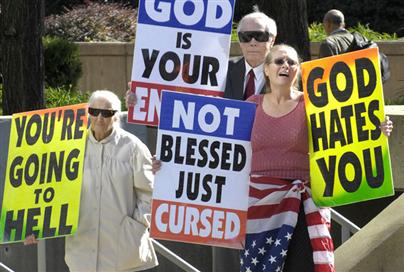
A new article about the hate-centric Westboro Baptist Church confirms what many of my secular, liberal friends and colleagues believe: fundamentalists hate.  Hate seems to be at the core of their fundamentalist identity.

But hate is a tricky thing.  Is it okay to hate the Westboro Church and its horrific tactics?  How about other fundamentalist groups?

Image Source: Top Ten Unbelievable Westboro Baptist Church Protests

Image Source: Top Ten Unbelievable Westboro Baptist Church Protests

The hatefulness of the Westboro sect is hard to deny.  Writing in the Los Angeles Times, Jenny Deam offers a portrait of Westboro refugee Libby Phelps-Alvarez.  Phelps-Alvarez, granddaughter of Westboro founder Fred Phelps, shares a story of cultish indoctrination into the Phelps family business.  You’ve seen the images: soldiers’ funerals picketed by Westboro members holding up signs saying, “God Hates Fags” and the like.

As Deams’ story relates, Libby grew up with the family church.  She began picketing at age 12.  By her late teens, though, according to Deams, “Libby began to wonder: ‘Am I doing the right thing? Should I be telling people they are going to hell?’”

Eventually, Libby left her church and family.  But she seems strangely ambivalent about it. As Deams concludes, “Libby isn’t sure what she believes anymore. She no longer hates homosexuality, but her journey is far from complete: ‘Everyone thinks when you leave you do this 180. It doesn’t work that way.’”

Many other ex-fundamentalists take a much angrier tone.  For some, hating the haters has freed them to engage in their own brand of hatefulness.

Ken Ham has complained recently of vicious verbal attacks on him and his young-earth creationist ministry by groups of atheists.  Ham planned to speak at a Texas homeschooling conference, and Texas freethinkers posted their discussion about their planned response.

Most of their planning revolved around intelligent protests and information-sharing.  Vic Wang of the Houston Humanists made the intelligent point that their protests should not be against religion.  Rather, Wang argued, they should paint Ham as a specific sort of “extremist,” a “crackpot.”

Other speakers took an angrier tone.  “Sister Shayrah” equated creationism and conservative religion with child abuse.    She insisted that religious parents were free to teach their children their beliefs, but that no parent, in any sort of school, could be allowed to use religion as an “excuse for damaging or hurting or indoctrinating your child.”

Shayrah and other participants, such as Neely Fluke, noted that they had been brought up in the world of young-earth creationism and fundamentalist Protestantism.  That has left them angry.

I can’t claim to know what it is like to grow up in the world of fundamentalism.  Many of those who grew up that way, such as Jonny Scaramanga or “Forged Imagination,” have offered compelling insights into their feelings and transformations.

But whatever personal anguish or turmoil these folks may have experienced, it does not make sense in the cold light of cultural politics to use angry, confrontational language.  It doesn’t help.

Indeed, the beneficiary of this sort of anger seems to be Ken Ham himself. He has promoted this anti-Ham video on his blog and website.  As he says to his creationist readers,

Everyone needs to experience this video chat for themselves to get an understanding of the increasing intolerance and aggressiveness of many atheists against biblical Christianity. . . .

And let’s get churches in Texas aware of this intolerance by atheists and publically get out the word, including alerting the Christian media. Pastors should speak out about the increasing intolerance of atheists to their congregations. In fact, these video excerpts should be used by pastors across this nation to warn their flocks about the growing intolerance being directed at Christians and then equip their people to stand against these secular attacks. . . .

So, let’s use this video chat by atheists as a tool to offer some practical teaching about those people who oppose the Bible’s messages.

I can’t claim to know what it was like to be taught the doctrines of young-earth creationism or Protestant fundamentalism.  I understand that I might be angry if I had.  But like any political movement, venting too much spleen against our opponents only fuels the other side.  Hate may feel good sometimes.  It may feel righteous.  But it only digs deeper the culture-war trenches that have divided our country.


Can an Atheist Pray in Greece?

The US Supreme Court has agreed to hear a new public-prayer case.  At issue here is whether a town worked hard enough to include religious diversity in its public prayers.

The town of Greece, New York, outside of Rochester, has been accused of favoring Christianity in its pre-meeting prayers.  The Second Court of Appeals ruled in Galloway v. Town of Greece that the town meeting prayers had favored Christianity over other religions.

According to USA Today, the Arizona-based group Alliance Defending Freedom appealed to the US Supreme Court on behalf of the town.

SCOTUS decided in 1983’s Marsh v. Chambers that legislative meetings can be opened with a prayer, as long as that prayer does not favor one religion, denomination, or sect over another.   The Second Court of Appeals explicitly noted that this case does not challenge that precedent.  “We do not hold,” the court wrote, “that the town may not open its public meetings with a prayer or invocation.  Such legislative prayers, as Marsh holds and as we have repeatedly noted, do not violate the Establishment Clause.”

What is at issue here is whether or not Greece worked hard enough to include religious and non-religious diversity in its opening prayers. The original suit, brought by Americans United for Separation of Church and State, charged that the overwhelming majority of the prayers represented Christianity.

The court granted that the town had the intention to represent a proper diversity of religious beliefs, but in practice, most of the prayers implied that Christianity was the town’s religion.  As the court described, a permissible public-prayer policy must be

inclusive of multiple beliefs and makes clear, in public word and gesture, that the prayers offered are presented by a randomly chosen group of volunteers, who do not express an official town religion, and do not purport to speak on behalf of all the town’s residents or to compel their assent to a particular belief….

In other words, it is not enough for a town to allow a diversity of religion in public prayer.  According to the Second Court of Appeals, in any case, public meetings must work harder to dispel the perceptions of a “reasonable objective observer under the totality of the circumstances” that the town tips one way or another.

Will SCOTUS agree?  Or will they rule that it is enough merely to welcome a diversity of belief?

Update: Cheerleaders Can Love Jesus

Tim Tebow can love Jesus.  But can cheerleaders at a public high school?  A Texas judge ruled this week that they can.

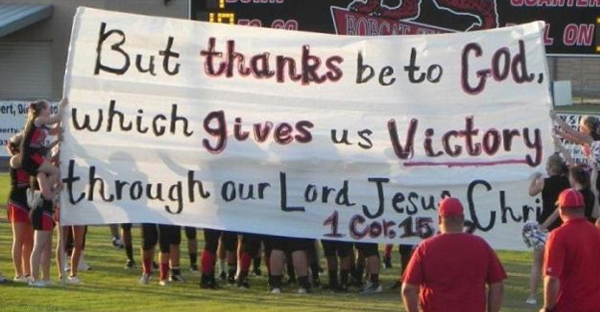
This story has been circulating for several months.  As we’ve reported here on ILYBYGTH, in September the Kountze Independent School District banned high school cheerleaders from displaying Bible-based banners at football games.  Prompted by the Wisconsin-based Freedom from Religion Foundation, the school district worried that such displays violated the Constitution.

Source: KNUE

Source: KNUE

Parents fought back.  They argued that the cheer squad was a student organization, not funded by public dollars.  As such, the students’ religious speech was protected by the Constitution.

Earlier this week, according to a local TV station, District Judge Steve Jones ruled that the cheerleaders should be allowed to continue with their religious messages. 

End of story?  Not quite.  The school district has promised to change its policies, which might give it the right to ban such banners again. 


A Christian Teen Army in Public Schools

“High school Christian teens, Join Us!”

That is the call of a new video promoted by the evangelical Christian group Reach America.

In the video, teenagers ask a series of provocative questions, such as the following:

Why can’t I pray in school?  Why do I have to check my religion at the door?  Why can’t I write about God in my school papers?  Why do I have to tolerate people cursing my God, but I’m not allowed to talk about God and my faith? Why are they taking God out of my history books? Why do they teach every other theory in science besides creation?  Why am I called names because I believe in marriage the way God designed it?

Like many conservative evangelical educational activists, Gary Brown, founder of Reach America, believes that public schools have lost their way.  Beginning with the prayer and Bible SCOTUS decisions in 1962 and 1963, Brown insists, God has been systematically frozen out of schools.  Christian students have been targeted for bullying, indoctrination, and harassment.  Every part of public education is a threat, from pornographic sex education to mandatory dating.

Brown’s answer has been a call for youth engagement.  In the recent video, Reach America teens warn, “People who do not love our God have stolen our country. . . . We are an army.  Christ is our commander. . . . We are in a war for the hearts and souls of our generation.  And we know it.”

This culture-war army can be directed, Reach America promises, by programs such as its new Educational Partnership.  From its headquarters in northern Idaho, Reach America wants to organize a non-school school.  At this “partnership,” students will come to this non-school school every day, September through June.  In the mornings, they will work on academic work.  That work, though, will not come from the non-school, but rather from parent-directed online education or homeschool assignments.  In the afternoons, students will work on the “four Cs:” Christ-Centered Counter-Culture.

So how is this school not a school?  Parents pay tuition.  Students study there.  The program even offers “P.E. and electives.”  Do the Browns avoid calling this a school to avoid legal hassles?  It certainly looks that way.

How big is the program?  Not too big.  According to Brown, twenty-three students are enrolled for the current non-school year.  My guess is that Reach America will attract the attention of scribblers like me with the culture-war rhetoric of this video, but will soon encounter the difficulties that plague every Christian school, even non-school ones.

In any case, the message of the teens’ video is clear.  The way to prevent bullying is to fight back.  As they declare, “America will be one nation under God, again.”