A Conservative Plea for the Common Core

Don’t throw the conservative baby out with the Common Core bathwater. That’s the plea this morning from two leading conservative intellectuals.

Writing in the Weekly Standard, Chester Finn Jr. and Michael Petrilli rally conservative support for the new standards.

As we’ve noted in these pages, all sorts of conservative activists, from Phyllis Schlafly to the Heritage Foundation to the Tea Party, have denounced the centralizing tendencies of the Common Core.

The conservative credentials of Finn and Petrilli are difficult to dispute.  Both have long been leading voices for the movement to introduce market choices into public education and reduce the influence of unions and left-leaning schools of education.  Both have worked in conservative think tanks and conservative political administrations to fight for such measures.

They want conservatives to embrace the Common Core as the best available program to heal public education.  As they argue,

the fact that Obama thinks well of it doesn’t means there’s anything (else) wrong with it. This is understood by the many respected conservatives who back the Common Core, including such scarred veterans of the education-reform wars as Jeb Bush, Bill Bennett, John Engler, Chris Christie, Mike Huckabee, Sonny Perdue, Bobby Jindal, Rod Paige, and Mitch Daniels. They realize that academic standards are only the beginning, setting out a destination but not how to get there. They understand, however, that a destination worth reaching beats aimless wandering—and a big modern country is better off if it knows how all its kids and schools are doing against a rigorous set of shared expectations for the three R’s.

Finn and Petrilli offer three specific ways to use the Common Core to best conservative advantage.  Conservatives, they insist,

should maximize the good it can do and minimize its potential harm. Here are three useful steps:

  • Draw a bright line between the standards and the federal government. (Iowa Senator Chuck Grassley is onto one approach with his proposal to ban any further federal spending related to the Common Core.)

  • Overhaul No Child Left Behind as proposed by Senator Lamar Alexander and House education committee chairman John Kline, in effect rolling back the regulatory regime that has turned results-based school accountability into Uncle Sam’s business. (The tighten-the-screws alternative advanced by Senate Democrats would entangle Washington even further with states’ standards and accountability systems—as well as much more mischief.)

  • Continue to push aggressively in dozens of states for more school choice, both public and private—and allow voucher schools (and maybe charters, too) to opt out of their states’ standards and tests (Common Core or otherwise) if they can present alternatives that are just as rigorous. (Disclosure: the co-authors of this piece are still tussling over this one!)

Finn and Petrilli base their argument on a conservative vision of the recent history of American education.  As I’ve argued in the pages of Teachers College Record, conservative school reform proposals, no less than progressive ones, depend on their own interpretations of American history.

In this case, Finn and Petrilli remind their fellow conservatives that the fundamental ideas embraced by the Common Core, including elevated academic standards as well as rigorous standardized testing, began as conservative responses to a public education system that had strayed from its true mission. In the 1970s, they recount, control over public education had been seized by well-meaning but short-sighted leftists who emphasized equity at the expense of rigor.  After 1983’s Nation at Risk report, bold conservative reformers such as Ronald Reagan, Lamar Alexander, and William J. Bennett took steps to reverse that curse.

The solutions back then included increased public money for private education as well as ambitious new standards.  To lend heft to such standards, iron-clad standardized tests hoped to limit the ways educational bureaucrats could game the system.

The Common Core, Finn and Petrilli insist, represent an imperfect attempt to impose those higher standards.  In the end, by providing better information about school performance to parents and policy makers, the standards will fuel the conservative drive for greater privatization of public education.

So what is a conservative to do?  According to these scholars, the real conservative choice is to back the Common Core.  As they conclude, conservatives who take time to read the standards themselves “will be impressed by their rigor, thoroughness, solidity, and ambition—even their ‘conservative’ nature.”


What’s the Matter with Vermont? Nullification and the Politics of Public Schooling

Vermonters want out.  Some of them, at any rate.

In the pages of The American Conservative, Kirkpatrick Sale reviews a new volume about a surprisingly long-lived secessionist movement in the Green Mountain State.

What do the new nullifiers want?  According to Sale, the freedom-fighters depicted in Most Likely to Secede have several related goals.

Vermonters want to take back control from the federal government in such areas as food policy, gun control, marijuana laws, and, of most interest here, public education.

Learning, according to volume editor and essayist Ron Miller, can be done better in Vermont.  Learning can be liberated from costly and nonsensical federal mandates and standardized testing.

As quoted by Sale, Miller wants “holistic education . . . an educational culture that respects and encourages learning on a human scale, that supports caring and loving communities of learning.”

Such goals, Miller argues, put right-thinking Vermonters at odds with an “authoritarian educational policy” dictated by Washington DC.  Freedom will come from refusing federal dollars, so that Green Mountain schools can be liberated from the mandates of centralizing bureaucrats.

Does nullification stand a better chance in Vermont than it did in South Carolina?

When it comes to education policy, refusing federal dollars is a tall order for cash-strapped states.  This is especially true when the ultimate goal is as mushy as “holistic education.”  Conservatives of all stripes make a politically powerful argument when they advocate for direct local control of schooling, or when they fight to keep objectionable ideas out of local school curricula.

It is much harder to fight for local control when the goals of that control include a new vision of what education can be.  As historian Arthur Zilversmit demonstrated, anything new in schooling faces a brutal uphill battle.  As Zilversmit concluded, most Americans, presumably even in Vermont, share a “strange, emotional attachment to traditional schooling patterns” (page 169).

Independent schools, in Vermont or anywhere else, only stand a chance when they have independent funding.  That will not likely soon be the case for public schools in breakaway Vermont.


Core Wars

What do conservative activists hate about the Common Core State Standards?

A recent essay by conservative commentator Stanley Kurtz in National Review points out some conservative objections.

As we’ve noted recently, conservatives share with progressives a fervent opposition to the CCSS, though usually for different reasons.  Everyone from Phyllis Schlafly to the Heritage Foundation has warned of looming implications for culture, politics, religion, and education.  For those of us trying to understand conservative attitudes toward American education, these diatribes against the CCSS are a good place to start.

Kurtz was responding to an article in the Washington Post about Tea Party objections to the new shared standards.  Obama officials, Kurtz complained, responded with deceptive statements and obfuscation.  In the end, Kurtz argued,

. . . the Tea Party is right when it accuses the Obama administration of nationalizing education standards through the back door. The Founders opposed that for a reason. Once de facto nationalization is achieved, parents will lose their ability to influence their children’s education. Leverage that can be easily exercised at local school-board meetings or through representatives in state legislators will be lost to unaccountable federal bureaucrats (like Lois Lerner), and worse, to the even less accountable private education consortia that are developing the Common Core. So if educators try to impose politicized curricula or “fuzzy” math, parents will have no recourse.

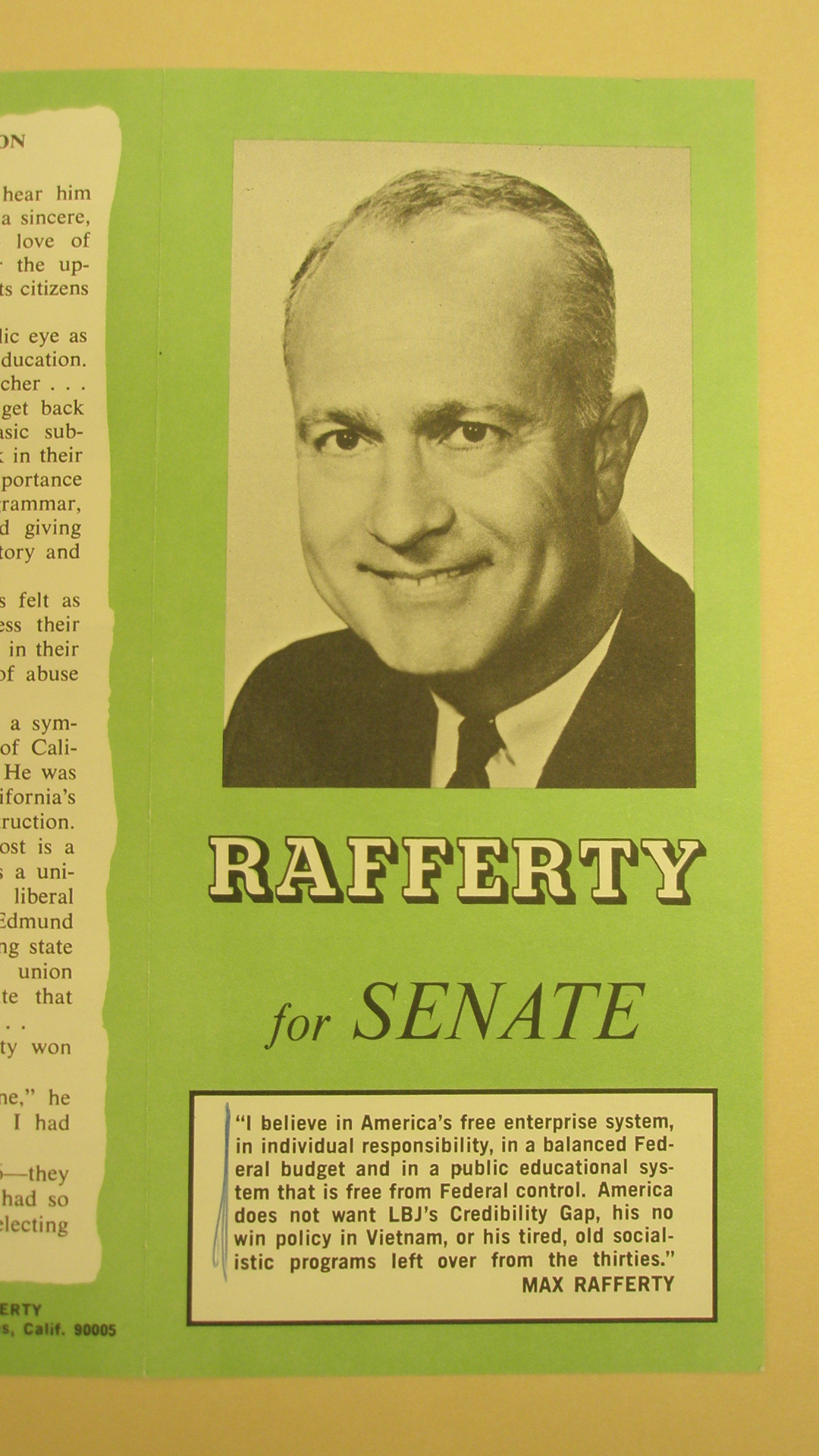
Kurtz’s “local control” argument echoes a long tradition among conservative education thinkers.  Most powerfully, California State Superintendent of Schools Max Rafferty pushed hard during the 1960s to combat increasing federal control.  Rafferty’s colorful prose often made the case more lyrically than I’ve seen it since.

In one speech from the archives,[1] Rafferty articulated a conservative position for local control that I suspect might still be appealing to today’s Tea Partiers.  As he told the California Small School Districts Association Convention on March 8, 1965,

You live and work in an out-of-the-way corner of this county.  A small town where the sky is still blue, where the roar and tension of freeway traffic has not yet penetrated; where a little boy can still run and play in open fields.  You’re there because you want to be.  You moved there deliberately a few years before because you liked that feeling of grassroots independence.  That unique sense of having an equal share in the controlling of one’s own destiny which has been the legacy of every American ever since the first little villages began to dot the New England countryside more than three centuries ago.  You’ve been happy there.  Your children are growing up clear-eyed and self-reliant with that indescribable look of quiet confidence which comes from life spent in a region where hills and trees are very real, very close at hand.  Where a neighbor is a lot more than someone who just happens to live close to you.  Suddenly, something goes wrong at your local school house, as things sometimes do.  Maybe it’s a new course of study which just doesn’t quite fill the bill.  Maybe it’s a neurotic old school administrator, we do run across one now and then!

No matter, you tell yourself, nothing can possibly happen in your community which can’t be solved by you and your neighbors, working and acting together in the traditional American spirit of mutual tolerance and good will.  But this time you’re wrong.  Shockingly, unbelievably wrong!  You and your friends try to arrange an appointment with your district superintendent to tell him of your problems and make your suggestions.  But you don’t have a district  superintendent anymore, in fact you don’t even have a district!  You try to contact your local school board, but it’s gone too!  A hundred miles away, a group of county or state officials meet once a month to decide the destiny of your children.  You don’t know any of them personally, in fact you never even heard most of their names!

But in our nightmare today, they tell you what your children will be studying.  They hire the teachers who will be molding the thinking and the behavior of your children throughout the years that lie ahead.  They decide whether or not the school bus is going to stop near your home or indeed if there is going to be a school bus at all.  Whatever they decide, you’re stuck with.

Rafferty worried about the Elementary and Secondary Education Act, the direct progenitor of No Child Left Behind.  As several of the commentators on Stanley Kurtz’s essay pointed out, the centralization of public schooling can be traced back through several generations of federal leaders, including President George W. Bush.

From the Hargis Collection.

From the Hargis Collection.

But that doesn’t mean that today’s version, the Common Core State Standards, will be greeted with anything but alarm among some sectors of conservative thought.


[1] This speech survives as a typescript in the Billy James Hargis Papers, University of Arkansas Mullins Library Special Collections, MC 1412, Box 48, Folder 2, Public Schools, 1950-1978 (1 of 2).  This collection of papers represents, IMHO, the best single-stop shop for any scholar hoping to understand the career of twentieth-century educational conservatism.  The Reverend Hargis was a leader in the Christian conservative movement in the second half of the twentieth century, and he was an avid collector of newsletters, correspondence collections, and other ephemera that shed a unique light on conservative thinking about education during the period.


Apocalyptic Academics: Conservatives and the Myth of Outrageous Schools

There it is again!

Today we find yet another example of conservative commentators lambasting the outrageousness of public education.  This firmly ensconced tradition of school-bashing doesn’t make much sense to me.  I would think conservatives would want to promote public education in America as one field in which conservative ideas and ideals have taken firm control.

Today’s example comes from the pages of Public Discourse, in an essay by Professor William Jeynes.  The opening paragraph highlights the terrible activism of public schools:

An inquisitive elementary school student asked his teacher, “Is it wrong to steal?” The teacher replied, “I don’t know. What do you think?” This incident in a major midwestern public school alarmed thousands of parents, and reminded myriad others why they value religious private schools: these schools are usually guided by a moral compass for academics and behavior that public schools patently do not offer.

This notion of vaguely outrageous teaching in America’s vaguely described public schools is a dominant theme of conservative talk about public schooling.

Browsers of conservative media hear about high-school students strip-searched during exams, or teachers rewarded for “stomping” on the American flag.

In all these stories, public schools and their teachers loom as out-of-control dictators, blasting away at traditional morality, patriotism, religion, and common sense.

Nor is this theme a new one among conservative pundits.

In the 1980s, for example, commentator Sam Blumenfeld warned readers that “the neighborhood school is controlled by a national educational and bureaucratic hierarchy completely insulated from local community pressures and answerable only to itself.”[1]

In the 1970s, US Representative John Conlan (R-AZ) worked hard to control what went on in public schools.  Debating House Bill 12851 in May, 1976, Conlan advised,

I think one of the things that perhaps the gentleman from Michigan is not aware of is that there is a significant current in education to teach children that there are no values, there is no right, there is no wrong, that everything is relative, and it all depends upon situational ethics.[2]

As I argued in my 1920s book, conservatives in that decade also insisted on the terrifyingly amoral or immoral dominance of public schools.  For instance, one well-funded insurgent group, the Bible Crusaders, warned that public schools had been taken over by a conspiratorial sect determined “to secretly and persistently work to overthrow the fundamentals of the Christian religion in this country.”[3]

In all these tellings, schools and teachers represent insidious threats to traditional values.  As with Professor Jeynes’ recent warning, a single example, often vague or imprecise, is used as proof of the continuing trend of public schools nationwide. For some reason, conservatives have long tended to exaggerate the perniciousness of public schools.

Of course, this is not only a conservative tendency.  Progressives, too, often hyperventilate over isolated examples of conservative influence in schooling.  As we noted recently, for instance, the specter of creationism often looms much larger in the progressive imagination than it does in actual schools.

In the face of such assertions of apocalyptic academics in public schools, more careful scholarship demonstrates that most teaching fits in with local community values.  Political scientists Michael Berkman and Eric Plutzer have noted that most teachers’ values match those of their school and district.[4]

Of course, there always are and always have been some teachers who flout local values.  But such events are newsworthy precisely because they are unusual.  In general, most teachers prefer to avoid controversy.  Most teachers, like most people, try to fit in.  The notion that teachers and schools are out to demolish the values of their students just doesn’t match experience.

Yet conservatives will presumably continue to trumpet examples of outrageous public-school teaching.  To a non-conservative like me, this does not make sense.  I would think conservatives would rather exaggerate the conservative nature of most public education.  These days, talk about public schooling is dominated by demonstrably conservative themes: privatization, competition, and union-bashing, to name a few.

Wouldn’t it make better strategic sense for conservatives to claim all of these as victories?


[1] Samuel L. Blumenfeld, Is Public Education Necessary?  (Old Greenwich, CT: Devin-Adair, 1981), 4.

[2] Congressional Record, May 12, 1976, pg. 13532.

[3] “The Bible Crusader’s Challenge,” Christian Fundamentals in School and Church 8 (April-June 1926): 53.

[4] Michael Berkman and Eric Plutzer, Evolution, Creationism, and the Battle to Control America’s Classrooms (New York: Cambridge University Press, 2010), 199-200.

Teen Rebels, Creationism, and the Real History of Kicking God Out of the Public Schools

The Abington School District v. Schempp (1963) case is not usually remembered as a case of teenage rebellion or creationist science.  But as the man at the center of the case recalled recently in the pages of Church & State, we can’t separate out such issues from the Bible, school prayer, or “The Man in the Gray Flannel Suit.”

Image Source: Wikipedia

Image Source: Wikipedia

As I’ve written in these pages and in the pages of the Journal of Religious History, it is difficult to overestimate the importance of this case for American schooling, religion, and culture.  In its decision, the US Supreme Court decided that public schools must not mandate the recitation of the Lord’s Prayer or the reading of the Bible.  Among many religious conservatives, this decision has taken on enormous symbolic significance as the moment that the United States “kicked God out of the public schools.”  In reality, the decision specified that religion still belonged in public schools.  It was only teacher-led devotional religion to which the Court objected.

Ellery Schempp, who went on to a highly successful career as a physicist, remembered his teenage decision to contact the American Civil Liberties Union to protest his treatment in his Pennsylvania public high school.

As Schempp recalled, his protest came partly from principle, and partly from “teen rebellion.”  The sixteen-year-old Ellery resented being squeezed into a conformist mold.  Schempp recalled his lightbulb moment:

“It was one day when some kid read Genesis in 10th grade,” Schempp continued. “I thought, ‘This is nonsense; this does not fit with the science that I know.’ I began to pay more attention.

For those like me who hope to understand the meanings of conservatism and conservative religion in American education, Schempp’s memories offer two important reminders.

First, we must keep in mind that we cannot easily separate out issues such as Bible reading, prayer, evolution, sex ed, or progressive pedagogy.  For activists and pundits on both sides of these culture-war divides, there is no bright line dividing them.  In this case, we see that the young Schempp was offended both by the Christian heavy-handedness of his school’s policy and by the anti-science of Biblical creationism.

Second, we must never forget the hidden vector of school issues: youth.  In most cases, protagonists such as the young Schempp are not only activists, they are young activists.  In his memories, at any rate, Schempp protested against the implied coercion to become another cog in the soulless wheel of American corporate governance.  As Schempp recalled, “There was enormous pressure to conform as the greatest goal in life – to be ‘The Man in the Gray Flannel Suit.’”  Fighting against this conformist compulsion was just as important a motivator as any civil-liberties principle.

Of course, folks like me sometimes assume that all teen rebellion must push against revealed religion and social traditions.  But we must remember that teenage pushback often pushes back in a variety of directions.  As we’ve noted before, in some cases conservative young Christians rebel by embracing a much more radical young-earth creationism than do their moderate Christian parents.

In whatever direction young people rebel, the youthfulness of that protest must be part of our analysis.  We can’t forget that schools are full of a specific type of people—young people.  As such, they may have very different attitudes and perspectives than the rest of their families.  They may be more likely to protest against traditional religion, OR more likely to fight for more traditional religion.

Phyllis Schlafly Blasts the Common Core

Don’t do it, Phyllis Schlafly warned states recently. Don’t fall for the hoopla about the new Common Core State Standards.

Schlafly is often best remembered for her successful campaign to block the Equal Rights Amendment in the 1970s. But as historian Don Critchlow has argued, Schlafly’s career was about much more than just the ERA.  An examination of Schlafly’s activism can tell us much more about the changing face of “conservatism” in the twentieth century.

Image Source: Christian Post

Image Source: Christian Post

Now Schlafly has joined the chorus of conservative anti-CCSS voices.  As we’ve noted earlier here at ILYBYGTH, conservatives join many progressives in lambasting the new unified state standards, but usually for different reasons.

Writing in the pages of the Christian Post, Schlafly offers conservative parents and voters solidly conservative reasons to get up off the couch and take an interest in their local schools’ new curricular guidelines.  “Common Core,” Schlafly warns, “means federal control of school curriculum, i.e., control by Obama administration left-wing bureaucrats.”

The standards will not improve students’ academic performance, Schlafly argues. Nor will they achieve their trumpeted goal of making all students “college ready.”  Rather, these new standards represent only the latest left-wing drive to transform the United States into a “totalitarian government.” In Schlafly’s words,

Common Core means government agencies will gather and store all sorts of private information on every schoolchild into a longitudinal database from birth through all levels of schooling, plus giving government the right to share and exchange this nosy information with other government and private agencies, thus negating the federal law that now prohibits that.

Everything about the standards is “encrusted with lies,” Schlafly insists. The suggested content itself predictably indoctrinates students toward leftist ideas and policies. As conservatives have warned for decades, the suggested readings even veer into the “pornographic.”

So what is a conservative to do? According to Phyllis Schlafly, the new Common Core State Standards represent only the latest effort by leftist federal bureaucrats to seize control of children’s minds. Any red-blooded American must shudder at the implications.

A Christian Teen Army in Public Schools

“High school Christian teens, Join Us!”

That is the call of a new video promoted by the evangelical Christian group Reach America.

In the video, teenagers ask a series of provocative questions, such as the following:

Why can’t I pray in school?  Why do I have to check my religion at the door?  Why can’t I write about God in my school papers?  Why do I have to tolerate people cursing my God, but I’m not allowed to talk about God and my faith? Why are they taking God out of my history books? Why do they teach every other theory in science besides creation?  Why am I called names because I believe in marriage the way God designed it?

Like many conservative evangelical educational activists, Gary Brown, founder of Reach America, believes that public schools have lost their way.  Beginning with the prayer and Bible SCOTUS decisions in 1962 and 1963, Brown insists, God has been systematically frozen out of schools.  Christian students have been targeted for bullying, indoctrination, and harassment.  Every part of public education is a threat, from pornographic sex education to mandatory dating.

Brown’s answer has been a call for youth engagement.  In the recent video, Reach America teens warn, “People who do not love our God have stolen our country. . . . We are an army.  Christ is our commander. . . . We are in a war for the hearts and souls of our generation.  And we know it.”

This culture-war army can be directed, Reach America promises, by programs such as its new Educational Partnership.  From its headquarters in northern Idaho, Reach America wants to organize a non-school school.  At this “partnership,” students will come to this non-school school every day, September through June.  In the mornings, they will work on academic work.  That work, though, will not come from the non-school, but rather from parent-directed online education or homeschool assignments.  In the afternoons, students will work on the “four Cs:” Christ-Centered Counter-Culture.

So how is this school not a school?  Parents pay tuition.  Students study there.  The program even offers “P.E. and electives.”  Do the Browns avoid calling this a school to avoid legal hassles?  It certainly looks that way.

How big is the program?  Not too big.  According to Brown, twenty-three students are enrolled for the current non-school year.  My guess is that Reach America will attract the attention of scribblers like me with the culture-war rhetoric of this video, but will soon encounter the difficulties that plague every Christian school, even non-school ones.

In any case, the message of the teens’ video is clear.  The way to prevent bullying is to fight back.  As they declare, “America will be one nation under God, again.”


Kruse-ing to Conservative Schools

For those of us who follow conservative education policy and ideology, Dennis Kruse of Indiana has been one to watch lately.  Senator Kruse chairs the state senate committee on education and career development.

In December, Kruse attracted our attention with his promise of a new “truth-in-education” bill.  This bill would allow students to question their teachers on any controversial subject.  Teachers would be legally responsible to provide evidence supporting his or her classroom content.

Recently, we discovered a helpful way to track the legislative ambitions of this conservative leader.  The Indiana State Senate website allows anyone to view legislation introduced or sponsored by any legislator.

A review of Kruse’s 2013 activity shows us the educational vision of this particular conservative, at least.  For example, this busy senator has authored bills to support prayer in charter schools, to declare that parents have supreme rights concerning their children, and even to mandate the teaching of cursive in Indiana public schools.

Of course, many of these bills will never see the light of day; many are simply political discussion starters.  But even as such, the vision of America’s schools demonstrated by Senator Kruse’s ambitions can tell us a great deal about what conservatives want out of education.  If somehow Senator Kruse became Supreme Emperor Kruse, we can imagine an education system in which religion played a leading role.  It might also be a school system where students learned traditional skills such as writing cursive.  Parents might be empowered to insist on curricula friendly to their religious backgrounds.

Kruse’s 2013 legislative record also demonstrates the tight connections—among conservatives like Senator Kruse—between educational conservatism and a broader cultural conservatism.  In addition to his school bills, Senator Kruse has supported bills to have mandatory drug testing for all state assistance recipients and to provide every abortion recipient with explicit information about the dangers and risks of abortion.

This tightly bundled conservatism demonstrates, IMHO, the need to understand conservatism broadly.  Too many commentators focus on high-profile issues such as creationism or school prayer in isolation.  By instituting better science standards, for instance, some progressive types think they can derail conservative policy.  Such one-issue reforms will not have much impact unless they recognize that educational conservatism is bigger than any one issue.

So what do conservatives want out of America’s schools?  In the case of Senator Kruse, at least, outsiders like me can see an explicit legislative program.

Who Owns the Children?

Do parents own their children?  Does the government?

A recent MSNBC promo has put this perennial conservative issue back in the headlines.  Glenn Beck, Sarah Palin, Rush Limbaugh, and others have denounced the sentiments of the ad.

Yesterday conservative pundit Glenn Beck accused liberal-leaning MSNBC of finally exposing their “radical goals” to steal children from parents.  The plan all along, Beck argues, has been for “progressives” to seize government control of the most intimate family decisions.

The specific MSNBC promo to which Beck objected contained this ideological smoking gun:

We have never invested as much in public education as we should have because we’ve always had kind of a private notion of children. Your kid is yours and totally your responsibility. We haven’t had a very collective notion of these are our children. So part of it is we have to break through our kind of private idea that kids belong to their parents or kids belong to their families and recognize that kids belong to whole communities.

This thirty-second promo by Melissa Harris-Perry contains the proof that liberals want to take children away from their parents and raise them in dysfunctional public schools.  His fears, Beck insisted, had been proven right by this “terrifying” video.  Though he recognized he might be called a “conspiracy theorist,” Beck insisted that this short video contained all the proof he needed of a vast left-wing plot to steal children into indoctrination centers.

Sarah Palin chimed in too, tweeting that MSNBC’s notion that children don’t belong to parents was “Unflippingbelievable.”

Rush Limbaugh predicted that soon children could be forced to mow everyone’s lawns, not just their own.  This notion, Limbaugh concluded, was as “old as communist genocide.”

The idea that “progressives” have set their sights on sneakily seizing control of America’s children has long ideological roots.

Back in the 1970s, for example, the influential conservative activists Mel and Norma Gabler asked fundamental questions about the nature of the textbooks under consideration in their home state of Texas:

To WHOM does the child belong?  IF students now belong to the State, these books are appropriate.  IF students still belong to parents, these books have absolutely no place in Texas schools.  The author clearly states that these books are designed to change the behavior, values, and concepts of the child, based on the premise that the teacher is NOT to instruct, but to moderate, and to ‘heal.’ [Gablers, What Are They Teaching Our Children, pg. 119]

Similarly, Connie Marshner, affiliated at the time with the Heritage Foundation, argued in 1978, “A parent’s right to decide the direction of his child’s life is a sovereign right, as long as the child is subject to his parent.  Educators have no business creating dissatisfaction with and rebellion against parental wishes” (Connie Marshner, Blackboard Tyranny, pg. 38).

But such notions go back much further in the conservative consciousness.  One leading conservative activist in 1951 Pasadena warned a state senate investigating committee that the root cause of public school problems was “a definite elimination of parental authority, undermining of parental influence.”

And back in the 1920s, the US Supreme Court ruled that parents had a right to educate their children in private schools if they chose.  The reason, the court ruled in Pierce vs. Society of Sisters (1925), is that “The child is not the mere creature of the state.”

Beck’s, Palin’s, and Limbaugh’s outrage are nothing new.  Conservative activists have long been convinced of a far-reaching plot to substitute state control of children for that of parents.


Do Conservatives Want the Government to Tell Americans What to Do?

Preschool or Parents?

That’s the question education pundits from the Heritage Foundation have been asking lately.  To a non-conservative outsider like me, this question raises key questions about the goals of conservative education policy.  It seems as if Heritage Foundation writers want both a less intrusive government and a more intrusive government.

Don’t get me wrong.  I understand that there are different sorts of conservatives, all of whom may have very different visions of the good society, good education, and the proper role of government.  I’ve read the work of historians such as George Nash who have chronicled the post-World War II tensions between libertarians and social conservatives.  But in this case, it seems as if one conservative organization—a small-government conservative organization—is calling for a big-government solution to education dilemmas.

Here is the recent confounding case: In light of President Obama’s recent call for universal, government-funded preschool, Heritage writers have renewed their push for a different vision.

Lindsey Burke and Rachel Sheffield of the Heritage Foundation insist that government-funded schooling is not the effective or ethical way to improve school achievement.  The obvious answer, Burke and Sheffield write, is to improve families.

They cite research to prove that programs such as Head Start have not been effective.[1]

They also note studies that tie school achievement to stable family structures.  As Burke and Sheffield argue,

 “A stable family, with married parents, provides the best foundation for a child’s academic success. Children raised in intact families are more likely to graduate from high school and more likely to attend and complete college than their peers raised in single-parent or blended families[30] They also score higher on reading and math, and exhibit fewer behavioral problems in school[31] A stable family also prevents a variety of other risk factors that would derail a child’s future success[32]

“However, over 40 percent of children are born outside marriage in America today. These figures are much higher among minorities: 72 percent among African Americans and 53 percent among Hispanics, while 29 percent among whites. Unwed childbearing is the greatest driver of child poverty today. Children in single-parent families are nearly six times as likely to be poor compared to their peers born in married-parent homes[33] Additionally, children in non-intact families have poorer academic performance and are at greater risk for dropping out of school, becoming antisocial and delinquent, and parenting a child outside marriage. These outcomes persist even after controlling for income.34” [N.b., there was no link in original for note 34. It referred readers to the same source as note 33.]

In this excerpt, Burke and Sheffield refer to three earlier Heritage-Foundation research articles: see here, here, and here.  I followed up on those sources, and found that the research came largely from peer-reviewed academic journals such as Journal of Marriage & Family and Social Forces.  (Without a library membership, it can be difficult to access these sources.  However, most public libraries have an EBSCO-or-similar database subscription that will allow readers access to these small-circulation academic journals.)

One conclusion that could be drawn from this is that the government needs to encourage families to stay together.  The public-policy goal would be obvious: if intact families improve school performance, then the government has a compelling interest in promoting stable families.

Burke and Sheffield avoid that conclusion.  Instead, they suggest that government should eliminate or reform Head Start, stop mandating government preschool, and reform existing preschool programs before expanding into new ones.

But other Heritage voices have taken a different approach.  Robert Rector, in 2012 a Senior Research Fellow in the Domestic Policy Studies Department at The Heritage Foundation, argued—in a study cited by Burke and Sheffield—that government should indeed engage in what Rector called a

broad campaign of public education in low-income areas. This campaign should be similar in scope to current efforts to convince youth of the importance of staying in school or to inform the public about the health risks of smoking. While the costs of such an effort would be small, its impact could be considerable.”

Rector also suggests concrete policy suggestions to strengthen families, such as increasing the tax benefits to married couples with children.

I honestly don’t mean to be snarky when I ask this next question; I am truly confused.  Do small-government conservatives such as Heritage’s Robert Rector really want the government to tell people how to regulate their intimate lives?

Heritage’s Derrick Morgan offered what seems to me an awkward patch of these conflicting sentiments a few months ago.  Small government was the answer, Morgan wrote.  But smaller government must also promote “traditional values” as part of its goal to shrink its own purview.

When it comes to education policy, this just doesn’t add up.  Small-government goals of privatized education, smaller government-funded programs, and fewer government education standards seem consistent.  Even if I don’t agree with them, I can see their logic.  But I don’t understand how Heritage’s conservative thinkers connect these goals with a simultaneous government intrusion into the most private, intimate decisions Americans make.

Hostile critics, I think, would assume that Heritage wants to impose government mandates on poor and powerless Americans, while allowing richer and more powerful citizens to enjoy freedom from government interference.  That seems a little simplistic, especially for the sophisticated thinkers preferred by the Heritage Foundation.

But is it true?  Does the Heritage Foundation suffer from—at best—confused ideology about education?  Or, at worst, is Heritage cynically promoting intrusive government for the poor, and small government for the rich?


[1] Here I think Burke and Sheffield need to be more careful.  The reference they cite was actually to a 2010 study, one that reports significant positive effects of 3- and 4-year-old Head Start problems.  But from the text of their article, I gather the authors meant to reference a more recent 2012 follow-up, in which few long-term differences were found between children who attended Head Start and those who did not.