Conservatives and the Common Core

What do conservatives think about the emerging Common Core State Standards?

As with any question, ask a hundred conservatives and you’ll likely get a hundred different answers.
However, some distinct themes have emerged in recent months.

First, many conservative politicians and activists object to the Common Core’s implications for the creeping expansion of government.  Some insist that the standards add another layer of inaccessible, distant, controlling, expensive central control.

Second, conservatives object that the new national standards chip away at parental control of children’s education.  With greater central control, parents and responsive local governments will lose that much more ability to control directly what goes in their local public schools.

Both of these are storied conservative protests against the trends in public education.

Before we examine these themes and their histories, let’s look at the CCSS themselves.  So far, forty-five states, plus the District of Columbia and Department of Defense schools have adopted these standards.  Supporters of the CCSS insist these are not imposed by the federal government, but rather created jointly by state education officials.  The reasons for such standards are many, according to supporters.  In the words of the CCSS Initiative,

“High standards that are consistent across states provide teachers, parents, and students with a set of clear expectations that are aligned to the expectations in college and careers. The standards promote equity by ensuring all students, no matter where they live, are well prepared with the skills and knowledge necessary to collaborate and compete with their peers in the United States and abroad. Unlike previous state standards, which were unique to every state in the country, the Common Core State Standards enable collaboration between states on a range of tools and policies.”    

Conservatives are not the only ones to dispute these claims.  Progressive critics (see one example here) often lament the new standards’ failure to consider adequately individual student situations.  Some progressives call the standards a greedy corporate power grab.  Others lament the goal of squeezing all young minds into a procrustean bed of regurgitative multiple-choice testing instead of pursuing the more difficult goal of authentic learning for real students.  Alfie Kohn, for instance, insisted that national standards would “squeeze the life out of classrooms” by mandating one-size-fits-all education, dictated by self-seeking corporate interests.

When conservative activists and pundits critique the CCSS, it is usually on different grounds.  Writing for the Heritage Foundation, for example, Lindsey Burke warned, “The push for centralized control over what every child should learn has never had more momentum.”  CCSS, which Burke called “national standards,” represented a “challenge to educational freedom in America.”  Implementation of the standards would be expensive, Burke pointed out.  Even worse, these standards reversed the proper structure of education.  Instead of more and more central control, Burke argued, “Education reform should give control over education to those closest to students.”

The Heritage Foundation’s Rachel Sheffield praised state lawmakers who pushed to exit the CCSS.  In Indiana, for instance, conservative state lawmakers have proposed a bill to put the CCSS on hold.  One of the requirements of Indiana’s Senate Bill 193, for instance, will be to include parent members on the standards committee.  Another will be to allow any parent to challenge their children’s standard-based high-stakes test results.

These themes—federal overreach and parental control—have long been central to conservative educational activism.

As we’ve noted, agitation against federal intrusion into the local politics of education has been an important element of conservative educational activism since at least the 1940s.  Though it might come as a surprise to some, before the 1940s many conservatives endorsed increased centralization of education policy, as Douglas Slawson has noted in his excellent book The Department of Education Battle, 1918-1932.

The second conservative worry about CCSS also has a long history.  Conservative pundits have argued for decades that parents need more control over their children’s education.  Back in the 1960s, conservative educational leader Max Rafferty insisted, “Children do not belong to the state. They do not belong to us educators, either. They belong to their parents and to nobody else.  And don’t you forget it.”  (Source: Rafferty, On Education, pg. 9)
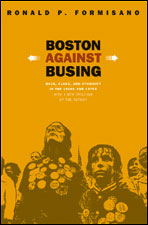
Note one protester's button: "Parent Power"

Note one protester’s button: “Parent Power”

These conservative concerns spanned the country and the decades.  As historian Ron Formisano noted in his landmark 1991 history of Boston disputes over forced busing, parents insisted on their fundamental rights to determine their own children’s educational careers.  As anti-busing leader Louise Hicks fumed, “If under a court order a child can be forcibly taken from his parents into unfamiliar, often hostile neighborhoods, then we shall have opened a pandora’s box of new, unlimited government powers” (pg. 192).

Similarly, President Reagan insisted in 1983, “I believe that parents, not Government, have the primary responsibility for the education of their children.  Parental authority is not a right conveyed by the state; rather, parents delegate to their elected school board representatives and State legislators the responsibility for their children’s schooling.”  (Source: Catherine Lugg, For God and Country, pg. 136).

Across the spectrum of conservative belief and activism, we hear similar echoes.  In 1989, for instance, creationist leader Ken Ham warned that “Most parents have left the training of their children to the church, school or college.”  No wonder, Ham argued, that children embraced anti-God theologies.

So when conservatives in 2013 warn that CCSS will undermine parental control, they draw on a rich tradition of conservative thought and activism.  Schools must remain on a tight leash, many conservatives have insisted over the years.  If allowed too much power, centralizing educational authorities will take over.


What Do You Want Your 7-Year Old to Learn about Lynching?

A story yesterday from Jacksonville, Florida raises some difficult questions about what we want to teach our children.

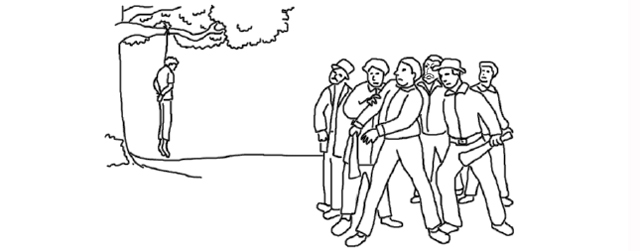
According to News4Jax.com, a parent of a second grader complained at the coloring book his child brought home.  The coloring book, “Who Was Jim Crow?” by edhelper.com, included some disturbing racial imagery.  Not least shocking was a picture of a crowd lynching a victim.

Image source: News4Jax.com

Image source: News4Jax.com

As a historian, I think we need to teach young people the sometimes-disturbing story of America’s past.  But this sort of classroom material raises all sorts of questions:

  • How old do Americans need to be to learn about racial stereotyping?
  • How should students be taught about America’s history of racial violence?
  • Should teachers be using cheap on-line teaching materials like this?  Even if the school board approved them?
  • Is this an example of racial political correctness gone wild?  Or is this an example of classroom racism?
  • Can offensive racial stereotyping ever make good teaching materials?

Do Georgians Hate Gay Kids?

About a week ago, an article in the New York Times drew attention to a report about anti-gay discrimination in tax-funded private schools in Georgia.  Though liberal groups such as Americans United for Separation of Church and State have publicized the findings, responses from conservative America seem more muted.  I wonder if this lack of indignant defenses from conservatives results from the implicit connection between this issue and racial discrimination.

The report from the Southern Education Foundation warned that of the 400+ Georgia private schools that receive tax-funded scholarship money, 115 schools discriminate openly and explicitly against homosexuality.

The report included policy statements from several such schools.  For instance, according to the report, the parent/student handbook at Shiloh Hill Christian School in Kennesaw warned that any student who said, “I am gay,” “I am a homosexual,” or a male saying, “I like boys,” could be expelled.  Another school statement quoted in the report warned,

“In accordance with the Statement of Faith and in recognition of Biblical principles, no ‘immoral act’ or ‘identifying statements’ concerning fornication, adultery, homosexuality, lesbianism, bisexuality, or pornography, will be tolerated.  Such behavior will constitute grounds for expulsion. . .”

These schools all receive funding from student scholarship organizations (SSOs).  SSOs, active in eleven states, according to the New York Times, allow taxpayers to divert taxes dollar-for-dollar to these scholarship organization.  Instead of paying their money in taxes, in other words, taxpayers can pay for students to attend private schools.

How have conservatives defended the program?  Fairly quietly, it seems to me.  Perhaps my antennae are simply not sensitive enough, but I have not read many endorsements of the Georgia program.  This is surprising, since other school-funding options such as charter schools and school vouchers usually draw vociferous defenses from conservatives.

There have been some arguments in defense of Georgia’s policies.

In a post on First Things’ First Thoughts blog, for example, Joseph Knippenberg made a religious-liberty defense of the Georgia program.  First, Knippenberg argued, taxpayers ought to have control over their tax dollars, to some extent.  Until their money enters the public treasury, it is still private, Knippenberg pointed out.  Therefore, choosing to donate to certain schools must be considered in the same category as choosing to donate to certain churches, or hospitals, or advocacy organizations.

Second, Knippenberg extended this argument to people’s right to practice their religions freely.  “To deny people the opportunity to make a contribution to the faith of their choice,” Knippenberg wrote, “is to deny their religious freedom.”

It seems there are other arguments conservatives could make.  As one commenter on a Christianity Today blurb noted,

“Sexual preference or orientation is not a person. It is not unjust discrimination to discriminate between acts, including sexual acts that respect the personal and relational essence of the human person and are thus acts of authentic Love, and acts, including sexual acts, that do not respect the personal and relational essence of the human person and are thus demeaning.”

These comments from “Kathleen” articulate a deeper possible defense of Georgia’s policies.  Though I personally agree that Georgia’s tax money ought not fund schools that discriminate against homosexual students, let me try to spell out this possible argument a little bit.

Here goes:

The argument against Georgia’s tax-funding scheme implicitly uses the history of racial school discrimination to discredit the current policy of religious school discrimination.  It fudges the difference.  This implied analogy does not hold water.

All schools, all people, all organizations discriminate.  Any school that admits some people and does not admit others discriminates.  In some cases, private schools discriminate openly against people who can’t or won’t pay their tuition.  And this sort of discrimination raises no objections.

The issue, then, is which sorts of discrimination are legitimate.  On the whole, Americans agree that discrimination by race is not legitimate.  Of course, there are plenty of white- and black-supremacist holdouts.  In general, however, in terms of constitutional law and explicit policy practice, America has abjured its white-supremacist past of schools segregated legally by race.

To imply that all school discrimination belongs in the same moral, legal, and Constitutional category as racial discrimination unfairly smears religious dissenters as bigots.

Again, just to ward off misunderstanding, let me be clear: I’m playing devil’s advocate here.  In this case, I personally believe that public money should not fund private schools that discriminate against homosexuality.

But intelligent scholars have pointed out the flaw in the “bigotry” analogy.

In an essay on Public Discourse a few months back, Princeton’s Robert George assailed the tendency to label all forms of discrimination “bigotry.”  Speaking in regard to the definition of marriage, George argued,

“Thus, advocates of redefinition [of marriage] are increasingly open in saying that they do not see these disputes about sex and marriage as honest disagreements among reasonable people of goodwill. They are, rather, battles between the forces of reason, enlightenment, and equality—those who would ‘expand the circle of inclusion’—on one side, and those of ignorance, bigotry, and discrimination—those who would exclude people out of ‘animus’—on the other. The ‘excluders’ are to be treated just as racists are treated—since they are the equivalent of racists. Of course, we (in the United States, at least) don’t put racists in jail for expressing their opinions—we respect the First Amendment; but we don’t hesitate to stigmatize them and impose various forms of social and even civil disability upon them and their institutions. In the name of ‘marriage equality’ and ‘non-discrimination,’ liberty—especially religious liberty and the liberty of conscience—and genuine equality are undermined.”

Similarly, Peter Berger noted the increasing tendency of homosexual-rights advocates to frame their arguments as matters of rights.  As Berger wrote in The American Interest,

“At the time [the 1950s] homosexual rights were advocated by a discourse of individual freedom, basically freedom to choose one’s values and way of life. In other words, the discourse was in terms of the first amendment to the US constitution. The discourse now is very different: Homosexuality is not a choice, but a destiny—an individual does not, cannot choose to be gay—one is born gay—and society should acknowledge and respect this congenital fate. I think it is very clear why this change in discourse occurred: If homosexuality is destined not chosen, it is analogous to race—and thus the movement for homosexual rights can wrap itself in the mantle of the Civil Rights movement. Let me reiterate: I have identified all along with the insistence on the rights of homosexuals, and I think I understand the rhetorical logic of the changed discourse. Is it based on good scientific evidence? I don’t know.”

In other words, if conservatives hope to maintain schools—even private schools, even religious schools—that discriminate against homosexual students, it will be imperative for conservatives to reframe this issue.  If Americans see Georgia’s funding of anti-homosexual schools as a fair analogy to public funding of anti-African American schools, the writing is on the wall.  Such racial discrimination no longer musters any public support.

Arguing that this is an issue of religious freedom will not be enough.  Conservatives must do more than just argue that discrimination against certain lifestyle choices is a legitimate part of their religious freedom and expression.  After all, religious freedom has been abridged in the quest for racially desegregated schools.  Conservatives, it seems to me, must do what Professor George advocates: break the intellectual connection between discrimination on the basis of race and discrimination on other bases.  Only if discrimination against homosexuals is seen as a legitimate option—even by those who do not agree—will religious institutions manage to maintain such policies.

Lesbians and Libraries: We’re All Victims Now

The recent fuss over Patricia Polacco’s In Our Mothers’ House has followed a familiar pattern.  First, a mother from conservative Davis County, just north of Salt Lake City, complained when her daughter brought the book home from her school’s library.  The book celebrates a family with two mothers and three children.  Next, the school district decided to keep the book, but put it behind the library counter.  Students would need a parent’s permission to check out the book.  Finally, the American Civil Liberties Union sued, claiming the book must be freely available for all students.

In this case as in so many others, both sides rushed to insist on their own victimhood.

Both sides make the customary arguments.  The ACLU fights for First Amendment freedom.  In the words of one ACLU blogger,

“Removing library books because they ‘normalize a lifestyle that parents don’t agree with’ or contain positive portrayals of LGBT protagonists violates the First Amendment rights of all students to access ideas in a school library on a viewpoint-neutral basis.” 

Conservative Christians claim the books are part of a widespread conspiracy—the “homosexual agenda”—to teach children in public schools that all sexual lifestyles are equally valid.  In this case, opponents of the book cite Utah law, which they say forbids school curricula that promote homosexual lifestyles.

Just as predictably, both sides depicted themselves as the victims.  Consider the author’s defense.  Polacco, writing on the ACLU’s blog, told the story of the book’s origins:

“One year I was visiting a fourth grade class and the teacher had arranged for me to hear essays that her students had written entitled: ‘My Family.’ . . . one little girl stood up and began to read. She was immediately asked to take her seat by an aide. The aide said scornfully, ‘No dear…you don’t come from a real family…sit down!’

“This child came from a family of two mothers and two adopted siblings. I was so appalled and insulted on that child’s behalf that I immediately, after school that day, went back to my hotel room and wrote, In Our Mothers’ House.”

From the other side, one commenter on a conservative Christian website asked, “Does the ACLU also require that Bibles be on the shelves!”  Another lamented, “Law suit by law suit [the ACLU] are coarsening the moral fabric of America, and our children are the victims!”  A third chimed in, “I don’t hate these people [i.e. homosexuals] & if they want to live this way that’s their business but don’t try to push it on the rest of us!! God help them!!”

Clearly both sides in this school-library dispute focus on their own victimhood.  The ACLU insists that hiding such books behind library desks hurts families.  Polacco argues that treating some families as illegitimate hurts children.  Conservative Christians, for their part, worry about the creeping influence of the ACLU.  Conservatives fret that they have no voice in public institutions.  Their books, most notably the Bible, have been “kicked out,” while books that denigrate traditional lifestyles and morals are promoted.

Neither side publicly notices their own strengths.  We will not hear conservative Christians gloating over the Christian-friendly policies of this Utah school district.  Nor will we hear ACLU types celebrating the power and influence of their national watchdog presence.

Does the rush to victimhood matter?  Only in the sense that a cornered animal fights the fiercest.  By reassuring ourselves that we are the true victims, we condone any escalation in culture-war rhetoric or strategy as a matter of simple self-defense.  If we are all victims, we all have the moral high ground; we all have license to fight dirty.

Fundamentalists Against CATCH

The headlines say it all.  Concerned Women for America’s article announces, “New York City Schools: Reading, Writing, and Morning-After Pills.”  The Family Research Council denounces “New York’s Deadliest CATCH.”

The Family Research Council’s Take on “the Deadliest CATCH”

Sifting through the arguments from these prominent conservative organizations will give us some insight into what religious conservatives dislike about New York City’s Connecting Adolescents to Comprehensive Health (CATCH) program.  As the CWA headline suggests, the program expands the district’s free-condom program to include birth control pills and “morning-after” pills.  As ILYBYGTH has reported, the NY Board of Health has insisted that a very low rate of parent opt-out suggests that most parents find the program inoffensive.

Fundamentalists beg to differ.

Both CWA and FRC point out the absurdity of a school system in which parents must provide copious paperwork in order for schools to provide basic medicine for schoolchildren, yet those same schools will administer Plan B pills without parental notification.  As the FRC briefing notes, “The same nurse’s office that demands a parents’ note for aspirin will be in the position to administer high (and potentially dangerous) doses of hormones to children as young as 14 without so much as a permission slip.”

Such contradictions, both groups insist, indicate the plan is both dangerous and insidious.  “Suppose [a student] has severe side effects from the pill but is afraid to tell her parents?”  CWA’s Brenda Zurita asks.  “It’s late at night or perhaps a weekend, what will she do? Who will she call?. . . Let’s pray that no young girl will die due to complications she was afraid to tell her parents about after she was encouraged at school to hide her sexual activity from her parents.”

Also worrisome, according to both reports, are the results of increased sexual behavior among teen-age girls.  The FRC report cites a 2010 study that finds such birth-control medications increase STIs among young women.

According to the FRC, the root of this problem is an inverted understanding of the proper role between parents, children, and government.  The FRC describes the “Nanny State” ideology at play: “If moms and dads can’t be trusted to ensure that their kids are eating well, then they certainly can’t be trusted with decisions about sex and abortion. So the government takes away chocolate milk because it’s too fattening–only to turn around and give kids the morning-after pill, which can really kill.”

Concerned Women for America’s Zurita agrees.  This program, Zurita insists, is yet another example of an “out-of-control bureaucracy.” “It is frightening and tragic,” Zurita warns, “that there are parents who do not care what their children are doing, and with each example of government intruding between parents and children, this story is fast becoming the norm.”

Finally, CWA’s Zurita raises a powerful point.  The NYC Board of Health has claimed that a low parental opt-out rate means this program is not upsetting parents.  But as Zurita notes, many parents could simply be unaware of the program.  Since when do schools assume that every announcement sent home with students has been dutifully delivered to parents?  With non-controversial notices such as bad report cards, students are required to return parent signatures to prove that parents actually saw the notice.  But with a more profoundly morally complex notice such as this, the school district simply assumes that students shared the information with parents?

In the eyes of these fundamentalist activist organizations, something stinks with New York’s CATCH.

CATCH-ing Up and Opting Out

ILYBYGTH reported yesterday on a new pilot program in New York City high schools.  The program, Connecting Adolescents to Comprehensive Health, or CATCH, will expand the district’s condom-distribution program to include birth control pills and “morning-after” pills.

This morning, we read Catholic League President Bill Donohue’s denunciation of this “imperial edict” in an interview in the Christian Post.  “Whenever it comes to sensitive issues such as sexuality, the government must  always play an ancillary role to that of parents,” Donohue told the CP. “The provision  that parents can opt out smacks of governmental arrogance and must be resisted:  the government has no business eclipsing parental rights.”

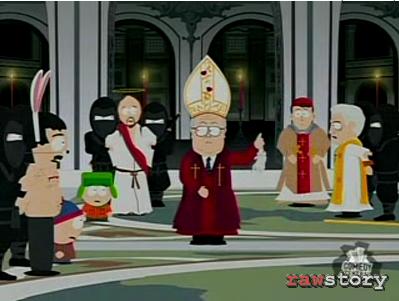
Bill Donohue as the Wild-Eyed Pope on South Park’s “Fantastic Easter Special”

I am usually no fan of

Bill Donohue.  I find myself siding more often with the South Park send-up of his public-morality campaigns.  But in this case, I find his criticism of CATCH more compelling than the lame defense offered by Chanel Caraway of the NYC Board of Health.  Since only 1-2% of parents had opted out of the program, Caraway told ABC News, “this suggests that parents are OK with the service being available to their children.”

Again, please don’t misunderstand.  I support the CATCH program and its goals.  I would want my daughter to be able to get free condoms and contraceptives at school if she couldn’t get them elsewhere.

However, Caraway’s opt-out argument demonstrates a frightening ignorance of America’s educational history.  In prominent cases such as Engel v. Vitale (1962) and Abington Township School District v. Schempp (1963), the US Supreme Court specifically concluded that “opt-out” provisions do not adequately respect families’ and children’s rights to be free of religious coercion.

As Justice Clark argued in his majority decision in Schempp, “Nor are these required exercises mitigated by the fact that individual students may absent themselves upon parental request, for that fact furnishes no defense to a claim of unconstitutionality under the Establishment Clause.”

I understand that this is a very different case.  Clark referred to the unconstitutionality of school-sponsored prayer.  It did not matter whether or not parents could opt out if the program defied Constitutional freedoms.  However, issues of sexuality are intimately connected to religious values for many students and families.  Could not a Bill Donohue argue that such state-imposed sexuality–even with an opt-out provision–denied some students their Constitutional right to free exercise of religion?  To assume that an opt-out clause defuses any potential complaint from conservative religious families seems ignorant at best, and, as Donohue put it, “imperial” at worst.

Traditionalism and Education

This morning’s column by David Brooks in the New York Times is sure to provoke some head-scratching.

Brooks points out the conventional division of contemporary conservatism into two constituent entities. He calls them “economic conservatism” and “traditional conservatism.” Economic conservatives are the free-market champions. They are the sort who cheered when Reagan described the nine most terrifying words in the English language as, “I’m from the government and I’m here to help.” Traditionalists, on the other hand, value localism, organic social structures, and community. They derive their ideas from the likes of Edmund Burke and Russell Kirk.

Those who follow the intellectual history of modern conservatism will scratch their heads that Brooks did not include other important types of conservatism, such as the Jerry-Falwell-style Moral Majoritarianism, the kind of conservatism that wants to regulate personal behavior and use government power to improve America’s morals. And where are the “tribal” conservatives, folks such as Rush Limbaugh who cling to “conservatism” largely as a form of in-group identity?

On the other side, people less familiar with the landscape of modern American conservatism might be surprised at Brooks’ evocation of an entirely different style of conservatism. Those unfamiliar with this traditionalist tradition might be shocked to hear of conservatives who oppose a pure laissez-faire approach to economics. Conservatives, as Brooks puts it, who want government to use a “subtle hand” to encourage family and neighborhood cohesion.

As Brooks notes, influential bloggers such as Rod Dreher at the American Conservative keep traditionalist conservatism alive and kicking. Brooks might also have included Patrick Deneen at Front Porch Republic in this survey.

Those of us most interested in the relationship between conservatism and education can explore Deneen’s exposition of traditionalist hero Robert Nisbet.  In 1953, Nisbet had lamented the increasingly universalist nature of higher education.  Deneen argues that such trends have only accelerated.  As Deneen noted a few years back,

“The modern university system has arisen with the consent of those on the Right and Left alike, particularly in its guise as the modern research university aimed toward the end of ‘creating knowledge’ and providing educations that allow our students to ‘succeed’ and to ‘solve problems.’ Both have actively assented to a national, and increasingly international educational system that becomes annually more homogenous and standardized (This is just as true of supposedly ‘conservative’ administrations, one of which gave us ‘No Child Left Behind’ and Margaret Spellings).”

The traditionalist solution, Deneen argues, is to restore some measure of true diversity to university life in America.  Instead of a spread of cookie-cutter colleges arrayed to produce skilled mechanics of a corporate juggernaut, institutions of higher education could instead strive to emphasize the particularities of their own local communities.  Elsewhere, Deneen has suggested that this particularity must embody not only a constrained localism, but also a truer conception of universality. 

As David Brooks suggests, much of the subtlety of this sort of traditionalism has been read out of today’s conservative discussions of education.  For those of us trying to understand conservative thinking about education, however, it is a useful reminder of the complexities of what Brooks calls “half of [the Republican Party’s] intellectual ammunition.”

Schools, Sex, and the War that Isn’t

Sex in our Public Schools is in the news again.  How about this for a headline: “No One Cares”?

It doesn’t promise to get a lot of readers.  But it seems the closest to the truth in this case.

Here’s the story: Thirteen public high schools in New York City will now dispense free contraceptives to high-school students, including the morning-after “Plan B.” As reported by the New York Times and the New York Post, the pilot program, Connecting Adolescents to Comprehensive Health, or CATCH, will supply students with free condoms, birth-control pills, and/or the morning-after pill.

According to the NYT, the new program has not caused any of the traditional controversy.  Only 1-2% of parents returned an opt-out form.  Yet the headlines from more conservative media have emphasized the outrageousness of the new program.  Glenn Beck’s The Blaze declared, “File this one under ‘controversial.'” Fox News’ headline announced, “Parents not told NYC schools dispensing morning-after pill.”

But is a program controversial if it doesn’t raise any controversy?  We are remined of Ben Justice’s terrific 2005 book The War That Wasn’t.  Justice examined nineteenth-century discussions in New York about religion and culture in public schools.  In most cases, Justice argued, “the warfare thesis” does not explain the way schools really work (9).  People usually resolve their disputes about schooling peacefully and even amicably.

That might be the case here.  However, simply because only a small minority of parents have opted out does not mean that most parents support the program.  It might simply mean that parents are not aware of the program.  Or that parents are not aware of their opt-out option.

After all, the fact that very few families complained about prayer and Bible reading in 1960s schools does not prove that such policies were uncontroversial.  It simply means that school policies often fly under the radar until enough parents and activists complain.  In this case, we might still get a public debate over the propriety of issuing birth-control pills to high-school students.  This certainly seems to be the hope of editors at The Blaze and Fox News.

Mommy, I Can Marry a Princess!

What is so frightening about gay marriage?  A TV ad from California’s 2008 battle over same sex marriage gives us a clue.  Gay marriage, to many conservatives, will ultimately tear families apart. 

For those of us trying to understand conservative, traditionalist, ‘fundamentalist’ culture in America, this TV ad offers some insight into conservative thinking.  Many of us are puzzled by conservative opposition to gay marriage.  Like Jonathan Rauch, it seems to me that a defense of traditional values should logically want to see as many people married as possible. 

Image source: A Collection of Odd

But for many conservatives, a redefinition of marriage will represent a cultural camel’s nose under the tent.  That is, if two same-sex partners are allowed to marry, then a slew of other cultural transformations will soon thrust themselves into mainstream culture.  Any opposition to these radical changes will soon be tarred as mere bigotry. 

In the same-sex marriage debate–as in so many cultural contests–schools and schooling play a central role.  For many conservatives, public schools often play the role of cultural contaminant.  Ideas such as evolution, secularism, moral relativism, and sexual liberation, in the conservative vision, are transmitted into cultural circulation by being injected into children at public schools.  Schools are used by progressive activists to subvert the proper relationship between parent and child.  Schools fill the heads of impressionable children with pernicious ideas about the nature of morality and values. 

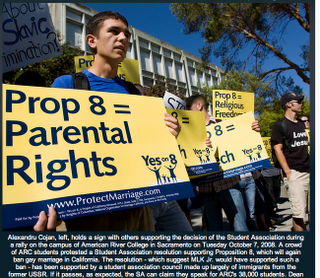
We see a particularly striking example of this in California’s TV ads.  During the fight over California’s Proposition 8  in 2008, ads depicted a girl coming home from school, happily telling her worried mother that she learned she could marry a princess.  The ad warned ominously: without Proposition 8 parents would have no legal right to complain.

This ad plays upon a very commonly held notion about the flawed relationship between traditional values, families, and public schools.  In this vision, schools become the institution that transforms cultural change from a general trend to a problem within conservative families. Schools become intrusive agents warping the minds of children and turning those children against the dearest beliefs of their parents.  

I’m sympathetic.  I support gay marriage, evolution, pluralism, etc.  But I recognize that many of my well-meaning education colleagues really do envision public schools as a vehicle to transform children’s culture.  When cultural conservatives worry about camels’ noses, I believe they are smart to worry.  Progressives yearn ardently for a network of public schools as “change agents.”  Just as fervently as conservatives worry about the intrusive moral role such schools might hope to play.