The REAL Reason It Doesn’t Matter that Ben Carson is a Creationist

Have you seen it yet? Commentators such as Rod Dreher and Jeff Jacoby have opined that Ben Carson’s creationist Seventh-day Adventist faith doesn’t matter. All sorts of leaders, they write, hold kooky religious ideas. But that’s not why Dr. Carson’s faith doesn’t disqualify him. There’s a more complicated reason.

It's always worthwhile talking to an intelligent man...

It’s always worthwhile talking to an intelligent man…

Jacoby argues that Carson would be a perfect surgeon general. He could follow other creationist surgeon generals such as C. Everett Koop. When liberals comment that Carson’s creationist beliefs mean he’s anti-science, Jacoby points out that all sorts of religious people have all sorts of anti-scientific beliefs. Such theology does not mean they can’t perform their scientific duties.

As Jacoby concludes,

Can you regard someone’s religious creed as preposterous, yet entrust the person who is faithful to that creed with public office? Of course; Americans do it all the time. I can’t see Carson as president, but what I really can’t see is why his religion or his doubts about evolution (neither of which I share) should even enter the conversation.

There’s a simpler reason why Dr. Carson’s creationism doesn’t really matter. Like other humans, Carson is not a simple religious robot. We cannot read his denomination’s creed and assume we know everything he believes on every issue.  More important, we cannot read his creed and assume we know much about his lived faith.

As critics have pointed out, Dr. Carson has ranged far afield from his SDA roots in his effort to win votes. Traditionally, for example, Adventists decry the use of violence. Traditionally, too, Adventists insist on a rigid separation of church and state. Recent campaigning seems to have pushed Dr. Carson to put his conservative American identity in front of his SDA denominational identity on these issues. He has argued for more weapons in the hands of everyday Americans and more religion in everyday government.

I disagree with Dr. Carson’s positions on all these issues (for that matter, I also disagree with SDA orthodoxy on all these issues), but I’m glad he is not simply a creature of his denominational beliefs. After all, if someone had only their religious beliefs to guide them, he or she would be a terrifying leader.

What if a surgeon general believed only in faith healing, so he or she canceled government health programs? What if a leader of the Joint Chiefs of Staff believed only that non-Christians were evil, so he or she indulged in missionary warfare?

Luckily, that sort of religious extremism is atypical. Most of us have official beliefs that don’t really impact the way we live our day-to-day lives. We are Americans first, and then we are Catholic, or Muslim, or Hindu.

Indeed, it is not only religious people who do this but also anti-religious people. As Dostoyevsky’s Ivan personifies in Brothers Karamazov, there are atheists who fail to follow their anti-religious beliefs to their logical conclusions.

And thank goodness they do.

In short, Dr. Carson’s creationist beliefs don’t disqualify him for high office because he seems willing to back-burner them when necessary.

Ignorance Unto Death

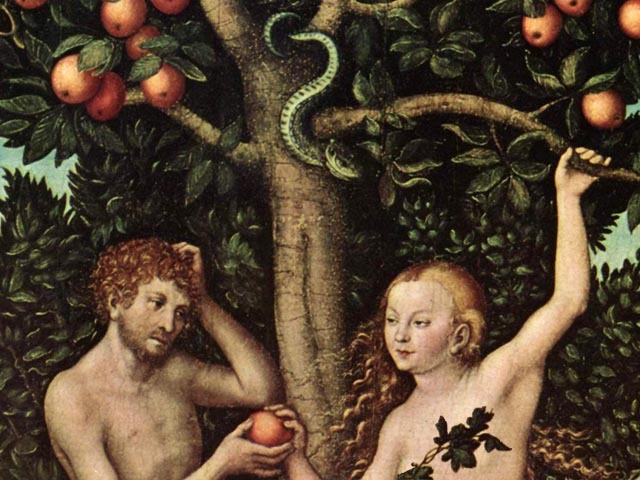
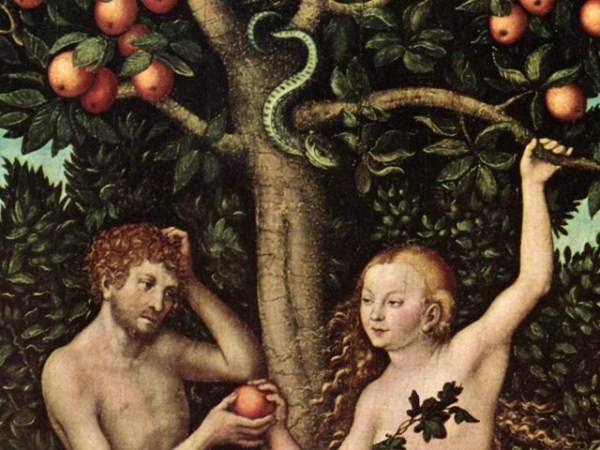
It is a dilemma at the heart of Christian faith: To know or to obey? The original sin of Adam & Eve, after all, was to become as gods by eating from the Tree of Knowledge of Good and Evil. This week, a state supreme court judge in Oregon faced the unenviable task of ruling whether faithful people knew by faith or by fact. Not surprisingly, she punted. Especially in schools and universities, questions of knowledge and faith will continue to bedevil us all. I’m arguing in upcoming books that religious people deserve considerable wiggle room when it comes to requiring knowledge about evolution or US history, but it’s not impossible for policy-makers to be bolder than they have been.
What did you know? And when did you know it?

What did you know? And when did you know it?

In the Oregon case, two parents from a strict religious sect were convicted in 2011 in the death of their infant son David. The boy had been born prematurely. The parents did not call for medical help but rather treated David at home. After nine hours, David died. Were the parents criminally liable for their faith-based failure to get medical help?

Oregon Supreme Court Justice Virginia Linder recently said yes. Sort of.

For our purposes, the most intriguing elements of this case are the tangled web of meanings in this case surrounding faith and knowledge. If the parents “knowingly” allowed their baby to suffer from treatable ailments, according to Oregon law, then they are criminally liable. But they hoped to force the state to prove that they “knew” it. They hoped to force the government to prove that they must know something that they refused to know.

Justice Linder did not decide the big question. Instead, she noted that the parents defended their actions with a different set of knowledge claims. The parents said they did not know the baby was sick. They said he appeared healthy until the very last minute. Doctors disagreed. They said any reasonable person could have discerned that the baby was in severe medical crisis.

In other words, the parents did not claim that they “knew” their faith could save the baby. They said instead that they didn’t “know” he was so very sick. The parents DID insist that the state had to prove that they “knowingly” refused care to their baby. As Linder summarized,

At trial, defendants argued that, because they withheld medical treatment from David based on their religious beliefs, the Oregon Constitution requires the state to prove that they acted “knowingly”—that is, they knew that David would die if they relied on prayer alone and, despite that knowledge, failed to seek medical treatment for him.

Justice Linder affirmed earlier court decisions that the parents were guilty of criminal neglect for their actions. The state, she ruled, did not have to prove that they “knew” of the harm they caused. But she did not decide if the parents must have known something they refused to know.

The complexity of the case shows yet again the durability of questions of knowledge and faith. Can the government insist that parents provide medical care for their children? In Oregon, yes. But can the government insist that parents “knew” their child needed medical care? That is a far more difficult question, and one that this ruling painstakingly sidesteps.

As SAGLRROILYBYGTH are well aware, nowhere do these questions of faith and knowledge clash more regularly and predictably than in the area of education. Can the government require that students “know” evolution? …that kids “know” how to prevent sexual transmitted infections? …that kids “know” how the first humans came to North America?   Also, how have private schools and universities attempted to shield young people from these sorts of knowledge?

Alas, secular progressive types like me cannot relax and claim that public schools should always promote knowledge over ignorance. After all, I agree that certain types of knowledge are not appropriate for certain groups of students. For example, we should teach all children about horrifying historical episodes, such as lynching in the USA or the Holocaust.   But we should not expose young children to gruesome images of charred corpses, sexually mutilated before being lynched. At least, I don’t think we should.

Such images are true. People should know about them. But I do not think seven-year-old children should be exposed to that sort of knowledge. I agree that schools should work to keep young children ignorant about such knowledge, even though I acknowledge that it is true and important.

The difference, in other words, is not that conservative religious people want to keep knowledge from children, while progressive secular folks want to give knowledge to children. The difference is only in what sorts of knowledge we want to shield students from, and how.

As I argue in a chapter in an upcoming book about ignorance and education, we can see these questions starkly exposed in the history of curriculum for private conservative evangelical schools. I looked at US History textbooks produced by Bob Jones University Press and A Beka Book. In each case, from the 1980s to the end of the twentieth century, publishers made claims about historical knowledge in each succeeding edition that were farther and farther afield from mainstream historical thinking.
Know this, not that.

Know this, not that.

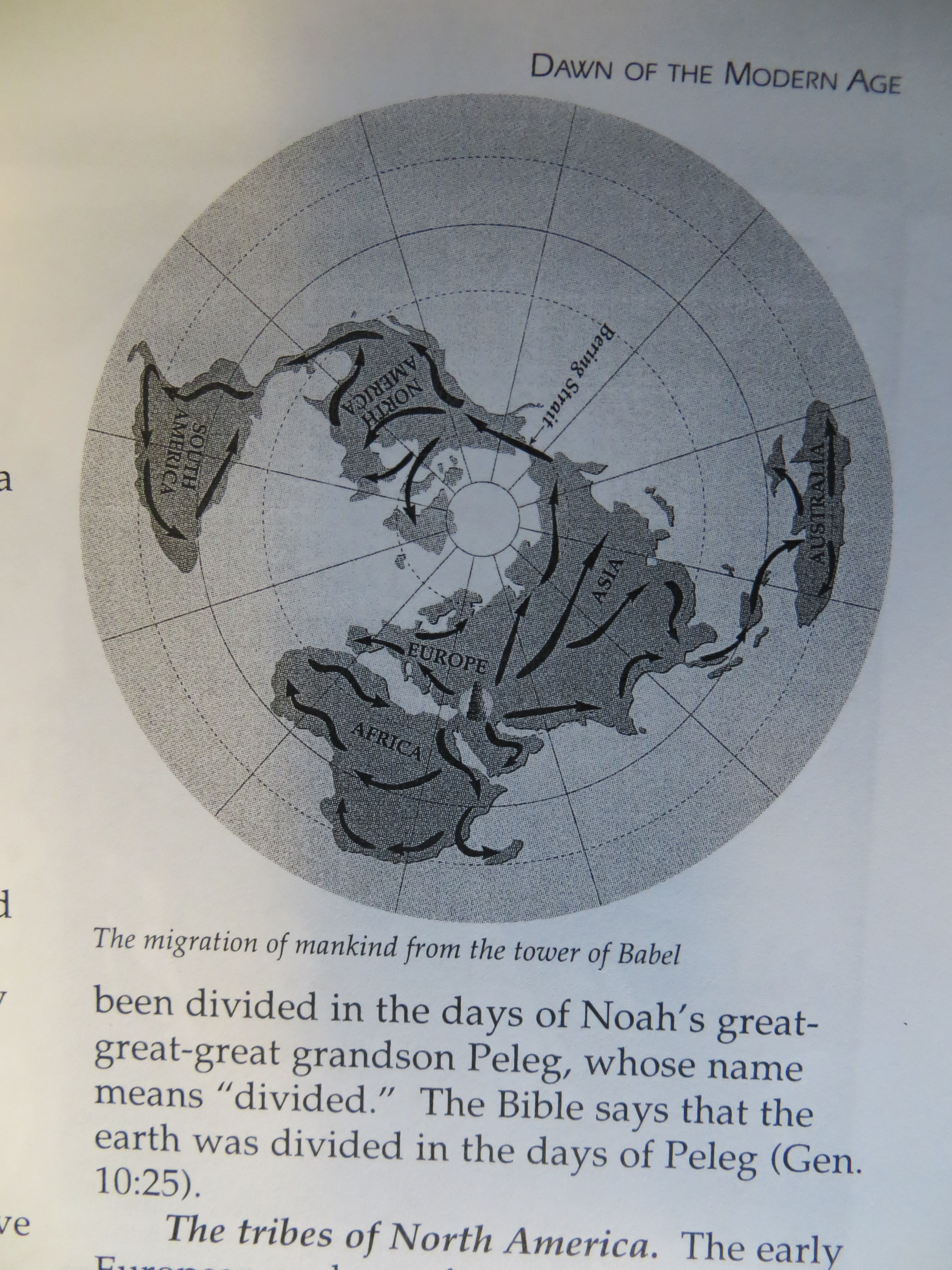
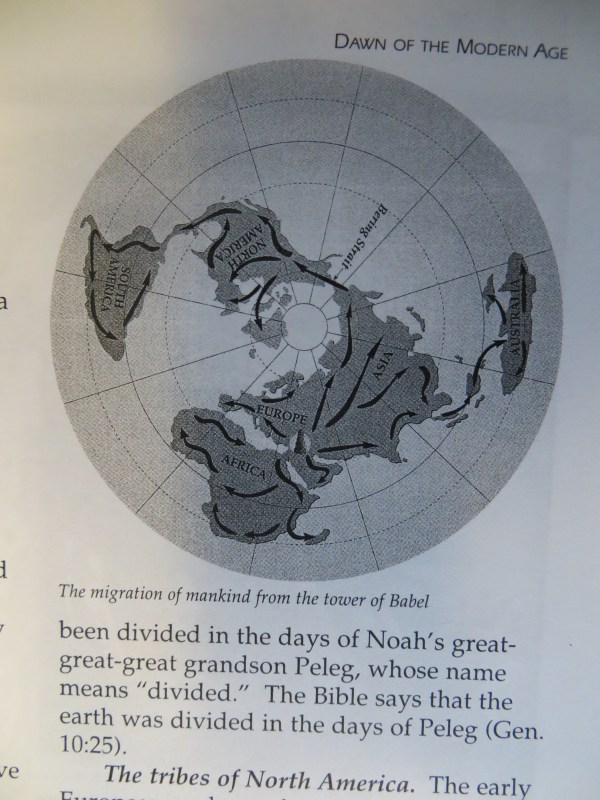
In a later edition, for example, a history textbook from A Beka explained that humanity expanded around the globe after the fall of the Tower of Babel. Obviously, that is a very different explanation from what kids would read in a mainstream textbook. Publishers like A Beka hoped to shield students from mainstream knowledge about history by replacing it with an alternate body of knowledge. These textbooks do not simply try to create ignorance by blocking knowledge, but rather try to foster ignorance about a certain sort of knowledge by producing a convincing set of alternate knowledge.

When it comes to evolution, too, questions of knowledge and belief quickly become tangled and tricky. I’m arguing in an upcoming book with co-author Harvey Siegel that students in public schools must be required to “know” evolution. But too many public-school enthusiasts, we argue, have a cavalier attitude about this sort of knowledge. Yes, students must “know” and “understand” the claims of evolutionary theory. But if they choose not to believe them, that is their business.

Perhaps an easier way to make the distinction is to say that public-school students can be required to “know about” evolution. They must be able to explain it correctly. They must be able to describe accurately its main points. But if they think it would harm their religious beliefs to say they “know” that humans evolved via natural selection, then they have the right to insist that they only “know about” it.

It’s not an easy distinction. Nor was it easy for Justice Linder to decide what to say about the Oregon case. Do parents have the right to their religious beliefs? Yes. Can they not know something that everyone else knows? Yes, certainly. Do they have the right to insist on that relative ignorance if it causes palpable harm to others? Not in Oregon.

But this ruling does not decide if the parents in this case “knew” that their faith would save Baby David. It only states that parents do not have the right to insist that the government prove that they knew it.

HateMyProfessor.com

HT: JG

Can fundamentalist colleges trust their faculty? We see this week an unfortunate blow-up in the continuing saga of power struggles at Bryan College in Tennessee. Does this bitter squabble between president and faculty represent an inherent problem for conservative evangelical schools? The history of these colleges suggests something along those lines.

According to Chattanooga’s Times Free Press, Bryan President Stephen Livesay has doubled down on his fight for control. As we’ve documented in these pages, for the past few years the college has gone back and forth in its struggle, with faculty approving a no-confidence vote last spring, and members of the board resigning this past summer.

He said, he said, c. 1953

He said, he said, c. 1953

As SAGLRROILYBYGTH are sick of hearing, I’m up to my elbows in my new book about the twentieth-century history of conservative evangelical colleges. Time and again, administrators and trustees have demonstrated a deep distrust of their faculty.

In the 1930s, for example, Bob Jones College purged a suspect group of teachers. One of the fired faculty, Joseph Free, penned a protest letter. He had previously worked at three different colleges, Free wrote,

two of them orthodox. (But not obnoxious.) My loyalty was never questioned. . . . It simply never occurred to me that I was not free to express my opinions and I did express them. How was I to know that loyalty meant dictatorship?

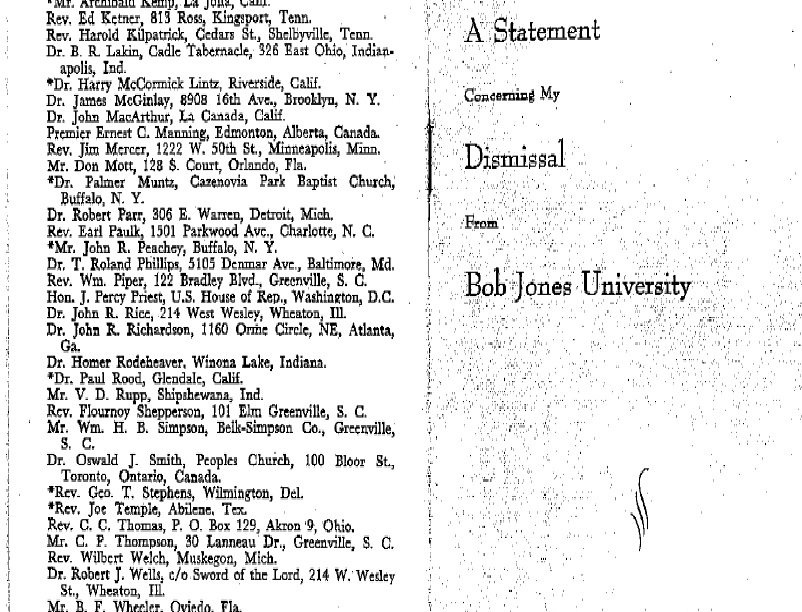
Perhaps more famously, this pattern was repeated at Bob Jones University in the 1950s. Ted Mercer was fired in the summer of 1953, accused of a host of crimes including planning a “revolt of many faculty members.” Mercer himself claimed to have been blindsided by his dismissal. Maybe he had become too popular with students and faculty. Perhaps Bob Jones Sr. was too zealous in his jealousy of other administrators. In any case, Mercer went on to a long career at Bryan College.

The abiding distrust of faculty at fundamentalist colleges has not been unique to Bryan and Bob Jones U. At Wheaton College as recently as 1961, faculty scientists were pressed into a needless and humiliating mea culpa. After a conference on evolution and creationism in 1960, anxious trustees forced Wheaton administrators to tighten the school’s official position on the origins of humanity. No longer would it suffice for faculty to agree that God created. Since 1961, they have had to affirm that Adam and Eve were real historical personages and the true parents of the species. Professor Russell Mixter had to affirm his orthodoxy over and over again in order to allay the fears of Wheaton’s guardians of orthodoxy.

Nor was Dr. Mixter’s ordeal out of the ordinary at Wheaton. As historian Michael S. Hamilton wrote in his brilliant 1994 study of Wheaton’s history, the board of trustees has always been distrustful of the faculty. In Hamilton’s words, trustees have believed “the faculty represented the single greatest danger to maintaining the college’s Christian character.”

As usual, Hamilton’s history proves prescient. According to the Times Free Press, new rules at Bryan College seem intended to crush any whisper of faculty independence. New rules restrict professors’ ability to call meetings, for example. As the TFP explains,

Under this new policy, a faculty member is required to go through a seven-step process that includes approval from the Academic Council, a written rationale stating the purpose of the meeting and a waiting period of at least a week.

This sort of contrived impotence may seem shocking to those unfamiliar with the unique traditions of fundamentalist higher education. Within that charmed circle, however, it seems like nothing more than a new take on an old tradition: When the going gets tough, the faculty get blamed.

Creation College Scorecard

How can you do it? How can outsiders push colleges to do more of what they want? The rage these days is to issue rankings. Since colleges are ferociously competitive and many of them are teetering on the brink of insolvency, college leaders are willing to do what it takes to move their colleges up any ranked list. Everyone from President Obama to young-earth impresario Ken Ham is issuing their own unique college scorecards.

Whom can a creationist trust?

Whom can a creationist trust?

In each case, influential outsiders promise that their scorecards offer students and parents a helping hand. President Obama, for example, insisted that his new scorecard was “meant to help students and parents identify which schools provide the biggest bang for your buck.” Ken Ham, too, promises that his Answers In Genesis ministry now has

resources to help young people (and their parents) with the upcoming college years. In addition to our annual College Expo weekend for students thinking about attending a Christian college (which will be here at the Creation Museum this November 6 and 7), we have just updated our special CreationColleges.org web site. It helps young people (and parents) narrow the overwhelming process of choosing a college even more.

These scorecards, though, do more than just provide information. They pressure schools to move in a certain direction. If college presidents want to move their schools up the list of rankings, they will make changes based on the scorecard’s values.

And college presidents DO want to move their schools up the rankings. Any rankings. Colleges and universities these days are locked in a death-struggle for students and tuition dollars. If they can’t attract ever-increasing numbers of applicants, they won’t survive.

President Obama wants schools to pay more attention to student finances. His recent scorecard compares schools based on their financial performance: How much do average graduates earn? How much debt to students accumulate?

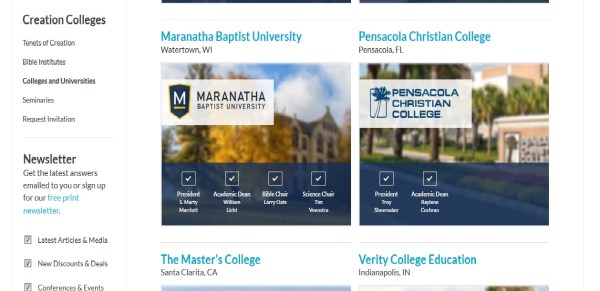
Ken Ham is playing the same game. His recently updated Creation College guide offers families information about the ways colleges measure up to Ham’s definition of creationist orthodoxy. Students can see if a school teaches young-earth creationism. They can also see if the president has agreed, and if other key leaders in the Bible and Science Departments have signed on.

Clearly, some conservative evangelical colleges will be tempted to do whatever it takes to get Mr. Ham’s stamp of approval. Some, like Bryan College, have already tightened their statements of faith and pushed out controversial teachers. Others will consider making similar moves.

Don’t like it?  Then why not try putting together a college scorecard of your own?  You could rank colleges based on whatever criteria you choose.  What are the most Benedict-Option-friendly colleges?  What are the most progressive colleges?  What colleges are the best for teaching evolutionary science?  Etc.!

New Evolution Stickers for Alabama

What should they say instead?

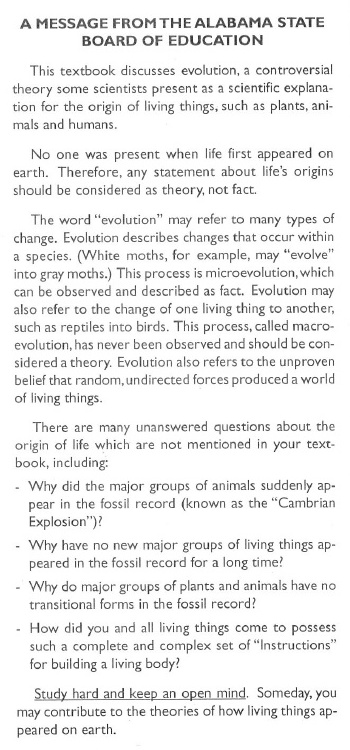
Alabama’s famed textbook-warning stickers might be on their way out. The National Center for Science Education reported recently that new science standards in the “Heart of Dixie” make the old stickers outdated.

Watch out!  Learnin' ahead!

Watch out! Learnin’ ahead!

Alabama’s textbooks have carried the warning since the beginning of the twenty-first century. New standards, though, suggest that evolution will no longer be scientia non grata in the state.

So here’s a puzzler for the SAGLRROILYBYGTH: If the old stickers are out, what should new stickers say instead? Of course, smart-alecks will suggest that we leave science textbooks sticker-free. That is the smart answer, but it leaves us with nothing to talk about on a Tuesday.

So let’s make up new stickers. A few ground rules:

1.) The language has to be readable and straightforward. No jargon.

2.) Maximum 250 words.

As SAGLRROILYBYGTH are well aware, I’ve been working on a new evolution/creation book with my co-author Harvey Siegel.  For years now, we have wrestled with this big-picture question.  In short, we want science teachers to teach evolution and nothing but evolution in their public-school science classes.  But we need to help teachers, students, and families understand that learning evolution does not need to impinge on any sort of religious belief.

Our simple prescription: Students need to know about it.  They need to understand it.  But they do not need to believe it.  Students need to be able to explain intelligently what scientists think about evolution.  If they choose not to accept it, that is their business.  More than that: It is the public schools’ business to make sure students and families feel welcomed, whatever their religious beliefs.  It is the schools’ business to encourage students to be who they are.

With all that in mind, here’s my entry:

These textbooks include information about evolution. Evolution is our current best scientific understanding of the ways species came to be different from one another.

Science encourages you to be skeptical about evolution and every other idea. If you choose not to believe that evolution is the best explanation of the origin of species, you have every right to doubt it.

You need to know about evolution. You need to be able to explain how scientists think it worked. You do not have to agree with these scientists.

Okay, okay,…it’s a long way from perfect.  Can you do better?

The Handwriting on the Wall for Christian Colleges

It doesn’t look good.

For small colleges of any sort, the future looks grim. A new report from Moody’s (the investor service, not the Bible institute) offers some scary predictions about the iffy future of small schools. For conservative evangelical colleges, however, this looming financial crisis also represents a uniquely religious crisis. Will small evangelical colleges be able to resist the growing pressure to become more radical in their orthodoxy?

Look out, Daniel!

Look out, Danny!

Inside Higher Education describes the sobering financial outlook. In the next few years, college closings will likely triple. Why? Fewer students means fewer tuition dollars, which means fewer scholarship dollars, which means fewer students. Rinse and repeat.

Among conservative evangelical schools, we’ve already seen the trend. Former evangelical schools such as Northland University, Tennessee Temple, and Clearwater Christian have all closed their doors. In some cases, the “Wal-Marts” of Christian colleges have emerged even stronger. Cedarville University, for example, has offered to accept all students from Clearwater Christian. As with non-evangelical schools, the big will likely get bigger and the small will get gone.

For small evangelical colleges, this presents a double pickle. In desperate need of more students, schools will likely become extra-timid about offending conservative parents and pundits. As I’ve argued before, young-earth impresarios such as Ken Ham already exert outsize influence on college curricula. If Ham publicly denounces a college—which he likes to do—you can bet young-earth creationist parents might listen.

We’ve seen it happen at Bryan College. Rumors of evolution-friendly professors caused administrators to crack down. Any whiff of evolutionary heterodoxy, and schools might scare away potential creationist students.

At other evangelical colleges, too, as we’ve already seen in schools such as Mid-America Nazarene or Northwest Nazarene, administrators desperate for tuition dollars will be tempted to insist on a more rigidly orthodox reputation.

Things aren’t looking good for small colleges in general. But conservative evangelical schools face this special burden. In order to attract the largest possible number of students in their niche, they might have to emphasize more firmly the things that make them stand out from public schools. In the case of conservative evangelical schools, that distinctive element has always been orthodoxy.

In the past, well-known schools such as Bryan College might have relied on their long history as staunchly conservative institutions. They might have assumed that conservative evangelical parents would trust their orthodoxy, based on their long-held reputation as a bastion of conservative evangelical education. These days, no-holds-barred competition for students will mean that every school must guard its image far more aggressively.

From the Archives: A Satanic Cult Leader for the GOP

US News & World Report calls him the “evangelical darling.” By some counts, he is the second-most-popular candidate in the GOP scrum. But for anyone familiar with the history of evangelical Protestants in the USA, it can be shocking that a Seventh-day Adventist such as Ben Carson can be so popular among conservative voters. It wasn’t so long ago, after all, that conservative evangelicals considered Seventh-day Adventism to be trick of Satan, a cult to lure unwary believers.

Kings Business anti SDA 1For those unfamiliar with the denomination, SDA had its origins in the “Great Disappointment.” In the mid-1800s, William Miller predicted the imminent return of Christ. Some true believers sold everything to prepare for the end of the world. When October 22, 1844 came and went, some folks reasonably concluded that Miller had been wrong.

But not everybody. One splinter group, guided by Prophet Ellen G. White, explained that Christ had come and gone, but it had been a spiritual event, invisible to the mundane eye. White experienced visions of God and angels, creation and the end of time.

Her followers coalesced into the Seventh-day Adventist Church. Unlike other Christian groups, SDA members had reason to believe that creation had been a literal six-day event. They had reason to believe that it had taken place within the past 10,000 years. After all, White had been shown it all.

This is the church from which Dr. Carson comes. Unlike some presidential contenders in the past, he has made no noise about separating himself from the teachings of his church. Quite the contrary. He has publicly and repeatedly embraced them.

So far, so good.

What remains shocking for those who know their SDA history is that Dr. Carson has been publicly and repeatedly embraced by evangelical Protestants. It was not so very long ago, after all, that evangelical intellectuals blasted SDA beliefs in the harshest terms.Kings Business anti SDA 2

Writing in the 1919 publication of the founding conference of the World’s Christian Fundamentals Association, George Guille described SDA this way:

It is Satan’s stroke against the throne and the heart of God.

Hrm.

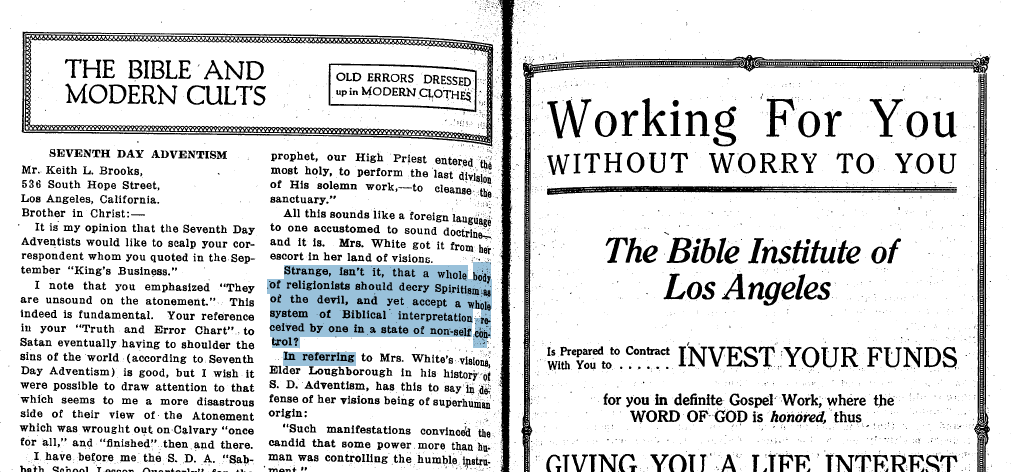
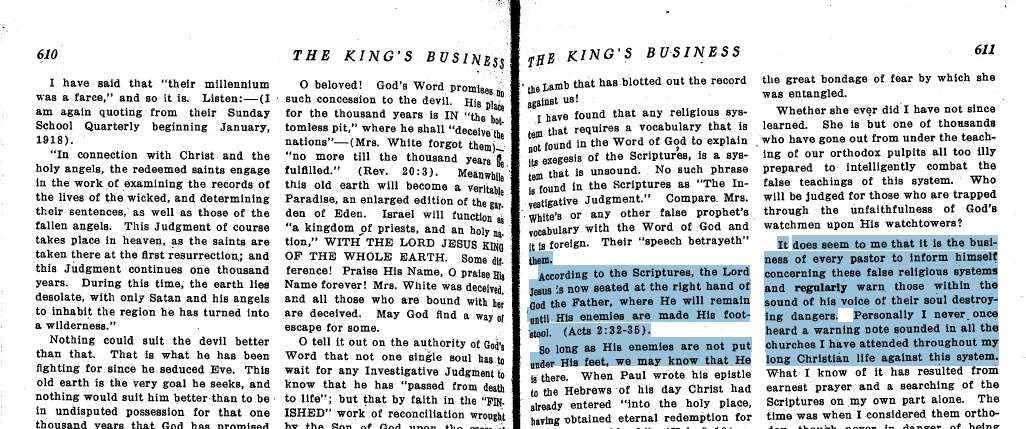
And a few years later, in 1921, in the pages of The King’s Business, the magazine of the Bible Institute of Los Angeles (today’s Biola University) one writer described SDA in similar no-holds-barred language. Jessie Sage Robertson warned Biola’s cult expert Keith L. Brooks that SDA was a dangerous cult. As she put it,

Strange, isn’t it, that a whole body of religionists should decry Spiritism as of the devil, and yet accept a whole system of Biblical interpretation received by one [Ellen G. White] in a state of non-self control?

Too many evangelical pastors, Robertson believed, were not aware of these “false religious systems” with “their soul-destroying dangers.”

If I were an SDA neurosurgeon, I might feel a little trepidation at accepting the friendship of such recent enemies. I might not feel excited to be welcomed by people who had so recently accused my religion of such terrible crimes.

Now, I’m not as dumb as I look. I am aware that these warnings are all from a long time ago. I am aware that our last round of elections brought a leader of the Latter-day Saints Church (the Mormons) to staunchly fundamentalist Liberty University to speak.

But I am also aware that schools such as the Moody Bible Institute in Chicago STILL sell charts warning true believers of the dangers of “cults” such as Mormonism and Seventh-day Adventism.

The point, however, is not that evangelicals should or should not embrace Dr. Carson. Rather, the point for all of us is that evangelical belief is always changing.

For progressive secular folks (like me), we need always to remember that evangelicalism is not somehow a product of a past America. Evangelical Protestants are not trapped in time, either from the Victorian 1870s or the Leave-It-to-Beaver 1950s.

And conservative evangelicals need always to remember that their religion is changing, no matter what they might hear. It can be tricky in evangelical circles to talk about religious change, since so much of evangelicalism is based on remaining true to God’s Unchanging Word. Smart evangelicals, however, will be the first to tell you that human interpretation of God’s Word is always changing, and always riddled with errors.

Will evangelical voters vote for a member of a Satanic Cult? Time will tell, but it seems most evangelicals have put that past behind them.

Alabama’s Fractured Evolution

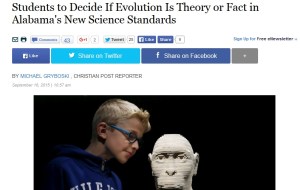
So…will kids in Alabama learn about evolution? Depends on who you ask. The state just published its new science standards. If you listen to NPR or read the update from the National Center for Science Education, then the new standards are unabashedly pro-evolution. But if you read the Christian Post, then the new standards offer students a choice. This is more than a question of headlines. It helps us see the tricky nature of teaching evolution and other controversial subjects.

Po-tay-to...

Po-tay-toe…

All parties concerned seem to agree that the new standards require more evolution. And they agree that the new standards will move students away from repeating rote facts. The goal of the new standards will be to allow students to get their hands dirty in the evidence itself. As the NCSE describes, [the new standards no longer seem available online], students will soon be expected to

“[a]nalyze and interpret data to evaluate adaptations resulting from natural and artificial selection” and to “[a]nalyze scientific evidence (e.g., DNA, fossil records, cladograms, biogeography) to support hypotheses of common ancestry and biological evolution” (p. 48).

For pro-evolution folks [like me], this means kids in Alabama will learn more evolution. As Alabama science teacher Ryan Reardon told NPR,

“I’m gonna let the data smack ’em in the face,” Reardon says of his students. “I’m gonna ask them what that suggests, and then I’m gonna ask ’em what the ramifications are.”

To Reardon, the message of the new standards is clear: His students will be learning the truths of evolution and climate change. But for the editors at the Christian Post, the new standards mean something very different. The Christian Post reported that students would “Decide If Evolution Is Theory or Fact.” Decide. Allowing students to wade into the evidence themselves does not necessarily mean that they will conclude that evolution happened.

NPR wondered why these new evolution-friendly standards passed with so little “pushback.” Why have conservative evangelicals in Alabama seemed so willing to support these new standards? Perhaps the reason is more obvious than it seems. While teachers like Ryan Reardon plan to push students to see the truths of evolution, perhaps other teachers plan to push students to see for themselves the weaknesses of evolutionary theory.

As political scientists Michael Berkman and Eric Plutzer argued, state science standards are not the best predictor of the ways evolution is actually taught.

Alabama teachers like Ryan Reardon will likely guide their students toward a full understanding of evolutionary theory. But other teachers in the state will likely guide students differently. By helping students “decide” if evolution is a fact or “just a theory,” many science teachers in the state will likely continue to teach a mix of religious ideas in with their state-approved science curriculum.

...po-tah-toe.

…po-tah-toe.

Certainly, readers of publications such as the Christian Post might not see the new standards as an undiluted victory for evolution. If students are allowed to “decide” if evolution is a fact or “just a theory,” creationists will be able to claim a victory.

Are the new standards better? For those of us who want to see more and better evolution education, they certainly seem to be. But we need to be cautious about our expectations. These contradictory headlines show that teachers and schools will implement the new standards in contradictory ways.

Creationists and the New “Ape-Man”

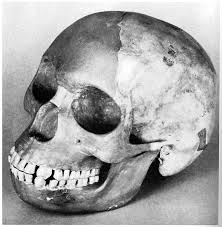
Evolutionary science marches on, it seems. The possible discovery of another extinct human species might seem to deflate creationists’ intellectual bubble. How have creationists handled the news?

In the long history of the evolution/creation wars, creationists have always pointed to gaps in the fossil record as proof of evolution’s empty claims. And evolutionists have repeatedly found evidence of “ape-men,” which turned out to be hoaxes as often as not.

Will the REAL ape-man please stand up?

Will the REAL ape-man please stand up?

The latest discovery of a collection of hominin fossils in a cave in South Africa has brought this old argument to the surface again. These days, creationists are more prepared to handle these sorts of scientific revelations.

Some of the scientists involved have claimed that the bones belong to a previously unknown human species, homo naledi. They’re not sure how old they are, and they’re not sure how the bones got into this cave, but they’re confident the bones come from a new sort of old human.

For creationists who accept mainstream evolutionary science, the news is nothing but exciting. But for those who insist on a young earth and an instantaneous creation of modern humans by divine fiat, the existence of other ancient human species would seem to present a pickle.

At Answers In Genesis, the answer is simple: these bones are probably from some form of ape, and if they are from a type of human, then it was a type descended from Adam & Eve. At the Institute for Creation Research, there are fewer ifs. As ICR writer Frank Sherwin reported,

As always, we at the Institute for Creation Research are extremely skeptical, taking such breaking news stories with a little more than a grain of salt. We have found that with more time and research, the preliminary spectacular claims of alleged “human ancestors” dissolve into a footnote, a non-story. We predict, on the basis of the creation model, Homo naledi too will become just one more dead end in the questionable human evolution parade. In fact, the story itself is rife with caution, unanswered questions, and speculation.

For those of us outside the world of creationism looking in, these sorts of distinctions are a source of continuous puzzlement. Why are Neanderthals okay, but more than two human ancestors not? How can young-earth creationists allow for Homo Naledi, but not make room for a necessarily diverse genetic background for our species?

Doctor Carson, I Presume?

Conservatives love Ben Carson! But they don’t seem to know one of the most important things about him. At least judging from the utterly unscientific evidence on hand at this humble blog, it looks like people want to know more about Dr. Carson’s peculiar religion.

SAGLRROILYBYGTH are well aware that we’ve spent our share of time discussing Carson’s ideas and background. As a devout Seventh-day Adventist, Carson has publicly and explicitly supported his denomination’s firm and fairly extreme creationist doctrines.

Unlike most other conservative Protestant denominations, SDA believers have a good reason to believe in a literal six-day creation within the past 8,000 years ago or so. Their founding prophet, Ellen G. White, saw it herself.

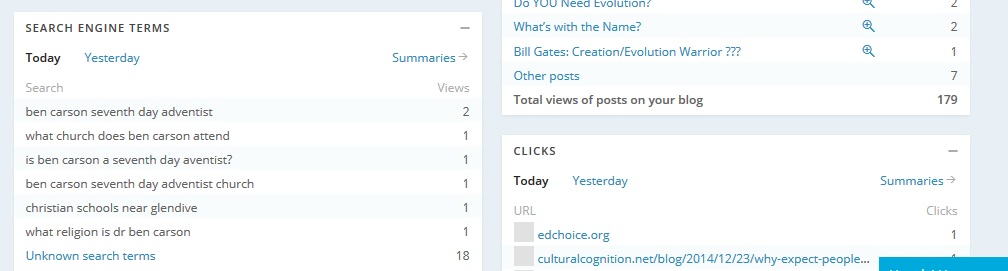
Today in the ILYBYGTH newsroom, we got some evidence that suggests people are curious about Dr. Carson’s religion. In this screenshot captured early this morning, we can see a number of people came to these pages searching for news about Carson’s denomination. Is he a Seventh day “aventist?” What religion is he? What church does he attend?

Who is this Carson fellow, anyway?

Who is this Carson fellow, anyway?

Conservatives love him, but it seems some of them want to know more. Would it be a turn-off for some voters if they knew about Carson’s denomination? Historically, as I argued in my first book, some conservative evangelical Protestants viewed Seventh-day Adventism as a dangerous and deceptive cult.

Things have changed, for sure. I wonder, though, if news of Carson’s denomination would hurt his chances with some conservative Christians.