Christian School Causes Student to Abandon Creationism

How can parents make sure their children don’t lose their faiths? Enrolling them in religious school is not enough. As a recent story from the BioLogos Forum makes clear, education ranges far beyond schooling. Too many hasty critics, religious and secular alike, have assumed that we can control education by controlling schooling. It’s just not that simple.

This Christian learned to embrace evolution, but not in school...

This Christian learned to embrace evolution, but not in school…

In the pages of the BioLogos Forum, college sophomore Garrett Crawford shared his educational story. Crawford was raised in a conservative evangelical household. He went to a Christian school, one that presumably hoped to shield Crawford’s faith from secularism. While at that school, Crawford relates, he grew curious about the scientific evidence for evolution. After a lot of reading and study, Crawford concluded that he could no longer believe in young-earth creationism. After a lot more reading and study, Crawford concluded that Christian faith does not require a belief in a young earth. It is entirely theologically legitimate, he decided, to accept the science of evolution.

In Crawford’s case, his education took him in directions his school never intended.

Such stories shouldn’t surprise us. After all, with just a moment or two of reflection, we can all think of ways that our “education” has differed from our “schooling.” Yet in all of our tumultuous educational culture wars, pundits rush to make sweeping claims about education based on scanty evidence from schools.

We’ve seen this recently in the pages of the New York Times, when philosopher Justin McBrayer declared–based on data that was not just slim, but positively anorexic–that Our Schools Were Training Amoral Monsters.

Among conservative Christians, too, this tradition of school-bashing has a long history.  In the 1970s, for example, fundamentalist school leader A.A. “Buzz” Baker decried the tendency of many conservative Christians to rush into school-founding for the wrong reasons. In his book The Successful Christian School (1979) Baker warned that too many parents and pastors rushed to open new schools because they thought

Public education has failed! It is failing to provide a good academic education while exposing our children to a godless, secular-humanistic approach to life.

Leading young-earth creationists have long assumed that the best way to protect their children’s faith is by attending creationism-friendly schools. Ken Ham, for example, argued that Christian colleges and universities can lead students astray from true faith when they abandon young-earth thinking. As he put it,

the real issue concerns Christian colleges, universities, and seminaries that break away from the authority of Scripture in Genesis—held to by the majority of scholars up through the Reformation—and teach students that God’s Word doesn’t mean what it says. That’s what makes students doubt the truthfulness of the Bible as a whole, and can be a major reason many of them walk away from the Christian (not “creationist”) faith, as we see happening in our culture today.

From the other side, many secular or liberal critics insist that fundamentalist schools are nothing but indoctrination factories. As friend of ILYBYGTH (FOILYBYGTH) Jonny Scaramanga told the BBC, his fundamentalist schooling experiences were nothing short of “horrendous.” During his sojourn in a fundamentalist school, Scaramanga remembers, he did nothing but recite back theological nostrums. The school was so socially crippling, Scaramanga relates, for the rest of his life he was “always playing catch up.”

Scaramanga’s own case, however, shows that schooling of any sort is only one part of a person’s education. Scaramanga himself has now become a leading voice in the anti-fundamentalist education scene. Like Garrett Crawford, Scaramanga’s education took him in directions that his schooling never intended.

The take-away? Of course we should all care about the way schools operate. Better schools will help produce better educations for all students. At the same time, though, we all need to remind ourselves that formal schooling makes up only one slice—sometimes a small slice—of a person’s education.

How many of us, after all, can say that we came out the way our schools intended?
Alert: Public Schools Teach Nihilism!

In the pages of the New York Times, philosopher Justin P. McBrayer repeated an age-old conservative fallacy: Our Public Schools Are Turning Our Children into Moral Monsters. Conservative intellectuals have seized upon McBrayer’s essay as more proof that they need their own conservative school refuges. But here’s the kicker: It’s just not true.

First, let’s clarify. Professor McBrayer is not writing as a conservative activist, it seems, but as a concerned citizen, parent, and philosopher. He notes that many of the college students he deals with seem to have little concept of moral facts. Why? Because, he concludes, “our public schools [are] teaching children that it is not true that it’s wrong to kill people for fun or cheat on tests.”

Scary! But not true. Let’s take a closer look at McBrayer’s argument. He admits that there is not any real evidence that college students these days are moral relativists. However, he asserts, “philosophy professors with whom I have spoken” have assured him it’s true. How does he know what’s going on in America’s public school classrooms? He took one (1) trip to his second-grade son’s classroom. He also looked at the Common Core standards.

From this scanty evidence, McBrayer makes sweeping claims about what’s going on in classrooms nationwide. He also uses this dog’s breakfast to insist that the moral attitudes of college students can be traced directly to this K-12 curricular problem. Why aren’t Americans more moral? Because The Public Schools Have Abandoned Moral Education.

Clearly, Professor McBrayer isn’t the first to make this sort of strained claim. As I argue in my new book, conservative educational activists have said similar things for nearly a century. The pattern is always the same. Texas textbook gadflies Mel and Norma Gabler, for example, claimed to have been minding their own business in 1961, when their son asked them to look at his textbooks. What they read, the Gablers later recalled, “set Mel on fire.” The textbooks, the Gablers concluded, were proof of “progressive education’s grand scheme to change America.”

In Pasadena in 1951, conservative activists became alarmed when one parent found a pamphlet under her daughter’s pillow: “How to Re-Educate your Parents.” Where did she get it? At school!

In 1938, American Legion activist Augustin Rudd found “to his utter astonishment” that his daughters’ textbooks mocked American values.

The problem with each of these claims, as with McBrayer’s, is that the goings-on in any school are not limited to readings and standards. What actually goes on in most classrooms is far more humdrum and traditional. Instead of making alarmist claims based on scanty evidence, it is important to dig deeper into the real practices of schooling.

That’s not easy to do, but scholars have been doing a lot of it for a long time. Perhaps the most relevant recent study might be Michael Berkman’s and Eric Plutzer’s look at teacher education in Pennsylvania. Berkman and Plutzer are well-known political scientists who have devoted a lot of attention to the ways evolution and creationism are taught in real schools. In their recent study, they found that most teachers-in-training are not activists; they are not classroom scientists. Rather, they are job-seekers who hope mostly to avoid controversy and prove their classroom competence.

In short, most public schools tend to reflect local values. They tend not to embrace bold challenges to the status quo. If people in any given school district seem to like evangelical Christianity, as we’ve seen recently, public schools will teach it, regardless of the Supreme Court or the opinions of academics.

Regardless of what standards say, teachers will tend to engage in what they see as common sense. Is it wrong to cheat on a test? Yes! Are there such things as right and wrong? Definitely.

Nevertheless, smart people like Professor McBrayer will likely continue to attribute America’s moral mayhem to K-12 classrooms, based on slim evidence. And conservatives will embrace those charges. In this case, conservative intellectual Rod Dreher has seized upon McBrayer’s charges. McBrayer’s indictment of public education, Dreher insists, proves the necessity of private schools. Only at conservative schools can real education take place.

Of course, I think there are plenty of problems with much of today’s public education, moral and otherwise. And I’m also mad because the New York Times won’t return my calls, even as it publishes flawed commentaries like this one. But in spite of all that, it is important to remember that schools are complicated places. It is not fair to blame our society’s moral morass on today’s curricular choices. Schools reflect our society’s values, they do not simply impose them on hapless children.

Religious Students, Secular Schools

HT: HH

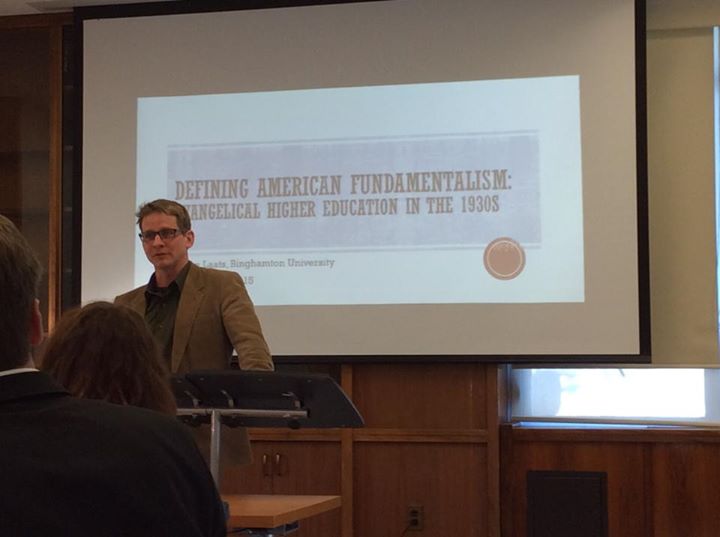
Thanks to all those who came out Wednesday to participate in my talk at Binghamton University about fundamentalist colleges in the 1930s.  Not only was a good time had by all, but the conversation made clear that even at this, our most “secular” of colleges, religion is thriving.  Despite the ignorant nostrums of elite secular academics and fuming fundamentalists, conservative religious students and faculty seem to thrive at pluralist schools like ours.

Don't hate me  because I'm beautiful...

Don’t hate me because I’m beautiful…

For those who are just tuning in, this talk was part of our series in “Religion in the Modern University.”  I shared my current research into conservative evangelical colleges.  The conversation after the formal talk revealed that both students and faculty at our beloved public university come from all sorts of religious backgrounds, including conservative evangelical Protestantism.

Unlike the schools I’m studying, our “secular” college does not actively encourage any specific sort of religious belief.  Nevertheless, our school proves a congenial home for students and faculty who hold conservative evangelical beliefs.

This flies in the face of some common assumptions about secularism and higher education.  As sociologist Elaine Howard Ecklund found in her study of elite secular academics, many of them have absolutely no idea of the high level of religious belief at their own non-religious elite universities.

Fundamentalists, too, have long assumed that “secular” colleges were hostile to their sort of religious belief.  As fundamentalist college founder Bob Jones Sr. was fond of saying in the 1920s, he would

just about as lief [sic] send a child to school in hell as to put him in one of those institutions.

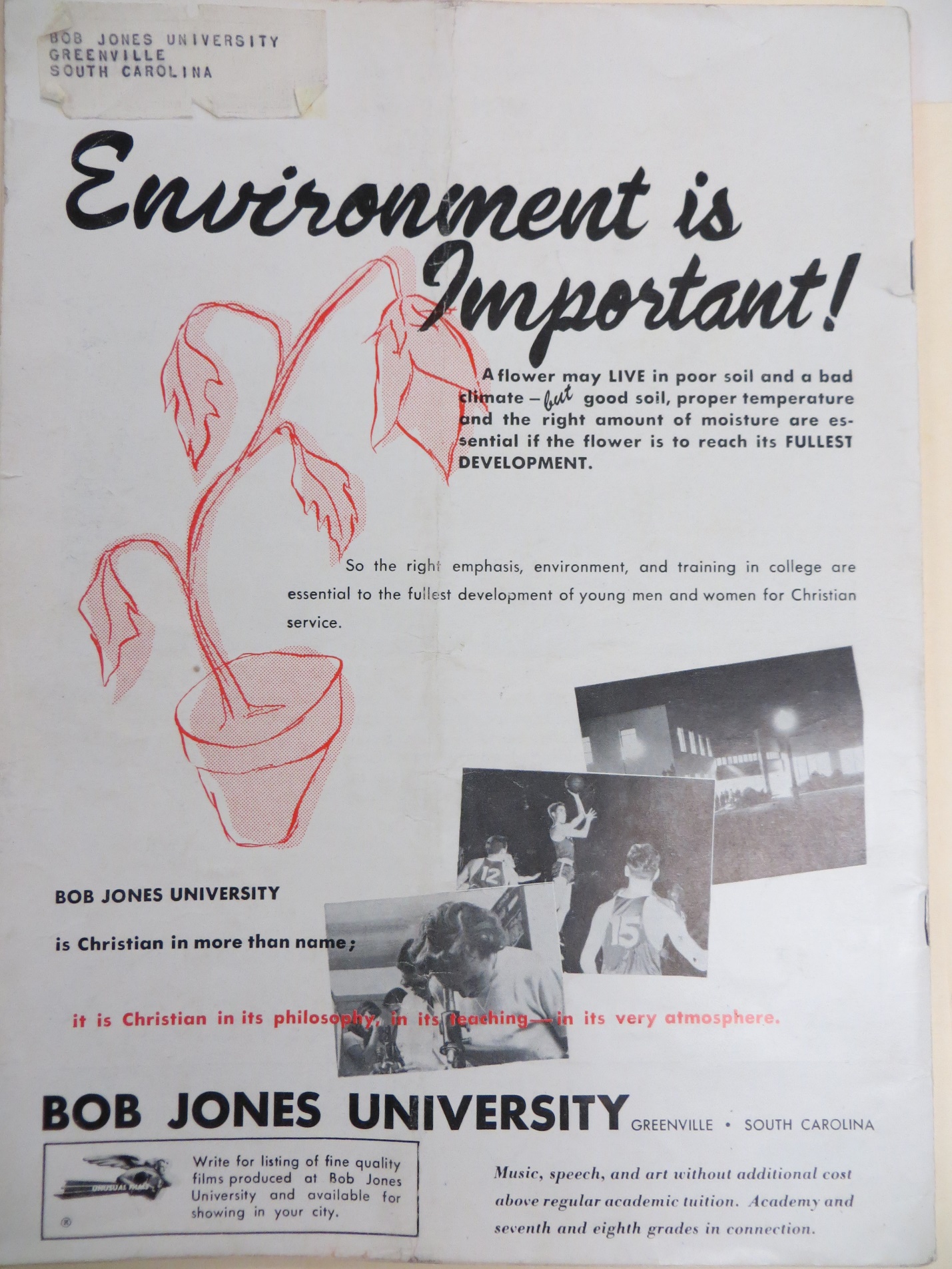
At Bob Jones University, as at other fundamentalist universities, this notion that only a truly fundamentalist school can protect students’ faith remained central throughout the twentieth century, as this 1956 advertisement demonstrated.

Fundamentalist students, fundamentalist schools

Fundamentalist students, fundamentalist schools

More recently, too, creationist leader Ken Ham took me to task for questioning his insistence that creationist families must send their children to young-earth-friendly colleges.  As Ham concludes,

at the very minimum I do urge parents to ensure they do all they can to equip their children to be able to defend the Christian faith against the attacks of our day, and to stand uncompromisingly on the authority of the Word of God.

Does that mean that religious students need to go to schools that share their faith?  I don’t think so.

I certainly understand the many differences between a pluralist school like our beloved Binghamton University and schools with a unified religious message.  But we need to remember that so-called “secular” colleges like ours are often very friendly places to creationists and fundamentalists.

On the Reviewing Block

How do you decide what to read?  For nerds, academic journals provide page after page of book reviews.  I love to read and write these sorts of academic reviews.  But are they really worth the time?

Right now, for instance, I’m reviewing four books for a variety of journals.

For History of Education Quarterly, I’m writing a review of Andrew Hartman’s War for the Soul of America (University of Chicago Press, 2015). Hartman

For the journal Church History and Religious Culture, I’m reviewing Christopher Rios’s After the Monkey Trial (Fordham University Press, 2014).rios

For Teachers College Record, I’m working on a review of Roger Geiger’s new book The History of American Higher Education (Princeton University Press, 2014).geiger

Last but not least, I just agreed to write a review of Bradley J. Gundlach’s Process and Providence: The Evolution Question at Princeton, 1845-1929 (Eerdman’s, 2013), for History: Reviews of New Books.gundlach

For those outside of the academic realm, here’s how the process works: Publishers send out review copies to a variety of journals and magazines.  Book review editors hunt down an appropriate reviewer, usually through word of mouth and academic reputation.  If the first person they ask can’t or won’t write a review, the editor asks for suggestions of other possible reviewers.

I love to write reviews for academic journals.  In each case, putting together a coherent review forces me to do more than simply absorb a book’s argument.  It forces me to take a sharper look at the sources, the implications, and the book’s strengths and weaknesses.  In all of the reviews I’m currently writing, I had planned to read each book already.  Writing the review simply forbids me to read any of them lazily.

But beyond the benefits for the writer, do these reviews matter?  After all, very few people read academic journals.  These days, the long peer-review process means that reviews in academic journals sometimes come out long after the books are published.  We might be tempted to conclude that these kinds of academic book reviews are merely an exercise in higher-education navel gazing.

I think there’s more to it than that.  After all, these reviews are not intended solely for individual readers or book buyers.  This is not just a “rotten-tomatoes” kind of review, in which readers might check out what has been said before choosing one book over another.  This is not simply “like”-ing something on Facebook or scrawling out an angry smear job on Amazon.  Those things may boost or crush sales and reach, but they don’t provide readers with careful descriptions of a book’s structure.

Book reviews in academic journals are different.  The audience for these book reviews is mostly university types, the professors who are choosing books to use with their classes and their students.  No one has time to read every book that comes out, but these short reviews allow academics to remain broadly aware of new trends in their fields.  A “good” review in this context does not mean glowing praise, but rather careful description of the book’s argument and significance.  A professor can choose which books to use in his or her classes.  Professors can also recommend certain titles to graduate students for further study.

Some things that are old fashioned deserve to wither away.  Cassette tapes, large lecture hall classes, and phones with cords come to mind.  This tradition of slow and careful review, on the other hand, may have its roots in a very different technological time.  Nevertheless, it remains a vital part of academic life.

OK: AP not OK

What does creationism have to do with the Continental Army? What does George Washington have to do with the Genesis Flood? This week the news from Oklahoma gives us an example of the ways conservative ideas influence every classroom, not just the science labs.

We will have more success understanding those ideas if we see them as part of a conservative notion of proper education. These are not just ideas about science, or the Book of Genesis, or George Washington at Valley Forge, but they combine all these things into a powerful educational impulse. As I argue more extensively in my new book, in order to make sense of any aspect of educational conservatism, we need to look at it as a whole, not just as a series of separate incidents.

First, let’s look at the goings-on in the Sooner State. Representative Dan Fisher has introduced a bill that will challenge the teaching of Advanced Placement US History in Oklahoma’s public schools. Why? As do many conservatives, Fisher believes that APUSH teaches a warped, slanted, leftist view of America’s past. The new APUSH framework, Fisher explains, emphasizes “what is bad about America.”

Fisher wants to blast progressive history out of Oklahoma's schools.

Fisher wants to blast progressive history out of Oklahoma’s schools.

Fisher is not alone. As we’ve explored in these pages, conservative activists have lashed out at the new APUSH framework. I’ve argued also that many conservatives see these AP standards as only the latest efflorescence of a vicious left-wing assault on real American history. These conservative notions about sneaky progressive subversion in history classrooms have a long history themselves, as I describe in the book. At least since the 1920s, conservative thinkers and activists have lambasted history curricula as hopelessly skewed. Children learn that the USA has been built on a legacy of greed and genocide. Children learn that traditional heroes such as George Washington and Thomas Jefferson have feet of clay, or worse.

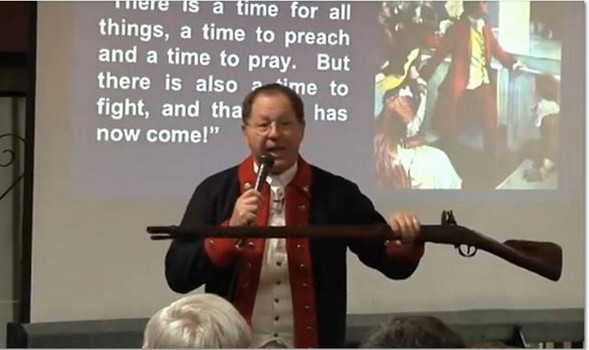
Representative Fisher, for instance, is a member of the Black Robe Regiment, according to the Tulsa World. As do many religious conservatives, this group ties together a romantic history of the United States with conservative attitudes about Scripture and religion. In those connections we catch a glimpse of the ways conservative thinking about education can link creationism with US History.

I want to be careful about what I’m saying here. I’m not arguing that there is some sort of vast underground conservative conspiracy connecting creationism with Fisher’s anti-APUSH activism. Nor am I saying that Fisher’s brand of religious conservatism is somehow the most real sort of conservative attitude about education. There are plenty of conservatives who will have no truck with this kind of religious and traditionalist interpretation of America’s past. But I do believe that deeply held attitudes about proper education fuel both creationism and Fisher’s sort of historical revanchism.

What’s the connection? At its heart, I suggest that this sort of conservatism springs from a notion that real education must come from a delivery of correct information from authoritarian sources to learners. That is, many conservatives—perhaps a better word would be “traditionalists”—believe that education must be a transmission of truth from top to bottom. That truth, if we back it up to its source, must come from God as the ultimate authority.

Perhaps this definition of proper education as the delivery of truth to each new generation seems unobjectionable. It is not. For about a century, educational thinkers have suggested that this “transmission” method is not good education. These “progressive” reformers have tried to impose instead an idea that students must construct knowledge on their own, not merely accept it or download it from authoritarian sources.

In the specific case of the new APUSH framework at issue in Oklahoma, historians have insisted that historical learning does not simply mean transmitting facts to children. And smart conservatives acknowledge that real education includes much more than just telling young people things that are true. But at its core, we might separate “traditionalist” from “progressive” ideas about education along these lines: Traditionalists think of education primarily as moving information from authoritative source to learners. Progressives think of education primarily as having learners construct knowledge.

With this sort of general attitude about education and knowledge, it’s easy to see the connections between creationism and the Continental Army, between George Washington and the Genesis Flood. For some religious conservatives, including apparently Representative Fisher of Oklahoma, knowledge about any subject must rely on traditional truths. Those truths have been delivered to us from on high. Proper education, in this mindset, consists of passing those truths along, not subjecting them to smarmy and self-satisfied criticism.

Evil and a Young Earth

It’s one of the oldest and toughest questions for monotheists. If God is all-powerful, and the world has evil in it, then God is responsible for that evil. Creationist leader Ken Ham recently argued that only a young-earth attitude can explain away this problem of theodicy.

Ham was reacting to a viral video of Irish comedian Stephen Fry. (Youtube has since taken the video down due to copyright claims.) In the interview, Fry blasted God as evil, capricious, and flat-out monstrous. “Because,” Fry explained,

the God who created this universe, if it was created by God, is quite clearly a maniac, utter maniac. Totally selfish. We have to spend our life on our knees thanking him?! What kind of god would do that?

Of course, theologians and atheists have wrestled with this challenge for centuries. Ham, the well-known leader of Answers In Genesis, explained recently that other forms of creationism could not handle the challenge.

Intelligent Design, Ham argued, fails because it argues only for a vague creator. If there is only a bland, inexact creator, then Fry’s challenge is correct. He, or She, or It, must have created everything, including evil.

Other creationists just don't get it...

Other creationists just don’t get it…

Evolutionary creationism, too, can’t handle evil, according to Ham. The sort of creationism embraced by the BioLogos folks stumbles in the face of Fry’s challenge, Ham says. “If God did use millions of years of evolutionary processes,” Ham wrote,

then He is responsible for all the death, suffering, disease, extinction, pain, cancer, and other evils in this world.

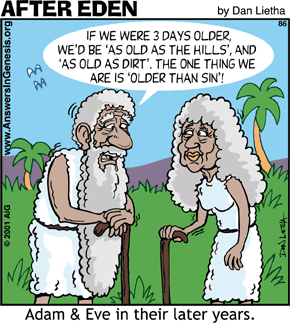
Only a young-earth approach gives a satisfying account of the origins of evil. In Genesis, as Ham reads it, God’s original creation was evil-free. Only when the sinful choices of Adam & Eve introduced evil into the world did things go awry.

For this to make sense, Ham says, we need a real, literal Adam & Eve. We need to take God at His Word. Otherwise, jokers like Fry have the last laugh.

“Enablers of Doubt:” What Do Science Teachers Learn about Teaching Evolution?

Creationists have an easy task. They don’t need to disprove evolutionary science. All they really need to do in public schools is create a reasonable doubt in students’ minds that evolution is the best available scientific explanation. That’s the argument, anyway, made in a recent article by political scientists Michael Berkman and Eric Plutzer. More interesting, from their point of view, are the ways science teachers learn to create that kind of reasonable doubt.*

You may remember Berkman and Plutzer from their terrific book, Evolution, Creationism, and the Battle to Control America’s Classrooms. You may also remember that Professor Berkman will be making a trip up to scenic Binghamton University next month to address our Evolution Studies Program. He’ll be talking about the new research from his new article.

For those who can’t make it up to Binghamton on March 30, you can check out the argument in the pages of The Annals. In evolution education, B&P argue that anti-evolution forces have acted similarly to tobacco companies or climate-change denialists. In each case, they write,

determined political actors have been able to force a stalemate—or even achieve a victory—on an issue by calling into question scientific consensus.

In other words, creationists these days can win merely by playing strategic defense.

Not teaching the controversy, avoiding the controversy

Not teaching the controversy, avoiding the controversy

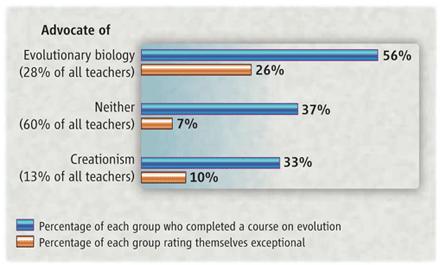
In their earlier survey work, B&P discovered that a large minority of high-school science teachers (28%) teach evolution as the only science game in town. A smaller minority, around 13%, teach creationism as science. The big middle group tended to teach a mish-mash of watered-down evolutionary science mixed with creationism-friendly ideas.

Using a new batch of focus-group data, B&P asked new questions:

How is it possible that young people who major in a scientific field and desire to be science educators lack confidence in their understanding of a central principle of modern biology? Where do teachers develop their belief that they are obligated to be “fair” to nonscientific accounts of creation? And how critical is personal faith in the development of the pedagogical choices that they will make over many years in the classroom?

To find out, B&P conducted focus-group interviews at four different sorts of colleges in Pennsylvania. They interviewed groups of students who planned careers as science teachers.

Significantly, B&P found that pre-service teachers had a shaky hold on evolutionary science, even though they often majored in biology. When the teachers looked ahead to possible future controversies in their own classrooms, an overwhelming majority of pre-service teachers expressed confidence that they could handle any controversy by using better classroom management techniques, not better science. As B&P put it,

The impression we got is that classroom management techniques and skills to negotiate controversy were aspects of professional capital that students felt they needed to absorb, internalize, and have at the ready. They understood that the content of science was also critical in any encounter with a skeptical parent or community member, but they did not feel they needed to own the content in the same way that they needed to become masters of management techniques.

Even when they knew the science and wanted to teach it, many of the pre-service teachers B&P interviewed seemed nervous about provoking any sort of controversy. As student teachers and then new teachers, their main goal was often to avoid attracting negative attention.

If a controversy did arise, pre-service teachers imagined they could take shelter behind their state’s standards or their district’s curricula. Without exception, the teachers-to-be insisted they did not want to become culture warriors in their classrooms. As B&P put it,

their primary identification as educators rather than scientists suggests that they are relatively passive recipients of arguments and political communication from elites and groups trying to shape popular opinion.

In short, teachers are people. As B&P argued in their 2010 book, teachers’ values tend to reflect the consensus values of their school communities. If they teach in a town in which large numbers of people are favorable to creationism, teachers will also be favorable to creationism.

Perhaps more important, teachers are people with very public jobs. Contrary to culture-war presumptions that teachers are somehow trying to undermine or subvert students in one way or another, most teachers are concerned with avoiding controversy.

As Professors Berkman & Plutzer conclude in this article, we are stuck too often in a “feedback loop” of evolution education. Student teachers didn’t learn much evolution in school, because teachers tended to avoid controversial issues. They don’t wrestle with issues of faith and doubt at public universities, since such issues are largely seen as religious, not scientific. As pre-service teachers, students are more concerned with studying nuts-and-bolts classroom issues, not basic science. And when they do their student teaching, they don’t often see classroom teachers wrestle with evolution in their classrooms.

Teachers become “enablers of doubt,” in other words, because anything else might stir up a hornet’s nest of controversy.  And almost all teachers are more interested in getting along with students and parents than in provoking controversy.

*The article requires a subscription to read the whole thing. If you don’t have access to a university library, ask your local public librarian to scour their databases. Many public libraries these days subscribe to pretty broad academic journal databases. Here’s the full citation to look up: Michael B. Berkman and Eric Plutzer, “Enablers of Doubt: How Future Teachers Learn to Negotiate the Evolution Wars in their Classrooms,” The ANNALS of the American Academy of Political and Social Science, March 2015, vol. 658 no. 1: 253-270.

Do Teachers Have the Right to Be Wrong?

How do we draw the line? How do we know when to punish a teacher for being wrong and when to insist that teachers have a right to express their views on controversial topics? A new bill in Montana again insists that creationist teachers should have legal protection to teach their views. Nor is this simply a Montana question. From its headquarters in Seattle, the Discovery Institute has proposed a model bill for legislatures nationwide. From Alabama to Colorado, Florida to South Dakota, lawmakers have offered similar bills.

The basic argument is the same: Teachers must be allowed to teach the full range of ideas about evolution and the origins of life. Should they? And if they shouldn’t, why not?

These are not easy questions, though they might seem so at first. Opponents of these sorts of creationist “academic freedom” laws scoff that no teacher has the right to tell students things that aren’t true. Supporters, on the other hand, might insist that this is a simple question of teachers’ rights to academic freedom.

Neither of those positions captures the complexity of the situation, though. For those of us who oppose these bills, it seems obvious that teachers must not be allowed to tell students things that are not true. As Glenn Branch of the National Center for Science Education put it, Montana teachers do not have the right to teach “bunk.”

The hard question, though, is who decides on the definition of bunk, and how. Historically, we’ve seen teachers persecuted for unpopular political beliefs. As historian Clarence Taylor has described, in the early 1950s eight New York teachers were fired for their leftist sympathies.

Throughout the twentieth century, as I argued in my new book, progressive teachers and school administrators struggled to protect their rights to their political opinions. These educators insisted on their right to hold controversial opinions. More pertinent, they insisted on their right to teach students about these ideas.

In hindsight, it’s clear that the rights of these teachers were egregiously violated. What’s worse, the climate of public education as a whole was degraded by these educational witch-hunts. Only a few teachers were actually purged, but a climate of fear pushed teachers and students to hew more closely to the patriotic party line. That’s not good education.

So creationists ask: Aren’t these bills protecting the same right? Don’t creationist teachers have the right to present all sides of scientific questions about origins?

Yes and no. As philosopher Harvey Siegel and I argue in our upcoming book, creationist teachers and students DO have enormous rights in public-school classrooms. Too often, evolution mavens get too wrapped up in winning culture-war battles to admit it. Far too often, science teachers imply that students need to believe evolution; earnest teachers want students to acknowledge the fact that real knowing means abjuring supernatural explanations of events. Creationist students have every right to dissent from such beliefs. If students want to believe that the earth is 6,000 years old, or that the earth is a floating turtle, or any other sort of thing, they have every right to do so.

Public schools must welcome a plurality of religious beliefs. Creationists—teachers and students alike—must be defended in their quest to protect their faith from assault, even if that assault is only implied or suggested.

By that same token, however, these sorts of academic bills fail on two counts. First, students in public schools have the right to be protected from religious indoctrination. No teacher may preach religious doctrine. Though creationists might howl in protest, even the most intelligently designed creationist bills have religious goals. Instead of protecting teachers’ rights to teach controversial subjects, in effect these sorts of academic freedom bills protect a non-existent right to preach a certain religion-friendly doctrine in public-school classrooms.

Second, students in public schools have the right to learn the best ideas available. When issues are truly controversial, students must be exposed to those controversies. But when ideas are not controversial, students must not be forced to mull false ideas as co-equal to truer ones.

This is not only an evolution/creation idea. In history classes, for example, students should not learn that the South won the Civil War. Or that most enslaved people preferred bondage to freedom. These ideas are held by lots of people, but that doesn’t make them just as true as other historical ideas.

Teach the controversy?

Teach the controversy?

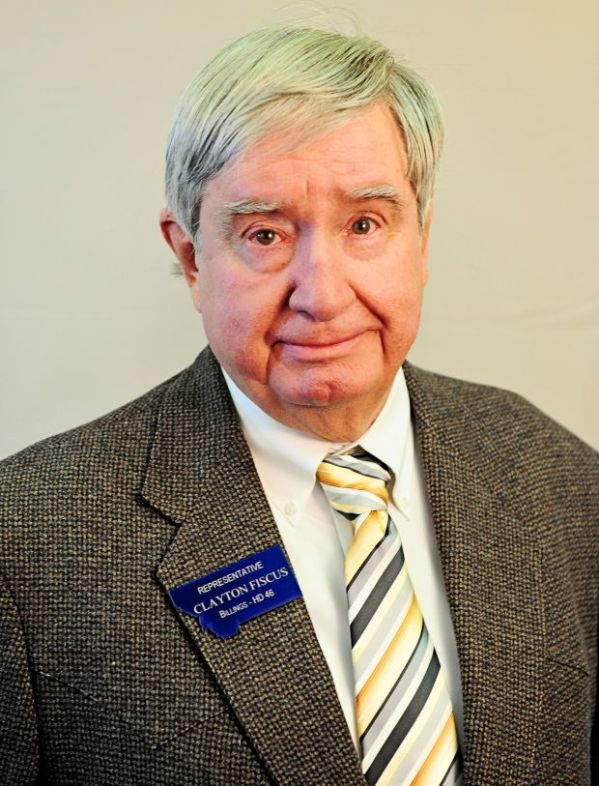
In science classes, the sorts of dissent that people such as Montana legislator Clayton Fiscus wants to protect are not equally scientifically valid. True academic freedom does not include the right to offer worse scientific ideas as equal to better ones. True academic freedom does not include the right to preach religious ideas as facts.

So do teachers have the right to be wrong? Yes, indeed. But they do not have a right to encourage students to believe any particular sort of religious belief. Nor do they have the right to pretend two sets of ideas are equally valid when they are not.

Teaching Evolution in a Creation Nation

What do we want out of America’s schoolchildren? . . . out of America’s creationists? I’m tickled pink to announce that my co-author Harvey Siegel and I have just sent in our final manuscript for our new book, Teaching Evolution in a Creation Nation. In this volume, we tackle these difficult questions head-on.

As we’ve explored in these pages, Harvey and I review the historical and philosophical issues involved in America’s long culture-war battle over evolution and creationism. Historically, I argue, creationism (in most of its religiously inspired variants) has worked like other forms of religious and cultural dissent. Philosophically, Harvey reviews the tricky definition of science, as well as the most common objections to evolution education.

In essence, we argue that the best way to understand creationism is as a form of educational dissent. By defining creationism that way, we can see some directions in which classroom policy should go.Jack chick Evolution

Most important, we argue that the proper aims of public-school evolution education should be to inculcate a knowledge and understanding of evolution. No creationist-friendly variants should be allowed in science classes as science. But dissenting students must be allowed and even encouraged to maintain their dissent. We can’t insist that students believe this or that about evolution. Not in public schools, anyway. We must insist, however, that students know and understand that evolution is the best scientific explanation of the ways life came to be on this planet.

Among the tricky questions raised by our book are these:

  1. Is “belief” an inherent part of good evolution education? That is, should children in public schools be encouraged not only to know and understand certain facts about evolution, but to believe that evolution is really the best way to understand the roots of our species’ existence?
  2. Does it water down evolution education to allow dissenters to maintain their dissent, even in the face of overwhelming scientific evidence?
  3. From creationists’ perspectives, is it too much to agree that mainstream evolution science really is the best science? Will creationists agree that their ideas are more religiously inspired belief than legitimate scientific dissent?
  4. Can teachers in the real world walk this line between teaching facts about evolution and teaching belief in evolution?

There’s one important question that is less difficult: When will this baby hit the bookstores? Our editor at the University of Chicago Press tells us our baby will be like a real baby: it needs to gestate for at least nine months before it’s ready to get slapped around.

And I’m confident it will attract plenty of slappers.

The Wide Wide World of Creationist Sports

When pro athletes start to fight, the officials intervene. What happens when pro sportscasters start to fight about creation and evolution? ESPN has had to silence at least one commentator for defending evolution. We got another taste of that sideline action when star-turned-commentator Bill Walton poked fun at award-winning announcer Dave Pasch.

Pasch has made no secret of his faith, including his Christian beliefs. He sees broadcasting as a perfect opportunity to spread the Word. As part of their jokey relationship, Bill Walton surprised Pasch at a recent game with some presents: a cake and a copy of Darwin’s Origin of Species. Here’s how the dialogue went:

Walton: We wanna make sure that you believe in evolution.

Pasch: I don’t. But I’ll set this over here…. By the way, Bill, I have a book that counters the Origin of Species if you’d like me to bring that to you next game.

Other guy [?]: Crickets…

Walton: I believe in science. And evolution. I’ve been to the Grand Canyon.

Other guy [?]: Alright, let’s…let’s move on here.

Pasch: We’ll take a break. Eat some cake. Talk about the book Bill gave me, and maybe a little irreducible complexity to straighten Bill out.

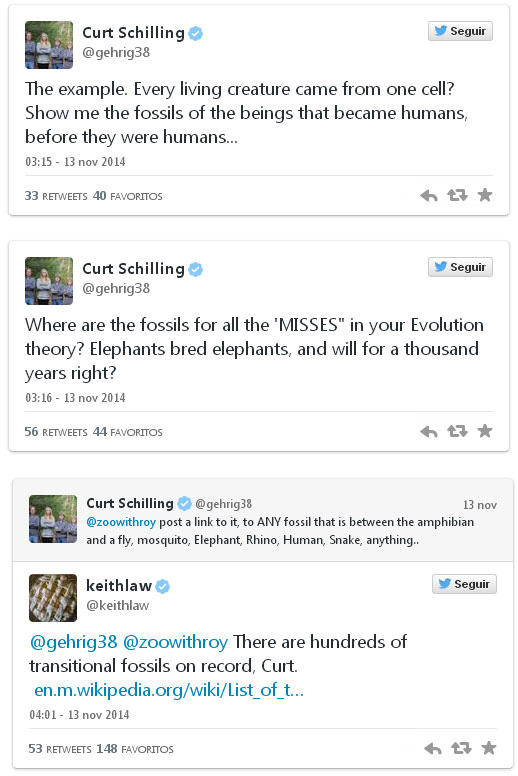
Sports fans may remember an angrier sideline fight a few months back between pitcher Curt Schilling and commentator Keith Law. The two got into a Twitter shouting match over the fossil record. In the end, ESPN suspended Law from Twitter, not officially for his pro-evolution stance.

What in the wide world of sports is goin on here?

What in the wide world of sports is goin on here?

We could ask if the interchange between Pasch and Walton gives us evidence that intelligent design really is just a stalking horse for conservative evangelical religion. The theorists of the “irreducible complexity” Pasch refers to insist that their ideas are not religious, just scientific. But we clearly see in this interchange that at least one ardent evangelical creationist considers intelligent design to be on His side.

We don’t want to get into all that, though. Instead, let’s focus this morning on some simpler questions:

What’s with all these sports creationists? We know that star athletes from Russell Wilson to Tim Tebow to Jeremy Lin have used their fame to spread the Gospel. Is there something about sports that is friendly to conservative evangelicals?