Kopplin, Creationism, and Liberal Book Burnings

A network of charter schools in Texas uses religious textbooks.  Bad religious textbooks.

That’s the accusation leveled last week by anti-creationism activist Zack Kopplin in the pages of Slate.

For anyone who has looked at the textbooks cranked out by conservative religious presses, as I have, the charges sound true.  But does this sort of expose rely too heavily on shock value?  Does it really tell us anything about what goes on in those charter schools?  Or does it rely on the dangerous mentality of the book burner?

Kopplin’s investigation uncovered the dodgy content of books used by Responsive Education, a network of charter schools that claims 65 schools and a plan to open more in the coming year.  Kopplin, a young but seasoned activist, found textbooks rife with creationist-friendly ideas.  Moreover, the textbooks promote a religious vision of history and repeatedly promulgate half-truths and lies as historic fact.  The books take a questionable tone about homosexuality and seem to embrace a distressingly patriarchal vision of proper family life.  Worst of all, Kopplin argues, these textbooks are used in public schools, schools that ought to be open and welcoming to all students, not just religious conservatives.  These slanted textbooks are peddling fake science, bad history, and sectarian “values,” and they’re using tax money to do it.

Let me repeat: Kopplin’s charges ring true to me.  I agree that public schools must not push theology.  But as I finish up my current book manuscript about the history of conservative school activism in the twentieth century, I can’t help but notice the disturbing echoes of Kopplin’s crusade.  His anti-textbook campaign seems to revive the worst elements of wartime book burning.

Sound outlandish?  Let me offer some specific examples.

First and most worrisome, Kopplin relies on the tried-but-false McCarthyite tactic of guilt by association.  In his article, Kopplin points out that some ResponsiveEd schools might assign readings from the Patriots’ History of the United States, a skewed and partisan book.  To discredit the book, Kopplin notes that the book is beloved by conservative blabbermouth Glenn Beck.

More troubling, Kopplin tars ResponsiveEd schools with all the sins of every right-wing theocrat with whom they can be associated.  Consider, for example, Kopplin’s takedown of Oklahoma businessman and curricular contributor Tom Hill.  Hill, Kopplin charges,

is a follower of Bill Gothard, a minister who runs the Institute in Basic Life Principles, a Christian organization that teaches its members to incorporate biblical principles into daily life. IBLP is considered a cult by some of its former followers. Gothard developed character qualities associated with a list of “49 General Commands of Christ” that Hill adopted for his character curriculum. Hill then removed Gothard’s references to God and Bible verses and started marketing the curriculum to public schools and other public institutions.

The values taught by Responsive Ed can often be found word for word on Gothard’s website. The Responsive Ed unit on genetics includes “Thoroughness: Knowing what factors will diminish the effectiveness of my work or words if neglected.” The only difference is that Gothard’s website also adds “Proverbs 18:15” after the quote.

What does this really prove?  That some of the origins of ResponsiveEd’s curriculum can be tied to conservative evangelical Protestants?  Is that illegal?  Is that even worrisome?  After all, taken another way, Kopplin’s accusation can be taken as proof that ResponsiveEd’s curriculum has been DE-Biblicized.

This sort of guilt-by-association has a terrifying history in American educational and political history.  Too often, left-leaning or liberal groups earned labels of “subversion” by association with communist thinkers or organizations.  Consider, for instance, the widely circulated “spider-web chart” used by patriotic activists in the 1920s, 1930s, and 1940s.  Any alleged association with leftist organizations, the chart accused, meant that organizations must not be trusted.
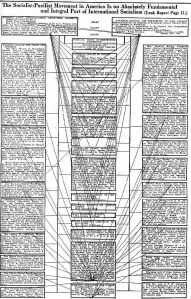
Image Source: Women's and Social Movements in the U.S.

Image Source: Women’s and Social Movements in the U.S.

In the late 1930s, a conservative campaign took off against a set of social-studies textbooks by left-leaning author Harold Rugg.  Time and again, those accusations were based on these guilt-by-association tactics.  Since Rugg taught at Teachers College Columbia, it was alleged, since he was a member of the Frontier Thinkers intellectual group, and since some members of that group had made statements or editorial decisions friendly to communism or Soviet Russia, Rugg was charged with treasonous intent.  His books were charged with all manner of subversive crime.  Just as anti-Rugg activists swung too wildly against Rugg’s books, so Kopplin seems over-ready to ban ResponsiveEd books based on questionable associations.

Another parallel between Kopplin’s article and earlier book-burning crusades is that Kopplin’s charges do not have much to do with actual classroom practice.  As Kopplin admits, he never actually witnessed the teaching in ResponsiveEd schools.  Rather, he relates that one classroom he looked at had the distinctive set up of an Accelerated Christian Education classroom.  Kopplin cites ILYBYGTH friend and guest writer Jonny Scaramanga as evidence that such classrooms teach terrible Bible-based schlock.

But here’s the problem: just as conservative book-burners in the 1940s gave too little thought to the ways Rugg’s textbooks might actually be used, so Kopplin does not offer any evidence about the actual goings-on in ResponsiveEd classrooms.  Anyone who has spent any time teaching knows that textbooks do not dictate classroom practice.  Take the most obvious example: What should we make of public-school classrooms that use the Bible as curriculum?  As religion scholar Mark Chancey has argued recently, the Bible can and should be taught.  But HOW it is taught makes all the difference.

I’m not saying that the ResponsiveEd curricular materials are wonderful.  But I am saying that jumping to conclusions about the practices at any school based mainly on textbooks is a fundamental mistake.

This is getting long, but here is one other creepy similarity between Kopplin’s article and earlier book-burning campaigns.  Like earlier campaigns, Kopplin’s charges have been passed along uncritically by allies seeking to discredit ResponsiveEd.  Intelligent, well-meaning critics such as Diane Ravitch, the Texas Freedom Network, and Americans United for Separation of Church and State have trumpeted the conclusions of Kopplin’s expose.

None of these liberal organizations seems troubled by Kopplin’s sketchy evidence or guilt-by-association tactics.  As an historian who has spent the better part of the last few years stuck in the anti-communist hysteria of the 1930s and 1940s, this knee-jerk boosterism alarms me.  For many patriotic book-burners in the 1940s, Elizabeth Dilling’s The Red Network served as a similar sort of convenient sourcebook for denunciation.  Too many conservative activists—even intelligent, well-meaning ones—repeated outlandish charges and baseless accusations from Dilling’s book.  The fact that a textbook author such as Harold Rugg showed up in Dilling’s pages served as proof positive for many school activists that his books must not be allowed in America’s public schools.

Creepiest of all, Kopplin’s language often echoes almost verbatim the language of 1940s book-burners.  For example, Kopplin engages in a sinister sort of hermeneutic when he says the following: “Some of Responsive Ed’s lessons appear harmless at first, but their origin is troubling.”

In other words, Kopplin admits that the books themselves might not be so bad, but since they came from conservative religious sources, we must automatically attack them.  This smacks too much of what political scientist Michael Rogin has described as “political demonology.”[1]

Consider some of the similar language from the 1930s/1940s anti-Rugg textbook fight.  One of the leaders of that anti-book battle, R. Worth Shumaker of the American Legion, told a correspondent that the dangers of the Rugg books only became clear if one went “back of the scenes.”  Reading the books themselves, Shumaker admitted, made them seem bland and harmless.  But once an earnest researcher discovered Rugg’s leftist connections, the slant of the textbooks became obvious.

Another American Legion activist agreed.  Hamilton Hicks admitted in a 1941 article that “intelligent people” could read Rugg’s book and find nothing wrong with them.  “Dr. Rugg,” Hicks accused, “is far too adept a propagandist to disclose his real purpose in any one textbook.”[2]  Just as Zack Kopplin warns that the ResponsiveEd textbooks might seem harmless until we understand their origins, so anti-Rugg activists admitted that Rugg textbooks might seem fine until their sinister backstory was uncovered.

We verge from activism to hysteria when we denounce textbooks for reasons other than the textbooks themselves.  If textbooks seem harmless, the first appropriate conclusion is that the textbooks are likely harmless.

So what is a liberal to do?  Kopplin makes an important point: public schools ought not cram dead science and bad history down students’ throats.  As organizations such as Texas Freedom Network have done, this situation calls for more rigorous examination.  What really goes on in ResponsiveEd schools?  They should not be allowed to use tax dollars to teach sectarian religion and false facts.  It is important for all of us to remember, however, the profound costs of over-hasty accusations.  Calling for book burnings is never an appropriate tactic.

Kopplin has made some serious charges.  So far, however, those charges have not been backed up by adequate proof.  More is at stake here than just one charter-school network.  If we veer into hysteria rather than activism, we repeat the worst mistakes of our history.


[1] Michael Paul Rogin, “Ronald Reagan,” The Movie and Other Episodes in Political Demonology (Berkeley: University of California Press, 1987), xiii.

[2] Hamilton Hicks, “Ours to Reason Why,” American Legion Magazine (May, 1941): 6, 51.

Save the Date!

Keep your evening free on Thursday, February 27th.  Here on the beautiful campus of Binghamton University in sunny Binghamton, New York, we’ll be hosting a listening session and panel discussion about Trey Kay’s new radio documentary, “The Long Game: Texas’ Ongoing Battle for the Direction of the Classroom.”

Readers may remember Trey Kay’s earlier award-winning radio documentary, “The Great Textbook War.”  In that piece, Trey explored the 1974-1975 battle over schooling and textbooks in Kanawha County, West Virginia.  In that fight–a fight that is also the subject of a chapter in my upcoming book–conservatives worried that a new textbook series presented students with perverted values and distorted grammar.

In his new documentary, Trey looks at ongoing ideological battles in Texas.  As filmmakers such as Scott Thurman and activists such as Zack Kopplin have demonstrated recently, there has been no better field for exploring cultural conflicts in education than the great state of Texas.

The details of our upcoming February 27 event are not yet finalized, but the general plan is clear.  We’ll be listening to “The Long Game,” then Trey and NYU’s electrifying historian Jon Zimmerman will offer a few comments, followed by a general discussion and Q & A.  I’ll post more details as they come available.

What Should The Science Guy Say?

It’s coming up. 

In just a few short weeks, Bill Nye “The Science Guy” will debate the scientific premise of creationism with Ken Ham at Answers In Genesis’ Creation  Museum.

What should Nye say?

Science writer Greg Laden offered this morning a short list of points he’d like Nye to make.  In general, Laden suggests that Nye focus on the unscientific nature of creationism.  The debate over divinity was real and important in the history of science, Laden points out, but that debate has come and gone.  Laden doesn’t use the phrase, but his argument is reminiscent of philosopher Philip Kitcher’s definition of creationism as “dead science.”  In this vision, it makes no sense to debate the science of creationism, since creationism is not even bad science.  Creationism, rather, represents an understanding of science that has been thoroughly and completely discredited.    

Laden’s debate prep brings up two important questions.  First, what would people advise Ken Ham to say?  And second, do we agree with Laden’s advice to Nye?

First things first: What do you think Ken Ham should say?  For those of us who live mental lives outside the boundaries of religious creationism, is there anything he could say that would convince us that his creation science should be taken seriously?  For me, the answer is no.  I’ve defended Ham in the past and taken heat for it from ardent anti-creationists.  But in this case, I’ll be flummoxed if Ham uses any arguments beyond his scriptural stock-in-trade.  That is, I don’t guess Ham will try to convince people like me who are not moved by references to Biblical passages. 

I’m thinking Ham will likely harp on the scientific merits of young-earth creationism, when in fact his argument would be much stronger if he tried a different approach.  To people like me, at least, Ham’s scientific credentials have no leg to stand on.  But as religious dissenters young-earth creationists can claim much more wiggle room in education and culture.  If Ham wanted to reach out to people beyond the ranks of his current religious supporters, he should argue for creationists’ rights as aggrieved minorities, as a religious group, not as a contender for scientific legitimacy. 

But Ken Ham is not likely to take this approach, since he has built his career on the promise that young-earth creationism is better science than mainstream science.  He will likely trot out his compelling but ultimately vacuous arguments about observational science vs. historic science.  He will likely ask Bill Nye some variant of his ultimately senseless question: “Were you there?”  If Ken Ham hopes to maintain his role as the charismatic leader of the young-earth creationist movement, he can’t really do anything else. 

Question two: What should Nye say?  I don’t think Laden’s advice is the first best answer.  IMHO, the most effective answer to young-earth creationists such as Ken Ham is a theological one, not a pop-science one.  As do the folks at BioLogos, I think the most effective message young-earth creationists need to hear is that Biblical faith does not require faith in a young earth.  As science pundits tend to agree, young-earth creationism is not really science, it is something else.  It is an outgrowth of a particular religious understanding.  Therefore, the strongest arguments against it are religious, not scientific. 

Also, I don’t think Nye should use his precious exposure to creationists to blast the dead-science nature of young-earth creationism.  Many creationists will expect a hostile attack on their belief system.  They will not be moved by it.  They will not be convinced by it, since they will not credit its source.  I think it will be more effective for The Science Guy to do what he does best: explain what science is.  Young-earth creationism is based on a very different way of defining knowledge.  If Bill Nye can explain what real science is—instead of attacking the reasons why young-earth creationism doesn’t meet that definition—he can expose some of the creationists in the debate audience to a very different way of understanding the entire debate. 


To Debate or Not to Debate

Bill Nye and Ken Ham will be going a few rhetorical rounds next month.

The mega-popular science educator will broach the creationist lion’s den of the Creation Museum on February 4th.  The topic: “Is creation a viable model of origins in today’s modern scientific era?”

Image Source: Answers In Genesis

Image Source: Answers In Genesis

Are these debates worthwhile?  In the past they had decisive impact on the formation of American creationism and fundamentalism.  But these days such debates are a different animal.

Science pundits don’t like it.  Jerry Coyne warned that Bill Nye will only be putting money and legitimacy in Ham’s deep pocketsPZ Myers wisely concludes that each side will likely only speak past the other.

I agree.  The audience at this debate will likely not be moved by either man’s arguments.  No matter how scientifically accurate or biblically flawless, logical arguments tend not to be the deciding factor in determining one’s beliefs about human origins.

As David Long’s ethnography demonstrated so powerfully, creationists can thrive in mainstream scientific environments without abandoning their religious ideas.  Many creationists have simply been taught to regard mainstream scientists as deeply flawed and bumbling fools.  It is easy to dismiss plausible-sounding talk from someone we have already deemed unreliable.

It’s hard to imagine Ham’s Cincinnati audience won’t be prepared to dismiss Nye’s mainstream science talk out of hand.  I assume Nye is hoping that he may still plant a few seeds of science doubt in the minds of those who hear him.  Not much reason to offer Ham such a plum chance to look like a reputable scientific authority.

At the start of America’s public evolution/creation battles, this legacy of public debating functioned much more powerfully, since creationists had not yet set up alternative institutions.  As I describe in my 1920s book, some of the most influential creationists of the 1920s received humiliating public trouncings in popular debates.

At a talk on the campus of the University of Minnesota, for example, fundamentalist leader William Bell Riley found himself surprised by a student prank.  Someone lowered a monkey onto the stage as Riley tried to convince his audience that creationism was reputable science.  “Every time I hear the argument that this is a controversy between experts on the one hand, and, as someone has said, ‘organized ignorance,’ on the other, I smile,” Riley told the St. Paul Pioneer Press in 1927.  “This is not a debate between the educated and the uneducated.”

Similarly, in London, creationist godfather George McCready Price found himself hooted off the stage in the days following the 1925 Scopes Trial.  He had tried to tell the merciless audience that the theory of evolution was doomed as mainstream science.  Such flawed science, Price insisted, may have worked fine

for the times of comparative ignorance of the real facts of heredity and variation and of the facts of geology which prevailed during the latter part of the nineteenth century; but that this theory is now entirely out of date, and hopelessly inadequate for us. . . .  We are making scientific history very fast these days; and the specialist in some corner of science who keeps on humming a little tune to himself, quietly ignoring all this modern evidence against Evolution, is simply living in a fools’ paradise.  He will soon be so far behind that he will wake up some fine morning and find that he needs an introduction to the modern scientific world.

The audience didn’t buy it.  Price found himself heckled so mercilessly that he could not complete his presentation.  That London debacle was Price’s last public debate.  After that experience he focused his considerable energy on founding alternative scientific institutions to prevent future creationists from needing to convert mainstream scientists.

Back in those days, creationists and fundamentalist scientists still attempted to tell audiences that they represented the true mainstream of scientific discovery.  Such early creationists eagerly debated in a variety of settings in hope of convincing middle-of-the-road audiences that evolutionary science was not real science.

In that context, public debates held promise for both sides.  Creationists hoped to prove that they had better science.  Evolutionary scientists hoped to demonstrate the scientific vapidity of creationism.

These days, both sides have hardened.  Creationists these days are not unaware of the fact that their science does not represent the scientific mainstream.  Evolutionary scientists are not hoping to relieve creationists of their naïve ignorance.

Rather, both sides in these debates enter and exit with the same set ideas.  Each side knows who to trust on that stage and who to ignore.  No matter how persuasive Ken Ham can be, he doesn’t really hope to change Bill Nye’s mind.  Rather, this exercise merely serves to give each charismatic speaker the chance to gain a sliver of legitimacy and respectability in the opposite camp.


Year-End Poll: America and Evolution

Do Americans think humans evolved?  Sorta.

Thanks to the watchful folks at the National Center for Science Education, we see a new year-end poll from the Pew Research Center.

The Pew folks talked to about 2,000 respondents over the phone.  All told, about sixty percent of them seem to accept evolution, while a third rejected it.

As always, the wording of these questions matters.  In this poll, respondents were asked if they thought humans or animals had “existed in their present form since the beginning of time,” or if they had “evolved over time.”

When interviewers put it that way, a significant majority of Americans seems to agree that humans or animals had evolved over time.  In contrast, when the Gallup pollsters ask people to pick between three options, a larger percentage–nearly half of respondents–tend to agree that “God created humans beings pretty much in their present form at one time within the last ten thousand years or so.”

It seems Americans have an easier time agreeing that humans had evolved over time than they do agreeing that “Human beings have developed over millions of years from less advanced forms of life, but God had no part in this process.”  Indeed, many of the respondents who agreed that humans or animals had evolved over time also believed that God had directed this process.

Breaking it down by demographic groups, we see some predictable results.  White evangelical Protestants tended to reject evolution in the largest numbers (64%).  Republicans tended to reject evolution more often than Democrats.

One surprise: no one seemed to care much if they were talking about human or non-human evolution.  In the past, as historians such as Ron Numbers have demonstrated, the sticking point of much resistance to evolution has been specifically human evolution.  In this poll, however, the answers did not change much when the questions were about human or animal evolution.


Year-End Quiz: Do You Speak Conservative?

It’s the end-of-the-year rush for every sort of retrospective.  Can you take the ILYBYGTH challenge?

Thanks to the folks at the Texas Freedom Network Insider, we have several lists of the most contumacious quotes from America’s conservative punditry.  One list describes the year in creationist/no-climate-change quotations, one from the anti-Islam contingent, and one from the continuing “War on Christmas” campaign.

Here’s the idea: The Insider compiled these quotes as a demonstration of the intellectual outrageousness of contemporary conservatism.  Here at ILYBYGTH, we have a different goal: Can we understand what these conservatives meant?  Can we see the point each speaker hoped to make?  Of course, we know that some quotations are just plain dumb.  This is not only true for conservatives, of course.  Every sort of political blabbermouth can say stupid stuff.  But in some cases, it seems that the quips that seem the most outrageous to liberal secular folks like me actually represent a coherent, compelling conservative worldview.

If you call yourself a conservative, can you explain these quotations in terms that might seem less outrageous to non-conservatives?

Or, if you think of yourself as non-conservative, can you try to put yourself deep enough into the conservative mindset to understand what each speaker was getting at?

So put down the pumpkin pie, stop donning your gay apparel, and try the quiz!

Quote #1: Pat Robertson on the definition of Islam:

I hardly think to call it a religion, it’s more of — well, it’s an economic and political system with a religious veneer.

Quote #2: Rafael Cruz, father of obstreperous Tea-Party favorite Ted Cruz, on the connection between evolution and communism:

You know most Americans have their head in the sand about evolution. I’ve met so many Christians that tell me ‘well, evolution is a scientific fact.’ Baloney! I am a scientist, there is nothing scientific about evolution. But you know something, Karl Marx said it, ‘I can use the teachings of Darwin to promote communism.’ Why? Because communism, or call it socialism if you think communism is too hard a word, necessitates for government to be your god and for government to be your god they need to destroy the concept of God. That’s why communism and evolution go hand in hand. Evolution is one of the strongest tools of Marxism because if they can convince you that you came from a monkey, it’s much easier to convince you that God does not exist.

Quote #3: Fox News’ Megyn Kelly, complaining about efforts to imply that Santa was not white:

Just because it makes you feel uncomfortable doesn’t mean it has to change. Jesus was a white man, too. It’s like we have, he’s a historical figure that’s a verifiable fact, as is Santa, I just want kids to know that. How do you revise it in the middle of the legacy in the story and change Santa from white to black?

How bout it?  Can you beat this year-end quiz?  What did these conservatives mean?  For folks like me, can you do the mental gymnastics to put yourself into a world in which these statements make sense?  Be sure to check out the fuller lists at the Texas Freedom Network Insider.

Happy 2013 and best wishes as we slide into 2014!


God, Darwin, Creationism, and UFOs

What do Americans believe?

A new Harris poll suggests that Americans believe all sorts of things.  Folks who think religion is a bad thing might be heartened by recent increases in the numbers of people who claim not to believe in God.  But the same anti-religion types might be depressed by the high numbers of believers and by their descriptions of their belief.

Consider some highlights: the number of respondents (out of 2,250 overall) who claimed not be “not at all religious” was 23%, up from 12% in 2007.  And the numbers of respondents who said they thought the Bible was the “word of God” was down 6% since 2008.

But before the American Humanist Association breaks out the bubbly, consider some countervailing numbers: even though the number of Bible-believers may have declined slightly, it still represents just under half of respondents. That is, almost half of Americans—if we can extrapolate from these responses—will tell you that the Bible is the Word of God.

And though the number of respondents who said they “believe in Darwin’s theory of evolution” is up five percent, the new total is still under half, far fewer than the number (58%) who say they believe in the Devil.

How about creationism?  Here are a few numbers to chew on: 29% of respondents say they don’t believe in “Darwin’s theory of evolution,” but 36% of them claim to believe in creationism.

Here’s my hunch: science pundits might fixate on the lead sentence that “36% each believe in creationism and UFOs.”  Some folks who don’t like creationism but don’t know much about it might conclude that belief in these things is somehow similar.  Those who don’t know enough real science, these pundits might assume, are prone to believe in all sorts of kooky non-science.

Such mistaken assumptions misunderstand the nature of creationism.  Belief in UFOs might come from all sorts of backgrounds, from eccentric FBI agents to rural isolation.

But in the USA, creationism represents something more than the lack of knowledge about evolution.  Instead, creationism comes from its own intellectual tradition, one that does more than simply ignore evolution.  You would be hard pressed, for example, to find a network of colleges and universities dedicated to teaching a worldview centered on the existence of UFOs.  But there is indeed a strong network of religious schools that teach creationism.

Certainly, belief that humanity resulted from God’s special creation can have lots of intellectual sources.  But it is a fundamental mistake of outsiders like me to assume that such creationist belief is a lack of something, a deficit of knowledge about evolution.

There are pundits out there who assume that these poll numbers represent a victory for anti-religious activism.  I’m not so sure.  Americans seem to believe all kinds of things.  The wobble in numbers represented by these results may point toward an anti-religious trend.  That is, if the number of respondents who said they did not believe in God increased ten percent in the last ten years, we might conclude that pretty soon large majorities of Americans will join them.

I doubt it.  My hunch is that these increases in atheism and skepticism will not represent a continuing trend.  Large numbers of people believe that the Bible is the Word of God.  Large numbers of people believe in things that mainstream science would pooh-pooh.  And they will continue to do so for a long time to come.


Teaching Evolution to Christians

Young Christians don’t know much about evolution.  As a result, they are either turning away from the faith or embracing a distorted hellfire theology.

That’s the diagnosis, anyway, from two academics at Bryan College.  Brian Eisenback and Ken Turner describe the problem of teaching evolution to young people who have spent their youth in Christian schools, nervous public schools, or Christian homeschools.  Eisenback, an entomologist, and Turner, an Old-Testament scholar, offer a new curriculum that promises to teach real evolutionary science without pushing students away from the faith or into bad theology.

As the authors describe, too many of their Christian students have faulty understandings of evolution.  As they put it,

If they were taught anything about evolution, students were often told that evolution is a component of an atheistic philosophy that aims to disprove God and undermine the authority of Scripture. For many, evolution was not a substantial component of their education; instead, more time and effort was spent on anti-evolution arguments. When these students are confronted with the evidence for evolution from multiple scientific disciplines, they are often shocked by the scope of evidence and react by wondering if their faith is still legitimate. They have often been taught that a Christian who holds a high view of Scripture rejects evolution, and Christians are obligated to interpret Genesis in a particular way. When they learn about evolution in a college biology classroom, they may feel their faith threatened or called in to question.

As a result, Eisenback and Turner explain, students often reject their home faith in toto or they hold their faith tighter and learn to feel suspicious toward mainstream science.  Whether they go to school in Christian schools that use curricula such as the Apologia series, or they go to pusillanimous public schools that tend to downplay evolutionary science, too many Christian students get only a distorted echo of real science, Eisenback and Turner point out.

Their solution?  A BioLogos-funded curriculum that will teach evolutionary science thoroughly and respectfully, yet do so in a profoundly Christian context.  Their curriculum will begin not with a primordial soup, but with the Old Testament.  It will include a broad range of ideas about life’s origins.  As Eisenback and Turner put it, they hope students will recognize the false dichotomy too often given between “atheistic evolution and young earth creationism.”

Will it work?  Will this curriculum help overcome the decades-long tension between evolution education and conservative evangelical belief?  Will students at Christian schools learn evolution better?  Will their faith be more durable when they encounter the compelling claims of mainstream science?

I wish Eisenback and Turner all the best.  As someone who hopes to see more and better evolution education in all kinds of schools, I strongly support efforts to bring good science into households that have, IMHO, been misled into believing that their faith won’t allow them to trust mainstream science.  But I can’t help but raise a couple of issues.

First, as many ILYBYGTH readers have taught me, there are intellectual and logical stumbling blocks to this approach.  In this as in many contentious issues, it ends up being simply dishonest at some point to mumble through some central concepts in the hope that “we can all just get along.”  For many evangelical Protestants, one such stumbling block is apparently the historicity of Adam & Eve.  Science demands a large genetic pool of original ancestors.  Many readings of the Bible demand an historical first pair.  Without that first pair and a real historical original sin, there is no need for salvation from Jesus, I’m told.  More than the age of the earth or the historicity of a global flood, this issue of sin and salvation are non-negotiable for many religious people.  How will this curriculum handle this stubborn intellectual conflict?

Second, though I do not know much about evangelical theology or genetics, I do know a thing or two about classroom teaching.  As an historian, I have seen, time after time, laments that America’s young people are not learning X or Y.  In most cases, the jeremiads about the state of student knowledge are followed up with grandiose plans to fix standards or textbooks.  Today’s huffapaloo about the Common Core Learning Standards, for instance, is based on deeply held assumptions that those standards are the most important way to fix or wound schooling, depending on one’s perspective.  But standards, textbooks, and curricula are not the most important determinant of learning.

As a teacher, I’ve learned to be skeptical about curricular panaceas.  I taught middle school and high school for ten years.  I’ve taught in a state university now for almost seven.  In all these teaching contexts, I’ve seen students go through identical curricula with wildly different results.  In other words, curricula/textbooks/syllabi/standards can be great, or they can be terrible, but either way, they will not determine student learning.  Don’t get me wrong: all other things being equal, good textbooks/standards/curricula are better than bad ones.  But good teachers, devoted parents, interested and engaged students…these are the things that make learning go on.  Without them, the best curricula are not going to produce great learning.  With them, bad curricula won’t get in the way.

Finally, we must also ask the $64,000 question: What about students in public schools?  They make up a vast majority of students.  Eisenback’s and Turner’s frankly theological curriculum could never be used in public schools without making a joke of the US Constitution.  But can there be a way to reach public-school students with evolutionary science when they live in communities that look askance at such things?

I’ll say it again: I hope Eisenback’s and Turner’s curriculum project takes off.  I hope students in Christian schools and Christian homeschools use their materials to see that questions of evolution are more complex than a stark choice between Darwin & hell on one side, and Jesus & bad science on the other.  But as Eisenback and Turner themselves would likely be the first to agree, these ambitions come with important roadblocks that must be overcome.


The Ink Is Dry!

I’m tickled pink to announce I’ve signed a deal with Harvard University Press to publish my next book.  The subject?  No surprise to ILYBYGTH readers: the book takes a historical look at educational conservatism in America’s twentieth century.  What did conservatives want out of schools?  How did they work to make that happen?

I’m extremely pleased to have the book join HUP’s top roster of educational histories.  All my favorite books are on that list: David Tyack & Larry Cuban’s Tinkering Toward Utopia, Jon Zimmerman’s Whose America?, Jeffrey Moran’s Teaching Sex, and now Bill Reese’s Testing Wars.

I’m honored to join this all-star lineup.  My book—which at this point I’m calling The Other School Reformers: The Conservative Tradition in American Education—takes a look at the four most explosive school controversies of the twentieth century.  My approach has been to examine these four culture-war fights to see what sorts of educational reform conservatives wanted in each case.  At first, I thought I’d pile up histories of leading conservative organizations and individuals: the American Legion, Max Rafferty, the Gablers, etc.  But I couldn’t find a way to decide whom to include and whom to leave out.  Did the White Citizens’ Councils count as educational conservatives?  Did the Institute for Creation Research?  Did Arthur Bestor?

Instead of imposing my own definitions on the outlines of educational conservatism, I took more of a naturalist’s approach.  I set up my blind, so to speak, at the four most tumultuous fights over the content of American schools and watched to see what kinds of conservative activists showed up.

The school controversies were all very different.  First I examine the Scopes Trial of 1925.  Then the Rugg textbook controversy of 1939-1940.  After that, the firing of Pasadena’s progressive superintendent in 1950.  Finally, the literally explosive fight over schools and textbooks in Kanawha County, West Virginia, in 1974 and 1975.

What did I dig up?  In short, I argue that there is a coherent tradition linking conservative school reform across the twentieth century.  Not that these different activists had any sort of conscious organization or program.  Conservatives differed—often differed widely—about key issues such as public religion, race, and the role of government and experts.  More than that, the consensus among conservatives changed over time, as American culture and society changed.  For example, racial attitudes among white conservatives changed enormously between 1925 and 1975.  But in spite of all this change and difference, a recognizable tradition of educational conservatism linked these disparate school reformers.  Conservatives usually agreed with progressive school reformers that good schools were the key to a good society.  But unlike progressives, conservatives wanted schools to emphasize traditional knowledge and beliefs: patriotism, religion, and the benefits of capitalism, for example.

In addition, my book makes the case for the importance of understanding these conservative activists as school reformers in their own right.  Too often, the history of American education is told as the heroic tale of progressive activists fighting bravely against a powerful but vague traditionalism.  My book argues instead that educational conservatism is more than just a vague cultural impulse; conservatism has always been a raft of specific policy ideas for specific historical contexts, fought for by specific individuals and organizations.

So be sure to save some space in your holiday gift list for next year.  The book is slated to appear just in time for Christmas/Hannukah/Kwanzaa/Festivus 2014.


Required Reading: Molly Worthen on the Intellectual Civil War among American Evangelicals

What does it mean to be an “evangelical” in America?

Molly Worthen of the University of North Carolina—Chapel Hill discussed her latest book recently with Tiffany Stanley of Religion & Politics.  The interview is sprinkled with gems that make me look forward to reading Worthen’s new book, Apostles of Reason: The Crisis of Authority in American Evangelicalism.

apostles of reason

Of course, for those of us interested in the intersection of conservative politics and American education, the meanings of “evangelical” are always of intense interest.  Controversies over sex education, prayer in schools, and creationism often feature conservative Protestant evangelicals as main players.

What does it mean to be “evangelical?”  In this interview, Worthen suggests three central questions that define the boundaries of the evangelical experience.  As she explains them,

First, how do you reconcile faith and reason? How do you maintain one coherent way of knowing? Second, how do you become sure of your salvation? How do you meet Jesus and develop a relationship with him, to use the language that some evangelicals prefer. And third, how do you reconcile your personal faith with an increasingly pluralistic, secular public sphere?

Worthen also suggests some useful insights into the complex interaction between evangelicalism and education.  For example, how does the historically defined divide between white and black evangelicals play out in schools?  As Worthen puts it,

If you really grilled black or Latino Protestants on this question [of creationism], many of them would say, “I prefer the Genesis narrative to Darwin’s account, but do I get worked up about it? No. I’m more concerned about educational opportunities for my kids and more concerned about structural injustice.”

And of creationists in general, Worthen hits on the deeper intellectual divide at the heart of the evolution/creation trenches.  “I think it’s a mistake,” Worthen told Religion & Politics’ Stanley,

to understand creationists as “anti-science,” at least if we want to understand how they see themselves. The reality is that the creationist movement comes out of a tradition of Biblical interpretation that understands itself as deeply rationalist, deeply scientific, that rests on the premise that God’s revelation is all one, that God is perfect and unchanging, and therefore his revelation must be perfect and unchanging too. Our two modes of encountering his revelation, in scripture and in the created world, cannot contradict each other. . . . To understand reality accurately, they say, you must take as your founding assumption the truth of God’s revelation. I think that is crucial for understanding the frame of mind of creationists and how they view their project.

Of course, as Dr. Worthen knows, it meant very different things to assert this “creationist” way of knowing in 1877 than it did in 1977.  As she points out, one of the main features of the American evangelical experience has been a profound and continuing tension between the claimed authority of religious leaders and that of the wider secularizing society.

In schools, this evangelical “crisis of authority” has often played out as a continuing tension between a lingering desire to assert Protestant authority over “our” schools and a lamentation that “God has been kicked out” of American education.

One of the continuing dilemmas of religious historians has been to reconcile the mixed bag of evangelical intellectual life.  On one hand, American evangelicalism has included many of the great thinkers of the American tradition.  On the other hand, it has included in its big revival tent some of America’s most fervently anti-intellectual personalities.  I’ll look forward to reading in more detail about the ways Worthen wrestles with these perennial questions.