Why Would Conservatives Want to Turn This Into a Religious Thing?

Not to beat a dead horse here, but I’m truly perplexed. During the long long hours I spent yesterday watching Endgame, I couldn’t stop thinking about our recent discussion. David French and other intelligent conservatives want to insist that America’s culture wars are primarily “a religious dispute.” I disagree, but the real question is this: Why do conservatives want to say that they are? The answer seems obvious to me, but maybe I’m missing something.


Here’s a little background: In his argument for free campus speech, French made the following assertion:

It’s time to recognize the American culture war for what it is — a religious dispute — and incorporate it into America’s existing religious pluralism.

As strategy, I get it. If conservative ideas are a religious imperative, they will get more respect. If culture wars are religious disputes, then both sides should get equal status, at least from the perspective of the government. But as an intellectually coherent way to understand America’s culture wars, I don’t get it. Lots of people share religious ideas yet find themselves on opposite sides of culture-war issues such as race, gender, and sexuality.

One sharp reader offered a better defense than French did. As PH put it,

we are certainly talking about competing ideas and systems of ethical and metaphysical values, beliefs, and commitments concerning the nature of reality, the basis for human flourishing, and ideal social norms. These are ideas based on faith as much as they are on reason or science. Personally, I think “religious” is a pretty good word for that, even if we’re not talking about formal organized religious groups or particular theological traditions.

The way I see it, though, people who share the same religion still disagree about key culture-war issues. For proof, we don’t need to look any further than the Veep’s office. Does Mike Pence represent conservative evangelical Protestantism? The community of Taylor University says both yes and no. And, as I argued recently in WaPo about Karen Pence’s lame defense of her anti-LGBTQ school, there is not a single, undisputed “orthodox” rule about proper social policy for LGBTQ people. Plenty of conservative evangelical Protestants are plenty “orthodox,” yet they disagree with the Pences on these issues.

So to me, it seems achingly obvious why some conservatives might want to redefine political disagreements as religious ones: For at least half a century now, politically conservative people have tried to insist that only their politically conservative version of religion is the true version of religion. They have argued that people who disagree with them cannot possibly be true Christians or Muslims or whatever.
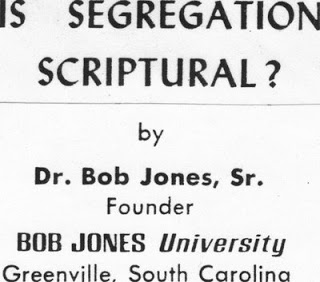
is segregation scriptural

There was more than theology at play then, and there is now…

If real, “orthodox” Christianity insists on racial segregation, for example, as Bob Jones Sr. famously argued in 1960, then the US government has no right to demur. If real, “orthodox” Christianity requires belief in a literal six-day flood and a recent creation of humanity, for example, as Ken Ham famously argues today, then evangelicals have no business questioning it.

Just like questions of LGBTQ rights, however, neither of those ideas are really as simple as conservatives like to think. Debates about them divide people who share the same religious backgrounds. The cultural battles over racism, creationism, and sexuality are not battles between people who have different religions. They are fiercest between people who SHARE religious ideas but have different ideas about public policy.

So are America’s culture wars “a religious dispute?” Only if we use a tortuous definition of the phrase. To say that conservative positions on sexuality, race, or gender are just being “orthodox” only makes sense as a political strategy. As an actual description of the divides we face on such issues, it doesn’t help at all.
Conservatives Should Be Nervous About This

I’m no conservative, but if I were I wouldn’t be celebrating this recent essay by David French. I’d be quaking in my penny loafers. If we’ve learned nothing else from the history of the culture wars, it’s that this kind of talk heralds the bitter end.

Here’s what we’re talking about: In the pages of National Review this week, conservative pundit David French made the case for freer conservative speech on college campuses. He decried the tactic used by progressive students to declare conservatives beyond the pale of civil discourse. Too often, French lamented, aggressive progressives freeze out any conservative challenge by labeling it “dehumanizing.”

As French puts it,

An atmosphere that is devoid of truly meaningful debate is one that is more likely to give birth to bankrupt ideas. And the woke progressive monocultures in quarters of academia and Silicon Valley have advanced and protected both the idea that speech is violence and the idea that disagreement is dehumanizing — especially when disagreement touches on matters of race, gender, and sexuality.

As SAGLRROILYBYGTH are aware, I’m no conservative myself, yet I’m on the record as agreeing with French that college campuses should welcome real culture-war debates. If I were a conservative, though, I would be terrified to hear French talking this way. If I knew my culture-war history, I’d know that this line of argument is always a memorial to a battle lost long ago.

Consider the case of creationism in public schools. A hundred years ago (ish), at the Scopes Monkey Trial in Dayton, Tennessee, the defenders of evolution education pleaded with America to allow evolution to be heard. As lead attorney Dudley Field Malone made his case,

For God’s sake let the children have their minds kept open — close no doors to their knowledge; shut no door from them. Make the distinction between theology and science. Let them have both. Let them both be taught. Let them both live….

It was a desperate argument for a losing side. Evolution education was not popular in 1920s America, at least not in places such as Dayton, Tennessee. As I discovered in the research for my first book, anti-evolution laws were usually only the sharp point of a much vaster campaign to impose theocratic rule on America’s public schools.

Fast forward seventy years, and the argument had switched sides. By the 1990s, it was the radical creationists who were pleading to have children’s minds kept open. They made their case for inclusion because by the 1990s creationists were just as desperate as Dudley Field Malone was in the 1920s. In 1995, arch-creationist Duane Gish told crowds it was now the creationists who were frozen out. Gish insisted he only wanted to fight against the “bigotry” of excluding creationism.

If you aren’t at the table, you’re on the menu…

What does any of this have to do with David French? A lot. Evolution-lovers like Dudley Field Malone only pleaded for inclusion when they were frozen out. Radical creationists like Duane Gish only begged for inclusion when they had already decisively lost the creationism culture war. By the 1990s, Gish’s brand of young-earth creationism had already become a relic of an imagined fundamentalist past, a fossilized idea that no longer had any real chance of returning to its spot in the American mainstream. It was still popular in fundamentalist pockets, but it had zero chance of returning to its former glories in the Princetons and Harvards of these United States.

If I were a conservative, I’d worry that French’s let-me-in rhetoric heralds the same sorry state for his outdated ideas about sexuality, gender, and race. Don’t get me wrong: I think there are strong conservative arguments that can be made in favor of greater inclusion of traditional sexual norms, but French ain’t making em.

The idea that traditional gender ideas should be included because all ideas should be included won’t convince anyone. Moreover, the fact that French feels obliged to make this case shows how desperate he is. If I were a conservative, these kinds of arguments would make me very nervous about the current state of conservatism in America.

The Conservative/Christian Coalition Gets Weird…

You scratch my back, I’ll…erm…pretend I didn’t just see that dinosaur on Noah’s Ark. It’s not news that more-secular conservatives have long paired up awkwardly with Christian conservatives. With T-Diddy in the White House, though, things seem to be reaching a crescendo of ultimate weirdness. A couple of recent news stories underline the contortions that both sides have to go through to make America great again.

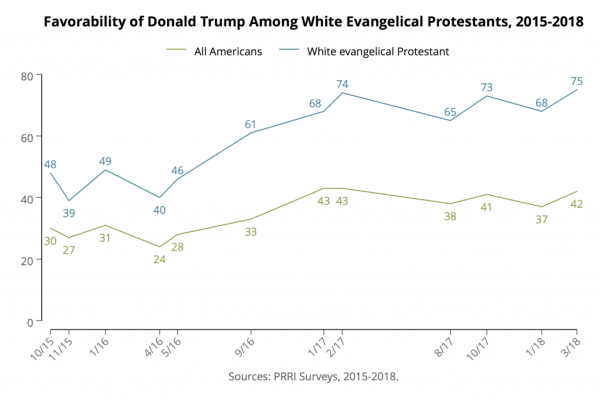
PRRI-Trump-Favorability-and-white-evangelicals-2015-2018-1-1024x683

Fox n Friends strategist: Who’da Thunk We’d Be Hanging out with Dinosaurs for this…?

First of all, let’s clear the air of a few stubborn misconceptions. As we’ve pointed out over and overSAGLRROILYBYGTH are likely tired of hearing it—there’s absolutely nothing “new” about the idea of conservative evangelicals getting involved in politics. The so-called “New Christian Right” of the 1970s was not the first time that evangelicals decided to jump into the political fray. As historians such as Daniel K. Williams, Matthew Avery Sutton, and yours truly have argued for years, evangelical Protestants have always been politically hyperactive.

As any historian knows—and any savvy evangelical could tell you—the evangelical community has always included political conservatives, political progressives, and a bunch of people in the political middle. The emergence of the “New Christian Right” was not a question of evangelicals getting into politics for the first time, but rather an always-awkward alliance between politically conservative evangelicals and the conservatives within the Republican Party.

Having said that, let’s look at some of the recent unpleasantness. At evangelical Taylor University in Indiana, for example (see our further coverage here), Vice President Mike Pence has caused a furor over his invitation to deliver a commencement address. Politically progressive members of the Taylor community have protested.

Not surprisingly, non-evangelical conservatives have weighed in to support the university’s decision. Non-evangelical conservatives have highlighted the justice of the conservative evangelical side at Taylor. For example, Fox & Friends tracked down a politically conservative alumnus of Taylor, who told them,

The vice president has very orthodox Christian beliefs – very traditional beliefs – that a vast majority of Christians believe. His political views are shared by a large section of America, so it’s not a radical choice, and I think people should be able to engage and disagree with his views and do it in a mature fashion.

The conservative PJ Media concluded,

Sadly, this incident illustrates yet again the trend of liberals demonizing dissent from their ideas. Conservative speech is not violence, and Mike Pence is not “rooted in hate.”

It’s no surprise that secular conservatives would jump in to side with evangelical conservatives at Taylor. After all, secular progressives have done the same thing for the anti-Pence side. Things get a little weirder, though, on a different episode of Fox & Friends.

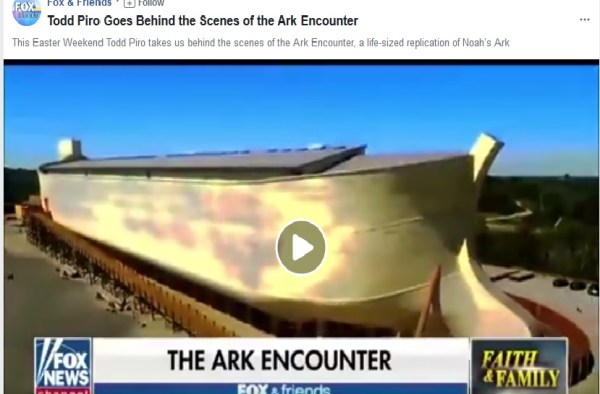
fox n friends at the ark encounter

just…wow!

One of the F&F hosts, Todd Piro, goes on a tour of Answers In Genesis’ Ark Encounter. With a straight face, so to speak, the F&F segment shows the creationist megalith in all its zombie-science glory. The camera pans over dinosaurs in cages. Piro interviews visitors who sincerely praise the displays. As one earnest youth explains,

Not only did it give you the Biblical side, but it gave you a lot of scientific facts.

In his introduction, Piro says the Ark is just… “Wow!”

Not, ‘Wow, do you really believe that dinosaurs lived at the same time as humans?’

Not, ‘Wow, do you really believe that a flood could have actually covered the entire planet?’

But, ‘Wow, this is a neat museum, full of learnin n stuff.’

Now, I’m no conservative, but I can understand perfectly well why non-evangelical conservatives would fall all over themselves to support Taylor’s conservative evangelicals. After all, both evangelical and non-evangelical conservatives can agree on their opposition to LGBTQ rights.

But I’m truly flabbergasted when I see non-evangelical reporters describing the Ark Encounter as if it were just another neat museum. How is it possible for anyone who is not themselves a radical young-earth creationist to see the Flintstones-level scientific displays and not ask about them? How is it possible that any journalist can see dinosaurs in cages and not wonder how they count as “scientific facts”?

Watching Piro sugar-coat the radical science on display at the Ark Encounter, one can almost hear the political calculations going on in the offices of Fox & Friends. We can almost hear the implicit deal non-evangelicals want to cut with evangelical conservatives. “You give us a solid 81% vote for T-Diddy,” we can hear them thinking, “You give us university commencement speeches for Pence, and we’ll give you a cake-walk visit to your kooky Bible-science museum and a stirring defense of your stubborn resistance to LGBTQ rights.”

The Creationist Harvard Is…

Quick: If you are a die-hard young-earth creationist, where would you want your kid to go to college? Bob Jones? Cedarville? They are both on Ken Ham’s list of “safe” schools. In fact, though, radical creationists are in a more complicated dilemma when it comes to elite higher education.CREATION COLLEGE MAP

Here’s what we know: In spite of their long-simmering resentment over the state of mainstream and liberal higher education—as I documented in Fundamentalist U—radical creationists are still trapped in a bitter one-way love affair with elite colleges. In the past, young-earth creationists pointed with pride to the credentials of people such as Kurt Wise.

Dr. Wise earned his PhD in the Harvard lab of the late Stephen Jay Gould. Yet Wise famously clung to his young-earths beliefs. As he wrote a few decades ago,

I am a young age creationist, because that is my understanding of the Scripture. . . . if all the evidence in the universe turned against creationism, I would be the first to admit it, but I would still be a creationist because that is what the Word of God seems to indicate.

For years, Wise’s devotion to young-earth beliefs, coupled with his Harvard credentials, earned him the love and respect of the radical creationist community. And now radical creationists have another Crimson hero to celebrate. Dr. Nathaniel Jeanson recently explained his academic journey in the pages of WORLD Magazine. Dr. Jeanson also earned his PhD at Harvard without giving up his young-earth beliefs. As WORLD explained,

Jeanson entered Harvard with a burning desire to find a cure for cancer. He emerged with a determination to push back against evolution and help people struggling with science-religion tension find their way back to Biblical truth.

So what? This celebration of a real live creationist who studied in the world’s greatest university is still a source of enormous pride among radical creationists. As Ken Ham bragged on his blog, Dr. Jeanson’s career proves that their science is really science. As Ham put it,

Creation science is such an exciting field. Many people have this idea that creationists don’t do research, but that’s not true. Many creation scientists are actively involved in exciting discoveries regarding the world around us.

Ham’s celebration of creationist achievement highlights the century-old creationist dilemma. On the one hand, they need to explain to themselves why mainstream science no longer values their vision of proper science. Usually, that means dismissing bitterly those mainstream institutions as “deluded” or “biased.” On the other hand, though, radical creationists yearn endlessly for recognition from those same mainstream institutions.

HarvardShield

Who wants to go to Harvard? We all do…

Harvard has long symbolized the very best and worst of these trends in higher education. Henry Morris, the godfather of radical American creationism, called out Harvard by name in his book The Long War Against God. Harvard went wrong, Morris warned, back in 1869 when Charles Eliot took the helm. In Morris’s telling, Eliot appointed John Fiske, like Eliot a Unitarian, to “introduce and popularize evolutionism in the Harvard curriculum” (pp. 46-47).

Yet as the recent celebration of Dr. Jeanson makes clear, radical creationists still relish the thought of a Harvard diploma. In their view, Harvard may be a terrible and terrifying spiritual institution, but creationists still love it deep down in their hearts.

Creationists: Have You Stopped Beating Your Wives?

Sometimes, it’s all in the way you phrase the question. Newish poll results from the Pewsters underscore the fact: Americans aren’t really sure what to think about creation and evolution. It all depends on how you ask.

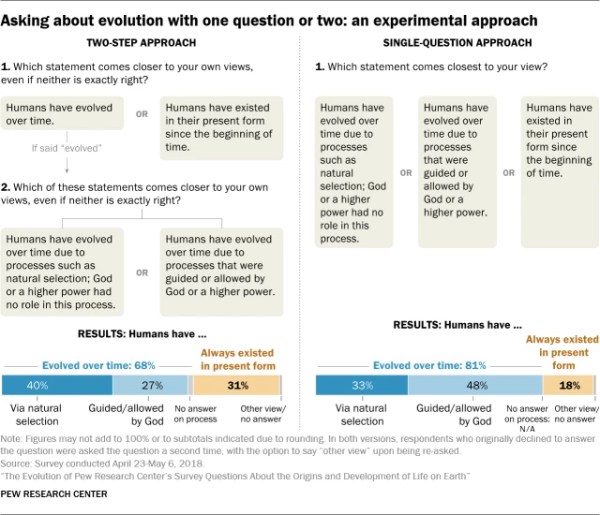
Here’s what we know: The folks at Pew Research Center experimented with different ways to ask respondents about evolution and creationism. As they discovered,

our estimate of the share of Americans who reject evolution and express a creationist view drops considerably (from 31% to 18% of U.S. adults) when respondents are immediately given the opportunity to say God played a role in human evolution. [Emphasis in original.]

Pew evolution questionsOther pollsters have come to similar conclusions. As the National Science Board found, what people say about evolution can change wildly when the questions are worded differently. In 2012, NSB asked two different sets of questions. When they asked people if “Human beings, as we know them today, developed from earlier species of animals,” a small majority (52%) said no.
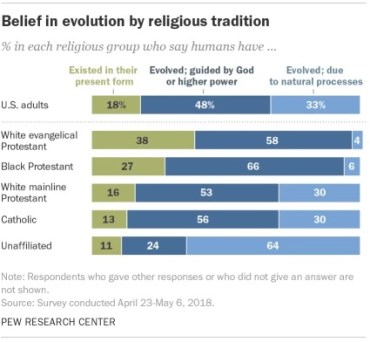

But when NSB asked if “according to the theory of evolution,” humans evolved from other species, a much larger group (72%) said yes. In a way, those responses make perfect sense. Lots of people might know that mainstream scientists agree about evolution, but still not think evolution really happened.

Other poll results, though, get weirder. A decade ago, George Bishop looked at poll numbers and came up with some flatly contradictory results. For example, it seems some people—a lot of people—agree that dinosaurs died out 65 million years ago (69%). However, because 40% of respondents also think that dinosaurs lived at the same time as humans, there seems to be some impossible crossovers going on.

What do Americans really think about evolution and creationism? Depends on how you ask the question. By and large, people don’t care too much about it and they certainly don’t care about intellectual consistency. And that’s not a jab at creationists alone—people who say they accept evolution often can’t explain its basic ideas. (Don’t believe it? Check out this study or this one.)

One thing seems likely: Those of us who want more and better evolution education should be encouraged by the fact that the number of intentional, hard-core, consistent radical creationists is nowhere near as high as we are sometimes told.

The Accidental Creationist Conspiracy

We didn’t mean to. But those of us who fight for more and better evolution education have occasionally unwittingly teamed up with radical creationists to promulgate a false myth about the nature of American creationism. We should stop.

Pew Creation eighty one

I’ll take those odds…

Here’s what we know: Most Americans know—or admit—that humans evolved. You may have heard the old Gallup poll results, the ones that keep finding almost half of Americans think God created humans in pretty much their present form at some time within the past ten thousand years.

More careful survey questions—it’s all about the questions—reveal much different numbers. The folks at Pew Research have found that about four in every five Americans accept human evolution. The numbers of die-hard evolution deniers is much smaller than you might have thought.

Why is that? Why do so many of us think that there are many more radical creationists out there than there really are?

For one thing, it might be because of the publicity. Whenever a high-profile radical creationist gets anywhere, it attracts a lot of attention. Consider the ill-starred campaign of Mary Lou Bruner in Texas. She didn’t win her race for state school board, but when she told her facebook friends that there had to have been dinosaurs on Noah’s Ark, and that Obama had put himself through law school as a prostitute, it attracted international attention to her campaign.

But there’s another reason, too. Radical creationists like Ken Ham of Answers In Genesis have an obvious interest in inflating the numbers of followers they have. When it comes to the attendance figures at AIG’s Ark Encounter in Kentucky, for example, Ham seems fond of exaggerating the number of people who trickle through his gopher-wood gates.

There’s a less obvious angle, too. Not only do Ham and other radical creationists exaggerate their own influence, so do Ham’s fiercest opponents. For instance, Americans United campaigns vigorously for secular public schools. They fight against any whiff of religiously inspired creationist curriculum. In doing so, however, they unintentionally promote the myth of vast creationist armies massing outside the schoolhouse door.

Now, to be clear, I personally support their work, and that of other anti-creationist groups such as the National Center for Science Education. Nevertheless, when AU rightly condemns the creationist activities of lawmakers such as Indiana’s Dennis Kruse, AU tends to imply that Kruse is not part of a desperate, go-nowhere radical creationist rump, but rather part and parcel of what they call elsewhere a

a coordinated national effort to codify a far-right, evangelical Christian America. [Emphasis in original.]

A casual reader might be forgiving for thinking that a “coordinated national effort” is scarier than what we might more appropriately describe in other terms. Instead of inflating the influence of radical creationism, what if we called it by more appropriate labels? How about “desperate?” How about “disappearing?” How about “shrinking and increasingly isolated?”

As I’m arguing in my new book about American creationism, the vast majority of Americans don’t really disagree about evolution. Not in ways that really matter. Instead, most of us are friendly to the mainstream science of evolution. We’re also friendly to religious ideas about divine involvement in the origins of life. Few of us agree with the radical positions on either side of the creationism culture war.

shipley war on modern science

“Vast armies?” or sad little cliques?

Instead of harping on the threat of radical creationism, it will be better strategy to emphasize the out-of-step nature of radical creationism. Instead of warning incorrectly—as NCSE godfather Maynard Shipley did in the 1920s—that “the armies of ignorance are being organized, literally by the millions, for a combined political assault on modern science,” we should be celebrating and publicizing the fact that only a small and shrinking band of out-of-touch radicals still deny the essentials of mainstream science.

Think Creationists Are Dumb?

To be fair, SOME creationists might just be ignorant. As I’m arguing in my new book about American creationism, though, there is more than enough ignorance to go around when it comes to evolution and creationism.

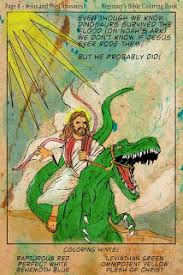
Jesus on a dinosaur.jpg 1

Why do creationists put Jesus on a dinosaur? Short answer: They don’t.

I recently made a short version of this case at UConn’s Humility and Conviction in Public Life blog. If we want to make any real progress in our continuing battle over creationism, we can at least start by acknowledging a few of these obvious truths.

Agree? Disagree? Click on over to H&CiPL to check it out.

Why We’re Doomed

We all knew it was going to be ugly and stupid. I’m still surprised, though, when people say these things with a straight face. Conservative pundits lump middle-of-the-roaders like me into a vast, scheming “secular Left . . . who cannot stand the presence of religion in everyday  life.” Lefties blast middle-of-the-roaders like Cory Booker into the conspiratorial Right. No wonder we can’t have a decent convo.

First, my alleged anti-religiosity. After my recent commentary about Karen Pence in the Washington Post, Ben Shapiro took to the tube-waves to rebut. At about 19:30 in this segment, he hoped to redefine Ms. Pence’s ordeal. Instead of an old-fashioned fight between religious groups, Shapiro insisted, what we’re facing now was an outright fight by powerful secular forces against traditional religion as a whole.

Shapiro argued that people like me assume that there is no legitimate traditional religion anymore. People like me, Shapiro said, see conservative religion as only

a basket of bigotries masquerading as religion.

I won’t rebut Shapiro’s rebuttal, though I will point out that SAGLRROILYBYGTH have offered much more powerful and insightful counterarguments to my Pence commentary in these pages.

The point this morning is bigger and it’s not only about my hurt feelings. It’s not even about conservatives alone. Pundits on the left tend to shoot their mouths off just as wildly. For example, though I’m not a fan of Senator Cory Booker’s (fading?) support for charter schools, I can acknowledge that he often endorses traditional progressive political positions.

Yet, as Molly Ball noted a few years back in The Atlantic,

Booker has faced a steady drumbeat of criticism from sites like Daily Kos, where a contributor asserted last year that he “would actually be much more at home in the Republican Party.” Booker’s team has grown all too familiar with the rap that he is “some sort of Manchurian candidate for the right,” as his campaign spokesman, Kevin Griffis, put it to me with a sigh.

The problem is bigger than Cory Booker or Karen Pence. It’s even bigger than Ben Shapiro. In a sensible system, pundits on both sides would rush to include as many people as they can on their team. Ben Shapiro would notice that my argument wasn’t really against traditional religion at all. Cory Booker would be welcomed into a big-tent Left and encouraging to squeeze every possible progressive drop out of his role.

That’s not what happens. Instead, as pundits on both sides try to get clicks by excoriating their natural allies, the left-right divide only gapes ever wider.

Creationism and the Conservative Vision Board

It was the creationism part that first got my attention. Why would a smart, dynamic politician introduce such an old-fashioned creationism bill for public schools, a bill obviously doomed to failure? As I read the rest of the bill, the answer became obvious. And for anti-creationist campaigners, the lesson is clear.


Indiana State Senator Dennis Kruse has a long record of introducing anti-evolution legislation. Twenty years ago, he began pushing bills that would allow for the teaching of creation science in Indiana’s public schools. When those flopped, he began fighting instead for “academic freedom” for Indiana’s teachers, to allow them to teach a “diverse curriculum.”

This month, however, for some reason Senator Kruse went back to an old-school school bill. Kruse is once again campaigning for schools that include “the teaching of various theories concerning the origin of life, including creation science.”

What gives? Why would a creationist go back to a failed strategy? After all, the inclusion of “creation science” in public schools has been definitively rejected by the Supreme Court. Why would Kruse bother to ask for something (again) when he knows he won’t get it?

The rest of the bill makes the answer painfully obvious. Senator Kruse isn’t really crafting legislation here. He is creating a conservative vision board.


Kruse is asking for a range of educational policies that might or might not be possible. He wants all Indiana public and charters schools to post big “In God We Trust” signs, along with a US and Indiana flag. He wants religious electives, including Bible studies. He wants students to be able to earn public-school credit for religion classes. Creationism—even the outdated “creation science”—is only one of the public-school visions on this Indiana board.

Why does it matter? As I’m arguing in my new book about American creationism, we will never really understand creationism if we think of it only as a fight about science curriculum. In most cases, creationism is only one aspect of a wide-ranging conservative attitude about education.

Yet too often, science teachers and science advocacy groups are left all alone in their fight against creationism in public schools, when the fight is not really about science. It is a fight over the proper nature of public education. Should schools be aggressively pluralist, ditching their historical Protestant baggage? Or should they be staunchly traditionalist, teaching children to be patriotic and Christian?

Karen Pence Falls into the Scopes Trap

SAGLRROILYBYGTH have likely been following the story: Second Lady Karen Pence has taken some heat for going back to work at Immanuel Christian School, an evangelical school with explicitly anti-LGBTQ beliefs. As they rush to defend her, I’m arguing this morning, Pence’s conservative allies are actually stumbling into an old culture-war trap.

shapiro pence

…ouch.

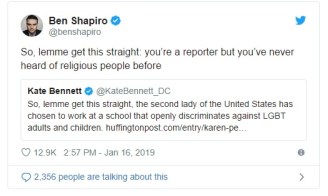
Understandably, some of her conservative defenders are taking the path of least resistance. Opposing any sort of non-hetero, non-married sexual activity, they say, has ALWAYS been a standard Christian belief. As Ben Shapiro put it most bitingly, Pence’s critics seem to have “never heard of religious people before.”

Thanks to the Made By History series editors, this morning I’m arguing in The Washington Post that Pence’s defenders are making an old mistake in their hasty counter-attacks. I won’t give away the details–you’ll have to click over to read the whole thing–but I will say I work in some of the biggest names in twentieth-century creationist history: Henry Morris, Bernard Ramm, and William Jennings Bryan.