Do Conservatives Want the Government to Tell Americans What to Do?

Preschool or Parents?

That’s the question education pundits from the Heritage Foundation have been asking lately.  To a non-conservative outsider like me, this question raises key questions about the goals of conservative education policy.  It seems as if Heritage Foundation writers want both a less intrusive government and a more intrusive government.

Don’t get me wrong.  I understand that there are different sorts of conservatives, all of whom may have very different visions of the good society, good education, and the proper role of government.  I’ve read the work of historians such as George Nash who have chronicled the post-World War II tensions between libertarians and social conservatives.  But in this case, it seems as if one conservative organization—a small-government conservative organization—is calling for a big-government solution to education dilemmas.

Here is the recent confounding case: In light of President Obama’s recent call for universal, government-funded preschool, Heritage writers have renewed their push for a different vision.

Lindsey Burke and Rachel Sheffield of the Heritage Foundation insist that government-funded schooling is not the effective or ethical way to improve school achievement.  The obvious answer, Burke and Sheffield write, is to improve families.

They cite research to prove that programs such as Head Start have not been effective.[1]

They also note studies that tie school achievement to stable family structures.  As Burke and Sheffield argue,

 “A stable family, with married parents, provides the best foundation for a child’s academic success. Children raised in intact families are more likely to graduate from high school and more likely to attend and complete college than their peers raised in single-parent or blended families[30] They also score higher on reading and math, and exhibit fewer behavioral problems in school[31] A stable family also prevents a variety of other risk factors that would derail a child’s future success[32]

“However, over 40 percent of children are born outside marriage in America today. These figures are much higher among minorities: 72 percent among African Americans and 53 percent among Hispanics, while 29 percent among whites. Unwed childbearing is the greatest driver of child poverty today. Children in single-parent families are nearly six times as likely to be poor compared to their peers born in married-parent homes[33] Additionally, children in non-intact families have poorer academic performance and are at greater risk for dropping out of school, becoming antisocial and delinquent, and parenting a child outside marriage. These outcomes persist even after controlling for income.34” [N.b., there was no link in original for note 34. It referred readers to the same source as note 33.]

In this excerpt, Burke and Sheffield refer to three earlier Heritage-Foundation research articles: see here, here, and here.  I followed up on those sources, and found that the research came largely from peer-reviewed academic journals such as Journal of Marriage & Family and Social Forces.  (Without a library membership, it can be difficult to access these sources.  However, most public libraries have an EBSCO-or-similar database subscription that will allow readers access to these small-circulation academic journals.)

One conclusion that could be drawn from this is that the government needs to encourage families to stay together.  The public-policy goal would be obvious: if intact families improve school performance, then the government has a compelling interest in promoting stable families.

Burke and Sheffield avoid that conclusion.  Instead, they suggest that government should eliminate or reform Head Start, stop mandating government preschool, and reform existing preschool programs before expanding into new ones.

But other Heritage voices have taken a different approach.  Robert Rector, in 2012 a Senior Research Fellow in the Domestic Policy Studies Department at The Heritage Foundation, argued—in a study cited by Burke and Sheffield—that government should indeed engage in what Rector called a

broad campaign of public education in low-income areas. This campaign should be similar in scope to current efforts to convince youth of the importance of staying in school or to inform the public about the health risks of smoking. While the costs of such an effort would be small, its impact could be considerable.”

Rector also suggests concrete policy suggestions to strengthen families, such as increasing the tax benefits to married couples with children.

I honestly don’t mean to be snarky when I ask this next question; I am truly confused.  Do small-government conservatives such as Heritage’s Robert Rector really want the government to tell people how to regulate their intimate lives?

Heritage’s Derrick Morgan offered what seems to me an awkward patch of these conflicting sentiments a few months ago.  Small government was the answer, Morgan wrote.  But smaller government must also promote “traditional values” as part of its goal to shrink its own purview.

When it comes to education policy, this just doesn’t add up.  Small-government goals of privatized education, smaller government-funded programs, and fewer government education standards seem consistent.  Even if I don’t agree with them, I can see their logic.  But I don’t understand how Heritage’s conservative thinkers connect these goals with a simultaneous government intrusion into the most private, intimate decisions Americans make.

Hostile critics, I think, would assume that Heritage wants to impose government mandates on poor and powerless Americans, while allowing richer and more powerful citizens to enjoy freedom from government interference.  That seems a little simplistic, especially for the sophisticated thinkers preferred by the Heritage Foundation.

But is it true?  Does the Heritage Foundation suffer from—at best—confused ideology about education?  Or, at worst, is Heritage cynically promoting intrusive government for the poor, and small government for the rich?


[1] Here I think Burke and Sheffield need to be more careful.  The reference they cite was actually to a 2010 study, one that reports significant positive effects of 3- and 4-year-old Head Start problems.  But from the text of their article, I gather the authors meant to reference a more recent 2012 follow-up, in which few long-term differences were found between children who attended Head Start and those who did not.
Jesus Increases Graduation Rates

In Christianity Today we find a story about Detroit’s Cornerstone Schools.

Founded in 1991, today these schools serve 1,500 students, 97% of whom graduate from high school and 90% of whom go on to college or the military.

These statistics have attracted national attention.  In one profile for CNN, the schools’ success was credited to “three Cs:” a Culture of education, Commitment to learning, and Community.  (See video clip, 2:28, right at the end.)

The profile in Christianity Today, not surprisingly, focused on another C: Christ.  In an interview with the schools’ leaders Ernestine Sanders and Clark Durant, CT‘s Dwight Gibson concluded that the schools’ success comes from one simple fact: Cornerstone represents “a school whose culture is centered on the person of Jesus.”

Chairman Durant framed the schools’ success this way:

“We have fabulous statistics. Most of our kids graduate from high school in a city where maybe 30 or 35 percent do. More than 90 percent go onto college, the military, or some other kind of learning. But those are not the measurements that really determine a fulfilling life. Sure, it’s important, but is it the measurement we use for our own children? Is it the measurement that God uses for us?”

President Sanders did not credit the schools’ academic successes with innovations such as an 11-month school year, mandatory Mandarin classes, or mandatory parental commitment.  Instead, Sanders explained Cornerstone’s success this way:

“It’s our people, whether it’s our maintenance man, Mr. Cole, or a teacher. In Mr. Cole finding his place in this community, the kids see him as valuable. He has wisdom.  That’s why Cornerstone is excellent—we try so hard even as imperfect as we are to lift up a Christ-centered culture.

“And in lifting up that culture, the education is coming along. So you keep aspiring to that excellence. What we try to do here is not to be daunted by the circumstances. Rather than being daunted by it, we try to be as strategic as we possibly can. I see us trying to build that broad and beloved community that Clark referenced.”

The story raises some key questions about the proper relationship between religion and education.

  • Can public-funded schools use religion to boost graduation rates?
  • Is it enough justification to have religion in public-funded schools if those schools produce academic success?
  • And why didn’t the CNN story mention the religious nature of these schools?

Conservatives and the Common Core

What do conservatives think about the emerging Common Core State Standards?

As with any question, ask a hundred conservatives and you’ll likely get a hundred different answers.
However, some distinct themes have emerged in recent months.

First, many conservative politicians and activists object to the Common Core’s implications for the creeping expansion of government.  Some insist that the standards add another layer of inaccessible, distant, controlling, expensive central control.

Second, conservatives object that the new national standards chip away at parental control of children’s education.  With greater central control, parents and responsive local governments will lose that much more ability to control directly what goes in their local public schools.

Both of these are storied conservative protests against the trends in public education.

Before we examine these themes and their histories, let’s look at the CCSS themselves.  So far, forty-five states, plus the District of Columbia and Department of Defense schools have adopted these standards.  Supporters of the CCSS insist these are not imposed by the federal government, but rather created jointly by state education officials.  The reasons for such standards are many, according to supporters.  In the words of the CCSS Initiative,

“High standards that are consistent across states provide teachers, parents, and students with a set of clear expectations that are aligned to the expectations in college and careers. The standards promote equity by ensuring all students, no matter where they live, are well prepared with the skills and knowledge necessary to collaborate and compete with their peers in the United States and abroad. Unlike previous state standards, which were unique to every state in the country, the Common Core State Standards enable collaboration between states on a range of tools and policies.”    

Conservatives are not the only ones to dispute these claims.  Progressive critics (see one example here) often lament the new standards’ failure to consider adequately individual student situations.  Some progressives call the standards a greedy corporate power grab.  Others lament the goal of squeezing all young minds into a procrustean bed of regurgitative multiple-choice testing instead of pursuing the more difficult goal of authentic learning for real students.  Alfie Kohn, for instance, insisted that national standards would “squeeze the life out of classrooms” by mandating one-size-fits-all education, dictated by self-seeking corporate interests.

When conservative activists and pundits critique the CCSS, it is usually on different grounds.  Writing for the Heritage Foundation, for example, Lindsey Burke warned, “The push for centralized control over what every child should learn has never had more momentum.”  CCSS, which Burke called “national standards,” represented a “challenge to educational freedom in America.”  Implementation of the standards would be expensive, Burke pointed out.  Even worse, these standards reversed the proper structure of education.  Instead of more and more central control, Burke argued, “Education reform should give control over education to those closest to students.”

The Heritage Foundation’s Rachel Sheffield praised state lawmakers who pushed to exit the CCSS.  In Indiana, for instance, conservative state lawmakers have proposed a bill to put the CCSS on hold.  One of the requirements of Indiana’s Senate Bill 193, for instance, will be to include parent members on the standards committee.  Another will be to allow any parent to challenge their children’s standard-based high-stakes test results.

These themes—federal overreach and parental control—have long been central to conservative educational activism.

As we’ve noted, agitation against federal intrusion into the local politics of education has been an important element of conservative educational activism since at least the 1940s.  Though it might come as a surprise to some, before the 1940s many conservatives endorsed increased centralization of education policy, as Douglas Slawson has noted in his excellent book The Department of Education Battle, 1918-1932.

The second conservative worry about CCSS also has a long history.  Conservative pundits have argued for decades that parents need more control over their children’s education.  Back in the 1960s, conservative educational leader Max Rafferty insisted, “Children do not belong to the state. They do not belong to us educators, either. They belong to their parents and to nobody else.  And don’t you forget it.”  (Source: Rafferty, On Education, pg. 9)

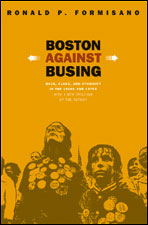
Note one protester's button: "Parent Power"

Note one protester’s button: “Parent Power”

These conservative concerns spanned the country and the decades.  As historian Ron Formisano noted in his landmark 1991 history of Boston disputes over forced busing, parents insisted on their fundamental rights to determine their own children’s educational careers.  As anti-busing leader Louise Hicks fumed, “If under a court order a child can be forcibly taken from his parents into unfamiliar, often hostile neighborhoods, then we shall have opened a pandora’s box of new, unlimited government powers” (pg. 192).

Similarly, President Reagan insisted in 1983, “I believe that parents, not Government, have the primary responsibility for the education of their children.  Parental authority is not a right conveyed by the state; rather, parents delegate to their elected school board representatives and State legislators the responsibility for their children’s schooling.”  (Source: Catherine Lugg, For God and Country, pg. 136).

Across the spectrum of conservative belief and activism, we hear similar echoes.  In 1989, for instance, creationist leader Ken Ham warned that “Most parents have left the training of their children to the church, school or college.”  No wonder, Ham argued, that children embraced anti-God theologies.

So when conservatives in 2013 warn that CCSS will undermine parental control, they draw on a rich tradition of conservative thought and activism.  Schools must remain on a tight leash, many conservatives have insisted over the years.  If allowed too much power, centralizing educational authorities will take over.


Why School Choice?

As National School Choice Week moved into the history books, we have to ask: Is school choice a “conservative” issue?

There is no doubt that conservatives support choice.  Stalwart conservative organizations such as the Family Research Council and the Heritage Foundation make choice a centerpiece of their education policy platforms.

But the arguments conservatives usually make in favor of school choice often sound more traditionally “progressive” than anything else.  Is this mere political strategy?  Or a more profound commitment to social justice for those without economic resources?

The stereotypically “conservative” reasons for school choice are fairly simple.  First, opening up a variety of schools that receive tax dollars will enshrine the principles of free-marketism into public education.  Second, a thriving choice system will send more tax dollars to religious schools.

And we do occasionally see such arguments by conservative intellectuals.  The Friedman Foundation, for instance, legacy of free-market guru Milton Friedman, argues that choice will fix America’s public-education system.  According to Milton and Rose Friedman, that system has too often been “deprived of the benefits of competition.”

Similarly, Notre Dame’s Richard Garnett recently argued that school choice could help save struggling Catholic schools like the one that educated US Supreme Court Justice Sonia Sotomayor.

More often, however, conservative activists argue for school choice using different themes.  Most commonly, choice is presented as the best hope of low-income families in neighborhoods with sub-par public schools.  During National School Choice Week, we saw an outpouring of such rhetoric.
For instance, the Heritage Foundation publicized a speech in favor of choice by former Alabama Congressman Artur Davis.  Choice, Davis argued, could give options to a seventh-grader who submitted the following barely literate argument:

“[Y]ou can make the school gooder by getting people that will do the jod that is pay for get a football tame for the kinds mybe a baksball tamoe get a other jamtacher for the school get a lot of tacher.”

According to Davis, this student from Highland Park, Michigan was passed into eighth grade despite his struggles with basic writing.  Choice, Davis argued, could help.  It could offer parents, teachers, and students better schools now.  According to the Heritage Foundation article, Davis believed that school choice offered “the education [children] need right now, instead of simply pouring more money into the program or waiting for some new reform plan.”

Similarly, a writer at the social-conservative Family Research Council insisted that the main reason to support school choice was that “School choice gives students an opportunity to achieve a quality education and helps them not to fall through the cracks. We should all be in favor of helping children reach their fullest potential.”

Perhaps the most compelling statement of this conservative argument for the progressive virtues of school choice came over twenty years ago in an essay by Berkeley Law School’s Professor Emeritus John Coons.  As Coons argued in his 1992 essay, school choice advocates too often focus only on choice as a free-market device.  Instead, Coons insisted, such choice must be seen as “Simple Justice.”  Despite efforts to desegregate schools and make schools less imposingly Protestant, Coons wrote,

“we still arrange education so that children of the wealthy can cluster in chosen government enclaves or in private schools; the rest get whatever school goes with the residence the family can afford. This socialism for the rich we blithely call ‘public,’ though no other public service entails such financial exclusivity. Whether the library, the swimming pool, the highway, or the hospital—if it is ‘public,’ it is accessible. But admission to the government school comes only with the price of the house. If the school is in Beverly Hills or Scarsdale, the poor need not apply.

Choice is the obvious remedy for such maldistribution and discrimination.”  

Coons argued that non-elite parents deserved the right to send their children to schools that matched parents’ religious and cultural beliefs.  Such parents did not write op-eds in the New York Times.  Such parents did not have the option to influence the greater culture by making award-winning films or prize-winning books.  “Children,” Coons wrote, “are the books written by the poor.”

Yet despite such protestations among conservative intellectuals and pundits, school choice remains its reputation as a conservative issue.  As one angry commenter noted on the Family Research Council website,

“you see, school choice is really about getting as many students to pray to God each day. And, how many of these school choice advocates would have pressed for integration back in the 50’s? Very few. It’s about supporting religious schools through taxpayer dollars.”

Similarly, Americans United for Separation of Church and State has protested,

“It’s about funding religious and other private schools with taxpayer dollars and ultimately destroying the public school system.

“If you think the Heritage Foundation, the Koch Brothers and Betsy DeVos are in this just to help to some poor kid in the inner city, they’ve got a privatized bridge in Brooklyn they want to sell you.”

We ask again: Why school choice?  Do conservatives support school choice because choice will crush teachers’ unions?  Because choice will promote a freer free market?  Because choice will get more students praying in schools?

Or do conservatives support choice in order to help more children faster?  Because choice offers a way to deliver better education to low-income students?

My hunch is that, for many conservatives, the best answer is all of the above.  No doubt many conservatives want freer markets and a more Christian public square.  And school choice promises to deliver those things.  But choice might also be attractive because it gives better schools to more people faster than any other measure. 

School Choice: Not Just for Conservatives Anymore?

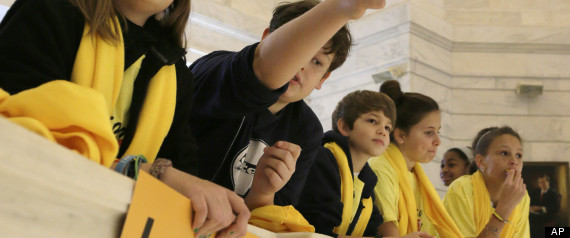
Have you seen the yellow scarves around?

Image Source: Huffington Post

Image Source: Huffington Post

They are the symbol of National School Choice Week, going on right now.

In a one-minute off-the-cuff interview with the Milwaukee Journal Sentinel, scarf-clad Wisconsin Governor Scott Walker claimed that the issue of school choice had outgrown ideology.  Support for school choice, Walker insisted, now “transcends party lines, it transcends ideological beliefs. . . .”

Walker himself is not exactly the poster child for post-culture-war dialogue.  His anti-union policies led to an unsuccessful recall attempt in Wisconsin.  In early 2011, Walker’s moves to curb collective-bargaining prerogatives led to a virtual caricature of the culture wars descending on the Capitol in Madison.

The history of “school choice” has been an ideological mishmash.  On one hand, one of the earliest and most influential proponents of vouchers has been free-market guru Milton Friedman.  As I argued in an article in Teachers College Record, Friedman saw vouchers as the single biggest reform to fix American education.  The quest for more school choice has been enthusiastically embraced by leading conservative organizations such as the Heritage Foundation.

Many liberals have offered across-the-board denunciations of vouchers and “school choice.”  Americans United for the Separation of Church and State, for instance, calls vouchers a thinly disguised propaganda program to divert tax dollars to religious schools.

However, some progressive leaders have supported vouchers and charter schools as a way to deliver better education to students who felt trapped in bad public schools.  Recently, however, outspoken voucher supporter Howard Fuller insisted that voucher programs must set clear limits.  If the programs did not specifically target low-income students, Fuller argued, they became just a shill for rich people.

Some education scholars have argued that the rhetoric of school choice has mainly served to redefine American democracy.  Instead of promoting equitable education choices, these authors contend, “school choice” tends to assume that free-market solutions are the only solutions, the best possible educational goals.

So is Governor Walker’s claim just a conservative pipe dream?  Has the goal of “school choice” overcome all ideological resistance?  Or will we see yet another split, between “progressive” supporters of school choice and “conservative” supporters, with “progressive” choice focusing on greater equity, and “conservative” choice emphasizing the God of the Free Market?

Fundamentalist Homeschoolers Seize Control of American Pop Music!

I am happy to say I don’t know anything about the Jonas Brothers.

I survive the shame of my ignorance by putting them in a mental category along with Hannah Montana, Barney, and all other noxious pop culture targeted at America’s youth.  As far as I am concerned, these are things I do not need to know about.

So imagine my surprise to learn that this pop group has become a leading advocate of school choice.  Imagine my surprise to learn that this leading pop group learned about the world and everything in it from their conservative evangelical Protestant homeschool curriculum.  It appears the Jonas Brothers have been educated with the Accelerated Christian Education curriculum, one of the most ferociously conservative Protestant curriculum choices available.

But let’s start at the beginning.

This morning, I came across a story from the libertarian Reason TV.  The Jonas Brothers headlined a National School Choice Week kickoff event.

Curious as to why such a high-profile pop band would sign up for an event so popular among conservatives, I looked into the Jonas Brothers.  As usual, everyone but me seemed to be already aware of the Jonas Brothers’ deep commitment to conservative evangelical religion.  Slack-jawed comedian Russell Brand, for instance, earned some opprobrium for mocking the Brothers’ virginity pledges.

When I checked out a “Day in the Life of the Jonas Brothers” video, I was surprised to see (check out the video at 3:58) that the homeschool curriculum they used was from Accelerated Christian Education.

Image Source: Accelerated Christian Education

Image Source: Accelerated Christian Education

As I argued a couple years ago in the pages of History of Education Quarterly, among Christian fundamentalist school publishers, ACE stands out for its rigid traditionalism and strict sectarian notions in every subject, from creationism to the religious meanings of the US Constitution.

I have no beef with conservative religious families who choose to use ACE materials to teach their children.

But I am surprised to find that young people educated with such materials have had such a meteoric rise to the peaks of pop culture.  After all, one common theme among conservative educational activists is that American pop culture peddles filth and trash.  Long before the Beatles, long before Elvis, conservatives worried about the sex and loose morals associated with such pop singers as Jimmie Rodgers.

Yet with the Jonas Brothers, we find a group doing very well in the choppy seas of pop music.  As far as I am aware, the Jonas Brothers did not come to fame as a particularly “Christian” music group, but rather as a particularly saccharine tween-idol music group.

Is it fair to say that conservative worries about the anti-Christian nature of American pop culture are overstated?  Or are groups like the Jonas Brothers simply exceptions that prove the rule?

Do Georgians Hate Gay Kids?

About a week ago, an article in the New York Times drew attention to a report about anti-gay discrimination in tax-funded private schools in Georgia.  Though liberal groups such as Americans United for Separation of Church and State have publicized the findings, responses from conservative America seem more muted.  I wonder if this lack of indignant defenses from conservatives results from the implicit connection between this issue and racial discrimination.

The report from the Southern Education Foundation warned that of the 400+ Georgia private schools that receive tax-funded scholarship money, 115 schools discriminate openly and explicitly against homosexuality.

The report included policy statements from several such schools.  For instance, according to the report, the parent/student handbook at Shiloh Hill Christian School in Kennesaw warned that any student who said, “I am gay,” “I am a homosexual,” or a male saying, “I like boys,” could be expelled.  Another school statement quoted in the report warned,

“In accordance with the Statement of Faith and in recognition of Biblical principles, no ‘immoral act’ or ‘identifying statements’ concerning fornication, adultery, homosexuality, lesbianism, bisexuality, or pornography, will be tolerated.  Such behavior will constitute grounds for expulsion. . .”

These schools all receive funding from student scholarship organizations (SSOs).  SSOs, active in eleven states, according to the New York Times, allow taxpayers to divert taxes dollar-for-dollar to these scholarship organization.  Instead of paying their money in taxes, in other words, taxpayers can pay for students to attend private schools.

How have conservatives defended the program?  Fairly quietly, it seems to me.  Perhaps my antennae are simply not sensitive enough, but I have not read many endorsements of the Georgia program.  This is surprising, since other school-funding options such as charter schools and school vouchers usually draw vociferous defenses from conservatives.

There have been some arguments in defense of Georgia’s policies.

In a post on First Things’ First Thoughts blog, for example, Joseph Knippenberg made a religious-liberty defense of the Georgia program.  First, Knippenberg argued, taxpayers ought to have control over their tax dollars, to some extent.  Until their money enters the public treasury, it is still private, Knippenberg pointed out.  Therefore, choosing to donate to certain schools must be considered in the same category as choosing to donate to certain churches, or hospitals, or advocacy organizations.

Second, Knippenberg extended this argument to people’s right to practice their religions freely.  “To deny people the opportunity to make a contribution to the faith of their choice,” Knippenberg wrote, “is to deny their religious freedom.”

It seems there are other arguments conservatives could make.  As one commenter on a Christianity Today blurb noted,

“Sexual preference or orientation is not a person. It is not unjust discrimination to discriminate between acts, including sexual acts that respect the personal and relational essence of the human person and are thus acts of authentic Love, and acts, including sexual acts, that do not respect the personal and relational essence of the human person and are thus demeaning.”

These comments from “Kathleen” articulate a deeper possible defense of Georgia’s policies.  Though I personally agree that Georgia’s tax money ought not fund schools that discriminate against homosexual students, let me try to spell out this possible argument a little bit.

Here goes:

The argument against Georgia’s tax-funding scheme implicitly uses the history of racial school discrimination to discredit the current policy of religious school discrimination.  It fudges the difference.  This implied analogy does not hold water.

All schools, all people, all organizations discriminate.  Any school that admits some people and does not admit others discriminates.  In some cases, private schools discriminate openly against people who can’t or won’t pay their tuition.  And this sort of discrimination raises no objections.

The issue, then, is which sorts of discrimination are legitimate.  On the whole, Americans agree that discrimination by race is not legitimate.  Of course, there are plenty of white- and black-supremacist holdouts.  In general, however, in terms of constitutional law and explicit policy practice, America has abjured its white-supremacist past of schools segregated legally by race.

To imply that all school discrimination belongs in the same moral, legal, and Constitutional category as racial discrimination unfairly smears religious dissenters as bigots.

Again, just to ward off misunderstanding, let me be clear: I’m playing devil’s advocate here.  In this case, I personally believe that public money should not fund private schools that discriminate against homosexuality.

But intelligent scholars have pointed out the flaw in the “bigotry” analogy.

In an essay on Public Discourse a few months back, Princeton’s Robert George assailed the tendency to label all forms of discrimination “bigotry.”  Speaking in regard to the definition of marriage, George argued,

“Thus, advocates of redefinition [of marriage] are increasingly open in saying that they do not see these disputes about sex and marriage as honest disagreements among reasonable people of goodwill. They are, rather, battles between the forces of reason, enlightenment, and equality—those who would ‘expand the circle of inclusion’—on one side, and those of ignorance, bigotry, and discrimination—those who would exclude people out of ‘animus’—on the other. The ‘excluders’ are to be treated just as racists are treated—since they are the equivalent of racists. Of course, we (in the United States, at least) don’t put racists in jail for expressing their opinions—we respect the First Amendment; but we don’t hesitate to stigmatize them and impose various forms of social and even civil disability upon them and their institutions. In the name of ‘marriage equality’ and ‘non-discrimination,’ liberty—especially religious liberty and the liberty of conscience—and genuine equality are undermined.”

Similarly, Peter Berger noted the increasing tendency of homosexual-rights advocates to frame their arguments as matters of rights.  As Berger wrote in The American Interest,

“At the time [the 1950s] homosexual rights were advocated by a discourse of individual freedom, basically freedom to choose one’s values and way of life. In other words, the discourse was in terms of the first amendment to the US constitution. The discourse now is very different: Homosexuality is not a choice, but a destiny—an individual does not, cannot choose to be gay—one is born gay—and society should acknowledge and respect this congenital fate. I think it is very clear why this change in discourse occurred: If homosexuality is destined not chosen, it is analogous to race—and thus the movement for homosexual rights can wrap itself in the mantle of the Civil Rights movement. Let me reiterate: I have identified all along with the insistence on the rights of homosexuals, and I think I understand the rhetorical logic of the changed discourse. Is it based on good scientific evidence? I don’t know.”

In other words, if conservatives hope to maintain schools—even private schools, even religious schools—that discriminate against homosexual students, it will be imperative for conservatives to reframe this issue.  If Americans see Georgia’s funding of anti-homosexual schools as a fair analogy to public funding of anti-African American schools, the writing is on the wall.  Such racial discrimination no longer musters any public support.

Arguing that this is an issue of religious freedom will not be enough.  Conservatives must do more than just argue that discrimination against certain lifestyle choices is a legitimate part of their religious freedom and expression.  After all, religious freedom has been abridged in the quest for racially desegregated schools.  Conservatives, it seems to me, must do what Professor George advocates: break the intellectual connection between discrimination on the basis of race and discrimination on other bases.  Only if discrimination against homosexuals is seen as a legitimate option—even by those who do not agree—will religious institutions manage to maintain such policies.

Glenn Beck’s Educational Utopia

“A place of real learning.”

What will life be like when Glenn Beck is finally made Emperor of the Universe?  More interesting for ILYBYGTH, what will education be like?

Beck recently outlined his vision of paradise.  As usual with Beck, the plan is short on details but expansive in its claims.  In short, it seems Glenn Beck’s perfect educational system would have three important components:

1.) apprenticeships;

2.) homeschooling;

3.) intellectual inoculation.

Image source: The Blaze

Image source: The Blaze

Beck described his vision of utopia in his plans for a new theme park, Independence, USA.  Like Walt Disney’s early visions, Beck wants a new kind of park, one that embodies Beck’s vision of proper American culture and society.

Parts of that vision include a radical de-schooling.  As Beck promoted it, this park would include a chance for students to learn by doing.  He asks (video 1—3:25),

“Does everybody have to go to an Ivy League university?  Or can we teach craft, can we teach business, can we teach things?  Are there people willing to teach through apprenticeships? . . . If it’s not possible, then America’s golden streets are dead.”

More profoundly, Beck insists, “Schools are a thing of the past the way we’ve designed them.”  For those who would live inside the boundaries of Beck’s Potemkin, children would learn in “neighborhood” clusters.  Children would be freed from the artificial constraints of institutional education, freed to learn by downloading content directly from the archives in Independence USA.

For those who insist on attending traditional schools, maybe even Ivy League colleges, Beck promises a handy inoculant.  Families should bring their college-age children to Independence for a week of authentic education.  Young people as well as old could receive a thorough training in Beck’s vision of American history and culture.  Such a week, Beck insists, will protect young people exposed to the lies and distortions in mainstream higher education.  Working with David Barton, Beck will teach young people, presumably, that the United States was created as an explicitly Christian nation, and that such Christian principles ought to remain at the center of American public life.  As Beck puts it (video 2—9:11),

“Before you send your kids to college, you come with us.  And you come here.  You spend a week.  You have a kid that’s going into college, you spend a week with us.  We’re going to tell them exactly, we will show them the truth, we will tell that what they’re going to try to do.  And we will deprogram them.  Every summer if you care.”

One is tempted to ask if any of this makes sense, as several commenters have done (see here and here for examples).  In this video, he offers only the vaguest sketches of his utopia, several aspects of which sound at best contradictory and at worst totalitarian.  More intriguing is the combination Beck demonstrates of a fairly radical anti-institutionalism with a keen, combative patriotism.  Beck combines an aggressive distrust of some of the central institutions of American life with an in-your-face defense of the American way of life.  Schools and colleges can’t be trusted, Beck insists, yet American traditions and culture are the strongest in the history of the world.  Young people need to be freed and protected from mainstream education, yet the theme-park plans—if they are to succeed at all—must appeal to large numbers of presumably mainstream folk.

For students of conservative education thinking in the United States, Beck’s paradoxes offer a unique window into the complex attitudes toward education among many American conservatives.  Beck, of course, is enough of an odd duck that his nostrums must not be taken as representative.  Yet he is popular enough that we can assume his fantasies resonate with at least a large number of his followers.

School, in this vision, has become something intellectually dangerous.  Young people, at the very least, need an intense counter-training, an intellectual inoculation against the false notions peddled in colleges.  If possible, in this plan, children should be freed from the outmoded walls of brick-and-mortar schools entirely.  Such institutions, Beck implies, have outlasted their usefulness.  Schools, Beck argues, have become the problem, not the solution.  Yet unlike the unschoolers of the cultural left, such as Ivan Illich, Paul Goodman, or John Holt, Beck’s deschooling promises a return to his vision of authentic American values of hard work, thrift, patriotism and religion.

Plumbers and Teachers

What is a teacher? A hired hand?  Or an independent scholar?  A functionary enrolled to help parents?  Or a professional charged to form young minds as she or he best sees fit?

Students of conservative educational activism like me often list the same litany of complaints made by conservatives about public schooling in the past century.  Schools, conservatives often complain, must not warp their students’ minds.  Schools should teach patriotism.  Schools should teach respect for religious values and traditional notions of right and wrong.  Some conservatives believe schools must not teach atheism and call it science.

But there remains one hugely important conservative issue that rarely gets the same amount of attention: conservative concern with the overweening authority of teachers and educational experts.

As part of his recent series on education at Front Porch Republic, Anthony Esolen articulates this traditional conservative frustration.

Esolen frames the question in a provocative fashion: What if teachers were plumbers?

Here is one of Esolen’s scenarios:

“Jones pokes his head into the basement. He hasn’t done that in two years. He’s told himself again and again that they must know what they are doing, they are the experts and he isn’t, they are from the government, and he must mind his own business. But the devil gets into him.

“‘What is that?’

“‘What is what?’

“‘That – that tangle of pipes! Why so many? It’s a maze! It takes up half the room. In some places you can’t stand up straight. It’s like what happens to a hundred foot extension cord. The whole contraption is in knots!’

“‘I fail to see what you are so concerned about. Presumably you wanted us to do your plumbing. Well, so we have. We’ve done a great deal more than you expected.’

“‘But it’s leaking all over the place! Why didn’t you just do the simple but necessary thing? Why didn’t you do what I hired you to do?’

“‘Hired, Mr. Jones?’”

In the research for my current book about twentieth-century conservative educational activism, I’ve seen this argument repeated with a variety of emphases.  For generations, conservative activists have argued that schools and teachers have taken too much authority over children.

For instance, during the 1920s school controversies, William Jennings Bryan famously argued, “The hand that writes the paycheck rules the school.”

A generation later, in 1951, Ernest Brower, a conservative leader from Pasadena, California, complained to a state senate investigating committee that “progressive” education had seized too much control.  In their citizen investigation, Brower reported,

 “Well, you might liken public education, in Pasadena at least, and I think probably in other sections of the country as well, to a patient who is very sick, and so, naturally, the proper thing is to start looking for symptoms, and we found several symptoms of the disease. . . . we noticed there was a definite elimination of parental authority, undermining of parental influence.”

For Brower, as for Bryan and Esolen, this undermining of parental influence signaled the underlying “disease,” of which other educational problems were merely symptoms.

In 1968, conservative California school superintendent Max Rafferty agreed.  “Children,” Rafferty warned,

“do not belong to the state.  They do not belong to us educators, either.  They belong to their parents and to nobody else.  And don’t you forget it.

“Because if you do forget it and let the kids become wards of an all-powerful government, you won’t have to look forward with fear and trembling any more to that dread year 1984.  It will be here, considerably ahead of schedule.”

In 1980, free-market economist Milton Friedman lent his considerable influence to this central conservative notion.  “Parents,” Friedman wrote,

“generally have both greater interest in their children’s schooling and more intimate knowledge of their capacities and needs than anyone else.  Social reformers, and educational reformers in particular, often self-righteously take for granted that parents, especially those who are poor and have little education themselves, have little interest in their children’s education and no competence to choose for them.  That is a gratuitous insult.”

We could multiply examples of this sentiment almost endlessly.  From the early years of the Heritage Foundation’s work, Connie Marshner insisted,

“A parent’s right to decide the direction of his child’s life is a sovereign right, as long as the child is subject to his parent.  Educators have no business creating dissatisfaction with and rebellion against parental wishes.”

Similarly, Texas school watchdog Norma Gabler echoed this sentiment in the 1980s,

“Number one, my sons belong to my husband and I.  They do not belong to you and the state—yet.”   

For all these leading conservative intellectuals and activists, one foundation of schooling is that it is a service provided for families by educators.  It has long been a source of intense frustration that progressive educators presume glibly to arrogate total control over children’s lives.

As Professor Esolen reflected in his recent essay series, this arrogance is all the more exasperating when it seems utterly unaware of its own ridiculousness.  We would not accept the fact that a plumber would ignore our wishes and have his way with our pipes.  Why, Esolen asks—echoing generations of conservative intellectuals—why do we accept this brazen arrogance from teachers?

R.R. Reno on the Future of Conservatism

This month’s Commentary Magazine includes a forum about the future of conservatism.  Fifty-two prominent conservatives opine on the best path forward for American conservatism in the wake of President Obama’s reelection.  As editor Elliott Abrams notes in his introduction, that future might not always seem bright.  “Some conservatives,” Abrams argues, “seem almost to frolic in their pessimism.”

In his short offering, R.R. Reno, editor of the conservative journal First Things, argues that conservatism must avoid a single-minded focus on free-marketism.  More important, Reno believes, will be a focus on moral values.  Since the 1960s, Reno writes, America’s “cultural revolution” has undermined its traditional values.  These days, according to Reno, “Round-the-clock irony and cynicism make old-fashioned values like working hard, paying your debts, and keeping your word seem, well, old-fashioned and even foolish.”

The solution, in Reno’s vision, is a conservatism that focuses on morals and culture.  Reno insists,

“Unless we reinforce and support clear norms for adulthood–marriage, family, work, community involvement, patriotic loyalty–then the disoriented middle of the middle, no matter how economically self-sufficient, will become increasingly dependent on bureaucratic and therapeutic support and guidance, which means more government.”

What does all this have to do with schooling and education?  Everything.  Though Reno does not make this connection explicitly, his call for a renewed morality serves as a pithy articulation of the educational ideology of many American conservatives since at least the 1920s.  After all, if conservatives hope to “reinforce and support clear norms for adulthood,” as Reno hopes, one obvious way to do this will be—has always been—to insist on clear moral standards in American schools.