Is Jerry Falwell an Idiot?

Is Jerry Falwell Jr. an idiot or a genius? Falwell, the president of Liberty University, has hit the jackpot with Liberty’s incredibly popular—and incredibly lucrative—online programs. Falwell has plowed that money into Liberty’s brick-and-mortar campus. Is Falwell a higher-ed visionary? Or does he simply not recognize the way things are really going in higher education?

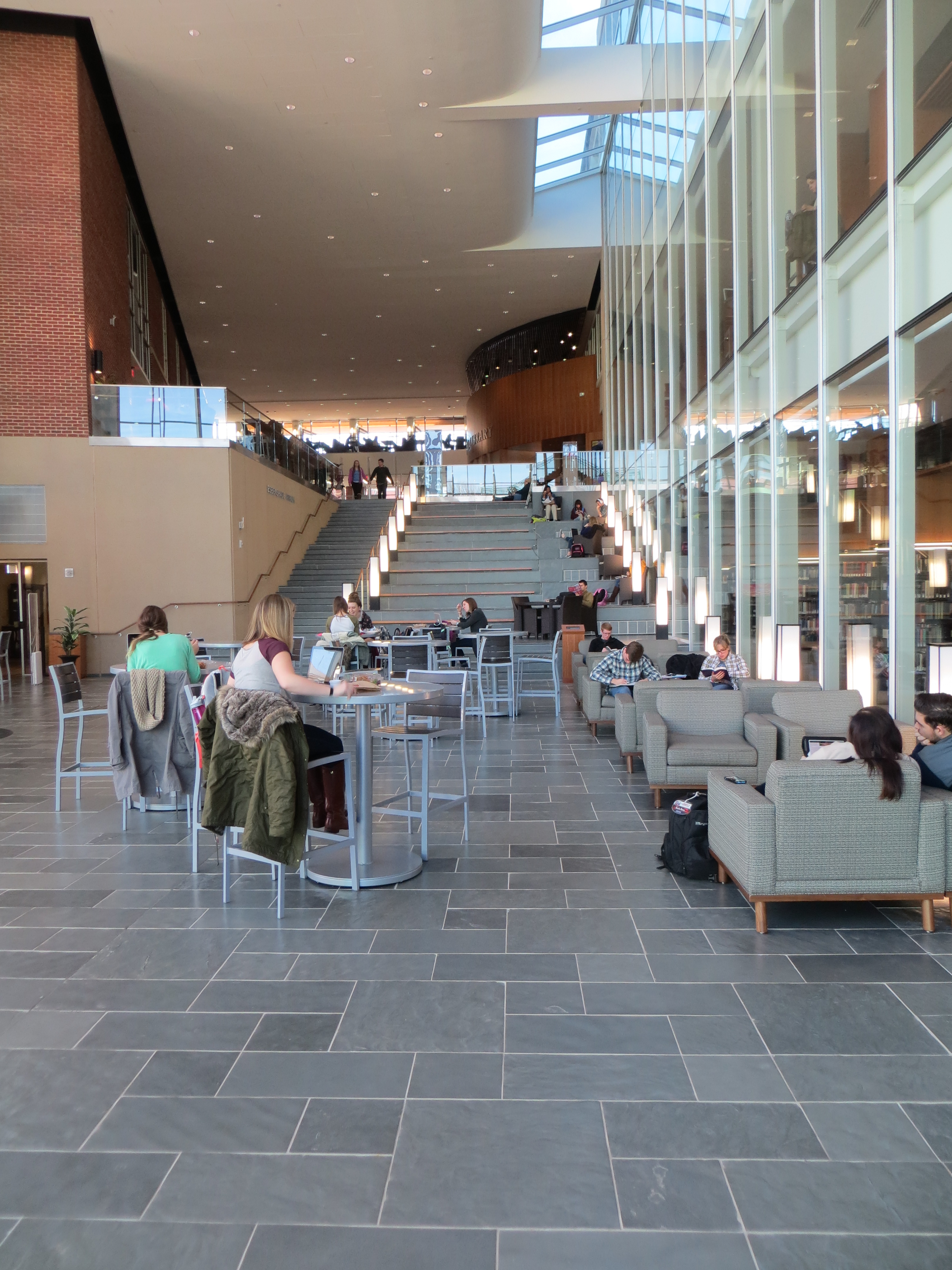
The money is hard to ignore. Between 2006 and 2012, Liberty’s net assets increased from $150 million to $860 million, thanks mainly to its booming online business. Instead of using those funds only to increase online education, Liberty has bankrolled an ambitious sports program and a recession-busting campus building program.
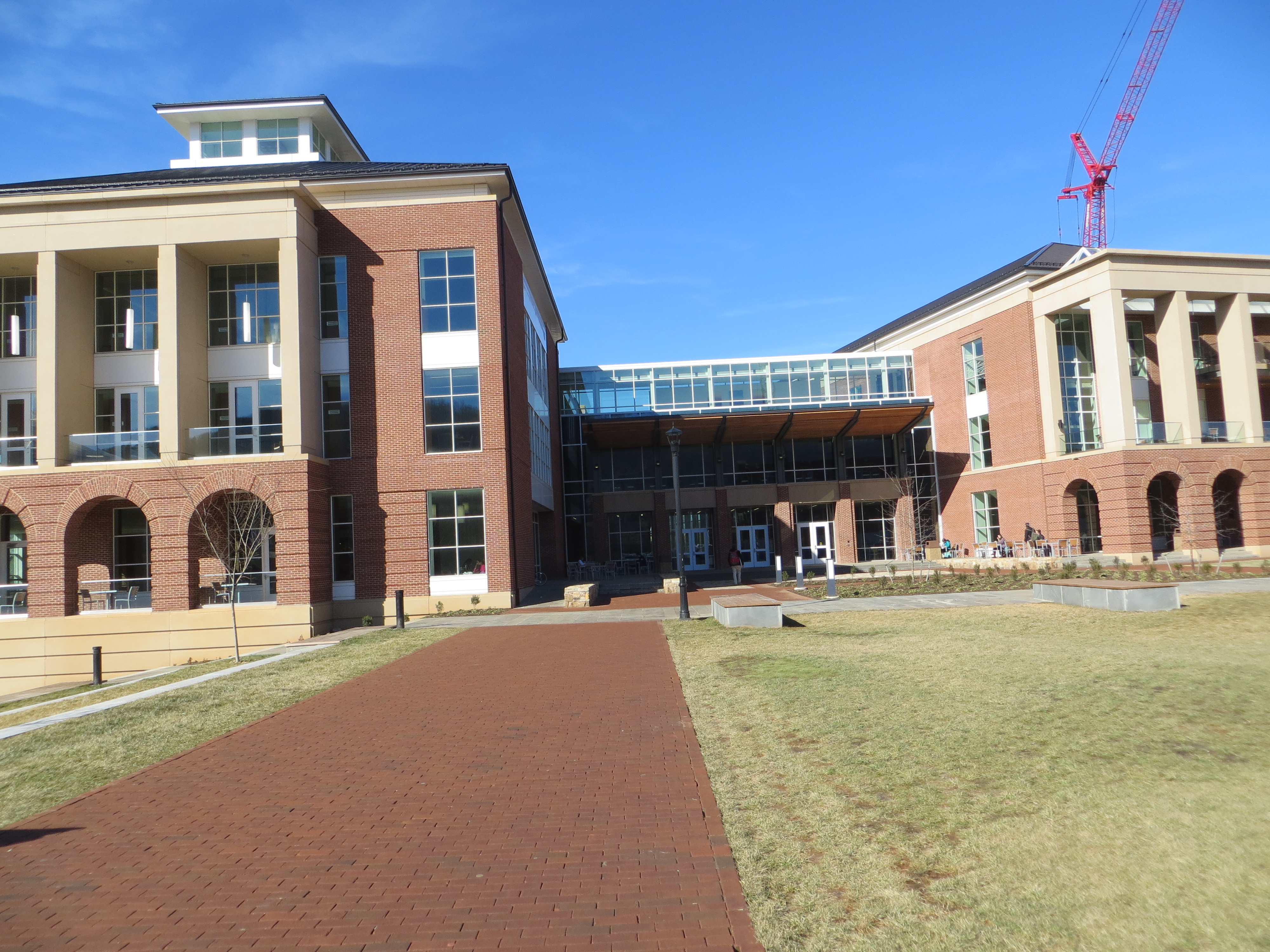
The new bajillion-dollar Jerry Falwell Library

The new bajillion-dollar Jerry Falwell Library

Most campuses are going the other direction. At traditional schools, including my beloved State University of New York, presidents and chancellors are scrambling to find ways to profit from online education.

Perhaps Liberty’s got something to prove. Founded only in 1971, it originally met in the basement of the Thomas Road Baptist Church. As I explore Liberty’s archives this week as part of the research for my next book, I’m finding reminiscences of those early years. One early ministry student remembered that he used to have revival meetings on the “old trash dump road” above the current campus. There was no campus back then, so these earnest “preacher boys,” this alum remembered, used to

Even the archives are nice.

Even the archives are nice.

pray, sing, and practice preaching for about an hour to an hour and a half. We would pray and preach in the Spirit! Walking, shouting, and praying up and down that road, calling out your name to the Father, tears streaming down our cheeks!

As do most fundamentalist schools, Liberty feels a constant need to prove that it is just as good, intellectually, as mainstream universities. As first president Pierre Guillermin put it in an early fundraising letter, any Christian college must maintain “performance standards of unquestionable academic excellence and admirable professional credibility.”
No more Trash Dump Road...

No more Trash Dump Road…

The campus building program may result from a deep need to prove that Liberty is a real university, not just a fundamentalist camp meeting. Or it may be something more strategic. College administrators these days are wracked with anxiety about the future of higher education. Will students in the future simply take classes from a menu of online providers? Will giants such as MIT and Harvard provide the world’s best content online? Can smaller schools continue to exist?

It seems President Falwell is betting big that people will continue to want a traditional campus, with traditional amenities such as sports programs and libraries.

I think he’s right. So far, the leaders in Massive Open Online Courses are not start-up companies in their garages, but established schools such as MIT and Harvard. People still have high expectations that their education—even their online classes—will come from a “real” university.

Spanked with the Bible Belt

Well, fry my biscuits;…things really are different down here. Historians have gone to great lengths to disprove the common misconception that fundamentalism is somehow only a southern thing, or only a rural thing. But there IS something profoundly different about Southern rural fundamentalism.

Go tell it on the mountain...

Go tell it on the mountain…

For those who are just joining us, I’m spending this year traveling to conservative evangelical colleges to research my next book, thanks to funding from the generous Spencer Foundation. Right now, I’m in scenic Lynchburg, Virginia, home of Liberty University. When I rolled into town, I saw something that blew my mind. No, it wasn’t the huge “LU” sign that had taken over a mountainside. I expected that.

Since the mid-1970s, academic historians have thrown out some old myths about American fundamentalism. Led by scholars such as George Marsden and Joel Carpenter, the new generation of histories no longer insist that fundamentalism is an outgrowth of hillbilly religion. Rather, fundamentalism has thrived in America’s biggest cities as well as in its rural hollers.

Consider my itinerary for this research year. To figure out what fundamentalism has meant across the twentieth century, I’ve traveled to schools such as Biola, Wheaton, and Gordon College. I plan to head to The King’s College and the Moody Bible Institute. My travels will take me to Los Angeles, Chicago, Boston, and New York City. Those are nobody’s ideas of rural backwaters. And yet they are the intellectual and spiritual headquarters of much of the fundamentalist movement.

Creationism in the lobby...

Creationism in the lobby…

Fair enough. But there is something different about things down here in the South, something different outside of bigger cities. Not only did I drive along Jerry Falwell Parkway to get here, but the lobby of my boring corporate hotel held a big surprise. The books for sale included the standard stuff about horses, cats, and jokes for kids, but there were also a lot of prayer, psalm, and Bible books. Even more remarkable, the shelf included relatively radical creationist books such as Ray Comfort’s Scientific Facts in the Bible.

This is the kicker: Sure, fundamentalism can thrive in big cities. It can certainly thrive in the North. But down here in the South, outside of big cities, fundamentalism becomes the usual fare. It becomes the accepted norm, not just one way to be religious. Even a non-religious, totally vanilla environment such as my hotel lobby offers books that prove the scientific veracity of the Bible.

...and horses.

Satan, Demons…and horses.

My hunch is that our so-called Bible Belt refers to those parts of our great country in which conservative Protestantism is something people assume they all share. It refers to those places where your new neighbor will ask you when you move in if you’ve found your church yet. It refers to those places where people think the “real” America is much whiter and more born-again Christian than it really is.

That’s my impression, anyway. I was raised in Boston, in a non-religious household. I’m guessing people more intimately familiar with life in the “Bible Belt” will know more about this sort of thing.

The Girl with No Hands and Other Mysteries of History

Sometimes the archives just aren’t enough. As I research my new book, I’m working this week in the archives of beautiful Gordon College just north of Boston. As is usual in this sort of primary archival research, I’m stumbling across mysteries that I just can’t figure out.

Some of them are curious, but fairly predictable. For example, as was the norm with this sort of conservative evangelical school, parents complained when they heard rumors of student hijinx. Whenever there was a whiff of unchaperoned boy-girl time, parents grew alarmed.

One mother wrote the school’s president in the mid-1960s. This parent was worried about the moral state of Gordon College. Her daughter’s dorm, she complained, had been “raided” by boys. The details of the “raid” were extremely hazy, which makes me think there was some sort of hanky-panky going on. All I can tell from the archival record is that the raiders climbed in through a bathroom window, left “obscene signs,” and did not respect the girls’ repeated disinvitations. At least, that’s what the girl told her mother.

The scanty correspondence leaves many key questions unanswered. What were the “obscene signs?” Were the boys really so unwelcome? How, for instance, would a boy just happen to notice that one particular bathroom window would be unlocked? Didn’t the “raiders” need some inside help?

There’s no way to find out from the archives. All the writers mentioned the “obscene signs,” but decorum prevented them from giving a detailed description. And no administrator suggested even a hint of doubt to the girl’s mother that these boys had been assisted or even encouraged to make their “raid.” No whisper of doubt sullied the stalwart moral righteousness of the girls.

All these questions are tricky, but not utterly confounding. We will never know exactly what transpired in this case, but we can make reasonable guesses that connections between boys and girls went on outside the supervisory gaze of parents and school administrators. It can be tricky to nail down the details from the sketchy and overly polite archival record, but we can distill the basic contours of student life.

????????

????????

Every once in a while, though, I come across a true oddball artifact. One that goes beyond this sort of archival mystery. In 1969, a guy from Pennsylvania wrote to the president of Gordon College with a truly bizarre request. I’ll leave out the guy’s name and address to be polite, but I can’t leave out the rest of his puzzling letter. “I am writing this,” our strange correspondent opened,

                in request of your help in locating a girl that I beleive [sic] may be at your college.

I do not know her name. All I can tell you about her is that she has two mechanical hands, an artificial leg, brown hair, and, except for the mentioned physical detractions, she is quite attractive. I have reason to beleive [sic again] she lives in Cleveland, Ohio, or further west.

The information I need is her name, address, and if possible, her picture for positive identification. I will pay for any valid information leading to her.

For personal reasons, I cannot tell why I need this information, but I can assure you that there is absolutely no intention of harm for her or anyone concerning her.

I would appreciate it if you would answer my letter if you do or do not have her. I am presently writing to seventy-one other colleges and would like to be able to check yours off my list.

If you do have this girl, please do not let this get around, for I feel that she would be deeply hurt if it did, which is something I do not want.

What was going on here? The questions pile up the more we try to knock them down. If the girl was in Cleveland, why was he writing to a school in Boston? What happened to the girl to make her lose her hands and leg? Was the writer in love with her? Or, despite his protestations, did he have some nefarious purpose in mind? Of course, we can’t ignore the obvious explanation that this is all some sort of kooky joke…but to what end?

To their credit, the leaders of Gordon College did not offer any help to this woebegone writer.  I think they were just as puzzled as I am.  Someone at Gordon took a moment to write a single elegant question mark at the top of the page.  That says it all: ?

From the Archives: Fashion & Calvin

As an outsider to evangelicalism, one of the biggest surprises I’ve found is the new hipness of Calvin. No, not THAT fashionable Calvin. Not that one, either. For the past decade or so, Christian intellectuals have been thrilled or horrified by the very old theology of Ur-Protestant John Calvin. As I continue my research into the twentieth-century history of evangelical higher education, I see that the trendiness of Calvinism has longer twentieth-century roots.

Not THAT fashionable Calvin...

Not THAT fashionable Calvin…

Of course, we all know Calvinism as such has a much longer American history. In the early British colonies of Massachusetts and Connecticut, Calvinism served as the de facto governing theology. As time went on, dissenters blasted the rigid dictates of predestination. Most famously, in the early 1800s, febrile anti-Calvinist Lorenzo Dow famously warned, with Calvinism

You can and you can’t

You shall and you shan’t-

You will and you won’t-

And you will be damned if you do-

And you will be damned if you don’t.

As the Second Great Awakening unfolded in Dow’s era, some might think that Calvinism’s days would be numbered. The notion that God has predestined all things and all souls can sound a little intimidating to go-getting Americans. It might be a tough sell, one might think, to convince twenty-first century Americans to embrace such a 16th-century idea. Americans, we might think, prefer the anti-Calvinist Arminian idea that people can choose to embrace the grace that God freely offers.

Not that one either.

Not that one either.

But as Collin Hansen noticed in an attention-grabbing article several years ago in Christianity Today, Calvinism has been making a steady comeback among earnest American evangelicals. The “Young, Restless, and Reformed,” as Hansen called them, had become the most exciting scholars at several leading evangelical seminaries. Writers such as John Piper had fired the hearts of young intellectuals with his “New Calvinism.”

To folks like me—secular types heedless about the internecine theological disputes among evangelicals—such storms raged utterly unnoticed. We were not aware of earnest groups of scholars debating TULIPs and other blooms in the garden of predestination.

In my new research, I’m finding that the “New” Calvinism has always played a role in evangelical intellectual life. Just as secular young folks might continually rediscover the works of Frantz Fanon or Antonio Gramsci, so each new generation of evangelical intellectual seems to feel it has found something radically new and exciting in Calvinism.

In my archive work today, I came across an echo of this sort of intellectual excitement from the 1930s. I’m at storied Gordon College this week, in scenic Wenham, Massachusetts. After I happily survived the drive through storms of Boston drivers, I dug into the papers of second President Nathan R. Wood.

In 1934, Wood wrote to Loraine Boettner, author of The Reformed Doctrine of Predestination. Wow, Wood wrote (in essence). Wood’s actual words were these:

The thinking of the Christian world has in general drifted a long way to the left, and such thinking as yours will be a tonic and should help to bring back the swing of the pendulum from that extreme. I am a great admirer of Calvin. I do not promise to follow him at certain points, but if anyone could make me do it, it would be you yourself in your candid, devout and virile statement of that great system.

At Gordon College in the 1930s, just as at seminaries today, Calvinism has always been a lurking fashion among evangelical intellectuals. It might have experienced an upsurge in the past few years, as Hansen argues, but that upsurge itself is nothing more, it seems, than a perpetually reoccurring enthusiasm over the stern doctrine.

The Perfect Valentine’s Day Gift

Nothing says “I Love You” more than a book about conservatism and education in American twentieth-century history. Looks like the timing will be perfect.

How to say "I Love You" (But You're Going to Hell)

How to say “I Love You” (But You’re Going to Hell)

My new book is slated for release in early February. Hard to know how it will be received, but one pre-reviewer has called it “a major rethinking of the history of American education.” Another has added, “it would be flat-out wrong to ignore this important book.” Pshaw. . .

For the sophisticated and good-looking readers of ILYBYGTH, the content might not be surprising. In this book, I try to figure out what it has meant to be “conservative” about education in the United States.  How have issues such as creationism, school prayer, and sex ed developed over the course of the twentieth century?  How are they related?  How have conservative attitudes and strategies changed?  How have they remained the same?

In the early days of my research, I had planned to explore the educational activism of leading conservative groups such as the American Legion and the Institute for Creation Research. I was stuck with two big problems, though.

First, the Legion and other conservative groups remained active throughout the twentieth century. How could I describe different conservatives without rehashing the chronology over and over again? I didn’t want to work from the 1920s to the 1970s in every chapter. What to do?

My second problem was one of definition. How could I choose which “conservative” groups to study? I could copy the method of leading conservative scholars such as Russell Kirk or George Nash and use my selection to make an argument about the definition of conservatism. Both Kirk and Nash picked their subjects to give a particular definition to conservatism. For both writers, being a true conservative has meant being a heroic intellectual battling waves of ignorance and knee-jerk leftism. But I’m no conservative myself, and I wasn’t interested in imposing a flattering (or un-flattering, for that matter) definition on American conservatism. What to do?

Luckily for me, I had some help. At a conference back in 2009, I was describing my research. One of the audience members suggested a new approach. Instead of picking and choosing which activists counted as “conservative,” instead of describing the activism of one group after another, why not do it differently? Why not let conservative activists define themselves? This leading historian suggested that I investigate events, not groups.

That’s what I did. I looked at the four biggest educational controversies of the twentieth century: The Scopes Trial of 1925, the Rugg textbook fight of 1939-1940, the Pasadena superintendent ouster of 1950, and the Kanawha County textbook battle of 1974-1975. In each case, conservative activists and organizations fought for their vision of “conservative” schools. By looking at controversies instead of organizations, I could let conservatives define themselves. And I could move chronologically through the twentieth century without rehashing the stories in each chapter.

Did it work? Now I have to let readers and reviewers be the judge. My goal was to explore what it has meant to be “conservative” in the field of education. I did not want to make the relatively simpler argument that conservatism has really meant X or Y. I did not want to give conservatives a heroic history they could draw upon. Nor did I want to give their enemies a catalog of conservative sins. I’m hoping readers think this approach has worked.

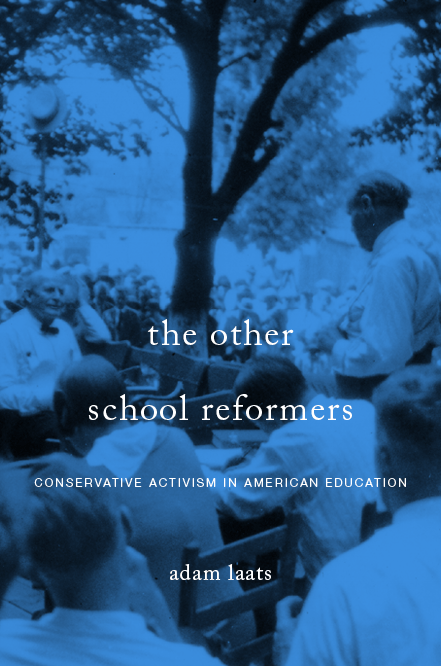
So if you’re looking for that perfect romantic gift, consider The Other School Reformers!

The Creationist Dream, Part II

What should public-school biology classes look like? A couple days ago, I shared an article from an evangelical magazine, c. 1967. It told a story of a creationist high-schooler who bravely stood up to her evolutionist teacher. As a result, the class put biology aside and had a spontaneous prayer meeting.

As one astute reader noted, it sounded like a fifty-year preview to the new film God’s Not Dead.

Whatever your beliefs about creationism and evolution, there was something dead wrong in the story. Something that just didn’t fit with the ways the creation/evolution battle really works. And this something was besides the hokey language and the Leave-It-To-Beaver creationism.

What was wrong? Was it

  1. No teacher really feels that gung-ho about teaching evolution?
  2. No student really cares that much about creationism?
  3. No parents would encourage their kid to publicly preach that way in a public school?
  4. There would never be that sort of religious revival in a public school? or
  5. A teacher would not likely be that clueless about the religious beliefs of her students?

Let’s take them one by one. In the story, the teacher was a mean-eyed evolutionist. She ridiculed creationist belief, while being stupidly ignorant of the fact that most of her students shared those beliefs. Could a teacher really feel that gung-ho about teaching evolutionism? Well, clearly the character was an utter caricature, but I think it is certainly possible for teachers in 1967 or 2014 to feel a passion for enlightening students with the truth of evolution. I would say that most teachers don’t feel this sort of mission, but some do.

What about number 2? Do any students really feel so intensely devoted to their creationist beliefs that they would risk public humiliation to express them in class? Just as with number 1, I think this would be unusual in the real world, but by no means impossible.

Would parents really encourage their kids to preach in a public school? Some would. Again, not likely in the same Richie-Cunningham tone presented in this story, but I don’t find it beyond belief that parents might want their children to stick up for their beliefs in public schools. Some parents likely encourage their kids to see their public schools as a sort of mission field. And there is a literature out there helping parents help their kids to evangelize properly in their public schools.

Could it work? As number 4 suggests, is this sort of religious revival beyond the possibility for a public school? Not at all. These days, for instance, public-school children are encouraged to meet at the flagpole of their schools one day in September. Just like in the story, this strategy promises “amazing transformations” of students and school culture.See you at the pole

So I agree with the sharp commenters who voted for number 5. It is possible, of course, that a teacher might have no idea that her students shared fervent creationist beliefs. But in general, that doesn’t happen much. As Michael Berkman and Eric Plutzer argued in their book Evolution, Creationism, and the Battle to Control America’s Classrooms, teachers tend to fit in with their communities. As they put it, “traditional districts and cosmopolitan districts tend to hire teachers whose training, beliefs, and teaching practices serve to reinforce or harmonize with the prevailing local culture.”

From the Archives: The Creationist Dream

What do creationists want? I know, I know, there are lots of different sorts of creationists out there. As a group, though, I think I found a story that might just articulate some of the fondest hopes and dreams of American creationists. There’s a terrible flaw in the story, and I challenge you to find what it is.

For those of you who are just joining us, I’m working on a history of conservative evangelical and “fundamentalist” colleges and universities. This year, thanks to the munificence of the Spencer Foundation, I’m traveling around to different schools to dig into the history of this network. This week, I’m visiting sunny Biola University in Los Angeles.

Biola University (originally the Bible Institute Of Los Angeles, get it?), in addition to its main job of cranking out missionaries and teachers, also published an influential evangelical magazine, The King’s Business. It was in the November 1967 edition that I found this little gem.

The King's Business, November, 1967

The King’s Business, November, 1967

I’ll give you the gist of the article. Then I challenge readers to pick out where this creationist fantasy veers most sharply from reality.

We read the story of Hope, the daughter of a fundamentalist minister. Gathered around the dinner table one night, Hope collapsed into tears. At (public) school that day, she finally confronted her aggressive evolutionist biology teacher, Miss Landon. Hope told her teacher that she didn’t believe in evolution. As she told her parents, “I felt I couldn’t sit there and take it any longer.”

The teacher ridiculed her. “I didn’t suppose,” Miss Landon said in front of the whole class,

anyone living in our enlightened age had such old-fashioned ideas. It surprises me that a person who has had the advantages of a modern educational system can be so narrow-minded. Surely there are not many who believe as you do.

Hope felt humiliated and ashamed. But she stood her ground. At the dinner table, as she sobbed, her father put his hand on her shoulder and said,

huskily, ‘Daughter, it gives us great joy to hear you tell this. Who would have thought that so soon after being saved [two weeks before] you would have an opportunity to witness so boldly to your teacher and classmates?’

Hope felt revived. She prayed hard before going to bed, and felt her dad was right. As a result,

Hope returned to school the next day with a song on her lips as well as in her heart. The Lord Jesus seemed to be walking at her very side and a great peace filled her soul. She felt no fear now of encountering Miss Landon again, even though she might be asked to give further ‘reason for the hope within her.’

Sure enough, the next day her evolution-loving teacher challenged Hope to prove that other students felt the same way. To Miss Landon’s surprise,

Before she had finished speaking, nearly half of the girls were standing. What followed can best be described as an old-fashioned ‘popcorn meeting.’ It seemed that everyone wanted to talk at once. Some were wet-eyed; others, with their arms around Hope, were asking her forgiveness for letting her stand alone. Miss Landon was at a loss to know how to handle the situation. She couldn’t be expected to know, since she had never attended a revival service or been asked to pray for souls under conviction. So she just stood there, helplessly looking on.

Finally it occurred to her that perhaps Hope could handle the group. Hope caught her distressed, appealing look, and in a calm voice said, ‘Let us all kneel in prayer.’

The praying and confessing continued throughout the 40-minute class period and Miss Landon made no effort to stop it. The girls may not have learned any biology that day, but many of them learned to know God in a new and real way.

That’s the story.

Now here’s the challenge: Where is the biggest, most obvious goof in this tale? Where does this creationist dream depart most obviously from the realities of evolution and creationism in American public schools?

Now, before people complain, let me offer a few caveats. First, we all understand that not every creationist hopes to have public schools turn into a “popcorn meeting,” whatever that is. And we know that the hokey tone of this story is more a result of its age than of its creationism. The aw-shucks brand of parenting displayed here would fit in just as well with Ward and June Cleaver as it would with Charles and Grace Fuller.

Given all that, I still assert that this story fails the sniff test. There is one element here that simply screams out “fantasy.”

Is it:

  1. No teacher really feels that gung-ho about teaching evolution.
  2. No student really cares that much about creationism.
  3. No parents would encourage their kid to publicly preach that way in a public school.
  4. There would never be that sort of religious revival in a public school.
  5. A teacher would not likely be that clueless about the religious beliefs of her students.

I’ve got to get back to work now, but I’ll offer my answer soon.

From the Archives: A Swizzle Mystery

Hello from sunny Biola University! In my continuing quest to dig into the history of conservative evangelical colleges, I’ll be working in the archives here all week. And I found a stumper in the archives this afternoon.

My oeil has been tromped...

My oeil has been tromped…

As I strolled across campus this morning, I was thinking that everything looked pretty similar to things at my own beloved State University of New York. The students looked the same, the vibe was the same…there was nothing particularly different about the goings-on at this Christian campus compared to my own secular campus. Except, of course, for the fact that the sun was shining and flowers were blooming and the air didn’t hurt when it hit your skin.

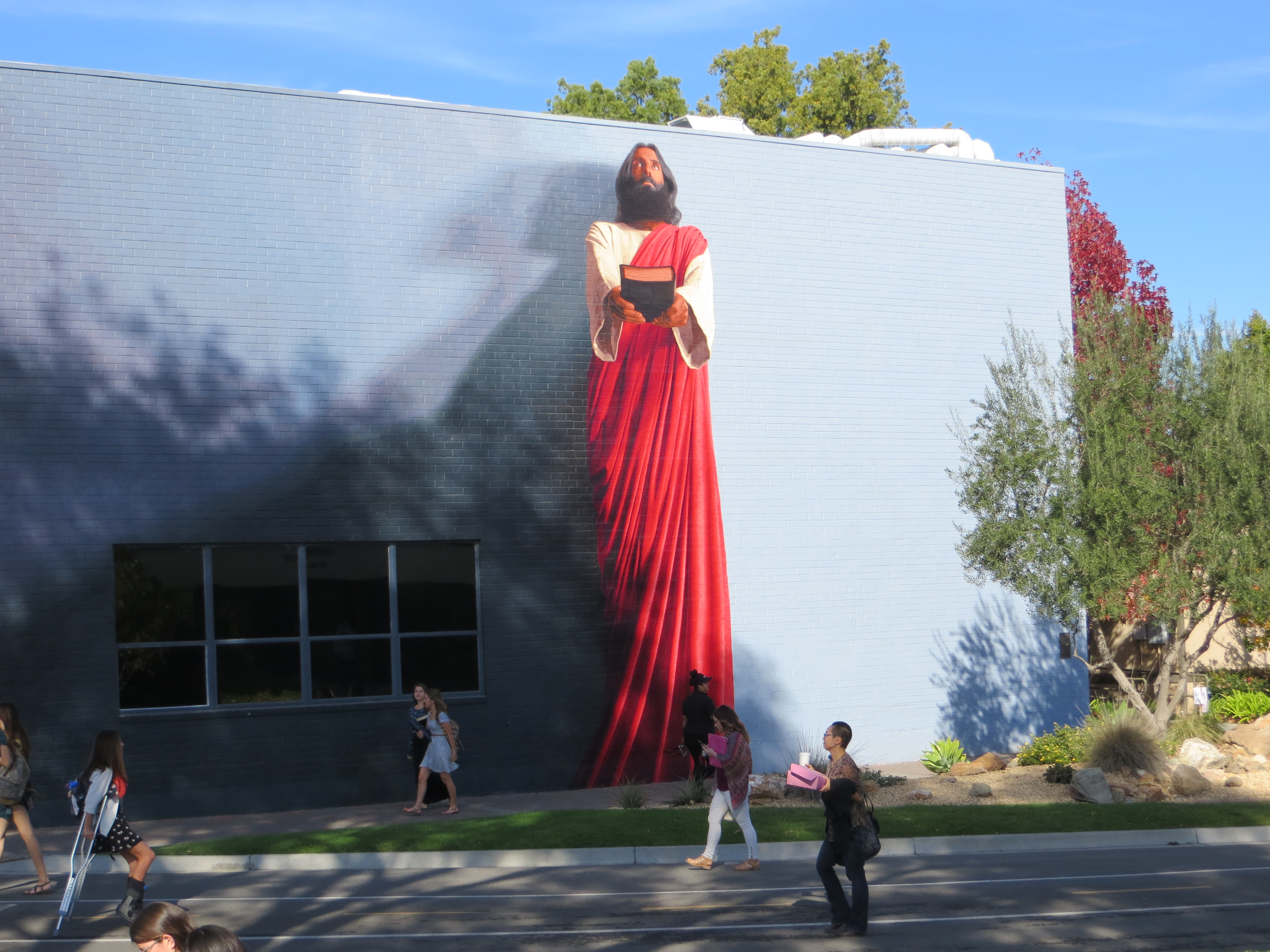
But then, I noticed something I wouldn’t be likely to see on my home campus. As far as I know, we don’t have any humongous Jesus paintings on our buildings.

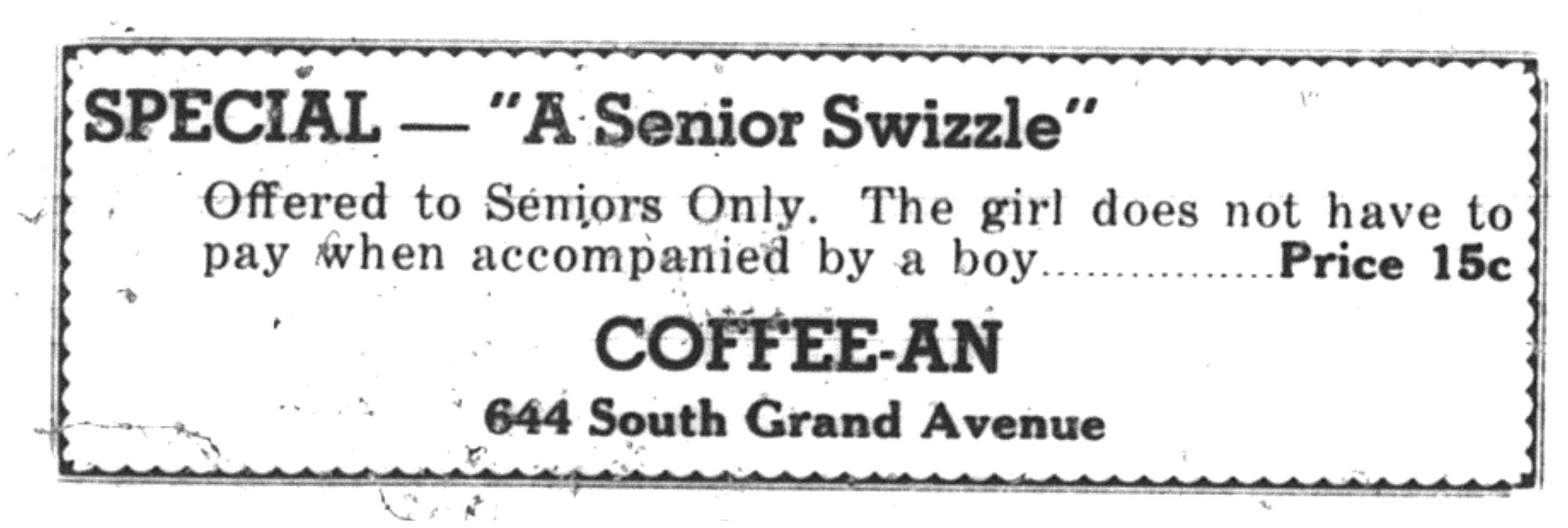
But let’s get to our archive challenge. Among the wonderful holdings here, the Biola library includes issues of the Biola student newspaper going back to 1938. And in the May 1938 edition, I saw this ad. For the life of me, I can’t figure out what it means. I looked up “swizzle,” of course, but besides a “rum swizzle” and a “swizzle stick” I couldn’t find a clue.

??????????????????

??????????????????

Any suggestions?  For full information, I can tell you that the Coffee-An was a lunch counter next to campus.  They advertised regularly in Biola publications.

From the Archives: Christian Comix against Communism

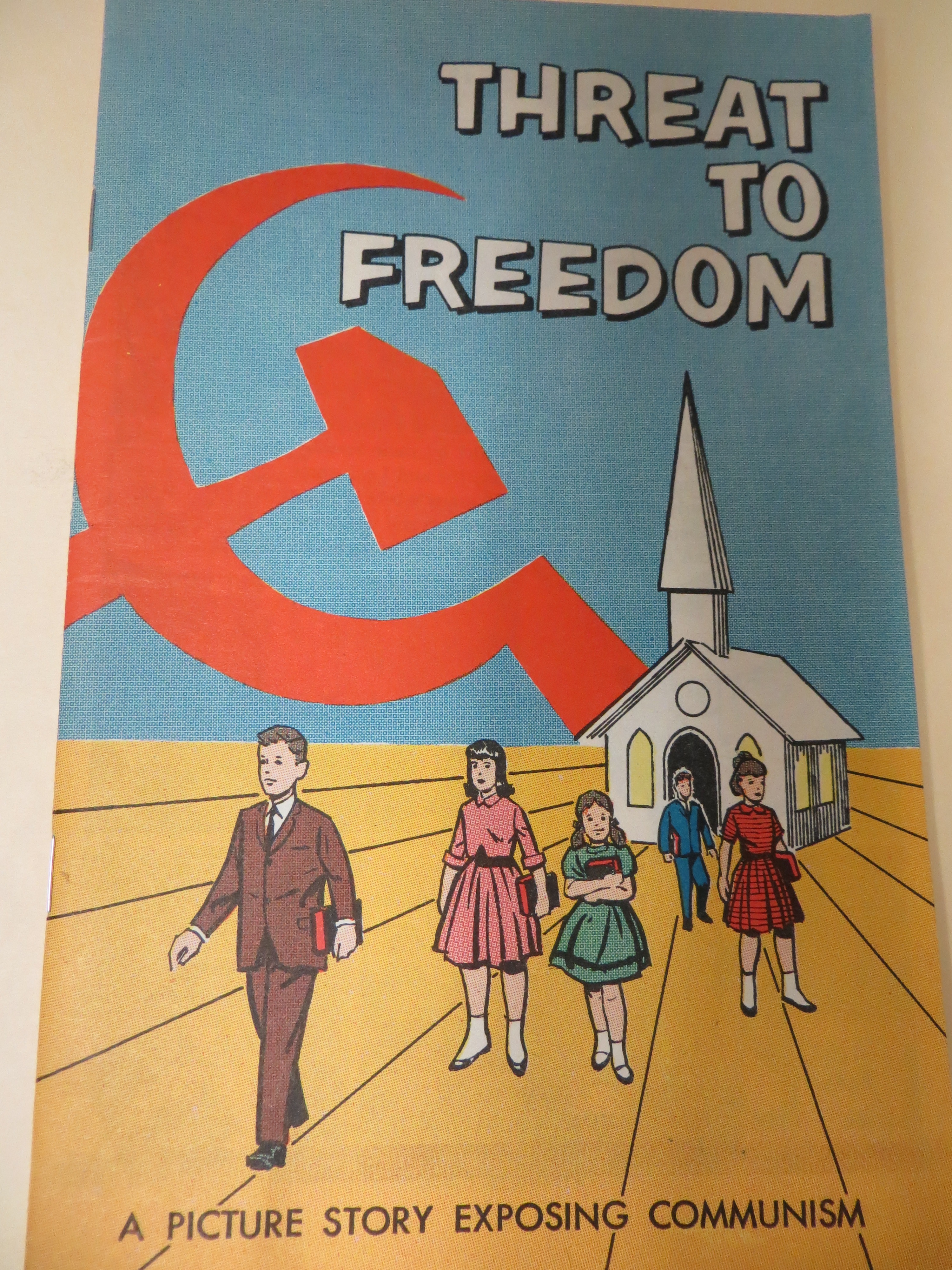
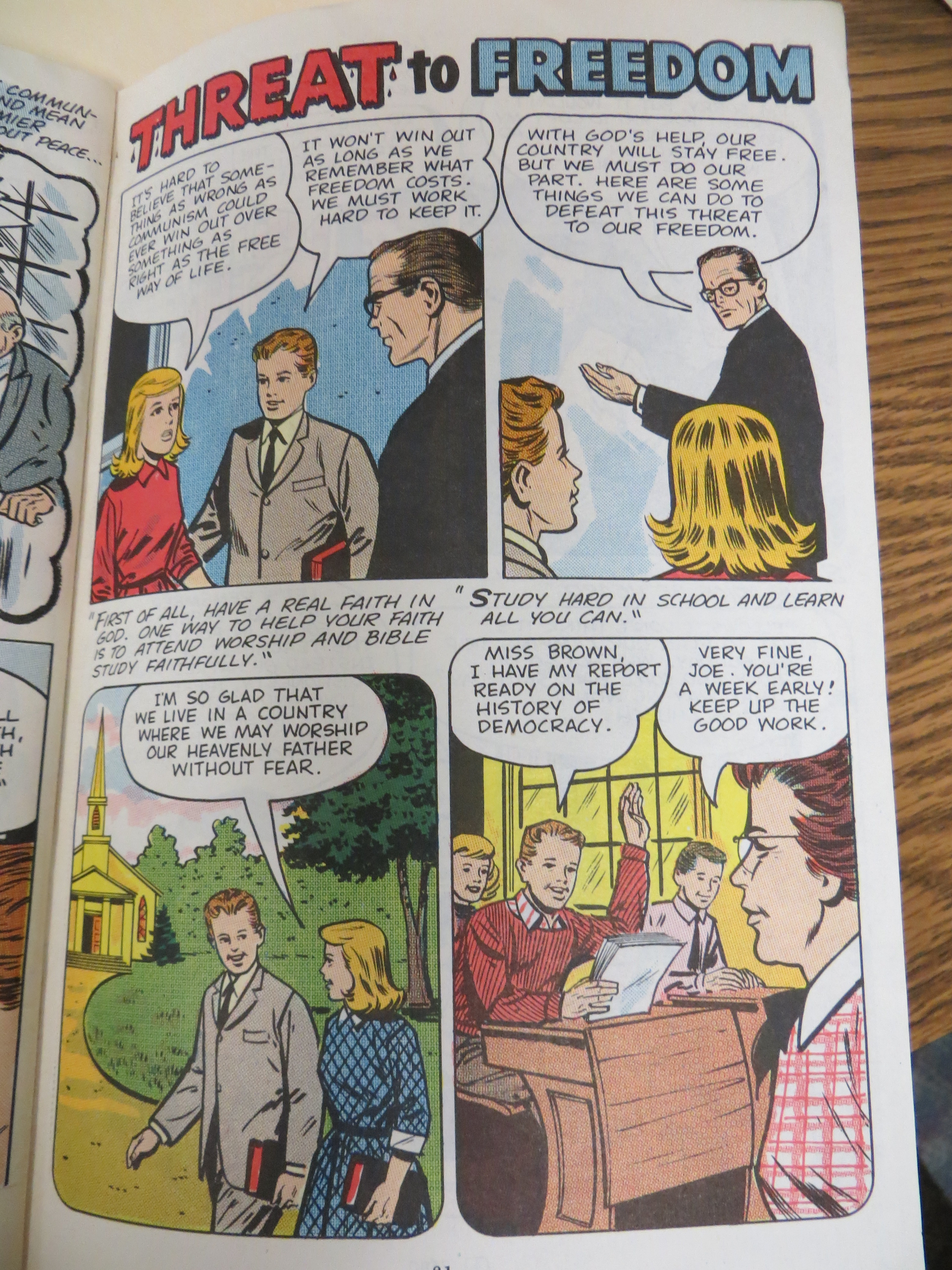
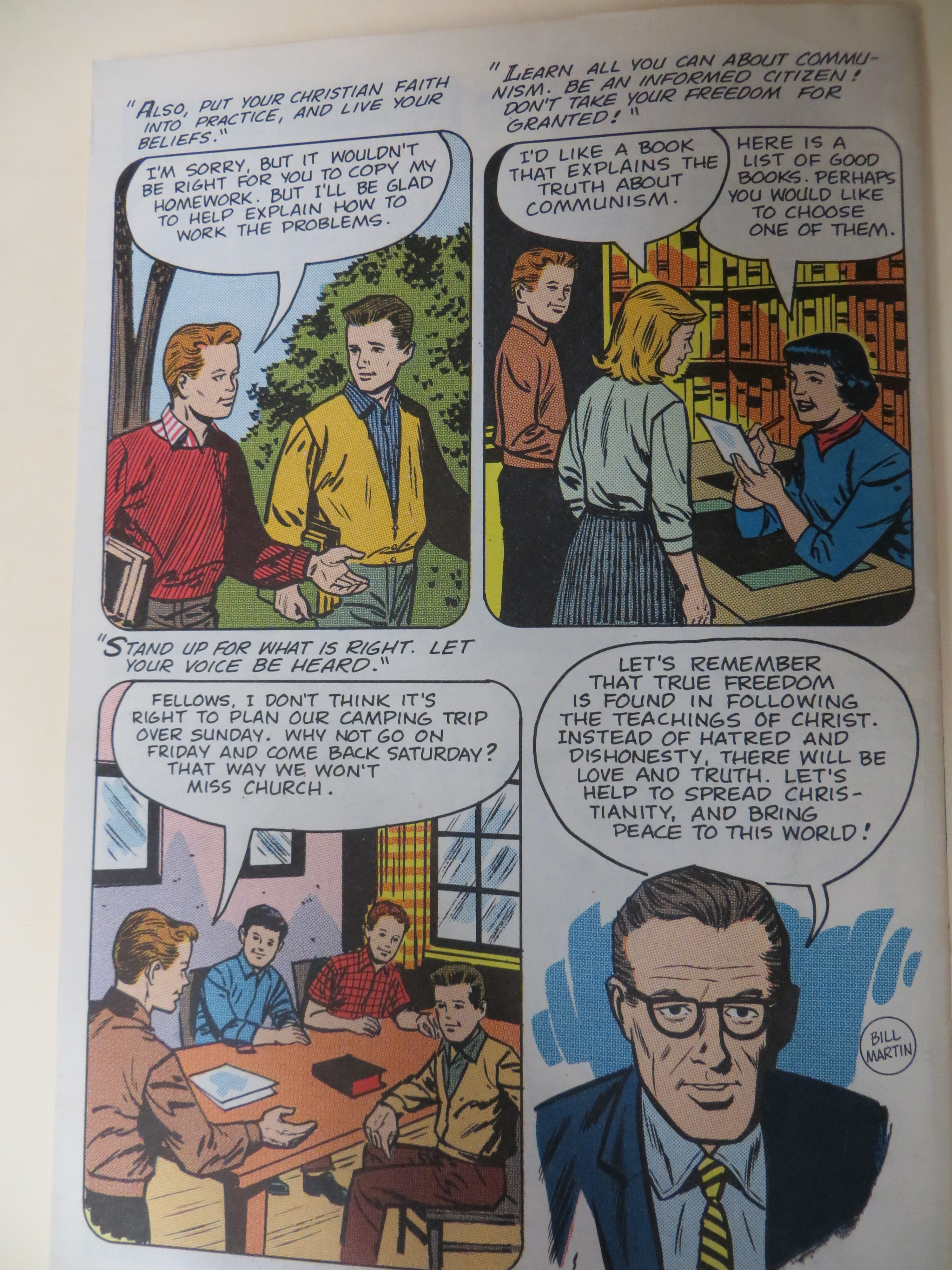
In this century, it can be difficult to remember the way most Americans used to feel about communism. As I describe in my upcoming book, the campaign against communism had an enormous influence on American education, one that is hard to overemphasize. As I work this week in the abundant archives of Bob Jones University, doing research for my next book, I’ve come across reminders of the ways conservative Christians saw communism as an existential threat. This evening, I’d like to share a few snippets from just one of those historical artifacts, c. 1965.

As the comics below demonstrate, for many conservative evangelicals, this was not just a question of politics, but of religion. Communism represented an aggressive atheism, the apotheosis of perverted human pride.

Other conservatives, of course, did not worry as much about religious issues. As historian George Nash has argued, the many meanings of communism allowed conservative intellectuals to coalesce around a vibrant anti-communism. Libertarians could join with Burkeans, who could clasp hands with religious conservatives and free-market conservatives. All could agree that the fight against communism outweighed any differences they might have among themselves.

coverIMG_1649IMG_1650

Christianity Kicked Out of Public Universities

Ball State University doesn’t want any more attention. It has been the subject of a nationwide campaign by pundits who were shocked—shocked!—to hear that one professor spoke kindly of intelligent design. But my current work in the archives at the Billy Graham Center at Wheaton College shows me just how dramatically things have changed in the past fifty years.

You may remember the intelligent-design case. In mid-2013, Eric Hedin was accused of larding his class with religious content. The Wisconsin-based Freedom From Religion Foundation complained, and eventually Ball State’s president announced that religious ideas must not be taught as part of science classes.

Hedin’s use of religious themes became objectionable for two reasons. Mainly, observers complained that he was presenting religious ideas as if they were scientific. But Ball State University was also criticized as a public school using taxpayer dollars to favor one religious group.

According to Jerry Coyne, when Ball State President Jo Ann M. Gora made her announcement that religious ideas should not be taught as science, she emphasized both of these notions. Intelligent design should not be taught as science, Gora told the Ball State community, since

Intelligent design is overwhelmingly deemed by the scientific community as a religious belief and not a scientific theory. Therefore, intelligent design is not appropriate content for science courses.

But Gora specified that even if such religious ideas were taught as part of humanities courses, they must only be taught as ideas, not as dogma. That is, even non-science classes could not teach religious ideas as true, but only as history or literature. As Gora put it,

Discussions of intelligent design and creation science can have their place at Ball State in humanities or social science courses. However, even in such contexts, faculty must avoid endorsing one point of view over others. . . . As a public university, we have a constitutional obligation to maintain a clear separation between church and state. It is imperative that even when religious ideas are appropriately taught in humanities and social science courses, they must be discussed in comparison to each other, with no endorsement of one perspective over another.

Things have changed. As I’ve dug through the archives here at the Billy Graham Center, I’ve come across an intriguing historical coda to the Eric Hedin story. These days, professors at Ball State may not teach religious ideas as science. They may not even teach any single religious idea as history or literature.

But as late as 1957, Ball State University—like many other public universities—taught evangelical Protestantism explicitly and purposefully. Many public colleges, especially teachers’ colleges, had entire programs devoted to what was usually called “Christian Education.” In these courses, public-school students could learn the basics of evangelical proselytization, usually under the heading of learning to be “Sunday School” teachers. Most typically, students were women who hoped to begin or enhance their careers as part-time religious educators.

The current logo hints at this heavenly history...

The current logo hints at this heavenly history…

In some cases, today’s public colleges used to be religious or denominational schools. That doesn’t seem to be the case with Ball State. It claims to have always been part of the government system.

Not only did universities such as Ball State teach courses in spreading the evangelical Gospel to children, but they also accepted transfer credits from unapologetically fundamentalist seminaries. In my archival work, I’ve found several examples of students using their credits from the Winona Lake School of Theology to advance their degrees at public universities like Ball State and the University of Georgia. Even the state of California apparently accepted Winona Lake credits toward public-school teaching certificates.

At the time, Winona Lake School of Theology was a firmly fundamentalist summer school. It was going through an ugly separation from the Fuller Theological Seminary over Fuller’s alleged drift away from Biblical inerrancy. Now defunct, the Winona Lake school refused to go along as Fuller Seminary moved into a more ecumenical attitude.

And in 1957, teachers could use their credits from this religious school to complete their religious program in Christian Education at Ball State University. Though there is too much heated rhetoric about God being “kicked out” of American public education, this example shows us how things really have changed over the past decades.

In 2013, the president of Ball State had no problem announcing that her university must not favor one religion over another; as a public school it must not teach religion, though it can and should teach about religion. But as late as 1957, Ball State and other public universities found it unexceptional to teach entire programs in Christian evangelism. Ball State had no problem taking credits from a fundamentalist seminary, since both programs taught similar course content.

More evidence that we are not just replaying every old culture-war script. Things really have changed.