Ken Ham Is My Guidance Counselor

Why does Ken Ham care where you go to college? Where you send your kids?   Because “college” is more than just a collection of classes and academics. For religious conservatives as for everybody else, “college” represents a formative experience. The ideas one will encounter, the personal connections one will make, and the changes in one’s outlook and worldview all make the college years some of the most transformative in our lives.

In recent years, Ham, America’s (and Australia’s) leading voice for young-earth creationism, has established himself as the arbiter of creationist orthodoxy in college attendance. And his word carries weight in the world of evangelical higher education.

Recently, for instance, Ham warned readers at Answers In Genesis about the dangers of attending Calvin College. Students at that storied Christian school, Ham explained, were “being influenced . . . to undermine the authority of Scripture in many ways.” When faculty engage in evolutionary research and teaching that might turn away from Ham’s strict attitudes about knowledge and creation, Ham warns, students will too often abandon their creationist faith.

As a precaution, Ham offers readers a list of schools that adhere to the young-earth creationism taught by Ham’s Answers In Genesis ministry. To be safe, Ham warns, parents and students ought to stick with schools that have proven their fidelity to these ideas.

Ham’s anxiety over the crumbling orthodoxy in Christian higher education is nothing new. As I argue in my 1920s book, many of today’s evangelical schools had their origins in the founding decade of American fundamentalism. Back in the 1920s, religious schools often faced a choice between fundamentalist orthodoxy and modernist adaptation. Most chose modernism. The University of Chicago, for example, founded as a Baptist beacon of learning, became the leading voice for theological modernism, employing such folks as Shailer Mathews and Shirley Jackson Case. In contrast, a few Christian schools, most famously Wheaton College, sided with the fundamentalist movement.

Leading fundamentalists in the 1920s also founded a spate of new schools to embody their theological and cultural conservatism. Perhaps most prominently, evangelist Bob Jones Sr. opened Bob Jones College (now Bob Jones University) in 1926. The goal of this school was to form the fundamentalist character of young people while educating them in the best traditions of arts and sciences. In order to reassure parents that the school would never slide toward theological modernism or cultural liberalism, Jones and his allies established a rock-ribbed charter. This charter hoped to guarantee the continuing orthodoxy of the school. The charter’s second paragraph outlined that orthodoxy:

The general nature and object of the corporation shall be to conduct an institution of learning for the general education of youth in the essentials of culture and in the arts and sciences, giving special emphasis to the Christian religion and the ethics revealed in the Holy Scriptures, combating all atheistic, agnostic, pagan and so-called scientific adulterations of the Gospel, unqualifiedly affirming and teaching the inspiration of the Bible (both Old and New Testaments); the creation of man by the direct act of God; the incarnation and virgin birth of our Lord and Saviour, Jesus Christ; His identification as the Son of God; His vicarious atonement for the sins of mankind by the shedding of His blood on the Cross; the resurrection of His body from the tomb; His power to save me from sin; the new birth through the regeneration by the Holy Spirit; and the gift of eternal life by the grace of God.

Perhaps most notably, the next line specified that this charter “shall never be amended, modified, altered, or changed as to the provisions hereinbefore set forth.” Also remarkable, according to a 1960 reminiscence by Bob Jones Sr., at its founding BJU decreed that every graduating senior would pledge to monitor the school’s continuing fundamentalism. “Should the policy and conduct of the University ever, in my lifetime, deviate, in the slightest particular, from the letter or spirit of this Creed,” seniors would promise,

I hereby pledge myself to exert all my influence to affect a change in conditions; failing which, I will resort to such legal measures as the courts may offer to the end that the institution may be kept true to the University Creed and the original intentions of the founder.

Most evangelical colleges established similar creeds and many promised never to amend them. Not many others, to my knowledge, required such strict supervision by their alumni.

These days, Ken Ham has taken over the role of orthodoxy’s gadfly. In addition to his warnings about waverings from his definition of creationism at Calvin College, Ham has warned that other evangelical schools might be threatening the faith of their students. And Ham’s warnings carry weight.

In one recent episode at Bryan College, for example, Ham’s public worries about faculty orthodoxy led the school’s leadership to instigate a new sort of creationist orthodoxy pledge for faculty. From now on, faculty must publicly avow their belief in a real, historic Adam and Eve. As I argued at the time, the fallout from Bryan College’s policy shift might lead to a shake-up of faculty. More directly relevant, the furor at Bryan seems to testify to Ham’s influence. Worried that creationist parents might not send their students and their tuition dollars, Bryan’s leaders acted to shore up their image as a home of young-earth creationist orthodoxy.

Also intriguing, I must ask again if the drive to protect their reputations as safe theological and cultural havens has led some conservative evangelical schools to cover up incidents of sexual assault. Of course, these are very serious allegations, and I do not ask these questions lightly. I am certainly not accusing Ken Ham or the leadership of these schools of condoning sexual assault. But the drive to present a public face as a uniquely safe environment for fundamentalist students certainly puts undue pressure on college leaders. It is not unfair to wonder if such pressure might lead schools to downplay any cases that might threaten those reputations.

Outside the world of conservative evangelical Protestantism, colleges spend an inordinate amount of time and treasure to attract students. Flashy dorm rooms, high-visibility sports programs, celebrity faculty, and lavish campus lifestyles all hope to convince families to send their kids and their money to certain schools. The pressure on recruiters is intense.

There is a similar pressure on evangelical colleges. Influential voices such as that of Ken Ham are able to exert outsized influence by warning creationist families toward or away from certain schools. Without Ham’s imprimatur, conservative schools may lose the loyalty of students and families.
 

From the Archives: Saving Hearts and Minds in the 1930s and 1940s

What do we need to do to educate young people? Conservative activists, just like their progressive or leftist opponents, have long recognized that education goes far beyond school. Doing archival research for my upcoming book about conservative educational activism in the twentieth century, I found abundant evidence of conservative activism that ranged far beyond the classroom walls. Unfortunately, due to space considerations, much of that material did not make it into the final book draft.

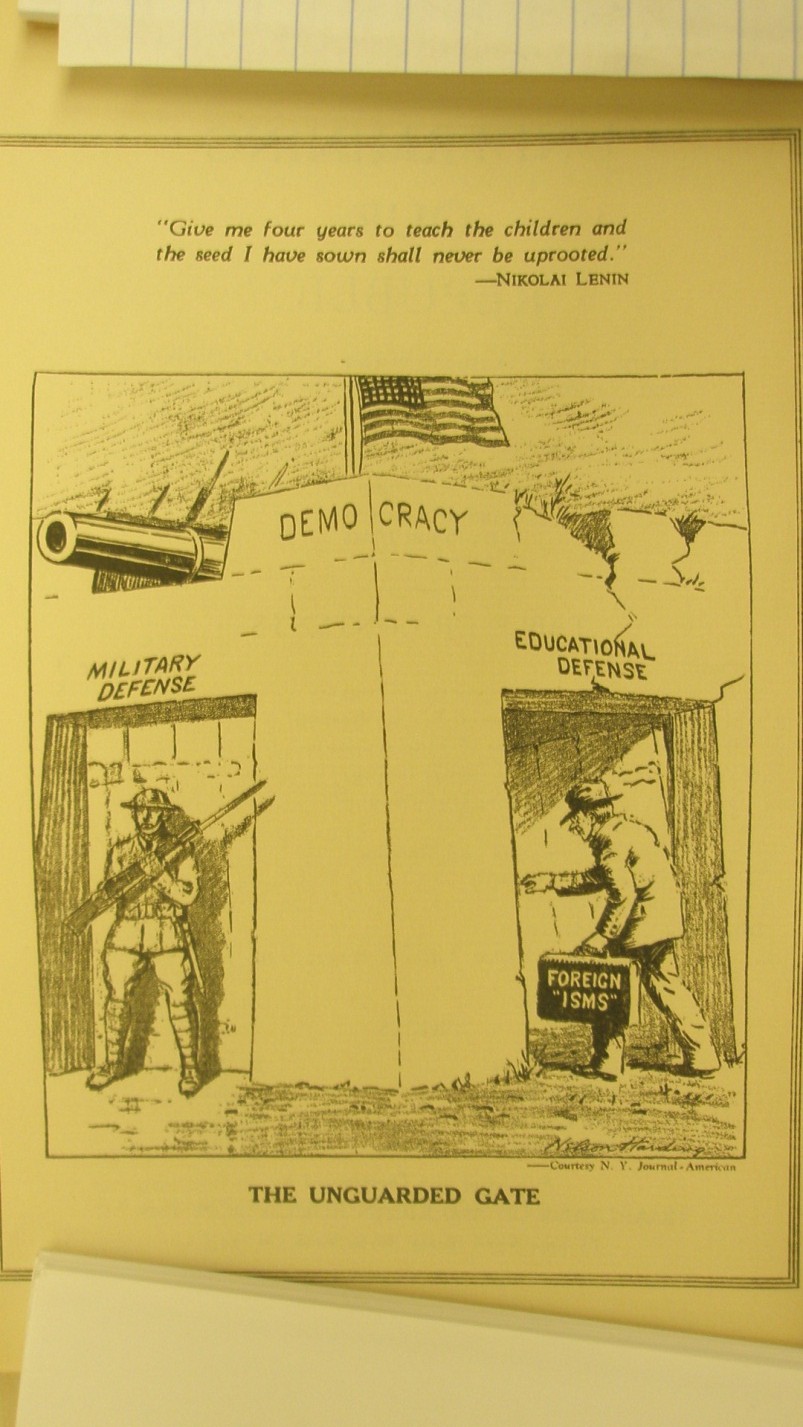
Today, I’d like to share some of the gems from the conservative patriotic activism of the American Legion, things I couldn’t fit in the book. Throughout its long existence, the AL has made education one of its primary concerns. Only if young people learned to love America, generations of AL activists have argued, would the nation remain strong. As this 1941 cartoon makes clear, some Legion members believed education was the “unguarded gate” through which un-American and anti-American sentiments could sneak into America’s body politic.

"The Unguarded Gate," from a 1941 magazine.

“The Unguarded Gate,” from a 1941 magazine.

Other Legion activists emphasized the need to fill children’s minds, souls, and schedules. Only by matching the energetic activism of communist subversives, some Legion voices claimed, could patriotic education match anti-patriotic. As national AL leader Homer Chaillaux warned in 1934, the Legion must provide a full menu of educational opportunities for young people, including baseball leagues, military training, Boy Scout groups, citizenship classes, and school awards. “The average citizen,” Chaillaux warned,

has either never heard of or knows nothing of the background of the Young Pioneers (a youth Communist group), the International Economic Conference of Students (a radical and pacifist student group), the Industrial Unions (at least 42 Communist Unions), the National Students’ League, the Trade Union Unity League, the American Civil Liberties Union (supposedly an organization standing for free speech, but we find them rising in defense of every Communist when in trouble), and numerous others traveling under camouflaged nom de plumes.

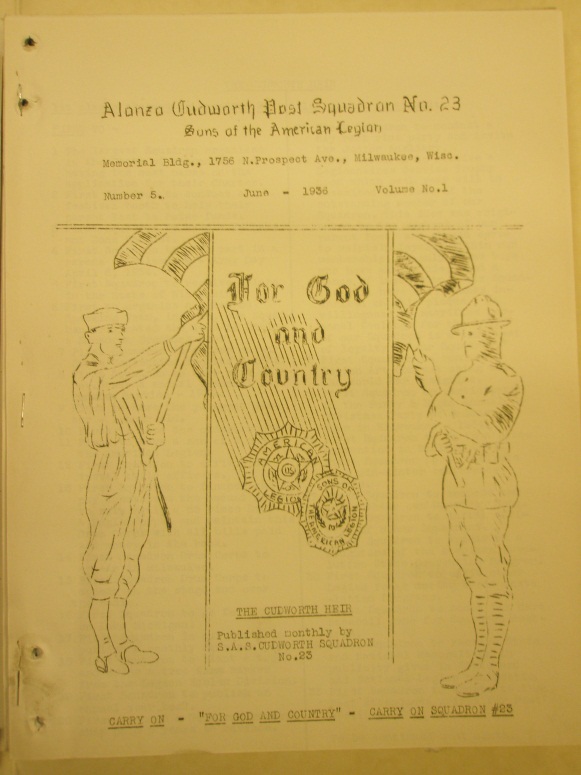
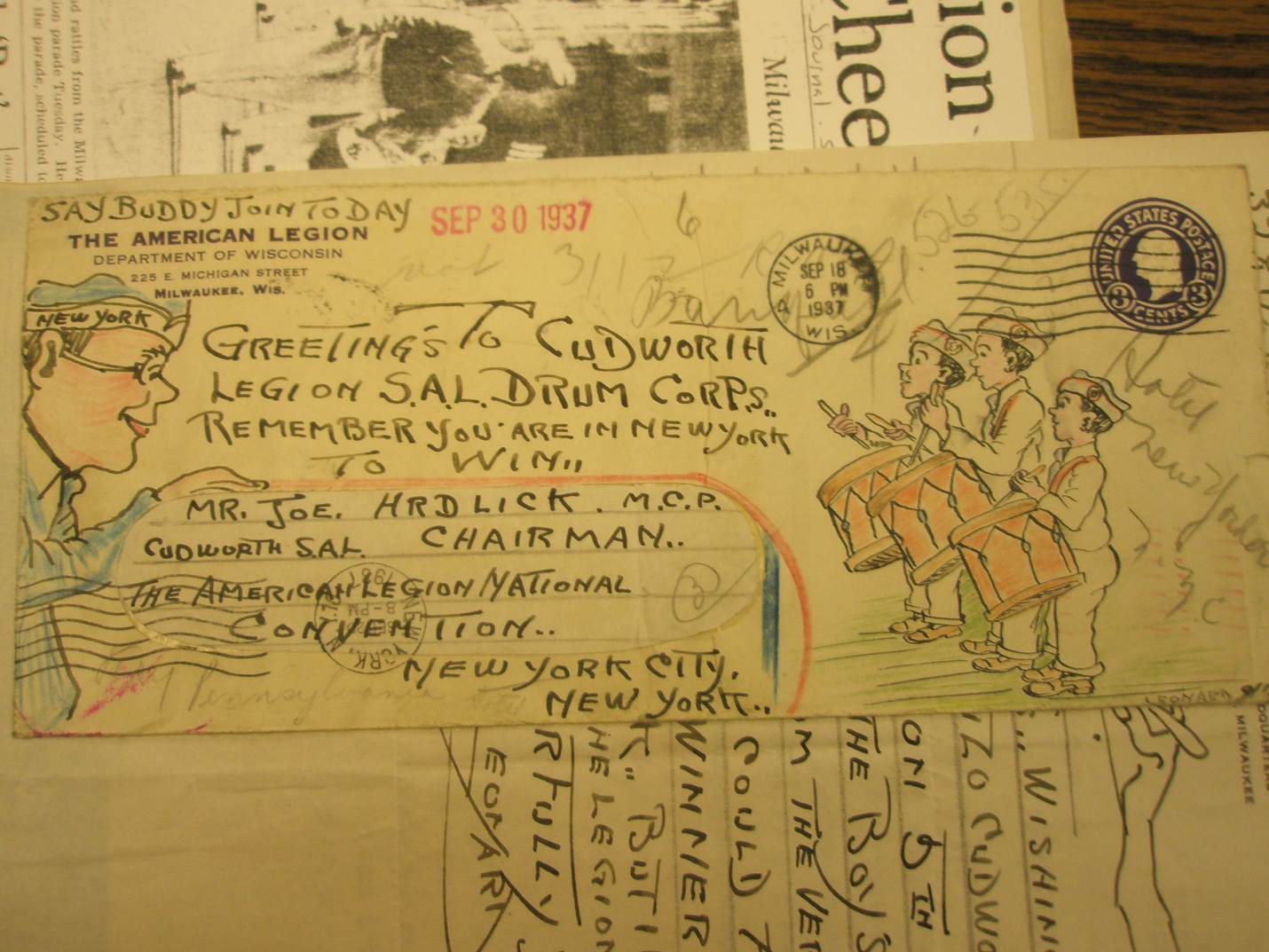
With this sort of foe, the American Legion wanted to be sure young people had patriotic, traditionalist American alternatives. Across the nation, local posts organized a wide array of youth activities.  I found these relics of such organizing from Milwaukee, Wisconsin.  As did posts around the nation, Legion adults set up youth chapters of the Sons of the American Legion, as well as marching bands, baseball leagues, essay contests, and a host of other activities meant to educate boys and girls into a firmly patriotic, socially conservative anti-communism.

A memento from a Milwaukee-area Sons of the American Legion Marching Band trip to the national championships.

A memento from a Milwaukee-area Sons of the American Legion Marching Band trip to the national championships.

From the same Milwaukee-area SOTAL club, a cover from a 1936 newsletter.

From the same Milwaukee-area SOTAL club, a cover from a 1936 newsletter.

As one Legion writer put it in 1930, these efforts must range far beyond just exhortation. They must envelop young people into a profound spiritual web of learning and becoming. In this writer’s words:

While the communist organizes his young pioneers, his youth movement in colleges, and so forth, let us do some organizing. Let us organize Boy Scout troops, ROTC units and boys’ baseball teams, if you please. Let us win and hold the confidence of our boys through such work. While the communist scatters literature among the youth of the land to teach it disrespect for parental authority, let us preach the doctrine of love of parents and love of home. While the communist ridicules the ethics of religion, let us teach its beauty and comfort and hope. While the communist preaches its cowardly philosophy of dissipating the fruits of labor and capital, let us strive to inculcate the manly principles of energy, ambition and thrift in the hearts of our people. While the communist, in the guise of the professional pacifist, spreads his doctrine to palsy the arm of our national defense, let us keep our people informed on matters pertaining to the need and necessity of national defense. … While the communist gathers up boys and girls and sends them to colleges and universities of his own endowment for the purpose of making teachers of communism and atheism out of them, let us make opportunity for patriotic and religious education more universal, in order that the schools and pulpits of tomorrow will be filled with right-thinking men and women.


From the Archives: Conservatives, Historical Knowledge, and the Political Process

Guest Post by Kevin B. Johnson

How could American History bother conservatives?

Most people probably believe that sex education and evolutionary biology are the most contentious subjects taught in school.

But conservative activists have also targeted American history.  Why?  Because as historians such as Jon Zimmerman and David Blight have argued, America teeters on a culture-war divide in its understanding of its own history; a culture-war divide no less contentious than questions about sex and God.

Nowhere has this battle over the nation’s history been more bitter or grueling than in Mississippi.

A look at the record of conservative activism in the Magnolia State may shed some light on the continuing battle over the nature of history.  It also demonstrates the ways conservatives have scored their greatest successes.  In Mississippi, at least, conservatives managed to win by promoting one central idea: historical knowledge, properly understood, is static and unchanging.

As the Cold War split nations into the Free, Unfree, and Third Worlds, Americans began scrutinizing their communities in search of suspected communists and subversives. In Mississippi, these searches involved the content in state-approved social studies textbooks. Civic-patriotic organizations such as the American Legion, the Sons of the American Revolution (SAR), the Daughters of the American Revolution (DAR), and the Mississippi Farm Bureau Federation led the charge in exposing objectionable historical knowledge presented in social studies texts.

The civic organizations were not alone in controlling textbook content. In the 1940s Mississippi began providing students with schoolbooks; lawmakers also set up the State Textbook Purchasing Board charged with governing the screening and selection of all texts. In the Cold War context, however, many civic organization leaders believed the state’s education professionals were ill-suited for this job and challenged their role in screening school materials.

A few key figures spearheaded the effort to guard historical knowledge. Mississippi State College education professor Cyril E. Cain, for example, found reading and “doing” history to be a mystical-spiritual experience. In 1949, Cain learned about the California SAR calling for removal from that state’s schools the Building America textbook series. America and its democratic system was not part of a process, the SAR argued. Rather, American democracy had been built and perfected in comparison to rival governments.

Through the Mississippi Patriotic Education Committee, Cain called upon other conservatives guard against the historical knowledge contained in schoolbooks. He wrote to the state regent of the Mississippi DAR—Edna Whitfield Alexander, asking for collaboration between their two organizations “for the common cause of defending America” from textbook authors who espoused “alien ideologies.”

For the next twenty years, Alexander became the South’s preeminent textbook activist. She developed her organizational skills through the Mississippi DAR, which held significant power in the 1950s and 1960s. Many DAR members’ husbands served in state government or were the state’s business leaders; the DAR owned numerous radio stations throughout Mississippi. A segregationist society like other civic clubs, its members naturally opposed perceived egalitarian messages in textbook treatments of history, civics, and economics. History was the DAR’s domain and it held what they believed was magnificent power to order present-day society.

Gaining the attention of Mississippi’s leaders, especially Mississippi House Speaker Walter Sillers, Jr, by 1958, Alexander and DAR activists officially recorded their objection to the content in dozens of state-approved books.

The following are just a few examples:

“Laconic treatment of the South…did not mention Fielding Wright as Vice-Presidential nominee of the States Right party…praises Federal aid to education…Booker T. Washington picture is much later than Thomas Jefferson [sic]” –review of United States History, American Book Company, 1955 reprint.

“This slanted-against-the-South book makes no mention of the fact that Russia offered to help the North [during the American Civil War]” –review of The Making of Modern America, Houghton-Mifflin, 1953.

“…records a good bit of history—some of which we are not too proud, and conspicuously omits some of which we are very proud like religious freedom!” –review of Your Country and the World, Ginn & Company, 1955.

“…advocates creation of a state of social equality…” –review of Economic Problems of Today, Lyons and Carnahan, 1955.

“Formerly history was largely concerned with kings, monarchies, laws, diplomacy, and wars…Today history deals with the entire life of a people. So now were are told that history must change along with this changing world and George Washington, Valley Forge, and the U.S. Constitution are no longer worthy of recognition to be ignored so far as our children’s history books are concerned.” – wrote a DAR reviewer of The Record of Mankind, published by D. C. Heath, 1952.

The DAR, in addition, opposed books citing renowned scholars such as Henry Steele Commager, Charles Beard, Allen Nevins, Gunnar Myrdal, Arthur Schlesinger, John Hersey, in addition to Mississippi writers like Hodding Carter, Ida B. Wells, and William Faulkner.

These comments sent to Sillers demonstrate the DAR’s view of History.  In the DAR vision, History should be dominated by pro-South, segregationist, and patriotic biases. The reason for teaching history in the Cold War context, the DAR and others agreed, was to instill in school children loyalty to state and country.

The DAR, under Alexander’s leadership, began a concerted lobbying effort. In 1959, Alexander informed the Mississippi Superintendent of Education and head of the State Textbook Purchasing Board, Jackson McWhirter “Jack” Tubb, that “youth must be taught Americanism in its purest form if this Republic is to survive.”

The American Legion and the Mississippi Farm Bureau Federation became important DAR allies. These civic clubs conducted official studies of Mississippi’s approved books and found that many “cater to alien ideologies contrary to the Mississippi way of life.” Boswell Stevens, a Legionnaire and president of the state’s Farm Bureau, believed social studies curricula should cultivate among students adoration of quintessential American values like Jeffersonian individualism, capitalism, and patriotism.

During state elections in 1959, the lobbyist coalition collaborated by staging exhibits of objectionable texts in the lobby of the Robert E. Lee hotel in Jackson. After Sillers intervened the DAR moved the exhibit to the lobby of the state capitol in time for the 1960 legislative session.

Lawmaker-members of American Legion and the Farm Bureau dominated the Legislature, passing amendments to state laws pertaining to textbook screening and adoption. The amendment gave the governor, recently elected Ross Barnett, appointment power over the state’s education professionals on these important textbook screening committees.

These conservative victories were not unopposed, however.  Newspapers editorials considered the DAR efforts as a “witch-hunt” and the state’s teachers association believed that textbook reviews were best left to education professionals.

But politics—in this case, staunchly conservative politics—trumped the claims of journalists and teachers.  Conservative activists also managed to stymie complaints from academic historians. In 1975, for example, James W. Loewen and several co-authors of the history text Mississippi: Conflict and Change had to file a federal lawsuit against Mississippi for adoption of their revolutionary new textbook. Loewen even commented at the time that most of the state-approved books were merely “didactic chronologies.”

Loewen’s lawsuit demonstrated the deeply entrenched nature of conservative visions of History in Mississippi.  For decades, conservative activists had succeeded in establishing state sanction for their vision of History: a static, unchanging field of facts, uniquely useful for promoting patriotism and instilling a love for traditional Americanism.


Kevin Boland Johnson is a doctoral candidate in American history at Mississippi State University and a dissertation fellow with the Spencer Foundation. His dissertation, “The Guardians of Historical Knowledge: Textbook Politics, Conservative Activism, and School Reform in Mississippi, 1928-1988,” explores numerous education reform efforts designed either to constrain or improve public school social studies curricula. You can reach Kevin at kbj41@msstate.edu.


I PROMISE Not to Pervert or Subvert

Good news: I just got a promotion!

But to do so, I had to promise not to subvert the constitution of the United States.

Why?

The answer can tell us something about the history of conservative educational activism in the US of A.

As part of my move to the rank of Associate Professor at the august Binghamton University, State University of New York, I had to reaffirm my pledge to support the constitution of the USA and of the State of New York.  I also had to promise to “faithfully discharge the duties” of my new position.

As I discuss in my current book, The Other School Reformers, conservative school activists throughout the twentieth century insisted on this sort of loyalty oath as an iron-clad requirement for all teachers in public schools.  It seems quaint these days to think of asking enemy agents to solemnly promise not to undermine the American way of life, but from the 1930s through the 1950s and beyond, many leading conservatives considered such oaths a primary means of combating alien influence in American society.

In 1950, for example, conservatives in Pasadena, California, fretted that their award-winning school superintendent had aligned himself too closely with communist-friendly “progressives.”  One of the fixes the conservatives insisted on was to put the Daughters of the American Revolution in charge of administering new teacher loyalty oaths.

The move made sense at the time.  Throughout the 1930s, the DAR had led the fight to pass mandatory loyalty-oath laws in several states.  By the 1950s, the DAR had established itself as the leading proponent of teacher loyalty oaths.  Therefore, it makes sense to think that if we want to understand the reasoning behind such oaths, we should start with the DAR.

At the tail end of the 1920s, for example, Grace Brosseau, national leader of the DAR, told the annual meeting that teachers’ loyalty oaths made up a key component of the DAR’s strategy to improve American education.  Such oaths, Brosseau insisted, could help America’s mothers be confident that “instructors in your communities are of the right calibre and are teaching sound Americanism instead of instilling pernicious doctrines into the minds of their pupils.”[1]

At that same national meeting, the assembled DAR representatives passed a resolution in favor of such teacher loyalty oaths.  Why?  Because, in their words, “anti-American elements are incessantly working to overthrow our constitutional form of government.”  Teacher loyalty oaths could help, they thought, along with “greater care in the selection of instructors for our schools, more widespread interest in curriculum and textbooks and a deeper understanding of methods of instruction.”[2]

In the mid-1930s, a successor to Grace Brosseau agreed that teacher loyalty oaths constituted a key element of right-thinking conservative school reform.  As President General Florence Becker argued in 1935,

A Teachers’ Oath of Allegiance law is but a tardy recognition of the fact that of all public servants holding positions of trust and receiving pay from public funds, the teacher holds the key position of importance.  The education system should be kept free from government control, and the American people should not commit suicide by failure to provide teachers who have faith in America.[3]

One DAR activist in Michigan thought that a teacher oath would at least give parents some legal recourse if they found a subversive teacher in their local school, “spreading his un-American doctrines among our children.”[4]

In sum, it seems that teacher loyalty oaths resulted from anti-communist political pressure in the 1930s and 1950s.  Even at the time, other anti-communists wondered if such oaths mattered.  Would a foreign agent dedicated to subversion be deterred by such an oath?

These days, the United States does not face the threat of a large body of communist agents.  Does it make any sense to continue these loyalty oaths?


[1] Grace L.H. Brosseau, “Annual Message of the President General,” Proceedings of the Thirty-Eighth Continental Congress, National Society of the DAR (1929), page 11.


[2] “Resolution No. 16, Teachers’ Oath,” Proceedings of the Thirty-Eighth Continental Congress, NSDAR (1929), 681-682.


[3] Mrs. William A. Becker, Tapestry Weavers: an Address of Mrs. William A. Becker, President General, National Society, Daughters of the American Revolution at Fall State Conferences, 1935 (no publisher, no date, [likely DAR published, likely 1935.  Copy in the NSDAR archives, Washington, DC]), pages 6-7.


[4] Vivian Lyon Moore, “Michigan’s ‘Oath of Allegiance’ Bill,” DAR Magazine Volume 65 (July 1931), page 404.


Jesus and the Ivy League

Religious conservatives often insist that America’s colleges and universities used to be “our schools.”

For example, Protestant fundamentalist educational writer A. A. “Buzz” Baker pointed out in the 1970s that, although “it may come as a surprise to some,” most of America’s leading colleges “used to be ‘our’ schools.”[1]  Similarly, B. Gray Allison, a conservative evangelical from Louisiana, noted in 1968 as campuses nationwide roiled with cultural conflict that not only Harvard, Yale, and Princeton began with explicitly religious missions, but “even the early state-supported institutions had a concern for the perpetuation of what might be termed religious culture.”[2]

Over at the inimitable The Way of Improvement Leads Home, historian John Fea offers some evidence from the archives to back up those assertions.

On March 19, 1761, Fea reports, the College of Philadelphia’s (the future Penn) Board of Trustees approved some student rules that might warm the heart of twenty-first century religious conservatives.

Every student had to attend chapel.  Slacking off or not paying attention during prayer or Bible readings could call for punishment.

Plus, no sauntering!  Check out Fea’s full post here.


[1] A.A. Baker, The Successful Christian School: Foundational Principles for Starting and Operating a Successful Christian School (Pensacola, FL: A Beka Book Publications, 1979), 34.


[2] B. Gray Allison, “The American Campus as a Spiritual Force,” Christianity Today 12 (May 10, 1968): 5.


Core Wars

What do conservative activists hate about the Common Core State Standards?

A recent essay by conservative commentator Stanley Kurtz in National Review points out some conservative objections.

As we’ve noted recently, conservatives share with progressives a fervent opposition to the CCSS, though usually for different reasons.  Everyone from Phyllis Schlafly to the Heritage Foundation has warned of looming implications for culture, politics, religion, and education.  For those of us trying to understand conservative attitudes toward American education, these diatribes against the CCSS are a good place to start.

Kurtz was responding to an article in the Washington Post about Tea Party objections to the new shared standards.  Obama officials, Kurtz complained, responded with deceptive statements and obfuscation.  In the end, Kurtz argued,

. . . the Tea Party is right when it accuses the Obama administration of nationalizing education standards through the back door. The Founders opposed that for a reason. Once de facto nationalization is achieved, parents will lose their ability to influence their children’s education. Leverage that can be easily exercised at local school-board meetings or through representatives in state legislators will be lost to unaccountable federal bureaucrats (like Lois Lerner), and worse, to the even less accountable private education consortia that are developing the Common Core. So if educators try to impose politicized curricula or “fuzzy” math, parents will have no recourse.

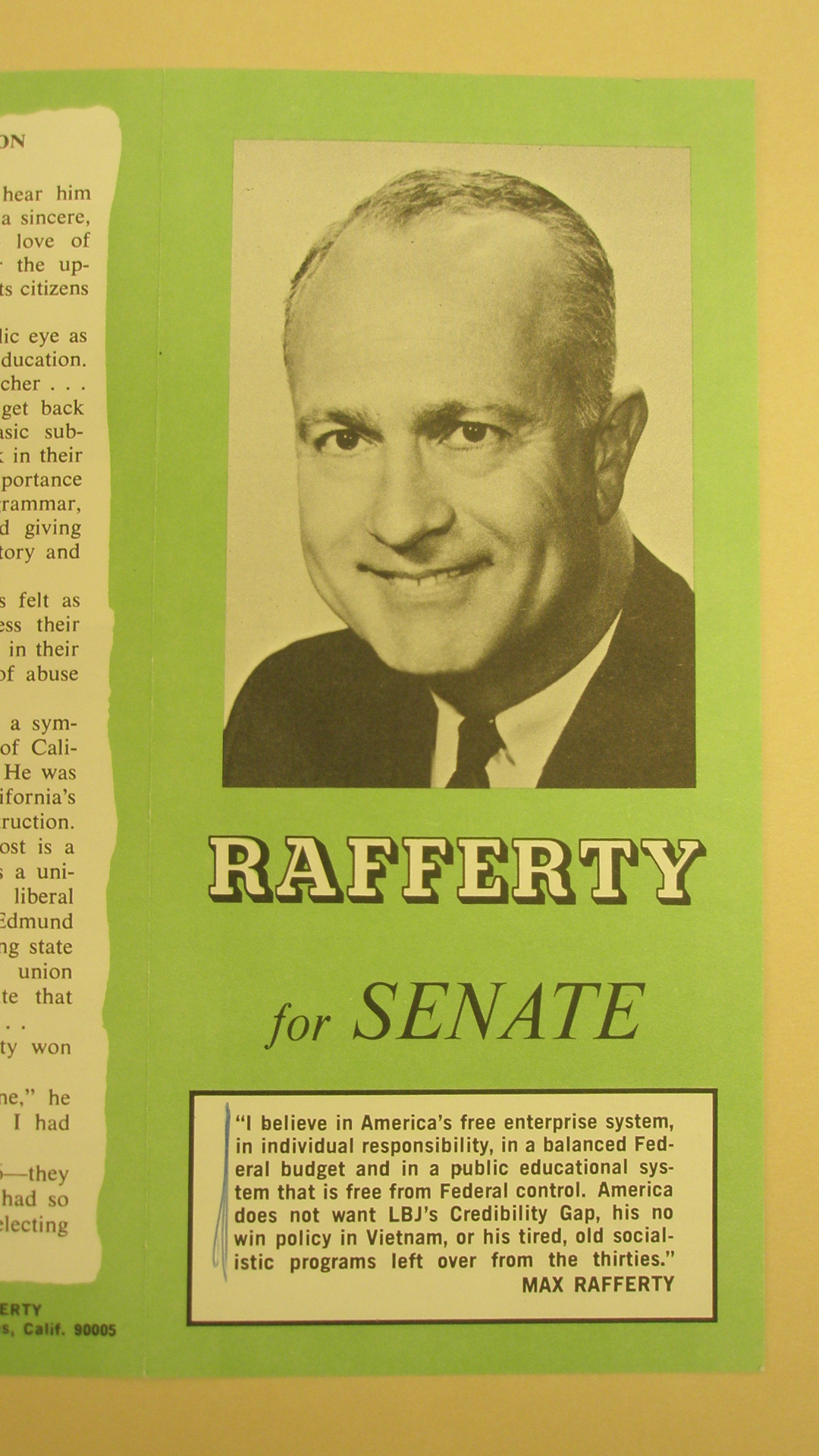
Kurtz’s “local control” argument echoes a long tradition among conservative education thinkers.  Most powerfully, California State Superintendent of Schools Max Rafferty pushed hard during the 1960s to combat increasing federal control.  Rafferty’s colorful prose often made the case more lyrically than I’ve seen it since.

In one speech from the archives,[1] Rafferty articulated a conservative position for local control that I suspect might still be appealing to today’s Tea Partiers.  As he told the California Small School Districts Association Convention on March 8, 1965,

You live and work in an out-of-the-way corner of this county.  A small town where the sky is still blue, where the roar and tension of freeway traffic has not yet penetrated; where a little boy can still run and play in open fields.  You’re there because you want to be.  You moved there deliberately a few years before because you liked that feeling of grassroots independence.  That unique sense of having an equal share in the controlling of one’s own destiny which has been the legacy of every American ever since the first little villages began to dot the New England countryside more than three centuries ago.  You’ve been happy there.  Your children are growing up clear-eyed and self-reliant with that indescribable look of quiet confidence which comes from life spent in a region where hills and trees are very real, very close at hand.  Where a neighbor is a lot more than someone who just happens to live close to you.  Suddenly, something goes wrong at your local school house, as things sometimes do.  Maybe it’s a new course of study which just doesn’t quite fill the bill.  Maybe it’s a neurotic old school administrator, we do run across one now and then!

No matter, you tell yourself, nothing can possibly happen in your community which can’t be solved by you and your neighbors, working and acting together in the traditional American spirit of mutual tolerance and good will.  But this time you’re wrong.  Shockingly, unbelievably wrong!  You and your friends try to arrange an appointment with your district superintendent to tell him of your problems and make your suggestions.  But you don’t have a district  superintendent anymore, in fact you don’t even have a district!  You try to contact your local school board, but it’s gone too!  A hundred miles away, a group of county or state officials meet once a month to decide the destiny of your children.  You don’t know any of them personally, in fact you never even heard most of their names!

But in our nightmare today, they tell you what your children will be studying.  They hire the teachers who will be molding the thinking and the behavior of your children throughout the years that lie ahead.  They decide whether or not the school bus is going to stop near your home or indeed if there is going to be a school bus at all.  Whatever they decide, you’re stuck with.

Rafferty worried about the Elementary and Secondary Education Act, the direct progenitor of No Child Left Behind.  As several of the commentators on Stanley Kurtz’s essay pointed out, the centralization of public schooling can be traced back through several generations of federal leaders, including President George W. Bush.

From the Hargis Collection.

From the Hargis Collection.

But that doesn’t mean that today’s version, the Common Core State Standards, will be greeted with anything but alarm among some sectors of conservative thought.


[1] This speech survives as a typescript in the Billy James Hargis Papers, University of Arkansas Mullins Library Special Collections, MC 1412, Box 48, Folder 2, Public Schools, 1950-1978 (1 of 2).  This collection of papers represents, IMHO, the best single-stop shop for any scholar hoping to understand the career of twentieth-century educational conservatism.  The Reverend Hargis was a leader in the Christian conservative movement in the second half of the twentieth century, and he was an avid collector of newsletters, correspondence collections, and other ephemera that shed a unique light on conservative thinking about education during the period.


From the Archives: August Heckscher and Conservative Multiculturalism

Could American conservatives embrace their own, distinctly conservative vision of “multicultural” education?

Thanks to Brad Birzer at The Imaginative Conservative, we find a resurrected 1953 argument that forces us to wonder.  This essay, by historian and parks administrator August Heckscher II, insists that true conservatism must never be an “ideology,” but rather

a way of thinking and acting in the midst of a social order which is too overlaid with history and too steeped in values, too complex and diverse, to lend itself to simple reforms. It is a way of thought which not only recognizes different classes, orders, and interests in the social order but actually values these differences and is not afraid to cultivate them.

Heckscher himself could not claim conservative credentials.  He worked in the Kennedy administration and gushed at the progressivism of Woodrow Wilson.  As one conservative commentator complained about Heckscher on the American Conservative, Heckscher was merely “another liberal Democrat explaining to Conservatives politely, but firmly, the need for them to shut up and get out of the way until certain debatable ‘reforms’ are irrevocably in place.”

Yet other conservative thinkers, notably the editors at The Imaginative Conservative and The American Conservative, consider Heckscher’s 1953 polemic worth revisiting fifty years later. Today’s Burkean, traditionalist conservatives were likely attracted by Heckscher’s Burkean, traditionalist definition of true conservatism.

It seems too strange to be a coincidence that Heckscher’s essay came out in the same year as Russell Kirk’s Conservative Mind.  Kirk transformed American conservative intellectual life by promoting this sort of Burkean traditionalism.

Heckscher, like Kirk, insisted that American conservatism must be, and has always truly been, more than simply rock-throwing at government expansion.  True conservatism, Heckscher wrote, would embrace programs such as social security, if those programs were “conceived as a means of strengthening local ties, strengthening the family, and strengthening the true spirit of inde­pendence in the citizens.”

At ILYBYGTH, our attention was drawn to Heckscher’s comments about the nature of truly conservative education.  Heckscher offered a 1950s preview that sounds strangely familiar.  Since the time of Herkscher’s essay, we have become accustomed to “multicultural” ideology in education.  But we generally have not thought of this as a particularly conservative idea.  Here is Heckscher’s vision:

Education in conservatism can come, I suggest, in part from a schooling that makes men aware of the values in a community, and tolerant of their differences. It can come in part, also, from the common everyday discipline of living in an environment where multitudinous groups think in their own ways and set a varying hierarchy of values upon the goods of life. In such a community the doctrinaire approach is impossible. Rationalism cuts athwart the basic understandings which hold all together; and the search for a unique solution would drive men to distraction were it not aban­doned for a spirit of practical accommodation and acceptable com­promise. The diversity with which the citizen learns to live sanely comes by degrees to seem a virtue; and the climax of the wise man’s education is when he turns about and begins consciously to preserve and nourish the institutions in which diversity has been bred. That is the moment, too, in which he becomes a conservative.

Recognizing the value of diversity, in other words, is the sine qua non of truly conservative education.  Since the time of Heckscher’s 1953 essay, “multiculturalism” has earned a negative reputation among many conservative intellectuals.  Many conservatives might line up more happily with Arthur Schlesinger Jr.’s blistering 1990s critique of multiculturalism than with Heckscher’s 1953 endorsement.

But in the context of Heckscher’s Burkean vision, this definition of proper education needs another look.  In the twenty-first century, when we hear a call for “diversity” and a non “doctrinaire” inclusion of “multitudinous groups,” our minds jump first to the sort of “multiculturalism” heralded by scholars such as James Banks.  Banks and other education scholars argued that good education must emphasize the contributions of many different cultural groups.  At its heart, this sort of multiculturalism suggests a radical egalitarianism.  Cultures are different, but all deserve equal respect.  This approach, Banks promised, would not only be good for students of minority ethnic groups, but for all students.  A multicultural curriculum, in this vision, would help overcome America’s history of white Christian hegemony.

Read in the context of his full essay, Herkscher’s call for multicultural education looks much different.  The various voices Herkscher wants to hear are those of different “classes, orders, and interests.”  Herkscher’s conservative multiculturalism does not seek to overcome or diminish those differences between classes and orders, but rather to cherish and promote those differences.

A conservative, Heckscher seems to be saying, learns that every class, every social group, has its intrinsic value as part of a well-ordered society.  Every member of each class must learn to think of himself or herself not primarily as an individual acting in isolation, but as an individual representative of his or her social class.  Harmony comes from valuing the diverse contributions of each group, not by trying to make each group equal.

This is a profoundly different sort of multiculturalism than the explicitly racial vision promoted by later generations of multicultural educators.  The ultimate vision of a harmonious and hierarchical society differs radically from the later multiculturalists’ ultimate vision of an egalitarian utopia. Today’s “multicultural” ideologues might recoil in horror at the notion that education should teach people to see society as a hierarchical structure in which every person must find his or her proper place.

Evidence from Heckscher’s career, too, supports the notion that Heckscher’s multicultural vision differed markedly from multiculturalism’s later incarnation.  As New York City Parks Commissioner between 1967 and 1972, Heckscher applied his vision of social justice in tricky circumstances.  According to his 1997 obituary, Heckscher removed a Black Panthers flag when it had been raised instead of the Stars and Stripes.  Other officials, including the police commissioner, had refused to confront the Panthers, fearing violence.  But Heckscher simply walked alone to the flagpole, took down the flag, and presented it to the African American crowd.  He told them not to put it up again.

Conservatives today might embrace Heckscher’s personal bravery and refusal to truckle to race-based bullying.  But they might also consider the educational ramifications of Heckscher’s 1953 essay.  What would a Burkean multiculturalism look like?  Could students learn to value different groups and classes, not as a way to overcome hierarchy, but as a way to preserve it?

Get In Line, David Barton

What history books should American school children read?

Most recently, the history darling-in-chief among many conservatives has been Wallbuilders’ David BartonGlenn Beck, Mike Huckabee, and other conservative politicians have praised Barton’s vision of American history.

For those who haven’t followed the story lately, here’s a brief synopsis: Barton claims to be the best historian around, the only one honest and dedicated enough to discover the real Christian intention of most of the Founding Fathers.  His latest book, The Jefferson Lies, came under brutal attack for its historical inaccuracies and misrepresentations.  The accusations came not only from partisan leftists, but also from conservative Christian critics.  As a result, the original publisher pulled the book from store shelves.  Glenn Beck’s publishing arm quickly picked up the title.

Image source: Ebay

Image source: Ebay

In the research for my current book about conservative educational activism in the twentieth century, I came across an eerily similar story from the 1920s.  In that decade, the American Legion resolved to sponsor a two-volume school history.  Too many of the books on the market, the Legion concluded in 1922, “contain misrepresentation of American history.”  Legion leaders contacted Charles F. Horne, a professor of English at City College of New York.  Horne agreed to author the books, to be called The Story of Our American People.

This textbook, the Legion’s special committee in charge of the textbook project declared in 1925, would build “character.”  Too often, the Legion leaders lamented, young people “grow up ignorant or anarchistic or otherwise ‘destructive.’”  There was no chance, the Legion wrote, that such youth, taught that their government deserved nothing but contempt, could mature into healthy, productive citizens.  Most commercial history textbooks only tore down young people’s confidence in their society and government.  A good history textbook could fix this.  The proper teaching of history, the Legion argued, must teach, despite “occasional mistakes,” that American history has been “so glorious that its proper study must inspire any child to patriotism.”

When a preliminary draft emerged in 1925, it earned some instant praise from conservatives who had long fretted about the deplorable state of most history textbooks.  Walter M. Pierce, for example, in 1926 the Klan-backed governor of Oregon, dashed off a letter to Professor Horne.  The new volumes, Governor Pierce gushed, represented “the finest history of early America that we have ever had.”

But other early readers took a different view.  Writing in the pages of Harper’s Magazine, historian Harold Underwood Faulkner blasted Horne’s books as “perverted American history.”  No professional historian, Faulkner sniffed, would have produced such drivel.  The books represented nothing more than a “bombastic eulogy of all things American.” (Harold Underwood Faulkner, “Perverted American History,” Harper’s, Feb. 1926, pp. 337-346. [Subscription only.]) They could not even be criticized on historical grounds, Faulkner claimed, since the books did not really constitute a history.  Worse, the books were intended to “produce a bigoted and stereotyped nationalism . . . a deplorable subservience to the rule of ignorance.”

Such criticism from snobby historians might not have doomed Horne’s books.  But an internal committee of the American Legion itself also found the books “filled with incomplete and inaccurate statements.”  Instead of inspiring American youth to embrace a patriotic vision of America’s past, the Legion investigators concluded, such shoddy history could only mislead youth and heap ridicule on the American Legion.

The Legion abrogated its contract with Horne.  They agreed not to receive any revenue from the book project and withdrew their endorsement.

As a result, the books never made the impact on schools Legion activists had hoped for.  Even among Legionnaires, the 1920s textbook project quickly became a politely forgotten story.  In 1949, for example, one Legionnaire wrote in the pages of The American Legion Magazine that the Legion ought to sponsor its own patriotic textbooks.  Such a textbook series, this writer insisted—apparently utterly innocent of the history of the Horne histories—could replace the overabundance of boring pink textbooks with “the rich and meaty story of American history.” [See John Dixon, “What’s Wrong with American History?” The American Legion Magazine (May, 1949): 40.]

So get in line, Mr. Barton.  You are far from the first to attempt to impose sectarian history on America.  Just as the fiercest and most effective critics of the Horne books were the Legion investigators themselves, so the conservative Christian criticism of Barton’s books helped isolate and neutralize Barton’s influence.

From the Archives: Yoga, Schools, and “Those Dirty Books”

As Natalia Mehlman Petrzela has argued in these pages recently, a yoga program in Encinitas public schools has raised the ire of some religious conservatives.  The story has subsequently been  picked up by the New York Times and National Public Radio.

As Professor Mehlman Petrzela pointed out in her article, such fears of yoga as religious indoctrination are not new among American conservatives.

During my research into an earlier generation’s fight over school textbooks, I discovered such complaints as early as 1974.  In that year, a school controversy exploded in Kanawha County, West Virginia.  As journalists such as Trey Kay and scholars such as Carol Mason have described recently, the bitter fight over new textbooks led to a months-long school boycott and repeated shootings and bombings.

In 1974, the beleaguered Kanawha County Board of Education appointed an eighteen-person committee to investigate the accused textbooks.  A majority of the committee found the books unobjectionable.  But in November, 1974, a minority splinter committee issued a blistering 500-page denunciation of the textbook series.  The minority report included specific objectionable passages with comment.

For instance, from a first-grade teachers manual from the DC Heath “Communicating” series, the committee extracted the following suggested discussion-starters: ‘Has anyone ever awakened and found a stranger looking at him?  Has anyone ever broken a toy, a chair, or some other article the first time he was visiting an unfamiliar house?  Has anyone ever had a dream in which he talked with some animals?  Has anyone ever seen a deserted house?  Did you go in?’

In the minority committee’s opinion, “A child should not be forced to discuss his own personal feelings.  This constitutes an invasion of privacy.  This is also
behavioral change.  Why should a 6-year-old child be subjected to questions that will implant fears and frustrations in his mind.  Why not have questions on pleasant and wholesome attitudes?”

The minority report complained that the textbooks’ version of the Jack and the Beanstalk story was “more sadistic and gruesome than usual.”  Elsewhere, the minority report objected, students were instructed to make up their own myths, including one about why all humans don’t speak the same language.  “The question why men do not speak the same language,” the minority insisted, “is answered in the Book of Genesis.  The inference that the answer can be classified as a myth again presupposes that the Bible is based on a myth.”

Most interesting to the folks of Encinitas, however, might be the minority committee’s complaint that articles about yoga amounted to “religious indoctrination.”

Makes me wonder where and when else the conservative campaign against the teaching of yoga in public schools has surfaced.  As Mehlman Petrzela points out, school-yoga supporters in the press and school district seem utterly unaware of this longer history.  As she wrote in her December article,

“The press, the EUSD, and scores of online commenters expressed shock that anyone would suggest, ‘a little stress-reducing exercise ever hurt anyone,’ especially in the context of a much-discussed ‘obesity crisis.’ The Los Angeles Times couldn’t believe the degree of the plaintive parents’ worries, as yoga is regularly practiced in San Diego spots as disparate as the Camp Pendleton naval base and the Jois yoga enclave, which funds the school program. Glamour commented, ‘most people associated with the controversy are scratching their heads,’ quoting similarly incredulous Jois chief executive: ‘It’s hard to know how to respond to someone who says if you touch your toes, you’re inviting the devil into your soul.'”

Perhaps this posture of surprise is put on only to discredit conservative opponents.  After all, if anti-yoga activism seems startling and unexplainable, it might gain fewer political supporters.  But at least some of the surprise sounds genuine to me.  It seems another good illustration of the ways widespread ignorance of the history of conservative educational activism impairs any sort of useful discussion of current educational policy.

From the Archives: Bobby Squirrel, Billy James Hargis, and the Counter-Subversive Imagination

Quick: What’s the most anti-communist animal?  The ass-kicking bald eagle?  The industrious ant?

Fifty years ago, prominent Mississippi conservative leader Edna Whitfield Alexander lamented the subversive communist takeover of another likely forest-dwelling Cold Warrior: the nut-hoarding squirrel.

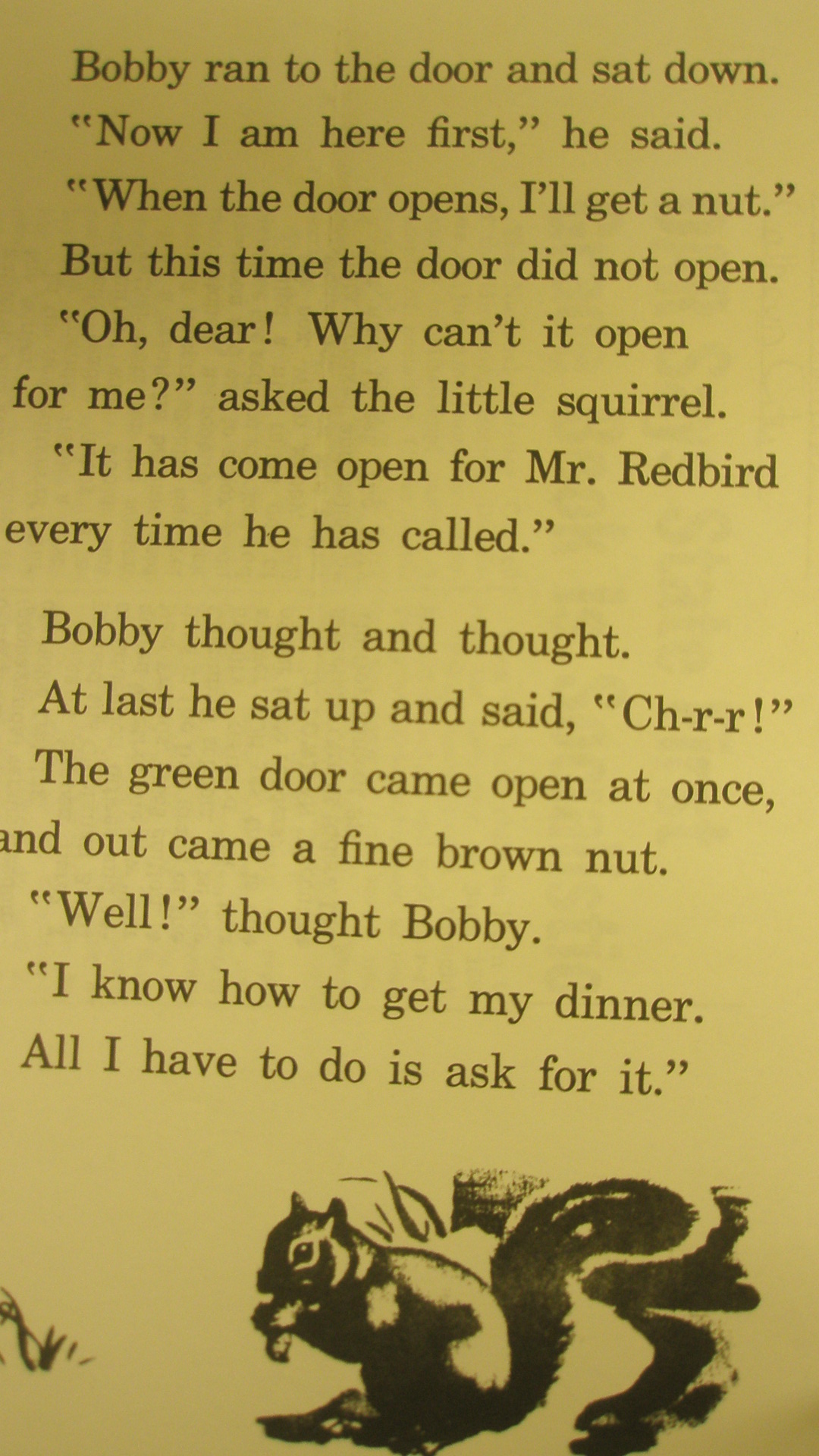
At the time, Alexander chaired the Mississippi Daughters of the American Revolution’s Committee on National Defense.  She complained that a story in one of Mississippi’s first-grade textbooks subverted the naturally capitalistic image of the squirrel.  In “Ask for It,” Alexander charged, “socialistic” authors used a tale of Bobby Squirrel insidiously to undermine the idea of hard work and thrift among Mississippi’s impressionable young school children.

In a pitch-perfect example of what historian Ellen Schrecker has called the “counter-subversive imagination,” Alexander blasted the textbook The New Our New Friends.  Among the seemingly innocuous just-so stories, Alexander sniffed out the “socialistic” message this book included about Bobby Squirrel.

OLYMPUS DIGITAL CAMERA

From “Ask for It,” The New Our New Friends, by William S. Gray, Marion Monroe, A. Sterl Artley, and May Hill Arbuthnot, (Chicago: Scott, Foresman and Co., 1956). Adopted as a school textbook by the State of Mississippi, 1963.

As Alexander asked in the pages of the Monitor Herald (Calhoun City, MS), January 3, 1963, “Have you ever heard or read about a more subtle way of undermining the American system of work and profit and replacing it with a collective welfare system?”

From a twenty-first-century perspective, it is difficult to remember the prominent role anti-communism played in American conservatism throughout much of the twentieth century.  As historian George Nash has argued, anti-communism often served as the intellectual glue that held together a disparate conservative movement, linking free-market activists with libertarians, Catholic intellectuals, and Protestant social traditionalists.

I came across this story in the Billy James Hargis Papers at the University of Arkansas in Fayetteville.  All historians interested in the history of conservatism in twentieth-century American education, religion, and culture should make this one of their first destinations.  Not only did the Reverend Hargis keep his own voluminous collection of small magazines, newsletters, and ephemera from various conservative evangelical and fundamentalist Protestant and anti-communist sources, but he also apparently bought up other collections, such as Allen Zoll’s.  As a result, the Hargis Papers in Fayetteville provide a one-stop reading shop for a vast collection of rare archival gems.

Unfortunately, Hargis did not keep much personal material.  It is not easy to get a sense of Hargis’ own thinking.  But the many boxes of newsletters and clippings include a wide array of pieces like Mrs. Alexander’s attempt to purge Mississippi schoolbooks of creeping, hopping Squirrel socialism.