How to Kill Public Schools

Well, we had a good run. For the past hundred-fifty years or so—depending on where you live—Americans have had public schools. I don’t mean to be Chicken Little here, but from an historical perspective, it looks like Queen Betsy has figured out a way to get rid of em.
simpsons school

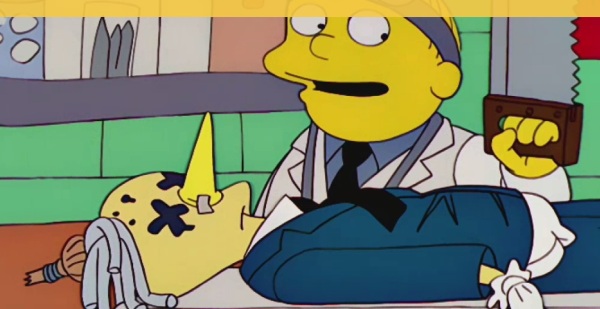
Who will pay to educate Mr. Burns’s doctor?

In some senses, of course, the United States has always had schools FOR the public. Even before the Revolution, there were schools that students without tuition money could attend. I’m finding out way more than I want to about the funding of early American “public” schools in my current research. As I’m finding, these “charity” schools had a wild mix of financial backers. Churches, taxpayers, wealthy individuals, and even not-so-wealthy people gave a lot or a little to educate impecunious children.

At different times in different places, a funding revolution swept the world of American education in the 1800s. Basically, this revolution replaced schools that were FOR the public with schools that were BY and FOR the public. That is, instead of parents, charities, philanthropists, churches, and governments all kicking in here and there to fund worthy students and schools, local and state governments committed to provided tax-funded educations to children. Those governments took tax money from everyone—whether or not they sent kids to the public schools—and in return promised to run schools for the benefit of the entire community.

There were big problems with this funding revolution. Not all children were included. Most egregiously, African-American students were often segregated out of public schools, or shunted off to lower-quality schools. And not all states participated equally. New England and the Northeast jumped early to the new model, while other regions hesitated. Plus, people without children and people who chose not to send their children to the public schools ended up paying for schools they didn’t personally use.

The heart and soul of public education, however, was that the public schools would be administered as a public good, like fire departments and roads. Everyone paid for them, everyone could use them, and everyone could in theory claim a right to co-control them. Even if your house didn’t catch fire, in other words, you paid taxes to support the firefighters. And even if you didn’t drive a car, you paid to maintain the public roads. And those firefighters and road crews were under the supervision of publicly elected officials, answerable in the end to taxpayers. Public schools would be the same way.

This funding arrangement has always been the heart and soul of public education. And it is on the chopping block. Queen Betsy recently proposed a five-billion dollar federal tax-credit scholarship scheme. Like the tax-credit scholarship programs that already exist in eighteen states, this plan would allow taxpayers to claim a credit for donations to certain non-profit organizations that would then send the money to private schools.

In some cases, donors can claim up to 100% of their donations back. For every dollar they “donate,” that is, they get a full dollar rebated from their tax bills. Tax-credit scholarship schemes serve to divert tax money from public education—administered by the public—to private schools without any public oversight.

[Confused? Me, too. For more on the ins and outs of tax-credit scholarships, check out this episode of Have You Heard, featuring the explanations of Carl Davis of the Institute on Taxation and Economic Policy.]
lancaster friend of the poor

Back to this future?

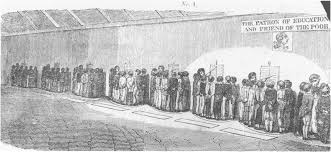
What’s the big deal? In essence, these schemes return us to the world before the public-education $$$ revolution. They return us to the world Joseph Lancaster knew so well in the first decades of the 1800s, where funding for schools was an impossibly tangled mess. Back then, parents who could afford it could send their kids to great schools. Parents who couldn’t had to hope their kids might get lucky and attract the attention of a wealthy philanthropist or a church-run charity program. They had to hope that a mix of government money, private tuition, church support, and philanthropist largesse could support their kids’ educations.

By allowing taxpayers to pick and choose whether or not to support public education, Queen Betsy’s proposal takes us back to those bad old days. Are we really ready to throw in the towel on public education? Ready to return to the old system, with “charity” schools run FOR the public by wealthy benefactors who wouldn’t send their own kids there?
Progressive Methodists, Welcome to the World of Fundamentalism

Conservatives are celebrating. Progressives are lamenting. From a historical perspective, we can’t help but notice that today’s liberal Methodists are likely feeling the same sort of betrayal and dismay that fundamentalists felt in the 1920s and 1930s.

methodist poll

American Methodists: More conservative than you might have thought…

Here’s what we know: The United Methodist Church (UMC) has long faced a dilemma. Its large US contingent has tipped to the liberal side of the spectrum, with some congregations ordaining LGBTQ ministers, even bishops. At the church’s recent special conference, however, conservatives won the day, powered in part by the surprising strength of American conservatives, but even more so by international conservatism.

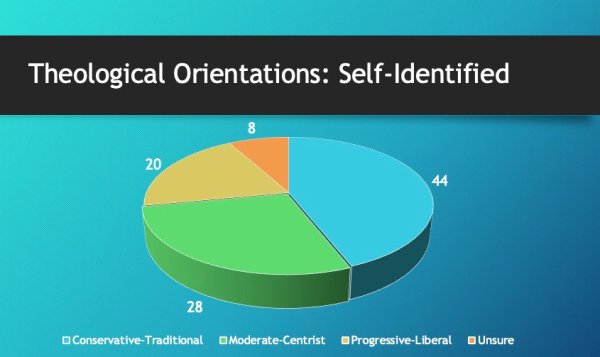
In a recent poll, for example, 44% of American respondents called themselves conservative-traditional. In African churches, an even stronger traditionalism dominates. As one African leader scolded the conference,

Friends, please hear me, we Africans are not afraid of our sisters and brothers who identify as lesbian, gay, bi-sexual, transgendered, questioning, or queer. We love them and we hope the best for them. But we know of no compelling arguments for forsaking our church’s understanding of Scripture and the teachings of the church universal.

And then please hear me when I say as graciously as I can: we Africans are not children in need of western enlightenment when it comes to the church’s sexual ethics. We do not need to hear a progressive U.S. bishop lecture us about our need to “grow up.”

As Emma Green writes in The Atlantic, progressive Methodists are stuck. Do they stay or do they go? As I read her report, I couldn’t help but hear the echoes of conservative Methodists in the 1920s. Back then, conservatives felt their church was being pulled away from them. Like today’s progressives, they often articulated a sense of both surprise and betrayal when they discovered the strength of their 1920s rivals.

To give you a taste of those feelings among early fundamentalist Methodists, I dug back through my files on one of the most famous American fundamentalists, Bob Jones. The founder of Bob Jones University was raised in the Southern Methodist Church and he felt a strong attachment to it his entire life.

However, he chafed at the attempts of the church to limit or control his preaching and institution-building. Most of all, like other fundamentalists of his generation, Jones Sr. believed that liberals had unfairly seized control of denominational institutions and used their power to crush legitimate differences of opinion.

As Jones liked to tell the tale, back in the early days of his career he had donated $300 to a Methodist college—he said it was “all the money I had on earth.” In Jones’ telling, that institution took his money “under false pretenses. They stole it. They are dirty rotten thieves.”

Jones liked to say that his experiences with the Methodist hierarchy led him to found an interdenominational fundamentalist college, one that would “never sell out.” As he put it in 1950,

I couldn’t conceive of anything as mean and low-down as to go out and raise money to build a certain type of school and then build another one…. That’s getting money under false pretenses.  That’s playing with the spiritual life of people.  That’s making capital out of the humble faith of humble saints.

Despite his antagonism toward the denominational hierarchy, Jones Sr. remained in the Methodist church through the 1930s. When a Methodist magazine refused to carry advertisements for Bob Jones College, the Joneses finally threw in the towel. As Jones Sr. wrote to a former editor in 1939, he had long hoped

there might be some hope for Methodism.  Since receiving your letter, I give up.  I say this kindly, and I love you just as much as ever, but I feel sad around the heart.

Eighty years later, we might change the reasons, but the language could remain exactly the same. I can picture a liberal Methodist minister sending in their credentials, saying that they had long hoped there was some hope for a progressive Methodism. After this week’s vote at the special conference, however, they might “give up,” even if it makes them feel “sad around the heart.”

Blackface at Fundamentalist U

So we’ve seen a lot of ugly racist yearbook photos lately. Sexist ones, too. I thought I’d take a look at Bob Jones University’s yearbooks to see how they stacked up. After all, BJU might just be the most famously racist university in the country. Yet the yearbooks don’t have much in the way of blackface and other minstrel-show racism. I think I have an idea why not.

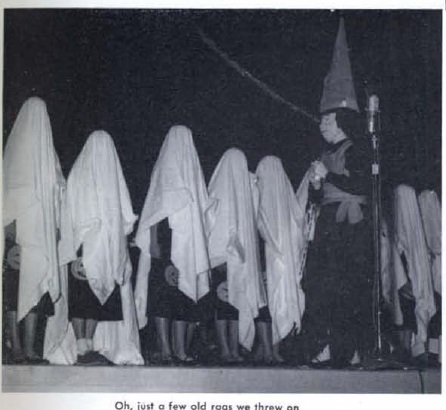
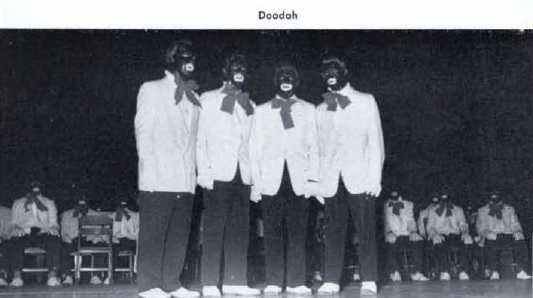
It’s not that there aren’t any. In 1954, for example, there is a typically nasty blackface performing group featured. And some sort of hooded goings-on that I can’t figure out.

BJU VINTAGE 1954 blackface

From BJU’s 1954 yearbook.

And it’s not that BJU wasn’t frankly and unapologetically racist. Up through the 1970s, there were no actual black faces on campus, period. At least not as students. Change was slow, with the school refusing to renounce its ‘no-interracial-dating’ policy until the twenty-first century.

BJU VINTAGE 1954 white robes

Another from 1954. ????

Plus, the yearbooks are deeply racist in other ways. In its 1970 year book, for example, BJU brags of visits to campus by the likes of Ian Paisley and John R. Rice. At the time, Paisley was best known as the angry face of virulent, violent Irish anti-Catholicism. Rice’s pro-segregation theology had gotten him uninvited from other conservative schools such as Moody Bible institute. (I tell this full story in Fundamentalist U if you’re interested.)

But in the 1960s, 70s, and 80s, I didn’t see any pictures of students in blackface or other racist garb. At least, not in the handful I looked at this afternoon. I might have missed it—take a look if you have the time and let us know what you find.

Why not? Why would America’s most famously racist college have yearbooks mostly free of ugly racist images?

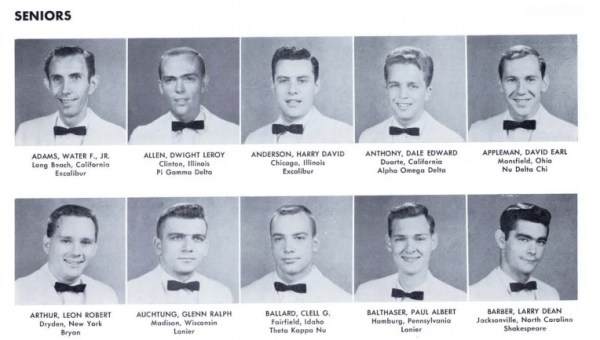
Here’s my suggestion: Unlike Governor Northam, students at BJU were not given much wiggle room to express themselves in their yearbooks. Consider this senior-class page from 1965. The men all wear identical outfits and only list their names, hometowns, and lit-society memberships.

BJU VINTAGE 1965 201

Not a lot of room for individuality, even the racist kind…c. 1965.

In other words, unlike the wilder and woolier yearbooks of non-evangelical colleges, those at schools like BJU were tightly controlled from the top. When blackface faded out of polite culture, the editors of BJU’s yearbooks edited out of their yearbooks, too.

That’s my guess, anyway. What do you think?

Trump’s S-Word 2020 Gamble

Will it work? Personally, I hope not. As a historian of American conservatism, however, I think it could turn out to be a winning strategy. And I’ll hazard an easy prediction right now: Schools and rumors about schools will continue to play a key role.

Here’s what we know. In his SOTU speech this week, President Trump harped on the dangers of socialism. As he put it,

Here, in the United States, we are alarmed by new calls to adopt socialism in our country. America was founded on liberty and independence—not government coercion, domination and control. We are born free, and we will stay free. Tonight, we renew our resolve that America will never be a socialist country.

SAGLRROILYBYGTH might be scratching their heads and asking why Trump is taking on a dead issue. Who worries about socialism anymore? The Soviet Union collapsed, China is careening forward with its some-pigs-are-more-equal-than-others capitalism, and Cuba seems poised to renounce its long socialist practice.

OLYMPUS DIGITAL CAMERA

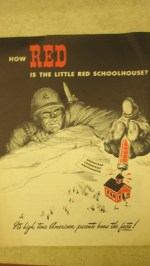
Unreasoning s-word school terror, c. 1949.

Indeed, the socialist pressure these days comes from a different direction, from the likes of Senator Bernie Sanders and Representative Alexandria Ocasio-Cortez, both loud and proud democratic socialists.

Some lefties think Trump is making a big mistake by focusing on the s-word. As John Nichols wrote in the Nation,

while Trump may think “socialism” is a scare word, and while many prominent Democrats may get scared when it is referenced, Sanders is comfortable discussing the ideology.

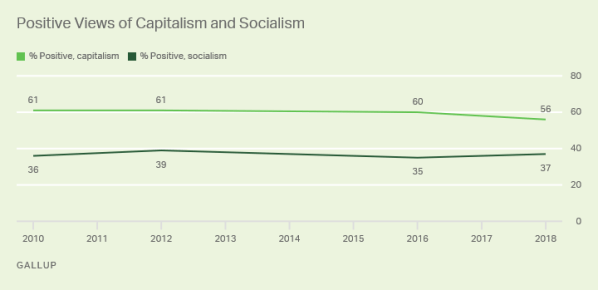
Nichols and other hopeful progressives look at recent Gallup poll results for encouragement. It seems more and more young people are expressing confidence in socialism.

gallup socialism

Changing attitudes…?

Let me be as clear as I can about this: I hope it’s true. I hope new majorities of American voters see the wisdom of policies such as health care for all, affordable college tuition, and aggressive economic policies to help lower-income Americans. I hope that the s-word has lost its enormous power to stop useful policies dead in their tracks.

But I don’t think it has. Any candidate—including Trump—can win instant and powerful support by screaming about the dangers of socialism. Maybe I’m scarred by my time in the archives, but I can’t help but remain impressed by the powerful emotions generated by the s-word.

For example, in the middle of the twentieth century anti-socialist conservative activists in the Daughters of the American Revolution went to great lengths to sniff out any traces of socialist subversion in America’s public schools. Their intense investigations would be hilarious if they weren’t so destructive.

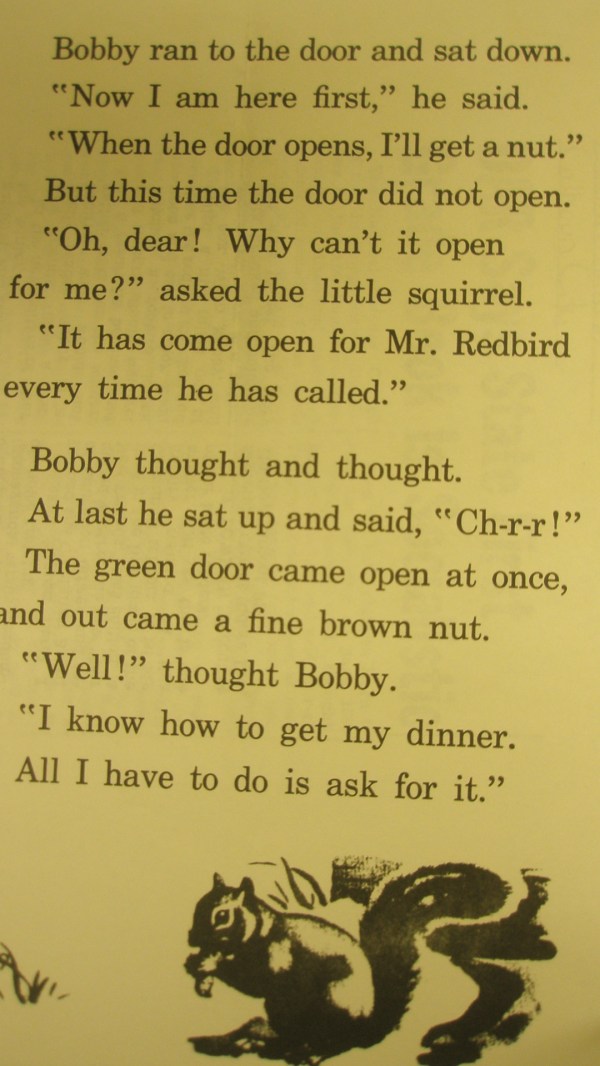
In the early 1960s, for example, Mississippi DAR leader Edna Whitfield Alexander warned of the dangers of Bobby Squirrel. The BS incident took place in a popular kids’ book used in schools, Ask For It.

OLYMPUS DIGITAL CAMERAAs Alexander asked in the pages of the Monitor Herald (Calhoun City, MS), January 3, 1963, “Have you ever heard or read about a more subtle way of undermining the American system of work and profit and replacing it with a collective welfare system?”
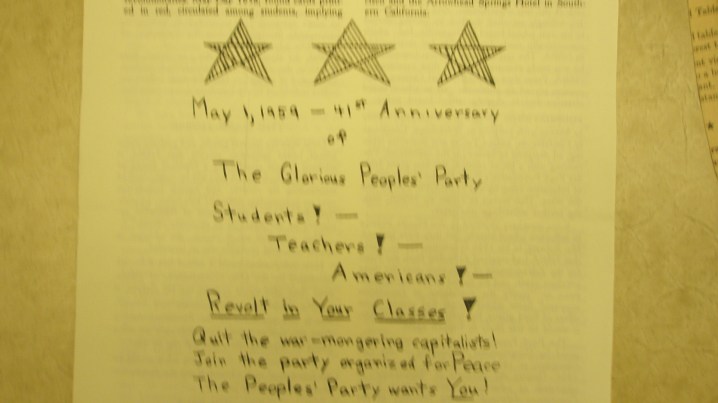
In that period, as well, conservative activists used their newsletters and mailing lists to spread terrifying rumors of socialist intrigue in the nation’s public schools. As this flyer warned, students nationwide were planning socialist revolts in school.

OLYMPUS DIGITAL CAMERA

Conservative activists reprinted flyers like this and included them in newsletters, c. 1959.

It was a ridiculous thing to panic about. Its ridiculousness, however, does not take away anything from its incredible political power. To a depth that progressives can’t hope to fathom, Americans have always been terrified of the prospect of socialism in our country.

It hasn’t gone away. As one conservative pundit wrote recently,

By making resistance to socialism a lynch pin of his 2020 campaign, Trump will be helping to right this extremely dangerous situation, giving cover to students being indoctrinated in our classrooms and to their increasingly alarmed parents.

Maybe it doesn’t need saying, but I’ll say it anyway. There IS NO “extremely dangerous situation” in American classrooms due to creeping socialism. It just doesn’t exist. The real dangers in American public school classrooms come from inadequate funding, cruel and imbalanced disciplinary practices, and rampant economic segregation.

Nevertheless, though I hate to say it, I think the sort of knee-jerk terror many Americans feel at any whisper of the s-word will prove Trump right. If he continues to portray himself as the bold defender of American freedoms against creeping socialism, he stands a chance of victory.

For Evangelical Colleges: The Dangers of Keeping Up

These are dark times for smallish institutions of higher ed. When it comes to universities, the rich are getting richer—in terms of applications and endowments—while the poor are getting closed down. To evangelical college administrators, this might seem like a new and desperate challenge, but in fact it goes back a long way. I know history is a bad guide, but as I found in the research for Fundamentalist U, in this case, the past fifty years offer pretty clear guidance about what NOT to do.

IMG_1558

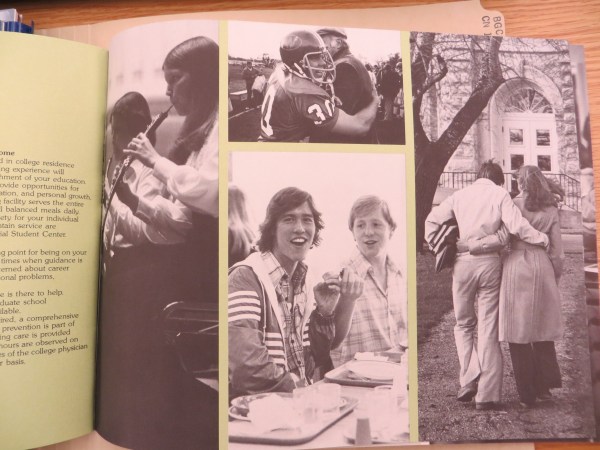
How Wheaton hoped to survive, c. 1980.

In today’s Chronicle of Higher Education, we read about administrators at small and smallish Christian schools trying to figure out how to stay alive. Indiana Wesleyan (IWU), for example, is emphasizing its traditional focus on person-centered spiritual education while also trying to cash in on online education.

If the past is any guide, one of those is a good idea.

IMG_1557

One promise: academic rigor. Another: smart girls with modest hairstyles.

Consider the bumptious early 1960s. In many ways, they were boom years for institutions of higher education. The post-war GI Bill had set millions—MILLIONS—of new students scrambling to find someone to give their government money to.

For evangelical colleges, however, the new landscape of American higher education presented a new dilemma. At Wheaton College in Illinois, for example, the early 1960s meant a startling and dangerous drop in applications. As Charles Schoenherr reported to President V. Raymond Edman, the numbers spelled doom:

  • 1958: 2009 applications
  • 1961: 1666
  • 1962: 1467
  • 1963: 998

For good reason, Wheaton’s top administrators panicked. They struggled to find reasons to explain this sudden drop in interest among the college-going evangelical public. For one thing, they had instituted a new way to count applications and a new high-school graduation requirement, but those changes could not account for this drastic drop. Like today’s administrators, Wheaton in the early 1960s faced two unpleasant questions:

  • Why were the numbers of applications plunging? And
  • What should they do about it?

Back then, Wheaton’s administrators couldn’t answer the first question satisfactorily. But they had some suspicions. As Schoenherr asked the next President, Hudson Armerding,

Has the ‘image’ of the College changed?  Has this had a bearing on the number applying?  What has been the image?  Has it been an image of excitement, challenge, and leadership or one of apathy, status quo, and noninvolvement?  To what extent have rumors about Wheaton going ‘liberal’ hurt?

If Wheaton was dying due to perceived progressivism, then one course was clear. They could choose to swing back toward their conservative traditions, emphasizing their continuing adherence to fundamentalist norms.

That’s not what Wheaton did and it should serve as a lesson to today’s evangelical college administrators. Wheaton decided to double down on its existing strengths. It had always been known as the premier academic evangelical college, and instead of swerving hard to the right, Wheaton swerved hard toward its reputation as academically elite.

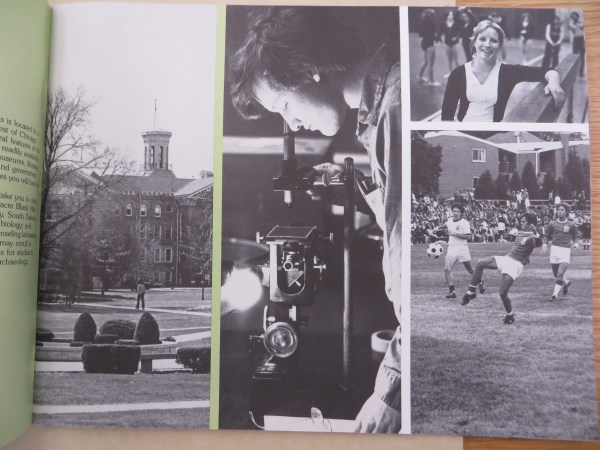
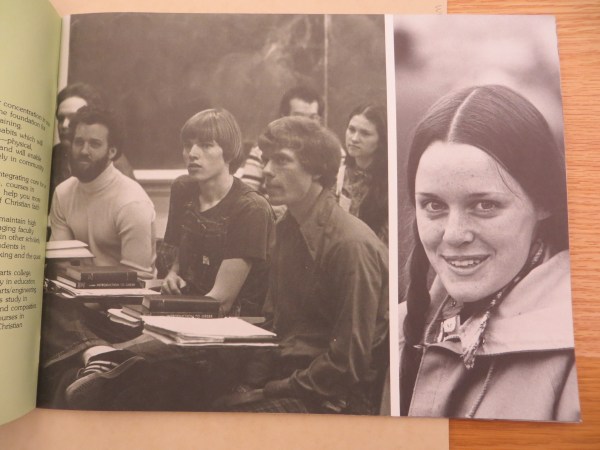
By 1980, for example, Wheaton’s promotional materials showed the school’s commitment to respecting its conservative roots while emphasizing its academic excellence. In a 1980 promotional brochure, the statement of Wheaton’s beliefs was shunted way to the back. “Yes, Wheaton is strict,” the statement concluded, “but we try not to be insensitive.”

The rest of the brochure showed pictures of students doing science-looking stuff, enjoying sports, and learning in the beautiful scenic campus. The message was clear. If you want an awesome, “real” college experience, come to Wheaton. Other evangelical colleges can’t match its traditions or academic excellence.

IMG_1562

…plus football and dates.

What’s the message for today’s strapped evangelical administrators? First, take heart. These are tough times, but you’ve been here before. Second, don’t chase after trends that don’t fit with the long-standing appeal of your school. If you think you can cash in quick on online education, watch out. You might find you’ve traded in your birthright for a mess of credits.

The Brave New World of “Workforce Preparation”

You almost feel bad for her. Queen Betsy’s ideas about ed history seem so rudimentary that it is almost too easy for historians such as Jack Schneider to tee off on her. Prof. Schneider pointed out recently how shoddy DeVos’s ideas about “workforce preparation” are. If we wanted to, though—if some sort of culture-war mercy rule didn’t kick in—we could take the critique one step creepier.

system show slates

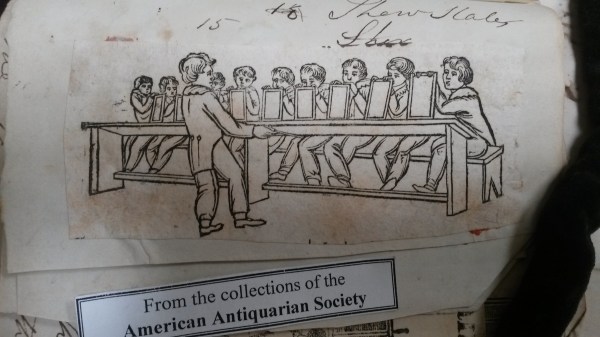
When the whistle blows, Show Slates!

As Prof. Schneider notes, Sec’y DeVos has long asserted that today’s schools are trapped in an outdated “factory” mindset, that schools today were created to train assembly line workers. Instead, DeVos likes to say, we need schools that prepare students for today’s workforce. As Prof. Schneider writes,

DeVos’s solution is misguided in part because it’s based on a fabricated story. The actual history of workplace training in American schools is far less convenient for her reform agenda.

Nineteenth-century public education, Prof. Schneider says, was always about much more than just training factory workers. As Schneider puts it,

schools were intended to foster civic virtue, Americanize immigrants, and inculcate dominant values. But vocational preparation was not a common objective.

True enough. But as Prof. Schneider is well aware, there has been a long tradition of public schooling that makes Queen Betsy’s promise of “workforce preparation” sound even worse. In a sense, Sec’y DeVos isn’t wrong about nineteenth-century schooling. There WAS an element of vocational training to it, but that history doesn’t make her promises of “workforce preparation” any more enticing.

These days, I’m studying Joseph Lancaster and the earliest roots of America’s public school systems. His vision of “Workforce Preparation” is no one’s idea of good schooling, not even Queen Betsy.

system boys one through four

“Workforce Preparation,” c. 1812

For example, one of Lancaster’s biggest admirers in Europe was Robert Owen. Owen is best known in the US as a starry-eyed socialist, but his education schemes weren’t particularly naïve. Among the mill’s children, Owen implemented some of Lancaster’s school reform ideas. Did they work? In 1811, Owen wrote breathlessly to Lancaster that his educated workers made

by far the most valuable Servants.

From the get-go, “Workforce Preparation” has been about taming disobedient poor children, coercing them into accepting timetables and efficiency goals. It has been about turning “worthless” “despicable” “benighted” children into “valuable Servants.”

It wasn’t just Robert Owen. Consider the testimony of another enthusiastic Lancasterian teacher in 1812:

When [the students] first came, they were like so many wild donkeys of the Common, for they did not care for any thing; I threatened them with the cradle, but that, did no good. So I got the Head of them, put him in, and gave him a bit of a rocking: well! He begged and prayed for me to take him out, and he would not swear nor talk again, upon that condition I let him out & he has kept his word ever since; it took such an effect on all the Boys, that I have never had to punish one since: so, out of a set of wild donkeys, they are made a set of good behaved orderly children. [Emphasis added.]

What was this “cradle” he referred to? The “cradle” was one of the names Lancasterians gave to their trademark disciplinary device. It was also called a “birdcage” or a “sack” or the “basket.” Students were put into a kind of cage, then suspended by a rope above the large classroom. Often, a sign would prominently display the student’s alleged misdeeds. Other students were positively encouraged to mock and tease the caged student.

A ha, Queen Betsy might say, this history makes my point. These outdated factory-style teaching methods are exactly what we are trying to “disrupt.” And that is where she misses the boat most egregiously. Between roughly 1810 and 1840, Lancaster’s reform ideas were the biggest thing going in American reform thinking. They were all about “workforce preparation.” And they were based squarely on the idea that poor children could be non-violently coerced into being better factory workers, more “valuable Servants.”

As Prof. Schneider points out, by the later nineteenth century reformers had recognized some of the shortcomings of thinking about schools as sites of “workforce preparation.” They had moved away from the coercion and punch-clock discipline of Lancaster’s factory schools. By calling for a return to the days when schools focused on squeezing students to fit the needs of the economy, Queen Betsy is calling—seemingly blithely unaware—for a return to the very factory model she claims to want to disrupt.

Robo-Teaching: It’s Not Just about the Benjamins

The creepiest part might be its utter believability. Curmudgucrat Peter Greene warns this morning of the dangers of artificial intelligence in the classroom. For a long time now, however, dreams of teacher-bots have been about more than just saving money.

Greene is reacting to news out of the big Davos conference. Tycoons are lusting after fully automated workforces with no pensions, no health insurance costs, and no wages at all. What could this mean for classrooms? As Greene worries, why wouldn’t fat cats set their sights on eliminating teachers? After all, as he puts it, reformers

were going to “teacher proof” classrooms with instruction in a box, complete with scripts, so that anybody could do it. We were going to staff schools with Teach for America temps who would never stay long enough to make more than starting salary or earn a pension. We were going to identify the super-teachers and give them classes of hundreds of students (after we fired everyone else). We were going to implement merit pay, meaning we’d lower the base pay into the basement and give “bonuses” whenever we felt like it. We were going to get rid of tenure and FILO so that we could fire people who were too expensive. We were going to redefine success as high test scores keyed to a list of simplified standards so that no special expertise was needed to achieve success. We would break the teacher unions and strip them of negotiating power.

The common thread, Greene concludes, is all about money: these “reforms” “allow management to spend less money on trained professional teachers.”

True enough, but as Greene would likely agree, there’s always been another dream that AI promises to fulfill: Utter control.

Back in the twentieth century, for example, some of the fundamentalist school reformers I studied shared the goal of teacher-proofing every classroom. Yes, having fully scripted lessons would be cheaper. But there was a more important purpose as well. For many conservatives, the ultimate ideological and religious threat of schools came from independent-minded teachers.

What if your kid’s teacher decided to teach them too much about evolution, or sex, or a secular vision of American history? What if your kid’s teacher was a closet socialist, infusing every lesson with a distorted and subversive anti-Americanism?

Baker successful christian school

Taking the “fun” out of fundamentalism

As fundamentalist ed pundit A.A. “Buzz” Baker wrote back in 1979,

The public school’s philosophy over recent years has been to take a new teacher who has just graduated from college and place her in the classroom, allowing her to do pretty much what she wants to do.  This is often referred to as ‘academic freedom’ and translates into nothing more than ‘experimentation at the expense of the students!’

Instead, evangelical schools, Baker advised, should purchase his company’s pre-made curriculum. No more experimentation, no more fake teacher freedom. Instead, as he promised,

one of the greatest benefits of using day-by-day curriculums is that the principal can know what is being taught.  He can check the class and the curriculum to make certain that the job is getting done.  Substitute teachers can also step in and continue without a loss of valuable teaching time.

What would a pre-scripted fundamentalist curriculum look like? Baker offered a script that could be implemented by a robot just as easily as by a human:

Teacher’s Statement:
Heaven is a real place, just as real as this room.  It is a wonderful, safe, happy home where God lives.  God wants everyone to come there and live with Him.  Anyone who has taken Jesus as his Savior will be able to go to heaven and live forever with God; but anyone who has not taken Jesus as his Savior cannot go to heaven, but must go to a terrible place of eternal punishment.
Drill Questions:
1. Will everybody get to go to heaven? No.
2. Who gets to go to heaven? The people who trust in Jesus and who take Him as their Savior while they live here on earth.
3. Does God want everybody to go to heaven? Yes.
4. Why won’t everybody get to go to heaven? Because some people won’t take Jesus as their own Savior.

The folks at Davos don’t care about Jesus. But their vision of a teacher-free classroom would be just as appealing to ideologues worried about the moral influence of unpredictable humans. Would teacher bots save money? Sure. Promote efficiency? Definitely. But for Baker and the hundreds of thousands of students who attended this kind of private school, teacher-proofing was all about CONTROL.

Crime and Punishment

I don’t often agree with free-marketeer Michael Petrilli, but this time he’s exactly right. When pragmatic issues such as school discipline become culture-war footballs, students are always the losers. What we need instead are policies that put students first. Alas, the history of educational culture wars makes me pessimistic that we can replace polemics with pragmatics.

Petrilli recently lamented the unhelpful back-and-forth over the issue of school discipline. The Obama administration supported the idea that racial disparities in punishments could be cause for federal intervention. Trump’s administration, in chest-thumping contrast, rejected the notion.


As Petrilli rightly noted, schools need something different. They need policies that recognize the cruel injustices of racially loaded punishments while still creating safe schools. Petrilli hoped even

In this age of base politics . . . communities nationwide can reject such cynical approaches and craft school discipline policies that can bring us together rather than drive us apart.

That would be nice, but as I found in my research into the history of educational conservatism, school discipline has always been about more than pragmatic problem solving. Planting a flag for harsher school punishments has always been a hallmark of American conservatism.

Consider the flood of pro-discipline conservative outrage that confronted Pasadena’s superintendent in the late 1940s and early 1950s. The new superintendent, Willard Goslin, became the whipping-boy for a host of perceived problems with “progressive” education. As one furious conservative critic wrote in the local paper in 1949,

But pity the poor teacher!  After all, it is his job to pamper the pupils (in progressive schools), and it is worth his job if he tried any old-fashioned discipline.  Problem children are not only tolerated but pushed right along ‘to get rid of them’—out into society, for others to worry about.

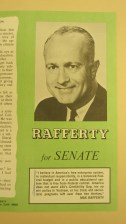
Better-known conservative pundits have also always taken pot-shots at non-traditional ideas of school discipline. Max Rafferty, a nationally syndicated columnist and one-time state superintendent of public education in California, had nothing but scorn and contumely for new-fangled ideas about punishment.

OLYMPUS DIGITAL CAMERA

…he didn’t win.

In one 1964 column, Rafferty lambasted new ideas of school discipline in his typically colorful language. As he put it,

a child usually has neither the maturity nor the judgment to understand the need for self-discipline. Too many instructors, fresh from college and still pretty Dewey-eyed about things, compromise themselves and their careers in a hopeless attempt to convince some freckled-faced [sic] urchin with devilment coming out visibly all over him that he must discipline himself when all he really needs is a session after school with the ruler.

In every decade, in every educational situation, school discipline has always been an us-or-them culture-war issue. Progressives have always lamented the racially loaded and ineffective traditions of whipping and my-way-or-the-highway teaching. Conservatives have always been sure that new-fangled ideas about child-rearing tragically misunderstood real human nature. As Rafferty explained in 1964,

The psychologists had been right in one respect.  Junior certainly had no repressions.  He could have used a few.

Thanksgiving, ILYBYGTH Style

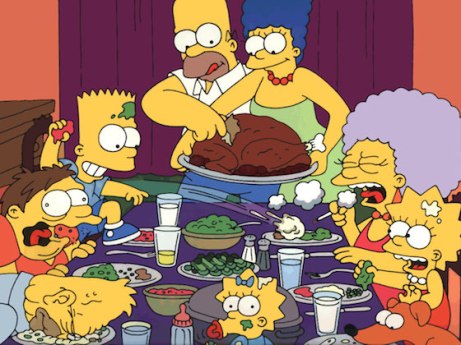
Ah…Thanksgiving. The holiday that brings us together to yell at each other and watch football. How can one Thursday fire up so much culture-war angst? How can it help explain both Rush Limbaugh and creationism?

simpsonsturkey

This year, as your humble editor prepares to head to an undisclosed location somewhere in Ohio to avoid any hint of culture-war histrionics, we stumbled across the ILYBYGTH Thanksgiving archives. Check out some of the ghosts of ILYBYGTH Thanksgivings past:

First, how does Thanksgiving help us understand the way schools really work? For everything from sex ed to evolution, Thanksgiving dinners can serve as metaphors for the real reasons why it is so hard to get schools to dive into controversial issues.

Second, were the Pilgrims really communists? And why do conservative pundits say they were? It seems to me conservatives would want to defend the tradition of friendly buckle-wearing Pilgrims.

Next, how does Thanksgiving play a role in climate-change culture wars? Some advice from the folks at National Center for Science Education.

Finally, some bad Thanksgiving advice on how to outsmart your crazy right-wing (or left-wing) uncles.

What Does Education Look Like from 1600 Penn. Ave?

It doesn’t mean much, but Trump’s official statement for “Education Week” tells us a little more about the hopes and dreams of America’s conservative education activists. It also includes one stumper.

OLYMPUS DIGITAL CAMERA

The roots of “Education Week,” c. 1941

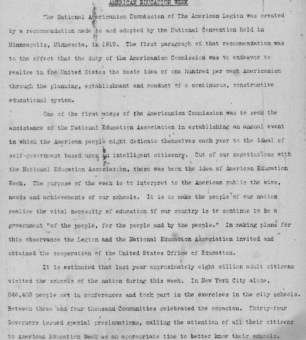
First, a little background on “Education Week.” As I found out in the research for my book about educational conservatism, Education Week started roughly a century ago as an effort to bring conservatives and progressives together for a whole-community focus on public schools.

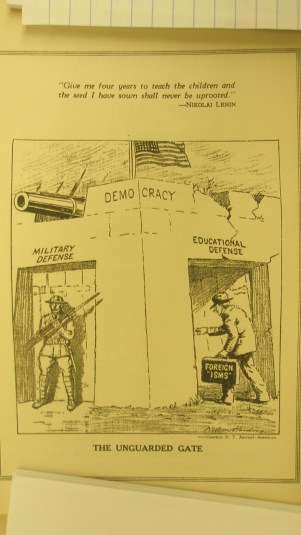
The leading players were the American Legion for the conservative side and the National Education Association for the progressives. The Legion hoped to use Education Week to fight socialist subversion in America’s public schools. They hoped the week would give a much-needed shot of patriotism and community oversight to possibly subversive teachers.

These days, Education Week mostly passes unnoticed by everyone. In line with tradition, however, President Trump issued a formal proclamation in support of it. Predictably, he hit a few notes calculated to warm the hearts of conservatives.

First, he included conservative educational dog-whistle #1:

Parents are a child’s first teacher.

At least since the 1920s, conservative activists have looked askance at the role of the teacher and school in forming children’s characters. Harping on the leading role of parents has long served as a promise to respect conservatives’ vision of proper education. As I argued in the pages of Newsweek, though, it’s not always as simple as people tend to think.

americanism address

The plan, c. 1934

Second, he used the c-word a lot. As Trump proclaimed,

We are also protecting and expanding parents’ access to a wide range of high-quality educational choices, including effective public, charter, magnet, private, parochial, online, and homeschool options.

Next, Trump’s proclamation noted that the primary goal of school should be to prepare students for employment. In the words of the proclamation,

My Administration is committed to ensuring that America’s students and workers have access to education and job training that will equip them to compete and win in the global economy.

As SAGLRROILYBYGTH recall, Trump made headlines last summer with a proposal to roll together the Departments of Education and Labor into a giant “workforce” department. It hasn’t always been the dream of conservatives to abolish the federal role in public education (see this Time article for my longer explanation of the history) but since the 1940s it has been a reliable conservative vote-getter.

So far, so good. Trump’s proclamation hit the notes calculated to encourage conservative education activists. But what about his oddball third paragraph? Here it is in all its glory:

Each student is unique, with their own distinct experiences, needs, learning styles, and dreams.  Thus, education must be customized and individualized as there is no single approach to education that works for every student.  My Administration encourages parents, guardians, educators, and school leaders to rethink the way students learn in America to ensure that every American receives a high-quality education that meets their needs.  We empower teachers to create learning environments that are challenging, relevant, and engaging.  When families are free to choose where and how their children learn, and when teachers are free to do their best work, students are able to grow and explore their talents and passions.

On the face of it, this paragraph seems to be balancing the ideological teeter-totter a little bit. Trump seems to be speaking to the progressive crowd, calling for student individualization and teacher empowerment.

How are we supposed to take it?

When I channel my inner curmudgucrat, this paragraph sounds like just another use of phony “personalized” buzzwords to sneakily privatize public education. Or if I remember the lessons of Larry Cuban and David Tyack, it might sound like a bureaucratic recognition of the eternally conflicted goals of public education.

Or maybe, just maybe, the proclamation simply doesn’t deserve this much parsing. Maybe it is merely the product of a group of Trump-bots who wanted to say something without saying anything.

I would love it if someone could explain it to me.