Gay + Christian = Celibate: A Long Tradition

What is a gay conservative Christian to do? With plenty of justification, many Americans think that conservative Catholics and evangelicals are anti-gay. A recent article in the Washington Post suggests that homosexual Christians have found a new answer to this conundrum, though those in the know know that there’s nothing new about it.

Michelle Boorstein’s article discusses the spiritual path of bloggers such as Eve Tushnet, whom Boorstein describes as a leader of a

small but growing movement of celibate gay Christians who find it easier than before to be out of the closet in their traditional churches because they’re celibate.

When Tushnet converted to Catholicism, Boorstein describes, she felt as if she were the first gay Christian to choose celibacy. To be fair, neither Boorstein nor Tushnet claims this is brand new.  It is “easier” to be openly gay, Boorstein writes.  But not easy.  As the article discusses, such a decision opens one up to attacks from both sides. Some conservatives hope that God can “heal” homosexuals. Such folks want homosexual Christians to abjure their homosexual identities. From the other side, some gay activists argue that choosing celibacy is a terrible option, a truckling to anti-gay animus among conservatives.

What the article doesn’t examine is the long history of this question among conservative evangelicals. As one might expect, issues of sexuality and sexual attraction have long played a central role at America’s network of conservative evangelical colleges. What should young people do if they feel sexually attracted to their own gender? What should loving Christians tell them in college classes and counseling sessions? In my current round of archival research into the history of these schools, I’m seeing a long tradition of the answer “discovered” by folks such as Tushnet: Gay conservatives can remain true to their religious beliefs and true to their sexual attractions by committing to lifelong celibacy.

Certainly, as Boorstein notes, the language has changed, as have public attitudes. In the past, conservatives did not claim their homosexuality as openly or as proudly. But this does not mean that the celibacy “solution” is at all a new one.

In the 1930s, for example, among the troubles at the Denver Bible Institute was the leader’s insistence that all relationships be “continent.” This leader, Clifton Fowler, was accused of homosexual attractions. Indeed, he was accused of active homosexual sexual relationships. His solution was to insist that all married relationships—apparently all potentially sexual relationships—remain celibate. In that case, the facts were obscured by conflicting accusations on all sides. It seems clear, however, that the celibate “solution” to the perceived dilemma of homosexual attraction among Protestant fundamentalists is nearly as old as American fundamentalism itself.

In a later generation, the language used to discuss homosexuality and celibacy grew slightly more frank, while remaining just as harshly anti-gay. In 1951, a student at Biola College (now Biola University) promised counselors that he would remain celibate. As I read the record, this promise was taken at the time as a satisfactory and traditional “solution” to the problem of gay fundamentalism. Take, for example, the following explanation he offered to his dean:

as to the matter [i.e., homosexuality] that has been at the root of all my grief, I am positive that I am cured. The perverted urge will probably come upon me many times in the future but now that I know giving in to it has cost me all that I held dear, I am certain that I will be enabled to grasp the strength of the Lord to withstand.

Back in 1951, it seems, as in the late 1930s, among these conservative Christians, celibacy seemed an appropriate and acceptable solution to homosexual attractions. The student here did not suggest that being “cured” of homosexuality meant becoming heterosexual. Rather, all he promised was the ability to “withstand” what he called his “perverted urge.”

Continuing into the 1970s, leaders at evangelical schools seemed open to the idea that celibacy could be an acceptable evangelical answer for homosexuals. For instance, in a 1977 interview with Wheaton College’s student newspaper, Wheaton President Hudson Armerding offered this response:

The church should respond in love toward those with homosexuality [sic] tendencies and in humility seek to assist such persons to maintain and develop a life-style that is in obedience to the Word of God.

Armerding did not insist that evangelical homosexuals be “cured” of their sexual identity. Rather, he simply demanded that they find a “life-style”—presumably including celibacy—that went with Armerding’s understanding of God’s Word.

From the 1930s to the 1970s, then, evangelical homosexuals could remain both evangelical and homosexual by living celibate lives. Nor does the notion of celibate homosexuality seem particularly revelatory to evangelical collegians today. Julie Rodgers currently works at Wheaton College as an openly gay celibate Christian. She helps counsel students about sexual issues, among other things.

Certainly, the language these days has changed. Rodgers, for example, openly describes herself as gay. The gay celibate student at Biola College in 1951, in stark contrast, was driven to extremes in his attempt to hide his gay identity. Back in the 1930s, Clifton Fowler never admitted to any homosexual attractions, though there seems ample evidence of it.

Nevertheless, for those in the know, there is nothing new among conservative evangelicals and fundamentalists about the celibate “solution” to homosexual attractions.

Investigative Report: Sex Abuse at Fundamentalist U

HT: DW

Are fundamentalist universities guilty of encouraging sex abuse? Does “purity culture” encourage predators? Does the environment at fundamentalist universities force victims, at best, to suffer in silence and shame?

We don’t have all the answers, but the GRACE report of sex abuse at Bob Jones University offers a few clues. Short answer: BJU is guilty of establishing an idiosyncratic administration and campus culture that punished victims and rewarded loyalty over caring and competence.

I’ve taken some heat in the past for wondering if fundamentalist universities had been targeted unfairly on this subject. Certainly, fundamentalist schools have done a terrible job in handling sexual assault and abuse. But so have secular and liberal schools. Wasn’t it possible, I asked, that the no-drinking, no-partying culture at fundamentalist colleges helped deter some cases of assault? Given the large number of alcohol-fueled assault cases recently, I still think these are fair questions.

In spite of such questions, however, the recent GRACE report paints a damning picture of Bob Jones University. I’ll repeat: I do not think it is fair to assume that conservative schools will somehow automatically do a worse job of handling abuse and assault cases than other schools. However, the GRACE report points to systemic problems at BJU that are likely shared by smaller, less prestigious fundamentalist colleges and schools.

As I see it, BJU has failed in two significant ways. First, it has insisted on a climate in which student complaints of any kind were viewed as a moral failing for the complainer. Second, since the 1930s BJU has maintained a policy of rewarding staff loyalty over any other concern. As a result, leading administrators were woefully—perhaps even criminally—incompetent to deal with student victims of sexual abuse and assault.

I do not make these charges lightly. Nor do I have any personal animus toward BJU or other fundamentalist colleges. But the record is clear.

First, some brief facts of the case. Two years ago, administrators at BJU commissioned an outside study of their response to abuse claims. In itself, this sort of outside examination made a clear break with BJU tradition. The assembled commission, Godly Response to Abuse in the Christian Environment, or GRACE, recently published its findings. BJU’s current leader, Steven Pettit, has apologized for any suffering the university has caused or ignored.

That is a start. The university, in my opinion, has two main faults for which it needs to apologize.

First, the leaders of the school have insisted for decades on one cardinal rule: No “griping.” Students who complain have been consistently treated as disloyal, or at least suspicious. For example, in one statement made by the founder, Bob Jones Sr., on June 19, 1953, Jones advised the BJU community of the first rule: “Griping not tolerated, but constructive suggestions appreciated.”

In practice, the culture at BJU has promoted a suffer-in-silence mentality.

Second, and perhaps more problematic, hiring and promotion practices at BJU have encouraged loyalty above all other factors, including competence. In cases of abuse and assault, this has led to terrible consequences. As the GRACE report documents, administrator Jim Berg handled many abuse reports since 1981. Time after time, Berg demonstrated his lack of preparation. For a while, Berg was unaware of South Carolina’s mandatory-reporting law.

The blame here belongs to more than Berg alone. Berg’s leadership role was the product of an institutional culture that valued loyalty first. Berg’s decisions and professional intuitions were the product of a culture that saw itself as removed from all obligations to the outside world.

The evidence for this loyalty-first culture is abundant. In the same 1953 statement referred to above, Bob Jones Sr. warned faculty that he had an obligation to fire anyone “who is not loyal.” This statement came in the wake of mass resignations at the school in 1952 and 1953.

That was not the only time the school’s leaders made their emphasis on loyalty clear. In 1936, just before another group firing, Bob Jones Sr. warned one faculty member,

First: There must be absolute loyalty to the administration. If something happens in the administration which you do not like, your protest is your resignation. If you stay here you must not under any circumstances criticise [sic] the administration.

The results of such a sustained policy are clear. Those who remained in leadership positions at BJU were rewarded for loyalty first, competence second. In the case of student abuse and assault, such an emphasis left students in the hands of utterly unprepared administrators.

All schools—all institutions—can suffer from incompetence, of course, but the BJU policy of loyalty-first intentionally undervalued professional competence.

It bears repeating that BJU’s current leader has apologized for these faults. As he put it,

I would like to sincerely and humbly apologize to those who felt they did not receive from us genuine love, compassion, understanding and support after suffering sexual abuse or assault …To them I would say—we have carefully listened to your voice. We take your testimony in this report to our hearts. We intend to thoroughly review every aspect and concern outlined in the investigation and respond appropriately.

And, sadly, we must remember that fundamentalist institutions are by no means alone in establishing and protecting cultures of abuse. Other religious groups, such as the Catholic Church, and other colleges, such as Penn State University, have similarly criminal histories.

As it might at those institutions, perhaps the future at BJU and other fundamentalist universities will be brighter than the past.

From the Archives: The Creationist Dream

What do creationists want? I know, I know, there are lots of different sorts of creationists out there. As a group, though, I think I found a story that might just articulate some of the fondest hopes and dreams of American creationists. There’s a terrible flaw in the story, and I challenge you to find what it is.

For those of you who are just joining us, I’m working on a history of conservative evangelical and “fundamentalist” colleges and universities. This year, thanks to the munificence of the Spencer Foundation, I’m traveling around to different schools to dig into the history of this network. This week, I’m visiting sunny Biola University in Los Angeles.

Biola University (originally the Bible Institute Of Los Angeles, get it?), in addition to its main job of cranking out missionaries and teachers, also published an influential evangelical magazine, The King’s Business. It was in the November 1967 edition that I found this little gem.

The King's Business, November, 1967

The King’s Business, November, 1967

I’ll give you the gist of the article. Then I challenge readers to pick out where this creationist fantasy veers most sharply from reality.

We read the story of Hope, the daughter of a fundamentalist minister. Gathered around the dinner table one night, Hope collapsed into tears. At (public) school that day, she finally confronted her aggressive evolutionist biology teacher, Miss Landon. Hope told her teacher that she didn’t believe in evolution. As she told her parents, “I felt I couldn’t sit there and take it any longer.”

The teacher ridiculed her. “I didn’t suppose,” Miss Landon said in front of the whole class,

anyone living in our enlightened age had such old-fashioned ideas. It surprises me that a person who has had the advantages of a modern educational system can be so narrow-minded. Surely there are not many who believe as you do.

Hope felt humiliated and ashamed. But she stood her ground. At the dinner table, as she sobbed, her father put his hand on her shoulder and said,

huskily, ‘Daughter, it gives us great joy to hear you tell this. Who would have thought that so soon after being saved [two weeks before] you would have an opportunity to witness so boldly to your teacher and classmates?’

Hope felt revived. She prayed hard before going to bed, and felt her dad was right. As a result,

Hope returned to school the next day with a song on her lips as well as in her heart. The Lord Jesus seemed to be walking at her very side and a great peace filled her soul. She felt no fear now of encountering Miss Landon again, even though she might be asked to give further ‘reason for the hope within her.’

Sure enough, the next day her evolution-loving teacher challenged Hope to prove that other students felt the same way. To Miss Landon’s surprise,

Before she had finished speaking, nearly half of the girls were standing. What followed can best be described as an old-fashioned ‘popcorn meeting.’ It seemed that everyone wanted to talk at once. Some were wet-eyed; others, with their arms around Hope, were asking her forgiveness for letting her stand alone. Miss Landon was at a loss to know how to handle the situation. She couldn’t be expected to know, since she had never attended a revival service or been asked to pray for souls under conviction. So she just stood there, helplessly looking on.

Finally it occurred to her that perhaps Hope could handle the group. Hope caught her distressed, appealing look, and in a calm voice said, ‘Let us all kneel in prayer.’

The praying and confessing continued throughout the 40-minute class period and Miss Landon made no effort to stop it. The girls may not have learned any biology that day, but many of them learned to know God in a new and real way.

That’s the story.

Now here’s the challenge: Where is the biggest, most obvious goof in this tale? Where does this creationist dream depart most obviously from the realities of evolution and creationism in American public schools?

Now, before people complain, let me offer a few caveats. First, we all understand that not every creationist hopes to have public schools turn into a “popcorn meeting,” whatever that is. And we know that the hokey tone of this story is more a result of its age than of its creationism. The aw-shucks brand of parenting displayed here would fit in just as well with Ward and June Cleaver as it would with Charles and Grace Fuller.

Given all that, I still assert that this story fails the sniff test. There is one element here that simply screams out “fantasy.”

Is it:

  1. No teacher really feels that gung-ho about teaching evolution.
  2. No student really cares that much about creationism.
  3. No parents would encourage their kid to publicly preach that way in a public school.
  4. There would never be that sort of religious revival in a public school.
  5. A teacher would not likely be that clueless about the religious beliefs of her students.

I’ve got to get back to work now, but I’ll offer my answer soon.

From the Archives: A Swizzle Mystery

Hello from sunny Biola University! In my continuing quest to dig into the history of conservative evangelical colleges, I’ll be working in the archives here all week. And I found a stumper in the archives this afternoon.

My oeil has been tromped...

My oeil has been tromped…

As I strolled across campus this morning, I was thinking that everything looked pretty similar to things at my own beloved State University of New York. The students looked the same, the vibe was the same…there was nothing particularly different about the goings-on at this Christian campus compared to my own secular campus. Except, of course, for the fact that the sun was shining and flowers were blooming and the air didn’t hurt when it hit your skin.

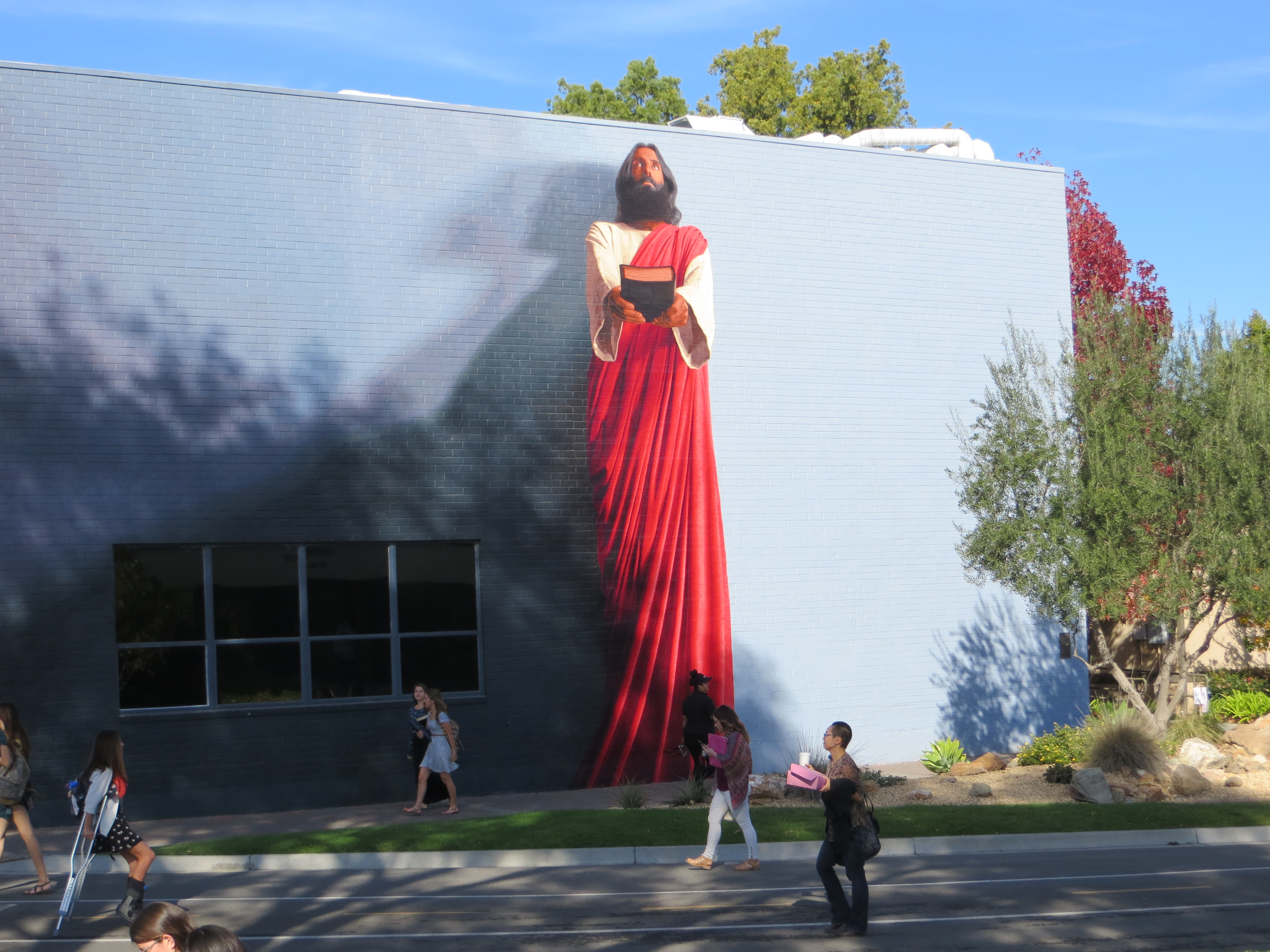
But then, I noticed something I wouldn’t be likely to see on my home campus. As far as I know, we don’t have any humongous Jesus paintings on our buildings.

But let’s get to our archive challenge. Among the wonderful holdings here, the Biola library includes issues of the Biola student newspaper going back to 1938. And in the May 1938 edition, I saw this ad. For the life of me, I can’t figure out what it means. I looked up “swizzle,” of course, but besides a “rum swizzle” and a “swizzle stick” I couldn’t find a clue.

??????????????????

??????????????????

Any suggestions?  For full information, I can tell you that the Coffee-An was a lunch counter next to campus.  They advertised regularly in Biola publications.

Jesus in Uniform

Can US military officers be required to sign a conservative evangelical statement of faith? That’s the question posed by the Wheaton College Reserve Officer Training Corps (ROTC) program. And it unearths broader questions about the proper relationship between the military and fundamentalist religion. Can fundamentalists serve as military chaplains?

Christianity Today reports on the investigation into Wheaton’s ROTC program. At Wheaton, faculty members above the rank of assistant professor are required to sign on to Wheaton’s conservative statement of faith. Recently, the Military Religious Freedom Foundation complained that ROTC officers at Wheaton, who are paid and appointed by the US government, are required to be “of Christian faith.”

According to the CT article, legal experts had differing opinions. One thought that the Wheaton rule passed constitutional muster, since the ROTC program required all professors at all schools to meet their schools’ policies. Another argued, in contrast, that the current situation represented an unconstitutional attempt to “Christianize” the ROTC program.

For Christ, Kingdom...and the Rolling Thunder Battalion?

For Christ, Kingdom…and the Rolling Thunder Battalion?

This report made me wonder about other military questions. In my recent trip to the archives of Bob Jones University, I discovered to my surprise that BJU had pursued an aggressive policy of finding spots for its seminary graduates in military chaplaincies. The fundamentalist school had used its considerable influence in the US government to grease the pipeline from the BJU seminary into military positions.

Now, I admit my vast ignorance about the role of chaplains in the US military. Most of what I know about a chaplain’s job comes from watching MASH. I earnestly invite those who know more to weigh in here. But the notion that BJU was sending its graduates into chaplain positions made me wonder.

As I understand it—and once again I freely admit that I don’t know much about it—the role of a military chaplain in the US armed services is to provide two things: religious services for those who desire them, and religious counseling for all.

Throughout the 1960s, at least, when significant numbers of BJU-trained ministers entered the chaplaincy, the school taught a rigid separatism. That is, a key religious tenet of BJU’s fundamentalist faith was that believers must not support the work of heretics. In the world of American fundamentalism, those “heretics” represented not only Jews, Muslims, and Catholics, but even liberal Protestants.

Perhaps the most dramatic example of this doctrine of separatism came with when the Bob Joneses denounced the headline-grabbing crusades of Billy Graham in the 1950s and 1960s. Graham agreed to co-sponsor those mass meetings with liberal Protestant groups. When enthusiastic attendees saw the light, they were sent to various churches to learn more about their new or renewed faith. And that was the problem for the leaders of Bob Jones University.

As they made clear time and time again, Bob Jones Sr. and Jr. never had a personal problem with Billy Graham. But in their opinion, sending new Christians to liberal Protestant churches meant sending them to hell. Real Christians, the Bob Joneses argued, could and should work with non-real Christians and other heretics on political issues. But they must not work together on religious issues, since endorsing heretics meant endorsing heresy.

With separatism such a guiding element of BJU theology, it seems to me that BJU-trained chaplains would be putting themselves in a very difficult position. If their jobs require that they respect the faiths of their military “flocks”—even if they don’t agree with those faiths—but their own faith requires that they DON’T respect those heretical faiths, what are chaplains to do?

I could see how some fundamentalist pastors would see their non-fundamentalist troops as a sort of “mission field.” That is, fundamentalist chaplains could see their goal as the ultimate conversion of non-fundamentalist soldiers. But that would put those chaplains at odds with the US military. As a governmental body, the military needs to respect all faiths (or no faith) equally.

On the other hand, I could see how some fundamentalist pastors might agree to respect the home faiths of their troops, whatever those faiths might be. But especially at the ferociously separatist Bob Jones University, that would put those chaplains in an equally untenable situation. They might be implicitly endorsing those faiths by working with non-fundamentalists on an equal basis.

Things are fuzzy enough in the world of religion and public schooling. These military questions raise an entirely new field of fuzz. Perhaps Wheaton College can make a case that its ROTC policy is constitutional. But how can fundamentalist pastors serve as military chaplains?

From the Archives: Fundamentalist Luxury

Why do families choose fundamentalist colleges? As regular ILYBYGTH readers know, I’ve been wondering about this question as part of the research for my new book. Today’s work in the archive of Bob Jones University offered one surprising answer from the early days.

I’ll be working in the archive here all week. The archivist has been extraordinarily helpful and productive, digging through piles of files to track down whatever I’ve mentioned.

I'll be here all week...

I’ll be here all week…

One of the questions I’m curious about is the appeal of these schools. In its early days, Bob Jones College (it only became Bob Jones University in the late 1940s) worked hard to attract new students. In the early files, I found an example of a personal letter written by a college official to a potential student in 1928.

It’s not clear who wrote it, but it may have been any of a handful of early 1920s administrators. In any case, the letter starts out as you’d expect. As I argued in my 1920s book, back then schools such as BJC promised a safe haven from the developing higher-education world of evolution, smoking, and flappers.

So the letter’s first questions are about what we’d expect:

Would you like to attend a school where you would be taken care of physically, where you have fine Christian boys and girls for associates—where you would have fine, scholarly, Christian teachers who would give you personal and constant attention, and where expenses are reasonable? If so, fill in the enclosed application blank.

But as always, it’s more complicated than that. Check out the promises at the end of the letter:

I will give you and [your friend] a room together. This is one of the nicest dormitories you ever saw. There is a connecting bath between every two bed rooms, hot and cold running water in every room and steam heat for winter time. It is the last word in physical convenience and comfort.

Not what I expected! But of course, it makes sense that a college recruiter would pull out all the stops in an effort to get students for a brand new college…any brand new college. To me, this is more evidence that the world of fundamentalist higher education shared a good deal more with mainstream schools than we tend to think.

Rah rah

Rah rah

Just as colleges these days go broke building climbing walls and luxury dorm suites, so colleges in the 1920s fell all over themselves to attract paying students. Even fundamentalist colleges—or, at least, this one fundamentalist college—promised a collegiate life of luxury.

Firing Creationist Scientists

HT: AT

Can a scientist be fired for simply being a creationist? Or for teaching what Glenn Branch has called “zombie science?” In contrast to what sharp-tongued activists on both sides may say, the answer is not at all clear. The case of Mark Armitage in the California State University system brings these questions back to the fore.

Armitage, a microscopist formerly at Cal State Northridge, is suing his former employer for wrongful termination. Armitage had discovered some soft-tissue residue in a fossil from a Triceratops horn. Like many young-earth creationists, he took this as proof that the fossil layer was thousands of years old, not millions.

Though he left his creationist conclusions out of his peer-reviewed publications about the fossil, he did not leave those conclusions out of conversations with students. And, though Nature magazine could not get a satisfying answer from Cal State Northridge, it seems those conversations were the problem. Armitage was not accused of doing a bad job as a microscopist. That’s why he’s suing.

Armitage complains that he was fired for his religious beliefs. According to Armitage, he had always been open and forthcoming with his colleagues about his religious beliefs. He had always been praised for his work in the microscope labs. But he had also been open and forthright in sharing his views with students. And that seems to have been the problem. After one such conversation, Armitage claims that the department chair of biology “stormed” into Armitage’s microscope lab and roared, “We are not going to tolerate your religion in this department!!”

Does Armitage have a case? Can a public university fire a scientist for being a creationist? Or for teaching students creationism?

It seems as if it would be easier to decide these issues at the K-12 level, but the case of John Freshwater demonstrates how complicated it can be even there. Freshwater was an Ohio middle-school teacher fired for teaching creationism in a public-school science class. Freshwater hoped to appeal the case all the way to the Supreme Court. He didn’t make it, but the lower courts didn’t give us the satisfying precedent we might hope for. The Ohio Supreme Court avoided any decision about Freshwater’s constitutional right to his religious and academic views. Instead, the Ohio court decided against him due to his insubordination.

When it comes to teaching creationism in public higher ed, the case is even more fudgy. Consider the case of Emerson McMullen at Georgia Southern University. McMullen attracted negative attention from the Freedom From Religion Foundation for his blatant preaching of creationist religion in his history of science classes. The FFRF asked GSU to discipline McMullen, but the issue raises difficult questions of academic freedom. Even staunch anti-creationists such as PZ Myers and Larry Moran worry about this kind of college crackdown on creationists.

Even more confounding, the federal government does not seem to have any qualms about employing young-earth creationists as scientists. As we noted a while back, Douglas Bennett and Brent Carter worked for decades as geologists for the US Bureau of Reclamation, all the while actively promoting young-earth creationism.

Maybe the long government careers of Bennett and Carter provide the central clue. Maybe the government can employ creationists as scientists, but it can’t pay them to teach creationism as science. As far as I can tell, neither Bennett nor Carter taught anyone anything. And Armitage was fired, it seems, not for believing creationist ideas, but for teaching them as science.

Which returns us to our central question: Should public universities get rid of creationist scientists? Should they only get rid of them if the creationists in question actually teach creationism as science? Or should there be a more energetic inquiry into the scientific thinking of publicly funded scientists?

Are creationists the victims of religious persecution?  Jerry Bergman says yes...

Are creationists the victims of religious persecution? Jerry Bergman says yes…

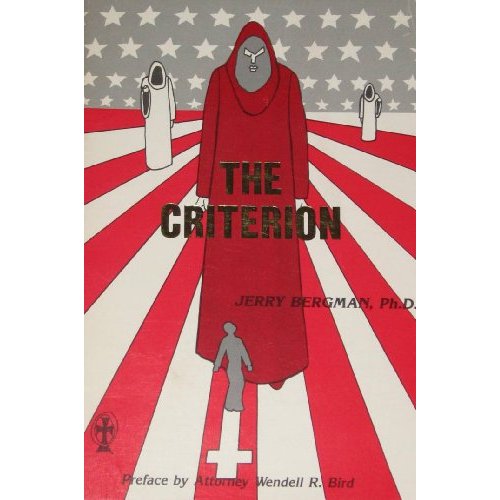
For their part, creationists have long complained, like Mark Armitage, that they have been persecuted for their religious beliefs. Over thirty years ago, Jerry Bergman insisted that he had been fired from Bowling Green State University solely for his religion. As he argued in his 1984 book The Criterion,

Several universities state it was their ‘right’ to protect students from creationists and, in one case, from ‘fundamentalist Christians.’ . . . This is all plainly illegal, but it is extremely difficult to bring redress against these common, gross injustices. This is due to the verbal ‘smoke-screen’ thrown up around the issue. But, a similar case might be if a black were fired on the suspicion that he had ‘talked to students about being black,’ or a woman being fired for having ‘talked to students about women’s issues.’

Creationists today are just as positive that Armitage is the victim of both religious and scientific persecution. As the Pacific Justice Institute put it,

It has become apparent that ‘diversity’ and ‘intellectual curiosity,’ so often touted as hallmarks of a university education, do not apply to those with a religious point of view. This suit was filed, in part, to vindicate those ideals.

Similarly, the headline in the ferociously conservative World Net Daily screamed, “Scientist Fired for Making Dinosaur Discovery.”

As Armitage’s lawsuit wends its way through the courts, I have a hunch that even the most conservative creationists might privately acknowledge that Armitage was not fired for his discovery. Rather, Armitage seems to have been fired for teaching students that the earth is likely only several thousand years old.

As Nature magazine concluded in its recent story about the affair, employers can’t legally fire someone for his or her religious beliefs. But employers can fire employees for conduct that goes against the mission of the institution. If radically dissenting visions of science undermine the assumptions of secular mainstream science, can a creationist scientist be fired?

If Fundamentalists Hate So Many People, Why Do They Love Artists?

Why does the leading fundamentalist university in America also have one of its best private art collections? Not just a collection of Jack Chick cartoons, either, but a diverse collection of religious art from the greatest of European old masters? One writer recently called this bewildering. The answer lies in the misunderstood nature of fundamentalism itself.

This is not what fundamentalist art looks like at Bob Jones University.

This is NOT what fundamentalist art looks like at Bob Jones University.

In the pages of The Imaginative Conservative, Dwight Longenecker recently described his trip to the art museum on the campus of Bob Jones University. As Longenecker explained,

I thought the art gallery would be perhaps a small and preachy collection of kitsch Evangelical art: pictures of the rapture taking place, memorabilia of the Jones family or stilted illustrations of Bible stories. I was wrong. The Bob Jones gallery houses an astounding array of old master paintings, icons, antiques, sculpture and Biblical antiquities.

And Longenecker asks the right questions: How can a school famed for its rigid fundamentalism host such an eclectic display of non-fundamentalist art? How can Bob Jones Jr. denounce Jerry Falwell as “the most dangerous man in America” in 1980 due to his willingness to work with conservative Catholics, yet splurge on a collection of Catholic and Russian Orthodox art treasures?

Fundamentalist art, BJU-style.

Fundamentalist art, BJU-style.

One question Longenecker doesn’t ask is also vital: How can a university pay faculty and staff much less than going salary rates, while its leader travels across Europe, purchasing world-class art for a private gallery?

The answer lies in the history of fundamentalist higher education itself. As I’m exploring in my new book, beginning in the 1920s, fundamentalist colleges struggled to figure out how to remain fundamentalist. After all, too many religious colleges had slidden into liberalism and eventually into secularism. Harvard, University of Chicago, Duke…too many leading schools had begun with conservative religious intentions, only to drift into worldly liberalism and pluralism.

Different schools worked out different solutions. One leading college, Wheaton College in Illinois, eventually settled into a pattern. The board of trustees kept careful watch on the goings-on among students and faculty. But the wider fundamentalist world, too, constantly questioned Wheaton’s leaders about on-campus events and tendencies. Conservative evangelicals around the country felt a right and a responsibility to keep Wheaton safely orthodox.

Wheaton’s archives are full of this sort of fundamentalist scrutiny. To pick just one example, President Hudson Armerding received a short, scrawled note in late 1968 from a woman who had no apparent personal connection to Wheaton. She was not an alumna, not a parent of a student. She was just a concerned fundamentalist who worried about the school’s continuing conservatism. “Recently after a church meeting,” she wrote to Wheaton’s president,

a group of persons was discussing Wheaton College. Some said that your school now teaches ‘theistic evolution’ and has departed from the fundamentals of the Bible. Is this true? Would you please investigate your curriculum? Also—statements made were that [sic] the school allows ‘worldly practices’—movies, smoking, etc. Please reply. Thank you.

At Bob Jones College (it became Bob Jones University only in the late 1940s), on the other hand, the 1930s wrought a very different way of maintaining orthodoxy. During that period, the school’s founder, Bob Jones Sr., established a principle of “loyalty.” The school community would be guided and maintained in its fundamentalist rigor by unswerving loyalty to the school’s original fundamental purpose. Faculty would be expected to support the school fervently and unstintingly. As Bob Jones Sr. put it in one chapel talk,

We are not going to pay anybody to ‘cuss’ us. We can get ‘cussin’’ free from the outside. . . . We have never been a divided college. . . . We are of one mind in this school. We have not always had smooth sailing, but we have thrown the Jonah overboard. If we get a Jonah on this ship, and the ship doesn’t take him, we let the fish eat him! We throw him overboard. . . ‘United we stand, divided we fall.’ That is the reason that in this school we have no ‘griping.’ Gripers are not welcome here. If you are a dirty griper, you are not one of us. . . . God helping us, we are going to keep Bob Jones College a kingdom that isn’t divided and a house that stands together.

In practice, this expected loyalty to the school became an expected loyalty to the school’s leader. The Bob Joneses—Senior, Junior, then III—embodied the meanings of “fundamentalism” at the school. As outsiders have struggled to understand, this development allowed Bob Jones College to be more liberal in some matters, while still maintaining its status as a ferociously fundamentalist school.

For example, at the far less conservative Wheaton College, students were not allowed to put on plays until the 1960s. The worry of the broad fundamentalist community was that “worldly” drama might tarnish students’ religion.

But throughout its existence, Bob Jones University has encouraged students to dive into drama, especially the not-particularly-Christian work of Shakespeare. This may seem like a paradox, a mystery, but it is explained by the principle of loyalty at BJU. At BJU, the entire fundamentalist community did not debate whether or not Shakespeare was acceptable for fundamentalists. The leaders decided.

And once they decided, it became a principle of loyalty for faculty and community members to go along. One faculty member in the 1930s criticized the school’s policy of putting on Shakespearean dramas. Such worldly amusements, she argued, could not help guide the fundamentalist faith of BJC students. At a school like Wheaton, those arguments carried a lot of weight. But not at Bob Jones College. As Bob Jones Sr. later explained,

She walked around and said, ‘You know, I’m so concerned. They have drama at Bob Jones College, and I think we should have a prayer meeting.’ . . . that’s her privilege. You don’t have to love Shakespeare. . . . But she knew Bob Jones College loved Bill Shakespeare.

She was fired.

For many observers, this is the constant paradox of Bob Jones University. As Dwight Longenecker reports from his visit to the art gallery, the school combines an indefatigable insistence on rigid fundamentalism with an embrace of non-fundamentalist art that might shock even moderate evangelicals. From the worldly Shakespeare to the Catholic Old Masters, Bob Jones University has the ability to be less conservative about some things than more moderate schools.

Dwight Longenecker attributes this seeming paradox to the “eccentric and unique flair” of Bob Jones Jr., president of the school between 1947 and 1971. There’s truth to that, but only part of the explanation. At Bob Jones University, the loyalty/leadership principle allowed Bob Jones Jr. to indulge his taste for non-fundamentalist art and drama in ways that less conservative fundamentalist institutions could never have allowed.

This history matters for more than just the campus surprise of BJU’s beautiful art museum. The influence of BJU among fundamentalists is hard to overstate. Due to its extensive network of influential alumni and its powerful school-publishing arm, the meanings of “fundamentalism” at Bob Jones University can influence the meanings of fundamentalism nationwide.

And with so much of that meaning determined by the school’s leaders, the personality and taste of a leader such as Bob Jones Jr. can have an enormously outsized influence on fundamentalism in general.

MOOCing Jesus

Does online education work? A new survey of college faculty by Gallup for Inside Higher Education offers an unstartling new answer: It depends. Here at ILYBYGTH, we have a different question: Does online education work for conservative religious colleges?

After all, as I’m exploring in my new book, conservative religious colleges have always had a different goal from secular schools. Instead of just hoping to prepare students for careers and intelligent life, conservative schools have also intended to bolster the faith of their students. They have worried that any change might lead them into a slow slide into secularism. As a corollary, most conservative schools have maintained stricter lifestyle rules over students than secular colleges have. Conservative schools have insisted that classes be led faithfully, not just competently. But can they do this in online classes?

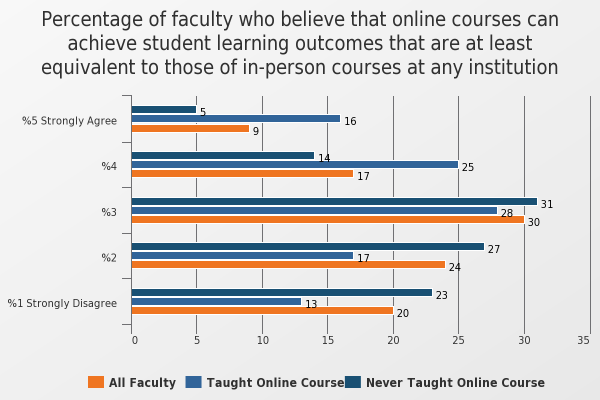
The survey of faculty for Inside Higher Ed includes some interesting points. [You can click to get the entire report, but you have to register.] In brief, faculty remain unconvinced that online education can deliver equal results to old-fashioned in-person classes. Online classes might do a good job—in some cases—at delivering content. But most faculty agree: there is something important lost when face-to-face interaction isn’t a leading part of university classes.

IHE CHART

Source: Carl Straumsheim, “Online Ed Skepticism and Self-Sufficiency: Survey of Faculty Views on Technology,” Inside Higher Education, October 29, 2014.

The survey specifically excluded some of the schools we’re interested in, what it calls “Bible colleges and seminaries.” And none of the questions included anything about student faith.

But no one interested in online higher education these days can ignore the fundamentalist elephant in the room. Liberty University, a school founded by Jerry Falwell in 1971, now claims almost 100,000 online students. In addition to standard online coursework, Liberty offers online spiritual help, too. Students can join online prayer groups and Bible blogs.

But this menu of religious fare does not seem to match the traditional goals of conservative religious colleges. At most schools, the faith of students has been the primary concern, not merely an additional click on a webpage. And most college administrators have been keenly worried about sliding into heterodoxy and secularism. In his brilliant 1994 dissertation about Wheaton College, historian Michael Hamilton explained this sentiment like this:

The paradigm that has dominated Wheaton through the [twentieth] century holds that colleges, more than any other type of institution, are highly susceptible to change, and that change can only move in one direction—from orthodoxy toward apostasy. . . . The very process of change, no matter how slow and benign it may seem at first, will always move the college in a secular direction, inevitably gathering momentum and becoming unstoppable, ending only when secularization is complete.

This mindset, I believe, is common among conservative evangelical schools. From Wheaton, to Biola, to Gordon, to more conservative schools such as Bob Jones and Liberty…all have worried that change will equal declension. All have been concerned, first and foremost, that novelty will lead faculty and students to abandon their faiths.

So here’s the question we wished Inside Higher Ed had asked professors at conservative schools: How can online education remain orthodox? How can the faith of students be preserved if student/teacher interaction is weakened?

And perhaps this is the toughest question for the folks at Liberty University: Has their wildly successful pursuit of online education changed their goal? Has Liberty abandoned its religious mission? Or, rather, could this massive online presence be compared to the televangelism of an earlier generation? Could the thousands of online students be seen as an enormous “mission field” for Liberty’s evangelical message?

How Far Should the Creationist Purge Go?

Is a creationist historian worse than a socialist one? That’s the question science pundit Jerry Coyne is not asking. But he should be.

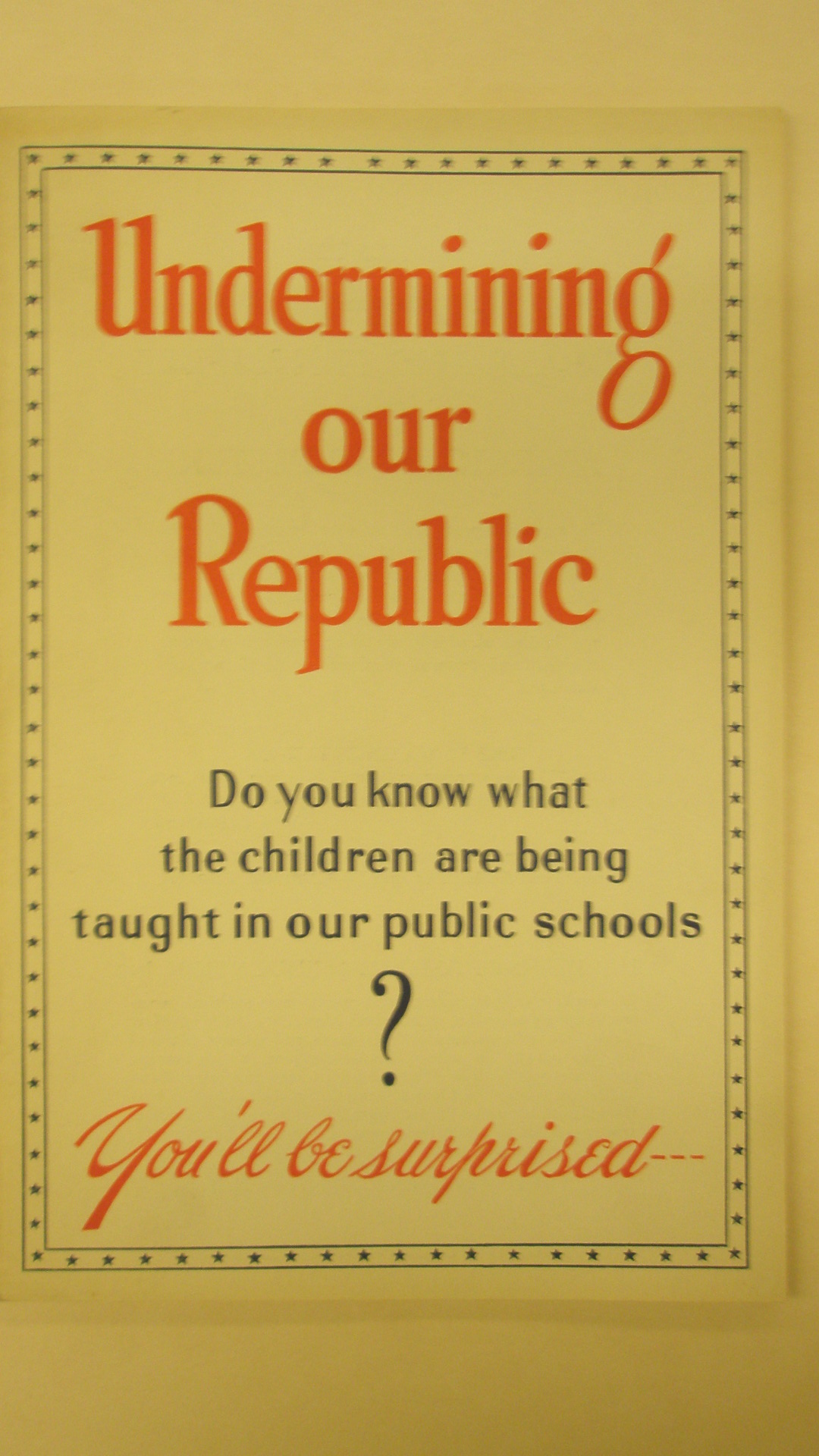
The 1941 report from the Guardians of American Education. Does Prof. Coyne really want to join this team?

The 1941 report from the Guardians of American Education. Does Prof. Coyne really want to join this team?

Like a lot of people, I’m a fan of Jerry Coyne. His tenacious attacks on all things religious are witty and smart. But in this case, his historical short-sightedness has caused him to blunder into dangerous terrain.

Here’s the story: In his continuing campaign against creationism, Coyne and his allies have singled out the creationist activism of Professor Emerson T. McMullen. McMullen teaches history classes at Georgia Southern University. Based on Coyne’s evidence, it does seem as if McMullen injects a good deal of proselytization into his classes.

McMullen teaches classes about the history of science and evolution. And, as one student noted in her evaluation, he gives extra credit if students attend religious films. As she warned, “most of it is trying to convert you, but hey, free points!”

Coyne and his allies in the Freedom From Religion Foundation wrote to the administration of Georgia Southern. They urged GSU to “investigate” McMullen’s teaching. They did not object to teaching about religious views, especially in a history class, but they did object to McMullen’s practice of pushing those views on students.

This presents us with a difficult question: How far do we want to go in purging creationists from college faculties? We agree that McMullen’s teaching seems to cross over into preaching. But there are a couple of ominous historical parallels that Professor Coyne seems to dismiss too breezily.

So, first, as Coyne and Co. acknowledge, there is no constitutional ban on teaching religion in publicly funded schools. As Justice Tom Clark made clear in his landmark 1963 opinion in the Schempp case,

Nothing we have said here indicates that such study of the Bible or of religion, when presented objectively as part of a secular program of education, may not be effected consistently with the First Amendment.

As Justice Clark specified, and as Professor Coyne acknowledged, the issue is not the teaching of religion, but the preaching of religion. As subsequent SCOTUS rulings have specified, public schools must not lend their imprimatur to religious preaching by either students or teachers. McMullen seems to be doing more than teaching about creationism. He appears to be using his authority as a teacher—dispensing grades and extra credit—to encourage students to repeat creationist-friendly ideas.

Does this mean we should actively “investigate” all such teaching? That universities have a constitutional duty to get rid of any professors or classes that move from teaching about religious ideas to preaching the ideas themselves? I think not, for two reasons.

First, university teaching is fundamentally different from K-12 teaching. The SCOTUS decisions about teaching and preaching have mostly dealt with younger students at public schools. Though Georgia Southern is a school that receives tax funding, its status as a university makes it a substantially different case from a high school, middle school, or elementary. The main issue in the Schempp verdict was that school prayer was something students could not evade. Such students were coerced, in effect, into listening to preaching. If, like the young Schempp himself, they have a pass to leave the classroom during prayers, they are still singled out by that action.  In contrast, students in college have enormous freedom to select classes. The faculties, in most cases, are much broader and more diverse. In most public high schools, students are assigned to a teacher without much input. In college, on the other hand, students put together their own schedules.

More important, Coyne doesn’t seem to grasp the tradition he would be joining if his McMullen campaign were successful, though Coyne nods to the importance of academic freedom. As I detail in my upcoming book, conservatives have conducted similar campaigns against leftist professors for decades. I doubt Professor Coyne wants to open up universities to allegations and investigations of ideologically suspicious professors.

In 1941, for example, a group of conservative leaders from the American Legion and the Advertising Federation of America teamed up to encourage Coyne-like investigations of college professors. Their main target was Professor Harold Rugg of Teachers College, Columbia University.

Should we guard the gate?

Should we guard the gate?

As the Guardians of American Education, they investigated Rugg’s teaching. They polled students and obtained copies of syllabi and course descriptions. One of Rugg’s courses, they alleged, featured what they called the “denial of certain natural and inalienable rights of man.” They gave specific examples of the way Rugg used his position as a professor to proselytize. On page 59 of Rugg’s syllabus for a course in Educational Foundations, for instance, Rugg pushed students to “admit the far too rottenness in our social, political, and financial life.”

Is this the sort of club Professor Coyne wants to join? In his earlier campaign against Eric Hedin at Ball State, Coyne alienated allies such as PZ Myers and Larry Moran. Both Moran and Myers thought that Coyne had gone too far in ignoring the sometimes-uncomfortable need to respect academic freedom. And that case was stronger than this one, since Hedin was teaching intelligent design as if it were mainstream science.

So, back to our main question: How far do we want to go to punish professors for their views? What should we do?

The purge is not the right approach. Instead, we should follow the model of Portland parents. When secular parents found out about preaching in an after-school club, they did not shut the club down. They couldn’t. The “Good News Club” had every constitutional right to do what it was doing. But the Portland parents realized that free speech and academic freedom cut both ways. They conducted a campaign to warn their fellow parents about the activities of the Good News Clubs.

That should be our model here. We do not want to slide into witch hunts and creationist-baiting. We do not want to encourage universities to investigate and purge faculty for their beliefs. Instead, we can let students at Georgia Southern know what goes on in McMullen’s classes. The publicity campaign should not be targeted at the administration of Georgia Southern, but rather at its students.

How far do we want to go in purging professors? In this case, Coyne goes too far.