Charles Murray, Extremist?

No one doubts that scholar Charles Murray is controversial.  Best known for his book The Bell Curve, Murray ruffled feathers by asserting that some sorts of people are naturally less intelligent than others.  Though he denies every accusation of racism, Murray’s reputation has caused the administration of Asuza Pacific University to abruptly cancel Murray’s upcoming campus talk.

Has Murray’s reputation as a racist caused him to be seen as too extreme even by administrators at conservative Christian colleges?  The leaders of APU, for example, worried that Murray’s talk might be hurtful to “our faculty and students of color.”

Scholar?  Or Racist?  Can He Be Both?

Scholar? Or Racist? Can He Be Both?

After all, Murray has been labeled as a “white nationalist” by the Southern Poverty Law Center.  Murray, the SPCL charged, uses

racist pseudoscience and misleading statistics to argue that social inequality is caused by the genetic inferiority of the black and Latino communities, women and the poor.

For his part, Murray accuses Asuza Pacific of pusillanimity and closed-mindedness.  In an open letter to APU’s students, Murray challenged them to think for themselves.  Murray invited students to explore his website and read some of his publications.  The more you know about me, Murray suggested, the harder it will be for you to take these accusations of extremism seriously.  “The task of the scholar,” Murray told APU students,

is to present a case for his or her position based on evidence and logic. Another task of the scholar is to do so in a way that invites everybody into the discussion rather than demonize those who disagree. Try to find anything under my name that is not written in that spirit. Try to find even a paragraph that is written in anger, takes a cheap shot, or attacks women, African Americans, Latinos, Asians, or anyone else.

There is no reason, Murray concludes, why students should not listen to talks by “earnest and nerdy old guys” like Murray.

This cancellation of Murray’s talk raises key questions.

First of all, does the goal of intellectual diversity on college campuses include the inclusion of unpopular conservative ideas?  We’ve seen recently examples of speakers protested against at Montana Tech for their support of creationism, pro-life student groups at Yale being refused fellowship in a social-justice club, and Steven Hayward’s lonely life as a token conservative campus intellectual at Colorado.

Second, what does it mean that this cancellation comes from a relatively “conservative” campus?  APU is one of the oldest evangelical universities in the country.  No one could safely accuse the leadership of APU of pandering to the traditional secularist campus leftism run amok.  Yet this school’s leadership saw fit to cancel Murray’s speaking appointment due to worries about Murray’s reputation.

Finally, who decides which ideas are extreme?  By any measure, Charles Murray’s work has been part of recent mainstream American conversations about race, class, and society.  His 2012 book, Coming Apart, for example, was prominently reviewed by such leading publications as the New York Times, Wall Street Journal, and the New York Review of Books.  It does not make sense to suggest that Murray has only some sort of fringe status as a scholar.  Yet in this case, even a conservative Christian school saw Murray as too controversial to speak on campus.


Abortion and Social Justice at Yale

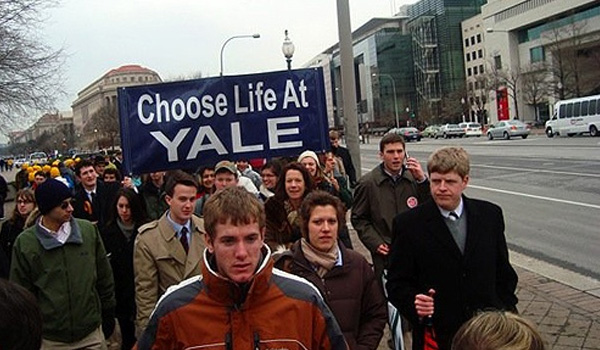
A pro-life student group at Yale University has been refused membership in a “social justice” organization.  Why?  Because, in the words of one student leader, “The pro-life, anti-choice agenda stands in the way of gender equity, and thus in the way of social justice.”

The controversy raises difficult questions: Is conservative religion still seen as a legitimate force for good?  For “social justice?”  Or has conservatism become irredeemably trapped by accusations of bigotry?  At least in the effete environs of Yale, it seems pro-life thinking has been stripped of its moral legitimacy.

Well-dressed Activists

Well-dressed Activists

The student group, Choose Life at Yale (CLAY), had been a provisional member of Dwight Hall, an umbrella group of student social-justice clubs.  Membership in Dwight Hall would have given CLAY access to meeting rooms and a sense of campus legitimacy.

Is pro-life a “social justice” cause?  Former CLAY president Michael Gerken thinks it is.  As he explained in the pages of First Things, CLAY members

realized that abortion has never been solely a matter of a baby’s life and liberty. It’s about the desperation and hopelessness of the mother that walked into the clinic. It’s about the grandfather who will never put that little girl in his lap. It’s about the classmates who will never sit next to her, and the boy who will never work up the courage to write her that awkward poem. It’s even about that friend who she would drift away from over the years, the successful sister who would make her insecure, and the God she’d curse when she lost her job and then her mortgage. The biggest lie in all this is that the choice to end (or to save) a life is a solitary one.

Of course, Yale will always have a special place in the history of conservatism and education.  It was William F. Buckley’s precocious expose of the godless atmosphere on campus that launched his career, and in many ways signaled the start of the modern conservative movement.

And college campuses have become leading forums to debate whether or not conservative religious ideas are legitimate traditions or vestiges of bigotry.  ILYBYGTH readers may remember a case at Tufts University a while back.  In that case, the evangelical student group Intervarsity was stripped of its official student-group status.  Other student groups complained that the prominent evangelical group represented an inherently bigoted worldview, one that did not recognize the full equality of homosexual students.

The current controversy at Yale represents a similar conundrum.  Do conservative religious groups automatically lose the right to participate in campus life?  Is it inherently bigoted to fight against abortion or gay marriage?  Perhaps most important, who gets to define “social justice?”


Conservative Politicians Need an Education

If you want to be President, go to college.  Eventually.

Wisconsin Governor Scott Walker has announced his intention to return to college to finish his bachelor’s degree.  The conservative Walker dropped out of Marquette University as a senior and never looked back.  Until now.

With presidential aspirations on the table, Governor Walker has decided to complete his undergraduate education.  He’ll use a program for working adults at the University of Wisconsin.

Makes us wonder: Would his opponents have used Walker’s incomplete college education against him?  Called him just another ignorant conservative?  As I’ve argued in the pages of the Chronicle of Higher Education and elsewhere, “ignorance” is one of the go-to accusations made against conservatives.

Doesn’t seem like good politics, with the vast majority of adults in a similar boat.  Only about one in five adults in the United States has a college degree.  Nevertheless, Governor Walker seems to think it’s not worth the risk.  These days, part of the resume for POTUS must include higher education.  But don’t tell that to G-Wash and Honest Abe.


Ken Ham Is My Guidance Counselor

Why does Ken Ham care where you go to college? Where you send your kids?   Because “college” is more than just a collection of classes and academics. For religious conservatives as for everybody else, “college” represents a formative experience. The ideas one will encounter, the personal connections one will make, and the changes in one’s outlook and worldview all make the college years some of the most transformative in our lives.

In recent years, Ham, America’s (and Australia’s) leading voice for young-earth creationism, has established himself as the arbiter of creationist orthodoxy in college attendance. And his word carries weight in the world of evangelical higher education.

Recently, for instance, Ham warned readers at Answers In Genesis about the dangers of attending Calvin College. Students at that storied Christian school, Ham explained, were “being influenced . . . to undermine the authority of Scripture in many ways.” When faculty engage in evolutionary research and teaching that might turn away from Ham’s strict attitudes about knowledge and creation, Ham warns, students will too often abandon their creationist faith.

As a precaution, Ham offers readers a list of schools that adhere to the young-earth creationism taught by Ham’s Answers In Genesis ministry. To be safe, Ham warns, parents and students ought to stick with schools that have proven their fidelity to these ideas.

Ham’s anxiety over the crumbling orthodoxy in Christian higher education is nothing new. As I argue in my 1920s book, many of today’s evangelical schools had their origins in the founding decade of American fundamentalism. Back in the 1920s, religious schools often faced a choice between fundamentalist orthodoxy and modernist adaptation. Most chose modernism. The University of Chicago, for example, founded as a Baptist beacon of learning, became the leading voice for theological modernism, employing such folks as Shailer Mathews and Shirley Jackson Case. In contrast, a few Christian schools, most famously Wheaton College, sided with the fundamentalist movement.

Leading fundamentalists in the 1920s also founded a spate of new schools to embody their theological and cultural conservatism. Perhaps most prominently, evangelist Bob Jones Sr. opened Bob Jones College (now Bob Jones University) in 1926. The goal of this school was to form the fundamentalist character of young people while educating them in the best traditions of arts and sciences. In order to reassure parents that the school would never slide toward theological modernism or cultural liberalism, Jones and his allies established a rock-ribbed charter. This charter hoped to guarantee the continuing orthodoxy of the school. The charter’s second paragraph outlined that orthodoxy:

The general nature and object of the corporation shall be to conduct an institution of learning for the general education of youth in the essentials of culture and in the arts and sciences, giving special emphasis to the Christian religion and the ethics revealed in the Holy Scriptures, combating all atheistic, agnostic, pagan and so-called scientific adulterations of the Gospel, unqualifiedly affirming and teaching the inspiration of the Bible (both Old and New Testaments); the creation of man by the direct act of God; the incarnation and virgin birth of our Lord and Saviour, Jesus Christ; His identification as the Son of God; His vicarious atonement for the sins of mankind by the shedding of His blood on the Cross; the resurrection of His body from the tomb; His power to save me from sin; the new birth through the regeneration by the Holy Spirit; and the gift of eternal life by the grace of God.

Perhaps most notably, the next line specified that this charter “shall never be amended, modified, altered, or changed as to the provisions hereinbefore set forth.” Also remarkable, according to a 1960 reminiscence by Bob Jones Sr., at its founding BJU decreed that every graduating senior would pledge to monitor the school’s continuing fundamentalism. “Should the policy and conduct of the University ever, in my lifetime, deviate, in the slightest particular, from the letter or spirit of this Creed,” seniors would promise,

I hereby pledge myself to exert all my influence to affect a change in conditions; failing which, I will resort to such legal measures as the courts may offer to the end that the institution may be kept true to the University Creed and the original intentions of the founder.

Most evangelical colleges established similar creeds and many promised never to amend them. Not many others, to my knowledge, required such strict supervision by their alumni.

These days, Ken Ham has taken over the role of orthodoxy’s gadfly. In addition to his warnings about waverings from his definition of creationism at Calvin College, Ham has warned that other evangelical schools might be threatening the faith of their students. And Ham’s warnings carry weight.

In one recent episode at Bryan College, for example, Ham’s public worries about faculty orthodoxy led the school’s leadership to instigate a new sort of creationist orthodoxy pledge for faculty. From now on, faculty must publicly avow their belief in a real, historic Adam and Eve. As I argued at the time, the fallout from Bryan College’s policy shift might lead to a shake-up of faculty. More directly relevant, the furor at Bryan seems to testify to Ham’s influence. Worried that creationist parents might not send their students and their tuition dollars, Bryan’s leaders acted to shore up their image as a home of young-earth creationist orthodoxy.

Also intriguing, I must ask again if the drive to protect their reputations as safe theological and cultural havens has led some conservative evangelical schools to cover up incidents of sexual assault. Of course, these are very serious allegations, and I do not ask these questions lightly. I am certainly not accusing Ken Ham or the leadership of these schools of condoning sexual assault. But the drive to present a public face as a uniquely safe environment for fundamentalist students certainly puts undue pressure on college leaders. It is not unfair to wonder if such pressure might lead schools to downplay any cases that might threaten those reputations.

Outside the world of conservative evangelical Protestantism, colleges spend an inordinate amount of time and treasure to attract students. Flashy dorm rooms, high-visibility sports programs, celebrity faculty, and lavish campus lifestyles all hope to convince families to send their kids and their money to certain schools. The pressure on recruiters is intense.

There is a similar pressure on evangelical colleges. Influential voices such as that of Ken Ham are able to exert outsized influence by warning creationist families toward or away from certain schools. Without Ham’s imprimatur, conservative schools may lose the loyalty of students and families.

 

“Conservative Thought” or “Bigotry”? A Conservative Professor Makes Waves

Is it “conservative” or “bigoted” to express skepticism toward sensitivity training about transgender people? About sexual-harassment investigations?

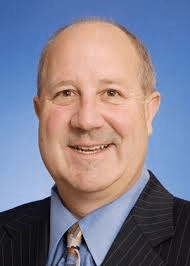
Steven Hayward finds himself facing these questions as he completes his one-year position as visiting professor of conservative thought at the famously left-leaning University of Colorado at Boulder. ILYBYGTH readers may remember the program that brought Hayward out to Boulder. Conservative critics of the university had complained that the school did not include any conservative intellectual presence. As a result, outside political pressure pushed through the program to welcome a series of one-year visiting professors to the campus. The hope was that these prominent conservative intellectuals would spark debate and a more profound sense of intellectual diversity.

Steven Hayward

Steven Hayward

Predictably, the sparks have begun flying. Hayward has been accused of bigotry. His representations of conservative thought, he has charged, have been said to “‘border’ on ‘hate speech.’” In response, Hayward declared, “they’re welcome to fire me if they want.”

What’s the issue? Hayward publicly questioned university policies about sexual harassment and gender sensitivity training. In an interview and an editorial a few weeks back, Hayward asked if the CU philosophy department was really guilty of sexual harassment. In his editorial, Hayward compared the investigation to a witch hunt:

Unquestionably philosophy is among of the most male-dominated disciplines in universities today, but inviting outside review by the American Philosophical Association’s (APA) Committee on the Status of Women was guaranteed to produce a finding as predictable as the Salem Committee to Investigate Witchcraft in 1691. The irony of this situation is the unacknowledged reversal of the presumption of “privilege” that was at the heart of the original (and justified) feminist complaint about sexism a generation ago. While it may still be justified in the case of academic philosophy, it should not be beyond question whether mere statistical “underrepresentation” should be regarded as prima facie evidence of guilt, and therefore allowing the APA report to assert damning findings about the whole department while disclosing virtually no concrete facts.

And recently, Hayward poked fun at campus sensitivity trainings. New faculty at Boulder, as at many college campuses, must attend a session geared toward increasing their awareness about transgender sensitivity. What pronouns should we use when addressing students? How can we avoid unintentional offense to those who do not fit into neat traditional gender divisions? Hayward dismissed this sort of training as “gender-self-identification whim-wham.”

Students reacted with predictable fury. “Bigotry is not diversity,” proclaimed student editorialists Chris Schaefbauer and Caitlin Pratt. In Hayward’s breezy dismissal of the complaints of sexual harassment in the philosophy department, Schaefbauer and Pratt charged, he engaged in the worst sorts of “victim-blaming.” In his dismissive comments about sensitivity toward gender-identity issues, Hayward “invalidate[d] the lived realities of transgender individuals and mock[ed] the LGBTQ community as a whole.”

The kerfuffle has raised some important questions about intellectual diversity and culture-war politics. Is it possible for a university to include a diversity of opinions? Or is there a need for inclusive environments to police any ideas that challenge that sense of inclusivity?

As we’ve seen recently with the case of Brendan Eich at Mozilla, some issues seem to include less wiggle-room than others. It is widely considered “bigotry” these days to oppose same-sex marriage. But I would suggest, in spite of what some conservative intellectuals have asserted, that it is not seen as bigotry to oppose abortion. It might be seen as “bigotry” to make fun of non-traditional attitudes toward gender identity, but it is generally not seen as bigotry to press for lower taxes or more free-market solutions to social problems.

Can a university include a diversity of opinions about sexual-harassment policies? About gender-sensitivity training? Or, to paraphrase one pithy conservative commenter on Hayward’s blog, have birkenstocks become the new jackboots?

It wasn’t a tough call to predict this sort of situation. Back when Hayward was announced as the first Visiting Professor of Conservative Thought at Boulder, your humble editor made the following guess:

this experiment seems certain to degenerate into the most fruitless sort of culture-war grandstanding.

It’s not very satisfying to be proven right when the case was so clear. It can be depressingly difficult to engage in discussions that cross culture-war trench lines.

Conservative thought has always struggled with accusations of bigotry. By framing themselves as defenders of tradition and traditionalism, conservative intellectuals have put themselves in the position of defending the gender and racial hierarchies that were part and parcel of those traditions. Perhaps most famously, conservative intellectual guru William F. Buckley supported segregationism in the 1950s. Though Buckley later repudiated those views, we must ask a difficult question: Will conservative intellectuals always have to defend yesterday’s traditions?

And, on the other side, student leftists have struggled with accusations of hypersensitivity. It is not difficult to lampoon campus activists. Students preach diversity while sometimes demonstrating a stern intolerance toward ideas that ruffle their feathers.

Is this just a question of irreconcilable cultural politics? Will conservative intellectuals continue to outrage leftist sensibilities? Or is there some way to find agreement about the definition and value of intellectual diversity across the culture-war trenches?


Florida, Football, and Fundamentalism

Is football a religion? Do the high priests of college football act like the leaders of the nation’s most conservative fundamentalist colleges? In some ways, when it comes to responding to accusations of rape and sexual assault, the similarities seem creepily prominent.

News emerged today that the case of football star Jameis Winston at Florida State will undergo a new round of scrutiny. Back in December, Winston evaded charges about an alleged sexual assault. At the time, pundits accused FSU of coddling Winston because of Winston’s star power.

As we’ve seen in these pages, conservative evangelical Protestant colleges–“fundamentalist” schools–have weathered similar charges of stonewalling and covering up charges of sexual assault on their campus.

Are these cases similar? Does football function like fundamentalism? That is, does the culture of big-name, big-money football create an environment in which everything else takes a back seat to success on the gridiron? Where any questioning of the football team becomes similar to questioning basic tenets of orthodox religious belief?

Let’s take a look at some of the similarities and differences.

At least according to some accusers, fundamentalist schools actively target victims of sexual assault. Both men and women, students and administrators, are steeped in a “purity culture” that encourages all involved to see female victims as sexual temptresses. When accusations of rape emerge, victims are attacked by students and administrators. The threat of making such accusations intimidates many other victims into a scarred silence.

Similar hostility emerges with college football. The alleged victim of the FSU rape, for instance, eventually dropped out of school and moved out of town due to constant harassment and death threats.

Also, it seems both football and fundamentalism push college administrators to worry first about the school, and only secondly about the complaints of victims. With football, the stars must be protected. No one can win a Heisman Trophy or a national championship from a jail cell. And with fundamentalism, schools must protect their reputations as uniquely safe environments. Publicity about sexual assault would certainly threaten that reputation.

But there are also significant differences. First of all, non-fundamentalist schools are almost all subject to review by federal guidelines. In the case of FSU, for example, the case has come back into the headlines because of accusations that the FSU administration might have violated provisions of Title IX in its handling of the case. Most fundamentalist schools refuse all federal funding, so they can operate without such oversight or federal review.

More profoundly, cases at fundamentalist schools are about more than just administrative cover-ups. Some pundits insist that the culture at fundamentalist schools operates as a hyper-charged version of broader cultures that blame women victims. More than at pluralist public schools such as FSU, critics allege, fundamentalist schools promote both sexual assault and victim-blaming by insisting on a “purity culture” standard. Women involved in sex of any kind often find themselves accused of instigating sinful acts.

Victory we have heard on high

Victory we have heard on high

There’s no doubt that big-time college sports look like religions, in lots of ways. They have weekly rituals, with ceremonial outfits and traditional musical accompaniment. They have high priests and acolytes who huddle to make important decisions. And, at least in the eyes of many fans and players, they involve the community in a staged fight of the powers of good versus the powers of evil.

But does this quasi-religious adoration of college sports bleed over into the treatment of accusations of rape as well?


Cruz at Liberty: Freedom under Attack

Senator Ted Cruz told the commencement crowd at Liberty University that they were in danger. Unless they remained willing to sacrifice for their faith, unless the Liberty community remained willing to get active in politics, the religious liberties of the United States could be crushed under the heel of a metastasizing federal government.  Unlike some typical graduation speakers, he hoped the career path of his audience would include some time in prison.

In some ways, Cruz’s commencement address sounded very similar to such addresses at colleges all across the nation and all across the political and religious spectrum. In spite of the fact that Senator Cruz has earned a reputation of one of the staunchest and most outspoken religious conservatives in national office, his speech often seemed mere boilerplate graduation fare: he told the crowd they were all inspirational; he told a few mildly humorous anecdotes; he allowed himself to notice how very famous he was; and he exhorted the crowd to get on out there and change the world.

But in the context of Liberty University, founded in 1970 by fundamentalist leader Jerry Falwell, Cruz also included more ideologically charged material. He reviewed the conservative vision of the nature of the United States. Throughout United States history, Cruz insisted, we see nothing more starkly evident than the fact that “Faith and freedom are intertwined.”

The United States had weathered storms, Cruz said, but he warned ominously, “religious liberty . . . has never been more imperiled than it is right now.”

Cases such as the Hobby Lobby suit or that of the Little Sisters of the Poor, Cruz told the Liberty audience, demonstrate the dangers to religious freedom. These cases are not about contraception, Cruz warned. If religious people can be forced to go against their beliefs to satisfy the demands of big government, Cruz warned, then the generations of sacrifice by Godly Americans will have been for naught.

The folks at Liberty had a chance to change things, Cruz concluded. If they were brave enough to remember that they were “called to action as believers,” Liberty grads could “change the world.” But they had to be willing to suffer for it, to sacrifice for it. Like The Reverend Dr. Martin Luther King Jr., Cruz told his Liberty audience, Christians need to be willing to go to jail to promote their beliefs.

“How many of us,” Cruz asked, “have been to prison for Christ?”


Montana Tech Faculty: Conservatism YES, Creationism NO

H/T: LMW

Can a science-oriented public museum welcome creationists as commencement speakers? No way, says a faculty group at Montana Tech.

According to an article by Scott Jaschik in Inside Higher Ed, the controversy at Montana Tech revolves around the coming commencement address by Greg and Susan Gianforte. No matter which way we slice it, this discussion raises crucial questions about the values of diversity, the politics of creationism, and the nature of science.

According to the university’s Chancellor, Don Blackketter, the Gianfortes are the perfect choice. After all, Montana Tech is a science-oriented subunit of the University of Montana. Ms. Gianforte has engineering degrees from fancy schools including Cornell and Berkeley and the couple together has a long record of success in software entrepreneurship. As Blackketter gushed on the school’s website,

Greg and Susan are a great example of passionate individuals and entrepreneurs who have had much success and have given back in so many ways. Their messages will resonate well with our students who will be leaving Montana Tech to make their mark out in the world. We are honored they will be a part of our event.

If you ask some of the faculty, however, you’ll likely get a different story. In addition to supporting conservative causes such as the Milton Friedman Foundation and the Association of Classical Christian Schools, the Gianfortes have donated to the creationist Glendive Dinosaur and Fossil Museum. The museum endorses a vigorously creationist vision of the origins of the earth and of humanity.

According to journalist Scott Jaschik, faculty protesters insist they do not have a beef with the conservative politics of the Gianfortes. But the faculty faction DOES object to the Gianfortes’ support for creationism. Pat Munday, department chair for technical communication and a professor of science and technology studies, told Jaschik that a “publicly funded, science-based institution” like MT could not seem to condone such anti-scientific beliefs. More provocatively, Henry Gonshak of the English Department told Jaschik that the Gianfortes could not cut the mustard. Though they promised not to discuss their political activism, Gonshak was not convinced. “If Saddam Hussein or Osama bin Laden promised not to mention their own political and religious beliefs,” Gonshak asked, “would we pick them as commencement speakers?”

Though I find Gonshak’s comparison excessive and counterproductive, I agree with him that inviting creationist-supporters to speak at a public science school’s commencement raises some difficult questions. First of all, are the Gianfortes automatically “anti-science” for their support of a creationist museum? Chancellor Blackketter doesn’t think so. He told Jaschik the Gianfortes were “great supporters of science and . . . science and math have been part of their successful business ventures.” As we’ve argued time and time again, the notion among some mainstream scientists that creationists are incapable of learning or using “real” science just doesn’t hold water. The Gianfortes seem like an example of successful creationist engineers.

Second, does it suppress the university’s mission of intellectual diversity to ban commencement speakers of any kind? What if the university wanted to ban prominent science pundit Jerry Coyne due to Coyne’s in-your-face atheism and unapologetic dismissal of religious beliefs? Wouldn’t that seem outrageous? How can we ban one sort of speaker and not another?

Third, should we think about this as a political question? That is, must we who want more evolution taught in our nation’s public schools fight against any event that lends scientific credibility to evolution deniers? If so, the faculty’s move at Montana Tech seems appropriate. Hosting the Gianfortes as commencement speakers at a public science university sends a message. If science does not include creationism, the Gianfortes should not be invited to speak.

Fourth, does it matter that the Gianfortes are charged with supporting a creationist institution, rather than promoting creationism directly? It seems an illegitimate McCarthyite tactic to dig through the record of public figures to denounce them by association. Do we know if the Gianfortes themselves are creationists? I’ve given money to the Catholic Church, for example. But I would not consider it fair to label my politics as anti-contraception because of that. People should be judged on their own merits, not smeared by tenuous affiliations.

The ultimate question, I suppose, is this: Would you sign a faculty petition to oust the Gianfortes as commencement speakers?


Conservatives Blast the “Myth” of Rape Culture

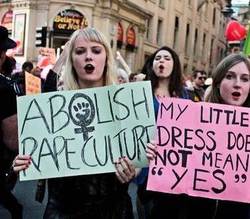
Why do some conservative thinkers insist that anti-rape-culture activism is a fraud? That “rape culture” itself is a myth?

As we’ve seen in these pages, talk about rape culture is often tied to the atmosphere of colleges and universities. And it is understandably an incredibly sensitive subject. Even asking about the nature of rape culture can be seen as truckling to rapists and those who hope to explain rape away.

Full disclosure: I am one of those who thinks that denying this problem is part of the problem. I agree that colleges and universities need actively to confront cultures that encourage sexual assault. For too long, college administrators have winked at the “boys will be boys” attitudes that lie at the heart of rape culture. In these pages, I have asked whether this is worse at conservative Christian colleges. I have wondered if non-denominational Christian schools, “fundamentalist” schools such as Bob Jones University, Patrick Henry College, and Pensacola Christian College have a harder or easier time dealing with these issues. In those cases, I was accused of apologizing for sexual assault myself.

And watch: I won’t be surprised if I am accused of supporting rape culture for writing these words as well.

But I’m going to do it anyway. Because there’s a new question that stumps me. Why do some conservative intellectuals attack the very notion of rape culture? What is “conservative” about dismissing the existence of rape culture on college campuses?

Minding the Campus Blasts Rape-Culture Activism

Minding the Campus Blasts Rape-Culture Activism

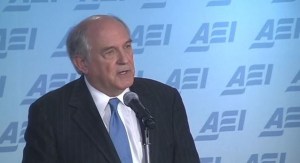
This past week, we’ve seen Caroline Kitchens of the American Enterprise Institute denouncing the “hysteria” over rape culture in the pages of Time Magazine. Kitchens asserted that there is no rape culture. There is no culture, that is, in which rape is apologized for and excused. America as a whole loathes rape and despises rapists, Kitchens points out. “Rape culture” only exists in the imaginations of over privileged college students and their tame faculty. Colleges such as Boston University and Wellesley ban pop songs and harmless statues as an overblown response to such rape-culture myths, Kitchens writes.

Kitchens claims the support of the Rape, Abuse, & Incest National Network (RAINN). She cites a recent RAINN letter to a White House Task Force. In order to help victims of sexual assault on college campuses, this RAINN letter asserts, administrators should understand that these are the acts of criminal individuals, not the result of a nebulous cultural trend.

It is rape-culture stereotypes themselves that absolve abusers of responsibility, Kitchens argues. “By blaming so-called rape culture,” she concludes, “we implicate all men in a social atrocity, trivialize the experiences of survivors, and deflect blame from the rapists truly responsible for sexual violence.”

Kitchens is not alone. In the pages of the conservative higher-ed watchdog Minding the Campus, KC Johnson has agreed recently that “rape culture” is a “delusion,” the product of overheated leftist imaginations. Johnson, a high-profile historian from Brooklyn College, worries that campuses from Dartmouth to Occidental to Duke suffer from an overabundance of intellectual cowardice and groupthink. “Fawning” media coverage has allowed for “transparently absurd allegations,” Johnson writes. Plus, harping on “rape culture,” Johnson argues, allows “activists to shift the narrative away from uncomfortable questions about due process and false accusations against innocent male students, and toward a cultural critique in which the facts of specific cases can be deemed irrelevant.” Finally, the blunt instrument of “rape-culture” accusations provides activists with “a weapon to advance a particular type of gender-based agenda.”

Such claims are intensely controversial. But before we examine the legitimacy of these arguments, we need to ask a more basic question: Why do conservative intellectuals make them? Now, I understand Johnson is no conservative himself. But it is telling that conservative organizations such as the American Enterprise Institute and Minding the Campus are the ones hosting these anti-rape-culture accusations.

Is there something “conservative” about disputing the existence of rape culture? Is “rape culture” a leftist ploy to assert (more) control over college campuses? To tighten the screws of the academic thought police? Or is something more profound at work? Do these conservative voices dispute the existence of rape culture in order to perpetuate traditional gender roles?


What Would Bryan Do?

H/t KT

Would William Jennings Bryan support the recent move by the president of Bryan College?  That’s the question Bryan’s great-grandchildren are asking these days.

As we’ve reported, Bryan College’s leadership has imposed a new, stricter faculty policy.  From now on, faculty must believe that Adam and Eve were real, historical persons and the real, genetic origins of all subsequent humanity.  As science pundit Jerry Coyne has pointed out, that puts evangelical scientists in a pickle, since genetic evidence indicates that the smallest possible pool of original humans had to be at least 2,250 people.  Bryan College is home to science-curriculum innovators Brian Eisenback and Ken Turner, who hope to show evangelical students that evolution does not necessarily disprove their Biblical faith.

What would the original Bryan say about all this?  The college, after all, was founded as a memorial to Bryan’s last decade of work defending the centrality of Biblical wisdom in American life and politics.  As I argued in my 1920s book, though, Bryan himself held some beliefs about both the beginnings and the end of time that have made other conservative evangelical Protestants uncomfortable.  Bryan did not believe in a young earth, nor in a literal six-day creation.  Nor did Bryan think Jesus had to come back before the earth experienced its promised thousand-year reign of peace and justice.

Bryan Gets Grilled by Darrow at the Scopes Trial

Bryan Gets Grilled by Darrow at the Scopes Trial

Other historians, too, have noted Bryan’s complicated relationship with the fundamentalist movement in its first decade, the 1920s.  Lawrence Levine’s Defender of the Faith and, more recently, Michael Kazin’s A Godly Hero both get into the gritty details of Bryan’s anti-evolution crusade.

Historians might disagree, but we all will get nervous about trying to predict what Bryan would say about today’s dust-up at Bryan College.  Because Bryan’s ideology and theology remain necessarily part of his life between 1915 and 1925.  It is mostly meaningless to ask what he would say today, because the situation today is so wildly different from what it was back then.

For example, when Bryan led his anti-evolution movement in the 1920s, the scientific jury was still out on the mechanism of evolution.  Darwin’s explanation—modified descent through natural selection—had been roundly criticized and nearly dismissed by the mainstream scientific community.  So when Bryan led the charge against the teaching of evolution, he could claim with scientific legitimacy that natural selection was not established scientifically.  It was not until years after Bryan’s death that biologists and geneticists such as Theodosius Dobzhansky, Ernst Mayr, R.A. Fisher, J.B.S. Haldane, Sewall Wright, and others solved the problem of genetic “swamping” that seemed to make Darwin’s idea of natural selection a non-starter.

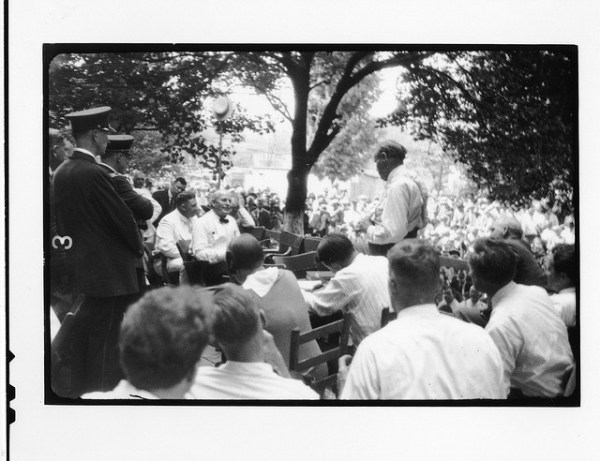
I’ve spent my time with Bryan’s papers at the Library of Congress.  I like Bryan.  He was a successful politician, but I don’t hold that against him.  I believe he was also sincere and devoted to justice.  I came to believe that Bryan was profoundly shocked and surprised when he could not produce his dream team of scientific experts at the Scopes Trial to put evolutionary scientists in their place.

Of course, Bryan died just a few days after the trial.  I can’t help but wonder how he might have “evolved” in his thinking if he had lived.  Would his experience at the Scopes Trial have caused him to re-think his confidence that evolutionary science would soon be disproven?  And, more intriguing, how would Bryan have responded if he had lived for an even longer stretch?  An Old-Testament sort of lifespan?

Would Bryan have embraced the “new evangelicalism” of Carl Henry and Billy Graham?  Would he have worked to make sure Biblical religion remained in conversation with mainstream American culture and politics?

I can’t help but think that he would.  I agree with Bryan’s great-grandson Kent Owen, who told reporter Kevin Hardy, “My view of Bryan is that things weren’t set in stone. . . .  He was pragmatic.”

What does this mean for today’s leadership at Bryan College?  On one hand, they are continuing the legacy of their school.  Bryan College was never bound too tightly to the thinking of the original William Jennings Bryan.  From its outset, Bryan College took a firmer, more “fundamentalist” position than Bryan himself ever did.  But on the other hand, the insistence of today’s leadership that Bryan College faculty sign on to a specific understanding of the historicity of Adam & Eve does not sound like something the Great Commoner would have supported.  As long as the principle of respect and reverence for the Bible was maintained, the original Bryan thought, people of good will could disagree on the details.