Celebrity to Nerd: New Leadership at The King’s College

Who will train a new generation how to bring America to Christ?

The leaders of The King’s College decided a nerd can do the job better than a celebrity.

After its unhappy breakup with headline-grabbing conservative icon Dinesh D’Souza, The King’s College will now be led by Southern Baptist theologian and administrator Gregory A. Thornbury.

Image Source: The King's College

Image Source: The King’s College

The bowtie-wearing, Carl-Henry-loving, religious-school administrating Thornbury seems to be the exact opposite of D’Souza, at least within the world of conservative Christian higher education.

Thornbury’s career has been squarely within the world of conservative evangelical higher education.  Before Manhattan and The King’s College, Thornbury served as the founding dean of Union University’s theology school.  His academic background as a philosopher with degrees from the Southern Baptist Theological Seminary and Messiah College puts him in a different league from the sometimes-fevered punditry of D’Souza.

Leaders of the evangelical establishment love him.  Russell Moore of the Southern Baptist Convention called Thornbury “Jonathan Edwards meets Rolling Stone magazine.”

Thornbury himself seems to prefer the Jonathan Edwards part.  His recent book about theological Carl Henry hopes to make Henry “cool again.”  Unlike other leaders at The King’s College, who stress its Manhattan location as the ideal spot to influence mainstream American culture, Thornbury himself notes the location’s close ties to the strongest intellectual giants of American evangelicalism and conservatism, including Jonathan Edwards, Alexander Hamilton, and Carl Henry.

What’s next for The King’s College under its new president?  In the words of one enthusiastic King’s College alum, Thornbury will lend new life to The King’s College mission: “a counter cultural Christian college in New York City that leads with academic excellence and ‘convictional civility.’”


Of MOOCs and Monsters

Does Monsters University have a conservative anti-MOOC message?

I took my daughter to see it the other day.  It was great.  I laughed.  I cried.  There were lots of creatively imagined monsters, smart dialogue, and sight gags.  Plus a heartwarming story of friendship and dedication.

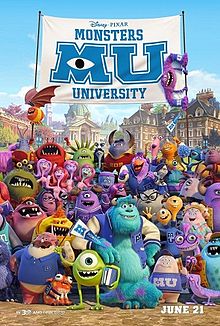
Monsters_University_poster_3But was it also a Disney-fied version of conservative arguments about the fate and future of higher education?

I couldn’t help wondering what the conservative intelligentsia would have to say about the movie’s implications for the future of higher education.  Especially about the latest craze to sweep the educational establishment, Massive Open Online Courses.

Conservatives have been divided about the moral and practical implications of MOOCs.

Some free-market aficionados have trumpeted the promise of the new approach.  By providing courses for free from elite universities such as Harvard and MIT, MOOCs make world-class learning more widely available than ever.  Economist Richard Vedder, for example, argued that a MOOC approach could cull out inefficiencies in higher education.

More recently, Benjamin Ginsberg fretted that MOOCs represented just another way for administrators to cut apparent costs, at the real cost of abolishing real learning.

Other conservatives have agreed that the MOOC model abandons the proper goal of higher education.  Rachelle DeJong complained that higher ed must take more responsibility for the formation of young minds and spirits. “The student,” DeJong wrote,

as yet unformed and uneducated, cannot judge what studies best suit his needs, his vocation, or his intellectual development. How can he discern a steep ascent to the mountaintop from a difficult dead-end, when all he knows are the briars, the rocks, and the stitch in his side?

In the pages of Minding the Campus, Peter Sacks warned that MOOCs will generate a crushing mediocrity and exacerbate the existing class divide among institutions of higher education.  Rich students will get a full learning experience, Sacks insisted, while less well-off students will only hear distant digital echoes of profound learning environments.

Such conservative arguments make sense to the historian in me.  Even a nodding acquaintance with the history of technology and education makes anyone skeptical of any new technological “revolution” for classrooms.  As Larry Cuban has demonstrated, new technologies often garner enthusiasm and enormous investment, only to crash against the reefs of complex educational reality.

Perhaps the best example was the flying broadcast technology of the 1950s.  The US government and the Ford Foundation poured tens of millions of dollars into this program, which sent planes circling over the Midwest and Great Plains.  These planes broadcast educational television programs to schools in those areas.  The idea was that the very best teachers could supply content for audiences of schoolchildren nationwide.

The program failed because schooling is about much more than simply receiving information from a TV screen.  CAN young people learn this way?  Of course.  Is such learning the equivalent of all the complex interactions that go into our notion of “school?”  Of course not.

A similar future seems in store for MOOCs.  Such distance learning is nothing really new and some students will likely benefit greatly from it.  But it will not replace the entirety of higher education, since that entirety includes such a broad range of ingredients.

What does all this have to do with adorable monsters?  I won’t give away any of the plot of Monsters University, but I can say that the movie centers around the dreams of a young adorable monster who yearns to attend Monster University.  The film includes long sweeping vistas of colored foliage and ancient-looking buildings.  It revolves around the intense traditions and intense personal interactions that make up higher education for monsters.

The main character, to be sure, went to MU for vocational reasons.  He wanted to earn a certain type of job.  Without giving away the plot, I can’t comment here on some of the movie’s ultimate implication about the career efficacy of those choices.

But for the main monster character, the allure of MU was at least as much about personal relationships between students and a hard-nosed dean as it was about attaining information.  The attraction of MU depicted in the film was at least as much about learning from fellow students as it was about downloading information from star professors.  The campus and its social scene played crucial roles in the education depicted in the film.

If the film gives us anything beyond two pleasant hours in an air-conditioned theater, it is an emotional, playful articulation of the drier anti-MOOC arguments made by conservative intellectuals.  College, in this film, is a whole-life experience.  College includes formal education, but it also requires a whole lot more.  In order to be educated, the film implies, young people must submit to a stupendous tradition.  Institutions of higher learning, as portrayed in this summer fantasy, are literally supernatural conglomerations of love, life, and learning.

Such conglomerations can never be replaced with online learning platforms.  No matter how much star power goes into them.


Lock Up the Principals!

Lock em up!  Charge em with felonies!

That is the prescription for education reform from Professor Richard Vedder.  In the pages of Minding the Campus, Vedder lamented recently the sad state of affairs in schools that train America’s teachers.  Ed schools, Vedder pointed out, do not attract the best or the brightest.  On elite campuses, Vedder argues, ed schools are seen as a “weak link, sometimes something of an embarrassment.”  Such lackluster ed schools only perpetuate an educational miasma.

How to get around this?  Vedder offers a bold plan:

the goal should be to eliminate undergraduate colleges of education. And rather than fight the battle one university at a time, state governments can make it happen easily:  make it a felony for a principal to knowingly hire a graduate of a college of education to teach our youth in public schools.

Though I am a card-carrying faculty member at one of the schools Vedder wants to criminalize, I will not use this space to defend schools like mine.  Instead, I will only point out the somewhat surprising durability of this anti-ed-school animus among American conservatives.

Why has the ed school been seen for so long as such an intellectually dangerous place?

Perhaps a look at the twentieth-century record will help…

In the ferociously anti-communist atmosphere of the 1930s, for instance, many conservative activists blamed ed schools for training subversive teachers.

In 1938, American Legion national leader Daniel Doherty claimed that “Many of our institutions of higher learning are hotbeds of Communism.”

Doherty was in illustrious company.  A few years earlier, conservative US Congressman Hamilton Fish had denounced schools such as Columbia, New York University, City College of New York, the University of Chicago, Wisconsin, Penn, and North Carolina as “honeycombed with Socialists, near Communists and Communists.”

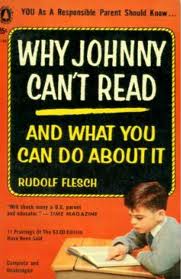
Into the 1950s, leading conservatives blamed ed schools for promulgating terrible teaching.  In his blockbuster phonics book Why Johnny Can’t Read (1955), for example, Rudolph Flesch blamed Teachers College, Columbia, for masterminding a plot to spread ineffective but progressive reading techniques.

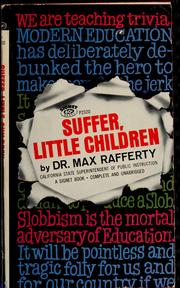
flesch why johnny cant readAs usual, among educational conservatives, few have articulated an idea with the same style and verve as the prolific Max Rafferty, in the 1960s the State Superintendent of Education in California.  In his syndicated column, published in book form in 1963 as Suffer, Little Children, Rafferty zeroed in on the role of education schools in promoting educational blah.

At that time, Rafferty identified the danger as a wrong-headed and misleadingly named “progressive education.”  Such dunderheaded notions, Rafferty argued, oozed out of ed schools to create a nation barely able to compete with the aggressive Soviet Union.

1963

1963

As Rafferty put it,

For thirty years, our Columbia University philosophers, our educational psychologists, and our state department consultants have been leading us down a primrose path where report cards read like Abbott and Costello comedy routines, where competition was a naughty word, and where memorization and drill were relics of the Dark Ages.

In the last three years, we have found out for ourselves that our morals are rotten, our world position degenerating so abysmally that a race of lash-driven atheistic peasants can challenge us successfully in our own chosen field of science, and our rate of juvenile murder, torture, rape, and perversion so much the highest in the world that it has become an object of shuddering horror to the rest of the human race.  More, our greatest leaders today, both in and out of Education, now assure us that these fairy stories with which we have for thirty years bulwarked our thinking and our actions are just—plain—not—true.

My hunch is that Superintendent Rafferty would approve of Professor Vedder’s suggestion.  Close down the ed schools, teach teachers the way we teach everybody else.

My hunch is that somewhere at the back of this conservative ire is a feeling that education schools have become the domain of the academic left.  On many campuses, not only do education schools represent a different sort of student, they often also represent a dwindling redoubt of the unapologetic academic left.

Are there other reasons why smart conservatives feel such virulent distaste for ed schools?


Are We Post-Racial Yet? Conservatives and Affirmative Action

It appears the US Supreme Court’s non-decision today about affirmative action won’t settle anything. In its 7-1 ruling in Fisher v. University of Texas, the Court sent the case back down to lower courts to decide.  This doesn’t rule out university use of affirmative action policies in admissions, but it does not exactly endorse it either.

Significantly, Court conservatives including Justices Scalia and Thomas voted with the majority today, but both indicated they would be willing (eager?) to rule such affirmative-action policies unconstitutional.

Legal and higher-ed policy wonks will have plenty to chew over in coming days.

For me, the recent ruling underscores the ways debates over affirmative action in university admissions policies have become a stand-in for conservative sentiment about race and racism in America.  Though it is too simple to say anything about conservatism as a whole, the last forty years have established a new kind of anti-racist conservatism.  These self-described anti-racists, however, have struggled to convince anyone besides themselves of their sincere dedication to fighting racism and traditional preferences that favor whites.

The recent SCOTUS history alone has given the debate over race and schooling a kick in the pants.  In the late 1970s, in the Bakke case, the Supreme Court ruled against the use of any racial quotas in college admissions.

More recently, in Grutter v. Bollinger (2003), SCOTUS decided that race could be used in admissions decisions, as one category among others.  The key element in this decision was that race could be used to further the state’s interest in fostering a diverse learning environment.

One influential strain of opinion among conservatives can be summed up in a pithy statement by Chief Justice Roberts from 2007.  In a case from Seattle, Roberts insisted, “the way to stop discrimination on the basis of race is to stop discrimination on the basis of race.”

Conservative thinking on this issue has, in some ways, remained remarkably constant for the past generation.  In the mid-1980s, for instance, writing for the Heritage Foundation, Philip Lawler articulated a conservative critique of affirmative action admissions policies that sounds fresh today.  Such policies, Lawler argued, effectively promote racism against African Americans and other historically underrepresented college populations.  Affirmative action degrades true achievement and breeds resentment towards all African Americans.  It also leads to a racist dismissal of the true achievements of some African Americans.

Former US Representative Allen West made similar arguments in his amicus brief filed in the Fisher case.  “Race-conscious policies do not advance – in fact, they harm – the most compelling of all governmental interests: protecting and defending our Nation’s security. This is true whether practiced by colleges and universities (which, together with the Nation’s military academies, produce the majority of the commissioned officers in our country’s military), or by the military itself in the selection and advancement of its officer and enlisted personnel,” West argued.  West, a prominent African American conservative, argued that affirmative action policies degraded all applicants, African Americans most of all.

The problem with these kinds of conservative arguments is that they are often dismissed as mere window dressing.  With important exceptions such as Representative West and Justice Clarence Thomas, most African Americans support affirmative action policies.  The NAACP, for instance, has consistently and energetically supported Texas’ race-conscious admissions policy.  The National Black Law Students Association, in its amicus brief in the Fisher case noted the “systematic racial hierarchy that produces and perpetuates racial disparities in educational opportunities and outcomes.”  Affirmative-action admissions policies, the NBLSA insisted, remained necessary to promote a truly non-racist society.  Conservative insistence that such affirmative action policies actually support anti-black racism tends to fall on deaf ears among the majority of African Americans and whites who consider themselves racial liberals.

Conservative activists and intellectuals—white and black—often express what seems like honest surprise when accused of anti-black racism.  Perhaps one episode that illustrates this kind of conservative anti-racism might be that of Alice Moore and the 1974 Kanawha County textbook protest.  In this battle from the Charleston region of West Virginia, conservative parents and activists protested against a new series of English Language Arts textbooks.  Among the many complaints were protests against the inclusion of authors such as Eldridge Cleaver and George Jackson.  Such militant African American voices, many Kanawha County residents insisted, did not belong in school textbooks.  Conservative leaders insisted that this was not because they were black, but because they were violent and criminal, and apparently proud of it.

Conservative leader Alice Moore came to the 1974 controversy freshly schooled in the ideology of anti-racist conservatism.  She had attended a conference in which conservative African American politician Stephen Jenkins blasted the anti-black implications of multicultural literature.  Such literature collections, Jenkins insisted, implied that the violent, angry, criminal voices of militants such as George Jackson and Eldridge Cleaver represented the thinking of African Americans.  Such implications, Jenkins explained, proved that the true racists were the multiculturalists.  By pushing a skewed vision of African American culture, such multicultural textbooks implied that African Americans as a whole were criminal and violent.

Moore embraced this sort of anti-racist conservative ideology.  When she (politely, as always) confronted African American leader Ron English at a heated board of education meeting, Moore seemed honestly flummoxed that the English did not agree with her.  Moore pointed out that voices such as Jackson and Cleaver did not fairly represent the truths of African American life.  But The Reverend English rebutted that such militant voices represented an important part of the American experience, stretching back to Tom Paine.

Moore’s befuddlement in 1974 matches that of anti-racist, anti-affirmative action conservatives today.  Many conservatives feel that their opposition to affirmative action makes them the true anti-racists.  Yet they consistently find themselves accused of racism.  The fight over Fisher never seemed to be changing this dynamic.  Now that the Court has punted, there is even less resolution on offer.  Conservative notions that true anti-racism requires the elimination of race-based considerations in college admissions will likely continue to fall on deaf ears among leading African American advocacy groups.


Being Gay at a Catholic College

Is gay okay the Catholic way?

Religion writer Michael O’Loughlin recently surveyed the experiences of gay students at a variety of Catholic colleges.  The answer, maybe not surprisingly, is that different schools do things differently.

At Chicago’s DePaul University, O’Loughlin found, students can minor in LGBTQ Studies. Students and faculty are out and supportive.

Other schools, such as Washington DC’s Catholic University, have a more mixed record.  Students are gay, O’Loughlin reported, and that’s only sort of okay.

One constant, at Catholic universities as across American culture, is rapid change.

O’Loughlin returned after just a handful of years to his alma mater, St. Anselm College in Manchester, New Hampshire.  When he attended, gay students kept their sexual identity private. Now, the school itself has initiated programs to make all students, explicitly including homosexual students, feel welcomed, loved, and guided.

As some of the comments on O’Loughlin’s essay proved, not all Catholics are okay with this trend.  As “JP” noted,

Can one imagine a group of Catholic adulterers or thieves organizing at a Catholic college in order for their “voice to be heard”? Homosexual acts as well as larceny or adultery are still considered Mortal Sins by the RCC.

Catholic schools are not alone in their struggles with this issue.  As we noted a while back, Brandon Ambrosino shared his experiences with faith and sexuality at the conservative evangelical flagship school, Liberty University.  Just as Catholic colleges have had a range of responses to the issues of student homosexuality, so folks at conservative Protestant schools  have had surprisingly mixed reactions as well.


To Win Elections, Conservatives Need to Win in Schools

What happened?

Why do conservative candidates lose elections?

That is the question Mark Bauerlein of Emory University asked in Friday’s Public Discourse.

Bauerlein finds the answer not in demographics or policy prescriptions, but in college and high-school curricula.  The revolution in teaching of the past forty years, he says, means that conservative candidates lack the intellectual heft and agility necessary to win.  Bauerlein modifies a Thatcher motto: “First you win the schools, then you win the government.”

Governor Romney, Bauerlein argues, exemplified the problem.  Romney’s famous blunder about “47%” of the electorate was a lost opportunity, Bauerlein thinks, to introduce a new generation of voters to true conservative principles.  Romney did not explain the central conservative principles of thrift, independence, and liberty that could have made his point.

The real remedy, Bauerlein insists, is not in new polls or smoother candidates.  The long-term conservative remedy will be to take advantage of the profound conservatism at the heart of American culture.  If young people receive a better education in the American tradition, they will be both more receptive to and more articulate about those conservative American principles.

“The lesson is this:” Bauerlein tells us,

Conservative candidates must possess, among other attributes, a conservative tradition in their heads, not just political principles, but great thinkers and artists of them, too. . . .

The best way, perhaps the only consistent one, to plant conservative writings and art in the formation of politicians is through the high school and college curriculum. There, individuals have the space to absorb them as common intellectual equipment, as regular facets of the world, not as political positions. . . .

What they encounter and how it is presented determine what they think is important. If English and history courses don’t include Brave New World and Fahrenheit 451 (an anti-political correctness novel) alongside multiculturalist fiction of the 2000s, if they don’t add David Horowitz’s Radical Son to celebrations of the 1960s counterculture, if James Madison doesn’t precede Malcolm X, then the conservative tradition has no place in the accepted body of cultural literacy. If The Scarlet Letter is taught as an indictment of sexual oppression in a Puritan community, not as a complicated tale in which the community has a valid claim upon Hester’s desires, then social conservatism is reinforced as an uptight, obsolete imposition.

This is to recognize the curriculum as an authorizing process. What makes it onto the syllabus has legitimacy, and the angle the teacher takes upon the materials tends to stick. If conservative donors wish to back winning candidates, to cultivate politicians who can deflect sallies of biased reporters and liberal counterparts with intelligent and informed convictions, they must reach conservative politicians not only in election years, but at impressionable ages, too.

The good news for conservatives, Bauerlein writes, is that many schools have already begun to implement this kind of strategy.  They teach conservative ideas not only in short-term intellectual boot camps, but as part of a thoughtful tradition that includes all the best thinkers from across the intellectual spectrum.

What could this look like?  According to Bauerlein, it could mimic the success of liberal efforts such as the Ford Foundation’s funding of centers for Women’s Studies.  That field went from zero to influential in a decade, thanks in part to such funding. Bauerlein thinks it’s time for conservatives to do the same.


Jesus and the Ivy League

Religious conservatives often insist that America’s colleges and universities used to be “our schools.”

For example, Protestant fundamentalist educational writer A. A. “Buzz” Baker pointed out in the 1970s that, although “it may come as a surprise to some,” most of America’s leading colleges “used to be ‘our’ schools.”[1]  Similarly, B. Gray Allison, a conservative evangelical from Louisiana, noted in 1968 as campuses nationwide roiled with cultural conflict that not only Harvard, Yale, and Princeton began with explicitly religious missions, but “even the early state-supported institutions had a concern for the perpetuation of what might be termed religious culture.”[2]

Over at the inimitable The Way of Improvement Leads Home, historian John Fea offers some evidence from the archives to back up those assertions.

On March 19, 1761, Fea reports, the College of Philadelphia’s (the future Penn) Board of Trustees approved some student rules that might warm the heart of twenty-first century religious conservatives.

Every student had to attend chapel.  Slacking off or not paying attention during prayer or Bible readings could call for punishment.

Plus, no sauntering!  Check out Fea’s full post here.


[1] A.A. Baker, The Successful Christian School: Foundational Principles for Starting and Operating a Successful Christian School (Pensacola, FL: A Beka Book Publications, 1979), 34.


[2] B. Gray Allison, “The American Campus as a Spiritual Force,” Christianity Today 12 (May 10, 1968): 5.


Does Jesus Love Shotguns? Liberty University and the Many Faces of American Conservatism

What do gun rights have to do with Jesus?

Nothing, right?

Then why did Liberty University offer a sweet scholarship to David Cole Withrow?

Here’s the latest, according to the Christian outlet World Magazine: Withrow had been punished for bringing two guns to his high-school campus in Princeton, North Carolina.  At first, it appeared he had accidentally left them in his truck.  As soon as he remembered his mistake, the story was first reported, Withrow informed school authorities of the guns.  In spite of the innocence of his mistake and his Eagle-Scout honesty in reporting the problem, school officials reported Withrow, who was charged with a felony and kicked out of school.  The story became a tempest in America’s culture-wars teapot.  Withrow became a symbol of an overreaching anti-gun governmental tyranny.  Since Withrow was wearing a Liberty University t-shirt in some public appearances, the University contacted him and offered him a full scholarship.

Falwell and Withrow

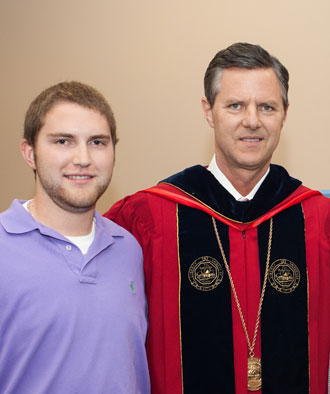
Falwell and Withrow; Image source, Liberty University

Turns out Withrow had known about the guns all along. According to World Magazine, Withrow admitted in court he had lied.  Nevertheless, Chancellor Jerry Falwell Jr. and Liberty University stand by their offer.  Withrow’s admission of dishonesty, Falwell announced, smacks of more heavy-handed state tactics.

So in the end, nothing really happened.  A conservative Christian youth will go to a conservative Christian college.

Why should those of us trying to understand the world of conservative educational thinking in America care about this story?

Because this story demonstrates the sticky web of connections between seemingly unrelated issues.  Liberty University was founded in the early 1970s by barnstorming evangelist Jerry Falwell.  The goal of the university was to produce new platoons of educated conservative Christians, ready to swing the United States back into the arms of its rightful Moral Majority.

This story demonstrates that the conservatism of Christian institutions such as Liberty University reaches beyond theology.  Liberty University may exist to teach students in a Christian environment.  But that environment also supports theologically unrelated notions, such as the rights of people to have and use guns, and the rights of people to be defended from an overreaching Obama regime.

As faculty star Karen Swallow Prior reported a while back, the broad cultural conservatism on Liberty’s campus may be relaxing a little. Students these days tend to wear less formal clothes, and some even started a Campus Democrat club.  Nevertheless, as Chancellor Falwell’s actions show in this case, Liberty still represents a bastion of an American conservatism that reaches far beyond Biblical interpretation.

What does Jesus think about shotguns?  I don’t know.  But the multifaceted ideology/theology/admissions policy on display in this story demonstrates the complexity of American educational conservatism.


Poem of the Week

If a picture is worth a thousand words, a good poem has to be worth a million, right?

We stumbled across this gem recently.  For those of us who are trying to understand educational conservatism in America, the sentiments expressed here go a long way.

“Buzzsawmonkey” left this poem as a comment on a recent essay by Stanley Kurtz in National Review.

The Red Faculty
—apologies to William Carlos Williams and “The Red Wheelbarrow”

so much depends
upon

a red prof
teaching

glazed eyed bored
students

to deride white
people.

Now, I realize the poem does not have much to do with Kurtz’s essay about the Common Core State Standards.  But it does sum up a good deal of conservative punditry about the lamentable state of American higher education.

I apologize for my ignorance if this poem has been around for a while.  It seems both too clever and too irrelevant to the essay it commented upon to have been used only in this context.  So please correct me if this is old hat.  This is my first sighting.

The skewed ideological environment of most college campuses has long been an article of faith among conservative activists and thinkers.  Long before William F. Buckley Jr. launched his career with his jeremiad about God and Man at Yale, conservatives warned about the terrifying intellectual bullying among once-hallowed quads.

In 1921, for example, William Jennings Bryan attacked the teaching at the University of Wisconsin.  In a scathing editorial, he sarcastically suggested the university post placards about the content of its curriculum.  “Our class rooms,” the warning could state, “furnish an arena in which a brutish doctrine tears to pieces the religious faith of young men and young women; parents of the children are cordially invited to witness the spectacle.”[1]

Neither the loquacious Bryan nor Buckley, however, managed to come up with as poetic an indictment as has Buzzsawmonkey.


[1] Bryan, “The Modern Arena,” The Commoner, volume 21:issue 6 (June 1921): page 3.

Eric Hedin and the Care and Feeding of Young Scientists

Scientists aren’t necessarily stupid.  Yet, as we’ve seen, some academic scientists demonstrate a curious ignorance or even proud self-delusion about important aspects of science and culture.

Perhaps the continuing kerfuffle over Professor Eric Hedin and Ball State University can shed some light on this puzzle.

The case began, it appears, with complaints by University of Chicago scientist and science activist Jerry Coyne.  Coyne complained that the teaching of Eric Hedin at Ball State University represented the indoctrination of students by a religious zealot. Professor Hedin taught a course cross-listed as “The Boundaries of Science” or “Inquiries in the Physical Sciences.”  True enough, Hedin’s reading list leaned heavily on old-earth creationism and intelligent design.  Worst of all, Professor Coyne argued, Hedin’s course proselytized for a specific sort of Christianity and called it science.  The university and department reluctantly agreed to investigate Hedin’s teaching.

Professor Coyne hoped the university would pressure Professor Hedin to stop his preaching.

Other leading science bloggers disagreed.  PZ Myers argued that Hedin’s teaching, though lamentable, must be allowed as an issue of academic freedom.  “If we’re going to start firing professors who teach things that are wrong,” Myers insisted, “we’re all going to be vulnerable.”

The debate between these science activists on the boundaries of acceptable university teaching might help us understand why so many scientists are so strangely unaware of the cultural context of their work.  Neither Professor Coyne nor Professor Myers seems to think that Professor’s Hedin course might actually be of value to the scientists-in-training at Ball State.  Myers defends the classes as a protection of Hedin’s rights, not the protection of student interests.

Is it not possible that such intellectual diversity could be a positive good?

In issues of race, the US Supreme Court has ruled that diversity is a legitimate goal of university admissions.  Racial diversity, in other words, is not only good for members of racial minority groups.  Diversity is good for everybody who wants to learn.

Does not the same principle apply here?

Of course, we would want to avoid the absurd extension of this principle.  We would not want to teach people things that were obviously not true only to give students some sort of intellectual workout.  But the ideas taught by Hedin are not the ravings of some isolated madman.  Rather, they represent an influential and important tradition in our culture.  Though these ideas do not qualify as representatives of mainstream science, they are nevertheless ideas about science.  Scientists should know about them.

Raising young scientists in an ideological or cultural hothouse produces fragile flowers.  It helps explain why so many smart people emerge from this training so remarkably dumb about important ideas.

If we looked into this question as one of encouraging intellectual diversity, we could shift the debate in useful ways.  Everyone can agree that students can benefit by being exposed to a diversity of ideas.  The question becomes, then, at what level and in what format should students learn about heterodox ideas?  What courses should count as requirements, and what courses should be elective?  Most important, where are the boundaries of acceptable diversity?  These are questions with which university faculties have long experience.

In my field, for instance, it would not make sense for introductory courses in American history to teach only a Marxist interpretation of the past.  Students from all sorts of fields take those introductory courses.  For many students, such a course may be their only collegiate exposure to American history.  It would not make sense for those students to learn that history is the unfolding of the class struggle.  But for history majors, students will benefit from having one or more advanced courses taught about specific interpretive traditions, whether or not the instructor is a Marxist.   Even though I do not think a Marxist interpretation is the best approach, I support the inclusion of such courses in university programs.  Not only to defend the teaching rights of professors, but more importantly, to ensure students experience a true diversity of intellectual approaches.

In the case from Ball State, it does not seem as if Professor Hedin’s religion-heavy course should be the ONLY exposure students have to science.  Nor should this course be taught as an introduction to science as a whole. But students who take a full course load of science classes could certainly benefit from considering such ideas.  Even if taught by an instructor who embraces the theological implications.  Other courses might study other aspects of science, and might usefully be taught by professors with strong intellectual commitments to a particular worldview.

Making the debate a question of when and how students encounter intellectual diversity is not as exciting as debating if religious ideas can be taught as science.  It is not as exciting as arguing whether professors have the academic freedom to teach heterodox ideas.  But it seems to me the most productive way to discuss Professor Hedin’s case.