Binder on “Becoming Right” at College

Since long before William F. Buckley published his enfant-terrible critique of rampant secularism and slouching liberalism at Yale, conservative intellectuals and activists have attacked the culture of American higher education.  As I argued in my 1920s book, such critiques have always been a central part of the educational culture wars.

A review of Amy Binder’s new book at Inside Higher Ed suggests that conservative worries about campus leftism may be misplaced, or at least oversimplified.

Binder, whose first book was a must-read study of creationism and afrocentrism, told the reviewer,  “I was really surprised at how university context makes a difference in how  students experience being conservative.”

Binder argues in her new book Becoming Right: How Campuses Shape Young Conservatives (Princeton University Press, 2013) that the type of school may have a bigger effect on young conservatives than most people have recognized.  Along with co-author Kate Wood, Binder studied conservative students at an “Eastern elite” university and a “Western flagship” school.  In the Eastern school, conservative students tended to adopt a conversational style of activism.  In the West, young conservatives got more combative.

In addition to the differences a campus can make, Binder & Wood find a much broader spectrum of student experience on “liberal” campuses than the traditional story suggests.  Some students even find themselves converted to conservatism by the liberal atmosphere.

One wonders what William F. Buckley would say.

The King’s College and Christian Higher Education

Can a firmly conservative Christian college save America?  Or should it focus on saving souls?  This is a question conservative evangelicals have been asking themselves for almost a century.  As I detail in my 1920s book, the first generation of Protestant fundamentalists hoped a new clutch of truly Christian colleges could heal America’s benighted culture.

The recent dust-up at The King’s College over the personal life of celebrity president Dinesh D’Souza illustrates this inevitable tension.

According to a recent article by Melissa Steffan in Christianity Today, The King’s College has moved itself away from the hurly-burly of D’Souza’s brand of cultural politics.  When asked if the college would keep D’Souza’s trademark political obstreperousness while finding new leadership, interim president Andy Mills replied, “[TKC] is a Christian college.  Period.”

According to Steffan, TKC has changed its self-description:

“In the presidential search that led to D’Souza’s hiring, TKC published a list of ‘”true ideas” that distinguish King’s within … higher education,’ including ‘biblical competition’ and the right to ‘seek prosperity and risk bankruptcy.’ TKC no longer lists these on its website.”

Even more intriguing, Steffan points to similar changes at similar schools:

“Gene Edward Veith, provost at Patrick Henry College, says his school’s conservatism has become ‘more sophisticated’ since its founding in 1998. What he described as a ‘meltdown’ in conflict between faculty and administrators six years ago ‘was mainly a matter of the institution maturing and going through some disillusionment struggles,’ he said. ‘I see that happening across the board. Christian activists who get involved with politics soon find that things are not so simple as getting Christians elected.’”

What direction for Patrick Henry and The King’s College?  Without their distinguishing dedication to ferociously conservative politics, do they become quiescent Christian colleges?  In the case of TKC, the question is whether they return to a long previous life avoiding headlines instead of chasing them.

Faith and Football

Forget Tim Tebow.  The real story in the world of fundamentalist football is Liberty University. The fundamentalist Virginia school founded in the early seventies by Moral Majority frontman Jerry Falwell wants to become the face of conservative Christian college ball.

This isn’t news, but Bill Pennington offered a new look at the program in last weekend’s New York Times.

Pennington points out that a big sports program can signal the emergence of a religious school from sectarian obscurity, as happened with Knute Rockne’s Notre Dame, or a later generation’s Brigham Young University.  Pennington gets the dates wrong; Rockne pulled Notre Dame football to national prominence in the 1920s, not the middle of the century.  But the point still holds.  Football made Notre Dame an American story, not just a Catholic one.

Image source: Wikipedia

According to Pennington, Liberty is different.  The vision of both founder Jerry Falwell and current chancellor Jerry Falwell Jr. is of a team that competes with the likes of Alabama and LSU while remaining staunchly fundamentalist.  As Falwell Jr. told Pennington,

‘“We think there would be a vast, committed fan base of conservative, evangelical Christians around the country and maybe even folks who are conservative politically who would rally behind Liberty football,” Falwell Jr. said, smiling at the thought. “They would identify with our philosophy.”’   

In order even to have a shot at such elite play, schools need money.  According to Falwell Jr., that should not be a problem.  Thanks largely to an exploding online program enrolling over 80,000 students, Liberty has announced it will soon reach one BILLION dollars in net assets.

Could they make it happen?  In the world of big-time college ball—to paraphrase an old prayer—with money, all things are possible.

Pennington’s article is worth reading, especially for those interested in college football.  Those interested in the world of conservative Christian higher education will wish Pennington probed a little deeper.  The story of Liberty University in 2012, after all, is much bigger than just an ambitious football program.  As Karen Swallow Prior of the Liberty University faculty pointed out recently, the campus culture has been changing in other important ways as well.  In addition to a loosening of the dress code, students at Liberty have begun showing more diversity in terms of politics and culture, according to Prior.

Liberty watchers have to wonder: Did all these changes—a push for big-time ball, loosening of the dress code, broadening of the politics of the student body—did these changes result from the big on-line payday, or did these changes lead to that payday?  That is, did Liberty make itself the big winner in the new world of online higher education by broadening its appeal?  Or did the broadening happen after the money starting rolling in so fast, according to Falwell Jr., that “we can’t spend it fast enough”?

These questions aren’t new to the world of fundamentalist higher education, nor are they unique to Liberty.  In the 1920s, Bob Jones University also fielded intercollegiate athletic teams.  However, school founder Bob Jones Sr. quickly dropped the program.  Friends said Jones worried that sports would pull the new school too far from its central mission.  Enemies whispered that Jones feared having to accommodate any outside influence in his flagship university.

Liberty University will certainly wrestle with this same tension.  As any football fan knows, money drives success.  It will be difficult for Liberty to compete without putting athletic success first.  And it will be hard to do that without changing the focus of the school from the religion of Falwell to the religion of football.


Progressive Teaching for Christian Schools? The Classical Christian Approach

–Thanks to P.H.

We’ve been learning a lot lately at ILYBYGTH about the Classical Christian Education movement. Recently on First Things we read a thoughtful analysis of the state of the movement today.  Brian Douglas warns of some growing pains for the movement.  He highlights the need for schools in this tradition to keep their eyes focused on the big educational picture.

But first, a few words on the background of the movement: The recent Classical Christian Education movement can date its origin to a 1991 book by Douglas Wilson, Recovering the Lost Tools of Learning.  Wilson, a Reformed pastor, Christian educator and school founder from Moscow, Idaho, popularized the classical education formula of Christian and crime writer Dorothy Sayers.

The Association of Classical & Christian Schools now claims 229 schools.  The movement is affiliated with two colleges, New Saint Andrews and New College Franklin.

Such a booming educational movement quickly runs into some definitional problems, as Douglas notes in his essay.  Douglas warns of “five temptations” for the growing movement: mistaking the trappings of success for true success; focusing on uniforms, discipline, and Latin instead of the broader Christian mission; assuming that success relies on the schools rather than on God; failing to integrate the Bible into a classical curriculum; and assuming that school will be the most decisive influence on every student.

For those of us outside the movement, the most intriguing parts of Douglas’ essay concern the growing middle ground between “progressive” and “traditional” education.

As we have noted here before, some leading “progressive” educational thinkers have long advocated a more traditional, authoritarian classroom style.

Similarly, conservative Christian educators affiliated with Walter Fremont’s School of Education at Bob Jones University have long argued for a more “progressive” pedagogy.

Douglas articulates a vision for this energetic new educational movement that seems to combine the “progressive” emphasis on child-centered education with the “traditional” emphasis on evangelical Christian theology, student discipline, and a Trivium-based, great-books curriculum.

Indeed, if words such as “Christian” and “Bible” were replaced, Douglas’ nostrums could certainly find a home in many ferociously “progressive” education schools.

For instance, Douglas wants an education that “tends to develop thinkers defined by who they are instead of workers defined by what they do.”  Similarly, Douglas warns of an over-emphasis on classroom discipline: “focusing on order becomes hazardous when it overtakes the joy of experiencing God’s grace.  When this happens, students may learn to jump through the hoops, obey the rules, do the right things, but they do not learn to love God and others. . . . Creating a truly gracious classroom is much harder than creating an orderly classroom.”  To pick just one more well-turned phrase of Douglas’ that could just as easily have come from the progressive camp: “Education cannot be reduced to a formula, even if the formula is a good one.”

Douglas’ essay, and the development of the Classical Christian movement as a whole, suggest a broad middle ground in education.  Make no mistake: Douglas is ferociously Christian.  He does not suggest any watering down of the uniquely Biblical elements of good education.  However, when advocates of Christian education can agree with advocates of “progressive,” “multicultural” education about the most important factors of good schooling, it seems we might have some room with which to work.


Creationists Excel in Science

What’s wrong with teaching creationism?  Some folks say creationism will block America’s students from learning science.  I oppose the teaching of creationism as science in public schools, but this argument does not hold up.  As uncomfortable as it might be for non-creationists like me, we need to abandon the false argument that creationism is incompatible with learning science.

We see it now and again.  For instance, in a recent editorial in Church & State, Americans United for the Separation of Church and State insisted that creationism “leaves youngsters woefully unprepared for the demanding science courses many of them will encounter in college.”

Similarly, in his recent Youtube video against creationism, Bill Nye “The Science Guy” insisted that creationism would cripple science education.  “I say to the [creationist] grownups,” Nye announced,

“if you want to deny evolution and live in your world, in your world that’s completely inconsistent with everything we observe in the universe, that’s fine, but don’t make your kids do it because we need them. We need scientifically literate voters and taxpayers for the future. We need people that can—we need engineers that can build stuff, solve problems.”

This is a powerful argument.  We must teach science well and thoroughly, otherwise young people will not be able to understand the world.  Young people robbed of scientific education will not be able to contribute to society.

Unfortunately for those of us who want to promote more comprehensive evolution education, this argument does not hold up when we examine it closely.  Turns out creationist students can do just fine with science.  We need to grapple with this inconvenient truth.  It seems that—somehow—creationists do fine with science.

Consider a few examples.

From the recent headlines, US Representative Paul Broun received a lot of criticism for his comments that evolution, along with embryology and the Big Bang, were “lies from the pit of hell.”  Many of Broun’s critics insisted that Broun was utterly ignorant of science.  Now, I don’t agree with Broun’s ideas about evolution or astrophysics.  But we non-creationists have to acknowledge that Broun, an MD with a bachelor’s degree in chemistry, is not really utterly ignorant of science.  He certainly understands it differently, but it is a false refuge to conclude that he is simply ignorant.  He has been educated in science.  It appears he somehow chooses creationism in spite of this education.

Or take one of the most famous creationists of the twentieth century, Henry Morris.  In spite of Bill Nye’s lament that creationism will block the flow of “engineers that can build stuff,” Morris held a PhD in hydraulic engineering from the University of Minnesota.  At the same time, Morris led the way for a new sort of creationism with his books and institutional leadership.

There are other leading creationists with scientific credentials.  Kurt Wise, for instance, earned his PhD in geology at Harvard.

But we non-creationists could take some solace from the notion that exceptions are always possible.  We could tell ourselves that a few outliers do not prove that creationism is somehow compatible with scientific education.  Like the folks at Project Steve, we could take comfort from the fact that overwhelming numbers of scientists DO embrace evolution.

However, those who have looked closely at the broader picture suggest that creationists often do just fine with mainstream science education.

Political scientists Michael Berkman and Eric Plutzer, for instance, found in their large-sample survey of high-school biology teachers that many self-professed creationists had completed lots of college-level science classes.  Of the teachers who professed a belief in young-earth creationism, 32% had completed a full-semester course in evolutionary science.  More than one in ten (13%) held a graduate degree in science.  Almost half (49%) had earned forty or more college credits in biology.

These creationists managed to do fine in what Americans United called “the demanding science courses” in college.  The creationist teachers, to evolutionists’ chagrin, must be acknowledged to be among Bill Nye’s “scientifically literate voters.”

Clearly, something else is going on here.  For those of us outside the circle of creationist thinking, it is difficult to understand how creationists can combine the utterly unscientific notions of a young earth with such widespread success in the highest levels of academic science.  How do they do it?

David Long’s ethnography provides at least one clue.  Long studied creationist students enrolled in a secular biology program at a large public university.  The results suggest some disturbing lessons for those of us who want a more thorough evolutionary education.  As one of his informants described, doing well in college science classes was a snap.  “I take those really big classes,” this student informed Long,

“because it’s really easy to excel in those huge classes.  I mean, I got like a hundred on every test.  You have to be an idiot pretty much not to.  If you just sit, and you listen to what they’re saying, and you know how to take tests, it’s very easy to do well in those classes.”

Long’s ethnographic study can’t tell us how common this experience is among creationist students.  But it suggests a far more complicated educational reality than the black-and-white schemes suggest by Bill Nye and Americans United.  In a nutshell, creationists do fine in college science classes.  They do fine in science-related careers such as engineering, teaching, and medicine.

If we really want to improve evolution education in the United States, we need to wrestle with this perplexing fact: Creationists excel in science.

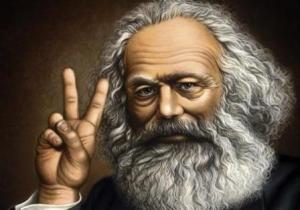
Marxists and Creationists: Peas in a Pod?

Are Marxists and Creationists sharing carrel space at American universities?

A query by Kurt Newman at the ever-interesting US Intellectual History blog generated a lively discussion of the question: How many Marxist historians are out there?

Reading the discussions led me to wonder a different question: Are academic Marxists and creationists flip sides of the same coin?

Darwin. Image Source: Humanist Life

Full disclosure: I’ve got thoroughly Marxist intellectual roots myself.  As an undergraduate, I found Marxism and its derivatives intensely interesting; those years remain profoundly influential in my thinking.  On the other hand, I’ve never been a creationist, though recently I’ve been accused of being one.  My intellectual world in my formative years had absolutely nothing to do with religion, the Bible, or creationism.

I’m not trying to promote one or the other, but the similarities between the two traditions jumped out at me.  Allow me to list a few of the obvious parallels:

  • Both Marxists and creationists remain surprisingly common on mainstream college campuses.  As David Long discovered when he began his ethnographic study of creationism on secular campuses, creationists are far more common than one might think.  The same result for Marxists becomes starkly clear when we read the responses to Newman’s query at USIH.
  • Both Marxists and creationists could make some claim to being persecuted.  Certainly, many mainstream scientists would not want to have creationist faculty in their departments.  And, as Newman points out in one of his comments, Marxist professors have a long history of institutional controversy.  Newman astutely mentioned in one aside, “(This is to say nothing of the apoplexy that would be induced in large swaths of the political class upon learning that any state-funded school was offering Marxist classes under the guise of US history, which might also say something about the stakes of doing Marxist research in 2012).”
  • Both Marxists and creationists could be accused of clinging obdurately to an intellectual tradition whose heyday has come and gone.
  • Both Marxist and creationist intellectuals and academics have always been famously and ferociously sectarian.  Gramsci-ites might not speak with Trotskyites, who might look down their noses at Bernsteinians, etc.  The same is true with today’s creationist galaxy of “evolutionary creationism,” “young-earth,” pre-Adamics, post-Adamics, day-agers, gap theorists, etc. etc. etc.

Marx. Image Source: Georgia Spears

Of course, some obvious differences jump out at us.  Here are a couple:

  • Marxism is profoundly secular, though some have called it a religion.  Creationism is profoundly religious, though some have insisted on its secular merits.
  • The two groups have enormous sociological differences.  Creationism does not thrive at elite schools, while Marxism seems to. The background of each group of scholars likely differs immensely.
  • Marxism seems to be losing influence outside the academy, while creationism has been steadily gaining strength in politics and popular culture for the past century.

So, are these flip sides of the same phenomenon?  Intellectuals who pride themselves on their superior insight into the workings of humanity and history?  Folks who take encouragement from the cultural slings and arrows directed their way?

Just askin…


Shake Up at King’s College

If you look at the $30,000,000 box office sales for his film 2016: Obama’s America, it would seem that Dinesh D’Souza is very in.

But at King’s College in Manhattan, D’Souza is out.  According to a recent story by Warren Cole Smith at WORLD magazine, D’Souza has stepped down as the high-profile president of King’s College.  Smith had reported a few days earlier on the tensions among King’s leadership.  D’Souza had ruffled some feathers when he appeared with a woman who was not his wife, shared a hotel room with her, and introduced her as his fiancee.  D’Souza had separated from his long-time spouse, but had not yet been officially divorced.

More interesting for ILYBYGTH readers than the Gossip Girl-ing involved, the story sheds some revealing light on the nature and institutional structure of King’s College itself.  As historian John Fea has remarked, the leadership of King’s College embarked on a remarkable re-branding in the mid-1990s.  It shifted from a small, quiet, conservative evangelical Westchester County college to an aggressive culture-war college in the heart of Manhattan.  The “new” King’s College narrowed its scope, offering only business and politics/economics majors.  The goal of the revised school was to bring conservative evangelical leadership to the heart of New York City.

As journalist Amy Sullivan noted in her piece in The New Republic about the King’s College shake-up, the rivalry between long-time provost Marvin Olasky and D’Souza likely contributed to the scandal.

It seems charismatic conservative evangelical leaders will continue to struggle with such issues.  King’s College represents a long tradition of “new” approaches to fundamentalist higher education.  Liberty University was founded in 1971 with the same purpose.  Even further back, this goal of teaching a new generation of conservative evangelical students to compete for the levers of cultural and political power has roots in the culture-war struggles of the 1920s.  As I argued in my 1920s book, college and seminary founders such as those at Dallas Theological Seminary and Bob Jones University explicitly set out to create schools that would train fundamentalist leaders for mainstream politics, religion, and culture.

Back in the 1920s, such schools wrestled with the same tensions that bedevil King’s College today: How can we institutionalize the uncompromising theology that so often thrives only under the leadership of charismatic individuals?  How can we remain true to our mission of training students in the specific doctrines of our faith while preparing them to engage with the wider world?  How can we retain the loyalty of those who want a firmly conservative evangelical institution, while convincing the world that our graduates have had the kind of broad education they might get at a more pluralistic college?

The Evolution of Liberty University

First flip-flops, now College Democrats.  What is next for Liberty University?

Karen Swallow Prior commented recently on the changing face of the school founded by Jerry Falwell just over forty years ago.  Prior, chair of Liberty’s English department, notes the remarkable achievements of Liberty.  Since 1971, it has grown to almost 100,000 students (including online) and has almost hit one BILLION dollars in net assets.

Like other Protestant fundamentalist schools, Liberty was founded with the specific intention of educating conservative evangelical Christian students in an environment that encouraged their faith.

Prior argued in Christianity Today that the school has been evolving.  A few years back, it eased up its dress code, allowing students to wear jeans and sandals if they preferred.  As Prior put it, “Administrators knew that the university couldn’t meet the goal of its founder of becoming a ‘world class’ evangelical university by requiring its students to dress like Mormons on mission.”

More recently, Prior writes, the school has had to wrestle with the thornier question of student politics.  Might a school explicitly founded as a conservative institution allow an organization of College Democrats?  As has been the question for fundamentalist higher education since the 1920s, there is an enduring tension between growth and fidelity to mission.  As I’ve analyzed in my 1920s book and an article in History of Education Quarterly, fundamentalist colleges have struggled to understand themselves as either “world class” universities or intentionally provincial ones.  Can they escape from the “scandal of the evangelical mind” without abandoning their unique faith mission?

At Bob Jones University, for example, founded in 1926, students have had to pledge their fidelity to an iron-bound statement of faith.  They have also had to pledge that they will prevent the school from every wavering from its commitment to those principles.

Doubtless Liberty will continue to struggle with this tension.  As Prior explains,

“whether Republican, Democrat, or Libertarian, Liberty students seem to recognize that none of the political parties aligns consistently with their faith. And so, they seem less willing than preceding generations of students to put their faith in politics.”

Deneen on Bloom, Conservatism, and Multiculturalism

What does it mean for schools to embrace “multiculturalism?”

One of the sternest and most popular condemnations of the implications of multicultural ideology was Allan Bloom’s The Closing of the American Mind (1987).

Political philosopher Patrick Deneen recently evaluated the book and its legacy.  Deneen concludes that the book could have done much more to condemn the pernicious influence of “multiculturalism.”

As Deneen notes, Bloom explicitly refused the label “conservative.”  Nevertheless, his book became a favorite of those culture-war activists who battled over the cultural content of higher education.  Should colleges teach Plato, Locke, and Shakespeare?  Or should they instead teach Fanon, Derrida, and Gloria Anzaldua?

Bloom plaintively argued that American higher education had abandoned its central mission.   In order for young people to doubt, Bloom argued, they must have some ground from which to question.  They must understand themselves as inheritors of a cultural tradition.  Higher education, Bloom argued, had willfully denied its central role as caretakers of students’ souls.  Instead of teaching young people to explore and question Truth, higher education shamefully evaded its responsibility and taught students instead that Truth was an illusion.

It is easy to see how this argument endeared Bloom to many conservative activists.  Yet Bloom himself did not argue for any specific tradition.  He was not a religious man himself, nor did his book insist that any religion embodied the truth.  Rather, he argued that students must be recognized as yearning souls, rather than transformed into indifferent spiritual husks.

Deneen’s critique raises many intriguing points and is worth reading in its entirety.  Deneen wishes Bloom might have pursued the analysis of multiculturalism to its logical conclusion.  As Deneen writes,

The stronger case would have been to expose the claims of multiculturalism as cynical expressions from members of groups that did not, in fact, share a culture, while showing that such self-righteous claims, more often than not, were merely a thin veneer masking a lust for status, wealth and power. If the past quarter century has revealed anything, it has consistently shown that those who initially participated in calls for multiculturalism have turned out to be among the voices most hostile to actual cultures, particularly ones seeking to maintain coherent religious and moral traditions.

If Bloom could have seen the current state of American higher education, Deneen argues, Bloom would have seen that his 1987 book underestimated the scope of the problem.  In the late 1980s, Deneen believes, advocates of multiculturalism shared Bloom’s sense of the importance of curriculum.  These days, even that awkward defense of multiculturalism has been eclipsed by what Deneen calls “an age of indifference.”  The cultural left no longer insists on a left-leaning set of counter-readings.  Instead, Deneen points out,

not only is academia indifferent to whether our students become virtuous human beings (to use a word seldom to be found on today’s campuses), but it holds itself to be unconnected to their vices—thus there remains no self-examination over higher education’s role in producing the kinds of graduates who helped turn Wall Street into a high-stakes casino and our nation’s budget into a giant credit card. Today, in the name of choice, non-judgmentalism, and toleration, institutions prefer to offer the greatest possible expanse of options, in the implicit belief that every 18- to 22-year-old can responsibly fashion his or her own character unaided.

Whatever Bloom’s personal views, the notion that schools at every level must teach a set of core values has been and remains central to conservative thinking about schooling and education.  The central issue remains the question of the function of schooling.  Conservatives embraced Bloom the skeptic because he made a powerful argument in favor of school as a transmitter of cultural values.  “Multiculturalism,” in contrast, became a label for a very different vision.  For multiculturalists, the purpose of school was to help students overcome their inherited cultural values, clearing the way for a logical, tolerant, reasonable set of beliefs.

Traditionalism and Education

This morning’s column by David Brooks in the New York Times is sure to provoke some head-scratching.

Brooks points out the conventional division of contemporary conservatism into two constituent entities. He calls them “economic conservatism” and “traditional conservatism.” Economic conservatives are the free-market champions. They are the sort who cheered when Reagan described the nine most terrifying words in the English language as, “I’m from the government and I’m here to help.” Traditionalists, on the other hand, value localism, organic social structures, and community. They derive their ideas from the likes of Edmund Burke and Russell Kirk.

Those who follow the intellectual history of modern conservatism will scratch their heads that Brooks did not include other important types of conservatism, such as the Jerry-Falwell-style Moral Majoritarianism, the kind of conservatism that wants to regulate personal behavior and use government power to improve America’s morals. And where are the “tribal” conservatives, folks such as Rush Limbaugh who cling to “conservatism” largely as a form of in-group identity?

On the other side, people less familiar with the landscape of modern American conservatism might be surprised at Brooks’ evocation of an entirely different style of conservatism. Those unfamiliar with this traditionalist tradition might be shocked to hear of conservatives who oppose a pure laissez-faire approach to economics. Conservatives, as Brooks puts it, who want government to use a “subtle hand” to encourage family and neighborhood cohesion.

As Brooks notes, influential bloggers such as Rod Dreher at the American Conservative keep traditionalist conservatism alive and kicking. Brooks might also have included Patrick Deneen at Front Porch Republic in this survey.

Those of us most interested in the relationship between conservatism and education can explore Deneen’s exposition of traditionalist hero Robert Nisbet.  In 1953, Nisbet had lamented the increasingly universalist nature of higher education.  Deneen argues that such trends have only accelerated.  As Deneen noted a few years back,

“The modern university system has arisen with the consent of those on the Right and Left alike, particularly in its guise as the modern research university aimed toward the end of ‘creating knowledge’ and providing educations that allow our students to ‘succeed’ and to ‘solve problems.’ Both have actively assented to a national, and increasingly international educational system that becomes annually more homogenous and standardized (This is just as true of supposedly ‘conservative’ administrations, one of which gave us ‘No Child Left Behind’ and Margaret Spellings).”

The traditionalist solution, Deneen argues, is to restore some measure of true diversity to university life in America.  Instead of a spread of cookie-cutter colleges arrayed to produce skilled mechanics of a corporate juggernaut, institutions of higher education could instead strive to emphasize the particularities of their own local communities.  Elsewhere, Deneen has suggested that this particularity must embody not only a constrained localism, but also a truer conception of universality. 

As David Brooks suggests, much of the subtlety of this sort of traditionalism has been read out of today’s conservative discussions of education.  For those of us trying to understand conservative thinking about education, however, it is a useful reminder of the complexities of what Brooks calls “half of [the Republican Party’s] intellectual ammunition.”