History for the Country-Club Set

Were/are you a history major? If so, you probably have experienced something like this:

  • Uncle at Awkward Family Gathering: Erm…so…how’s college?
  • History Major: Fine. Good, I guess.
  • UAFG: Umm….what’s your major?
  • HM: History. I’m taking a seminar in post-colonial Caribbean insurgencies. It’s amazing. I had no idea the US had such an active military presence throughout the region. Have you ever read Fanon? Like, really read it, not just read about it? I hadn’t—well I had sort of heard about it. But now we’re interrogating it as a historical text and I can’t get over how 2018 a lot of it is…
  • UAFG: Oh.
  • ….
  • UAFG: So…
  • UAFG: Are you thinking about law school?

New numbers published by the American Historical Society point to some sad trends in undergraduate history majors. Overall, the number of history majors is declining fast. But there are some weird quirks in the decline.
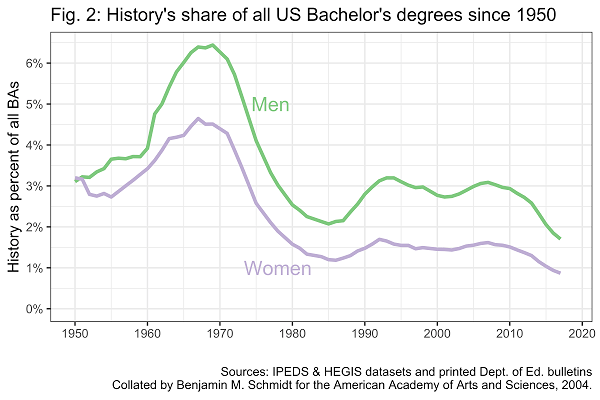
AHA history trends 1The headline is that fewer and fewer college students are choosing to major in history. The obvious culprit is the job market. Though it might not be true in practice, students and their parents tend to see history and other liberal-arts majors as non-professional degrees. Unlike, say, electrical engineering, history doesn’t have a clear and lucrative job path right out of the graduation gate.

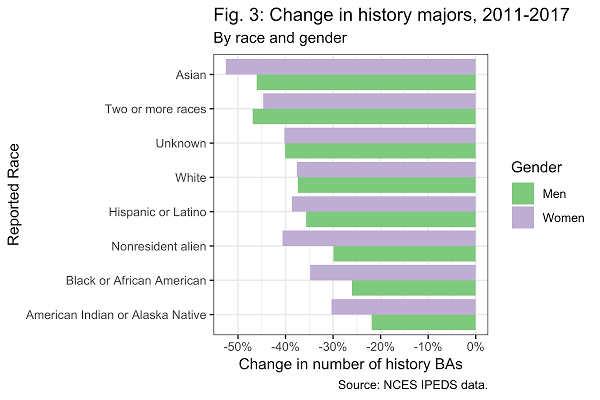
When we poke the numbers a little, though, other trends emerge. For example, the declines among history majors are strongest among Asian-American students, and stronger among women than men.
AHA history trends 2And though the declines are pretty consistent across different types of colleges and universities, they are not universal. At Yale, for example, history has returned to its top spot as the most popular undergraduate major.

What’s going on? First, it’s important to remember that this report focuses on changes in enrollments, not absolute numbers. So, though history may have the largest declines in enrollments, it might still be a very large and very popular major. And while the declines are less steep among some groups, such as African Americans and Native Americans, those groups may have started out from lower enrollment numbers to begin with.

Benjamin Schmidt, author of the AHA report, points to the 2008 economic bust. As he puts it,

the timing of the trend strongly suggests that students have changed their expectations of college majors in the aftermath of the economic shifts of 2008. That the declines have continued among students who entered college well into the economic recovery shows that the shifts are not just a temporary response to a missing job market; instead, there seems to have been a longer-term rethinking of what majors can do for students.

Having noted all that, it’s time for a little wild speculation. Why do Yale undergrads flock to the history major? It could be that affluent, privileged, “country-club” students have the luxury to ignore the job market and follow their academic hearts. Or it could be that Yale undergrads have their flinty hearts set on law school and see a history major as a great preparation.

In the end, it serves as yet another reminder that when it comes to American higher education, elite schools like Yale are not usually trend-setters, but rather oddball exceptions. Time and time again, historians and journalists cite a few elite schools as evidence of the state of American higher ed, but as this evidence reminds us, conditions at those elite schools are usually vastly different than they are on Earth.


Who Pays Tuition to Have Students Killed?

I’m sorry to hear about the death of American missionary John Allen Chau. I don’t want to argue over it—whether he died a hero, a “terrorist,” or a “self-important, arrogant, deluded, foolish . . . pest.” Instead, I want to point out that Chau’s life and death demonstrate the one way that “Fundamentalist U” is now and has always been radically different from mainstream higher ed.

north seintinel island

“Fields white unto harvest…?”

If you haven’t heard the story yet, here it is in a nutshell: Chau was a missionary working with an organization called All Nations. He had made several efforts to contact an isolated group of islanders in the Indian Ocean. The hundred people who live on North Sentinel Island are protected by the Indian government. They have had very limited contact with outsiders.

Chau hired some locals to take him near the island. Islanders paddled out to meet their boat and fired a volley of arrows at Chau, one lodging in his Bible. Chau took a solo kayak and paddled to the island. Later, locals saw islanders burying a body that looked like Chau’s.

missions cartoon guy

The mission: From Liberty University student newsletter, c. 1982

Clearly, the missionary impulse is alive and well. Chau wrote in his diary that he didn’t want to die, but he accepted the risks in his effort to spread the Gospel to the world.

But that missionary impulse hasn’t survived on its own. It has been nurtured and supported by organizations such as All Nations. It has also been taught and encouraged by evangelical colleges and universities. And this missionary focus, I argued in Fundamentalist U, is the thing that most sharply defines evangelical higher education from mainstream schools.

Mission centered

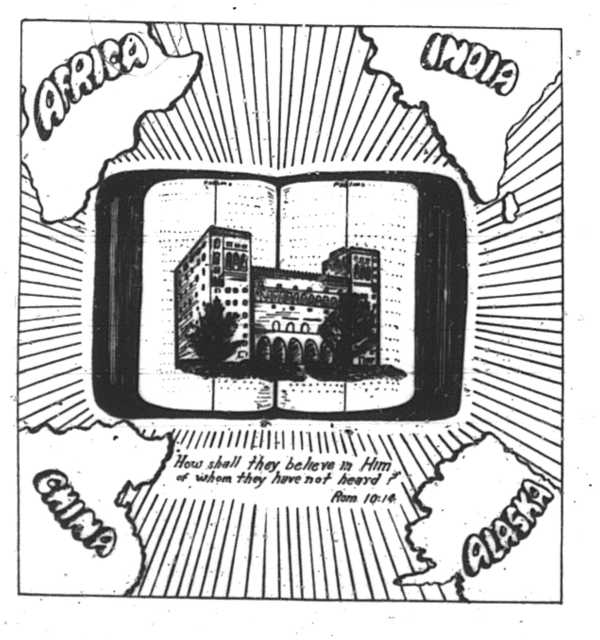
From Biola’s student paper, 1939.

In Chau’s case, it was Oral Roberts University. ORU celebrated the fact that its teaching had led directly to the death of a former student. As ORU put it,

Oral Roberts University alumni have gone to the uttermost bounds of the earth for the last 50 years bringing hope and healing to millions. We are not surprised that John would try to reach out to these isolated people in order to share God’s love. We are deeply saddened to hear of his death.

In most ways, evangelical colleges and universities look and feel a lot like mainstream schools. They promise to prepare students for careers. They promise to help shape students’ values. They promise to keep students safe.

When it comes to missionary work, however, evangelical colleges throw the higher-ed playbook out the window.

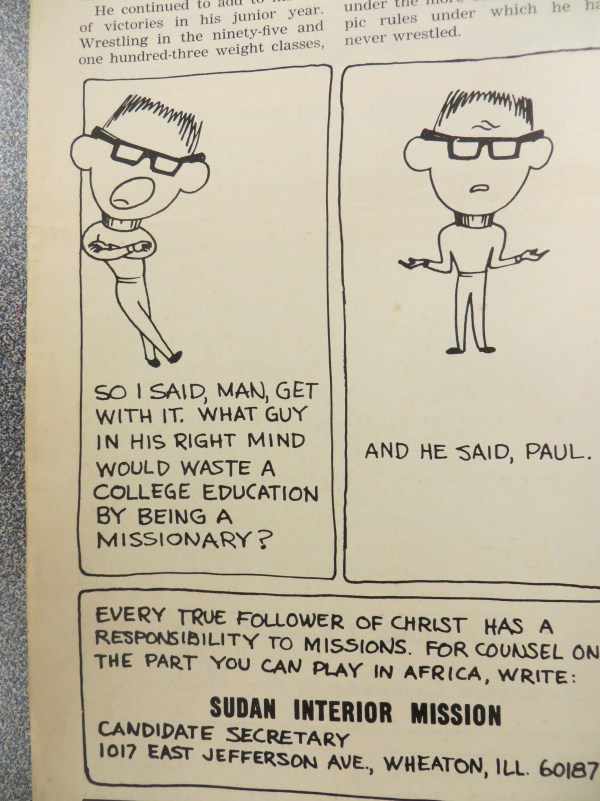
missionary cartoon ad

From the Moody Student, 1969.

For generations, evangelical colleges have maintained their focus on guiding students toward missionary careers. Especially among schools with roots in the Bible-institute tradition, the pressure on students to think about self-sacrificing missionary work was often intense.

One student who attended Moody Bible Institute in the 1920s was a case in point. His father was an atheist. His mother was Catholic. Neither of them wanted him to attend MBI. But he went anyway. And the central lesson he learned there was that he had to give his life to Jesus as a missionary. As he later remembered,

It dawned on me that I had a responsibility toward the Lord’s Great Commission (Matthew 28:18-20).  You see, you can’t be in the Moody Bible Institute very long before you’ll have to face that.

The dedication to sending young missionaries out into the world remained central to evangelical higher education throughout the twentieth century. To offer just one small example of the scope of these schools’ missionary efforts, consider a poll from Biola University in 1962. In that year, according to the student paper, 47% of its graduating class was heading out to full-time missionary work.

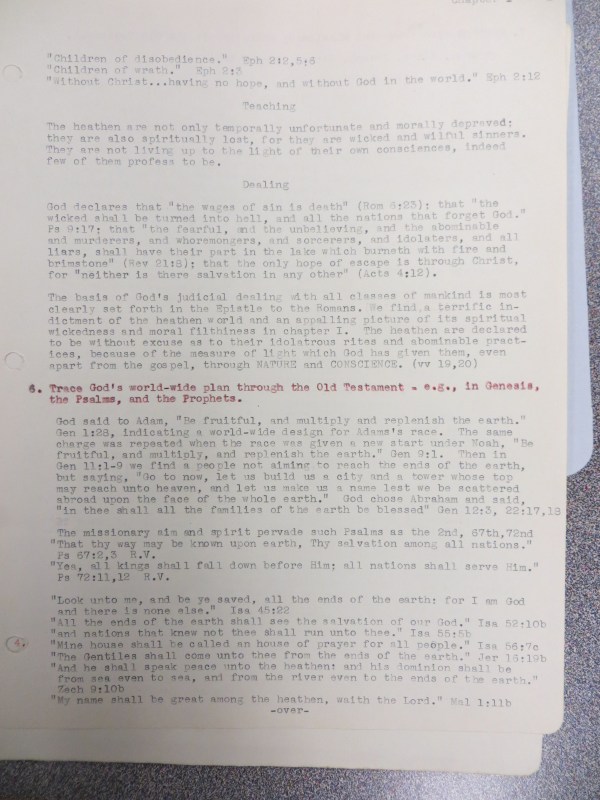
IMG_1919

Classroom notes, MBI, c. 1940s

This focus on missionary work—today and in the past—has been the thing that has made evangelical higher education most radically different from the mainstream. In addition to all the ways it has mimicked mainstream schools—with sports, careers, social life, and academics—“Fundamentalist U” also trained students to give it all up, to sacrifice themselves in missionary labor.

Did Rutgers Just Fulfill the Dreams of White Supremacists?

He’s off the hook. Professor James Livingston has been cleared of charges of racism and harassment by Rutgers University. He might be relieved, but hidden in Rutgers’ decision is a kernel of racial thinking that might dismay Livingston and the rest of us.

Yale White Student Union_1542397045372.jpg_62387087_ver1.0_640_360

This isn’t what he wanted…

SAGLRROILYBYGTH may remember this oddball story. Last summer, historian James Livingston caught grief for his satirical (and IMHO hilarious) anti-white FB rants. As a resident of Harlem, the white professor expressed dismay at the gentrification and suburbanization of the neighborhood. As he put it,

OK, officially, I now hate white people. I am a white people, for God’s sake, but can we keep them — us — us out of my neighborhood? I just went to Harlem Shake on 124 and Lenox for a Classic burger to go, that would be my dinner, and the place is overrun by little Caucasian assholes who know their parents will approve of anything they do. Slide around the floor, you little shithead, sing loudly, you unlikely moron. Do what you want, nobody here is gonna restrict your right to be white. I hereby resign from my race. Fuck these people. Yeah, I know, it’s about my access to dinner. Fuck you, too.

And, in a later post,

I just don’t want little Caucasians overrunning my life, as they did last night. Please God, remand them to the suburbs, where they and their parents can colonize every restaurant, all the while pretending that the idiotic indulgence of their privilege signifies cosmopolitan–you know, as in sophisticated “European”–commitments.

Did these anti-white rants mean Livingston was racist? That he would not be fair to the white students in his classes? That he was guilty of discrimination and harassment? Recently, Rutgers said no. According to documents posted by the Foundation for Individual Rights in Education, Rutgers concluded that Livingston’s posts were beyond humor, but they were not “pervasive,” nor were they directed toward any of his own students. Most important, Rutgers noted that no students had ever complained about Livingston, even in the months following the scandal.

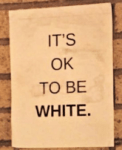
its okay to be white

…or this.

Buried in this apparent vindication of Professor Livingston’s rights to academic freedom, though, is a nugget that should cause great consternation to Livingston and his ilk. To wit: Prof. Livingston defended himself, in part, by saying that there can be no such thing as racism against white people. As the dominant class, Livingston contends, white people by definition can’t be the victims of racism. Portentiously, the university disagreed. As Rutgers put it,

The University makes no such distinction, but prohibits discrimination based on any race, in a blanket manner. As such, from a legal and Policy perspective, “reverse racism,” to the extent it is defined as offensive or intimidating conduct directed at another because he or she is white, is indeed possible and prohibited.

I think it’s a safe guess that Rutgers didn’t mean to do it, but this chunk of legalese seems to confirm the fondest dreams of alt-right pundits. For decades now, conservatives and right-wingers have argued that white people deserve to be treated as just another protected class.

Just recently, we’ve seen a spate of campus activism based on this notion that white students deserve protection, too. Would this Rutgers ruling set a precedent?

Professor Livingston may have won his battle, but did his victory lose a war?

Fundamentalist U at HES

Maybe I should have taken a quantitative turn at Albuquerque! I was honored and delighted to have a group of top historians discuss Fundamentalist U at the recent History of Education Society meeting in sunny Albuquerque. They raised some tough questions and we had a great discussion about the need for a better historical understanding of evangelical higher education.

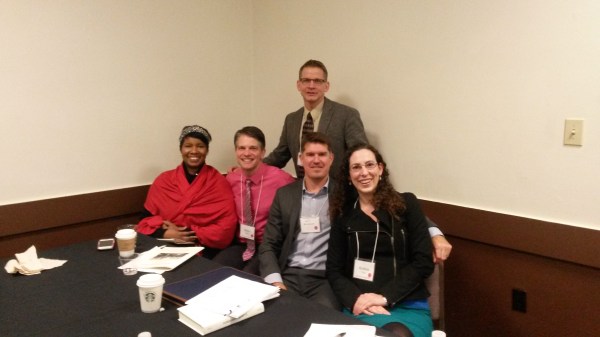
The panel was put together by Professor Andrea Turpin of Baylor University. She invited academic heavy-hitters AJ Angulo, Milton Gaither, and Katrina Sanders. The inestimable Jonathan Zimmerman served as our chair.

HES 2018

Professors Sanders, Gaither, Angulo, and Turpin. Yours truly in the back.

All of the panelists had nice things to say about the book, which was great to hear. But they also raised insightful questions. For example, why doesn’t the book include a clearer description of the numbers of institutions involved? It would have been fairly easy to do and it would have helped readers get a sense of the scope of the evangelical-college movement over time.

Also, the book claims to examine the history of evangelical higher education, but it leaves out large swathes of evangelical schools. Where are the Pentecostals? The Peace-Church schools? It’s a fair point and one I readily acknowledge. The focus of my book is on a subgroup of the evangelical tradition, schools that called themselves “fundamentalist” at some point in time.

We talked about the top-down focus of the book, too. Yes, I tried hard to include student experiences as much as possible, but the central theme of the book, as Professor Gaither pointed out, was

the narrow channel administrators had to navigate between the Scylla of angry fundamentalists watching their every move for signs of creeping secularization and the Charybdis of parents, students, and accreditation bodies who wanted to make sure that the education being provided was respectable.

Last but not least, we discussed the challenges of my sources. In some cases, I was only given access to small parts of archival collections. I wasn’t allowed at all into some archives, like at Bryan College. How did this curated set of papers influence my ability to draw fair conclusions?

All fair questions. And, as I particularly appreciate, questions that demonstrate a keen understanding of the book and my goals. Even given these limitations, I consider the book to be worthwhile. (To be clear, the panelists agreed on this point as well.)

First of all, for historians and others interested in American higher ed, we absolutely must include this family of institutions in our considerations. Too often, we hear pundits and policy-makers talk about the ideological draft of “American higher ed” in ways that seem willfully blind to the true diversity of the higher-ed landscape.

Second, though this wasn’t the focus of these educational historians, we will never understand religious bodies and religious identities if we don’t do a better job of studying affiliated educational institutions. As I argued in Fundamentalist U, too often observers and historians have assumed that we should understand fundamentalism and conservative evangelicalism on theological grounds. That’s useful, but it’s not enough. If we really hope to get a handle on what it has meant to be an evangelical, we need to see what evangelicals have done with their schools. And we need to ask why.

[Oh, and I also saw a roadrunner. I guess they’re like pigeons down there…]

HES 2018 roadrunner

meep meep.

Love Letters from Unexpected Quarters

There aren’t a lot of heroes in Julie Schumacher’s new novel. SAGLRROILYBYGTH will be able to imagine my surprise when I discovered Schumacher’s surprising exception. It wasn’t really the main character, a crusty and cynical novelist and chair of the English Department. It wasn’t even the out-of-touch Shakespeare scholar who insisted on keeping the liberal arts in a liberal arts college. No, the only character that came out as truly sympathetic didn’t come out of the world of elite higher ed but rather from the closed-off world of evangelical home schooling. And it leads us to a bigger question: Do the conservative skeptics have more allies in mainstream higher-ed than they realize?

shakespeare requirement

We’re (almost) all adrift…

I don’t want to give away too much of Schumacher’s plot, so I’ll tell my own story instead. When I first took my current job, a friend in the English Department of the high school at which I worked gave me a copy of Richard Russo’s Straight Man.

“Read it,” my friend said. “You’ll need it.”

Straight Man was my introduction to the field of higher-ed satire. In the novel, a bumbling hero fights to keep college less insane. As the imagined traditions of liberal-arts education crumple in the face of careerism, credentialism, and ruthless bottom lines, Russo’s straight man can only offer ridiculousness in protest.

More recently, one of my current colleagues recommended Schumacher’s fantastic higher-ed satire, Dear Committee Members. Schumacher offered a witheringly on-point send-up of today’s higher-ed scene, with embittered English professor Jay Fitger revealing through a series of recommendation letters his dwindling influence at Payne University. Hilarious and bitterly accurate.

So it was with a lot of eagerness that I finally got my hands on The Shakespeare Requirement. In this novel, Jay Fitger is back, and Payne University is still wallowing in the unenviable position of a small liberal-arts college. In a nutshell, the plot revolves around an attempt to bring the school—and its wacky English Department—into the contemporary world of mainstream higher education.

External funding rules the campus, and notions such as knowledge for knowledge’s sake are out the window. Under pressure, the English Department eliminates its requirement of a Shakespeare class for all English majors. Antics ensue.

All told, I’m pretty disappointed by the novel. It does not capture the wit and weariness that made Dear Committee Members so good. But it does include a curious celebration. Few of the characters or types come off well in the novel. Students are lazy and selfish. Professors are either grasping or clueless. The administration is, at best, pathetic.

Given the bleak landscape, I was surprised to find Schumacher’s ray of hope. One character shines. Angela Vackrey is a freshman, from a family that didn’t want her to come to Payne. She had been homeschooled in a rigorously conservative evangelical household. Angela wanted to find out more about the world than

The pile of paperbound workbooks (Broad Horizon: A Christian’s Historical Perspective) next to the chicken-and-egg-shaped salt and pepper shakers on the maple table where she had completed her schoolwork at home.

Angela is not at all typical of Payne students. For one thing, Schumacher tells us, she still dresses as if she were at church:

Unlike most of the young women in the room, who dressed as if stopping by class on their way to a nightclub, she wore a homely denim skirt and white buttoned blouse.

Also unlike most Payne students, Angela takes her school work seriously. As Professor Fitger discovered, Angela’s writing

Evinced a startling ability to think clearly, express original ideas, and write.

At Payne University, in any case, such abilities make Angela stand out. Her modesty, temperance, and hard work are a stark and startling contrast to the rest of the student body, and even to the debauched faculty.

Indeed, if this novel were to some from some of the usual conservative suspects—higher-ed critics such as Rod Dreher or Peter Wood—it wouldn’t be very interesting at all. But as far as I can tell, Professor Schumacher is no conservative. The yearnings of her characters are not for a purer, Christian society. Rather, Jay Fitger is utterly adrift, and at times, sympathetically so.

In the end, The Shakespeare Requirement is, like Professor Fitger, rudderless. Yet even from that position of cynical drift, Schumacher seems to yearn for a better world, one that can only be maintained by fundamentalist strictures that no one can abide.

Notre Dame and the Fundamentalist Dream

Is it practical? I have no idea. But the proposal last week from students at the University of Notre Dame to block porn from campus pushes all the buttons that animated fundamentalist college reformers a century ago. It goes against the very openness—as Gene Zubovich wrote recently—that has led Catholic higher education to be so much more intellectually vibrant than the conservative evangelical versions.

notre dame

Can they keep the baby if they block the bathwater?

Don’t get me wrong—I’m all for student activism against pornography. I admire the zeal and vision of the Notre Dame students. I’m especially happy to see my fellow men stand up against the exploitation of women and children. As the Notre Dame signatories argued,

We are calling for this action in order to stand up for the dignity of all people, especially women. . . . Pornography is the new sex education, providing a disturbing script about what men find sexually appealing and what women should do to please them. Notre Dame’s sincere efforts to educate students about consent and other aspects of healthy sexuality are pitifully weak in light of the fact that by the time students arrive on campus, many have been addictively watching pornography for years. . . . ​Porn is not acting. The overwhelming majority of contemporary pornography is literally filmed violence against women — violence somehow rendered invisible by the context.

I don’t dispute any of that. Historically, however, the goal of blocking and shielding students as part of a righteous college education has had some unintended consequences. As I argued in Fundamentalist U, the heart and soul of the fundamentalist college dream was to block, ban, prohibit, limit, encircle, and deny. In short, what fundamentalist school founders wanted was to create an alternative system of higher education in which young people could learn without being exposed to the behaviors and attitudes that had taken over mainstream higher education.

As Gene Zubovich argued recently, Catholic higher education has had a different tradition. Of course the Catholic Church has its own long, lamentable tradition of prohibition. Nevertheless, Catholic intellectuals became the big brains of America’s conservative movement in the twentieth century, Zubovich wrote, because

Unlike evangelicals, conservative Catholics could draw on research universities, law schools, medical schools, business schools and other intellectual-producing institutions in the fight against secularism.

Now, I disagree with Zubovich’s across-the-board dismissal of academic and intellectual life at evangelical universities. It was not only Carl Henry (whom Zubovich mentions) who dreamed of creating an academic intellectual powerhouse. As I recount in Fundamentalist U, the roots of the Council for Christian Colleges and Universities were in another ambitious and practical plan to improve the tenor of intellectual life in evangelical schools.

However, that quibble is beside the point this morning. Zubovich is absolutely correct in marking a big difference between the attitudes of leaders at Catholic universities, compared to evangelical ones. Faculty at Catholic universities do not have to sign detailed statements of faith. Hiring for academic positions is done by credentials, not by faith backgrounds. Most important, the expectations of students at Catholic universities has never matched the sometimes-extravagant lifestyle controls imposed by evangelical schools.

What does this all have to do with Notre Dame’s proposed porn filter? Just this: imposing a block or a filter might seem like a laudable purpose, but the long-term impact on any academic institution will be serious, even severe. Do Notre Dame’s signatories want to take their institution down the long path to wall-building?

Higher Ed: The Conservative Crisis that Isn’t

Beware college! That’s the old cry today’s conservative intellectuals are pretending they invented. But they don’t mean it. The best evidence for conservatives’ real affection for American higher ed is the political campaign we haven’t seen recently.

Here’s what we know: Benedictophile Rod Dreher has grown fond of fanning the flames of crisis among his fellow conservative intellectuals. Recently for example, Dreher shared an exposé of the lamentable practices at one elite university. As Dreher’s correspondent concluded,

the balance has been tipped in higher education. It’s not just useless anymore, but it’s now actually doing harm. Not many normal people will be willing to accept that reality — i.e. that their children (and our culture) will be better served by their NOT going to (most) colleges and universities.

Tough talk! We might be tempted to conclude that conservative intellectuals are moving toward a new antipathy toward higher education, but we’d be wrong in two big ways. For one thing, there is absolutely nothing new about this conservative “crisis” in higher education. Furthermore, conservatives don’t really dislike college as a whole.

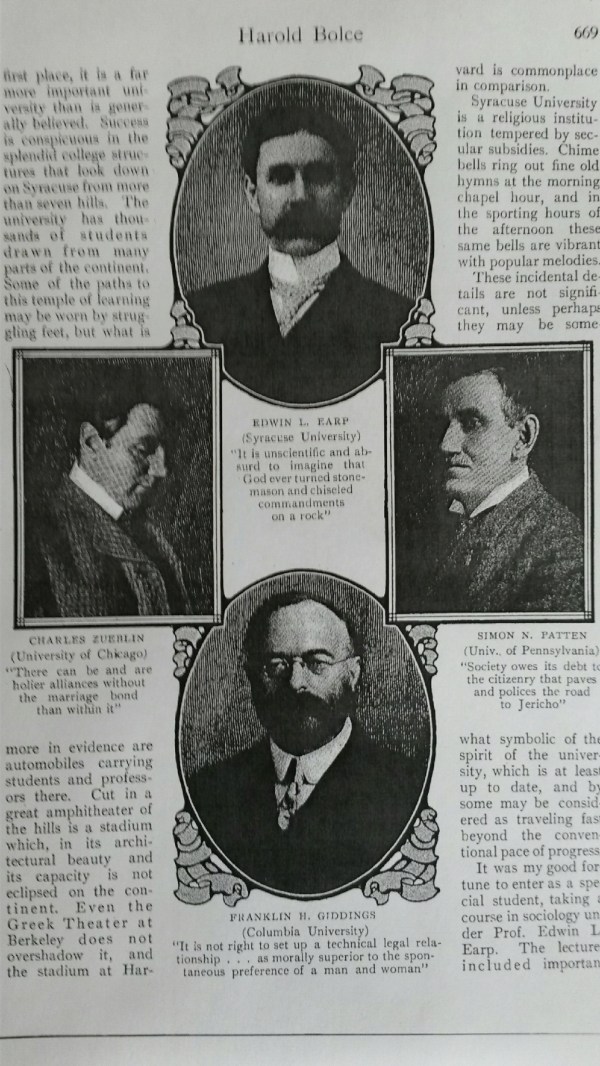
Let’s start with the history. As I argued in Fundamentalist U, conservatives have been noticing the “new” crisis in American higher education for well over a century. In a three-part expose in 1909, journalist Harold Bolce warned readers of the absolutely shocking decline in the state of America’s elite colleges.

bolce page image

Beware! c. 1909

For example, Bolce quizzed Syracuse sociologist Edwin L. Earp and breathlessly reported Earp’s shocking refusal to honor traditional ideas:

“Do you not believe, Professor,” I asked, “that Moses got the ten commandments in the way the Scriptures tell?”

The professor smiled. “I do not,” said he. “It is unscientific and absurd to imagine that God ever turned stone-mason and chiseled commandments on a rock.”

By the 1920s, some conservatives liked to reprint a purported letter home from a pathetic college student. As the student supposedly fretted to his mother,

My soul is a starving skeleton; my heart a petrified rock; my mind is poisoned and fickle as the wind, and my faith is as unstable as water . . . . I wish that I had never seen a college.

We might remind Dreher and his correspondents, then, that their sudden crisis has been percolating for a long time now.

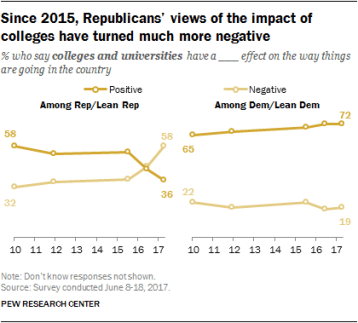
But perhaps something has suddenly changed? After all, we have been told by journalists recently that conservatives have recently begun to distrust American higher education. Last summer, poll results seemed to suggest as much.

pew college gone to the dogsIn fact, though, as we’ve argued before in these pages, it is not college itself that conservatives have come to distrust. Dreher and his associates will surely lose their campaign to warn people away from college as a whole.

How do we know? In this case, we can borrow a page from Sherlock Holmes and listen to the dog that didn’t bark.

True, conservative intellectuals might feel chagrined at their loss of influence in elite universities. Also true, the American public is very willing to believe that silly, leftist things go on in elite colleges. But Americans still want to go. They want their kids to go. And they think people who do go are smart and competent.

Exhibit A: The 2016 presidential campaign of Wisconsin Governor Scott Walker. As journalists noted at the time, Walker was a college drop out. If there really were a widespread, popular disaffection with American higher education, we would have heard him brag about that.

We didn’t. A couple of conservative voices tried to defend Walker’s lack of a degree, but they didn’t say Walker hated college. Rather, they said he had learned from the school of hard knocks instead.

Walker himself bragged that he was a “fighter” who learned from experience instead of in a classroom, but he didn’t pooh-pooh the idea of college as a whole.

What does that tell us?

If nothing else, Governor Walker is a savvy and successful politician. If he thought he could derive political advantage from his drop-out status, he surely would. But Walker is too savvy for that. He knows—even if Rod Dreher doesn’t—that Americans still love higher education. Americans—even conservative Americans—haven’t turned their back on elite colleges. Americans still dream of sending their kids to Yale or Brown or Oberlin, even if they fret about the ideological goings-on.

The “crisis” hasn’t suddenly boiled over in the past year or so. Rather, it is a steady simmering state and has been for a long time now. Even conservatives love and cherish elite universities. If they didn’t, after all, they wouldn’t spend so much time anguishing over them.

Admissions of Guilt

I don’t know anything about the Harvard lawsuit. But there is no doubt that America’s elite universities have a long tradition of elaborate systems of admissions meant to keep out certain categories of student. For a century now, schools like Harvard have scrambled to set up ways to eliminate academically talented students who didn’t fit the Ivy-League mold.

geiger

Non-WASPs need not apply…

Here’s what we know: As Politico reports, the Harvard lawsuit has been dragging on. The school is accused of discriminating against Asian-American applicants. Based on test scores and other numerical data, it appears that Asian-Americans have a higher bar for admissions.

Harvard’s chief admissions officer has made some embarrassing admissions (pun intended. Sorry.) It’s no big surprise to anyone, but students from families of big donors tend to get a better chance. One applicant was added to a list mainly because of input from the fundraising department. As that department chair wrote to the admissions chief in an email, the donor

“has already committed to a building” and “committed major money for fellowships … before the decision from you!) and all are likely to be prominent in the future. Most importantly, I think all of these will be superb additions to the class.”

It’s not only big bucks that give some students preferential treatment. The litigants accuse Harvard of harboring social prejudice against Asian-Americans. Even with great test scores and stellar applications, some students were given poor scores after personal interviews, in which alumni rated the applicants as less likeable. Allegedly.

As historian Roger Geiger has shown, this sort of social scale has always weighed heavily in elite college admissions. Schools such as Harvard, Princeton, and Yale did not start holding competitive admissions processes until the 1920s.

Back then, the schools struggled to find a way to admit desirable students and a fair-sounding way to exclude the undesirables. Back then, according to Prof. Geiger, most of the undesirables were brilliant, hard-working Jewish students. At the time, these Jewish students were derided as “grinds,” students who worked too hard and didn’t fit it with the genteel college culture of the day.

At Princeton, admissions officers in the 1920s had an official social scale. Any student—based purely on their family background and the accompanying personalities—was graded on a four-point scale. The “ones” were automatic admits. Even without looking at messy data such as high-school transcripts, those students from elite families were in. At the other end, students from working-class or non-WASP backgrounds were likely to be branded a “four.” They were automatically barred without any consideration of their academic merit.

Maybe the ugliest example of this genteel anti-Semitic tradition was at Yale. Yale worked closely with the Scholastic Aptitude Test to derive an evaluation that was tightly linked to the curriculum at a few elite prep schools. Students from those schools would do well and earn admission. Students from other schools wouldn’t, no matter how talented or hard-working.

This system allowed Yale to claim an objective, numeric measure for rejecting Jewish applicants, without making the Yalies seem prejudiced or biased.

Are things any different today? The Asian-American plaintiffs say no. They say Harvard is trying to limit the numbers of Asian-American students and using biased, prejudicial standards to do so. I have no idea if they’re right, but elite schools certainly have a long history of doing exactly that.

Heresy Is in the Eye of the Beholder

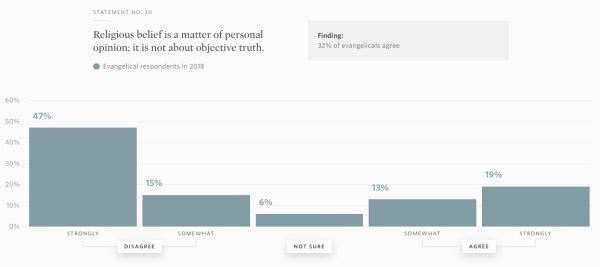
Are you a Christian? Are you sure? A new survey finds that most American evangelicals embrace heretical notions. More evidence that the real meaning of “evangelical” isn’t really theological, but something else.religion as personal belief

Christianity Today reports on new data from Ligonier Ministries and LifeWay Research. Even among evangelical believers, majorities of respondents disavowed orthodox theology. As CT reported,

When it comes to Americans with “evangelical beliefs”. . . the survey found that a majority say:

  • Most people are basically good (52%)

  • God accepts the worship of all religions (51%)

  • Jesus was the first and greatest being created by God the Father (78%)

The last point, especially, has a long and contentious history. The ancient church kind of settled it at the Council of Nicaea in 325, but as this survey proves, ideas about a three-part God are still thinly settled.

Why does it matter? Just like other large religious bodies (by way of comparison, ask any self-described Catholic about Catholic theology), evangelical Protestantism in practice is not defined by theology. Rather, American evangelicalism is a cultural identity that includes religious ideas, but isn’t actually based primarily on religious ideas. To make things more confusing, most religious identities assume that they are based primarily on theological definitions.

In other words, when you ask an evangelical what makes her an evangelical, she’ll likely give you a religious answer. But if you ask her about actual beliefs, she is likely not to know or care much about evangelical theology. The reasons she identifies as evangelical are described in religious language, but they are really a bigger mix of family, tradition, politics, and culture.

This was a big part of my argument in Fundamentalist U. If we really want to understand American evangelicalism we need to push beyond and behind the official dogma that evangelicals have used officially to define themselves. Throughout the twentieth century and continuing today, the leaders of evangelical colleges had to continually prove to a nervous evangelical public that they maintained the standards of evangelical culture—even when those standards weren’t really based in conservative evangelical theology.

To cite just one example, when fundamentalist intellectual J. Gresham Machen left Princeton Seminary in 1929 to open his own, purer Westminster Seminary, he got grief from other college leaders because Machen allowed his seminarians to drink alcohol.

There was no theological reason to ban alcohol, Professor Machen concluded, so he didn’t. Other college leaders were scandalized. The ban on alcohol might not have been a theological requirement–at least for Presbyterians–but it was written so deeply into the cultural bones of America’s conservative evangelicals that it had assumed sacred status.

We can see similar examples everywhere we look today. For instance, why was administrator Randy Beckum chastised at Mid-America? Theologically, there can be little reason to criticize a reminder that Christians need to put their faith before their patriotism.  Culturally, however, that can come as a shocking notion.

Evangelicals like to talk about doing more than just avoiding sin, but even avoiding the appearance of sin. If we want to make sense of the complicated realities of evangelical identity, we need to add a cumbersome caveat. It’s not only that evangelicals need to avoid the appearance of sin, but that they need to even avoid the appearance of things that aren’t really sins but America’s evangelicals think they are. On the flip side, they are free to embrace heresy as long as no one seems to care.

Falwell Wasn’t Trying to Be Funny…

To be fair, it wasn’t the worst mistake he ever made. But Jerry Falwell Jr.’s recent goof has some complicating factors that make it hard to ignore.

lincoln

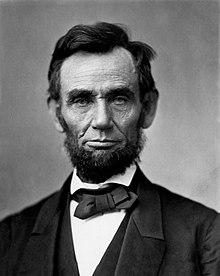
Erm…actually, Jer…

As we’ve seen, Falwell has a rough track record in quotable quotes. As the president of a huge evangelical Christian university, he has in the past misquoted the Bible. That has to hurt.

In his recent interview with The Guardian, President Falwell compounded his errors. If it were someone else speaking, I would be tempted to think Falwell was making a subtle and hilarious gibe. In reality, though, I think he just got mixed up.

Here’s what we know: In the recent Guardian interview, Falwell lauded President Trump to the skies. Not only did Falwell support Trump for strategic reasons, he actually believed Trump to be a morally good person. As Falwell put it,

Ever since I’ve known him, he’s been a good, moral person, a strong leader, a tough leader – and that’s what this country needs.

That’s a difficult position for me to understand. I can understand backing a bad person who is fighting for your side. I can understand backing an immoral character who fulfills important promises. But I can’t understand how anyone would call Trump a “good, moral person.” Maybe some SAGLRROILYBYGTH can explain that one to me.

The point this morning, though, is different. In his encomiums to President Trump, President Falwell insisted that he and Trump were totally on the same page. As Falwell told the Brits,

I usually tweet something similar to what he tweets a day or two before him. We think alike.

And, apparently unintentionally, Falwell went on to prove his intellectual similarity to Trump by making a glaring historical error. I can’t tell for sure, but I think Falwell got confused about what century America’s Civil War was in. America had not been this polarized in a very long time, Falwell said.

not since the civil war. I don’t know where that takes you. I can’t imagine a war breaking out in a civilised society in the 21st century. But if this was the 18th century, I think it would end up in a war. It’s scary.

I hate to be this guy, but anyone could tell you that America’s Civil War happened in the 19th century, not the 18th.

I know, I know, it’s an understandable mistake, sort of. And I don’t think Falwell meant to be funny, but how hilarious would it be if he wanted to prove his similarity to the fact-averse Trump by insisting on making at least one glaring error per public appearance?