Gay Students and the New Fundamentalism

The distinction between “new evangelicalism” and “fundamentalism” was never all that clear. As a story from my neighborhood this week shows, though, it is getting easier to see the difference on the campuses of evangelical colleges and universities. We seem to have a new fundamentalist checklist, not of policies necessarily, but of institutional attitudes on certain key issues.
campbell csu

Out and out.

As I described in Fundamentalist U, the split between fundamentalists and new evangelicals was not a clean break on evangelical campuses. Between the late 1940s and, say, the late 1980s, there were a lot of continuing close connections between evangelical schools that remained with the “fundamentalist” branch of the family and those that had moved to the “new evangelical” side.

These days, generally, the “fundamentalist” label is out of fashion, even among fundamentalist stalwarts such as Bob Jones University. But the meaning remains, and these days we are seeing a clearer and clearer dividing line between evangelical colleges and no-longer-fundamentalist-in-name-but-fundamentalist-in-spirit institutions.

How do you know these days if a school is fundamentalist? It’s not necessarily a question of policies, but rather a spirit in which certain hard-line positions are maintained and a zeal with which they are publicized. ALL evangelical colleges and universities will be creationist, for example. And all will—from a mainstream perspective—have discriminatory policies against LGBTQ+ students and faculty. All conservative-evangelical schools will also tip toward conservative politics and cultural traditionalism.

The fundamentalist branch of the family, though, will insist on the hard edge of these positions in a consistently aggressive way and they will go out of their way to publicize their hard stand on these issues. Fundamentalist schools will trumpet their insistence on the following:

  • Young-earth creationism ONLY;
  • Political and cultural traditionalism;
  • And, most relevant for our purposes today, a loud, publicized hard line against any whiff of homosexuality on campus.

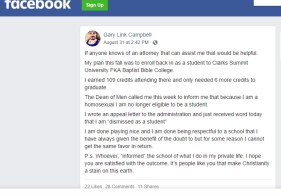
Consider the news from Clarks Summit. A former student has tried to re-enroll. Gary Campbell dropped out in 2005, only six credits shy of his degree. After a rough stint in the Navy, Campbell now wants to return. The school says no.

According to Campbell, the Dean of Students contacted him to let him know Campbell won’t be allowed to return, because Campbell is homosexual.

To be clear, from a mainstream perspective, all evangelical colleges discriminate against LGBTQ+ students and faculty. Even firmly non-fundamentalist evangelical institutions such as Gordon College and Wheaton College have issued reminders recently that gay is not okay.

But Clarks Summit University’s stance has a hard edge to it that helps define the new fundamentalism. Campbell’s sexual identity was apparently revealed to administrators by a fellow student, at least according to Campbell. The school could easily have re-admitted Campbell quietly.

Instead, the school’s administration chose to use this case as a chance to publicize its hard line. When journalists called about Campbell’s story, the university issued the following statement:

As a Christian college, we expect all students to act in a way that is consistent with our biblical belief system. We have always clearly stated those beliefs and have exercised the freedom to uphold our faith. . . . To prepare students for worldwide service opportunities, CSU clearly affirms biblical sexuality. We clearly communicate to all prospective students that we adhere to biblical truths, and expect them to do the same. That is part of what has made CSU a successful educator for more than 80 years. We would be happy to assist any former or prospective student who does not choose to agree with those faith standards to find another school in order to finish a degree.

These days, to be a fundamentalist institution means flying and flaunting the fundamentalist flag. It means taking every opportunity to enforce hard lines on sexual identity.

We see the same phenomenon in other issues such as creationism or political conservatism. In order to remain attractive to fundamentalist students and parents, school administrators take drastic steps to ratchet up their commitment to young-earth creationism or knee-jerk political conservatism.

What does it mean to be “fundamentalist” these days in evangelical higher education? As has Clarks Summit University, it means taking and, importantly, publicizing a hard line on issues of sexuality, creation, and political conservatism.

Fundamentalist colleges want their level of commitment to be known. They hope students, alumni, parents, and donors will recognize their positions and reward them with continued enrollments, donations, and support.
Will Liberty Get on the Ozark Train?

For those people who still think evangelicalism should primarily be defined by theological distinctions, consider the news: Yet another conservative evangelical college is considering dropping its Nike contract over the anthem-protest issue. How does theology explain that one?

falwell on nike

Football, America, and God too.

SAGLRROILYBYGTH will remember that the College of the Ozarks already announced its anti-Nike stance in the wake of Nike’s Colin-Kaepernick ad. They may also recall our point here at ILYBYGTH that such staunch knee-jerk conservative patriotism was not the exception, but the rule for evangelical universities in the twentieth century.

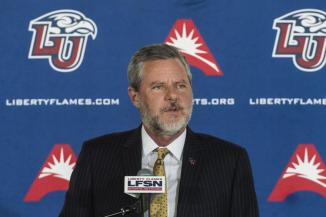
Some might say that COE’s uber-patriotism is just an odd outlier in the world of evangelical higher education. Today it looks like COE might have more company. According to President Jerry Falwell Jr., Liberty University in Virginia is considering scrapping its sponsorship deal with Nike. Unlike College of the Ozarks, Liberty is a cash-rich up-and-comer in the world of NCAA athletics.

As Liberty University’s Jerry Falwell Jr. told USA Today:

We’re exploring the situation. . . . If Nike really does believe that law enforcement in this country is unfair and biased, I think we will look around. If we have a contract, we’ll honor it, but we strongly support law enforcement and strongly support our military and veterans who died to protect our freedoms and if the company really believes what Colin Kaepernick believes, it’s going to be hard for us to keep doing business with them.

But if it’s just a publicity stunt to bring attention to Nike or whatever, that’s different. We understand that. We understand how marketing works. But they’re going to have to convince us that they’re not proactively attacking law enforcement officers and our military. If that’s the reason behind using this ad, we’re going to have a hard time staying.

For many Americans, Falwell’s defiant conservative patriotism makes sense. For a lot of people, it’s probably even admirable. But how is it part of evangelical religion?

In short, it’s not, if we try to define evangelicalism only by theological notions such as a reverence for Scripture and an emphasis on soul-winning.

But! If we understand American evangelicalism—the Falwell/Liberty kind, at least—as a conservative cultural mish-mash, including conservative ideas about religion, but also about race, the South, gender rules, sexuality, and so on, then Falwell’s aggressive militarism fits perfectly.

An Exception? Or a Rule?

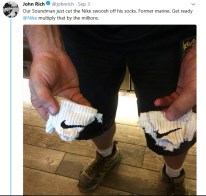
Conservatives are cutting up their socks in protest. And at least one evangelical college has dumped Nike over its defense of Colin Kaepernick’s anthem protests. Some in-the-know commentators think this is way out of bounds for evangelical schools. Historically, though…not so much. Is knee-jerk patriotism the rule or the exception at conservative evangelical colleges?

nike sock protest

Take that, anti-anthem mega-corp!

As I argued in Fundamentalist U, during the twentieth century aggressive conservative patriotism played a large role at all the evangelical colleges I studied. At some, such as The King’s College and John Brown University, it became a central focus. In the mid-1960s, at least, notions of fusing traditional patriotic conservatism with evangelical conservatism held a lot of appeal for many evangelical academic types.

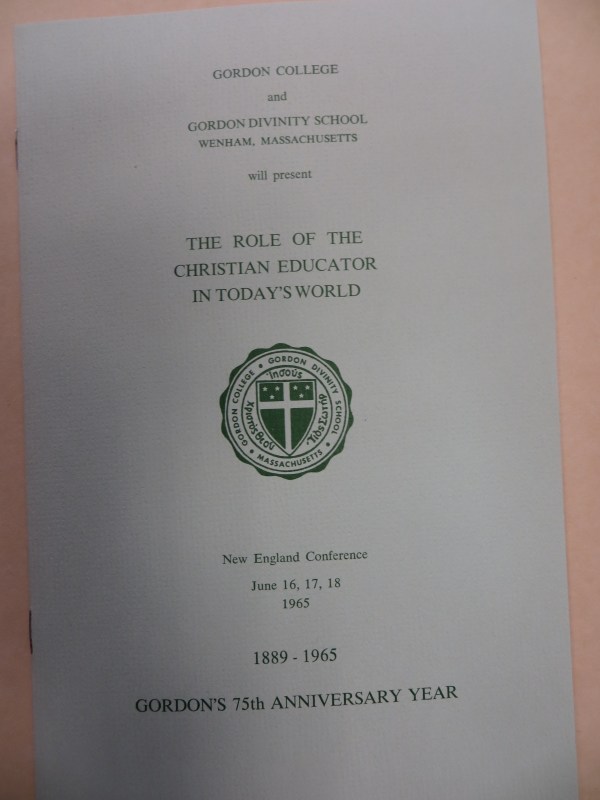
A “Freedom Forum” planned at Gordon College in 1965, for instance, offered the following rationale:

What philosophy shall give direction to the material world we are developing?  Shall the long-felt influence of the Christian ethic be brought to bear on current history?  Dare we succumb to the seemingly plausible suggestions that in our time government-over-man is preferable to America’s long proven concept of man-over government?

Can we survive as a people, even with our unparalleled abundance of things, if our thinking excludes our traditionally motivating intangibles . . . . [sic ellipsis in original] reverence for God, total human concern for the individual, an abiding dedication to preservation of our Constitution and a cherishing regard for personal Freedom? [sic]

The Christian educator occupies a unique position of leadership from which emanate those spiritual emphases which give salutary meaning and purpose to life, not only individual but national.  Waiting for that leadership are millions of earnest Americans who need help in their endeavor to ‘prove all things and hold fast that which is good.’ . . .

Objective: Inclusion in the curricula and teaching emphasis in Christian colleges of a pervading high regard for Freedom in its spiritual, economic and political dimensions and to create an informed student-citizen leadership needed to safeguard and extend Freedom in the years ahead.”

In the end, under pressure from Gordon faculty to avoid too close collusion with the political “extreme right,” the vaunted Freedom Forum didn’t happen. But there was always—and I think still is—a very strong push among many evangelicals to tie their conservative patriotic impulses to their religious beliefs.

american studies conference 1966 program

For God and Country…or Country and God…?

This is true not only for uber-patriotic schools such as Harding, John Brown, and the College of the Ozarks. Giants like Liberty University and smaller schools such as Mid-America Nazarene still have a hard time figuring out the relationship between religion and patriotism, with patriotism often coming out on top.

In this case, College of the Ozarks certainly seems like a Nike-hating outlier. But is the impulse to in-your-face conservative patriotism really so out of bounds for other conservative evangelical colleges? I don’t think so.

The Even-Less-Sexy Truth about this Sexy Scandal

Sometimes the devil doesn’t wear Prada. Sometimes she wears clunky oversized glasses and ostentatiously kitschy t-shirts. At least, that’s the lesson I’m getting from the sad stories oozing out of New York University’s latest scandal. What I don’t understand is why so many academic commentators think the situation is somehow unique to elite academic life. To this reporter, it seems that condemnations of grad studies as “cultish subjection” seem to sidestep the most important point.

Here are the basics: NYU’s comparative literature department is roiled by accusations and counter-accusations in the case of Professor Avital Ronell. Ronell is accused by former graduate student Nimrod Reitman of harassment and abuse. The accusation is littered with kooky emails [here are some examples] and trainwreck-level details about their relationship.

Adding even more complication, several top scholars have come to Prof. Ronell’s defense, claiming special status as feminists.

avital ronell

…you are under my commaaaand…

Former students of Ronell’s have gone public with their additional accusations. According to former student Andrea Long Chu, Ronell really was a mercurial, dictatorial, needy oddball. She insisted her grad students relish their status of “cultish subjection.”

Is this a story a condemnation of elite academic culture? As Corey Robin has argued, is this about more than sex, more than feminism? Professor Robin has argued the case was really about

the question of power. This is a grad student trying to make his way in an institution where everything depends on the good (or bad) word of his adviser.

To my mind, that sounds true enough, but I don’t see how this problematic relationship is unique to academic life. It seems to me that anytime employees are dependent on their boss’s good opinion, exceptions like this will pop up.

I don’t see how this sad scandal tells us anything that we didn’t already know. Namely, in any job in which the employee is willing to do anything to get ahead, some exceptional bosses will take cruel advantage.

Does This Help?

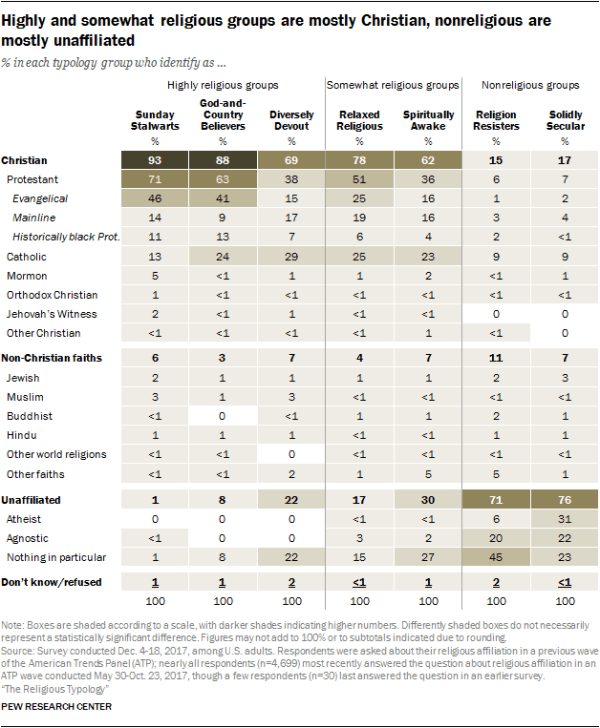
We all know it doesn’t help much to know someone’s religion. That is, just knowing that someone is Catholic, or Jewish, or Muslim, or Protestant doesn’t really tell us much about them. We want to know what KIND of Protestant someone is, what KIND of religious person. The folks at Pew have taken a stab at a new way of grouping religious people. Instead of denominations, sects, or faiths, Pew offers new “typologies.” Do they help you understand American religious and culture better? And do they confirm Professor Hunter’s twenty-five-(plus!)-year-old prediction?Pew typologies

Here’s what we know: The typologies cluster Americans into three categories and seven groups. Some people are “highly” religious, others are “somewhat” religious, and the rest are “non-religious.” The highly religious folks are subdivided into “Sunday Stalwarts,” “God-and-Country,” and “Diversely Devout.” The somewhats are broken down into “Relaxed Religious” and “Spiritually Awake.” The non-religious are cut up into “Religion Resisters” and the “Solidly Secular.”

In some ways, these categories point out surprising facts. For example, as Friendly Atheist Hemant Mehta pointed out, the Solidly Secular are surprisingly similar to the stereotype of the GOP: Richer, whiter, and maler than the American average.

In other cases, the categories seem to confirm culture-war stereotypes. As the report notes,

Although no political measures were used to create the typology, arraying the groups from most to least religious also effectively sorts Americans by party identification and political ideology. Republicans make up a majority of Sunday Stalwarts and God-and-Country Believers, while even larger majorities of Democrats comprise the two nonreligious groups. Similarly, self-described conservatives prevail among the two most religious groups, while, by comparison, the two nonreligious groups lean left.

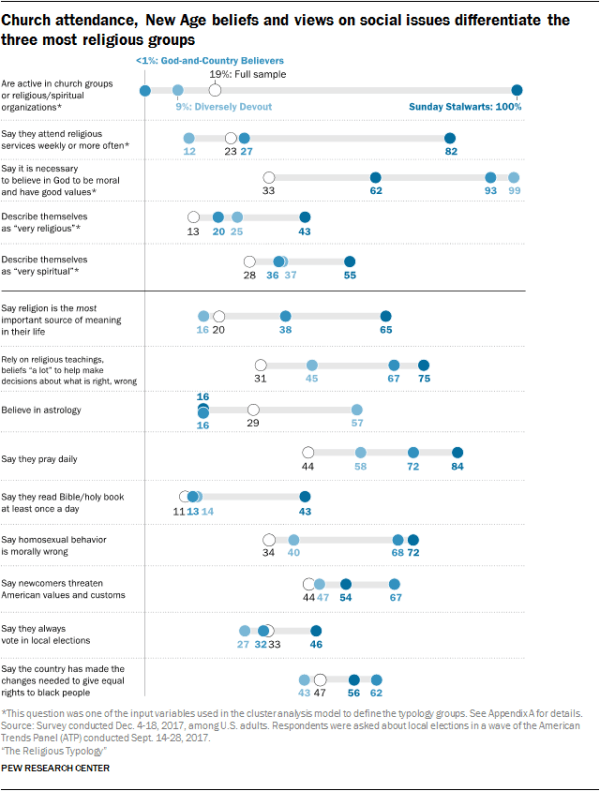
Certainly, when we look at the three “highly” religious typologies, they seem to tilt hard to the cultural right. For example, they are more likely than average to think homosexuality is morally wrong. They are more likely to be leery of immigrants. And the Sunday Stalwarts and God-and-Country folks are more likely to think racial inequalities are a thing of the past.Pew typologies 3 very religious

To my mind, these typologies are much more useful than traditional labels such as “evangelical.” Lots of self-identified evangelicals, for example, cluster in the Sunday Stalwart, God-and-Country, and Diversely Devout types. But there are also plenty of evangelicals who are more “relaxed” about their faiths.

In part, these types seem to confirm what sociologist James Davison Hunter predicted back in the early 1990s. His claim at the time was that traditional religious labels would become less and less important. It would matter less and less, Professor Hunter argued, if someone was Catholic, Protestant, Jewish, or Muslim. Instead, people would tend to cluster around the culture-war poles, either “orthodox” or “progressive.”

Does it work for you? Do you feel these types are more useful than traditional labels to understand religious and cultural life in America? Do you fit into one of these typologies, or do they seem too simplistic?

Teachers as Culture Warriors? …Really?

Have you hung out with a schoolteacher lately? In general, we are a pretty mild-mannered set. Sure, there’s the occasional Thursday-night margarita/gripefest, but by and large the teachers I know are mostly interested in doing their jobs well and eventually paying off their student loans. So why, oh why, have teachers always been at the forefront of our educational culture wars? For at least a century, teachers have been the darlings of the Left and the demons of the Right.

Gillum

Love em…

We see it again in the recent surprise victory of Andrew Gillum in Florida. The mayor of Tallahassee, Gillum was far from the front runner in the state’s democratic primary for governor. How did he score the surprise win? For one thing, Gillum has promised to boost pay for Florida’s teachers. As Gillum told his story,

We didn’t have much money, but my parents and grandmother made sure we took our education seriously. I was blessed to have great public school teachers who poured their energy, time and love into me.

Without them I wouldn’t be running for Governor today — and next year as Governor, we’re going to give all of our teachers and support staff the raise they deserve. From setting a statewide floor for new teachers’ salaries of $50,000, to bringing every public school instructional teacher up to the national salary average of $58,000, and making sure veteran teachers are compensated for their years of service, it’s time our teachers get paid appropriately for doing some of the important work in our society.

Right now, they’re woefully underpaid, and many are struggling to provide for themselves.

For Mayor Gillum and other lefties these days, public-school teachers represent all that is good and hopeful in American politics. By maintaining strong unions (maybe) and striking for better conditions, teachers have come to serve—for some—as a symbol of socialist promise.

For once, conservative pundits agree. Unlike Gillum, conservatives hate it, but they agree that teachers are a powerful force for the Left. As one conservative writer described, teachers are

spending time promoting a left-wing agenda and bullying conservative students rather than teaching the subjects they are paid to teach.

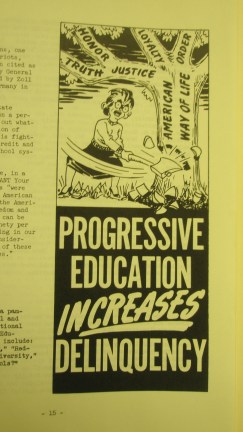
It was ever thus. As I argued in my book about the history of conservative educational activism, I looked at culture-war thinking about teachers throughout the twentieth century. In every decade, in every school controversy, teachers were beloved by progressives and despised by conservatives. The assumptions were usually the same—wild-eyed leftist teachers were trying to warp their students’ minds, to get kids to embrace the latest versions of amorality and socialism.

Zoll, Progressive Education Increases Delinquency

… or hate em, both sides agree that teachers are progressive culture warriors.

For example, in 1935 US Communist Party leader Earl Browder took to the pages of Social Frontier journal to encourage teachers to fulfill their potential, to serve as a “special sector of a common battle-front” for progressive ideals. In the same era, right-wing education pundit Allen Zoll condemned precisely the same goal for teachers. Too many teachers, Zoll denounced, only wanted to promote the “inculcation of currently popular herd ideas on a mass basis.” The ultimate goal of teachers, Zoll believed, was to produce

a tragically misshapen generation . . . without the ability to think for themselves, filled only with the desired herd ideas—fit only to be citizens of the authoritarian state?

Both Zoll and Browder were extremists, but they shared this vision of the power, promise, and plausibility of large numbers of teachers who see their main goal as promoting leftist politics.

And, of course, the stereotype sometimes fits. I know teachers who see their primary mission as political. Some teachers hope to push their students toward a leftist viewpoint. But most teachers are mainly trying to help students do as much as well as students can.

So here are my questions this morning:

  • Do many teachers really fit the culture-warrior stereotype?
  • If not, why are those stereotypes so powerful and so enduring?

Can This Professor Be Racist?

Should he stay or should he go? The alt-right has been howling for James Livingston’s professional blood. Rutgers seems willing to punish him. Is this a case of academic racism? Or of academic freedom? I know there are no simple equivalencies among different sorts of racism, but it seems to me we DO have a relevant precedent for this case.

livingston 1

Rude, yes. Racist?

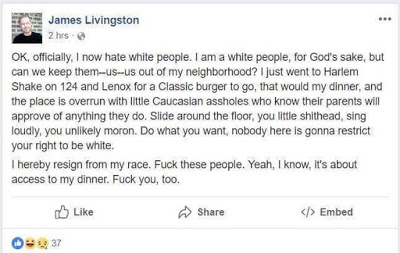
Here’s what we know: History professor James Livingston attracted a lot of negative attention for his anti-white screeds on Facebook. He railed against white people for their sense of entitlement and their arrogant ignorance. As he put it,

OK, officially, I now hate white people. I am a white people, for God’s sake, but can we keep them — us — us out of my neighborhood? I just went to Harlem Shake on 124 and Lenox for a Classic burger to go, that would be my dinner, and the place is overrun by little Caucasian assholes who know their parents will approve of anything they do. Slide around the floor, you little shithead, sing loudly, you unlikely moron. Do what you want, nobody here is gonna restrict your right to be white. I hereby resign from my race. Fuck these people. Yeah, I know, it’s about my access to dinner. Fuck you, too.

And, in a later post,

I just don’t want little Caucasians overrunning my life, as they did last night. Please God, remand them to the suburbs, where they and their parents can colonize every restaurant, all the while pretending that the idiotic indulgence of their privilege signifies cosmopolitan–you know, as in sophisticated “European”–commitments.

Is this racism? And therefore cause for dismissal? Livingston says no. He defended his comments as partly satirical, partly ridiculous, but also non-racist. There is no such thing as anti-white racism, Livingston explained. As he put it,

Racism is the exclusive property of white, mostly European people in this part of the world (the western hemisphere), because such people were able to impose their will on 9 million Africans via a labor system called slavery, and benefit from the economic and social capital of that system unto this day—regardless of their class standing, then or now.

Rutgers disagreed. The administration concluded that Livingston’s comments violated the university’s discrimination and harassment policies and damaged the university’s reputation. As the administration explained,

Professor Livingston clearly was on notice that his words were offensive, yet instead of clarifying that he meant to comment on gentrification, he chose to make another belligerent barb against whites. Given Professor Livingston’s insistence on making disparaging racial comments, a reasonable student may have concerns that he or she would be stigmatized in his classes because of his or her race. As such, Professor Livingston’s comments violated university policy.

What to do? Can the university fire a tenured professor for offensive comments? Rutgers says yes. The administration announced it will soon decide the proper disciplinary action, up to and including discharge. Will Creeley of Foundation for Individual Rights in Education (FIRE) says no. As he told IHE,

Rutgers has effectively subcontracted out its obligations as a public institution under the First Amendment to outraged internet mobs. . . . The real concern for us is that this is part of a trend, and if would-be internet trolls see that flooding universities with hate mail and being loud online is a successful way to silence faculty members whose views they disagree with, that will be repeated.

How can this baby be successfully cut in half? How can an academic’s right to freedom of thought and expression be balanced with a university’s duty to protect its reputation and its students from angry professors?

To this reporter, it seems like we’ve been here before. Rutgers could follow the example of Penn last year. SAGLRROILYBYGTH might remember the case of law-school professor Amy Wax. Wax had already attracted negative attention for her recommendation of “bourgeois culture.” In a radio interview, Wax noted that she hadn’t had any top-notch African American students in her class. People were outraged.

What did Penn do? They didn’t fire Wax. They defended her right to academic freedom. But they DID remove her from teaching a mandatory class. It would not be fair to force students to take a class from a professor that had such pre-conceived notions about racial disparities, they concluded.

Could Rutgers do something like that here? As the Rutgers administration noted, students were leery of taking a class from Professor Livingston, who clearly has preconceived notions discriminatory against white people. So just have Livingston teach optional courses. Make a public statement condemning his attitudes but defending his right to speak them publicly.

Would that be a fair solution in this case?

An Errant Evangelical

C’mon….we all know what he meant. But for the president of an evangelical university to make this sort of goof and leave it undeleted still surprises me for two big reasons.

falwell sewed

“…by their tweets shall ye know them…”

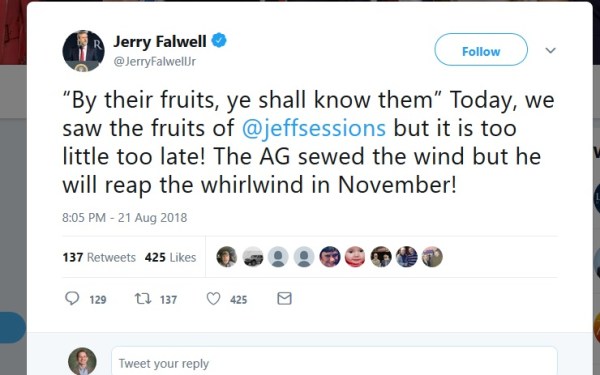
Here’s what we’re talking about: The tweeters are aflutter about a statement by Jerry Falwell Jr. of Liberty University. Falwell blamed Attorney General Jeff Sessions for the recent legal hot-water of top former Trump aides.

Here at ILYBYGTH, we’re more interested in Falwell’s scripture goof. Of course, he didn’t mean anyone “sewed” the wind. He’s referring to Hosea 8:7, in which people “sowed” the wind.

On one hand, it’s easy to make a simply typing mistake, especially on Twitter. In this case, though, I’m really surprised Falwell has left it up, mostly because it’s not a simply misspelling. “Sewed” is a totally different word with a different meaning, implying that Falwell doesn’t understand what Hosea was talking about. In other words, it’s not only a misspelling, but a misquotation.

It would be different if Falwell had accidentally typed “sowd the wind” or “sowed teh wind,” but “sewed the wind” makes it seem like Falwell just doesn’t really know the Bible verse all that well.

And that makes me surprised to see it linger, for two big reasons.

First of all, among the conservative evangelical and fundamentalist public, nothing matters more in a university leader than deep knowledge of and reverence for scripture. This sort of uncorrected typo makes it look as if Falwell didn’t understand the gist of the chapter and verse. Or worse, he doesn’t care enough about fidelity to Scripture.

Second, Liberty University has always desperately wanted to win mainstream academic respectability. In recent years, they have spent bajillions of dollars to do so. For Falwell to leave this misquotation undeleted makes his school look even more like the anti-intellectual cloister it has often been accused of being.

In School We Trust

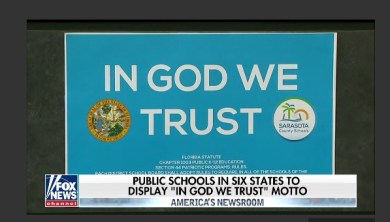
Why do conservatives want to put “In God We Trust” banners in public schools? So far, six states have okayed the plan and Kentucky has just entertained a bill to join the list. Why? After all, conservative religious people have the MOST to lose if public schools ditch their fifty-year-old goal of secularism.

in god we trust

Why do conservatives want to trust salvation to the government?

The laws mandating or allowing the display of “In God We Trust” banners are the fruit of a push by the Congressional Prayer Caucus Foundation. The CPCF has offered a list of model bills for state lawmakers to consider, with “In God We Trust” school banners at the top of the list.

Why does the CPCF want to put up this banner in public schools? The CPCF insists that the United States must “protect religious liberties” and remain a religious nation. As their promotional video proclaims,

We need this kind of revival of people turning back to God . . . . “In God We Trust.”. . .  it’s an American thing. . . . let’s again write “In God We Trust” on our buildings, in our classrooms, to combat the anti-God dismantling of our nation.

I understand why certain religious conservatives want to see more proclamations of religious faith in public spaces. But I don’t understand why more conservative intellectuals don’t step up to explain the anti-religious implications of these governmental efforts.

After all, back in 1962 when the US Supreme Court ruled that public schools could not impose a vague prayer on schoolchildren, conservative evangelical intellectuals celebrated the decision. I’ve written more about this history in an academic article, but in brief, conservatives were delighted that the government would not be allowed to force children to pray a bad prayer.

In that SCOTUS case, New York schools had been leading children in this blah prayer:

Almighty God, we acknowledge our dependence on Thee, and we beg Thy blessings upon us, our parents, our teachers, and our Country.

To conservative religious thinkers, the idea that a mere government entity could teach children that this was an acceptable prayer was horrific. William Culbertson of Chicago’s conservative Moody Bible Institute commented,

The public as a whole and Christians who sense the necessity for safeguarding freedom of worship in the future are always indebted to the Court for protection in this important area.

Where are today’s conservative Culbertsons? Where are the conservative leaders pleading with politicians to avoid stepping on their religious toes? To avoid replacing real, heartfelt, meaningful religious expression with state-friendly, patriotic, bland platitudes? After all, as Culbertson and his conservative colleagues recognized, it is people who care the most about religion who have the most to lose if public schools cram ANY religion down children’s throats.

Tinder and the Death of God

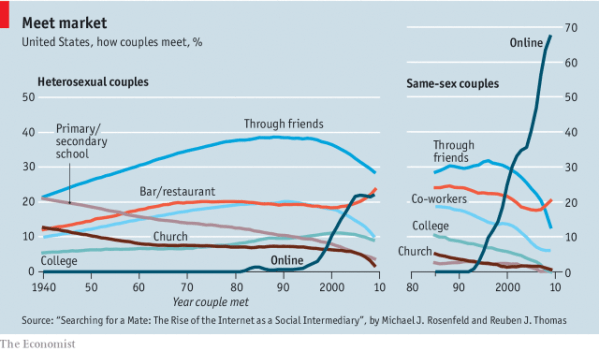
Where did YOU meet your spouse? If you’re as old as I am, you likely met them through friends, or at work, or out and about. If you’re much younger, chances are increasing that you met online. A recent survey in The Economist has me wondering if the popularity and success of online dating has something to do with the slo-motion secularization of society.meet market

Here’s what we know: Apps like Tinder have become the norm for dating. So while a significant proportion of married couples used to meet at church, that number has dwindled to nearly zero in recent years. I can’t help thinking that couples who met in church might be more likely to remain in that church and raise their kids in that church.

If fewer and fewer couples—both same-sex and hetero—are meeting in church, does that bode ill for religious affiliations? Are couples who meet on line less likely to have a strong affiliation with a church, or with organized religion as a whole?