The contradiction that seems so obvious to me is apparently a false one. To me, it would make sense if white evangelicals became disaffected with Trump’s in-your-face leadership style, with his reputed sexual dalliances, and with his hazy patriotism.
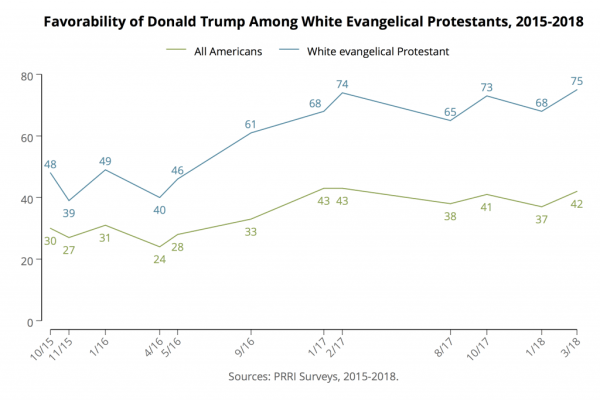
Among white evangelical respondents, there is no problem. A whopping seventy-one percent of white evangelical women like Trump. An even higher eighty-one percent of men do.
Could this be a division between “faculty-lounge” evangelicalism and the popular sort? The numbers suggest otherwise. True, college-educated white evangelicals support Trump in lower numbers, but still at a very high sixty-eight percent. Among those who have not been to college, seventy-eight percent of white evangelicals are pro-Trump.
Why so much Trumpism? One of my conservative evangelical friends offered his two cents. As he put it,
Adam, it is very simple why Trump has such wide-spread support among conservatives, we finally have a president on our side in the culture wars.
I get it, I really do. I think arming teachers is a terrible idea, but I understand that lots of people disagree with me. When it comes to ideas like the ones we’re seeing this morning, though, we can’t possibly disagree. Does anyone really think this is a good idea? More important, the kerfuffle might tell us something about how schools work in the real world.
The superintendent explains his plan…
Here’s what we know: Some school districts in Pennsylvania have approved plans to arm their teachers…with miniature baseball bats. You know, the kind you got as a kid when you went to a Brewers game, then left on your desk in your bedroom until finally someone threw it out or something.
The head of the local teachers’ union defended the move. As he put it,
This is a tool to have in the event we have nothing else. . . . Part of the formula now is to fight back. . . . The theory behind the attack option is to create noise, distract, or defend against an active shooter. For a classroom or office setting, this translates to books, staplers, chairs, fire extinguishers, etc. being used as defensible tools.
We didn’t want our students to be helpless victims. . . . River stones were my idea. I thought they would be more effective than throwing books or book bags or staplers.
Can they be serious? Is there any support out there for these sorts of preposterous plans?
It seems merely wacky, but this story tells us something about the way public schools often work in practice. There will be a controversial idea—evolution, sex ed, or, as in this case, arming teachers. District leaders will want to be seen taking action, but they also want to avoid controversy at all costs. The result? Half measures that veer sharply into the ridiculous.
Early distance-learning programs at MBI claimed to reach the world with cutting-edge technology, c. 1947. These “mountaineers” got free Gospels if they read them in school. And, yes, that is their school building.
The Liberty Online story is a big one. As the Times article describes, Liberty now claims $2.5 billion (yes, that’s B-illion with a B) in net assets, largely from its online department. Because Liberty is a non-profit, it is not subject to the same oversight as for-profit schools such as Corinthian and the University of Phoenix.
Some online students, the article describes, felt pressured to sign up and ripped off with the results. As one unhappy former Liberty student told the Times,
What’s killing me is that I went into this program to try to change my situation . . . and I’m worse off than I was at the beginning.
But the Times story leaves out a crucial part of the historical context. The way they put it, Liberty’s online program came about as part of an experiment, an “educational novelty.” As the article explains,
One educational novelty that Falwell dabbled in, starting in the mid-’70s, was an early form of distance learning. Liberty would mail lecture videotapes and course packets to paying customers around the country — at first just certificate courses in Bible studies, and by the mid-’80s, accredited courses in other subjects as well.
The inspiration, according to the NYT, was the work of John Sperling and the University of Phoenix. I don’t doubt that President Falwell Jr. admired Sperling’s business model. I don’t dismiss the importance of the notion that Falwell has treated his school, as he told NYT, “like a business.”
However, if we really want to understand Liberty’s online success, we have to also understand its context as part of the history of evangelical higher education. It is difficult for some secular people (like me) to notice or acknowledge, but evangelical schools and missionary institutions have always led the way with finding new ways to use new technology to deliver distance education.
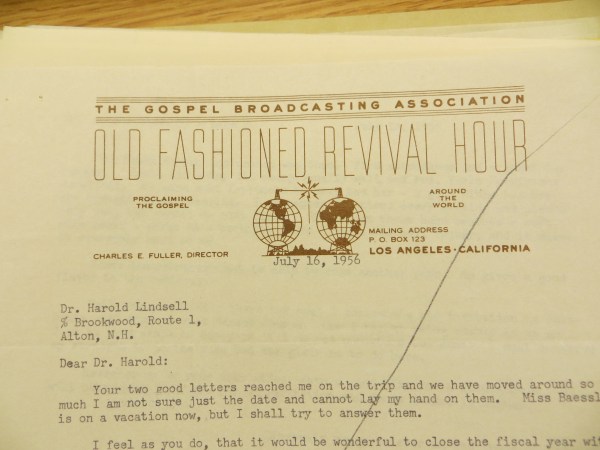
Check out the 1950s-era “high-tech” logo! More evidence of the evangelical obsession with technology and distance learning, from Fuller Seminary, c. 1956.
Perhaps the best example might be the Moody Bible Institute in Chicago. No matter the decade, no matter the technology, the Moody educational empire has found ways to expand its reach using new technological means. The drive is obvious: For MBI and other evangelical institutions, the primary goal is to deliver the Gospel to as many human eyes and ears as possible, as fast as possible. If new technology will help accomplish that mission, all the better.
To note just a few of the best-known programs, MBI was a pioneer in early radio, with its WMBI established in 1926 to bring the Word to the world. By 1940, WMBI’s Radio School of the Bible had over 10,000 registrants. In 1942, WMBI claimed to broadcast its programs through 187 radio stations across the USA, Canada, China, and Latin America.
In the 1940s, MBI set up its Moody Institute of Science, distributing missionary science films to a wide audience.
At the same time, MBI carried out less-well-known distance-learning programs as well. As I discovered in the MBI archives, from the 1920s through the 1960s the Moody Literature Mission delivered millions of books and tracts to readers throughout the country and throughout the world.
The point of these distance-learning programs was always the same. MBI, like all evangelical colleges and universities, had a mission of missions. It was dedicated to training young people to carry the Gospel around the world. And, unlike some people’s image of stuffy Luddite conservatives, evangelical institutions were always pioneers in every type of technology: print, radio, film, and internet.
So when the Jerry Falwells experimented with distance education, they weren’t innovating at all, really. Rather, they were merely continuing the long tradition of evangelical higher education—using all available means to deliver the Gospel around the world.
Piepenbring is mad that Chik-fil-A is sneaking into his city. He dislikes the conservative evangelical politics of the chain’s founder. More than that, though, he seems put out by the Midwestern aw-shucks-ism at play. Piepenbring seems offended by the way Chik-fil-A imported a family-values vibe into his grunge-chic citycape. The company’s trademark Cows exemplify the problem. As Piepenbring puts it,
The joke is that the Cows are out of place in New York—a winking acknowledgment that Chick-fil-A, too, does not quite belong here.
Conservatives reacted with predictable hauteur. For example, American Conservative’s Rod Dreher blasted Piepenbring’s “Yankee bigot[ry].” “In terms of parochial, un-self-aware narrow-mindedness,” Dreher opened,
it is hard to beat this piece from the New Yorkeron how the a [sic] popular purveyor of delicious chicken and waffle fries is making Manhattan into an unsafe space.
It should be funny, Dreher notes, to read anything that soberly invokes phrases such as “suburban piety.” In actual fact, Dreher concludes, Piepenbring’s half-baked screed is more than a sad joke; it serves as yet more evidence of widespread “anti-Christian bigotry.”
I can’t agree with Dreher’s main point about anti-Christian bigotry, but I do think that Piepenbring’s brand of “keep New York weird” rhetoric misses some important truths. Full disclosure: I share the desire to sponsor local over chain. Up here in sunny Binghamton, I go to Laveggio instead of Starbucks; Consol’s instead of Olive Garden. But even though I share Piepenbring’s anti-corporate aesthetics, I can’t help but think he is willfully ignoring some fundamental truths about his city.
It’s beyond obvious, of course, that New York City is the headquarters of America’s financial and corporate culture. Less obvious, perhaps, is that New York has also served as a center of conservative evangelical intellectual culture and activism.
A century ago, progressive New Yorkers were similarly riled by the fiery fundamentalism of New York’s John Roach Straton, pastor of Calvary Baptist and one of the undisputed national leaders of the 1920s fundamentalist movement. I spent some time with Straton’s archived papers a few years back and they are chock-full of ardent correspondence with all the top conservative evangelicals of his generation.
Again and again, fundamentalist intellectuals and activists praised Straton and acknowledged his New-York-based leadership of the national fundamentalist movement. In 1922, for example, the president of fundamentalist Wheaton College in Illinois wrote to Straton
to thank you for the attack you are making on the infidel teaching of our time.
Beyond any dispute, Straton used his New York City headquarters to fight evolution and theological liberalism. He used the cultural clout of his big-city address to add oomph to his fundamentalist activism. Yet even his fundamentalist admirers tended to assume that fundamentalism was not a true product of the Big Apple. Straton himself sometimes agreed. In spite of the fact that he had built his fundamentalist empire from Manhattan, Straton told the New York Times in 1925 that fundamentalism was a Southern thing. As Straton put it, fundamentalism represented
a rising tide of spiritual earnestness preparing in the South and West which will sweep the country.
a counter cultural Christian college in New York City that leads with academic excellence and ‘convictional civility.’
Though both conservatives and progressives have tended to assume that conservative evangelicals don’t fit in New York’s hurly-burly cultural landscape, both sides have frequently missed the long, continuing tradition of New York’s role as a capital city of conservative evangelicalism.
They don’t agree on much, but both sides seem to ignore New York’s real role as an international headquarters of conservative evangelical religion. Why?
Here’s what we know: The National Center for Education released its new report today about school safety. By any measure, schools today are much safer places than they’ve been since 1992. Crime reports from schools are down, security measures are improved, staffs are better trained in safety measures, and students report less crime.
Why won’t we hear more culture-war blather about this news? Here’s my guess: Whether you’re a conservative, a progressive, or other, you want people to think that schools are dangerous places.
It wasn’t only Bill Bennett who worried. Religious conservatives also warned that public schools had
grown into jungles where, of no surprise to Christian educators, the old Satanic nature ‘as a roaring lion, walketh about, seeking whom he may devour’ (I Peter 5:8). Students do well to stay alive, much less learn. . .
In most cases, if conservatives hate something, progressives will love it. But that hasn’t been the case with public schools. From the left, critics charge that public schools are abusive places, especially to students from minority backgrounds. In one recent case from Maryland, for example, activists note that African American students
are subject to daily abuse and humiliation. . . . [from] a decades-long pattern of resistance to change and the creation of a hostile environment for children of color.
Conservatives don’t agree with progressives about much. When it comes to school safety, however, both sides agree that public schools are dangerous and getting worse. Both sides, it seems, won’t allow themselves to be troubled by inconvenient truths.
It’s true—there are lots of topics that I had to leave out of my new book about evangelical higher education. Among the most difficult choices was the decision to focus tightly on one group of interdenominational evangelical schools that had its roots in the 1920s fundamentalist movement. Lots of important and interesting evangelical colleges got (mostly) left out of the story: Oral Roberts University, Regent University (VA), and Patrick Henry College, to name a few.
Cactus, cross…and ka-ching?
A recent call from a journalist has me yearning to have been able to include one of the most unusual and idiosyncratic stories in the history of evangelical higher education—the tangled tale of Grand Canyon University.
Like a lot of evangelical schools, Grand Canyon University started out as humbler Grand Canyon College, an institution catering to local Southern Baptists. With such a small draw, the school had trouble keeping the lights on. In an effort to attract more students, it adopted an interdenominational evangelical posture. So far, so ho hum. All evangelical colleges—well, almost all—could tell similar tales in the 1960s, 1970s, and 1980s—tales of dwindling enrollments and desperate attempts to lure more students.
Some of the benefits are concrete. As a non-profit institution, GCU will once again be eligible to accept tax-deductible donations. It will be able to participate in NCAA sports and compete for research grants. As all colleges must do to survive, these trappings will allow GCU to look like a “real” college.
The quest to maintain status as a “real” college has always animated evangelical schools. They have fretted that their doctrinal peculiarities and severe campus rules would cause higher-ed outsiders to look down their noses at them as mere “church colleges.”
So GCU’s desire to reclaim its non-profit status makes perfect sense in the longer story of evangelical higher education. This morning I’ve got a different question. All evangelical colleges want to have sports, research, and the other trappings of “real” colleges. But they’ve also insisted on their status as “real” Christian institutions, though they have never been able to agree on a precise definition of that term.
So here’s the question: How could GCU have ever moved into the for-profit world? Could an evangelical college ever hope for respect if it made a profit off of its students? Wouldn’t that undermine its claims to being a truly Christian institution?
It’s no skin off my nose, but I can’t help but wonder what creationists will say now. And not just the more radical young-earth creationists, but all the dissenting scientists who insist for religious reasons that our species must have begun with two and only two ancestors in the Garden of Eden. As reported in the New York Times, the science of human origins is getting better and better. What will creationists do?
The science doesn’t come close to matching the Bible…
Here’s what we know: This weekend the New York Times profiled the work of Harvard’s David Reich. Dr. Reich and his team have plucked DNA from ancient human bones. Using new techniques, the team has been able to create new maps of human and other groups dating back tens or even hundreds of thousands of years. The ultimate goal?
Dr. Reich’s plan is to find ancient DNA from every culture known to archaeology everywhere in the world. Ultimately, he hopes to build a genetic atlas of humanity over the past 50,000 years.
Here’s the problem: for many creationists, even those who are willing to believe in an ancient universe and planet, the idea of a real, historic Adam & Eve is absolutely non-negotiable. As we’ve examined before in these pages, even creationists who accept the science of evolutionary theory in general balk at the notion of abandoning the Garden story. Even institutions such as Wheaton College that openly embrace evolutionary creationism shudder to advertise their faculty’s skepticism about a real historic Adam & Eve.
So what will creationists do now? Here’s my guess: The more radical young-earth crowd will simply dismiss the new discoveries in human origins as simply more fluff n stuff, more flawed conclusions from flawed pseudo scientists based on flawed assumptions. But among creationists who have embraced evolutionary science in its particulars, while insisting on the fundamental truths of divine creation as described by the Bible, each new scientific discovery will present a new challenge.
As the scientific evidence gets stronger and stronger for a complex, multi-site origin of the human species, creationists will have some splainin to do.
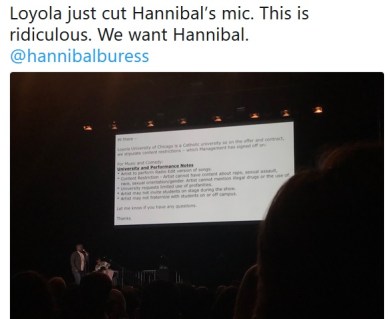
Here’s what we know: The Chronicle of Higher Education is reporting on a free-speech stunt by comedian Hamilton Buress. The well-known comic (so I’m told. I’d never heard of him, but that doesn’t mean much) had signed a contract for his bit at Loyola University in Chicago. He had agreed not to discuss certain subjects, including sexual abuse, rape, race, or sexual and gender orientation.
Buress didn’t only ignore the contract. He projected an image of the list of forbidden topics, then proceeded to make a joke about each one in turn. When he got to a joke about child sexual abuse by the Catholic church, the (Catholic) university cut off his mic.
What do you think?
Me, I’m torn. On the one hand, the guy signed a contract. He agreed not to make certain jokes.
On the other hand, Buress’s deliberate and provocative method of spurning the contract, IMHO, is more than just comedy. It makes a powerful point about the need to speak freely about sensitive topics.
Would I want him to perform at my kid’s fifth birthday party? Probably not. But do I think his stunt was a healthy shake-up of campus stultification? I think so.
Here’s what we know: A week or so ago, Oconomowoc residents erupted in anger over a student-initiated program. The students had hoped to teach their fellows about the concept of white privilege. Due to parent anger, the principal is out and schools are officially banned from teaching white privilege except in classes dedicated to teaching white privilege.
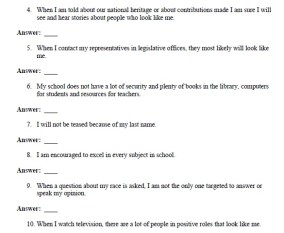
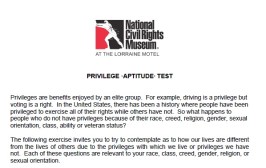
The students had asked their fellows to complete a privilege survey created by the National Civil Rights Museum. Students were asked if they felt comfortable going into stores, if they thought people in power would look like them, if they had been taught to fear walking alone at night, if their schools had good resources, and other pointed questions.
The goal, as the survey explained, was to help students notice the ways they have experienced privilege. As the survey put it,
In the United States, there has been a history where people have been privileged to exercise all of their rights while others have not. So what happens to people who do not have privileges because of their race, creed, religion, gender, sexual orientation, class, ability or veteran status?
So far, so good. For the record, I applaud these students and their supporters for trying to help themselves understand the ways American society really works.
Not everyone does. In Oconomowoc, Wisconsin, this exercise proved extremely provocative. Parents absolutely refused to have their kids talk about these questions in school. They ousted the high-school principal and banned further talk of white privilege.
This robust anger leads us to our question for the day: Why do some people feel so angry about these questions? Why do they feel a need to ban them from their children?
I have a hunch and I’ll be curious to hear what SAGLRROILYBYGTH think.
white privilege is a lightning rod for some parents. . . . We have poor people in Oconomowoc who are saying they’re not privileged … and people that say, ‘Don, we worked our butts off to have what we have’
Some parents in Oconomowoc apparently feel that teaching white kids that they are privileged is like teaching them that they are to blame for society’s faults. It is refusing to notice the hard work and sacrifice that their families have made. It is nothing less than a slap in the face to every penny-pinching Grandma, every two-job-working Dad, every after-school-job having kid.
As I see it, the topic of white privilege is so ferociously controversial because it strikes at the heart of our culture-war sore spot over victimhood. In the minds of many parents—in Oconomowoc at least—telling white kids they enjoy privilege is the same as telling them their struggles aren’t real; their sacrifices aren’t meaningful; their victories are vampiric.
White evangelicalism—the church of the “slave state,” at Forbes. [Editor’s note: The original Forbes article was taken down as “way out of bounds,” but the text is still available at this new link. Thanks to alert reader for pointing it out.]











 I Love You but You're Going to Hell