What Joe Biden Didn’t Mean to Say

Unlike the GOP, the Democratic presidential hopefuls seem united about education policy, to the point of boringness.  In his promise not to join the race, however, VP Joe Biden made some odd historical claims about schooling.  Surely he didn’t mean to imply what my nerdy ears heard.
Say, it ain't so, Joe...

Say, it ain’t so, Joe…

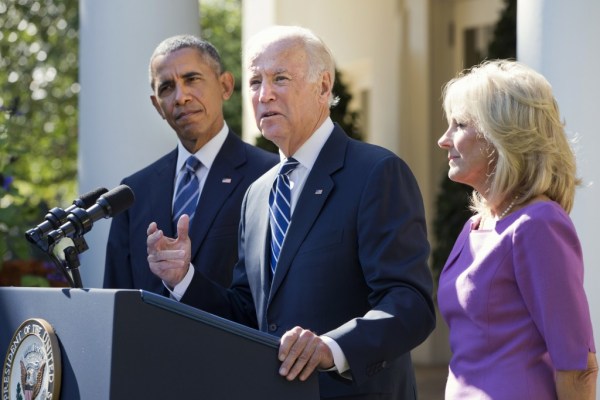
The Democratic leaders seem to have rallied around the promise of free or reduced college tuition for all.  That was the point Vice President Biden made.  “We need to commit,” Biden intoned,

To 16 years of free public education for all our children.  We know that 12 years of public education is not enough.  As a nation, let’s make the same commitment to a college education today that we made to a high school education 100 years ago.

With apologies to the SAGLRROILYBYGTH, let me clarify at the outset: I am no Biden-basher.  I will be voting Democrat in the upcoming presidential election.  Guaranteed.

But that doesn’t mean that Democrats get a free pass to Stupid.  Let’s politely ignore for the moment Biden’s implication that students in the USA now receive 12 years of public education.  For most kids, the real number is thirteen years, including kindergarten.  In many states, it is fourteen years or more, including pre-k and preschool.  But let’s not focus on such details.

The real stumper in VP Biden’s claim is that the United States committed to free high school for all in or around 1915.  That just doesn’t fit, for two reasons.  First, the history of high school attendance and tuition is much more depressing and complicated than Biden implies.  Second, there is a much more obvious parallel that he and other leading Democrats could draw.  Why don’t they?

To take them one at a time: Every nerd knows that a majority of 14-17-year-olds did not begin attending high school until the 1930s, not the 1910s.  Moreover, most so-called “public” high schools—the line between “public” and “private” schools as we know them was vague—stopped charging tuition by the 1870s, not the 1910s.  As historian extraordinaire William J. Reese has demonstrated in his book The Origins of the American High School, the high school has had a long and jagged path from elite finishing school to mass institution.  There was no obvious transformation 100 years ago.

Here’s the worst part for Biden: The reason more kids began attending high school in the 1930s was depressingly obvious.  The Great Depression crushed the economy and squeezed the most vulnerable workers out of scarce jobs.  For young people, there was often no viable option outside of school.  I know Biden didn’t mean it, but his promise to revisit America’s commitment to high-schooling for all implies a desire to return America’s economy to the dumpster.

Nerds have another question for Democrats: Why don’t they make the more obvious parallel?  This great nation has a long history of free college tuition.  Some of the best of our public institutions began with free (ish) tuition for locals.  If we want to go back that far, The University of Pennsylvania was opened as a radical new vision of higher education, one that would be attainable to all.  Cornell University, too, promised that students could work their way through without worrying about tuition costs.

In more recent and relevant history, the University of California system—still home to our country’s most prestigious public universities—long promised a tuition-free education for residents.  The City College of New York, too, was built on the idea of free elite college educations.

Of course, students still paid in one way or another.  School was not absolutely free but rather a mish-mash of fees and living costs.

When they talk about free college, why don’t Democratic leaders talk about this history?  Maybe they do and I just haven’t paid close enough attention.  But in recent debates and speeches, Secretary Clinton, Senator Sanders, Governor O’Malley and now VP Biden all repeated this dream of free college as a new thing, an innovation, a shiny promise.

Why don’t they sell it instead for what it is: One of America’s most cherished traditions of higher education?

I have a hunch.  Democratic leaders don’t want to be seen as old-school leftists, rewarming the failed policies of the 1780s, 1860s, 1930s, or 1960s.  Instead, they want to appear to offer the public something new, something bold, something untried and remarkable.

I’m all for it.  My beloved university is not tuition-free for all, but it fulfills the promise of affordable public higher education for many of our students.  I believe in the American tradition of affordable and attainable higher education for those who want it.

But I also believe in learning from the past.

The Real Reason Trump Hates the Education Department

It wasn’t hard to predict. As I argued a few months back in the pages of Time Magazine, this round of GOP primaries would be full of threats to the Education Department. In a recent interview, front-runner Donald Trump made the usual accusations. But I wonder if there is another, more obvious reason why conservatives like to take potshots at the Ed Dept.

Don't trust anyone under 37...

Don’t trust anyone under 37…

In his recent interview with Chris Wallace, Trump made the usual conservative noises: The Ed Department is trying to replace local control of schools with control by “Washington bureaucrats.” Trump blasted competitor Jeb Bush as supporting the sinister Common Core. Trump’s solution? Get rid of the Education Department entirely. It is home to egregious “waste, fraud, and abuse.” [You can find Trump’s education comments starting just before the five-minute mark in the video clip.]

Since its birth, the Education Department has been the target of conservative ire. President Reagan wanted it gone. In the run-up to 2012, the Ed Dept was one of the targets Rick Perry could remember.

As I’ve argued in my recent book, things weren’t always this way. Attacking federal influence in education only became the default “conservative” position in the late 1930s or early 1940s. At that time, conservatives horrified by New Deal growth lambasted any exertion of federal influence. Before then, however, influential conservatives eagerly embraced the possibilities of federal control over education. Such control, conservative leaders in the 1920s insisted, could force new immigrants to become Anglicized and “Americanized” at a faster clip. Such control, conservatives hoped, could cram traditional values down the throats of leftist teachers nationwide.

Only after the New Deal equated federal power with progressive politics–in the minds of many conservative activists, at least–did “Big Education” come to be equated with “Left-wing Influence.”

I wonder, though, if there’s a simpler psychological reason why today’s conservatives hate the Ed Dept. The department is a novelty. As education nerds are well aware, the Ed Dept recently celebrated its thirty-sixth birthday.  36!  It was created only in 1979 by President Jimmy Carter.

So here’s my hunch: Conservatives have many reasons to promise to cut the Education Department. In The Donald’s case, he can use the Common Core to attack rival Jeb Bush. He can appeal to voters’ sense of distrust of “Washington bureaucrats.” He can make it look as if he has concrete plans to slim government and eliminate waste.

But he also can imagine a time without such a department. Indeed, neither he nor anyone else of a certain age needs to imagine it at all. The Education Department is so brand-spankin new that conservatives have no trouble concluding that we will get by just fine without it.

Why Didn’t They Talk about Schools?

There was plenty of talk. Senator Sanders admitted he was “sick and tired of hearing” about Secretary Clinton’s emails. Senator Webb jabbed Wall Street. Governor O’Malley championed the middle class. And Governor Chafee was also there. But nobody said anything about K-12 education. Why not?

There was some talk about higher education. Both Senator Sanders and Secretary Clinton insisted we need some way to relieve student debt loads, maybe with free college tuition. Governor O’Malley bragged about low tuition rates in his state.

But only Secretary Clinton mentioned early childhood education, saying offhand that every child needed it to live up to his or her “God-given potential.”

Seems odd. The Democratic Party, after all, is the party of both Head Start and Race To The Top. The Democrats’ Big Tent includes both “Test-Em-n-See” Arne Duncan and Curmudgucrat Peter Greene.

It seems in the high-stakes world of primary debates, these stark differences between leading Democratic voices would offer a chance for some lively back-and-forth on key issues. What should we do with the Common Core? How should teachers be evaluated? How do we know if a school is doing a good job?

We didn’t hear it.

Loudmouth education parvenu Campbell Brown calls it a conspiracy. The Democratic Party, she claims, is in the back pocket of the teachers’ unions. They don’t even dare RSVP to her debate invitation.

Peter Greene thinks the answer is even simpler: “when it comes to public education in this country, none of the candidates actually gives a shit.”

In The Atlantic, David Graham thought there was just nothing much to disagree about. “Overall,” Graham opined, “the Democratic candidates simply don’t have the same divisions that the Republicans one [sic] do.”

But none of those explanations makes sense. This sort of forum offers candidates a chance to grab attention. Clinton’s identification with the Obama administration makes her an easy target. Yet none of them took it.

Here in the Great State of New York, we’ve seen how protest candidates can and do win votes by blasting other Democrats. I’m stumped why none of these candidates—not even the fire-breathing Senator Sanders—took this opportunity to do so.

Here’s my hunch: In the fervent calculations of any serious presidential campaign, candidates must make careful bets about issues and positions. In the face of Mr. Greene’s assertion that the candidates don’t care, I think candidates will care about what they think voters will care about.

Why didn’t candidates make political hay about K-12 education? Because they thought it would not win them any votes. With their finely tuned political antennae, these leading candidates concluded that Democrats in general did not want to hear about it.

Compare that to the GOP, where every candidate is forced to pay lip service to creationism. Compare that to the GOP, where every candidate falls all over him- or herself to show off his or her penchant for “education reform.”

Leading Democrats, in contrast, don’t air their differences in public. Why not? I’m no cynic, but it seems obvious to me that all candidates have agreed implicitly that their differences will not give them a competitive advantage. In short, none of them is willing to bank on a groundswell of support for iconoclastic progressive educational notions.

Ignorance Unto Death

It is a dilemma at the heart of Christian faith: To know or to obey? The original sin of Adam & Eve, after all, was to become as gods by eating from the Tree of Knowledge of Good and Evil. This week, a state supreme court judge in Oregon faced the unenviable task of ruling whether faithful people knew by faith or by fact. Not surprisingly, she punted. Especially in schools and universities, questions of knowledge and faith will continue to bedevil us all. I’m arguing in upcoming books that religious people deserve considerable wiggle room when it comes to requiring knowledge about evolution or US history, but it’s not impossible for policy-makers to be bolder than they have been.

What did you know? And when did you know it?

What did you know? And when did you know it?

In the Oregon case, two parents from a strict religious sect were convicted in 2011 in the death of their infant son David. The boy had been born prematurely. The parents did not call for medical help but rather treated David at home. After nine hours, David died. Were the parents criminally liable for their faith-based failure to get medical help?

Oregon Supreme Court Justice Virginia Linder recently said yes. Sort of.

For our purposes, the most intriguing elements of this case are the tangled web of meanings in this case surrounding faith and knowledge. If the parents “knowingly” allowed their baby to suffer from treatable ailments, according to Oregon law, then they are criminally liable. But they hoped to force the state to prove that they “knew” it. They hoped to force the government to prove that they must know something that they refused to know.

Justice Linder did not decide the big question. Instead, she noted that the parents defended their actions with a different set of knowledge claims. The parents said they did not know the baby was sick. They said he appeared healthy until the very last minute. Doctors disagreed. They said any reasonable person could have discerned that the baby was in severe medical crisis.

In other words, the parents did not claim that they “knew” their faith could save the baby. They said instead that they didn’t “know” he was so very sick. The parents DID insist that the state had to prove that they “knowingly” refused care to their baby. As Linder summarized,

At trial, defendants argued that, because they withheld medical treatment from David based on their religious beliefs, the Oregon Constitution requires the state to prove that they acted “knowingly”—that is, they knew that David would die if they relied on prayer alone and, despite that knowledge, failed to seek medical treatment for him.

Justice Linder affirmed earlier court decisions that the parents were guilty of criminal neglect for their actions. The state, she ruled, did not have to prove that they “knew” of the harm they caused. But she did not decide if the parents must have known something they refused to know.

The complexity of the case shows yet again the durability of questions of knowledge and faith. Can the government insist that parents provide medical care for their children? In Oregon, yes. But can the government insist that parents “knew” their child needed medical care? That is a far more difficult question, and one that this ruling painstakingly sidesteps.

As SAGLRROILYBYGTH are well aware, nowhere do these questions of faith and knowledge clash more regularly and predictably than in the area of education. Can the government require that students “know” evolution? …that kids “know” how to prevent sexual transmitted infections? …that kids “know” how the first humans came to North America?   Also, how have private schools and universities attempted to shield young people from these sorts of knowledge?

Alas, secular progressive types like me cannot relax and claim that public schools should always promote knowledge over ignorance. After all, I agree that certain types of knowledge are not appropriate for certain groups of students. For example, we should teach all children about horrifying historical episodes, such as lynching in the USA or the Holocaust.   But we should not expose young children to gruesome images of charred corpses, sexually mutilated before being lynched. At least, I don’t think we should.

Such images are true. People should know about them. But I do not think seven-year-old children should be exposed to that sort of knowledge. I agree that schools should work to keep young children ignorant about such knowledge, even though I acknowledge that it is true and important.

The difference, in other words, is not that conservative religious people want to keep knowledge from children, while progressive secular folks want to give knowledge to children. The difference is only in what sorts of knowledge we want to shield students from, and how.

As I argue in a chapter in an upcoming book about ignorance and education, we can see these questions starkly exposed in the history of curriculum for private conservative evangelical schools. I looked at US History textbooks produced by Bob Jones University Press and A Beka Book. In each case, from the 1980s to the end of the twentieth century, publishers made claims about historical knowledge in each succeeding edition that were farther and farther afield from mainstream historical thinking.

Know this, not that.

Know this, not that.

In a later edition, for example, a history textbook from A Beka explained that humanity expanded around the globe after the fall of the Tower of Babel. Obviously, that is a very different explanation from what kids would read in a mainstream textbook. Publishers like A Beka hoped to shield students from mainstream knowledge about history by replacing it with an alternate body of knowledge. These textbooks do not simply try to create ignorance by blocking knowledge, but rather try to foster ignorance about a certain sort of knowledge by producing a convincing set of alternate knowledge.

When it comes to evolution, too, questions of knowledge and belief quickly become tangled and tricky. I’m arguing in an upcoming book with co-author Harvey Siegel that students in public schools must be required to “know” evolution. But too many public-school enthusiasts, we argue, have a cavalier attitude about this sort of knowledge. Yes, students must “know” and “understand” the claims of evolutionary theory. But if they choose not to believe them, that is their business.

Perhaps an easier way to make the distinction is to say that public-school students can be required to “know about” evolution. They must be able to explain it correctly. They must be able to describe accurately its main points. But if they think it would harm their religious beliefs to say they “know” that humans evolved via natural selection, then they have the right to insist that they only “know about” it.

It’s not an easy distinction. Nor was it easy for Justice Linder to decide what to say about the Oregon case. Do parents have the right to their religious beliefs? Yes. Can they not know something that everyone else knows? Yes, certainly. Do they have the right to insist on that relative ignorance if it causes palpable harm to others? Not in Oregon.

But this ruling does not decide if the parents in this case “knew” that their faith would save Baby David. It only states that parents do not have the right to insist that the government prove that they knew it.

Bill Gates Pushes a Rope

Must be tough. All that money and doodly-squat to show for it.

Bill Gates gave a speech yesterday about his plans to fix American education. He has found the secret, he explained. It took him seven years and ba-jillions of dollars, but he has found it. Seems like he could have just spent a few hours and thirty bucks to discover why his big plans are still doomed to failure.

Gates isn’t alone. Other new-rich tech types have also crashed on the reefs of education reform. Most recently, Facebook’s Mark Zuckerberg frittered away $100 million in a good-hearted but wrong-headed attempt to help Newark’s public schools.

To be fair, Bill Gates has spent more time and effort (and moolah) than Zuckerberg in his attempts to improve America’s public schools. His foundation has funded a host of reform efforts.

What has he learned? As he put it yesterday,

We set out on this path seven years ago. If I had to place our foundation somewhere on our own learning line today—where the starting point is absolute ignorance and the end point is knowing everything about great teaching and how to spread it—I would say we’re not even halfway to our goal.

But I believe we are on the right track. For today, and for the coming years, this is our vision: Every student deserves high standards. Every student deserves an effective teacher. Every teacher deserves the tools and support to be phenomenal. And all students deserve the opportunity to learn in a way that is tailored to their needs, skills, and interests.

Gates’s current plan focuses on improving teachers. In his words:

Building effective teacher feedback and improvement systems everywhere is the most important movement in American education today.

Good teachers make a huge difference, he argues correctly. And good school districts do what it takes to make their teachers better.

So what is wrong with Gates’s strategy? It’s not a secret and it’s not a surprise. Mr. Gates could have spent a few hours with David Tyack’s and Larry Cuban’s book Tinkering Toward Utopia to figure out something that every veteran teacher knows already. And it would only have cost him thirty bucks.

Read these works, ye mighty, and despair...

Read these works, ye mighty, and despair…

To wit: Good teachers are hungry for help. They want reform that will help them do a better job at what they are already doing well. But ALL teachers are good at dodging fads and gimmicks. They have to be. Every experienced teacher has survived wave after wave of “the latest thing.” We have tall bookshelves stacked with chart-packed three-ring binders about how to implement each new reform.

Teachers know what to do. When someone offers them something that helps them do it, they jump on board. Smartboards, for example, or teaching teams, are one-time “reforms” that have now become standard operating practice in many public schools. Why? Because they work. They help teachers do a better job at their jobs.

As Tyack and Cuban document, however, history is littered with the Ozymandian dreams of earlier generations of Gateses and Zuckerbergs. At the advent of television in the 1950s, for example, the US government and the Ford Foundation plunked down tens of millions of dollars to have a plane always circling the Great Plains states, broadcasting the latest educational TV programming for schools. No kidding. The plan was to have the country’s smartest experts teaching kids directly. No more vagaries of teacher quality or school efficiency. This multi-million-dollar reform was going to use the latest technology to fix American public schools in one fell swoop.

Did it transform schools? No. Why not? Because good teachers struggled to find a way to incorporate that expensive “reform” into their teaching. For some reason too mysterious for the experts to divine, students in Kansas did not want to sit quietly while fuzzy black-and-white professors laboriously explained sentence structuring or osmosis.

Bill Gates is pushing a rope. Trying to fix America’s teachers from the outside is a losing proposition. The language itself generates its own defeat. Instead of fixing America’s teachers, Gates and other well-heeled know-it-alls should focus on HELPING America’s teachers.

Scott Walker’s Collapse Means School Is Still Cool

Governor Scott Walker dropped fast. According to the conservative Weekly Standard, Walker led the field of GOP presidential hopefuls in April, dropped to second in August, then plummeted to last place in no time flat. Why? Perhaps his campaign collapse proves that conservative voters do not hate the devils of public education as much as Walker (and I) thought.

Maybe school bashing's not enough...

Maybe school bashing’s not enough…

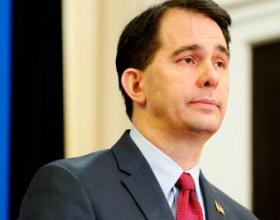
Walker had built his national reputation on a consistent diet of education-bashing. He famously attacked teachers’ unions. More than that, though, he blasted lazy university professors. Perhaps most uniquely, he himself had never completed college, having dropped out to pursue more worthwhile goals.

Make no mistake. As a voter and a teacher and a lazy college professor, I’m glad to see Walker crumble. But as an historian, I’m surprised. Whatever his faults, I thought Walker had shown some savvy in following a conservative script with nearly a century of success behind it.

SAGLRROILYBYGTH know the story, but for new folks, here’s a quick history lesson: When Governor Reagan was elected president, his first decorating move was to put a large portrait of Calvin Coolidge in the Oval Office. Reagan, after all, modeled himself after Coolidge’s brand of small-government conservatism.

Coolidge had come to national prominence for his stern opposition to a police strike in Boston. Reagan, too, made his bones by combatting an air-traffic controllers’ strike.

I thought Walker could win by using the Coolidge playbook. I thought his union-bashing policies were terrible, but I thought they would win.

We were both wrong. Walker went from conservative hero to zero practically overnight.

Why? There might be education-related reasons other commentators have missed. Maybe GOP voters really don’t hate public-school teachers as much as people think they do. Maybe GOP voters expect their candidate to have a college degree. Could it even be—perish the thought—that voters don’t hate university professors as much as Governor Walker thought they did?

Conservative pundits offer different reasons. Jonathan Last at the conservative Weekly Standard found Walker’s collapse “shocking.” Unlike other meltdowns, Walker’s campaign had suffered no embarrassing gaffes or scandals. Walker had real credentials, so his early front-runner standard was not a fluke. Last concluded that Walker’s loss was likely due to the weirdly broad field of candidates this year and to Donald Trump’s “disruption” of the nominating process.

Over at the progressive Nation, John Nichols focused instead on Walker’s tired and unpopular anti-unionism. As Nichols put it,

A lot of Republican voters work for a living, and a substantial number of them are union members. While grassroots conservatives have been instructed by corporate America’s amen corner in the media to be angry with unions and living wages and teachers and public employees, they have never been so enthusiastic in that anger as the billionaires who seek to build their empires on a foundation of income inequality and wage stagnation.

So Walker’s core message—union busting—never really resonated to the extent that the governor and his strategists imagined it would.

But don’t forget that Walker’s union-busting was only one leg of a broader strategy based in educational culture-war thinking.  He loudly and proudly fought against teachers’ unions, certainly, but also aggressively went after lazy college professors. Even his own story of dropping out of college to do something more important shows a long-term dedication to bucking the educational status-quo.

I admit it. I thought Governor Walker had hit upon a winning program, even if it was a program I didn’t like. In my last book, I argued that Walker’s brand of educational conservatism had proven politically unbeatable time and again. Throughout the twentieth century, it became a winning strategy among conservatives to bash teachers in no uncertain terms.

I thought it would still work, especially in the howling scramble of this year’s GOP presidential contest. But maybe I got it as wrong as Governor Walker did. Maybe that time has passed.

Doctor Carson, I Presume?

Conservatives love Ben Carson! But they don’t seem to know one of the most important things about him. At least judging from the utterly unscientific evidence on hand at this humble blog, it looks like people want to know more about Dr. Carson’s peculiar religion.

SAGLRROILYBYGTH are well aware that we’ve spent our share of time discussing Carson’s ideas and background. As a devout Seventh-day Adventist, Carson has publicly and explicitly supported his denomination’s firm and fairly extreme creationist doctrines.

Unlike most other conservative Protestant denominations, SDA believers have a good reason to believe in a literal six-day creation within the past 8,000 years ago or so. Their founding prophet, Ellen G. White, saw it herself.

Today in the ILYBYGTH newsroom, we got some evidence that suggests people are curious about Dr. Carson’s religion. In this screenshot captured early this morning, we can see a number of people came to these pages searching for news about Carson’s denomination. Is he a Seventh day “aventist?” What religion is he? What church does he attend?

Who is this Carson fellow, anyway?

Who is this Carson fellow, anyway?

Conservatives love him, but it seems some of them want to know more. Would it be a turn-off for some voters if they knew about Carson’s denomination? Historically, as I argued in my first book, some conservative evangelical Protestants viewed Seventh-day Adventism as a dangerous and deceptive cult.

Things have changed, for sure. I wonder, though, if news of Carson’s denomination would hurt his chances with some conservative Christians.

Conservatives against Kim Davis

Which side are you on?

That’s the question that fuels most of our culture-war animosity. Instead, the question we should all be asking is this: What’s the right thing to do? In the case of same-sex refusenik Kim Davis, some conservative intellectuals and pundits are willing to break ranks and see the bigger picture.

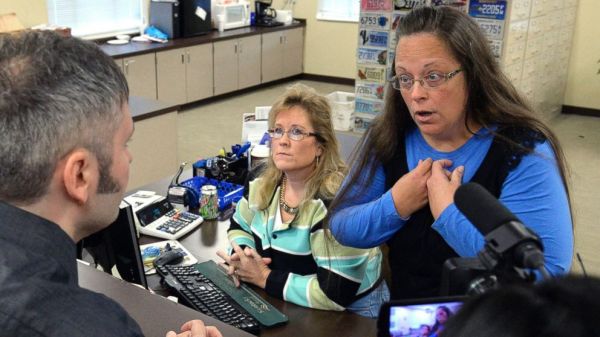
In case you’ve been milking the last warm days of summer and haven’t seen this story, Kim Davis is the Kentucky county clerk who has been jailed and released for her refusal to issue same-sex marriage certificates. Opportunistic conservative politicians such as Mike Huckabee have promoted Davis as a conservative Christian hero, stage-managing Davis’s release as an American triumph, equal parts Christianity Triumphant and Rocky III.

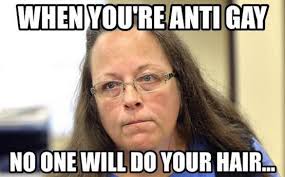
Governor Huckabee’s shameful pandering to frustrated Christian voters should be an embarrassment for every conservative out there. But progressives also could stay a little classier in this case. For those like me on the progressive side of things, the furor and venom over the Kim Davis case burst onto our Facebook feeds like a sweaty middle-school pimple. I don’t agree with Davis’s refusal to do her job, but I also think it is counter-productive and petty to attack Davis’s hairstyle.

Missing the point...

Missing the point…

We could all learn a lesson from a few conservatives who refuse to conform to their culture-war scripts. Fox News anchor Shep Smith, for example, earned the ire of conservative viewers for pointing out the obvious hypocrisy in the case. Critiquing the Huckabee rally, Smith commented,

They set this up as a religious play again. This is the same crowd that says, ‘We don’t want Sharia law, don’t let them tell us what to do, keep their religion out of our lives and out of our government.’

Predictably, conservative Fox News viewers reacted furiously, calling Smith a “puke” and accusing him of “anti-Christian bias.”

But Smith was not alone. Conservative intellectuals also took issue with Davis’s brand of publicity-hogging culture-warriorism. Writing in the pages of The American Conservative, crunchy conservative Rod Dreher warned that Davis had ignored the central point of civil disobedience. Dreher argues,

It’s clear that there are many Christians who support Kim Davis because she’s doing something, even if that something is arguably counterproductive. This is unwise. . . . If the public comes to think of religious liberty as the constitutionally guaranteed right to ignore the Constitution whenever it suits us, the cause of religious liberty — which is guaranteed by the First Amendment — is going to suffer tremendously. Conservatives are supposed to understand the difference between the vice of cowardice and the virtue of prudence. If religious liberty means that even officers of the state can defy the law without consequence, then it makes every individual a potential tyrant.

Writing from the conservative bastion of the Southern Baptist Convention, Russell Moore and Andrew T. Walker made a similar point. While Moore and Walker bemoaned the “judicial overstep” and “government inaction” that led to this situation, they did not excuse Davis’s reckless behavior. “We must recognize,” they note,

the crucial difference between the religious liberty claims of private citizens and government officials. Let us be clear: Government employees are entitled to religious liberty, but religious liberty is never an absolute claim, especially when it comes to discharging duties that the office in question requires. While government employees don’t lose their constitutional protection simply because they work for the government, an individual whose office requires them to uphold or execute the law is a separate matter than the private citizen whose conscience is infringed upon as a result of the law. It means the balancing test is different when it comes to government officials because of their roles as agents of the state. Government officials have a responsibility to carry out the law. When an official can no longer execute the laws in question due to an assault on conscience, and after all accommodating measures have been exhausted, he or she could work for change as a private citizen, engaging the democratic process in hopes of changing the questionable law.

We must be very clear about the distinctions here between persons acting as an agent of the state and persons being coerced by the state in their private lives. If the definition becomes so murky that we cannot differentiate between the freedom to exercise one’s religion and the responsibility of agents of the state to carry out the law, religious liberty itself will be imperiled.

For these brave conservative commentators, agreement with Davis’s opinion of same-sex marriage did not mean an automatic endorsement of Davis’s actions. All of us could learn from their example.

Those of us who consider ourselves progressives should commit to examine every case with the same gimlet eye. Just because we agree with someone’s position in general does not mean we must agree with their actions in every case.

Conservatives should be reminded to differentiate between today’s headlines and the big picture. Civil disobedience is a right and duty of us all, at times. But not every act of civil disobedience is equal, and civil disobedience has never meant simply flouting the laws we don’t like.

More important, we must all be willing to speak up against our own “side” when it is in the wrong. The first question should not be “Which side are you on?” but always “What is the right thing to do?”

Obama-Core?  More like Conserva-Core!

Who’s to blame?  In this year’s ferocious presidential debates, GOP candidates are falling all over themselves to point fingers about the Common Core State Standards.  Jeb Bush, who still supports the standards, has come under withering attack from folks such as Mike Huckabee, who used to.  A new report from the liberal-leaning Brookings Institution lays out the real history of the standards.  It’s true: If we have to assign praise or blame for these standards, we should be looking to the right.

Report author David Whitman does a nice job of detailing the story back to the 1980s. Still, I can’t help but be miffed when he says that this is a “surprising” story, one that “few are familiar with, and even fewer have written about.”  Of course, as SAGLRROILYBYGTH are well aware, your humble editor has been trumpeting this history in these pages and in venues such as Time Magazine.

Conservative intellectuals, too, have done what they can to draw attention to this history.  In the pages of The Weekly Standard, for instance, free-market maven Michael Petrilli has told the story to anyone who will listen.

Such complaints aside, however, Whitman’s report is still worth reading.  He details the history of the Common Core standards themselves.  As he describes correctly, in the 1980s the drive for “high standards” was a leading conservative issue.  As Ronald Reagan’s second Secretary of Education, William J. Bennett pushed hard to make these standards a reality.

In the 1990s, Lamar Alexander continued the conservative push for more rigorous state standards.  Alexander never envisioned increasing federal control of local education.  Rather, he saw these standards as an appropriate way that the federal government could provide help to state governments as they hammered out their education policies.

Whitman also argues convincingly that conservative opposition to the standards is really about something else.  The standards themselves are fairly popular when they are not called “Common Core.”  Whitman blasts conservative politicians for using “the big lie technique” to smear the standards, to create misinformation among the public.  As Whitman cites, many Americans think the standards force children to learn about sex and evolution, when they really don’t.

Make no mistake about it: Whitman’s report is a partisan attack on conservative opposition to the Common Core.  And the SAGLRROILYBYGTH know that I generally don’t go for knee-jerk partisanship.  In this case, however, Whitman has his historical facts straight.

The Common Core was meant to be a conservative initiative.  It was meant to push schools toward more rigorous learning, away from touchy-feely progressive nostrums and toward ol-fashioned book learnin.

Whitman’s liberal glee at pointing out this irony is overdone at times, but his argument is still solid.  The Common Core represents an historic win for educational conservatives.  Why won’t they admit it?  Why do conservatives love to lose when it comes to education policy?

Teachers, Tests, and Gay Marriage

Quick: What do high-stakes tests have to do with gay marriage? Michael Petrilli argues that teachers who discourage students from taking the tests are like government officials who refuse to issue same-sex marriage certificates. Whether you like his argument or not, Petrilli is drawing on a long but ambivalent American tradition.

By now you’ve heard of Kim Davis. She is the county clerk of Rowan County, Kentucky. She has attracted national attention with her refusal to issue marriage licenses to same-sex couples.

Heroically flouting the Constitution?

Heroically flouting the Constitution?

Petrilli, in many ways the leading public voice of market conservatism in education, implies that progressives might not want to be so quick to condemn Davis’s pugnacious policy. After all, Petrilli writes, many progressive teachers these days encourage parents to opt-out of high-stakes tests. Are those teachers similar to Davis? Petrilli asks,

Here the question isn’t whether parents have a right to excuse their children from taking the state assessment. (They almost certainly do.) The issue is whether educators can face sanctions for encouraging parents to engage in an act of civil disobedience. Is that akin to refusing to give the test (which surely is reason for dismissal)? What if they merely inform parents of their rights?

As I argued in my recent book, this argument about the role of teachers has long roots. When it comes to educational culture wars, the winds have blown both ways. When conservatives felt that school law enforced their side, they insisted teachers must obey. When they felt otherwise, they lauded brave teachers who resisted.

Back in the 1920s, for example, William Jennings Bryan knew he had popular opinion on his side. He refused to allow teachers to teach evolution against the wishes of their local communities. As Jennings famously argued back then, “The hand that writes the paycheck rules the school.”

Similarly, when left-leaning teachers from the 1930s through the 1950s were thought to be too friendly to communism, conservative activists insisted on teacher obedience. In 1950s Pasadena, for instance, conservative leader Louise Padelford blasted progressive teachers who sought to drill suggestible students in the need for “social change,” rather than simply teaching “reading, writing, spelling, grammar, arithmetic, history, etc.”

When the shoe is on the other foot, of course, conservatives have praised teachers for bravely resisting the dictates of educational higher-ups. Writing from the Pacific Justice Institute, for instance, Brad and Susanne Dacus have offered teachers a handy guide for safely and legally evangelizing in public schools. Too many teachers, the Dacuses warn, cower before the seemingly invincible might of secularism. “Would you be willing,” they ask,

to take a stand for the sake of the young, innocent children who are bombarded by a pro-homosexual agenda? As a parent, would you be willing to stand up for your child’s right to express his religious views? Many are timid about standing by the Word of God when it has the potential to create a ruckus. Reading through the Gospels reminds us that Christ was not afraid to make a ruckus in the name of truth. The New Testament, especially the book of Acts, focuses on the apostles’ goal to take a stand for the Gospel, regardless of the circumstances. We are not alone in this challenge. Be reminded of the verse in Joshua, which says,

“Be strong and courageous. Do not be afraid or terrified; do not be discouraged, for the Lord your God will be with you, wherever you go.”

To be fair, Petrilli will have none of this argument. He specifically notes, for instance, that public-school science teachers have a responsibility to teach evolution—and only evolution—as science. If they don’t like it, they can resign.

Petrilli’s argument, like those of other conservative activists going back a hundred years, relies on the fact that we Americans aren’t quite sure of what we want teachers to do.

Do we expect teachers to be brave rule-flouters, a la Dead Poets Society?

Or instead to we insist that teachers embody “the rules,” a la Principal Skinner?

The correct answer, of course, is “Yes.” We Americans expect the impossible of our teachers. We count on them to be both daring iconoclasts and sober rule-followers. We depend on them to encourage students to wonder and to inhibit students from wiggling.

So is Michael Petrilli right? Are dissenting teachers like dissenting county clerks? Only half. In the American tradition, teachers do indeed have to embody the rules and respect for the rules. But teachers also have to embody the right moral decisions, even when those decisions go against the rules.