Are Schools Guilty in Sexual Assault Cases?

It is a sobering question to ask: Do schools—all schools—put kids in danger? Another terrifying news story of rape at school demonstrates the point. Because schools take authority over young people, because schools put young people together, because schools necessarily put students in close private contact with peers, coaches, and teachers, schools of all sorts become the arena for rape, assault, and abuse. No type of school seems immune, but each type of school has its own unique blend of dangerous cultural components.

Exception?  Or rule?

Exception? Or rule?

The story of Owen Labrie at the elite St. Paul’s School in New Hampshire proves that parents can’t buy themselves out of this dilemma. Labrie was accused of participating in a tradition of a “senior salute,” in which students target younger students for sexual conquests.

Before we look more closely at the Labrie case, though, we need to ask some uncomfortable questions:

  • Do all schools inadvertently support rape culture?
  • Is there no way to protect vulnerable young people?
  • Does the culture of school push administrators to downplay the sexual dangers of their institutions?

In recent years, I’ve been exploring the troubled history of evangelical colleges and universities. As we’ve explored in these pages, such schools have a history of sweeping cases of sexual assault under the rug. At some of the more conservative schools, loyalty to the administration has trumped care for victims of assault and abuse.

But such schools are not alone. Though I’ve been accused of ignorance and insensitivity for pointing this out, secular and pluralist colleges also have a terrible record of ignoring sexual crimes on their campuses.

What’s worse, these things are not incidental or accidental. The history and culture of these schools contributes directly to the atmosphere of sexual aggression. In some schools, for example, football coaches and players have been elevated to godlike status. They have been protected from punishment for terrible crimes. At other schools, administrators pointedly ignore an alcohol-soaked “party culture” that attracts students but leaves them woefully vulnerable to assault and abuse.

As the recent case at St. Paul’s School shows, even the fanciest private prep schools haven’t avoided this dilemma. Though the school has denied it, some involved parties have accused St. Paul’s of fostering a culture of entitlement, a culture of callous arrogance, which turned vulnerable students into sexual targets.

Both sides agree that Owen Labrie and a younger student met on a school rooftop. They engaged in some kissing at first. Then the sexual activity escalated. The victim accused Labrie of ignoring her repeated attempts to stop. Labrie denied that they had had vaginal intercourse and denied that the victim had said “no.” The jury seems to have split, acquitting Labrie of the most serious felony rape charges but convicting him of several counts of electronic predation.

Who is guilty here? The victim’s family charged that the school “allowed and fostered a toxic culture that left our daughter and other students at risk to sexual violence.” As the New York Times reported, even Labrie’s defense accused the school of creating “an educational haven with a troubling culture of sex, entitlement and misogyny.”

Is the school culpable? Even more troubling, we need to ask if schools in general are culpable. Elite schools create environments of entitlement. Football schools create environments of hero-worship. Fundamentalist schools create environments of victim-blaming. Secular schools created environments of drunken hook-ups.

All schools, it seems, have their own dangerous mix of cultural factors. It can’t be enough for school administrators to issue statements of remorse, if those same administrators have tacitly condoned the things that encouraged sexual assault and abuse in the first place.

Why The Donald?

There’s not much that conservative and progressive intellectuals can agree on. But one thing unites thinkers across the culture-war divide these days: Why do so many people like Donald Trump? Fred Barnes at the conservative Weekly Standard visited a focus group of Trump fans to find out. Maybe the answer lies deep in the heart of American culture and history.

What's to like?

What’s to like?

For those of you who are just emerging from under your summer rocks, Trump has grabbed everyone’s attention with his successes in recent presidential polls. He has uttered outlandish statements, calling Mexicans rapists, implying that women reporters can’t handle the job, and ridiculing John McCain’s war record.

Conservative pundits have scrambled to distance themselves—and conservatism itself—from Trump’s brand of schlock.  Erick Erickson disinvited The Donald from a GOP debate.  George Will has denounced “[e]very sulfurous belch from the molten interior of the volcanic Trump phenomenon.”  Crunchy conservative Rod Dreher has scratched his head in bemusement as he’s watched the emergence of “Trumpenstein Monster.”  As Barnes asks, what is it about Trump that attracts people?

The twenty-nine assembled fans like more than Trump’s policies. They like Trump. As Barnes puts it,

Their tie to him is almost mystical. He’s a kind of political savior, someone who says what they think.

Will such Trumpies stick with the Donald all the way? Of the assembled group, most said they’d stick with Trump if he ran for president as head of a third party. They viewed Trump as a non-politician, someone who tells it like it is regardless of the consequences.

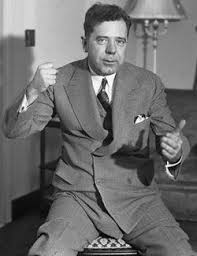
Maybe it isn’t so difficult to understand Trump’s attraction. People on both sides of the political spectrum have always rooted for brash, in-your-face candidates. Those who know their history can’t help but think of Huey Long, the governor, senator, and sometime presidential candidate from Louisiana. Long’s antics put The Donald’s to shame. Has Trump ever gotten beat-up in the bathroom of a bar for attempting to urinate between the legs of another gentleman? Has Trump ever greeted a foreign ambassador wearing nothing but silk pajamas?

Trumping Trump

Trumping Trump

The more outlandish the behavior, the more people like it. The more offensive the ideas, the more people respect them.

Does Trump stand a chance at becoming president? I’ll say it: No. This sort of behavior plays well in primaries, but in the end, Americans still prefer boring presidents.

A Socialist in the Liberty Lion’s Den

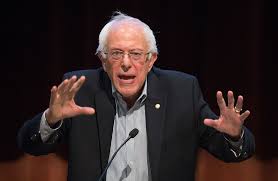
Ronald Reagan. Mitt Romney. Ted Cruz. Jeb Bush. ….Bernie Sanders?

For decades, Liberty University has played host to leading conservative politicians. From Reagan to Romney, (Jeb) Bush to Cruz, presidential hopefuls have visited the campus to make speeches about Jesus and American greatness. So it’s no surprise that a leading presidential candidate will make a speech at next month’s convocation. But hold on to your fair-trade coffee: This year the presidential hopeful on the Liberty docket will be none other than Bernie Sanders. Why would this self-proclaimed non-religious socialist rabble-rouser from the hippie hills of Vermont want to journey to the unofficial headquarters of fundamentalist politics? Why would Liberty want to include him?

Could he grab some votes?

Could he grab some votes?

First of all, let me admit that this is old news. I’ve been on vacation recently and I’m just now catching up on all the latest culture-war headlines. A few weeks ago, Liberty published its schedule for its fall convocation. Along with predictable right-wing notables such as Texas’s Louis Gohmert and presidential hopeful Ben Carson, Liberty will welcome Senator Sanders.

As the SAGLRROILYBYGTH are well aware, I’m up to my eyeballs in research for my new book about the history of evangelical/fundamentalist higher education. Liberty was a latecomer to that story, but it soon became a 500-pound gorilla in the world of Christian higher education. Thanks to its huge and lucrative online program, Liberty can claim enormous cash reserves. It has used that money to build big sports programs, big libraries, and big convocation rosters.

Yet in spite of all its parvenu riches, Liberty has struggled to overcome its image as a fundamentalist madrassah. When Ted Cruz made a speech on campus a few months back, outsiders like me gasped that Liberty’s students were forced to attend. The school, journalists exclaimed, still imposed rigid lifestyle requirements on its students. The school, some writers implied, was trapped in the past.

Perhaps the invite to Bernie Sanders resulted from an ambition to overcome this provincial reputation. As current president Jerry Falwell Jr. told the Washington Post, his school is only doing what great universities do. Liberty, Falwell said, is taking up the mantle of true higher education. As he put it,

A university is supposed to be a place where all ideas are discussed. . . . That’s what we’re doing.

But what’s in it for Senator Sanders? In a statement, he explained that he hoped to pull a Pope Francis at the conservative campus.

It goes without saying that my views on many issues — women’s rights, gay rights, education and many other issues — are very different from the opinions of some in the Liberty University community. I think it is important, however, to see if we can reach consensus regarding the grotesque level of income and wealth inequality in our country, about the collapse of the middle class, about the high level of childhood poverty, about climate change and other issues.

Before we pooh-pooh Sanders’s dreams, let’s remember that today’s Liberty University is much different from the rigidly political campus of the 1980s. Back in Jerry Falwell (Sr.)’s heyday, the school was a proud incubator of right-wing politics. These days, as faculty member Karen Swallow Prior has argued, there is much more cultural wiggle room for students.

The dress code has been lifted. There has even (briefly) been a College Democrats club.

This leaves us with a few tough questions to consider:

  • Is it possible? Can Liberty University transform itself from a southern fundamentalist college to a Great American University?
  • And, could Senator Sanders convince any Liberty students that they are part of a progressive alliance, part of a left-leaning movement that has excited the base of the Democratic Party?

The Crack Appears at Christian Colleges

It wasn’t hard to predict, but I’m surprised it has come so quickly.

World Magazine reported recently that a potential split had developed among the members of the Council for Christian Colleges and Universities. Two schools, it seems, have liberalized their policies about homosexual employees. Will this lead to a break in the CCCU? If so, it might be the last blow for a network that started with big ambitions.

SAGLRROILYBYGTH will know that I hardly ever get anything right. It is famously difficult for historians to use the past to predict the future. But in my current research, I see time and again that issues such as homosexuality have divided the family of evangelical colleges and university. It was not very hard to see that the recent SCOTUS decision about same-sex marriage would lead to a split among evangelical schools.

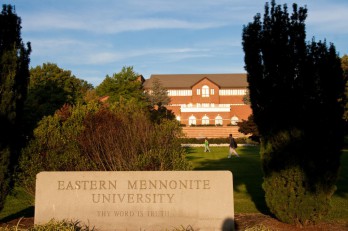
eastern mennonite university

A founding member of the CCC upsets the applecart…

Exactly three months ago in these pages, I put two and two together: the Supreme Court decision in favor of same-sex marriages would present evangelical schools with a terrible dilemma.

Sure enough, Goshen College and Eastern Mennonite University recently announced their plans to hire non-celibate homosexual faculty. They do not necessarily want to leave the CCCU, though. Leaders of the CCCU network are wondering: Will this lead to a split? Will member schools be forced to choose between a homosexual-friendly evangelical network and a traditional gay-is-not-okay one?

Unfortunately, the history of the CCCU offers little help on that question. In its early days as the Christian College Consortium, the network had some grandiose dreams. Some leaders, such as Hudson Armerding of Wheaton College, fantasized about a multi-campus evangelical university. The dream was to concentrate resources in order to keep up with secular colleges.

As far back as the 1950s, some evangelical college leaders toyed with this idea of a California-style mega-versity. Some schools, Armerding hoped, could offer more intense engineering programs. Others might focus on missionary preparation or languages. Yet others could host pre-med degrees. All of them would contribute toward a central graduate campus, too.

In this way, the future CCCU would remain orthodox in religion, yet be able to compete with big public and rich private universities.

As Armerding put it in a confidential letter to his fellow school leaders in 1955,

Each particular college would offer the same undergraduate instruction for the first two years and then would offer a limited number of majors for the final two undergraduate years and graduate studies leading to the doctorate. . . . There would be the possibility of mobilizing the entire evangelical community to support the proposed Christian university, challenging their loyalties through familiar and accepted institutions to which this constituency had already committed itself. Hence the continuing support of the university would be relatively assured. The geographic distribution would make possible a nation-wide impact upon the social and cultural life of the nation and would facilitate the educating of students who might otherwise be unable to travel to one central location.

Speaking from Gordon College near Boston, President James Forrester wrote in 1961 to evangelical intellectual leader Carl F. Henry to support the idea:

I have wondered if a beginning might not be made toward the consolidation of some of the evangelical effort at the undergraduate level on such a campus as ours. This could be done under a federated scheme similar to Oxford, Cambridge, the University of Toronto, Claremont College, and other associated programs. I think particularly of King’s and Barrington and wonder if some person who transcends the entrenched interest of our three schools, could bring together in conference key personnel for a discussion of this possibility. I do find that the limited assets available to Christian higher education in the area are divided among Wheaton, King’s, Barrington, and Gordon. All of us struggle with capital problems and operating deficits. . . . I am also conscious that with such a fractured effort as we now represent, we are no match for the consolidated interests of educators committed to the philosophical position of a naturalistic humanism in the university field. I also feel that this could be the natural groundwork from which could be extended ultimately your magnificent concept of a great Christian university.

It didn’t work out that way. In practice, the CCCU became a loose association of schools. So loose, in fact, that no one seems really sure what will happen now. Member colleges pledge vaguely

To advance the cause of Christ-centered higher education and to help our institutions transform lives by faithfully relating scholarship and service to biblical truth.

Can they do that if they welcome non-celibate homosexual faculty and staff? Or do those schools need to go elsewhere? If they do, how many of the 181 member schools will they pull with them?

From grand 1950s dreams of a powerful and aggressive evangelical multiversity, it seems evangelical colleges will be split yet again into smaller and smaller organizations.

Is THIS the Future for Christian Colleges?

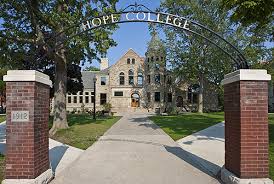
Now what do we do? That is the question plaguing conservative college administrators nationwide. Since the Supreme Court decision in favor of same-sex marriages, many evangelical schools have wondered if they will have to change the way they do things. In Michigan, Hope College has announced its accommodation with the ruling. Will other Christian colleges do the same thing?

The gateway to the future?

The gateway to the future?

As the Sophisticated and Good-Looking Regular Readers of I Love You but You’re Going to Hell (SAGLRROILYBYGTH) are well aware, questions of homosexuality and same-sex marriage have long bedeviled evangelical colleges. For non-evangelicals, it might come as a surprise to hear that the issue is contentious. After all, at most evangelical schools, the official doctrine clearly and resolutely condemns homosexual activity.

Yet at all sorts of schools, the campus community is much more welcoming. At Gordon College recently, the president’s reminder that the school officially bans “homosexual practice” brought furious protests from students and faculty. Even at the far more conservative Liberty University, faculty members do not always take the harsh tone we progressives might expect.

As our Supreme Court decided the constitutionality of state bans on same-sex marriage, many evangelicals fretted that their decision would trash traditional rules on their campuses.

At Hope College in Michigan—a school in the Reformed Church tradition—the leadership and campus has experienced similar turbulence on the issues of homosexuality. In 2010, for example, the administration provoked protests when it banned the film Milk. More recently, the campus has welcomed homosexual student organizations, though the administration has continued to endorse the Reformed position on homosexuality.

In its most recent announcement, the school’s leaders have declared their intention to abide by the SCOTUS decision. From now on, same-sex married partners of college employees will be eligible for the same benefits as heterosexual partners. The administration again affirmed its respect for the Reformed Church’s official doctrine that homosexuality is a sin. That does not mean, however, that the school will contravene the law.

Is this the path other schools will follow? Unlike pluralist colleges, evangelical schools face intense pressure to stay true to traditional beliefs and norms. As Professor Michael Hamilton wrote in his study of Wheaton College,

The paradigm that has dominated Wheaton through the century holds that colleges, more than any other type of institution, are highly susceptible to change, and that change can only move in one direction—from orthodoxy toward apostasy. . . . The very process of change, no matter how slow and benign it may seem at first, will always move the college in a secular direction, inevitably gathering momentum and becoming unstoppable, ending only when secularization is complete.

Hope College may find itself the front line for this debate within the Reformed Church in America. The church as a whole has gone back and forth for decades about the proper Christian reaction to homosexuality. Is it better to embrace the sinner? Or to drive out the sin? Conservatives within the RCA will doubtless take this announcement as proof that Hope has gone soft. Progressives will celebrate it as a small step towards equity.

Other evangelical schools will face similar scrutiny. If they openly welcome homosexual students, faculty, and staff, they will be subject to withering condemnation from conservatives. If they don’t, however, they’ll risk being sidelined, branded as anti-gay bigots.

Postcards from Christian America

Is America a “Christian” nation? What do we even mean by that question? Historically, as I argued in my recent book, even secular conservatives have tended to assume that the United States needs Christianity. Is that still the case? Will it be the case for the foreseeable future? A couple of new polls offer contradictory impressions.

LifeWay, an evangelical research organization, asked 1,000 Americans if they thought God and America had a “special relationship.” Most did. Fifty-three percent overall agreed. In different categories, the percentages went up. Just over two-thirds of self-described evangelical Protestants thought America and God had a special bond. African Americans believed it (62%) more commonly than white Americans (51%). Tellingly, among the highest percentages of agreement were from white evangelicals over 45, seven of ten of whom agreed (71%).

Special friends?

Special friends?

Perhaps this demography helps explain a seeming paradox. Another Fourth of July-timed research report from the Public Religion Research Institute asserted that the numbers of Americans who think the USA is a “Christian nation” is declining, fastest among the young. Only about a third of respondents agreed that the USA is now and has always been a Christian nation. Older people tend to believe it more often.

What does it mean to think of the country as a “Christian” nation? These polls are tricky, since different respondents can think different things, even if they check the same boxes. For some respondents, the idea of a Christian nation likely evokes a tight bond between public spaces and evangelical religion. In a properly Christian nation, some think, public schools and meetings ought to be guided by Christian prayers and ideas.

Other people might simply mean that the USA has a majority of Christians. If we understand “Christian nation” in this sense, it means public spaces can still be secularized, even if a majority of citizens share a Christian faith.

As I’ve argued in the past, it is a mistake to try to pinpoint one point in time when America turned into a secular society. It is a mistake to try to understand the history of evangelicals in America as having changed at a specific point in time from an unchallenged majority to a beleaguered minority. We hear these sorts of claims all the time, of course, especially when the Supreme Court issues a seemingly anti-Christian decision.

Booming with boomers...

Booming with boomers…

From an historical perspective, evangelical Protestants have always held enormous influence over the entirety of American society. Over the long haul, certainly, evangelicalism’s influence in public life has waned.

Does that mean America is moving away from its history as a “Christian” nation?

Or does it only mean that the United States is now and has always been a pluralistic society, with evangelicals battling for control with all kinds of other religious and non-religious groups?

Gay Marriage and Christian Resistance

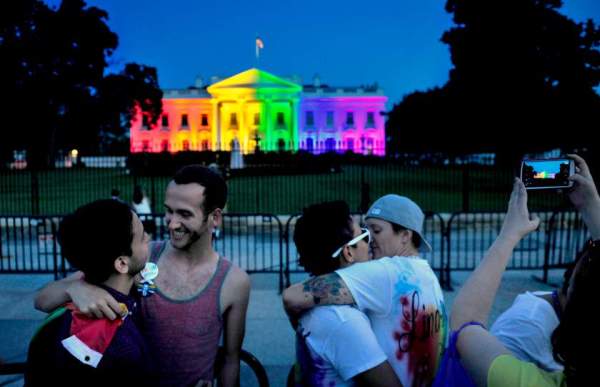
What is a conservative Christian to do? The US Supreme Court’s decision in favor of gay marriage has sent shock waves across America. Will conservative Christians accept this decision? Or, as some have warned, does this move our culture war over sexuality one step closer to real war?

More rainbows than a box of Lucky Charms...

More rainbows than a box of Lucky Charms…

Of particular interest at ILYBYGTH these days, the new ruling will likely meet its first test at conservative religious colleges. As we’ve noted (and as the New York Times eventually noticed) the SCOTUS ruling has brought up questions about the limits of acceptable dissent in higher ed. Can schools discriminate against homosexual “practice?” As I’m writing about in my current book, the same tension played out in the 1970s, when Bob Jones University insisted on its religious right to racial discrimination. It seems colleges will be the first institutions to feel pressure to accommodate demands to end institutional discrimination against homosexuals.

The reaction to the SCOTUS decision has been fast and furious among conservative evangelicals and other Christians. Rick Scarborough of Vision America told the New York Times that the decision must be resisted. “If they change the playing field and make what we do out of bounds,” Scarborough said,

we will disobey; we will disrespect this decision. . . . We’ll treat it like Dred Scott and other decisions courts have handed down over the years that counter natural law. God made a male and a female, and no amount of surgery is going to change that.

Similarly, Robert Jeffress told the Christian Post that the decision proves America’s persecution of Christians. As the Rev. Jeffress put it,

I think today’s decision is just one more step in the marginalization of conservative Christians. I made this argument and have been ridiculed for doing so, but I think it is very legitimate. The Nazis did not take the Jews to the crematoriums immediately. . . . The German people would not have put up with that. Instead, the Nazis begin to marginalize the Jewish people, make them objects of contempt and ridicule. Once they changed the public opinion about the Jewish people, then they engaged the [Holocaust]. . . . Once secularists have made Christians objects of contempt, I think it will be very easy to revoke other rights that they have as American citizens.

And in the pages of World Magazine, Ryan Shinkel advocated Christian resistance to an overweening state and society. “The movement for marital restoration is beginning,” Shinkel wrote just before the SCOTUS decision,

and the chance for moral courage and a life daring to be countercultural is at hand. By continuing to speak up for religious freedom, the restoration of a marriage culture, and dignity of the family in the face of potential setbacks at the Supreme Court, we can become the Nietzscheans who hammer the libertine and atomistic idols of our age.

Secular folks like me, progressive people who celebrate the SCOTUS decision, might blanch at these dire warnings. Some of my friends and colleagues might take these statements as proof that conservative Christians will never admit to marriage equality. But folks like us need to listen also to the other voices of conservative Christians.

In the Washington Post, for example, Russell Moore of the Southern Baptist Convention suggests Christians calm down. It is a terrible ruling, Moore agrees. And it does indeed push conservative evangelicals into a dissenting position that might seem “freakish” these days. But so what? Moore wants conservatives to “embrace a freakishness that saves.”

Similarly, Mark Galli of Christianity Today worries that evangelicals will react badly. “The temptation,” he writes,

is to go off and sulk in our holy corner. Or to dig in our heels and fight harder. Or to lash out in anger. Or to despair. We can do better.

The goal for Christians, Galli writes, is to take confidence that they are on the right side, God’s side. This decision provides another healthy—if intensely uncomfortable—opportunity for Christians to re-engage with important questions above love, marriage, and the proper relationship between Church and society. Though some conservatives might offer extreme rhetoric, Galli warns, evangelicals in America “are far from living at the margins.”

If we are to make sense of the culture-war rhetoric surrounding this SCOTUS decision, we need at least to remember some historical precedent. As I’ve argued elsewhere, for generations evangelical Christians have been battered by landmark SCOTUS decisions that seem to kick them out of public life. In every case, evangelical pundits have insisted that each new SCOTUS decision changed America from a Christian nation to a persecuting Babylon. In every case, however, evangelicals have continued to wield enormous cultural and political power.

Will this decision be any different? Will this decision really change the balance of power in America’s continuing culture-war debates?

Mixing It Up with Pope Francis

Confused by the incessant culture-war back and forth on the issue of climate change? Usually, it’s pretty easy to pick a side. Since, as Yale Law School’s Dan Kahan argues, what we “believe” about issues such as evolution, vaccinations, and climate change tells us more about who we are than what we know. Usually, those of us who consider ourselves progressives push for more and faster action on climate change. Those who consider themselves conservatives pooh-pooh the urgency of the issue. Yesterday, Pope Francis threw a St.-Peter’s-size monkey wrench into the works with his encyclical about the environment. In this searing statement, the pope challenged all of us to take a stronger stand about the changing climate.

Is THIS what conservatives should drive? . . .

Is THIS what conservatives should drive? . . .

Now, I admit, I have not read the full document. It weighs in at 184 pages and I’ll be sure to put it at the top of my reading list. Analysis by the New York Times paints a picture of a fairly radical stand by the Argentinian pope. In short, Pope Francis went further than tut-tutting the bromides of climate science. The pope blamed affluent throwaway culture for the dangerous changes that have already begun. What are we to do? Not just consume smarter, but change our feelings of entitlement and our endless apotheosis of appetite.

Climate change, the pope wrote, is nothing less than “one of the principal challenges facing humanity in our day.” It is not enough for us to merely cap-and-trade carbon emissions. It is not enough for us to merely “grow” our way out of the dilemma. The pope’s message is clear, and rather startling in its Greenpeace-scented tones. Those of us who follow culture-war-related developments are more accustomed to the Vatican as a world headquarters for staunchly conservative thinking on issues such as abortion and gay rights.

The new Popemobile?

The new Popemobile?

What does this mean for our climate-change culture wars? It will certainly mess up any bright lines between “conservative” and “progressive” orthodoxies. Of course, we’ve seen conservative intellectuals at places such as Front Porch Republic and The American Conservative who have long promoted this sort of less-is-more conservatism. But by and large, American conservatives might be more likely to agree with Richard Viguerie, who called Pope Francis’ statement a “confusing distraction.”

As Josh Rosenau of the National Center for Science Education has pointed out, American Catholics have been divided on the issue of climate change. “Traditional” Catholics in the USA have tended to be split on the issue and generally have been more interested in preserving traditional religious practices than in environmental activism. Could Pope Francis’ statement push them to action?

More broadly, might the pope’s statement encourage American conservatives to consider tackling climate change as a conservative mission? What about conservative Christians who are not Catholic? Some American evangelicals have openly attacked environmentalism as a “green dragon.” Others have talked about an evangelical environmentalism, calling it “creation care” or respect for the “doctrine of dominion.” Still others have voiced more complicated positions. American creationists, for example, have wondered about their theology of climate change. At the young-earth creationist ministry Answers In Genesis, for instance, readers are told that climate change is certainly a real phenomenon. But should we worry? Here is AIG’s advice:

should we be alarmed about climate change? Not at all. Yes, climate change is real, but according to the true history book of the universe, we should expect it as a consequence of the cataclysmic Flood. Also, Earth—and Earth’s climate—was designed by the all-knowing, all-wise Creator God. He built an incredible amount of variety into the DNA of His creatures so that they could survive and thrive as Earth’s environments change. Surely the God who equipped life to survive on a changing Earth also designed Earth with the necessary features to deal with environmental changes.

No one doubts the pope’s credentials as a smart, earnest, conservative Christian thinker. Might his encyclical spark a dialogue between conservative Catholics and other conservative Christians about the issue of climate change? Could an inter-Christian, inter-conservative dialogue move conservative Christians towards the pope’s position?

The Creeping “Christian” Coup

Take a stroll around America and you’ll see bajillions of “Christian” book stores, “Christian” schools, “Christian” churches. Of course, these institutions represent a certain sort of Christianity, a conservative evangelical Protestant one. There are lots of Christians who do not fit this definition of “Christian.” But a new set of survey data from the Pew Research Center for Religion and Public Life shows that the gap between the two seems to be narrowing. There are fewer Christians overall, but “Christians” are doing just fine.

Anytown, USA

Anytown, USA

So get ready for it. In the next week or so we’ll hear lots of exclamations about the recent Pew numbers. We’ll be told that the United States is becoming less Christian. As the folks at Pew tell us,

The Christian share of the population is declining and the religiously unaffiliated share is growing in all four major geographic regions of the country. Religious “nones” now constitute 19% of the adult population in the South (up from 13% in 2007), 22% of the population in the Midwest (up from 16%), 25% of the population in the Northeast (up from 16%) and 28% of the population in the West (up from 21%). In the West, the religiously unaffiliated are more numerous than Catholics (23%), evangelicals (22%) and every other religious group.

Does this mean we’ll see an abatement in culture-war scuffles over religion? Will America disagree less about abortion? Gay rights? School prayer? Evolution?

Not likely. In fact, we should expect the opposite.

Here’s why: Christianity’s share of the overall population might be dwindling, but evangelical Christianity has shrunk, if at all, by a much smaller percentage. In the words of the Pew report,

The new survey indicates that churches in the evangelical Protestant tradition – including the Southern Baptist Convention, the Assemblies of God, Churches of Christ, the Lutheran Church-Missouri Synod, the Presbyterian Church in America, 0ther evangelical denominations and many nondenominational congregations – now have a total of about 62 million adult adherents. That is an increase of roughly 2 million since 2007, though once the margins of error are taken into account, it is possible that the number of evangelicals may have risen by as many as 5 million or remained essentially unchanged.

I don’t know why the pollsters lumped Missouri Synod Lutherans in with evangelical denominations, but they certainly belong in the conservative camp. In any case, as anyone who knows the long history of our culture wars is aware, the fiercest fights have usually been between liberal and conservative Protestants.

Many of our liberal and secularizing culture-war leaders have come from mainline Protestant denominations. These days, for example, from the United Church of Christ, the denomination formerly known as Congregationalism, The Reverend Barry Lynn heads the liberal Americans United for Separation of Church and State. In the 1920s, as I argue in my first book, liberal Protestants such as Edward Birge and Edwin Conklin led the fight for evolution education.

If that sort of liberal Christianity continues to dwindle, it is entirely possible that Americans will come to agree that to be a “Christian” means adhering to a conservative evangelical Protestant faith. It might even snowball. The new Pew numbers show that evangelicalism is the only major religious group to pick up adherents from other churches. As they put it,

The evangelical Protestant tradition is the only major Christian group in the survey that has gained more members than it has lost through religious switching. Roughly 10% of U.S. adults now identify with evangelical Protestantism after having been raised in another tradition, which more than offsets the roughly 8% of adults who were raised as evangelicals but have left for another religious tradition or who no longer identify with any organized faith.

If evangelical Christianity bucks the trend of shrinking Christian identification, it makes sense to think that soon more and more Americans will identify evangelicalism with Christianity as a whole. What might that mean?

It’s impossible to predict, of course, but I’ve got a couple of hunches. First, we’ll see a stronger distinction between liberal evangelical Protestants and conservative ones. There is a strong tradition of politically progressive evangelicals, but its story tends to get swamped when people talk about evangelicalism.

Second, we’ll see a continuing weakening of the racial divisions between conservative evangelicals. As the new Pew report asserts, “Black Protestant” groups are also growing. But the Pew pollsters don’t differentiate between very different sorts of African American evangelicals. If evangelicalism becomes more of a stand-in for Christianity as a whole, pollsters will begin to connect conservative evangelicals across the race line. The interesting questions will become how many conservative evangelicals there are out there, not how many “Black Protestants.”

Third, and for SAGLRROILYBYGTH perhaps the most interesting, we will likely see a heating-up of culture-war rhetoric. Conservative evangelicals will frame themselves more and more vociferously as the voice of “Christianity.” With smaller numbers of liberal Christians to naysay, the identification of conservative evangelicals with the entire Christian community will become ever tighter.

Bush at Liberty: “Seven Thousand Acres of Shared Conviction”

He didn’t have much choice. These days, any front-runner for the Republican Party presidential nomination seems required to make a speech at Liberty University. But when Jeb Bush gave his commencement address at Liberty this week, he did not have to emphasize one of American fundamentalism’s deepest-held convictions. But he did.

As the sophisticated and good-looking regular readers of I Love You but You’re Going to Hell (SAGLRROILYBYGTH) are well aware, I’m working on a book about the history of schools like Liberty. And among the issues I’m struggling with are the distinctive traditions that set off fundamentalist and evangelical colleges from other religious schools.

Certainly, as Roger Geiger outlined in his definitive new history of American higher ed, in the United States every religious group has scrambled to establish its own colleges and universities. It has become a way for religious groups to confirm their legitimacy and American-ness.

So, for Catholics, and Lutherans, and Methodists, and Nazarenes; for Muslims, and Jews, and Mennonites…every religious group has its own network of schools that train its young people in its distinctive faith traditions as well as in professional skills and the liberal arts.

Unlike most of those other traditions, however, the network of fundamentalist colleges that developed since the 1920s has seen itself not only as a haven from a hostile wider American culture, but more specifically as an enclave of true Americanism. Unlike most other conservative Protestants, even, fundamentalists have a fairly unique proprietary feeling about the US of A.

Back in the day, brainy Catholic kids might have gone to Georgetown or Boston College, either to become priests or just become educated Catholics. And they did so in order to study in an intellectual refuge from the relentless anti-Catholicism that permeated mainstream culture for so long.

Since the 1920s, brainy evangelicals and fundamentalists have gone to Bob Jones or Wheaton or Liberty, either to become pastors or just to become educated evangelicals. But these evangelical schools were not seen as islands set off from a hostile mainstream America. Or, to be more specific, they were seen as islands, but only in the sense that they represented a last resort of true Americanism. Such schools often talked about their need to preserve a slice of the true America.

Since the 1950s, those schools that aligned with the more moderate “evangelical” wing of fundamentalism tended to downplay this tradition. Schools who clung to the “fundamentalist” label—such as Bob Jones, Pensacola Christian College, the late Tennessee Temple University, and Liberty—often doubled down on their sense of usurped Americanism.

When Governor Bush made his Liberty speech, he made the usual paeans to religious freedom and religious liberty. But he also went the extra rhetorical mile to endorse Liberty’s sense of itself as an outpost of true Americanism. As Bush put it,

How strange, in our own time, to hear Christianity spoken of as some sort of backward and oppressive force. Outside these seven thousand acres of shared conviction, it’s a depressing fact that when some people think of Christianity and of Judeo-Christian values, they think of something static, narrow, and outdated. We can take this as unfair criticism, as it typically is, or we can take it as further challenge to show in our lives the most dynamic, inclusive, and joyful message that ever came into the world.

“Seven thousand acres of shared conviction”! A phrase surely calculated to warm the hearts of Liberty’s leaders. The implication, clearly, is that Liberty represents an enclave of purity, a reservation for America’s Moral Majority, which promises to preserve American values until that day that they can be spread back into the rest of America’s 2,432,000,000 acres.