Conservative Politicians Need an Education

If you want to be President, go to college.  Eventually.

Wisconsin Governor Scott Walker has announced his intention to return to college to finish his bachelor’s degree.  The conservative Walker dropped out of Marquette University as a senior and never looked back.  Until now.

With presidential aspirations on the table, Governor Walker has decided to complete his undergraduate education.  He’ll use a program for working adults at the University of Wisconsin.

Makes us wonder: Would his opponents have used Walker’s incomplete college education against him?  Called him just another ignorant conservative?  As I’ve argued in the pages of the Chronicle of Higher Education and elsewhere, “ignorance” is one of the go-to accusations made against conservatives.

Doesn’t seem like good politics, with the vast majority of adults in a similar boat.  Only about one in five adults in the United States has a college degree.  Nevertheless, Governor Walker seems to think it’s not worth the risk.  These days, part of the resume for POTUS must include higher education.  But don’t tell that to G-Wash and Honest Abe.


Eat a Meanwich, Michelle Obama

Kids don’t eat their vegetables.  No news there.  But new rules about school lunches have got some students and their parents up in arms against an overreaching federal government.

As described by the LA Times, the new rules mandate more fruits and vegetables for school lunches.  This seems like a good thing.  But as the LA Times editors argued recently,

the program is afflicted by rigid, overreaching regulations that defy common sense. Schools must provide items from five food groups, including a fruit and a vegetable, every day. Students must choose three items, even if they’re not hungry enough for all of them, and at least one must be produce. But fruits and vegetables rank as the least popular items, so requiring schools to offer one of each for each student practically guarantees that an enormous amount of fruits and vegetables will go to waste.

More colorfully, the editors at Twitchy compiled a series of student tweets about the new lunch rules. Be warned: these tweets include some harsh language, most of it directed at First Lady Michelle Obama. Obama, of course, has made healthy food one of her signature programs. One student memorably complained, “Sorry michelle obama but i dont wanna eat crusty ass broccoli for lunch at school.”

One mom complained, "This is sad!"

One mom complained, “This is sad!”

As historian Susan Levine demonstrated, the history of school lunch is fraught with the politics of poverty, influence, and agriculture. In their early days, powerful US Senators such as Richard Russell of Georgia promoted school lunches as a guaranteed market for struggling farmers. In the 1960s, federal policy-makers began to see school food as a way to address economic inequality in society. By guaranteeing meals for low-income students, it was hoped, school food could even the playing field somewhat.

So there’s nothing new about school lunch as a tool of social engineering. And there’s also nothing new about conservative outraged reactions. As Baylen Linnekin insisted in the pages of Reason recently,

The government’s efforts to pad school lunch enrollment numbers by expanding the program should be seen as what it is: a cynical attempt to avoid admitting failure. There’s nothing palatable about that.

Even here, though, it seems libertarian and/or conservative pundits will be on tricky terrain. Perhaps the new lunch program is unpopular. And perhaps the government has assumed an enormous role in the feeding of America’s children.  But who wants to be on the side of nixing fruits and vegetables?

Building the Machine: Conservatives Debate the Common Core

She’s in a hurry.

Balancing a crate of oranges in one hand, a purse and bag of groceries in the other, a stylish, affluent, and beautiful mom hustles to answer a call on her iPhone from a friend. “Calling to see if you’re going to the special PTA meeting,” the friend asks as creepy music deedles in the background, “the school is changing the tests next Spring . . . something about the Common Core Standards?”

That’s the opening of a new short film about the Common Core Standards produced by the Home School Legal Defense Association. The forty-minute film, Building the Machine, examines conservative arguments for and against the new standards. As we’ve noted in these pages [check out ILYBYGTH coverage here, here, or here, for instance], conservatives have wondered about the implications of these new standards. I’m told by watchful members of the ILYBYGTH community that the film has made a big splash among conservative homeschoolers. What are conservatives supposed to think about the new standards? What do they need to know about them?

The conservative HSLDA certainly wants to portray the CCSS in a negative light. As HSLDA leader Michael Farris makes clear in the documentary, he feels the standards make a fetish of centralization, systematization, and data collection. But the film gives ample time for pro-CCSS conservative intellectuals to make their cases.

Most prominently, Michael Petrilli of the conservative-leaning Fordham Institute tries to allay conservative worries. The standards, Petrilli argues, resulted from an open and public process. They were not imposed top-down by grasping central elites. Best of all, they will improve education. They will hold teachers, unions, administrators, and students to higher standards. Are they perfect? Not according to Petrilli. But they are the nation’s best shot at renewing academic rigor in public education.

Petrilli is joined by conservative standards-boosters such as Mike Huckabee and Chester Finn. But most of the screen time is devoted to CCSS dissidents Sandra Stotsky and Jim Milgram. Both were part of the original validation committee in charge of the standards, and both refused to sign off on the final product. Why? Both Stotsky and Milgram assert that the new standards are not offering the rigorous academic benchmark that they claim to be. And both insist that their dissent was swept under the rug.

The HSLDA documentary also features conservative critics from the Heartland Institute and Pioneer Institute. The new standards, conservative intellectuals complain, were crafted in a secretive manner, rammed through by the federal government, and do not make academic sense. By aiming at the broad middle, by promising to make all students “college and career ready,” these standards fail to prepare students for either college or careers. More troubling, the standards represent a dictatorial overreach by central government. Mega-rich donors such as Bill Gates greased the slide and snuck this project past the complacent American public.

Perhaps more than the messages delivered by the talking heads, the film’s fast-cut montages and sinister musical background send a clear message: Take your kids and run for the hills. We can’t all be as hip, rich, and beautiful as the mom in the opening montage. But the film makes it clear. All of us—beautiful moms and the rest of us alike—need to wake up and smell the Common Core.


Astorino Blasts the Common Core: “Our Children Are Not Guinea Pigs!”

Should conservatives embrace the Common Core? As we’ve seen [check out ILYBYGTH coverage here, here, or here, for instance], conservative intellectuals have disagreed about the new standards. New York gubernatorial hopeful and staunch conservative Rob Astorino offered a stinging attack on the new standards last week. His analysis of the good and the bad might give us some insight into the ways conservatives view these new standards. Indeed, Astorino’s comments might offer insight into conservative attitudes about education as a whole.

Astorino is leading the conservative charge against sitting New York Governor Andrew Cuomo. Astorino, a County executive from affluent Westchester County, just north of New York City, has pledged to take the Great State of New York in a more conservative direction. As part of that campaign, Astorino issued a blistering attack on the Common Core Standards.

http://vimeo.com/90498744

Flanked not only by the US flag, the New York flag, and a copy of the US Constitution, but also by a few cheerful children’s drawings, Astorino blasted the CCSS as an “untested experiment” that would lead America in dangerous directions. Indeed, Astorino repeated the word “experiment” or “experimental” a total of four times in the four-minute announcement. He also repeated the phrase “Andrew Cuomo’s Common Core exam” four times. Clearly, Mr. Astorino hopes to label the CCSS as both experimental and part of Governor Cuomo’s program.

Most compelling, Astorino announced last week that his own children will be opting out of the exams. The Opt-Out movement has attracted support from all across the political and ideological spectrum.

For Astorino, opting out is the right choice for conservatives. Why? He offered a laundry list of problems with the standards and with the associated exams.

First, with common standards and exams, Astorino warned, local schools will become “centralized organs of the Federal government.”

Second, these exams and standards will raise property taxes “through the roof.”

Third, these exams are not tested, but are simply the misbegotten brainchildren of people such as Bill Gates. According to Astorino, the exams came from the same political greenhorns who cobbled together the disastrous “Obamacare.” Worst of all, Astorino asserts, these standards and exams represent just the latest effort by distant educational elites to exert their unwanted and poorly conceived influence over all the nation’s schools. As he put it, “We’re risking our children’s futures for a few scraps from Washington.”

As I argue in my upcoming book about conservatism and American education, the notion that a scheming group of educational usurpers has taken—or is taking—control of our nation’s schools has a long and potent history. Astorino appeals to this tradition by taking a firm stand on what he calls this “expensive, experimental, Federal curriculum.”

So what’s a conservative to do? According to presumptive GOP gubernatorial candidate Rob Astorino, conservative parents should run for the hills.


Persecution, Mozilla, and Gay Rights

Who is the bully? Who is the victim? Is it former Mozilla CEO Brendan Eich? Or is it the many LGBT people who might not have equal marriage rights?

Unless you’re living under a rock, you’ve heard the story by now. Co-founder and former Chief Technology Officer of Mozilla Brendan Eich recently resigned from his new job as Chief Executive Officer. Why? In 2008, he donated $1000 to support California’s Proposition 8. The Proposition would have banned same-sex marriage. His donation caused such a backlash against Mozilla that Eich resigned.

Throughout the furor, Eich made conciliatory noises about the values of diversity and tolerance, but he did not abjure his political beliefs against gay marriage. For many in the tech community, such beliefs are tantamount to bigotry and politicized hatred. To be against gay marriage, for many folks (full disclosure: I include myself in this group), implies a willingness to deny equal legal rights to a category of people. This is the very definition of bigotry. Such a position, pro-gay-marriage activists insist, is akin to denying people the right to marry across the race line.

In short, by opposing gay marriage, Eich defined himself as a bully and a bigot. To oppose gay marriage, many felt, puts Eich and his ilk beyond the pale of civil society.

In the conservative intellectual community, of course, the shoe is on the other foot. Conservatives insist that the bullying is being done by the pro-gay-marriage crowd. How is it “tolerant,” conservatives ask, when successful business leaders are forced to step down strictly because of their political beliefs? The bigots here, conservatives argue, are those who won’t allow a true intellectual or political diversity. The real bullies, conservatives say, are those who won’t allow for any disagreement with their worldview.

As usual, one of the most perspicacious articulations of these positions came recently from Princeton’s Robert George. In the pages of First Thoughts, George argued the case that the victims here were religious folks. Anti-Eich-ism, George asserts, threatens to squeeze religious folks out of the public sphere entirely. As Professor George puts it,

Now that the bullies have Eich’s head as a trophy on their wall, they will put the heat on every other corporation and major employer. They will pressure them to refuse employment to those who decline to conform their views to the new orthodoxy. And you can also bet that it won’t end with same-sex marriage. Next, it will be support for the pro-life cause that will be treated as moral turpitude in the same way that support for marriage is treated. Do you believe in protecting unborn babies from being slain in the womb? Why, then: “You are a misogynist. You are a hater of women. You are a bigot. We can’t have a person like you working for our company.” And there will be other political and moral issues, too, that will be treated as litmus tests for eligibility for employment. The defenestration of Eich by people at Mozilla for dissenting from the new orthodoxy on marriage is just the beginning.

Are conservatives the victims here? Is it legitimate political activism to oppose same-sex marriage? Or is it bigotry and intolerance?


Florida, Football, and Fundamentalism

Is football a religion? Do the high priests of college football act like the leaders of the nation’s most conservative fundamentalist colleges? In some ways, when it comes to responding to accusations of rape and sexual assault, the similarities seem creepily prominent.

News emerged today that the case of football star Jameis Winston at Florida State will undergo a new round of scrutiny. Back in December, Winston evaded charges about an alleged sexual assault. At the time, pundits accused FSU of coddling Winston because of Winston’s star power.

As we’ve seen in these pages, conservative evangelical Protestant colleges–“fundamentalist” schools–have weathered similar charges of stonewalling and covering up charges of sexual assault on their campus.

Are these cases similar? Does football function like fundamentalism? That is, does the culture of big-name, big-money football create an environment in which everything else takes a back seat to success on the gridiron? Where any questioning of the football team becomes similar to questioning basic tenets of orthodox religious belief?

Let’s take a look at some of the similarities and differences.

At least according to some accusers, fundamentalist schools actively target victims of sexual assault. Both men and women, students and administrators, are steeped in a “purity culture” that encourages all involved to see female victims as sexual temptresses. When accusations of rape emerge, victims are attacked by students and administrators. The threat of making such accusations intimidates many other victims into a scarred silence.

Similar hostility emerges with college football. The alleged victim of the FSU rape, for instance, eventually dropped out of school and moved out of town due to constant harassment and death threats.

Also, it seems both football and fundamentalism push college administrators to worry first about the school, and only secondly about the complaints of victims. With football, the stars must be protected. No one can win a Heisman Trophy or a national championship from a jail cell. And with fundamentalism, schools must protect their reputations as uniquely safe environments. Publicity about sexual assault would certainly threaten that reputation.

But there are also significant differences. First of all, non-fundamentalist schools are almost all subject to review by federal guidelines. In the case of FSU, for example, the case has come back into the headlines because of accusations that the FSU administration might have violated provisions of Title IX in its handling of the case. Most fundamentalist schools refuse all federal funding, so they can operate without such oversight or federal review.

More profoundly, cases at fundamentalist schools are about more than just administrative cover-ups. Some pundits insist that the culture at fundamentalist schools operates as a hyper-charged version of broader cultures that blame women victims. More than at pluralist public schools such as FSU, critics allege, fundamentalist schools promote both sexual assault and victim-blaming by insisting on a “purity culture” standard. Women involved in sex of any kind often find themselves accused of instigating sinful acts.

Victory we have heard on high

Victory we have heard on high

There’s no doubt that big-time college sports look like religions, in lots of ways. They have weekly rituals, with ceremonial outfits and traditional musical accompaniment. They have high priests and acolytes who huddle to make important decisions. And, at least in the eyes of many fans and players, they involve the community in a staged fight of the powers of good versus the powers of evil.

But does this quasi-religious adoration of college sports bleed over into the treatment of accusations of rape as well?


Cruz at Liberty: Freedom under Attack

Senator Ted Cruz told the commencement crowd at Liberty University that they were in danger. Unless they remained willing to sacrifice for their faith, unless the Liberty community remained willing to get active in politics, the religious liberties of the United States could be crushed under the heel of a metastasizing federal government.  Unlike some typical graduation speakers, he hoped the career path of his audience would include some time in prison.

In some ways, Cruz’s commencement address sounded very similar to such addresses at colleges all across the nation and all across the political and religious spectrum. In spite of the fact that Senator Cruz has earned a reputation of one of the staunchest and most outspoken religious conservatives in national office, his speech often seemed mere boilerplate graduation fare: he told the crowd they were all inspirational; he told a few mildly humorous anecdotes; he allowed himself to notice how very famous he was; and he exhorted the crowd to get on out there and change the world.

But in the context of Liberty University, founded in 1970 by fundamentalist leader Jerry Falwell, Cruz also included more ideologically charged material. He reviewed the conservative vision of the nature of the United States. Throughout United States history, Cruz insisted, we see nothing more starkly evident than the fact that “Faith and freedom are intertwined.”

The United States had weathered storms, Cruz said, but he warned ominously, “religious liberty . . . has never been more imperiled than it is right now.”

Cases such as the Hobby Lobby suit or that of the Little Sisters of the Poor, Cruz told the Liberty audience, demonstrate the dangers to religious freedom. These cases are not about contraception, Cruz warned. If religious people can be forced to go against their beliefs to satisfy the demands of big government, Cruz warned, then the generations of sacrifice by Godly Americans will have been for naught.

The folks at Liberty had a chance to change things, Cruz concluded. If they were brave enough to remember that they were “called to action as believers,” Liberty grads could “change the world.” But they had to be willing to suffer for it, to sacrifice for it. Like The Reverend Dr. Martin Luther King Jr., Cruz told his Liberty audience, Christians need to be willing to go to jail to promote their beliefs.

“How many of us,” Cruz asked, “have been to prison for Christ?”


…but God IS My Hero

“But God IS my hero.” That’s a dramatic reconstruction of what ten-year-old Erin Shead told her teacher in October. Her teacher had asked her to do a writing assignment about a hero. When Erin turned in an essay about God, her teacher told her she couldn’t write about God, she had to write about her personal hero.

Source: WRCB Chattanooga

Source: WRCB Chattanooga

The resulting kerfuffle pushed Tennessee lawmakers to pass the Religious Viewpoints Anti-Discrimination Act. According to this bill, which now goes to Tennessee Governor Bill Haslam for a signature to become law, students must be allowed to voluntarily express religion viewpoints “on an otherwise permissible subject in the same manner [the school] treats a student’s voluntary expression of a secular or other viewpoint.” In other words, students must be allowed to write about God as their hero.

Here at ILYBYGTH, we have to wonder if this sort of law might represent a powerful new conservative tactic in America’s ongoing educational culture wars.

Tennessee is not alone in passing this sort of school rule. Texas has such a law on the books. Missouri has a similar rule enshrined in its constitution. And Oklahoma is considering something along these lines.

Today, I’m not going to argue the merits of these sorts of laws. In short, though, I’m against them. As I’ve argued in places such as Education Week and the Washington Post’s Answer Sheet blog, these kinds of bills threaten to impose an utterly unmanageable free-for-all in our nation’s classrooms. IMHO. Other commentators, too, have worried that these laws will impose a renewed theocracy in public schools. If students can use class time to make religious statements, some worry that religious students might turn classrooms into religious battlegrounds. What if a creationist student insisted that she could answer questions about evolution with references to Genesis? What if a Muslim student made a speech in which he denied that Jesus was God? It’s not hard to imagine dicey situations these new laws might encourage.

Today, though, instead of arguing against these kinds of bills, I’d like to make a different point. It seems educational conservatives can win politically by protecting students from a perceived overreach by educational leaders. In the case of Tennessee, the senate bill passed unanimously. In the assembly, only two representatives voted against it.

Why did this bill have such overwhelming political support? Two reasons. First, there is not much new in these laws. Students already had the right to engage in self-directed religious activity in public-school classrooms. Erin Shead already had the right to write about God as her personal hero. Second, conservative educational thinkers and activists have long worried about school as a potential threat to young people’s faith. Anything that looks to support religious young people from what many people see as an aggressively secularizing public-school establishment will win political points among religious conservatives.

So liberal-leaning lawmakers can vote for these laws as mere clarifications of already-existing rules. And conservative-leaning lawmakers can promote these votes as an effort to protect religious youngsters from the sinister aggression of secularizing teachers and schools. Together, that is a powerful political coalition.

If I were a conservative activist, I would be watching very closely. Bills that underscore the religious rights of students in public schools have a powerful symbolic effect, if nothing else. And politically, they may be hard to stop.

Why shouldn’t conservatives push these sorts of school laws all over the country?


Hating the Haters

Should Fred Phelps’ funeral be a protest site?

Insta-pundits have debated the issue.  With the anti-homosexual founder of the Westboro Baptist Church possibly on death’s door, would it be proper for gay-rights activists to protest at Phelps’ funeral?

fredphelps

Fred Phelps in Action

Phelps attracted the most attention, after all, for his policy of hateful protests at the funerals of US servicemen and –women.  His “God Hates Fags” signs became a byword for extremist fundamentalism.

Should those opposed to Phelps’ awful tactics engage in those tactics?  We think not.

While it might be satisfying to stand with “God Hates Haters” signs, it would only exacerbate the culture of hate.


What Would Bryan Do?

H/t KT

Would William Jennings Bryan support the recent move by the president of Bryan College?  That’s the question Bryan’s great-grandchildren are asking these days.

As we’ve reported, Bryan College’s leadership has imposed a new, stricter faculty policy.  From now on, faculty must believe that Adam and Eve were real, historical persons and the real, genetic origins of all subsequent humanity.  As science pundit Jerry Coyne has pointed out, that puts evangelical scientists in a pickle, since genetic evidence indicates that the smallest possible pool of original humans had to be at least 2,250 people.  Bryan College is home to science-curriculum innovators Brian Eisenback and Ken Turner, who hope to show evangelical students that evolution does not necessarily disprove their Biblical faith.

What would the original Bryan say about all this?  The college, after all, was founded as a memorial to Bryan’s last decade of work defending the centrality of Biblical wisdom in American life and politics.  As I argued in my 1920s book, though, Bryan himself held some beliefs about both the beginnings and the end of time that have made other conservative evangelical Protestants uncomfortable.  Bryan did not believe in a young earth, nor in a literal six-day creation.  Nor did Bryan think Jesus had to come back before the earth experienced its promised thousand-year reign of peace and justice.
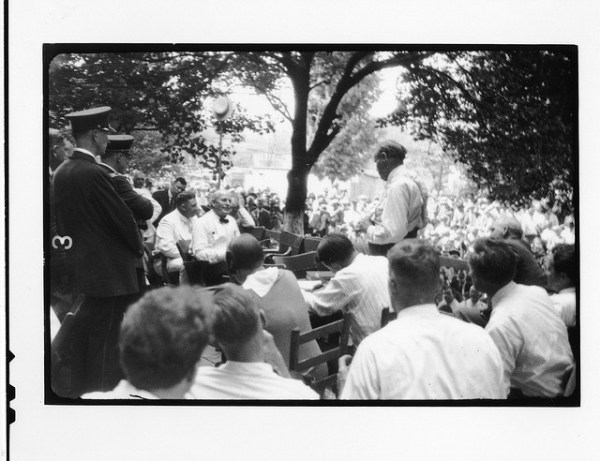
Bryan Gets Grilled by Darrow at the Scopes Trial

Bryan Gets Grilled by Darrow at the Scopes Trial

Other historians, too, have noted Bryan’s complicated relationship with the fundamentalist movement in its first decade, the 1920s.  Lawrence Levine’s Defender of the Faith and, more recently, Michael Kazin’s A Godly Hero both get into the gritty details of Bryan’s anti-evolution crusade.

Historians might disagree, but we all will get nervous about trying to predict what Bryan would say about today’s dust-up at Bryan College.  Because Bryan’s ideology and theology remain necessarily part of his life between 1915 and 1925.  It is mostly meaningless to ask what he would say today, because the situation today is so wildly different from what it was back then.

For example, when Bryan led his anti-evolution movement in the 1920s, the scientific jury was still out on the mechanism of evolution.  Darwin’s explanation—modified descent through natural selection—had been roundly criticized and nearly dismissed by the mainstream scientific community.  So when Bryan led the charge against the teaching of evolution, he could claim with scientific legitimacy that natural selection was not established scientifically.  It was not until years after Bryan’s death that biologists and geneticists such as Theodosius Dobzhansky, Ernst Mayr, R.A. Fisher, J.B.S. Haldane, Sewall Wright, and others solved the problem of genetic “swamping” that seemed to make Darwin’s idea of natural selection a non-starter.

I’ve spent my time with Bryan’s papers at the Library of Congress.  I like Bryan.  He was a successful politician, but I don’t hold that against him.  I believe he was also sincere and devoted to justice.  I came to believe that Bryan was profoundly shocked and surprised when he could not produce his dream team of scientific experts at the Scopes Trial to put evolutionary scientists in their place.

Of course, Bryan died just a few days after the trial.  I can’t help but wonder how he might have “evolved” in his thinking if he had lived.  Would his experience at the Scopes Trial have caused him to re-think his confidence that evolutionary science would soon be disproven?  And, more intriguing, how would Bryan have responded if he had lived for an even longer stretch?  An Old-Testament sort of lifespan?

Would Bryan have embraced the “new evangelicalism” of Carl Henry and Billy Graham?  Would he have worked to make sure Biblical religion remained in conversation with mainstream American culture and politics?

I can’t help but think that he would.  I agree with Bryan’s great-grandson Kent Owen, who told reporter Kevin Hardy, “My view of Bryan is that things weren’t set in stone. . . .  He was pragmatic.”

What does this mean for today’s leadership at Bryan College?  On one hand, they are continuing the legacy of their school.  Bryan College was never bound too tightly to the thinking of the original William Jennings Bryan.  From its outset, Bryan College took a firmer, more “fundamentalist” position than Bryan himself ever did.  But on the other hand, the insistence of today’s leadership that Bryan College faculty sign on to a specific understanding of the historicity of Adam & Eve does not sound like something the Great Commoner would have supported.  As long as the principle of respect and reverence for the Bible was maintained, the original Bryan thought, people of good will could disagree on the details.