Jesus Teaching Evolution

We’ve been hearing a lot in the last few days about 47% of Americans: Governor Romney’s comments about the 47% who don’t pay federal income taxes, or the 47% whom he assumes won’t vote for him. 

I’m more interested in the 46% of adult Americans who believe humans were created in “pretty much their present form at one time within the last 10,000 years or so.”  For believers in evolution like me, that number is hard to understand.  How can so many adults–almost half of whom hold college degrees–believe in this kind of young-earth creationism? 

As we’ve discussed here recently, this is not merely a question of shoddy science education.  Mere exposure to evolutionary science does not promise to increase the number of believers in evolution.  The important element seems to be the messenger of evolutionary science, not just the message. 

A brief autobiography this morning by evolutionary creationist educational writer Abigail McFarthing seems to confirm this notion.  McFarthing describes her upbringing as a youngster homeschooled into the tenets of young-earth creationism.  As she writes,

“In ninth grade, I went to public high school armed and ready for the fight I had been trained to expect. When my biology teacher taught evolution and required us to write an essay, I hi-jacked the essay topic and turned it into an apologetic for six-day creation. Because I was in ‘conflict mode,’ I was not ready to consider the arguments for evolution, or the possibility that Christians could actually accept it.” 

It was not until McFarthing attended the evangelical Wheaton College that she was brought out of conflict mode.  As she studied to become a high-school teacher, one of her evangelical Christian professors insisted, “‘Jesus is not going to be standing at the gateway of heaven . . . holding a clipboard in his hand and asking, “Did you believe in six-day creation? Did you believe in evolution?” He’s going to be asking the one question that matters: “Did you believe in ME?”‘” 

The goal of McFarthing’s new homeschooling curriculum is not to train students away from their conservative evangelical faith.  Rather, she describes her goal as “resilience.”  She wants young people to realize that they can be Christian and accept the evidence for evolution. 

I’m not advocating McFarthing’s curriculum.  I do not think that her evolutionary creationism will fit in public schools, nor does she suggest that it should.  The interesting point here is McFarthing’s story.  It seems to add one more bit of evidence to a growing pile.  The way to educate people about evolution is not simply to bash them over the head with scientific evidence.  As we noted recently, evidence alone does not convince.  Rather, for people like McFarthing, the messenger is more important than the message.

Keep Your “Facts,” I Know the Truth

Cass Sunstein argues in this morning’s New York Times that balanced reporting will lead to more, not less, polarization.  When people read both sides of an argument, Sunstein points out, they tend to dismiss the other side and only accept the facts that bolster their previously held opinions.

This does not seem like a ground-breaking insight into human nature.  Anyone who has had an argument in a bar–or in school, or at church, or at a Thanksgiving dinner–knows that facts don’t make much impact on people’s thinking.  Sunstein, a law professor at Harvard, a university in Massachusetts, vaguely cites unnamed “studies” that confirm this tendency to “biased assimilation.”  When we hear information that confirms our beliefs, we absorb it.  When we hear information that challenges our beliefs, we dismiss it.

The implications of these notions for our entrenched culture wars in education are obvious.  To cite just one example, mainstream science educators tend to take a public-health approach to evolution education.  If we can just expose enough creationist students to the overwhelming evidence for evolution, such scientists usually assume, the students surely will be convinced.

Yet generations of effort have yielded very little result in this direction.  These days, according to Gallup polls at least, Americans are just as fervently creationist as ever, despite nearly a century of crusading evolution education.

The answer can’t be simply more of the same.  Perhaps science educators such as Lee Meadows have a better solution.  Instead of assuming that the profoundly impressive scientific evidence for evolution will do the job on its own, what if we consider packaging that information in a way that will be sensitive to the cultural background of creationist students?

As Meadows argues, educators have long tried to make other kinds of education culturally sensitive.  Why not do the same with evolution?  As Sunstein concludes in this morning’s op-ed, “What matters most may be not what is said, but who, exactly, is saying it.”

Look, Kids, a Real Live Conservative…

The ad hit the Chronicle of Higher Education yesterday.

The University of Colorado at Boulder is looking for a Visiting Scholar in Conservative Thought and Policy.  Chancellor Philip DiStefano disputed criticism that this move was either a sop to politically powerful conservatives or a strategy to hire one “token” conservative on a liberal campus.

The original plan to fund a full Chair has been scaled back to a three-year pilot program to bring in prominent visiting scholars, according to a school news release.  The program hopes to bring in a prominent intellectual, not necessarily an academic, to provoke intellectual ferment on the beautiful mountain campus.  Will it work?

As we’ve discussed here recently, the notion that many public universities have been captured by the cultural, intellectual, and political left resonates strongly with many conservatives.  But we’ve also noticed that such “secular” universities are also often home to many conservative students and faculty.

Whatever the true purpose for this new program, I can’t wait to see who takes the job.  Would a young-earth creationist–no matter how distinguished–be considered intellectually respectable enough?  Or, if a young-earth thinker lays beyond the pale, could someone such as Alvin Plantinga or Darrel Falk fit the bill?  Or would the campus powers-that-be prefer a more secular thinker?  How about Paul Gottfried?

Though the university insists it would be open to a scholar as well as an activist, it seems they would prefer someone who speaks as a conservative, not just about conservatism.  That’s too bad.  Some of the most interesting university interactions might come from hiring a scholar of whatever personal beliefs, someone whose work illuminates conservatism in America.  Maybe someone like George Marsden?  Or Ron Numbers?

We’ll be watching to see what shakes out with this position.  Who do you think it should go to?  For those conservatives and scholars of conservatism out there, would you want the job?

In the News: The Chicago Teachers’ Strike and the “Educrats”

As several commentators have pointed out, the Chicago teachers’ strike puts Chicago Mayor Rahm Emanuel in an awkward position politically. He has been gleefully endorsed by conservative Republicans such as VP nominee Paul Ryan.  Emanuel’s fight with the teachers’ union puts him on the side of union-busting GOP governors such as Chris Christie of New Jersey and Scott Walker of Wisconsin. 

In cultural politics, too, fighting with a teachers’ union puts Mayor Emmanuel in the company of decades, even generations, of conservative educational activists and intellectuals. As I discussed in an article in Teachers College Record a few months back, teachers’ unions have often been the primary villain in conservative versions of American educational history.

Free-market pioneer Milton Friedman, for example, blamed America’s educational woes on the increasing power of teachers’ unions. In Free to Choose (1990) the Friedmans explained that even well-meaning teachers and school administrators always want “greater centralization and bureaucratization” at the cost of worse schooling (pg. 157). Since the 1950s, Milton Friedman had argued that teachers’ unions invariably degraded education, since most teachers are “dull and mediocre and uninspiring” (Capitalism and Freedom, 2002 edition, pg. 96). Union control of school, Friedman believed, protected less talented teachers and led to less efficient, less effective schooling.

California State Superintendent of Public Instruction Max Rafferty argued that the choking tendrils of unions and educational bureaucracy had almost killed real education. “Education evolved,” Rafferty argued in 1964, “from a sparkling, beckoning opportunity into a more humdrum, sober-sided obligation. It became hedged about with legal requirements and equalization formulas, credentialing criteria and personnel-pupil ratios.” (What Are They Doing to Your Children, 1964, pg. 109).

In the 1980s, conservative educational thinker Sam Blumenfeld called the National Education Association “the Trojan Horse in American Education.” Educational experts, Blumenfeld noted—what he called “remote educational commissions in far-off universities” (Is Public Education Necessary, 1981, pg. 4), had long planned to discredit traditional values in the eyes of American schoolchildren.

For these conservative educational thinkers, teachers’ organizations epitomized all that was wrongheaded about American public education. For free-marketeers like Friedman, unions selfishly choked out all alternate ideas about schooling. For traditionalists like Rafferty, union bureaucracy forced a pernicious pablum down the intellectual gullet of America’s schoolchildren. For more extreme conspiratorial thinkers such as Blumenfeld, teachers’ unions carried out a long-standing plot to rob Americans of their patriotic and spiritual heritage.

And now Rahm Emanuel stands on their side. Emanuel will be gleefully supported not only by contemporary conservative politicians like Paul Ryan, but by generations of conservative educational activists and intellectuals.

The Real Wall of Separation

At ILYBYGTH, we’ve been following stories in Missouri and New Hampshire about religion, authority, and public schools.

Today in a guest post on Valerie Strauss’ Washington Post Education blog, I argue that these kinds of laws just won’t work.  In this post, I allow myself to get a little more strident than I usually do on these pages.  I argue that rules allowing parents and families to opt out of school rules a la carte just won’t work.  Nor are they new.  In the 1920s, anger at and fear of a steamrolling anti-religious curriculum drove the first anti-evolution campaign.  In the 1970s and 1980s, in places such as Kanawha County, West Virginia, and Hawkins County, Tennessee, battles over school curriculum led to a new generation of conservative school activists.

The maturation of that generation can be seen in laws and amendments such as those in Missouri and Tennessee.  I am deeply sympathetic to parents who don’t want schools to dictate hostile ideas to their children.  But putting up a wall of separation around each individual student just won’t work.

In the News: God and the DNC

If the RNC tried to act like a multi-headed tent revival, the DNC seems to be fighting a bitter struggle against its own Godlessness.  According to reports from the Huffington Post and Fox News, a mini-floor fight erupted over an attempt to reinsert “God” and Jerusalem back into the 2012 Democratic platform.

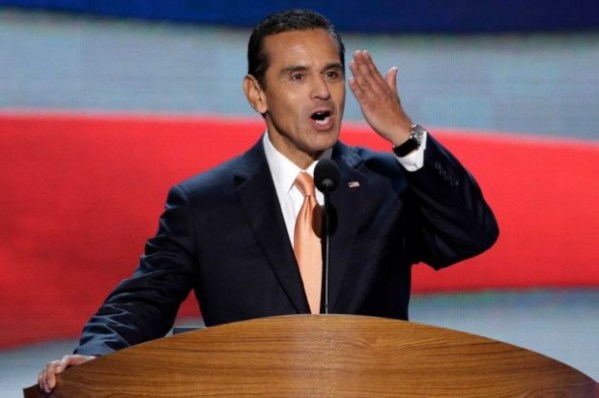
Villaraigosa, image source: Human Events

When Los Angeles Mayor Antonio Villaraigosa called for a voice vote on two measures, the reinsertion of language supporting “God-given potential” of working people, along with language supporting Jerusalem as the capital of Israel, loud dissent roiled the convention.  After three unclear voice votes, Mayor Villaraigosa declared the measure passed, to a chorus of boos from the floor.

According to Fox News, the new “God language” restores the 2008 platform.  The party now claims,

“‘We need a government that stands up for the hopes, values, and interests of  working people, and gives everyone willing to work hard the chance to make the  most of their God-given potential.’

“The initial 2012 platform language said this: ‘We gather to reclaim the  basic bargain that built the largest middle class and the most prosperous nation  on Earth — the simple principle that in America, hard work should pay off,  responsibility should be rewarded, and each one of us should be able to go as  far as our talent and drive take us.'”

What does this mean?  First of all, it is unclear what conventioneers booed.  Was it the recognition of Jerusalem as an Israeli city?  Or the return of the God language?  Both?  Or just the heavy-handed tactics steamrolling over their opposition?  It is hard to tell.

Second, this mini-episode demonstrates the political power of God.  President Obama had maneuvered to get the God language back in.  Republican party hacks circulated the video immediately as proof that the Democrats hated God and the Jewish state.

In America, not just Fundamentalist America, it is good politics to get an endorsement from God.  And it is bad politics, apparently, to fight over it.

In the News: A Party with the Soul of a Church

With apologies to GK Chesterton, we notice a remarkable collection of photos from the GOP’s national convention this week at the Washington Post.

Many commentators (check out samples here, here, or here) have opined on the abundance of religious rhetoric emanating from the Florida convention.  If each of these photos is worth 1,000 words, this photoessay tells the story best of all.

The first thing any viewer will notice is the diversity of religious speakers.  From Judaism, Greek Orthodoxy, the Church of Jesus Christ of Latter-day Saints (Mormons), Catholicism, Sikhism, Protestantism…the convention made an effort to promote itself as ferociously religious, but determinedly non-sectarian.

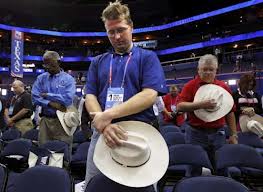
Image source: Twin Cities.com

The second reflection that jumps out at us is the spectacle of the convention floor during each invocation.  A vast room, not too unlike an old-fashioned revival tent, packed with people from all walks of life, bowing their heads in reverent prayer.  The image of a convention floor giving its moment of respect to God sent a political statement.  Whatever God you worship, the GOP seemed to be saying, we’re the Party for you.

In the News: What Is a Family? CA Approves Multiple-Parent Bill

We read in yesterday’s First Thoughts that California lawmakers have passed a new law.  Senate Bill 1476 will allow courts to recognize that “a child may have a parent and child relationship with more than 2 parents.”

This bill came about from a complicated family situation.  In In re M.C., a child had been put into the foster system.  Neither the biological mother, nor the mother’s new partner, could or would care for the child.  But the child’s biological father was not legally her parent, so the child could not be given to his care.

The arguments for and against the new law provide an illuminating glimpse into culture-war positions about the meanings of traditional families.  Supporters of the law claim that such laws simply move the courts into balance with the messy realities of our contemporary society.  Bill sponsor Mark Leno (D-San Fran) stated, “We live in a world today where courts are dealing with diverse circumstances  that have reshaped California families.”  Similarly, an LA Times editorial in favor of the law opened with this gambit: “For better or worse, families have changed.”

Opponents of the law have articulated some of the reasons often given in Fundamentalist America for supporting traditional family structures.  Writing in the Huffington Post, John Culhane and Elizabeth Marquardt argued that the new law will open a Pandora’s Box of unintended, but predictable, consequences.  “The ‘rule of two,'” they noted,

“for assigning legal parenthood has rarely been breached, for good reason. Again, consider In Re M.C.. Reunification is always challenging; here, it is unlikely to succeed with anyone except (possibly) the biological father. Is it really wise to deploy already-strained government resources toward three parents? And what if, in another case, reunification with all three parents were achieved?

“The problems would then multiply. It is hard enough for even two parents to agree on how to raise a child. Three parents in conflict would be still worse. Constant judicial involvement in decision-making would be the unintended but entirely predictable consequence. If there were a custody battle, the child might end up being shuttled between all of them. In fact, a Pennsylvania court has ordered custody to be shared among three legal parents.

“And why stop at three? Senator Leno’s bill places no limit on the number of possible parents. If three’s a crowd, four or more is a mob.”

Along the same lines, according to a story in the San Francisco Chronicle, California Assemblyman Tim Donnelly (R-Twin Peaks) complained, “This smacks of the state redefining parenthood.  What’s next? Are we going to parent by committee?”

For conservatives, the primary danger seems to come from state intervention into private family structures.  Those structures, many conservatives believe, have precedence to the state and ought to be immune to state meddling.  For religious conservatives, this is often articulated as a notion that God created the traditional two-heterosexual-parent family.  Human governments ought only to support what God has created.

Bill Nye Doesn’t Get Creationism

Thanks to Our Man in Scotland, we recently read some comments on American creationism from “The Science Guy,” Bill Nye.  Though we at ILYBYGTH don’t defend young-earth creationism, we do hope to understand it on its own terms.  In that task, mainstream scientists like The Science Guy often seem uniquely unhelpful.

Bill Nye The Science Guy. Image Source: Educational Communications Board

In a bit from February on Big Think, the well known TV science popularizer had some harsh words for those who believe in a young earth.  Only when we understand the extreme age of the universe, Nye charged, does the story of life on Earth make sense.  Those who try to stick to a young earth make things “fantastically complicated,” Nye insisted.  “The idea of deep time,” Nye explained, “of this billions of years, explains so much of the world around us.  If you try to ignore that, your world view just becomes crazy, just untenable, itself inconsistent.”

Let’s take this accusation apart a little bit.  As I read it, America’s favorite nerd is not quite calling young-earthers crazy, the way Richard Dawkins likes to do.  Instead, Nye is saying that trying to frame a conception of the universe that takes all the evidence into a account is crazy, unless we assume an extremely long timeframe.

Nye makes other statements about creationism that are just plain wrong, though.  First, Nye ends his diatribe with a familiar “progressive” fallacy.  Nye asserts that young earth belief will wither away.  “In another couple centuries,” Nye states, “. . . it just won’t exist.  There’s no evidence for it.”  But that is not how things have worked historically.  Young earth belief was far less prevalent in 1920 than it became in 1980, for instance.  Some evolutionists fall into this trap of assuming that young-earth belief is strictly a matter of ignorance and isolation.  As more and more people are exposed to the evidence for evolution, the assumption goes, young earth belief must surely die out.  But young-earth belief has grown along with America in the twentieth century.  As more and more people get more and more education, a significant minority of them are educated into young-earth belief, not away from it.  As I describe in my 1920s book (Now in paperback!) anti-evolutionists in the 1920s set up a durable and influential network of schools and colleges to educate American toward young-earth belief, not away from it.

Ronald Numbers. Image Source: University of Wisconsin Madison

The second error Nye makes is in his opening statement.  “Denial of evolution,” Nye insists, “is unique to the United States.”  That is simply not true.  Strong creationist movements thrive world wide, especially in Australia and New Zealand.  As my mentor Ronald Numbers has explored in the new edition of his classic book The Creationists, young-earth belief is also strong in countries such as Turkey.

Like a lot of evolutionists, Nye seems to be a particularly bad guide to the world of young-earth creationism.  Perhaps because from his position firmly within the scientific mainstream, the ideas of creationism look particularly outlandish.  Nye and his mainstream scientific colleagues have no ability to understand something that builds its intellectual structure upon a radically different foundation.  To Nye and his ilk, the only explanation is that such thinking is crazy, etc.  We at ILYBYGTH hope to understand it more profoundly.

Is Gay Okay? Not in Utah…

Image source: Business Insider

I’ll admit it.  I find Glee offensive.  Not because of any teen-steam sexuality or anything, but just because everyone keeps singing and dancing all the time.

Now it appears a new show by one of the creators of Glee will not be aired by a Utah NBC affiliate.  According to an article by Scott Pierce in the Salt Lake Tribune, TV station KSL will not show The New Normal in the usual NBC timeslot.  Why not?  The show depicts the lives and times of a gay couple and their quest for a surrogate-carried baby.

For the culture-war-tuned antennae of ILYBYGTH, the interesting part of this story is the language each side uses to explain its position.  According to Jeff Simpson, CEO of KSL’s parent company, the show was banned because, “The dialogue might be excessively rude and crude. The scenes may be too explicit or the characterizations might seem offensive.”

Voices from Fundamentalist America support this decision.  The activist group One Million Moms has opposed the show.  According to the group’s website,

“NBC is using public airwaves to continue to subject families to the decay of morals and values, and the sanctity of marriage in attempting to redefine marriage. These things are harmful to our society, and this program is damaging to our culture. . . .

“Millions of Americans strongly believe that marriage should be between one man and one woman. NBC’s “The New Normal” is attempting to desensitize America and our children. It is the opposite of how families are designed and created. You cannot recreate the biological wheel.”

In these short paragraphs, One Million Moms sums up (sum up?) the reasons some conservatives give for opposing homosexual marriage and homosexuality in general.  In coming weeks, we at ILYBYGTH will be exploring these arguments in more detail.

In the meantime, the defense of the show demonstrates one of the most popular arguments made in favor of gay marriage.  As Glee and New Normal producer Ryan Murphy argued, “It’s 2012.  I don’t think this is anything so outrageous.”