Shake Up at King’s College

If you look at the $30,000,000 box office sales for his film 2016: Obama’s America, it would seem that Dinesh D’Souza is very in.

But at King’s College in Manhattan, D’Souza is out.  According to a recent story by Warren Cole Smith at WORLD magazine, D’Souza has stepped down as the high-profile president of King’s College.  Smith had reported a few days earlier on the tensions among King’s leadership.  D’Souza had ruffled some feathers when he appeared with a woman who was not his wife, shared a hotel room with her, and introduced her as his fiancee.  D’Souza had separated from his long-time spouse, but had not yet been officially divorced.

More interesting for ILYBYGTH readers than the Gossip Girl-ing involved, the story sheds some revealing light on the nature and institutional structure of King’s College itself.  As historian John Fea has remarked, the leadership of King’s College embarked on a remarkable re-branding in the mid-1990s.  It shifted from a small, quiet, conservative evangelical Westchester County college to an aggressive culture-war college in the heart of Manhattan.  The “new” King’s College narrowed its scope, offering only business and politics/economics majors.  The goal of the revised school was to bring conservative evangelical leadership to the heart of New York City.

As journalist Amy Sullivan noted in her piece in The New Republic about the King’s College shake-up, the rivalry between long-time provost Marvin Olasky and D’Souza likely contributed to the scandal.

It seems charismatic conservative evangelical leaders will continue to struggle with such issues.  King’s College represents a long tradition of “new” approaches to fundamentalist higher education.  Liberty University was founded in 1971 with the same purpose.  Even further back, this goal of teaching a new generation of conservative evangelical students to compete for the levers of cultural and political power has roots in the culture-war struggles of the 1920s.  As I argued in my 1920s book, college and seminary founders such as those at Dallas Theological Seminary and Bob Jones University explicitly set out to create schools that would train fundamentalist leaders for mainstream politics, religion, and culture.

Back in the 1920s, such schools wrestled with the same tensions that bedevil King’s College today: How can we institutionalize the uncompromising theology that so often thrives only under the leadership of charismatic individuals?  How can we remain true to our mission of training students in the specific doctrines of our faith while preparing them to engage with the wider world?  How can we retain the loyalty of those who want a firmly conservative evangelical institution, while convincing the world that our graduates have had the kind of broad education they might get at a more pluralistic college?
Zimmerman on School T-Shirt Politics

Jonathan Zimmerman wants students in public schools to be able to wear any kind of t-shirt they want.

He asks a pointed question in this morning’s Inquirer about the Romney t-shirt controversy: What if Sam Pawlucy’s shirt had not supported Romney, but supported an anti-homosexual position?  In a similar case in 2007, a student was prohibited from wearing a shirt that proclaimed, ‘Homosexuality is shameful.’

I’m a big fan of Zimmerman, the reigning Pooh-Bah of American educational historians and the author of the best book out there on culture wars in public schools.  As he has argued for years, in this morning’s op-ed Zimmerman wants students to be given freer range to offend.  He asks in his Inquirer piece,

“Why should we assume that some people need special protection from distasteful speech? In the guise of defending minorities, these restrictions actually patronize them. And they make a mockery of Tinker, which emphasized the rights of students to exercise free speech, not to be shielded from it.”

As Our Man in Scotland commented yesterday about the Philadelphia t-shirt controversy, Sam Pawlucy would not likely have received such enthusiastic support if her shirt had not supported GOP candidate Romney.  Zimmerman agrees.  The point of free speech, Zimmerman argues, is not to protect speech with which we agree.  The point of free speech is to protect all forms of speech, even and especially those phrases that are offensive or controversial.

Romney Shirts and a Public School

You may have heard about this one by now: A teenager in the Port Richmond neighborhood of Philadelphia has complained that her teacher ridiculed her Romney t-shirt.  But have you heard that an up-and-coming politician plans to respond by bombarding the school with the Pledge of Allegiance?  There may not be a clear logical connection, but the emotional connection is clear.

The teenager, Samantha Pawlucy, complains that her teacher, Lynette Gaymon, made fun of her campaign t-shirt.  According to Pawlucy, Gaymon pointed and laughed at the shirt.  Gaymon allegedly told Pawlucy that such a shirt was just as ridiculous in their neighborhood as if Gaymon, an African American woman, wore a t-shirt in support of the Ku Klux Klan.  According to relatives, Gaymon was simply making a joke about the heavily Democratic voting patterns of Philadelphia.  Gaymon has apologized to the Pawlucy family.  Philadelphia Mayor Michael Nutter has met with both parties in the controversy, and, predictably, both Pawlucy and Gaymon have reported threats and harassment.

There is not much doubt in this case that Gaymon was out of line.  If she really ridiculed Pawlucy for wearing a Romney t-shirt, her actions were not only unconstitutional, but simply irresponsible teaching.  If, as her relatives assert, she was only making a joke about the slim chances Romney had for gaining votes in Philly, then she is at least guilty of making a joke in bad taste, to a student who didn’t find it funny.

But Gaymon has apologized for all that.

There is no question that a student in a public school is entitled to wear a political t-shirt.  There is no question in this case that teachers at public schools ought not make fun of students’ political beliefs.  Yet politicians and activists have been able to use this case to make strong public arguments about the proper nature of public education.

Dave Kralle, for instance, a candidate for the Pennsylvania State Legislature, has called for a rally this morning at Pawlucy’s high school.  Kralle wants Gaymon fired.  His call for a rally laments the fact that “We have been told there isn’t a single American flag at the school and the Pledge is NEVER recited.  This gives you an indication of how far our public education system has fallen.”

For Kralle and his supporters, the notion that a public school might not prominently display the flag or have students recite the Pledge of Allegiance is a clear sign of educational malfeasance.  Such an environment, Kralle implies, contributes to partisan jokes like the ones made by Gaymon.

We hope that this controversy dies down quickly.  But Kralle’s accusations that Pawlucy’s public school is un-American demonstrate some of the emotional wrappings of patriotism in public schooling.  Kralle’s seeming non sequitur might not make much sense, Constitutionally.  There’s no reason why a school that does not display the flag or recite the Pledge would have anything to do with a comment about a Romney t-shirt.  But Kralle’s rally makes a lot of sense emotionally.  For many Americans, public schools must embody the tradition of patriotism; public schools must exist to train young people in patriotic symbolism.  As Kralle complains, any school with no flags and no Pledge has “fallen.”

***UPDATE, TUESDAY EVENING, OCTOBER 9, 2012***

Cheering for Jesus in a Public School

Source: KNUE

Can they or can’t they?

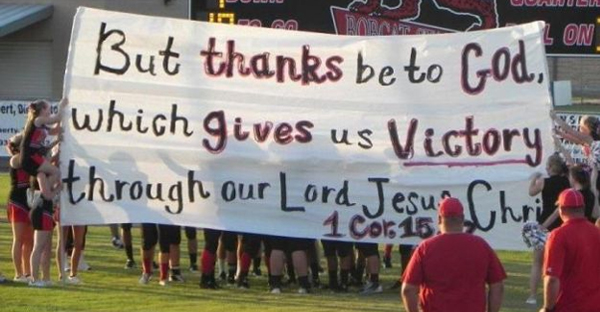
No one seems too sure of the situation in Kountze, Texas.  In this town of around 2,000, high-school cheerleaders have attracted attention for their religious banners at school football games.

In late September, the district superintendent banned the explicitly Christian banners, under pressure from the Wisconsin-based Freedom from Religion Foundation.

The cheerleaders sued.  The latest decision has been that the cheerleaders can continue to display the banners while the wheels of Constitutional justice grind along.

The case demonstrates the ferocious complexity of school-prayer rules and traditions.  The cheerleaders seem entirely oblivious to the Constitutional issues.  In interviews, they tend to hurt their own legal case by stating such things as “It’s our religion and we want to portray that.”  Or this gem about the complainants, “They can be offended, because that’s their right.”

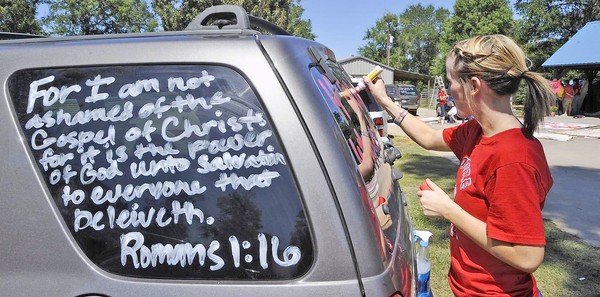
There is not much doubt of the facts of the case.  The banners are obviously and designedly Christian.  They bear such Biblical phrases as the following:

“I can do all things through Christ which strengthens! Phil 4:13.”

“If God is for us, who can be against us? Romans 8:31.”

“But thanks be to God which gives us Victory through our Lord Jesus Christ. 1 Cor 15:57.”

Image Source: Los Angeles Times

The SCOTUS precedents in this sort of case are fairly clear.  The most obvious precedent is Santa Fe v. Doe (2000), the famous football-game-prayer case.  In that case, the Court ruled that a prayer at a high school football game, even when led by students, implies school endorsement of religion.

Lawyers in this case are keenly aware of the precedent.  The cheerleaders’ lawyers, therefore, emphasize the fact that this cheer group is not a school-sponsored organization.  They have no coach, they have no school-provided budget.  In essence, the cheerleaders claim that theirs is purely private speech.  If so, they would have a strong case for passing Constitutional muster.  Their lawyers have also cited the SCOTUS precedent of Tinker v. Des Moines, in which student protest-armbands against the Vietnam War were ruled protected free speech.

The school district has made the predictable counter-argument.  The cheer team, the district has argued, represents the school at a public function.  Cheerleaders must sign a “cheerleaders’ constitution,” which includes a pledge to represent the school well.  As district attorney Tom Brandt argued, “This is government speech. It’s on public property. The cheerleaders represent the school.”

This case also demonstrates the fact that public schooling in America is fractured into what political scientists Michael Berkman and Eric Plutzer have called “Ten Thousand Democracies.”   Regardless of SCOTUS decisions or state education policy, local school districts often support policies that represent the majority views of local communities.  Arguments in favor of such policies are usually framed in terms of the will of the majority.  As one of the cheerleaders insisted, “so far there hasn’t been any opposition to what we’re doing. Nothing but support.”  Such has been the case for much of the history of religion in public schools.  Local schools tend to endorse and embody local traditions.  Many of those traditions, like explicitly Christian prayer at football games, seem to imply an official endorsement of a particular religion.

It has often required outside intervention to draw attention to these continuing traditions.  In this case, that pressure came from Madison, Wisconsin, and the Freedom from Religion Foundation.

And school prayer has often, as in this case, proven to be enormously popular.  In this case, Texas Attorney General Greg Abbott has publicly supported the cheerleaders.  And the Facebook page set up in their support looks ready to top the 50,000 friends mark.

So, whether or not the Kountze cheerleaders can or can’t lead prayers at football games, they are.  Whether or not they will be allowed to continue will likely hinge on whether or not their activities are seen as school-sponsored, or private.

Rhee and Jesus in Public Schools

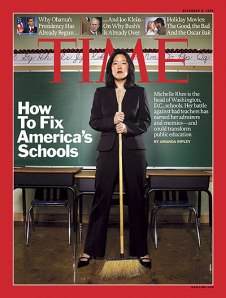
Michelle Rhee wants to get Jesus involved in fixing America’s public schools.

Image Source: Time Magazine

Rhee, the former chancellor of DC schools, has long been the darling of conservatives.  Her anti-union, market-based approaches to fixing public education have won her plaudits as America’s best hope for reforming sclerotic public education systems.

Along the way, Rhee has become the bete noire of educational thinkers such as Diane Ravitch.

Most of the Rhee talk has centered around conservative shibboleths such as vouchers, union-busting, and market-based reforms.

Recently, however, Rhee organized a meeting of religious leaders in Atlanta to discuss the possible roles of religion in reforming public schools.

Rhee’s willingness to talk with folks who want more religion in public schools may signal her broader willingness to engage with the traditional ‘other half’ of conservative school reform.

Among conservatives, free-market ideas and religious traditionalism have long rubbed alongside one another in any discussion of fixing public education.

Now Rhee seems eager to cross that bridge, too.

In the News: Dancing the Rights Away

The New York Times reports this morning on a strange crackdown in Cranston, Rhode Island.  Seems a father-daughter dance tradition had been taking place despite a state law and district policy against it.  In addition, Federal Title IX rules forbid any gender-discriminatory activities.  In this case, a single mother of a daughter objected to the dance.  Though the school had also organized a mother-son baseball game, the two events were ruled to be not similar enough to avoid charges of sex discrimination.

In the big scheme of things, this tempest on a dance floor seems like no big deal.  The mother attended the dance with her daughter, and the school district reminded dance organizers of their ban on gender-specific events.

But the story serves as an illustration of a few items of perennial interest to those trying to understand the conservative impulse in American education.  First of all, we see again that school policy does not always match school practice.  Most memorably, when the US Supreme Court ruled in 1963 that school-sponsored prayer and Bible-reading violated students’ First Amendment rights, many schools continued to sponsor prayers and Bible-reading regardless.  As political scientists Kenneth Dolbeare and Phillip Hammond found in their 1971 study, many towns and schools continued to pray and read the Bible without eliciting a whisper of controversy.

Even the district in Cranston, Rhode Island, had hung a “prayer banner” in its high school, according to the New York Times.

As in many other cases, we see in this disco scuffle the ways conservatives embrace such seeming government overreach as a culture-war cause.  In this case, Sean Gately, a candidate for State Senate, along with Cranston Mayor Allan Fung, have come out strongly in favor of father-daughter dances. Such politicians have publicized the ban and tried to associate it with their Democratic opponents.  As Gately told the NYT, “Having those little father-daughter dances and seeing her all dressed up in her pretty dress — it’s a very special moment.”  Gately said the ban “offended me as a father and a husband.”   In the end, Gately insisted, “Nobody is being hurt by a father-daughter dance.”   Fox News condemned the “political-correctness police” of the American Civil Liberties Union for stirring up controversy where none existed.  The ACLU, according to Fox, had objected to the dance tradition as perpetuating harmful gender stereotypes: fancy dances for girls, baseball games for boys.  Gately told Fox this was a case of the “local ACLU kind of bullying our school system.”

From the ACLU’s perspective, local school officials just don’t “get it yet,” as state ACLU director Steven Brown told the New York Times.  Gately would likely respond that Brown simply does not “get” that most Cranstonites have no problem with reinforcing gender stereotypes for their children.

Perhaps most important, this dance debate demonstrates the way schools are more often guided by tradition than by explicit policy.  According to the NYT, the district had banned this father-daughter dance years ago.  However, no one on the current Parent-Teacher Organization was aware of that policy.  They organized the “Me and My Guy” dance simply because they had done so in the past.

In dancing as in much else, these kinds of traditions tend to be more powerful than any policy, whether in Cranston, Rhode Island, or from the US Supreme Court.

Fundamentalists Against CATCH

The headlines say it all.  Concerned Women for America’s article announces, “New York City Schools: Reading, Writing, and Morning-After Pills.”  The Family Research Council denounces “New York’s Deadliest CATCH.”

The Family Research Council’s Take on “the Deadliest CATCH”

Sifting through the arguments from these prominent conservative organizations will give us some insight into what religious conservatives dislike about New York City’s Connecting Adolescents to Comprehensive Health (CATCH) program.  As the CWA headline suggests, the program expands the district’s free-condom program to include birth control pills and “morning-after” pills.  As ILYBYGTH has reported, the NY Board of Health has insisted that a very low rate of parent opt-out suggests that most parents find the program inoffensive.

Fundamentalists beg to differ.

Both CWA and FRC point out the absurdity of a school system in which parents must provide copious paperwork in order for schools to provide basic medicine for schoolchildren, yet those same schools will administer Plan B pills without parental notification.  As the FRC briefing notes, “The same nurse’s office that demands a parents’ note for aspirin will be in the position to administer high (and potentially dangerous) doses of hormones to children as young as 14 without so much as a permission slip.”

Such contradictions, both groups insist, indicate the plan is both dangerous and insidious.  “Suppose [a student] has severe side effects from the pill but is afraid to tell her parents?”  CWA’s Brenda Zurita asks.  “It’s late at night or perhaps a weekend, what will she do? Who will she call?. . . Let’s pray that no young girl will die due to complications she was afraid to tell her parents about after she was encouraged at school to hide her sexual activity from her parents.”

Also worrisome, according to both reports, are the results of increased sexual behavior among teen-age girls.  The FRC report cites a 2010 study that finds such birth-control medications increase STIs among young women.

According to the FRC, the root of this problem is an inverted understanding of the proper role between parents, children, and government.  The FRC describes the “Nanny State” ideology at play: “If moms and dads can’t be trusted to ensure that their kids are eating well, then they certainly can’t be trusted with decisions about sex and abortion. So the government takes away chocolate milk because it’s too fattening–only to turn around and give kids the morning-after pill, which can really kill.”

Concerned Women for America’s Zurita agrees.  This program, Zurita insists, is yet another example of an “out-of-control bureaucracy.” “It is frightening and tragic,” Zurita warns, “that there are parents who do not care what their children are doing, and with each example of government intruding between parents and children, this story is fast becoming the norm.”

Finally, CWA’s Zurita raises a powerful point.  The NYC Board of Health has claimed that a low parental opt-out rate means this program is not upsetting parents.  But as Zurita notes, many parents could simply be unaware of the program.  Since when do schools assume that every announcement sent home with students has been dutifully delivered to parents?  With non-controversial notices such as bad report cards, students are required to return parent signatures to prove that parents actually saw the notice.  But with a more profoundly morally complex notice such as this, the school district simply assumes that students shared the information with parents?

In the eyes of these fundamentalist activist organizations, something stinks with New York’s CATCH.

CATCH-ing Up and Opting Out

ILYBYGTH reported yesterday on a new pilot program in New York City high schools.  The program, Connecting Adolescents to Comprehensive Health, or CATCH, will expand the district’s condom-distribution program to include birth control pills and “morning-after” pills.

This morning, we read Catholic League President Bill Donohue’s denunciation of this “imperial edict” in an interview in the Christian Post.  “Whenever it comes to sensitive issues such as sexuality, the government must  always play an ancillary role to that of parents,” Donohue told the CP. “The provision  that parents can opt out smacks of governmental arrogance and must be resisted:  the government has no business eclipsing parental rights.”

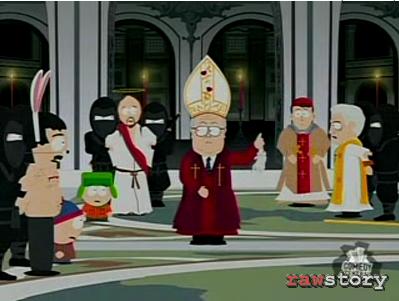
Bill Donohue as the Wild-Eyed Pope on South Park’s “Fantastic Easter Special”

I am usually no fan of

Bill Donohue.  I find myself siding more often with the South Park send-up of his public-morality campaigns.  But in this case, I find his criticism of CATCH more compelling than the lame defense offered by Chanel Caraway of the NYC Board of Health.  Since only 1-2% of parents had opted out of the program, Caraway told ABC News, “this suggests that parents are OK with the service being available to their children.”

Again, please don’t misunderstand.  I support the CATCH program and its goals.  I would want my daughter to be able to get free condoms and contraceptives at school if she couldn’t get them elsewhere.

However, Caraway’s opt-out argument demonstrates a frightening ignorance of America’s educational history.  In prominent cases such as Engel v. Vitale (1962) and Abington Township School District v. Schempp (1963), the US Supreme Court specifically concluded that “opt-out” provisions do not adequately respect families’ and children’s rights to be free of religious coercion.

As Justice Clark argued in his majority decision in Schempp, “Nor are these required exercises mitigated by the fact that individual students may absent themselves upon parental request, for that fact furnishes no defense to a claim of unconstitutionality under the Establishment Clause.”

I understand that this is a very different case.  Clark referred to the unconstitutionality of school-sponsored prayer.  It did not matter whether or not parents could opt out if the program defied Constitutional freedoms.  However, issues of sexuality are intimately connected to religious values for many students and families.  Could not a Bill Donohue argue that such state-imposed sexuality–even with an opt-out provision–denied some students their Constitutional right to free exercise of religion?  To assume that an opt-out clause defuses any potential complaint from conservative religious families seems ignorant at best, and, as Donohue put it, “imperial” at worst.

Traditionalism and Education

This morning’s column by David Brooks in the New York Times is sure to provoke some head-scratching.

Brooks points out the conventional division of contemporary conservatism into two constituent entities. He calls them “economic conservatism” and “traditional conservatism.” Economic conservatives are the free-market champions. They are the sort who cheered when Reagan described the nine most terrifying words in the English language as, “I’m from the government and I’m here to help.” Traditionalists, on the other hand, value localism, organic social structures, and community. They derive their ideas from the likes of Edmund Burke and Russell Kirk.

Those who follow the intellectual history of modern conservatism will scratch their heads that Brooks did not include other important types of conservatism, such as the Jerry-Falwell-style Moral Majoritarianism, the kind of conservatism that wants to regulate personal behavior and use government power to improve America’s morals. And where are the “tribal” conservatives, folks such as Rush Limbaugh who cling to “conservatism” largely as a form of in-group identity?

On the other side, people less familiar with the landscape of modern American conservatism might be surprised at Brooks’ evocation of an entirely different style of conservatism. Those unfamiliar with this traditionalist tradition might be shocked to hear of conservatives who oppose a pure laissez-faire approach to economics. Conservatives, as Brooks puts it, who want government to use a “subtle hand” to encourage family and neighborhood cohesion.

As Brooks notes, influential bloggers such as Rod Dreher at the American Conservative keep traditionalist conservatism alive and kicking. Brooks might also have included Patrick Deneen at Front Porch Republic in this survey.

Those of us most interested in the relationship between conservatism and education can explore Deneen’s exposition of traditionalist hero Robert Nisbet.  In 1953, Nisbet had lamented the increasingly universalist nature of higher education.  Deneen argues that such trends have only accelerated.  As Deneen noted a few years back,

“The modern university system has arisen with the consent of those on the Right and Left alike, particularly in its guise as the modern research university aimed toward the end of ‘creating knowledge’ and providing educations that allow our students to ‘succeed’ and to ‘solve problems.’ Both have actively assented to a national, and increasingly international educational system that becomes annually more homogenous and standardized (This is just as true of supposedly ‘conservative’ administrations, one of which gave us ‘No Child Left Behind’ and Margaret Spellings).”

The traditionalist solution, Deneen argues, is to restore some measure of true diversity to university life in America.  Instead of a spread of cookie-cutter colleges arrayed to produce skilled mechanics of a corporate juggernaut, institutions of higher education could instead strive to emphasize the particularities of their own local communities.  Elsewhere, Deneen has suggested that this particularity must embody not only a constrained localism, but also a truer conception of universality. 

As David Brooks suggests, much of the subtlety of this sort of traditionalism has been read out of today’s conservative discussions of education.  For those of us trying to understand conservative thinking about education, however, it is a useful reminder of the complexities of what Brooks calls “half of [the Republican Party’s] intellectual ammunition.”

Mommy, I Can Marry a Princess!

What is so frightening about gay marriage?  A TV ad from California’s 2008 battle over same sex marriage gives us a clue.  Gay marriage, to many conservatives, will ultimately tear families apart. 

For those of us trying to understand conservative, traditionalist, ‘fundamentalist’ culture in America, this TV ad offers some insight into conservative thinking.  Many of us are puzzled by conservative opposition to gay marriage.  Like Jonathan Rauch, it seems to me that a defense of traditional values should logically want to see as many people married as possible. 

Image source: A Collection of Odd

But for many conservatives, a redefinition of marriage will represent a cultural camel’s nose under the tent.  That is, if two same-sex partners are allowed to marry, then a slew of other cultural transformations will soon thrust themselves into mainstream culture.  Any opposition to these radical changes will soon be tarred as mere bigotry. 

In the same-sex marriage debate–as in so many cultural contests–schools and schooling play a central role.  For many conservatives, public schools often play the role of cultural contaminant.  Ideas such as evolution, secularism, moral relativism, and sexual liberation, in the conservative vision, are transmitted into cultural circulation by being injected into children at public schools.  Schools are used by progressive activists to subvert the proper relationship between parent and child.  Schools fill the heads of impressionable children with pernicious ideas about the nature of morality and values. 

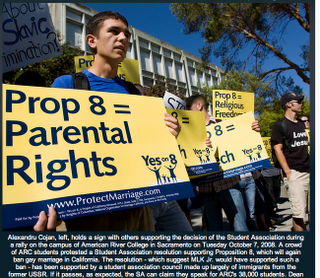
We see a particularly striking example of this in California’s TV ads.  During the fight over California’s Proposition 8  in 2008, ads depicted a girl coming home from school, happily telling her worried mother that she learned she could marry a princess.  The ad warned ominously: without Proposition 8 parents would have no legal right to complain.

This ad plays upon a very commonly held notion about the flawed relationship between traditional values, families, and public schools.  In this vision, schools become the institution that transforms cultural change from a general trend to a problem within conservative families. Schools become intrusive agents warping the minds of children and turning those children against the dearest beliefs of their parents.  

I’m sympathetic.  I support gay marriage, evolution, pluralism, etc.  But I recognize that many of my well-meaning education colleagues really do envision public schools as a vehicle to transform children’s culture.  When cultural conservatives worry about camels’ noses, I believe they are smart to worry.  Progressives yearn ardently for a network of public schools as “change agents.”  Just as fervently as conservatives worry about the intrusive moral role such schools might hope to play.