Where Orthodox Meets Hippie

They don’t agree on much. But on this they do agree: MMR vaccines are not good for their kids. In my great home state of New York, Orthodox Jewish groups and rich hippies are uniting on this one issue (sort of). Why? As I’m arguing in my new book about creationism, it’s not really about God or ethics or any of that stuff. It all comes down to Billy Joel.

Here’s what we know: In Rockland County, New York—just northwest of New York City—the government has taken drastic steps to ban unvaccinated children from all public places. A measles outbreak has led to this unusual measure. Traditionally, most states allowed parents pretty wide leeway in religious and moral exemptions to mandatory-vaccination laws. Today’s outbreak is forcing a re-think of those exemptions.

What does it have to do with Orthodox Judaism and hippie culture? In this case, a lot. The unvaccinated children are clustered in private schools, some of them Orthodox Jewish schools and others from a fancy-pants Waldorf school. In general, the cultural worlds of these two schools could not be further apart. In one thing, though, the parents agree, and this one thing is at the root of the measles problem.

From the Orthodox perspective, MMR vaccines have a complicated backstory. Some Orthodox leaders have counseled against vaccinations, but now leaders agree that vaccines are kosher. Parents, though, are still divided. As Forward described, many in the Orthodox community share

a feeling that their worldview is not in keeping with modern secular society, said Samuel Heilman, a Queens College sociology professor who has authored several books about Orthodox Jews.

“It’s about a view that we have our ways and they have their ways,” he said.

When it comes to measles vaccines, many parents in the Orthodox community simply do not trust the experts, and it is that distrust that brings Orthodox and hippies together.

Just down the street from Rockland’s Orthodox schools, but culturally a million miles away, parents at Green Meadow Waldorf School have also attempted to keep their kids from receiving the MMR vaccine. The lesson about distrusting vaccines is the same, but practically every other aspect of these schools is different. Green Meadow, for example, promises that their school will

create a social, cultural, and learning environment that recognizes the child’s spiritual freedom and growth. . . . Rather than teaching to the test or adhering to Common Core standards, the Waldorf curriculum fosters independent, critical thinking and problem solving, develops ethics and morality, and promotes true joy in learning.

The progressive, child-centered world of Green Meadow may be totally different from that of Orthodox schools, but the parents share one fundamental beef. Just like skeptical Orthodox parents, anxious Waldorf parents share a virulent distrust of the medical establishment. They feel it so strongly they are willing to put their children’s health on the line. They probably wouldn’t agree on much else, but they might agree with Billy Joel that it’s always been a matter of trust.
Pandering? Or Progress?

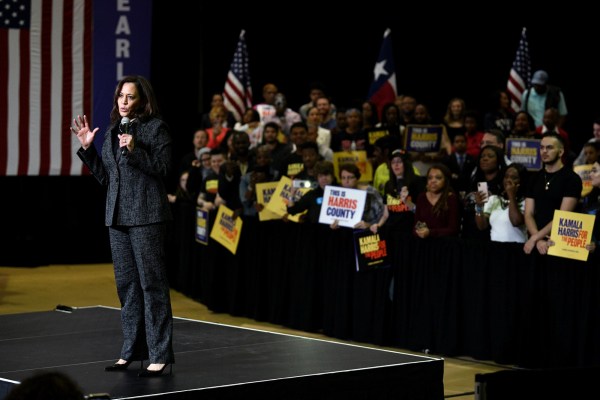
What do you think? Is Senator Harris’s new plan to raise teacher pay a real winner? Will it improve public schooling? Or is it just an election-season stunt, a way to gain attention without really solving any problems?

Kamala Harris

A winner?

Here’s what we know: In a speech at Texas Southern University, the Democratic 2020 presidential hopeful outlined a plan to increase pay for public-school teachers. In brief, Senator Harris is pledging $315 billion to raise teacher pay an average of ten percent. Here’s how NBC described the plan:

According to the Harris campaign, the goal is to eventually increase teacher pay by an average of $13,500 per person, putting it in line with typical salaries for other employees with college degrees. Campaign materials pointed to research by the left-leaning Economic Policy Institute that found teachers make 11 percent less than college-educated workers on average in combined salary and benefits.

Under the California senator’s plan, the federal government would finance 10 percent of the total pay increase for the first year and then pay out 3 dollars to states for every 1 dollar they put into additional salaries.

It would commit additional funds to further increase salaries for teachers in highest-need schools along with a “multi-billion dollar investment” in career development for educators. Half of it would go toward teachers studying at historic black colleges and universities (HBCUs) and other institutions with predominantly minority students.

In a sense, Harris’s plan is merely a continuation of a Democratic Party tradition. In the 2016 campaign, Comrade Sanders liked to call vaguely for better pay for public-school teachers. As Sanders liked to say back then,

the top 25 hedge fund managers earned more than the combined income of 425,000 public school teachers.

But Sanders didn’t offer the kind of detail that Harris has laid out this year. Clearly, the echoes of teacher strikes over the past two years have changed the political landscape of progressive politics.

Conservatives are likely to see this proposal as dangerous and extreme. As ed commentator Rick Hess told Politico, it sounds like more of a fantasy for the primary season than a real plan for the Oval Office. As Hess put it,

I don’t know that it’s being proposed as actionable legislation so much as a marker. . . . Republicans, in particular, are nervous about once you open that barn door, just how involved Washington winds up getting in local education decisions and deciding who gets hired, how they get compensated.

And progressives are not falling over themselves to celebrate, either. As my favorite progressive-ed observer noted, Harris’s plan has some glaring problems. As Curmudgucrat Peter Greene tweeted,

If a Dem wants to score points with teachers, pledge to kill test-driven faux accountability. Pledge to champion public ed over privatization. Pledge to put actual educators in charge of Ed Department. Get the federal government out of teachers’ way. And don’t make teachers have to negotiate with DC for their next raise.

All good points, but I can’t help but feel optimistic when I see that teacher-pay is at least being discussed in more depth and detail this campaign season. Like they say, “If you aren’t at the table, you’re on the menu.”

What You Need to Know about: Yoga in Public Schools

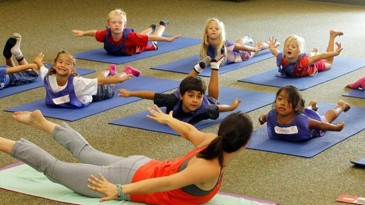
The most recent case is enough to make anyone’s head spin. It involves a disgruntled former school administrator, yoga stretches, and community prayer rallies to help “Jesus to rid the school of Buddhism.” Sic.

yoga in sschools

Look out! Flying Buddhists!

Here’s what we know: This case has roots back to 2014, when Cobb County (Georgia) elementary principal Bonnie Cole introduced a yoga program into her school. Local parents protested. Cole was transferred and is now suing the district. She claims that pro-Christian religious influence unduly hurt her career.

Cole insisted that her use of yoga was not at all religious. She used it for purely secular reasons, to help students stay healthy and manage stress. The school already removed some religious elements of yoga practice. For instance, they didn’t allow students to say “Namaste” or press their hands to their hearts. Students were also not allowed to color mandalas.

In this case, though, the specific lawsuit isn’t about whether or not yoga is a religious practice. Rather, it is about whether or not Christian protesters exerted undue religious influence on the school to ban yoga. Principal Cole explains that parents would press their hands up against her office window to put prayer-pressure on her to stop teaching yoga. And in this case, that Christian influence is the legal issue, not the notion of yoga as a religion (or not).

Clear as mud!

In an effort to clear up some of the religion-in-school fog, we’ve dug through our ILYGYBTH archives for relevant background material. Here’s some earlier coverage you might find interesting:

wellness programs are likely the next theater of battle in our ongoing but evolving educational culture wars… in which the earnest claim of the Encinitas superintendent that “it is just physical activity” sounds ever more naïve.

  • In that Encinitas case, Professor Candy Gunther Brown of Indiana University thought the judge goofed. As we observed at the time, Prof. Brown thought that certain forms of yoga practices—and certain deep-pocketed devotees—insisted that yoga practice would “automatically” lead people to god, “whether they want it or not.”
  • The controversy over yoga as a religious practice in school is nothing new. As far back as the 1970s, religious conservatives—Christian ones—were protesting against such “religious indoctrination” in public schools.
  • Last but not least, evangelical Christians are divided over the religious implications of yoga. As we noted, some think the practice can be done in purely secular fashion, one acceptable for public schools. Others disagree.

Of course, none of this helps us sort out this most recent case from Georgia. Legally, after all, the religious nature (or not) of yoga is not in dispute. Bonnie Cole accuses the school district of succumbing unfairly to Christian pressure. Of course, underneath that complaint festers the unanswered question of yoga’s religious nature.

Under current rules, if yoga constitutes religious practice, it shouldn’t be taught by teachers in public schools. It could be taught about, of course, but yoga classes actually engage students in yoga practice. On the other hand, if yoga is done as a secular pursuit for purely secular reasons, it would be okay for public schools. However, in that case, religious devotees of yoga would likely complain—with good reason, IMHO—that the school districts were unfairly appropriating their religious practice and mutilating it into something it shouldn’t be.

Just another example of the ways nobody knows quite what to do about religion in public schools!

A Pew Puzzle

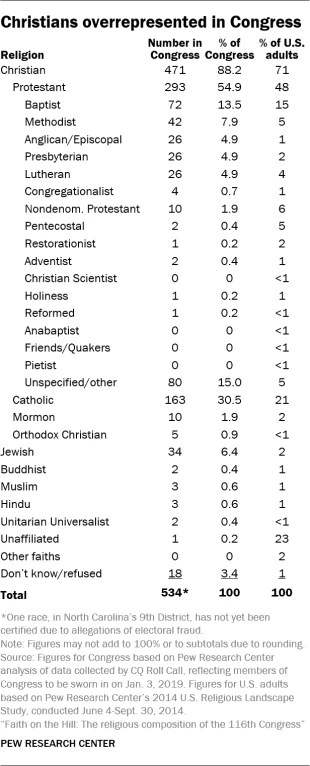
It’s not fair. It’s not pretty. But I get it—Anglicans get more seats in the US Congress than Pentecostals do. What I DON’T understand is the Catholic question. Any ideas?Pew congress faith

Here’s what we know: the Pew Research Center released its new numbers for the religious makeup of the new US Congress.  As usual, Protestants are heavily overrepresented in power, some denominations more than others. Anglicans, for example, make up almost five percent of Congress, even though they only make up one percent of the (adult) population. On the other hand, groups such as Pentecostals don’t get a fair shake. They are only 0.4% of Congress, even though they are five percent of the population.

It’s ugly, but at least it makes sense. Anglicans tend to be richer and whiter than America as a whole, whereas Pentecostals have traditionally been poorer and blacker. Not that it’s fair, but it isn’t a shocker to anyone who understands American politics. Money and power have always gone hand in hand.

But what’s the deal with Catholics? They represent a whopping 30.5% of Congress, even though they are only 21% of the population. What gives?

Why Queen Betsy’s Rule about Religious Schools Is a Very Big Deal

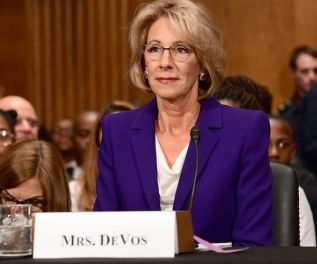
If life gives you Lemons…change fifty years of SCOTUS precedent. That might be the new motto of Ed Secretary Betsy DeVos, as she pushes through a change in the relationship between private religious schools and public ones.

Betsy DeVos Confirmation Hearing, Washington DC, USA - 17 Jan 2017

…I’ll make Lemon-ade.

Now, I’ve been accused by very smart SAGLRROILYBYGTH of being hyperbolic when it comes to interpreting DeVos’s recent moves, so I’ll try to be careful in my hysteria here. Here’s what we know: This week DeVos introduced a change in enforcement of federal law regarding the interaction between public schools and private religious ones. It may sound like a snoozer, but it has enormous implications for those interactions. And those interactions, in turn, have huge implications for the presumed boundaries between religion and government in these United States.

Some facts in the case:

  • Queen Betsy’s proposed change would cease enforcement of a rule banning religious groups from providing secular services to students in private religious schools.
  • So, for example, if a student in a Catholic school needed speech therapy, the law requires the public school district to provide those services.
  • In the past, the district had to provide the services itself, or hire a non-religious contractor to do it.
  • Now, the public school district can hire a religious organization—not the private religious school itself—to provide those services.
  • The services are only supposed to be “secular, neutral and nonideological” in nature. In other words, things like speech therapy and literacy coaching, not religious instruction.

Clear as mud?

To understand why these changes are such a big deal, we need to revisit the SCOTUS ruling that has laid the foundation for the past half-century of policy regarding public aid to religious schools. One of the outcomes of that case, Lemon v. Kurtzman, was the famous “Lemon test.” This three-prong guideline helped Americans find the proper line when it came to public funding of religious education. Since 1970, when deciding if relations were too close between a religious school and the government, we could check these three guidelines:

  1. Does the statute have a “secular legislative purpose?”
  2. Is the “principal or primary effect . . . one that neither advances nor inhibits religion?”
  3. Does the rule “foster an excessive government entanglement with religion?”

In the original case, SCOTUS considered laws that helped pay the salaries of religious-school teachers. They found that those laws did indeed have a secular purpose—states wanted all children to get good educations. They punted on the second part—they didn’t rule on what the primary effect of the laws were. But the justices agreed that the laws violated the third rule. By putting government in charge of part of the school day of teachers at religious schools, the laws hopelessly entangled government with a religious institution.

To this reporter, it seems DeVos’s new rule would throw the Lemon Test out the window. Imagine the likely outcomes. A public school district would be able to hire a speech therapist (for example) who is employed by the Catholic Church, or by Focus on the Family, or by any other of a million religious organizations. The school district would not be able to pay for any type of religious instruction, but only the secular services provided.

In practice, the school district would have to monitor the goings-on in the speech-therapy sessions themselves. The “entanglement” of the public school district and the religious service provider would be beyond “excessive.”

Furthermore, if any religious service provider were able to capture the market for, say, speech therapy in religious schools, it would be able to earn a huge payday from the public tax coffers. I can’t see how that is anything other than a rule that “advances . . . religion.”

Is it a done deal? Not yet. As Americans United protested,

Betsy DeVos is neither the Supreme Court nor Congress. She does not get to unilaterally declare that a statute is unconstitutional, especially with a provision that is designed to protect church-state separation, a bedrock of our democracy.

An administrative decision not to enforce certain provisions of existing legislation is not at all permanent. Just ask Obama. If DeVos’s plan survives, however, it will reverse the past fifty years of church-state guidelines when it comes to private religious schools.

A Deal-Breaker for Biden?

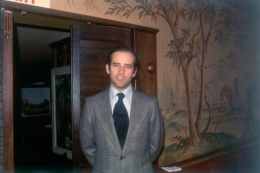
I would not want to be Joe Biden right about now. In so many ways, he could be the 2020 front-runner for the Democratic Party if he decides to run. A recent expose in the Washington Post, however, might be enough to kibosh the whole thing.

biden 1975

Frosh Senator, 1972

First, some history for our younger readers: We all know SCOTUS’s 1954 Brown v. Board decision didn’t end racial segregation in schools. What some people might not know if they didn’t live through it was the bitter 1970s battle over busing that followed.

As Roy Formisano has described so brutally, cities such as Boston roiled over the topic. Anti-busing groups coopted 1960s-style protest tactics and language to oppose mandatory plans to shuttle children between schools. The goal was to achieve more racial equality; the effect was much different. The protests ripped the Democratic Party apart back then.

Could they do it again now?

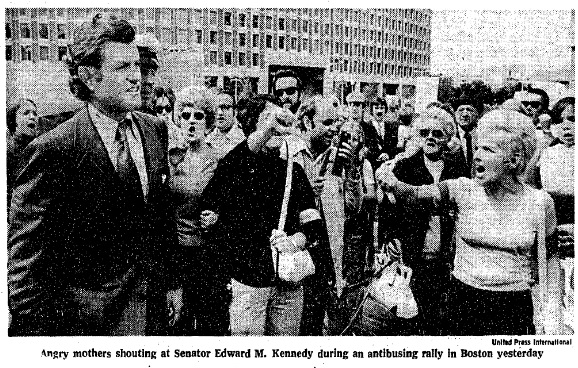
Consider one episode that Joe Biden would like us all to forget: On September 9, 1974, a crowd of white working-class anti-bussers gathered to hear Senator Ted Kennedy speak in Boston. This demographic, usually a solid supporter of the Kennedys and the Democrats, showed their displeasure with Kennedy’s pro-busing stance by turning their backs on him as he spoke. Then, fired up, the crowd chased him from the podium, flinging eggs and expletives. The fury of the crowd was so intense they shattered the glass doors of the Federal building, chanting, “Pig, Pig Pig.”

ROAR button

Boston’s protesters also insisted they weren’t racist, but…

What does any of this have to do with Joe Biden and the 2020 elections? Everything.

The Washington Post uncovered a public statement Biden made against busing in 1975. Back then, the first-term senator from Delaware came out forcefully against busing, though he tried to maintain his support for equal racial rights. As Biden said back then,

I do not buy the concept, popular in the ’60s, which said, ‘We have suppressed the black man for 300 years and the white man is now far ahead in the race for everything our society offers. In order to even the score, we must now give the black man a head start, or even hold the white man back, to even the race.’

How were such comments perceived at the time? Although Biden can point to his long record in favor of civil rights, he won’t be able to spin this as anything but political surrender to the overwhelming unpopularity of busing. At the time, the infamous segregationist Jesse Helms welcomed Biden “to the ranks of the enlightened.”

What biden was trying to avoid

What Biden was scared of in 1975:

While some white Democrats were supporting busing and taking their lumps, Senator Biden was working the political middle, a middle that—at the time—lined up with Jesse Helms and Boston’s fervent racial protesters.

Morals aside, it might have been a savvy political calculation in 1975. However, will be be enough to undo Biden’s calculations for 2020?

The New Conservative Campus Strategy: Punch-bait!

You’ve heard it before: Conservatives have long felt bitterly estranged from mainstream higher education. I’m wondering if we’re on the cusp of a weird new conservative strategy, one in which young conservatives try their hardest to get punched in the face.

https://www.youtube.com/watch?v=UKYemhhzAC4

Here’s what we know: Hayden Williams has attracted a lot of attention recently as the victim of a conservative-bashing at Berkeley. President Trump brought Williams up on stage during Trump’s CPAC speech to help introduce Trump’s new hard line against universities. As Trump crowed,

Ladies and gentlemen — [Williams] took a punch for all of us. … Here’s the good news: He’s going to be a very wealthy young man. Go get ’em, Hayden.

Williams was on campus as part of Turning Point USA’s recruitment drive. In the past, Turning Point USA has provoked attention on campuses for recruiting students to its brand of millennial conservative campus activism. In Nebraska, for example, a Turning Point USA member garnered significant political support in her fight to be heard on campus.

Turning Point USA founder Charlie Kirk was quick to capitalize on the Berkeley bashing. As he told CNN,

Our amazing grassroots organizers courageously face threats of violence and discrimination as they fight for the right for conservative voices to be heard on college campuses.

So how about it? Maybe the most effective strategy for conservative pundits will be to get punched in the face. After all, nothing goes further to prove their claims of persecution and anti-conservative discrimination.

How to Kill Public Schools

Well, we had a good run. For the past hundred-fifty years or so—depending on where you live—Americans have had public schools. I don’t mean to be Chicken Little here, but from an historical perspective, it looks like Queen Betsy has figured out a way to get rid of em.

simpsons school

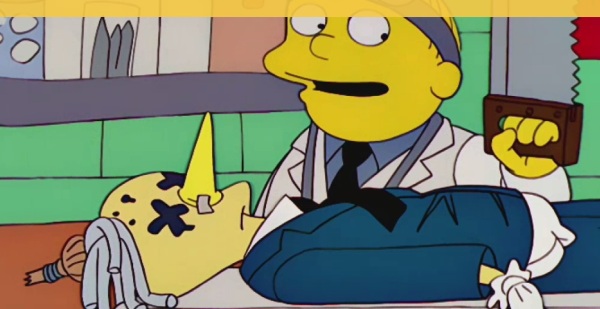
Who will pay to educate Mr. Burns’s doctor?

In some senses, of course, the United States has always had schools FOR the public. Even before the Revolution, there were schools that students without tuition money could attend. I’m finding out way more than I want to about the funding of early American “public” schools in my current research. As I’m finding, these “charity” schools had a wild mix of financial backers. Churches, taxpayers, wealthy individuals, and even not-so-wealthy people gave a lot or a little to educate impecunious children.

At different times in different places, a funding revolution swept the world of American education in the 1800s. Basically, this revolution replaced schools that were FOR the public with schools that were BY and FOR the public. That is, instead of parents, charities, philanthropists, churches, and governments all kicking in here and there to fund worthy students and schools, local and state governments committed to provided tax-funded educations to children. Those governments took tax money from everyone—whether or not they sent kids to the public schools—and in return promised to run schools for the benefit of the entire community.

There were big problems with this funding revolution. Not all children were included. Most egregiously, African-American students were often segregated out of public schools, or shunted off to lower-quality schools. And not all states participated equally. New England and the Northeast jumped early to the new model, while other regions hesitated. Plus, people without children and people who chose not to send their children to the public schools ended up paying for schools they didn’t personally use.

The heart and soul of public education, however, was that the public schools would be administered as a public good, like fire departments and roads. Everyone paid for them, everyone could use them, and everyone could in theory claim a right to co-control them. Even if your house didn’t catch fire, in other words, you paid taxes to support the firefighters. And even if you didn’t drive a car, you paid to maintain the public roads. And those firefighters and road crews were under the supervision of publicly elected officials, answerable in the end to taxpayers. Public schools would be the same way.

This funding arrangement has always been the heart and soul of public education. And it is on the chopping block. Queen Betsy recently proposed a five-billion dollar federal tax-credit scholarship scheme. Like the tax-credit scholarship programs that already exist in eighteen states, this plan would allow taxpayers to claim a credit for donations to certain non-profit organizations that would then send the money to private schools.

In some cases, donors can claim up to 100% of their donations back. For every dollar they “donate,” that is, they get a full dollar rebated from their tax bills. Tax-credit scholarship schemes serve to divert tax money from public education—administered by the public—to private schools without any public oversight.

[Confused? Me, too. For more on the ins and outs of tax-credit scholarships, check out this episode of Have You Heard, featuring the explanations of Carl Davis of the Institute on Taxation and Economic Policy.]

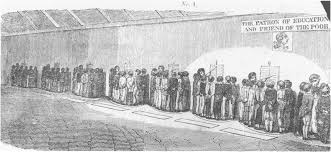
lancaster friend of the poor

Back to this future?

What’s the big deal? In essence, these schemes return us to the world before the public-education $$$ revolution. They return us to the world Joseph Lancaster knew so well in the first decades of the 1800s, where funding for schools was an impossibly tangled mess. Back then, parents who could afford it could send their kids to great schools. Parents who couldn’t had to hope their kids might get lucky and attract the attention of a wealthy philanthropist or a church-run charity program. They had to hope that a mix of government money, private tuition, church support, and philanthropist largesse could support their kids’ educations.

By allowing taxpayers to pick and choose whether or not to support public education, Queen Betsy’s proposal takes us back to those bad old days. Are we really ready to throw in the towel on public education? Ready to return to the old system, with “charity” schools run FOR the public by wealthy benefactors who wouldn’t send their own kids there?

Progressive Methodists, Welcome to the World of Fundamentalism

Conservatives are celebrating. Progressives are lamenting. From a historical perspective, we can’t help but notice that today’s liberal Methodists are likely feeling the same sort of betrayal and dismay that fundamentalists felt in the 1920s and 1930s.

methodist poll

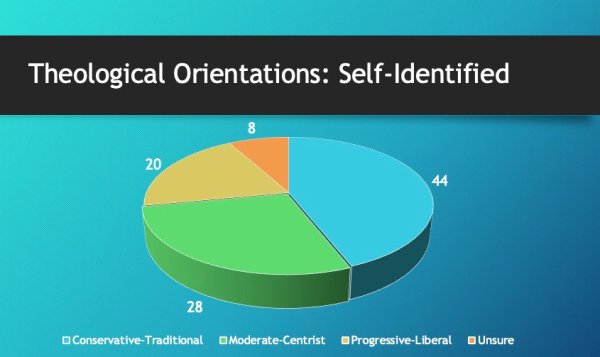
American Methodists: More conservative than you might have thought…

Here’s what we know: The United Methodist Church (UMC) has long faced a dilemma. Its large US contingent has tipped to the liberal side of the spectrum, with some congregations ordaining LGBTQ ministers, even bishops. At the church’s recent special conference, however, conservatives won the day, powered in part by the surprising strength of American conservatives, but even more so by international conservatism.

In a recent poll, for example, 44% of American respondents called themselves conservative-traditional. In African churches, an even stronger traditionalism dominates. As one African leader scolded the conference,

Friends, please hear me, we Africans are not afraid of our sisters and brothers who identify as lesbian, gay, bi-sexual, transgendered, questioning, or queer. We love them and we hope the best for them. But we know of no compelling arguments for forsaking our church’s understanding of Scripture and the teachings of the church universal.

And then please hear me when I say as graciously as I can: we Africans are not children in need of western enlightenment when it comes to the church’s sexual ethics. We do not need to hear a progressive U.S. bishop lecture us about our need to “grow up.”

As Emma Green writes in The Atlantic, progressive Methodists are stuck. Do they stay or do they go? As I read her report, I couldn’t help but hear the echoes of conservative Methodists in the 1920s. Back then, conservatives felt their church was being pulled away from them. Like today’s progressives, they often articulated a sense of both surprise and betrayal when they discovered the strength of their 1920s rivals.

To give you a taste of those feelings among early fundamentalist Methodists, I dug back through my files on one of the most famous American fundamentalists, Bob Jones. The founder of Bob Jones University was raised in the Southern Methodist Church and he felt a strong attachment to it his entire life.

However, he chafed at the attempts of the church to limit or control his preaching and institution-building. Most of all, like other fundamentalists of his generation, Jones Sr. believed that liberals had unfairly seized control of denominational institutions and used their power to crush legitimate differences of opinion.

As Jones liked to tell the tale, back in the early days of his career he had donated $300 to a Methodist college—he said it was “all the money I had on earth.” In Jones’ telling, that institution took his money “under false pretenses. They stole it. They are dirty rotten thieves.”

Jones liked to say that his experiences with the Methodist hierarchy led him to found an interdenominational fundamentalist college, one that would “never sell out.” As he put it in 1950,

I couldn’t conceive of anything as mean and low-down as to go out and raise money to build a certain type of school and then build another one…. That’s getting money under false pretenses.  That’s playing with the spiritual life of people.  That’s making capital out of the humble faith of humble saints.

Despite his antagonism toward the denominational hierarchy, Jones Sr. remained in the Methodist church through the 1930s. When a Methodist magazine refused to carry advertisements for Bob Jones College, the Joneses finally threw in the towel. As Jones Sr. wrote to a former editor in 1939, he had long hoped

there might be some hope for Methodism.  Since receiving your letter, I give up.  I say this kindly, and I love you just as much as ever, but I feel sad around the heart.

Eighty years later, we might change the reasons, but the language could remain exactly the same. I can picture a liberal Methodist minister sending in their credentials, saying that they had long hoped there was some hope for a progressive Methodism. After this week’s vote at the special conference, however, they might “give up,” even if it makes them feel “sad around the heart.”

Fundamentalist U Leads from Behind

When universities these days re-impose in loco parentis rules to avoid lawsuits, they are joining a group of schools that never abandoned that role. Despite the headline in this week’s Chronicle of Higher Education, there’s nothing “new” about it. There’s not even anything new about secular schools copying evangelical ones. It’s been going on for a while. We might even say that evangelical colleges and universities have become the accidental trend-setters for mainstream higher ed.

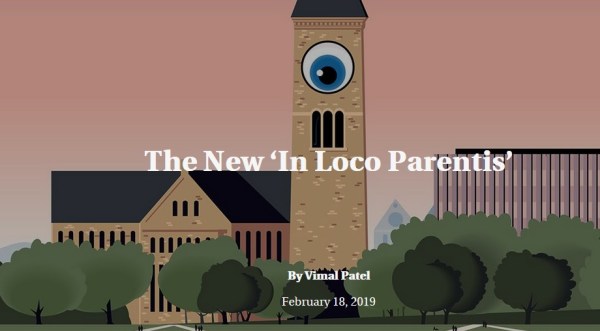
eye on u

How “New”?

Here’s what we know: In CHE, Vimal Patel describes the trend: Some universities are claiming more institutional control over students’ lives. Historically, as Patel correctly notes, some mainstream schools abandoned such rules after student protests in the 1960s. Universities no longer agreed to act, in essence, as local parents.

With accusations of sexual assault, unsafe hazing, and other campus dangers, though, universities these days worry about legal liability. A lot. As a result, they are returning to their tradition of asserting control over students’ lives outside the classroom. As Patel writes,

This resurgent version, at traditional four-year colleges, is more attitudinal than legal, and motivated by 21st-century conditions. Past iterations were paternalistic, but the new version is driven by tuition-payers’ expectations, colleges’ concerns about legal liability, shifting cultural and social norms, and an evolving understanding of human development.

What Patel doesn’t mention is that plenty of institutions don’t have to return to in loco parentis, because they never really left. Consider as one example a talk given by President Hudson Armerding of Wheaton College at Parents’ Day Chapel, October 30, 1971. President Armerding told the assembled parents that most colleges had abandoned their in loco parentis responsibilities. He told them that mainstream colleges positively bragged about their lack of concern for students’ non-academic lives. What was the result? Quoth Armerding,

a shallow permissiveness conveys a distorted view of God who deals far differently with His children.

Wheaton College would be different, Armerding promised. He and his school embraced their in loco parentis responsibilities. As he concluded,

We believe that students should be disciplined and corrected and that this should be consistent with the teachings of the Word of God.

Patel’s not interested in the distinct and vital traditions I analyzed in Fundamentalist U. But this is not meant as a knock on Patel. (Though to be fair, I find it egregious that anyone writing about the history of in loco parentis rules wouldn’t mention Christopher Loss’s book Between Citizens and the State.)

Rather, I take Patel’s article as just another example of the ways evangelical colleges have served as reservoirs of academic tradition, reservoirs that mainstream colleges keep returning to.

Today’s interest in in loco parentis rules is only one example. Consider, too, the ways mainstream institutions seek to establish “safe spaces” on campuses. As we’ve argued in these pages, ALL of evangelical higher education was meant as an intellectual “safe space.”

Or consider today’s wave of student protests at elite mainstream schools. In many ways, like in loco parentis rules, what we call the “impulse to orthodoxy” was shepherded and nurtured at evangelical colleges long after mainstream institutions tried to discard it. When student radicals at Yale, Middlebury, and Claremont McKenna push their administrators to enforce moral absolutes, they are not breaking new ground but merely returning to old ground—ground on which evangelical schools have always remained.

If there really is a trend to return to in loco parentis rules at mainstream colleges, it might just add fuel to a surprising conclusion: After a century, instead of lingering as institutional backwaters, evangelical colleges have become trend-setters for the mainstream.