Teaching Evolution in a Creation Nation

What do we want out of America’s schoolchildren? . . . out of America’s creationists? I’m tickled pink to announce that my co-author Harvey Siegel and I have just sent in our final manuscript for our new book, Teaching Evolution in a Creation Nation. In this volume, we tackle these difficult questions head-on.

As we’ve explored in these pages, Harvey and I review the historical and philosophical issues involved in America’s long culture-war battle over evolution and creationism. Historically, I argue, creationism (in most of its religiously inspired variants) has worked like other forms of religious and cultural dissent. Philosophically, Harvey reviews the tricky definition of science, as well as the most common objections to evolution education.

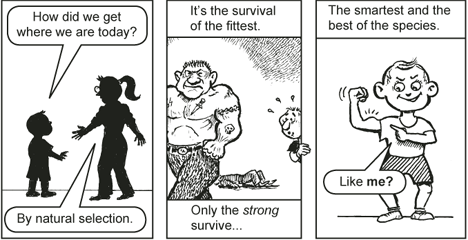
In essence, we argue that the best way to understand creationism is as a form of educational dissent. By defining creationism that way, we can see some directions in which classroom policy should go.Jack chick Evolution

Most important, we argue that the proper aims of public-school evolution education should be to inculcate a knowledge and understanding of evolution. No creationist-friendly variants should be allowed in science classes as science. But dissenting students must be allowed and even encouraged to maintain their dissent. We can’t insist that students believe this or that about evolution. Not in public schools, anyway. We must insist, however, that students know and understand that evolution is the best scientific explanation of the ways life came to be on this planet.

Among the tricky questions raised by our book are these:

  1. Is “belief” an inherent part of good evolution education? That is, should children in public schools be encouraged not only to know and understand certain facts about evolution, but to believe that evolution is really the best way to understand the roots of our species’ existence?
  2. Does it water down evolution education to allow dissenters to maintain their dissent, even in the face of overwhelming scientific evidence?
  3. From creationists’ perspectives, is it too much to agree that mainstream evolution science really is the best science? Will creationists agree that their ideas are more religiously inspired belief than legitimate scientific dissent?
  4. Can teachers in the real world walk this line between teaching facts about evolution and teaching belief in evolution?

There’s one important question that is less difficult: When will this baby hit the bookstores? Our editor at the University of Chicago Press tells us our baby will be like a real baby: it needs to gestate for at least nine months before it’s ready to get slapped around.

And I’m confident it will attract plenty of slappers.

Required Reading: A Boom Year for the Culture Wars

You’ve got no more excuse. As historian Andrew Hartman pointed out recently, we used to be able to shrug our shoulders and say that we really didn’t have many historical examinations of America’s culture wars. That’s not the case anymore. Hartman gives us a list of new books coming out in 2015—including one by your humble editor—that look at key aspects of America’s long fight over morality and education.

Daddy, What did YOU do during the Culture Wars?

Daddy, What did YOU do during the Culture Wars?

Hartman’s list includes his own upcoming War for the Soul of America, as well as my Other School Reformers, Stephen Prothero’s Why Liberals Win, Natalia Mehlman-Petrzela’s Classroom Wars, and Jonathan Zimmerman’s Too Hot to Handle.

As you’ll see when you check out Hartman’s full post, these books promise to establish a new tradition among historians and the reading public.

Best of all, these books will give us plenty to read and argue about for the rest of the year.

Something New for the Shelfie

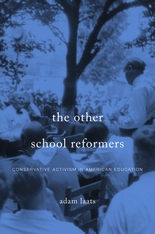
The first copies are in!  Thanks to the folks at Harvard University Press, I’ve got my hands on my new book, The Other School Reformers: Conservative Activism in American Education.

A snappy addition for the bookshelf...

A snappy addition for the bookshelf…

As far as I can tell, they should be getting into stores in the next few weeks.  So here’s my suggestion: Let’s all dress up as our favorite conservative activist, a la Harry Potter, and camp out outside our local bookstores until these babies hit the shelves!

Dibs on Max Rafferty…

The Perfect Valentine’s Day Gift

Nothing says “I Love You” more than a book about conservatism and education in American twentieth-century history. Looks like the timing will be perfect.

How to say "I Love You" (But You're Going to Hell)

How to say “I Love You” (But You’re Going to Hell)

My new book is slated for release in early February. Hard to know how it will be received, but one pre-reviewer has called it “a major rethinking of the history of American education.” Another has added, “it would be flat-out wrong to ignore this important book.” Pshaw. . .

For the sophisticated and good-looking readers of ILYBYGTH, the content might not be surprising. In this book, I try to figure out what it has meant to be “conservative” about education in the United States.  How have issues such as creationism, school prayer, and sex ed developed over the course of the twentieth century?  How are they related?  How have conservative attitudes and strategies changed?  How have they remained the same?

In the early days of my research, I had planned to explore the educational activism of leading conservative groups such as the American Legion and the Institute for Creation Research. I was stuck with two big problems, though.

First, the Legion and other conservative groups remained active throughout the twentieth century. How could I describe different conservatives without rehashing the chronology over and over again? I didn’t want to work from the 1920s to the 1970s in every chapter. What to do?

My second problem was one of definition. How could I choose which “conservative” groups to study? I could copy the method of leading conservative scholars such as Russell Kirk or George Nash and use my selection to make an argument about the definition of conservatism. Both Kirk and Nash picked their subjects to give a particular definition to conservatism. For both writers, being a true conservative has meant being a heroic intellectual battling waves of ignorance and knee-jerk leftism. But I’m no conservative myself, and I wasn’t interested in imposing a flattering (or un-flattering, for that matter) definition on American conservatism. What to do?

Luckily for me, I had some help. At a conference back in 2009, I was describing my research. One of the audience members suggested a new approach. Instead of picking and choosing which activists counted as “conservative,” instead of describing the activism of one group after another, why not do it differently? Why not let conservative activists define themselves? This leading historian suggested that I investigate events, not groups.

That’s what I did. I looked at the four biggest educational controversies of the twentieth century: The Scopes Trial of 1925, the Rugg textbook fight of 1939-1940, the Pasadena superintendent ouster of 1950, and the Kanawha County textbook battle of 1974-1975. In each case, conservative activists and organizations fought for their vision of “conservative” schools. By looking at controversies instead of organizations, I could let conservatives define themselves. And I could move chronologically through the twentieth century without rehashing the stories in each chapter.

Did it work? Now I have to let readers and reviewers be the judge. My goal was to explore what it has meant to be “conservative” in the field of education. I did not want to make the relatively simpler argument that conservatism has really meant X or Y. I did not want to give conservatives a heroic history they could draw upon. Nor did I want to give their enemies a catalog of conservative sins. I’m hoping readers think this approach has worked.

So if you’re looking for that perfect romantic gift, consider The Other School Reformers!

Holiday Reading List

Ho ho ho and all that. Like it or not, the holidays are upon us. For you nerds out there who, like me, view such breaks as a chance to catch up on our nerdy reading, I’ll share my plans for the next ten days.

Who's got time for presents?

Who’s got time for presents?

What are you reading these (holi)days?

BOOKS:

I’ve got three books on my desk. One new, one old, and one in the middle. First, I’m excited to read Christopher Rios’s After the Monkey Trial: Evangelical Scientists and a New Creationism (2014). Rios looks at the emergence of a network of creationist scientists after the 1920s. Next, I’ll be taking another whack at Virginia Brereton’s Training God’s Army: The American Bible School, 1880-1940 (1990). Over the years, I’ve read this book several times. As Brereton puts it in her introduction,

The fundamentalist movement was decidedly an educational movement and most fundamentalists were educators; education was implicit in their overriding objective, which was the evangelization of America and the world. To understand fundamentalists, then, it is absolutely necessary to examine their educational efforts.

Hear, hear! This time around, I’m reading it with an eye to my new book about evangelical higher education between 1920-1980. Last but not least, I want to spend some time with John Rawls’s A Theory of Justice (1971). This is one that I read many years ago as an undergraduate. For so long now I’ve been reading conservative writers and pundits, I feel a need to re-connect with this fundamental statement of liberal ethics.

Top of my stack...

Top of my stack…

ONLINE:

I’ve been putting off Ted Davis’s series at the BioLogos Forum for too long. Davis is the one of the best historians out there for those of us interested in creationism and evolution. His series, “Fundamentalists, Modernists, and Evolution” ran through the summer into this past fall. I meant to read them as they came out, but as usual I fell behind. Thanks to these holidays, I’ll finally take time to read them more carefully.

There have been a couple of longish articles recently about evangelical religion and higher education that I didn’t have time to read yet. In The Atlantic, Laura Turner noted the activism at evangelical colleges about the killings of Michael Brown and Eric Garner. I have high hopes that Turner does not assume that evangelical college students have never engaged in this sort of social activism before. As I’m discovering in my current research, there is a strong tradition at Christian colleges of left-leaning student activism.

Next up, an article that is doubly interesting for anyone who wants to understand evangelical higher education. Esmerelda Sanchez writes in Christianity Today about the experiences of Latina Pentecostals in higher ed. I’ve only read the teaser so far, but it looks as if Sanchez argues that as women, as Latinas, and as Pentecostals, those like her have faced special hurdles in the world of American higher education.

DISSERTATION:

At the far edge of nerdy, I’m looking forward to reading a newly completed dissertation. Just completed at the University of Delaware is Kevin Currie-Knight’s From Laissez-Faire to Vouchers: An Intellectual History of Market Libertarian Thought on Education in Twentieth-Century America. Aside from the peerless Milton Gaither, historians have not taken a close enough look at the libertarian tradition in educational thought in US history. I’m hoping Currie-Knight’s work addresses some key issues of the meanings of markets in the imaginations of ed reformers. For those who don’t have access to a university library, you can always get easy access to dissertations like this at your local public library. Most public libraries have access to interlibrary-loan services, and they can often get you a pdf of any dissertation lickety-split.

That’s my plan. As usual, I won’t be likely to get to all of this in the next week. I’ll try to read all I can as I breeze through the holidays, packed full of candy canes and booze.

What are YOU reading as we say goodbye to 2014?

Who “Gets” Left Behind

I remember reading the novels.  I read them in the gym of the high school I taught in.  Sometimes students would ask me about them, and I’d say they were about the end of the world.  But I also sometimes wondered if people would think I was a fundamentalist, an end-of-the-worlder, a kook.  Now that the new movie is out, friend of ILYBYGTH Daniel Silliman has offered a thoughtful essay about what it means to be a fan of Left Behind.

For those of you who haven’t heard, the Left Behind series blew a lot of minds when it came out in the 1990s.  Fundamentalist writer Tim LaHaye and his colleague Jerry Jenkins set out to present another gripping fictional story of the end of the world.  But not just any end of the world.  Left Behind told the story of the way many American fundamentalists have come to interpret the Bible’s eschatology.

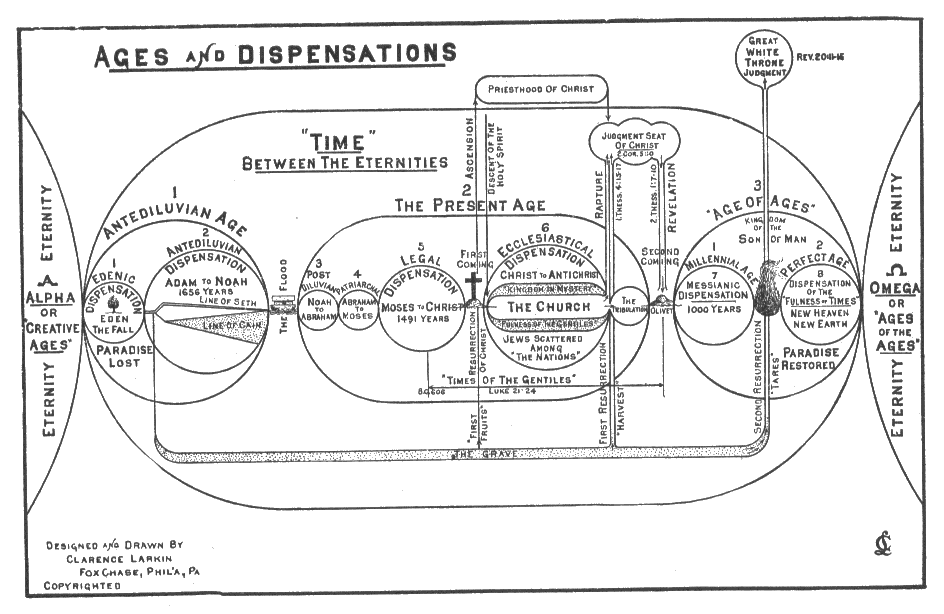
Clarence Larkin's theological charts were very popular among the first generation of fundamentalists in the 1920s.

Clarence Larkin’s theological charts were very popular among the first generation of fundamentalists in the 1920s.

Since around the beginning of the twentieth century, many (but by no means all!) fundamentalists and conservative evangelicals have embraced the theology of dispensational premillennialism.  This interpretation of the Bible sets out a series of ages, or “dispensations.”  Our current Age is set to expire sometime soon.  When it does, this theology predicts, Jesus will lift all true believers to meet him “in the air.”  This event will be known as the “rapture.”  After the rapture, those who have been left behind will suffer through seven years of tribulation before Jesus returns in glory.  Once Jesus and his angelic hosts have defeated the Antichrist on the field of Armageddon, a thousand years of peace and love will follow on earth, the millennium.

That’s a quick and dirty summary, but for our purposes, it will do.  Tim LaHaye was not the first prophecy writer to fictionalize this story.  As many evangelicals of a certain age will remember, an older generation of films such as A Thief in the Night told a similar story, in a similarly dramatic fashion.

But LaHaye’s Left Behind series took this Bible apocalypse into the mainstream.  Millions of people read the books.  And evangelical sorta-star Kirk Cameron made a series of movies to bring the message to even more fans.  And now, for some reason, there’s a new movie version, this time starring Nicholas Cage.

For nerds like me, the interesting question is not whether the new film is good or bad.  (Although I couldn’t find a single review that said it was good.  Just bad, really bad, and “God-awful.”)  Instead, I want to know what it can tell us about American religion.  Specifically, I want to know why so many people gobble up these fundamentalist bedtime stories.  Is America really that sympathetic to fundamentalism?  Does some part of our national psyche still yearn for this sort of stern hellfire morality play?

Daniel Silliman tackles this question of audience.  Take a few minutes to read his whole essay.  In short, he demonstrates that we can’t really assume much about America based on its seeming never-ending appetite for Biblical apocalypses.  Just because millions of people read these books, we can’t assume we know if those readers bought into the fundamentalist end-of-the-world story.

Left Behind

Some people, Silliman notes, will watch this movie ironically.  That is, they will rush out to see the movie to see just how silly those Christians will get this time around.  Like the infamous Snakes on a Plane, many movies become popular because of their badness.

But Silliman also gives some examples of people who seem to embrace the film precisely because they embrace the theological message.  Just because the story seems outrageous to me doesn’t mean that other viewers are not watching it with very different attitudes.

In other words, we must be careful about assuming too much from this film.  If it flops, we will not be able to say that America has turned its back on fundamentalist theology.  And if it’s a huge box-office success, we won’t be able to say that America is still a fundamentalist fief.

Does Anyone Actually Read the Index?

My eyeballs are beginning to chafe.  This week, I’m finishing up the index for my new book.  It’s a lot of work, even though I had a gifted grad student do most of the intellectual heavy lifting.

How the sausage gets made...

How the sausage gets made…

So now I’m wondering: Does anyone actually read the index?  I know professional academic historians do.  In fact, that’s one of the first cheap tricks we learn in our PhD programs.  We flip quickly to the back to see what we can glean from the index.  What are the book’s themes?  What are its main ideas?  Its blind spots?

But do any normal people read a book’s index?  Make no mistake, I’m compiling a kick-ass index, whether anyone ever reads it or not.  But I can’t help but wonder if readers will find useful my painstaking distinctions between “authoritarian teaching” and “traditional education.”

Coming soon...

Coming soon…

Will anyone care that I spent so many long hours in a stuffy library teasing out the nuances of “educational conservatism” as opposed to the broader category of “conservatism” in general?


Required Reading: Faces of Fundamentalism

When I first saw notice for Jona Frank’s book I worried it was another callow safari-style tour of fundamentalism in America.  I worried that the photographer hoped to shock and titillate non-fundamentalists with photographs from a bizarre subculture.  While Right: Portraits from the Evangelical Ivy League does include some elements of that cultural-tourist mindset, overall Frank offers a rich collection of portraits that are well worth exploring.

The book is a collection of portraits of the students at the new Patrick Henry College.  The students at PHC usually come from conservative religious homeschooling families.  The raison d’etre of the school, after all, is to get conservative kids into influential positions in politics and culture.  When I first saw promo photographs from the book, it looked to me as if Frank hoped to emphasize the distinctive subcultural elements of these students.  Many of the students appear awkward and over-dressed.  Some look distinctly overstuffed and uptight, as if they are surprised to find themselves in twenty-first century America.

Juli, whose career goal is to be a homeschooling mom.

Juli, whose career goal is to be a homeschooling mom.

After spending some time with the book, I feel Frank deserves more credit.  She wrestles explicitly with these issues in her conclusion.  As she writes, the “assuredness” of PHC students “confuses me.”  As she put it,

I had vague notions that I would marry and have a family when I was twenty-two, but both were far off.  What I wanted was exploration, travel, stories, youth hostels and road trips, part-time jobs and film school.  Before commencement I yearned for freedom.  This is part of being young in American, or so I believed until I went to Patrick Henry.

It has to be a lot of pressure to have a daily conversation with yourself about how you will impact the world.  In some ways, it’s the summer of ’69 at PHC, and they experiencing their own counterculture.  Of course, they are not ripping off their shirts and taking LSD.  It’s much quieter, but it’s not less complex.  The world is a complicated place.  It’s at odds with the homes they grew up in, and they are holding fast to the ideals of a life they believe is right.

In this passage and elsewhere, Frank demonstrates her awareness of her own limited perspective.  Just because we make certain assumptions about what “college” is supposed to be like, we must not impose those assumptions on everyone.  This is true whether students attend a button-down fundamentalist school like Patrick Henry or whether students are working two jobs while taking classes at a local community-college campus.

For those of us trying to understand conservative thinking and practice in education, Frank’s book also contains valuable samples of student work and wonderfully lengthy interviews with students.  One student sample, by “Grace M.,” reported on David Aikman’s biography of George W. Bush.  As this student reported dutifully, as “Dubya” matured,

It became obvious that his faith and religious convictions were a pleasant aroma to Americans.

Maybe not the best prose, but no worse than much of the student work from the non-fundamentalist schools in which I’ve worked.

Some of the students sound as if they are simply parroting the party line.  Jeremiah, for example, related his understanding of the purpose of PHC.  The school’s mission, he told Frank, included

Impacting government, impacting the media, impacting Hollywood, the culture, the arts. . . . Now our heaviest focus is on government, but the long-term goal is to impact the media, the arts, television, and the movies.

To my ears, this sounds like the sort of indoctrination I’d fear at a fundamentalist school.  Teachers say something, and students repeat it.  But, to be fair, when I listen to many of my undergraduate students here at a highly selective pluralist public university, they often also sound as if they are just repeating back what they’ve been told.

And we see some evidence that PHC dives deeper into true intellectual diversity than do many secular schools.  Another student, Juli, explained why they read so many non-Christian and even anti-Christian writers.  Such writers as Nietzsche, Juli explained

May be absolutely wrong, but they are not foolish, so we can’t just mock them.

How many students at pluralist universities would say the same thing about writers they disagree with?  How many students even read the work of conservative intellectuals as part of their training?  As former New York mayor Michael Bloomberg recently accused, have too many mainstream colleges turned into liberal indoctrination mills?  Have fundamentalist schools like PHC become more intellectually diverse than mainstream colleges?

To be sure, Frank’s book also contains glimpses of more disturbing tendencies at PHC.  One student accused the leadership of being “Draconian, totalitarian, in regard to students and faculty.”  And Frank includes an image of a repressive-sounding “Bride’s Guide.”  Young women are offered the following tidbit of complementarian advice: “Be a Woman Who Is Willing to Give Up All your Dreams.”

To outsiders like me, that sounds shockingly sexist.  To her credit, Frank includes this sort of depressing anti-feminism alongside photographs of an engagement party in which the women seem joyful and wholly at peace with their complementarian commitments.  Frank seems aware that the “Bride’s Guides” might fulfill my stereotypes of harsh fundamentalist impositions, but she also seems aware that the students at PHC often confound my stereotypes by embracing such rules freely and healthily.

Of course, a book can only be so long, but I wish that Frank had explored the theme of institutional growing pains more deeply.  She notes the generational divide at work here.  Many of these students came from families who see themselves as homeschooling pioneers.  But in being part of the first decade of life at PHC, these students also take a role as pioneers.  As I explored in my 1920s book and plan to treat at more length in my upcoming higher-ed book, fundamentalist universities are similar to other organizations in many ways.  The first generation, under the direct leadership of a charismatic founder, has a unique set of challenges and problems.  PHC still lingers in that first phase of development.  It seems to me that Frank could have taken more time to explore that tension.

She might have looked at the history of evangelical higher ed, in which each successive generation has opened a new school meant to be a “fundamentalist Harvard.”  In the 1920s, it was Bob Jones University.  In 1970, it was Liberty University.  How does PHC echo those experiences?  How is it unique?  Frank seems disappointingly uninterested in those questions, or unaware of them.

Instead, Frank seems to play along with the school’s claim to be part of something new, a new “evangelical Ivy League.”  Why, when she is careful to hold the school’s other assumptions at arm’s length, does Frank simply accept this kind of description?  After all, a school founded in the past five years can’t fairly be compared to the Ivy League.  Those institutions have a unique place in elite circles.  No student from the real Ivy League would say that no one knows about their college, as one of the PHC students complained about PHC.  Though PHC’s students might have ambitions of taking a fast track to elite positions, the school itself is more bluster than reality at this point.  To accept the founder’s (and students’) claim that PHC represents the very best of evangelical higher education is to make a woeful misapprehension of the state of American evangelical culture.

Such quibbles should not deter readers from getting their hands on a copy of Frank’s book.  For those interested in exploring the world of conservative education, Right will be well worth your time.

 

The Files Are In!

Well, there’s nothing more to be done about it now.  I’ve just sent my final draft of my next book manuscript to the publisher.  There’s a sense of relief at being done, but also trepidation at the impossibility of further revisions.  After years of researching, writing, then revising, revising, revising, it’s hard to believe I won’t be able to keep tweaking and improving.

Pre-order your copy today!

Pre-order your copy today!

In general, though, I’m extremely pleased with the shape of the manuscript.  In a nutshell, I try to make the case that we’ve seen a potent tradition of educational conservatism in the United States, one that has had a decisive impact on the structure and content of schooling.  And, I argue, that tradition has not been recognized by historians or education scholars.

To make this case, I examine in four looooong chapters the four biggest school controversies in twentieth-century America: the Scopes Trial of 1925, the Rugg textbook controversy of 1939-41, the Pasadena superintendent ouster of 1950, and the Kanawha County textbook battle of 1974-75.  What did conservatives say and do in these controversies?  In each case, the attention-grabbing events attracted conservative participation from both locals and national leaders.  In each case, the issues prompted conservatives to articulate their visions of proper schooling.  To me, that’s the interesting question.

We’re still a ways from final publication.  The publisher will send me proofs in July.  At that stage, I’ll put together the index and fine-tooth-comb the proofs for any typos.  But I won’t be able to make substantive changes at that point, just minor corrections.

During these last weeks, as I’ve been going over the copy-edited chapter files, I’ve been very grateful for the careful work of the editor.  She or he pointed out some embarrassing errors on my part and I’ve been able to make changes in the argument.  Hopefully this draft is as crystal-clear as I can make it.

I’m looking forward to hearing what readers think of the book.  For that, I’ll have to wait until 2015.  The press will release the book on January 12, 2015.  Pre-orders are available!


Required Reading: Wal-Mart and Fundamentalist U

A recent exposé in the New York Times attacked Wal-Mart’s funding of charter schools. Conservative pundits defended Wal-Mart. But neither side took notice of a more profound tradition of educational activism by the leaders of the mega-retailer.

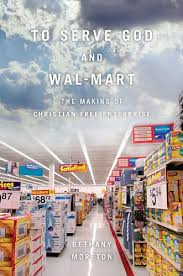
Historian Bethany Moreton, in her not-so-recent-anymore book To Serve God and Wal-Mart, describes a different sort of educational work by the founders and leaders of Wal-Mart. In addition to funding charter schools, the Waltons and Wal-Mart developed a network of fundamentalist colleges and universities that may have had far more long-term impact on American society and culture than any charter school.

How did capitalism, Christianity, and college combine?

How did capitalism, Christianity, and college combine?

The 2009 book garnered plenty of rave reviews from academic historians. I won’t try to offer a full review here, but if you’re interested, you can check out this one in Church History, or this one in the American Historical Review. Instead, I’ll sketch a few of Moreton’s points about the links between the Wal-Mart fortune and a network of evangelical colleges in the Ozark region. As I move into the research for my next academic book, a twentieth-century history of conservative evangelical colleges and universities, it seems clearer and clearer to me that these colleges have played a huge role in determining some of the basic culture-war landscape of recent United States history.

As Moreton describes, Wal-Mart and Walton money helped support some schools that desperately needed financial help. Especially close to Wal-Mart were the University of the Ozarks, John Brown University, and Harding University. Each of these schools embraced a Wal-Mart friendly combination of evangelical Protestantism and free-marketeering. And each benefited from substantial financial support from the Wal-Mart empire. Indeed, as Moreton relates, University of the Ozarks students joked that they should just change the name of their school to “Wal-Mart U” (pg. 144).

In the mid-1980s, as Moreton tells the story, with help from the Waltons, the faculty of the University of Ozarks spelled out the connections between traditional evangelical higher education and an intellectual embrace of the values of capitalism. In 1983, Mrs. Walton launched a series of “Free Enterprise Symposia” to trumpet the achievements—both moral and economic—of capitalism (pg. 154). A few years later, the faculty agreed that a new student concentration in entrepreneurship would include traditional courses in Old and New Testament, government, and liberal-arts electives. But the focus would be on business and the moral triumph of capitalism over “socialism/marxism” (pg. 155).

Students at these capitalist/Christian colleges embodied a very different sort of student identity from those of the hippies and leftists dominating headlines at other schools. For instance, Moreton describes one example of student activism at the University of the Ozarks in the late 1970s. Students joined with downtown merchants to encourage Christmas shopping. Students combined patriotic displays of red, white, and blue with traditional Santas to connect Jesus, America, and consumerism (pg. 143).

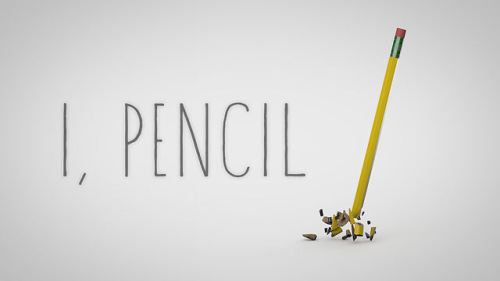
Wal-Mart also supported student organizations such as Students In Free Enterprise (SIFE). These pro-Christian, pro-capitalism student groups claimed to enroll 40,000 college students at 150 campuses nationwide. Together, SIFE bragged that it reached 100,000,000 people with its message of Christian free enterprise. Moreton described one example of that sort of student outreach by the SIFE chapter at Harding. Harding students tromped about the region with a student in a giant pencil costume. They spoke at schools, club meetings, and any other venue that would have them. Their message? Following the work of pundit Leonard Read, the students explained that worldwide capitalism managed to produce goods and services for all without central guidance. The humble pencil, for example, took materials and know-how from all around the world, bringing profit and uplift to all involved. Yet the invisible hand of the market accomplished this incredibly complex task without oversight from bumbling and greedy governments (pp. 193-197).

Leonard Read's Free-Enterprise Tale

Leonard Read’s Free-Enterprise Tale

As Moreton tells it, Wal-Mart’s college activism did not limit itself to the borders of the United States. In the late 1980s, the Waltons funded scholarships for students from Central America to study at colleges such as Harding, John Brown, and the University of the Ozarks. The goal was to train managers and workers in the pro-business, pro-Christian approach to big-block retailing and worldwide supply chains (pp. 222-247).

Moreton rightly emphasizes the centrality of higher-educational activism by conservatives such as the Waltons. Throughout the twentieth century, as I argue in both my 1920s book and my upcoming book on educational conservatism more broadly, the nature and purpose of higher education remained a central focus of American conservatism. As Moreton’s study reveals, the brains behind the Wal-Mart phenomenon took an active part in sponsoring the sorts of college and university “experience” that they thought would promote proper, traditional Americanism.

If I were to quibble with this book, I’d note that Moreton sometimes seems unaware of the longer, broader connections between pro-business groups and educational institutions. She describes what she calls the “national context of business colonization of education generally” (pg. 151) in the 1970s, but she doesn’t adequately note that the roots of that colonization go back into the 1930s, at least. Groups such as the National Association of Manufacturers, for example, actively conducted the same sorts of pro-business educational outreach that Moreton describes. A quick consult with Jon Zimmerman’s Whose America? would have helped Moreton flesh out the longer history.

But this sort of historian’s quibble does not detract from the importance of Moreton’s book. As the recent New York Times attack makes clear, conservative activism in K-12 education will always get plenty of attention. But the more profound cultural work of changing higher education may have much bigger impact on the nature of America’s culture wars. Who teaches the many conservative teachers in K-12 schools, for instance? Where do Christian executives learn to combine Jesus with Milton Friedman? Moreton’s look at the connections between Wal-Mart and higher education help illuminate the core intellectual premises of Christian capitalism.