Watch a Conservative Lawmaker Abort a Progressive Ed Project

For a hundred years now, progressive educators have pleaded with teachers to help their students learn by doing. In New Hampshire recently, a bold teacher who tried to do so with a fourth-grade class got a brutal public smack-down from a conservative legislator. The vicious culture-war politics of abortion took over.

Teacher James Cutting had helped his fourth-grade class engage with real-world issues. The students, he told NH1, took the initiative and proposed a bill to make the red-tailed hawk the official state raptor. They delivered their bill to the state house and watched as it moved through committee. When the bill had a hearing in the full legislature, the students were in the gallery to watch the proceedings.

What they saw there might have blown their minds.

One conservative legislator, Warren Groen of Rochester, took the podium to denounce the bill. The students’ choice for state raptor, Representative Groen intoned, was a vicious bird.

It grasps [its victims] with its talons then uses its razor sharp beak to basically tear it apart limb by limb, and I guess the shame about making this a state bird is it would serve as a much better mascot for Planned Parenthood.

This was not the first time that Representative Groen used his time in Concord to fight against abortion. In an earlier speech, Groen compared abortion to slavery.

Kansex Teachers: No More Excuses

Here’s the question: If a teacher shows students lewd and lascivious material, can she escape punishment because that material is part of an approved curriculum? Not if a new bill in Kansas is approved. The case raises some difficult questions: Are some forms of knowledge harmful? If so, who gets to decide which ones? …and how?

Those aren’t the only difficult questions. The bill itself is hard to figure out at first glance. Politico reported yesterday that the bill has already passed through the Senate and is heading for the House. Senate Bill 56 amends an earlier law. If 56 passes, teachers will no longer be able to defend themselves against charges of impropriety by saying that any offensive material was part of an approved curriculum.

It’s a little confusing, so I’ll say it again: An earlier state law had specified that librarians, college professors, and K-12 teachers could be prosecuted for using any material “harmful to minors” unless that material was owned (or leased) by the school or library and used as part of an “approved course or program of instruction.”

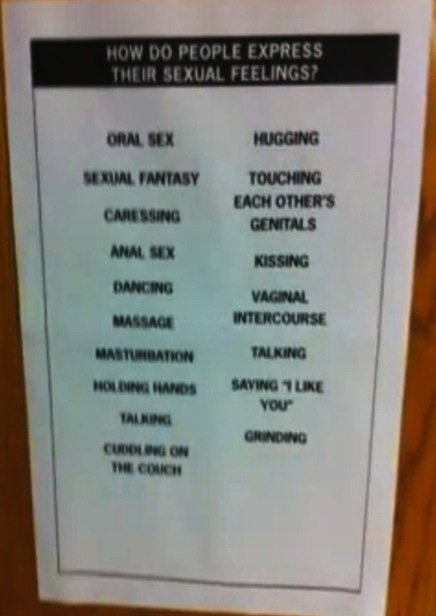
Under the proposed law, professors and librarians could still claim that defense, but K-12 teachers could not. The bill had its origins in a poster controversy last year. The poster listed ways people might act on their sexual feelings. The sponsor of today’s bill, Senator Mary Pilcher-Cook, called it “highly offensive and harmful.”

Is this a misdemeanor?

Is this a misdemeanor?

Pilcher-Cook’s attitude raises a central culture-war question. The notion that children in school must be protected from harmful words and ideas is a vital tradition among educational conservatives.

To be clear, not only conservatives want to ban harmful ideas from schools. Progressives, too, often assume that certain kinds of knowledge are harmful. From Huckleberry Finn to the University of Oklahoma, for instance, racist language and ideas have long been targets for progressive censorship. Merely hearing racist words, some activists have argued, can damage children.

In the case of sex education, though, progressives tend to think that more information is a good thing. Students need to hear explicit sexual terms. Students need to know about specific sex acts. Learning it in a classroom setting, the classic progressive argument goes, is better than learning it on the street.

Conservatives, in contrast, often think that exposure to sexual information is damaging. In this case, as Senator Pilcher-Cook told Politico, the “damage” caused by the middle-school sex-ed poster “could not be undone.” Merely hearing these words constitutes harm to children.

As I argue in my new book, conservatives have traditionally enjoyed great political success with these anti-sex-ed arguments. In the 1970s, for example, conservative school board member Alice Moore from Kanawha County, West Virginia, rallied protesters against a new series of textbooks by reading part of a salacious passage, then refusing to go on because the material was too offensive.

Children, the argument goes, are harmed by seeing or hearing certain sexual terms. They are harmed by knowing about certain sex acts. One goal of proper education, some feel, must be to protect children from these kinds of sexual knowledge.

The language of the Kansas bill makes clear the crux of the issue. If enacted into law, teachers could be prosecuted for sharing material that is “harmful to minors,” even if that material is part of an approved curriculum. Of course, such a law would put teachers in a terrible pickle.

Supporters of the bill insist that common-sense guidelines would protect teachers. As we all know, though, common sense is anything but common. Teachers and parents who think explicit sexual information is helpful would be up against those who think the exact same information is harmful.

Beyond such concerns, though, the language of the bill reveals our divided conscience. No one thinks teachers should harm students. But is exposure to information about sexual behavior—even explicit information—harmful?

Anti-Semitism at UCLA and the Anti-Christian University

Can a qualified student be barred from a student organization because she is Jewish? That is the awkward debate from UCLA that has attracted national attention recently. Here at ILYBYGTH, we have to ask a different awkward question: How is this debate different from the one about conservative evangelicals on campus? UCLA’s student leaders have apologized for the anti-Semitic slant of this incident, but many universities have intentionally de-recognized Christian organizations due to their Christian beliefs.

As the New York Times reported, Rachel Beyda’s confirmation hearing on February 10 turned into a painful debate about her Judaism and her affiliation with campus Jewish groups. Beyda is a sophomore pre-law student, hoping for a place on the student judicial council. At the February 10 meeting of the Undergraduate Students Association Council, her qualifications were questioned. One councilwoman asked Beyda,

Given that you are a Jewish student and very active in the Jewish community … given that recently … [inaudible] has been surrounding cases of conflict of interest, how do you see yourself being able to maintain an unbiased view … [inaudible]?

Eventually, Beyda was voted in, but the agonizing back-and-forth about Judaism and bias has caused the university and the student group to apologize. They had not meant to imply that Jewish students have a special sort of bias; they did not mean to say that Jewish students have divided loyalties. Such ideas, they affirmed later, have a long and ugly history in American history.

As the New York Times points out, this sort of anti-Jewish attitude has become more common on college campuses, largely due to protest against Israel’s politics. The Boycott, Divest, and Sanction movement in support of Palestinian rights has attracted widespread support among college leftists. It has become increasingly difficult for students to separate their anti-Israel ideas from anti-Semitic ones.

As the New York Times’s Adam Nagourney writes, this incident

has set off an anguished discussion of how Jews are treated, particularly in comparison with other groups that are more typically viewed as victims of discrimination, such as African-Americans and gays and lesbians.

What about the anti-evangelical bias of many universities? As we’ve seen here at ILYBYGTH, evangelical groups such as Intervarsity Christian Fellowship have been de-recognized at many pluralist colleges, including the Cal State system.

First, a few caveats: I’m no evangelical myself. I’m not asking this question as an apologist for conservative Christianity. Indeed, I vehemently disagree with most conservative evangelical political and theological positions. Nor am I unaware of the fact that these are different situations. I understand that Intervarsity has been derecognized not because of its ethnic background, but because of its discriminatory beliefs. Intervarsity members are not barred from leadership in campus activities because they might have “divided loyalties,” to use the ugly rhetoric of the recent UCLA discussion. Rather, the group as a whole is pushed out because it does not allow non-evangelicals to take leadership positions in its own group.

Having said all that, I think the Intervarsity case is another prime example of the ways “discrimination” is often used in conflicting and short-sighted ways on today’s college campuses. The student council members at UCLA insisted that they did not mean to imply that Jewish people somehow could not be full members of the university community. In short, the student-council members suffered from an overzealous interpretation of discrimination. Some council members apparently believed that there was something “discriminatory” about being Jewish.

Similarly, Intervarsity has been de-recognized because its leadership policy is discriminatory. It really is. Only those who affirm Intervarsity’s statement of faith can be leaders. This rules out students engaged in active homosexual relationships, not to mention Jewish students, Muslims, Catholics, and even liberal Protestants.

The awkward result, of course, is that Intervarsity itself has been discriminated against. Can’t some student groups engage in some forms of discrimination? Isn’t it fair for a religious group to insist that its leaders be part of its religion? Yes, such policies are frankly discriminatory. But is all discrimination necessarily beyond the bounds of proper campus thinking?

Let me repeat: I do not think the two situations are identical. I’m no member or fan of conservative evangelical student groups. But it does seem as if the zeal to purge campuses of any group that might be “discriminatory” has led to weird and troubling sorts of discrimination. Like the confused student council members at UCLA, some zealous campus voices seem to overcompensate in their desire to purge discrimination.

Harvard Brings Lynching Back

Have college campuses welcomed a new generation of lynch mobs? It is a disturbing question raised recently by Harvard Law School Professor Janet Halley in the pages of the Harvard Law Review.

New home of the academic lynch mob?

New home of the academic lynch mob?

Last November, Halley publicly critiqued Harvard’s new policy for handling accusations of sexual assault. Under pressure from the federal Office of Civil Rights, Harvard and many other schools, Halley charged, felt

immense pressure to decide flimsy, weak, doubtful and difficult cases favorably to complainants, or face the wrath of a government agency that can cut off all federal funding to the entire institution.

In her commentary in the Harvard Law Review, Halley takes her argument a step further. How can we decide cases of alleged sexual assault, Halley asks, when policy is decided more by emotion than by reason? As she asks, new policies at many schools include

a commitment to the idea that women should not and do not bear any responsibility for the bad things that happen to them when they are voluntarily drunk, stoned, or both. This commitment cuts women off — in theory and in application — from assuming agency about their own lives. Since when was that a feminist idea?

More disturbing, Halley raises the obvious but horrifying parallel. In America’s brutal history, there is plenty of precedent for what can happen when those accused of sexual assault have no legal right to defend themselves. We call it lynching. As a new report from the Equal Justice Initiative makes painfully clear, America’s white population often brutalized and murdered African American men on the merest whiff of accusations.

Is it hyperbole to suggest that today’s campus-rape rules threaten to bring back such lynch-mob mentalities? The danger, Professor Halley suggests, is that colleges are under intense pressure to convict someone accused of sexual assault, even if there is not enough evidence to do so. She cites a widely publicized case from Hobart and William Smith Colleges. In that case, the college decided that it did not have enough evidence to charge anyone with sexual assault, in spite of ample evidence that a rape had occurred.

Halley does not suggest that the victim was lying or making it up. But she worries that colleges will feel pressure to convict someone in such cases, even when there is not enough evidence to do so. In this case, Halley argues that the rush to bring justice for the victim blinds us to the rights of the accused. As she puts it,

the Colleges had to assign blame to one or more of their students despite their complete lack of direct evidence about which of them actually deserved it.

Halley wonders if such policies will bring lynching back. She writes,

American racial history is laced with vendetta-like scandals in which black men are accused of sexually assaulting white women that become reverse scandals when it is revealed that the accused men were not wrongdoers at all.

These are difficult charges to hear, much less evaluate. After all, the more obvious moral challenge facing colleges is not the violent history of lynching, but the shameful history of ignoring the pleas of victims of sexual assault. For decades, universities—including the evangelical schools I’m studying these days—covered up campus rape in an ill-conceived quest to preserve their reputations as safe havens for young people.

Nevertheless, these are vital questions we must ask. Do Professor Halley’s worries have merit? Are colleges these days—in an understandable rush to correct past abuses—heading too far in the other direction? Must the rights of the accused be protected with the same vigor as the rights of the accuser?

Hookers for Jesus; or, Fundamentalists on Valentine’s Day

Well…didn’t Jesus hang around with tax collectors and prostitutes? Former sex worker Annie Lobert is promoting her new book, Fallen: Out of the Sex Industry and into the Arms of the Savior. She told The Christian Post recently that romance—real romance—should start and end with the love of Jesus Christ. It prompts us to ask a central but awkward question: Are evangelicals really all that different from the rest of us when it comes to love and sex?

To those of us outside the circle of evangelical Christianity, this sort of religion-ized sexual tell-all can seem like a cheap way for sexually repressed evangelicals to get their jollies. Time and again, as an outsider observing conservative religious culture, conservatives’ attitudes seem like nothing so much as a “health” lecture at a strict Midwestern high school in 1953.

But is that fair?

The pages of evangelical magazines exploded recently with comments about Fifty Shades of Grey. Evangelical women were scolded for reading the book, which one writer condemned as “a written form of pornography, plain and simple.” Other conservatives offer visions of what real Christian romance is, what Fifty Shades of Grace might look like.

To me, such huffing and puffing sounds downright embarrassing. Are conservative Christians really still so flustered over sex that Fifty Shades of Grey can cause such hand-wringing? But then I remember that silly flouncing over FSoG is not at all limited to evangelical culture. Americans as a whole seem to share the desire to half-condemn and half-giggle at the goings-on between the covers of FSoG.

Certainly, non-evangelical writers have also condemned the cartoonish sex and romance of the FSoG movie. And who can forget Saturday Night Live’s funny-because-it’s-true parody of Americans’ goofy obsession with the book?

In my current research, too, I’m struggling to figure out how much fundamentalist sexual angst is different from the sexual angst of mainstream culture, and how much it is largely the same. The archival record at evangelical colleges and universities is full of real anguish over questions of proper courtship and sexuality.

You’ll have to wait for the book to read the full stories, but from one college I find a 1950s story of a gay divinity student who faked his own death to escape from the condemnation he felt as a gay fundamentalist. Faked his own death. And escaped to a new life in Texas. From the 1940s, I read a bittersweet diary of a college student who agonized over her choice of future spouses. She did not feel much attraction for one potential mate, but as she wrote to her mother, a campus speaker turned her around. This speaker told of what true Christian romance should feel like. In this speaker’s case, God

showed him that God’s intent is for the man to be a special means of communicating his love to the woman, and vice versa. It is like the offerings of honey and frankincense. The honey is natural sweetness, and is never to be burned. It stinks. It cannot stand the test of fire. But frankincense smells sweeter the hotter the fire. So the natural love and the divine. His natural love for Irene ebbed and flowed, rising and falling with the state of his soul. But God’s love, in Christ, through Bill, to Irene, was constant—a thing of divine origin and purpose, pure and living. What a revelation!

For this young woman in the 1940s, the fact that she did not feel much actual attraction for her future husband became swathed in layer after layer of indecipherable religious enthusiasm.

To me, that seems awfully odd. As does faking one’s own death and secretly absconding to Texas. But I ask myself: in the 1940s and 1950s, how different were these fundamentalist feelings about sex and courtship from those prevalent in non-fundamentalist America?

Certainly, in the 1950s, almost no one felt comfortable living openly as a homosexual. In the 1940s, the romantic experiences of young heterosexual couples on secular college campuses reeked of unhealthy layers of this or that cultural imperative.

And now, conservative evangelicals fuss and fume about proper sex and relationships.  But so do the rest of us.

To put it bluntly, the question is not: How sexually messed-up are evangelical Christians? Rather, the question is: Are evangelical Christians notably MORE sexually messed up than the rest of us?

The Perfect Valentine’s Day Gift

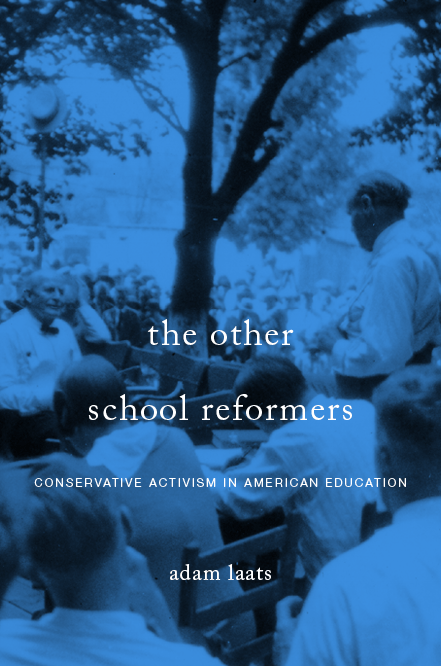
Nothing says “I Love You” more than a book about conservatism and education in American twentieth-century history. Looks like the timing will be perfect.

How to say "I Love You" (But You're Going to Hell)

How to say “I Love You” (But You’re Going to Hell)

My new book is slated for release in early February. Hard to know how it will be received, but one pre-reviewer has called it “a major rethinking of the history of American education.” Another has added, “it would be flat-out wrong to ignore this important book.” Pshaw. . .

For the sophisticated and good-looking readers of ILYBYGTH, the content might not be surprising. In this book, I try to figure out what it has meant to be “conservative” about education in the United States.  How have issues such as creationism, school prayer, and sex ed developed over the course of the twentieth century?  How are they related?  How have conservative attitudes and strategies changed?  How have they remained the same?

In the early days of my research, I had planned to explore the educational activism of leading conservative groups such as the American Legion and the Institute for Creation Research. I was stuck with two big problems, though.

First, the Legion and other conservative groups remained active throughout the twentieth century. How could I describe different conservatives without rehashing the chronology over and over again? I didn’t want to work from the 1920s to the 1970s in every chapter. What to do?

My second problem was one of definition. How could I choose which “conservative” groups to study? I could copy the method of leading conservative scholars such as Russell Kirk or George Nash and use my selection to make an argument about the definition of conservatism. Both Kirk and Nash picked their subjects to give a particular definition to conservatism. For both writers, being a true conservative has meant being a heroic intellectual battling waves of ignorance and knee-jerk leftism. But I’m no conservative myself, and I wasn’t interested in imposing a flattering (or un-flattering, for that matter) definition on American conservatism. What to do?

Luckily for me, I had some help. At a conference back in 2009, I was describing my research. One of the audience members suggested a new approach. Instead of picking and choosing which activists counted as “conservative,” instead of describing the activism of one group after another, why not do it differently? Why not let conservative activists define themselves? This leading historian suggested that I investigate events, not groups.

That’s what I did. I looked at the four biggest educational controversies of the twentieth century: The Scopes Trial of 1925, the Rugg textbook fight of 1939-1940, the Pasadena superintendent ouster of 1950, and the Kanawha County textbook battle of 1974-1975. In each case, conservative activists and organizations fought for their vision of “conservative” schools. By looking at controversies instead of organizations, I could let conservatives define themselves. And I could move chronologically through the twentieth century without rehashing the stories in each chapter.

Did it work? Now I have to let readers and reviewers be the judge. My goal was to explore what it has meant to be “conservative” in the field of education. I did not want to make the relatively simpler argument that conservatism has really meant X or Y. I did not want to give conservatives a heroic history they could draw upon. Nor did I want to give their enemies a catalog of conservative sins. I’m hoping readers think this approach has worked.

So if you’re looking for that perfect romantic gift, consider The Other School Reformers!

Conservative Warriors and Homosexuality

Where is the line? What can conservatives say about homosexuality that won’t be considered bigotry? The case of Professor John McAdams has lit up the conservative intellectual world with its implications for the eroding respectability of conservative opposition to gay rights and the utterly transformed intellectual environment on US college campuses.

Let’s start with a few caveats. First, full disclosure: I taught one semester at Marquette University, Professor McAdams’s school. I also taught for several years down the street at Marquette High School, which is no longer directly connected to the university. I feel an abiding love for both institutions. More important, I am unapologetically biased in this case. I believe it is legitimate and important to regulate speech in public (and some private) forums, including college classrooms. Hard as it is to hear, some ideas do not deserve to be granted equal status with others. Ideas that dehumanize classes of people are not just as good as other ideas. For instance, if a student in a seminar wants to insist that no white people can possibly understand US history because they are by definition part of an exploitative class, such talk should be ruled out of bounds. It would tend to exclude an entire class of people simply because of their cultural identity. Similarly, if a student wanted to rule that homosexuals were incapable of being moral in their relationships, or that women cannot understand certain concepts, or that non-citizens have no right to be heard in political discussions, such talk should be out of bounds.

Of course, many conservative intellectuals share that basic framework, but they disagree bitterly that traditionalist notions about homosexuality constitute that same sort of exclusionary mentality. In other words, many conservative thinkers agree that public speech shouldn’t be racist or chauvinist, but they disagree that conservative ideas about homosexuality fall into that same category.

The steamroller drive of homosexual rights in recent months and years has put some traditionalist conservatives on edge. A few recent cases have raised hackles among many conservative thinkers. At Mozilla and Gordon College, to cite just two examples, conservative intellectuals attracted instant and furious retribution for statements that have been perceived as anti-gay. In each case, ideas that would have been unremarkable just a few years ago are now taken as beyond the pale of respectable public speech.

In the case of Professor McAdams, college politics and bureaucracy have added new wrinkles into the question of acceptable conservative opinion about homosexuality. In brief, McAdams has been suspended with pay and asked to stay away from campus. Why? He blogged about the statements of a teaching assistant. That TA had told a student that opposition to homosexual marriage would not be considered in a class on ethics. The student complained to Professor McAdams, and McAdams outed the TA on his blog.

As McAdams noted, his support for the student prompted furious condemnation by “leftist academics,” who “demanded our head on a pike.” A group of prominent faculty at Marquette published an open letter on the issue. McAdams’s actions, they write, constituted “harassment and intimidation” of the TA. Other members of the Marquette community, they write, altered their behavior to avoid similar attacks from McAdams.

In the end, McAdams has been suspended with pay. The Fox-News commentariat has had its chance to recoil in horror at the anti-conservative “inquisition.”

There is, of course, more at stake here than intellectual positions about homosexuality and gay rights. We also must consider faculty politics and the unfortunate ways academics learn to teach. How do teaching assistants learn to handle disagreement among students? When does a tenured professor have a duty not to attack publicly a non-degreed teaching assistant? How should faculty respond when a colleague behaves in ways they dislike?

At the center of all these questions, however, is the question of conservatism and homosexuality. Not too long ago, opposition to gay marriage was a common part of our mainstream political discussion. These days, in college seminars, newspapers, technology companies, and public policy, any conservative notion that homosexuals do not have the right to marry one another is often considered rank bigotry.

Is it possible for conservative intellectuals to oppose gay marriage without being branded bigots? Has that culture-war train left the station?

Gay + Christian = Celibate: A Long Tradition

What is a gay conservative Christian to do? With plenty of justification, many Americans think that conservative Catholics and evangelicals are anti-gay. A recent article in the Washington Post suggests that homosexual Christians have found a new answer to this conundrum, though those in the know know that there’s nothing new about it.

Michelle Boorstein’s article discusses the spiritual path of bloggers such as Eve Tushnet, whom Boorstein describes as a leader of a

small but growing movement of celibate gay Christians who find it easier than before to be out of the closet in their traditional churches because they’re celibate.

When Tushnet converted to Catholicism, Boorstein describes, she felt as if she were the first gay Christian to choose celibacy. To be fair, neither Boorstein nor Tushnet claims this is brand new.  It is “easier” to be openly gay, Boorstein writes.  But not easy.  As the article discusses, such a decision opens one up to attacks from both sides. Some conservatives hope that God can “heal” homosexuals. Such folks want homosexual Christians to abjure their homosexual identities. From the other side, some gay activists argue that choosing celibacy is a terrible option, a truckling to anti-gay animus among conservatives.

What the article doesn’t examine is the long history of this question among conservative evangelicals. As one might expect, issues of sexuality and sexual attraction have long played a central role at America’s network of conservative evangelical colleges. What should young people do if they feel sexually attracted to their own gender? What should loving Christians tell them in college classes and counseling sessions? In my current round of archival research into the history of these schools, I’m seeing a long tradition of the answer “discovered” by folks such as Tushnet: Gay conservatives can remain true to their religious beliefs and true to their sexual attractions by committing to lifelong celibacy.

Certainly, as Boorstein notes, the language has changed, as have public attitudes. In the past, conservatives did not claim their homosexuality as openly or as proudly. But this does not mean that the celibacy “solution” is at all a new one.

In the 1930s, for example, among the troubles at the Denver Bible Institute was the leader’s insistence that all relationships be “continent.” This leader, Clifton Fowler, was accused of homosexual attractions. Indeed, he was accused of active homosexual sexual relationships. His solution was to insist that all married relationships—apparently all potentially sexual relationships—remain celibate. In that case, the facts were obscured by conflicting accusations on all sides. It seems clear, however, that the celibate “solution” to the perceived dilemma of homosexual attraction among Protestant fundamentalists is nearly as old as American fundamentalism itself.

In a later generation, the language used to discuss homosexuality and celibacy grew slightly more frank, while remaining just as harshly anti-gay. In 1951, a student at Biola College (now Biola University) promised counselors that he would remain celibate. As I read the record, this promise was taken at the time as a satisfactory and traditional “solution” to the problem of gay fundamentalism. Take, for example, the following explanation he offered to his dean:

as to the matter [i.e., homosexuality] that has been at the root of all my grief, I am positive that I am cured. The perverted urge will probably come upon me many times in the future but now that I know giving in to it has cost me all that I held dear, I am certain that I will be enabled to grasp the strength of the Lord to withstand.

Back in 1951, it seems, as in the late 1930s, among these conservative Christians, celibacy seemed an appropriate and acceptable solution to homosexual attractions. The student here did not suggest that being “cured” of homosexuality meant becoming heterosexual. Rather, all he promised was the ability to “withstand” what he called his “perverted urge.”

Continuing into the 1970s, leaders at evangelical schools seemed open to the idea that celibacy could be an acceptable evangelical answer for homosexuals. For instance, in a 1977 interview with Wheaton College’s student newspaper, Wheaton President Hudson Armerding offered this response:

The church should respond in love toward those with homosexuality [sic] tendencies and in humility seek to assist such persons to maintain and develop a life-style that is in obedience to the Word of God.

Armerding did not insist that evangelical homosexuals be “cured” of their sexual identity. Rather, he simply demanded that they find a “life-style”—presumably including celibacy—that went with Armerding’s understanding of God’s Word.

From the 1930s to the 1970s, then, evangelical homosexuals could remain both evangelical and homosexual by living celibate lives. Nor does the notion of celibate homosexuality seem particularly revelatory to evangelical collegians today. Julie Rodgers currently works at Wheaton College as an openly gay celibate Christian. She helps counsel students about sexual issues, among other things.

Certainly, the language these days has changed. Rodgers, for example, openly describes herself as gay. The gay celibate student at Biola College in 1951, in stark contrast, was driven to extremes in his attempt to hide his gay identity. Back in the 1930s, Clifton Fowler never admitted to any homosexual attractions, though there seems ample evidence of it.

Nevertheless, for those in the know, there is nothing new among conservative evangelicals and fundamentalists about the celibate “solution” to homosexual attractions.

Investigative Report: Sex Abuse at Fundamentalist U

HT: DW

Are fundamentalist universities guilty of encouraging sex abuse? Does “purity culture” encourage predators? Does the environment at fundamentalist universities force victims, at best, to suffer in silence and shame?

We don’t have all the answers, but the GRACE report of sex abuse at Bob Jones University offers a few clues. Short answer: BJU is guilty of establishing an idiosyncratic administration and campus culture that punished victims and rewarded loyalty over caring and competence.

I’ve taken some heat in the past for wondering if fundamentalist universities had been targeted unfairly on this subject. Certainly, fundamentalist schools have done a terrible job in handling sexual assault and abuse. But so have secular and liberal schools. Wasn’t it possible, I asked, that the no-drinking, no-partying culture at fundamentalist colleges helped deter some cases of assault? Given the large number of alcohol-fueled assault cases recently, I still think these are fair questions.

In spite of such questions, however, the recent GRACE report paints a damning picture of Bob Jones University. I’ll repeat: I do not think it is fair to assume that conservative schools will somehow automatically do a worse job of handling abuse and assault cases than other schools. However, the GRACE report points to systemic problems at BJU that are likely shared by smaller, less prestigious fundamentalist colleges and schools.

As I see it, BJU has failed in two significant ways. First, it has insisted on a climate in which student complaints of any kind were viewed as a moral failing for the complainer. Second, since the 1930s BJU has maintained a policy of rewarding staff loyalty over any other concern. As a result, leading administrators were woefully—perhaps even criminally—incompetent to deal with student victims of sexual abuse and assault.

I do not make these charges lightly. Nor do I have any personal animus toward BJU or other fundamentalist colleges. But the record is clear.

First, some brief facts of the case. Two years ago, administrators at BJU commissioned an outside study of their response to abuse claims. In itself, this sort of outside examination made a clear break with BJU tradition. The assembled commission, Godly Response to Abuse in the Christian Environment, or GRACE, recently published its findings. BJU’s current leader, Steven Pettit, has apologized for any suffering the university has caused or ignored.

That is a start. The university, in my opinion, has two main faults for which it needs to apologize.

First, the leaders of the school have insisted for decades on one cardinal rule: No “griping.” Students who complain have been consistently treated as disloyal, or at least suspicious. For example, in one statement made by the founder, Bob Jones Sr., on June 19, 1953, Jones advised the BJU community of the first rule: “Griping not tolerated, but constructive suggestions appreciated.”

In practice, the culture at BJU has promoted a suffer-in-silence mentality.

Second, and perhaps more problematic, hiring and promotion practices at BJU have encouraged loyalty above all other factors, including competence. In cases of abuse and assault, this has led to terrible consequences. As the GRACE report documents, administrator Jim Berg handled many abuse reports since 1981. Time after time, Berg demonstrated his lack of preparation. For a while, Berg was unaware of South Carolina’s mandatory-reporting law.

The blame here belongs to more than Berg alone. Berg’s leadership role was the product of an institutional culture that valued loyalty first. Berg’s decisions and professional intuitions were the product of a culture that saw itself as removed from all obligations to the outside world.

The evidence for this loyalty-first culture is abundant. In the same 1953 statement referred to above, Bob Jones Sr. warned faculty that he had an obligation to fire anyone “who is not loyal.” This statement came in the wake of mass resignations at the school in 1952 and 1953.

That was not the only time the school’s leaders made their emphasis on loyalty clear. In 1936, just before another group firing, Bob Jones Sr. warned one faculty member,

First: There must be absolute loyalty to the administration. If something happens in the administration which you do not like, your protest is your resignation. If you stay here you must not under any circumstances criticise [sic] the administration.

The results of such a sustained policy are clear. Those who remained in leadership positions at BJU were rewarded for loyalty first, competence second. In the case of student abuse and assault, such an emphasis left students in the hands of utterly unprepared administrators.

All schools—all institutions—can suffer from incompetence, of course, but the BJU policy of loyalty-first intentionally undervalued professional competence.

It bears repeating that BJU’s current leader has apologized for these faults. As he put it,

I would like to sincerely and humbly apologize to those who felt they did not receive from us genuine love, compassion, understanding and support after suffering sexual abuse or assault …To them I would say—we have carefully listened to your voice. We take your testimony in this report to our hearts. We intend to thoroughly review every aspect and concern outlined in the investigation and respond appropriately.

And, sadly, we must remember that fundamentalist institutions are by no means alone in establishing and protecting cultures of abuse. Other religious groups, such as the Catholic Church, and other colleges, such as Penn State University, have similarly criminal histories.

As it might at those institutions, perhaps the future at BJU and other fundamentalist universities will be brighter than the past.

Can YOU Pick the Right Decade?

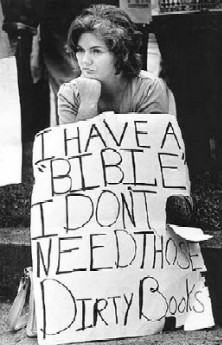
I guess I should see a doctor. Reading the news from Highland Park, Texas, I had a dizzying sensation of whirling around in time, not sure if it was 2014 or 1974. The Dallas-area controversy over school readings sounded so similar to one that happened forty years ago, I’ve come up with a reader challenge: Can you put the quotations below in the right decade?

Here’s some background: As I describe in my upcoming book, in 1974 Kanawha County, West Virginia was roiled by a ferocious controversy over a new set of language-arts textbooks. Conservative protesters worried that the books had an anti-American tone. They worried that the books promoted a vicious sexuality, an angry rebelliousness, and an unhealthy sense of anti-authoritarianism. Until the books were removed, parents boycotted the region’s public schools. It got ugly. Buildings were firebombed, cars and school buses were attacked, and two people were shot.

From Trey Kay, "The Great Textbook War."

From Trey Kay, “The Great Textbook War.”

This year, as the New York Times reports, an eerily similar protest took off in Highland Park, Texas. In that fancy Dallas suburb, a short list of books were pulled from school shelves. Parents had complained that the books promoted a precocious deviant sexuality. After counter-protests, the district’s superintendent put the books back in schools.

So here’s the challenge: Can you guess the right decade for the quotations below?  Each quotation comes from a conservative challenge to school textbooks.  And the bigger challenge: Can you figure out if this means we are trapped in a never-ending cycle of educational culture wars?

QUOTATION 1: The books include “seduction, rape, child pedophilia, whether oral sex is sex, premarital sex as normative, reincarnation, or that those in authority over them approve of foul language.”[1]

QUOTATION 2: “I found this book to be crass, vulgar, and indecent for students.”[2]

QUOTATION 3: Offensive textbooks are “negative, racist, impulsive, and in some cases right-down vulgar.”[3]

QUOTATION 3: “The book introduces ideas . . . such as beastiality [sic], and sexual penetration by an object, among others.”[4]

QUOTATION 4: “In all of these books . . . I’ve seen many references to God and to Christianity . . . and every time it’s been derogatory.” These books “ridicule Christianity again and again.”[5]

QUOTATION 5: “A child’s formal education should expose him to a broad spectrum of views, but explicit and vulgar writings are not warranted.”[6]

QUOTATION 6: One objectionable book “seeks to frighten children of authority figures, asks children to criticize their parents and invasion of privacy is almost commonplace throughout.”[7]

QUOTATION 7: The offensive books “dwell at length on the sexual aspects of human relationships in such an explicit way as to encourage promiscuity.”[8]

How did you do?  Could you place the conservative protests in the right decade?  Without cheating?

More important, what does it say about our continuing battles over proper education that these parent protests sound so similar?

**********************************************************************************************************

[1] From the NYT article, 2014

[2] From conservative committee member minority report, 2014

[3] June 13, 1974: conservative protester speaking at school board meeting in Kanawha County.

[4] From conservative committee member minority report, 2014

[5] Conservative leader Alice Moore, speaking at school board meeting, June 27, 1974.

[6] From conservative parent protest website in Highland Park, 2014

[7] Judith Casto, “3 basic Kanawha book objections evident,” [sic no caps] The Herald Advertiser [Huntington, WV], November 24, 1974, 41, 44.

[8] Elmer Fike, “Textbook Controversy in Perspective,” Elmer’s Tune, n.d. [fall 1974].