Persecution, Mozilla, and Gay Rights

Who is the bully? Who is the victim? Is it former Mozilla CEO Brendan Eich? Or is it the many LGBT people who might not have equal marriage rights?

Unless you’re living under a rock, you’ve heard the story by now. Co-founder and former Chief Technology Officer of Mozilla Brendan Eich recently resigned from his new job as Chief Executive Officer. Why? In 2008, he donated $1000 to support California’s Proposition 8. The Proposition would have banned same-sex marriage. His donation caused such a backlash against Mozilla that Eich resigned.

Throughout the furor, Eich made conciliatory noises about the values of diversity and tolerance, but he did not abjure his political beliefs against gay marriage. For many in the tech community, such beliefs are tantamount to bigotry and politicized hatred. To be against gay marriage, for many folks (full disclosure: I include myself in this group), implies a willingness to deny equal legal rights to a category of people. This is the very definition of bigotry. Such a position, pro-gay-marriage activists insist, is akin to denying people the right to marry across the race line.

In short, by opposing gay marriage, Eich defined himself as a bully and a bigot. To oppose gay marriage, many felt, puts Eich and his ilk beyond the pale of civil society.

In the conservative intellectual community, of course, the shoe is on the other foot. Conservatives insist that the bullying is being done by the pro-gay-marriage crowd. How is it “tolerant,” conservatives ask, when successful business leaders are forced to step down strictly because of their political beliefs? The bigots here, conservatives argue, are those who won’t allow a true intellectual or political diversity. The real bullies, conservatives say, are those who won’t allow for any disagreement with their worldview.

As usual, one of the most perspicacious articulations of these positions came recently from Princeton’s Robert George. In the pages of First Thoughts, George argued the case that the victims here were religious folks. Anti-Eich-ism, George asserts, threatens to squeeze religious folks out of the public sphere entirely. As Professor George puts it,

Now that the bullies have Eich’s head as a trophy on their wall, they will put the heat on every other corporation and major employer. They will pressure them to refuse employment to those who decline to conform their views to the new orthodoxy. And you can also bet that it won’t end with same-sex marriage. Next, it will be support for the pro-life cause that will be treated as moral turpitude in the same way that support for marriage is treated. Do you believe in protecting unborn babies from being slain in the womb? Why, then: “You are a misogynist. You are a hater of women. You are a bigot. We can’t have a person like you working for our company.” And there will be other political and moral issues, too, that will be treated as litmus tests for eligibility for employment. The defenestration of Eich by people at Mozilla for dissenting from the new orthodoxy on marriage is just the beginning.

Are conservatives the victims here? Is it legitimate political activism to oppose same-sex marriage? Or is it bigotry and intolerance?

 

Florida, Football, and Fundamentalism

Is football a religion? Do the high priests of college football act like the leaders of the nation’s most conservative fundamentalist colleges? In some ways, when it comes to responding to accusations of rape and sexual assault, the similarities seem creepily prominent.

News emerged today that the case of football star Jameis Winston at Florida State will undergo a new round of scrutiny. Back in December, Winston evaded charges about an alleged sexual assault. At the time, pundits accused FSU of coddling Winston because of Winston’s star power.

As we’ve seen in these pages, conservative evangelical Protestant colleges–“fundamentalist” schools–have weathered similar charges of stonewalling and covering up charges of sexual assault on their campus.

Are these cases similar? Does football function like fundamentalism? That is, does the culture of big-name, big-money football create an environment in which everything else takes a back seat to success on the gridiron? Where any questioning of the football team becomes similar to questioning basic tenets of orthodox religious belief?

Let’s take a look at some of the similarities and differences.

At least according to some accusers, fundamentalist schools actively target victims of sexual assault. Both men and women, students and administrators, are steeped in a “purity culture” that encourages all involved to see female victims as sexual temptresses. When accusations of rape emerge, victims are attacked by students and administrators. The threat of making such accusations intimidates many other victims into a scarred silence.

Similar hostility emerges with college football. The alleged victim of the FSU rape, for instance, eventually dropped out of school and moved out of town due to constant harassment and death threats.

Also, it seems both football and fundamentalism push college administrators to worry first about the school, and only secondly about the complaints of victims. With football, the stars must be protected. No one can win a Heisman Trophy or a national championship from a jail cell. And with fundamentalism, schools must protect their reputations as uniquely safe environments. Publicity about sexual assault would certainly threaten that reputation.

But there are also significant differences. First of all, non-fundamentalist schools are almost all subject to review by federal guidelines. In the case of FSU, for example, the case has come back into the headlines because of accusations that the FSU administration might have violated provisions of Title IX in its handling of the case. Most fundamentalist schools refuse all federal funding, so they can operate without such oversight or federal review.

More profoundly, cases at fundamentalist schools are about more than just administrative cover-ups. Some pundits insist that the culture at fundamentalist schools operates as a hyper-charged version of broader cultures that blame women victims. More than at pluralist public schools such as FSU, critics allege, fundamentalist schools promote both sexual assault and victim-blaming by insisting on a “purity culture” standard. Women involved in sex of any kind often find themselves accused of instigating sinful acts.

Victory we have heard on high

Victory we have heard on high

There’s no doubt that big-time college sports look like religions, in lots of ways. They have weekly rituals, with ceremonial outfits and traditional musical accompaniment. They have high priests and acolytes who huddle to make important decisions. And, at least in the eyes of many fans and players, they involve the community in a staged fight of the powers of good versus the powers of evil.

But does this quasi-religious adoration of college sports bleed over into the treatment of accusations of rape as well?


Christian School: Be a Girl

Does an eight-year-old girl have the right to like traditionally “boy” things such as baseballs and short haircuts? Or, more precisely, is she permitted to cause confusion about her gender identity among her fellow students? Not if she wants to attend Timberlake Christian School in Virginia.

Does this story represent an outrageous outlier along the fringes of Christian education, or is this typical of the strictly gendered worldview of conservative evangelical Protestantism? Here at ILYBYGTH, we try not to rush to assume the worst about conservative schooling. In this case, however, it seems the school really did push Sunnie to be more of a girl.  And prominent evangelical intellectuals are willing to defend this decision as central to the cultural politics of conservative evangelical Protestantism.

According to a story by James Gherardi at WSET TV in Lynchburg, Virginia, eight-year-old Sunnie Kahle likes to have short hair. She likes to dress in jeans and t-shirts. She likes to play outside. For all these reasons, school administrators at Timberlake Christian School worried she was not acting enough like a girl. To be more specific, they worried about student confusion. Apparently, a group of boys had attempted to pull Sunnie into a boys’ bathroom.

It seems this is not a case of a student who chooses to identify as a different gender than the one she has been assigned. Sunnie agrees that she is a girl. She just likes to have short hair and play outside in the mud. Her fellow students think she acts too much like a boy and insisted she use the boys’ bathroom instead of the girls’ room.

School administrators worried that Sunnie’s dress and behavior did not match the school’s gender standards. As principal Becky Bowman told Sunnie’s guardians (her great-grandparents) in a letter,

we believe that unless Sunnie as well as her family clearly understand that God has made her female and her dress and behavior need to follow suit with her God ordained identity, that TCS is not the best place for her future education.

For their part, Sunnie’s great-grandparents insist they will not accommodate the school’s demands. Sunnie is just fine, they insist. They pulled her out of TCS and enrolled her in the local public school.

For those of us outsiders trying to understand conservatism in education, we have some questions we need to ask: Does the attitude of TCS represent the thinking of many other conservative evangelical Protestants? Would other Christian schools have acted similarly? Or was this an outrageous exception, a story that garnered international attention precisely because it was so outlandish?

As we’ve noted in the past, conservative Christians have long worried about loosening gender norms in schools. School bathrooms, specifically, have been a hot-point in these school-gender deliberations. Can students who were identified as one gender at birth, but who choose to identify as another, use bathrooms of their chosen gender? That is, can a student who was called a “boy” at birth but who calls herself a “girl” use the girl’s room? This has been a concern far beyond the reaches of Timberlake Christian School.

And significantly, Mat Staver of Liberty University School of Law has waded into this controversy. Staver has announced that Liberty will represent the nearby Christian school. This issue, Staver announced, “is far beyond a simple ‘hairstyle and tomboy issue’ as inaccurately portrayed.” The support and involvement of Staver and Liberty University makes it appear as if this issue represents something widespread among conservative evangelical Protestant educators.

For their part, the school clarified its position. This was never about hairstyles or clothing, they insist. Nor was Sunnie every kicked out of the school. Rather, this was in line with the school’s duty to create and maintain a Christian environment. As the school explained in a public statement to the Roanoke Times,

Parents and guardians send their children to the School because of our Christian beliefs and standards. We have a duty to create an environment that is supportive of these Christian values. We cannot have conflicting messages or standards because such conflict will confuse our students and frustrate the parents and guardians who have entrusted the education of their children to us.

When elementary children and their parents or guardians express concerns regarding use of the restroom and other matters arising from the sensitive issues here, the School has a duty to address those concerns and to ensure that all interests are heard and protected in accordance with the Christian mission of the School.

At least according to these sentiments, this episode was more than just an over-hyped miscommunication. The school really did insist that Sunnie make her gender identity clearer to other students. And school administrators really did envision this as part of the central mission of the school.

But note also that the school was not the gender-monolith we might think. According to Sunnie’s great-grandmother Doris Thompson, Sunnie’s kindergarten teacher worried about Sunnie’s gender identity. But Sunnie’s first-grade teacher did not. Then again this year in second grade, the issue cropped up once more. It seems the teachers at TCS have different attitudes themselves about the centrality of gender identity to proper Christian education.

So what’s the connection between gender identity and conservative Christian schooling?   It seems the attitudes of Timberlake Christian School administrators represent widespread feelings among conservatives. Girls must be clearly girls. Boys must be clearly boys. This is not just a question of haircuts and blue jeans. This is a more profound question of public behavior and gender expectations.  At TCS, traditions of gender behavior and identification have become a central part of non-negotiable theological principles.


Conservatives Blast the “Myth” of Rape Culture

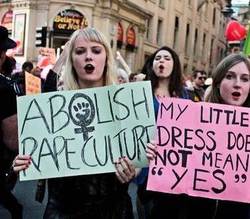
Why do some conservative thinkers insist that anti-rape-culture activism is a fraud? That “rape culture” itself is a myth?

As we’ve seen in these pages, talk about rape culture is often tied to the atmosphere of colleges and universities. And it is understandably an incredibly sensitive subject. Even asking about the nature of rape culture can be seen as truckling to rapists and those who hope to explain rape away.

Full disclosure: I am one of those who thinks that denying this problem is part of the problem. I agree that colleges and universities need actively to confront cultures that encourage sexual assault. For too long, college administrators have winked at the “boys will be boys” attitudes that lie at the heart of rape culture. In these pages, I have asked whether this is worse at conservative Christian colleges. I have wondered if non-denominational Christian schools, “fundamentalist” schools such as Bob Jones University, Patrick Henry College, and Pensacola Christian College have a harder or easier time dealing with these issues. In those cases, I was accused of apologizing for sexual assault myself.

And watch: I won’t be surprised if I am accused of supporting rape culture for writing these words as well.

But I’m going to do it anyway. Because there’s a new question that stumps me. Why do some conservative intellectuals attack the very notion of rape culture? What is “conservative” about dismissing the existence of rape culture on college campuses?

Minding the Campus Blasts Rape-Culture Activism

Minding the Campus Blasts Rape-Culture Activism

This past week, we’ve seen Caroline Kitchens of the American Enterprise Institute denouncing the “hysteria” over rape culture in the pages of Time Magazine. Kitchens asserted that there is no rape culture. There is no culture, that is, in which rape is apologized for and excused. America as a whole loathes rape and despises rapists, Kitchens points out. “Rape culture” only exists in the imaginations of over privileged college students and their tame faculty. Colleges such as Boston University and Wellesley ban pop songs and harmless statues as an overblown response to such rape-culture myths, Kitchens writes.

Kitchens claims the support of the Rape, Abuse, & Incest National Network (RAINN). She cites a recent RAINN letter to a White House Task Force. In order to help victims of sexual assault on college campuses, this RAINN letter asserts, administrators should understand that these are the acts of criminal individuals, not the result of a nebulous cultural trend.

It is rape-culture stereotypes themselves that absolve abusers of responsibility, Kitchens argues. “By blaming so-called rape culture,” she concludes, “we implicate all men in a social atrocity, trivialize the experiences of survivors, and deflect blame from the rapists truly responsible for sexual violence.”

Kitchens is not alone. In the pages of the conservative higher-ed watchdog Minding the Campus, KC Johnson has agreed recently that “rape culture” is a “delusion,” the product of overheated leftist imaginations. Johnson, a high-profile historian from Brooklyn College, worries that campuses from Dartmouth to Occidental to Duke suffer from an overabundance of intellectual cowardice and groupthink. “Fawning” media coverage has allowed for “transparently absurd allegations,” Johnson writes. Plus, harping on “rape culture,” Johnson argues, allows “activists to shift the narrative away from uncomfortable questions about due process and false accusations against innocent male students, and toward a cultural critique in which the facts of specific cases can be deemed irrelevant.” Finally, the blunt instrument of “rape-culture” accusations provides activists with “a weapon to advance a particular type of gender-based agenda.”

Such claims are intensely controversial. But before we examine the legitimacy of these arguments, we need to ask a more basic question: Why do conservative intellectuals make them? Now, I understand Johnson is no conservative himself. But it is telling that conservative organizations such as the American Enterprise Institute and Minding the Campus are the ones hosting these anti-rape-culture accusations.

Is there something “conservative” about disputing the existence of rape culture? Is “rape culture” a leftist ploy to assert (more) control over college campuses? To tighten the screws of the academic thought police? Or is something more profound at work? Do these conservative voices dispute the existence of rape culture in order to perpetuate traditional gender roles?


Hating the Haters

Should Fred Phelps’ funeral be a protest site?

Insta-pundits have debated the issue.  With the anti-homosexual founder of the Westboro Baptist Church possibly on death’s door, would it be proper for gay-rights activists to protest at Phelps’ funeral?

fredphelps

Fred Phelps in Action

Phelps attracted the most attention, after all, for his policy of hateful protests at the funerals of US servicemen and –women.  His “God Hates Fags” signs became a byword for extremist fundamentalism.

Should those opposed to Phelps’ awful tactics engage in those tactics?  We think not.

While it might be satisfying to stand with “God Hates Haters” signs, it would only exacerbate the culture of hate.


Can Christian Colleges Say the R-Word?

Do conservative Christians encourage rape?  It’s a difficult thing to talk about, but it is a question these days at the center of discussions about conservatism, Christianity and higher education.  Most recently, blogger Samantha Field related the stories of students at Pensacola Christian College who had been punished by the school after suffering sexual assaults.  The accusations have attracted enough attention that PCC has felt obliged to make a public denial.  The school said it has been “harassed and victimized” by these accusations.  PCC, the school insisted, has always acted in accordance with the law.

This is not only an issue at Pensacola Christian College.  As journalist Kiera Feldman argued in a recent New Republic article, a similar culture of institutional arrogance prevails at Patrick Henry College.  And Bob Jones University has gone back and forth with its efforts to examine its own culture.  More broadly, Billy Graham’s grandson attracted attention a few months back for asking if evangelical Protestants had a worse record of dealing with sex abuse than did the Catholic Church.

These are difficult questions to ask.  For an earlier post about this issue, I’ve been called insensitive (fair, and I apologize again), ignorant (sometimes fair, sometimes unfair) and guilty of condoning or excusing cover-ups (utterly unfair).  What I asked was whether or not these accusations of institutional misconduct rely on stereotyped assumptions about conservative evangelical Protestants.  In other words, is there something specifically about the religion of these schools that is somehow to blame?  Or is it an institutional culture at these conservative schools that blames victims and excuses criminals?  Is there something about the Christian nature of these schools that promotes and excuses rape?  Or is this a question of institutional mismanagement?  Finally, we have to ask, is this whole thing somehow more aggravated at these schools than it is at secular or pluralist schools?

After reading more about these cases, it seems the attitude toward rape of school leaders really is wrapped up intimately with their institutional tradition, and maybe even with their theological tradition.  It seems this is more than just another case of fundamentalist-bashing.  In the past, I have defended young-earth creationists against accusations that they are guilty of criminal abuse.  I’ve chided secular journalists—with whom I’m generally sympathetic—for misrepresenting the claims of young earth creationists.  These cases from conservative colleges seemed to me, at first, to represent similar sorts of knee-jerk anti-fundamentalist stereotyping.  I didn’t try to cast doubt on the sincerity of the victims, to be clear, but I did ask whether the accusations against the schools unfairly tied belief in an inerrant Bible to cases of institutional misconduct.

I do not come from a conservative evangelical or fundamentalist background.  But for a living, I study conservative educational activism, especially the educational thinking of conservative Protestants in the United States.  I’m aware of the history of American fundamentalism, including the ways theology has been profoundly combined with hierarchical gender notions.  As I wrote in my 1920s book and as Margaret Bendroth argued in hers, in its early decades American fundamentalism relied on notions of male dominance and female submissiveness.

We know that all colleges these days are struggling with proper ways to handle sexual assault cases.  The charges against schools such as Patrick Henry College, Pensacola Christian College, and Bob Jones University suggest that the campus culture at these conservative schools makes that difficult task much harder.  It seems the fundamentalist culture of these schools has intensified the already brutal culture on many secular college campuses.

This does not mean that every fundamentalist condones sexual assault, of course.  This does not even mean that every student, faculty member, or administrator of these schools agrees with the overall school culture.  Nor can we even say with confidence that this culture is somehow a necessary outgrowth of the theology of the schools, rather than primarily a question of hierarchical, closed-off, inflexible administrative structure.  But it does seem that the dominant atmosphere of these schools needs to share blame in this aggravated culture of condoning and excusing sexual assault.

The best comparison, it seems to me, is the atrocious record of the Catholic Church with its recent sex-abuse scandals.  No one says that every Catholic—let alone every Catholic priest—is part of this scandal.  Nor do we even say with confidence that this is something caused directly by the theology of the Catholic Church.  And we can of course point out that far more non-Catholics committed sex abuse than did Catholic priests.  But such objections miss the point.  There was something profoundly wrong with the way the power structure of the church handled those cases.  It seems there’s a similar connection here between institutional structure and moral accountability.

Those few who might use these cases to suggest that Christianity as a whole is a rape-centered religion are just as wrong as they have ever been.  And we must remember that there is a wide variety in conservative evangelical colleges.  A culture that dominates at BJU, PHC, or PCC will be very different from the culture at other evangelical schools such as Wheaton.  But even remembering those important caveats, there is something deeply troubling with the institutional power structure in these fundamentalist schools.

What will colleges do to respond?  As I’ve argued elsewhere, these schools rely on their reputation as havens of religious orthodoxy in a secularized society.  As the first Bob Jones insisted when he founded Bob Jones College in the 1920s,

Fathers and mothers who place their sons and daughters in our institution can go to sleep at night with no haunting fear that some skeptical teacher will steal the faith of their precious children.

Today’s school leaders, no less than the founders, must be able to say confidently that students will be theologically and physically safe.  How can they reassure parents and future students that they have responded to these accusations?

C’est la Guerre…La Guerre Culturale

We hear it from time to time.  Scientists claim that only America suffers from widespread creationism.  Hip liberals fume that only America puts prudes and fogies in political office.  America’s culture wars seem to be uniquely American.  Or are they?

We read in The Economist about a recent education culture-war in France that seems as American as apple pie.  It seems France—the land of laid-back attitudes about sex and uptight attitudes about food—has more in common with the US of A than some people might like to admit.

The recent flap follows the American pattern.  A new curriculum has riled cultural conservatives.  The new school materials, ABCD of Equality, hoped to instill ideas of gender equality in young people at a young age.  Books in the series, including “Jean Has Two Mummies” and “Daddy Wears a Dress,” hoped to teach students that gender and sexuality do not need hard-and-fast boundaries.  As often happens in this country’s culture-war politics, the book that sparked the most outrage was not even officially part of the curriculum, but rather part of a list of suggested additional picture-books on an affiliated website.  That book, “Everybody Naked!” showed page after page of, well, just what the title suggests.

Everybody Naked!

Everybody Naked!

In France, according to the Economist essay, a coalition of cultural conservatives objected.  Objections to the book series unite Catholic and Muslim traditionalists.  One conservative activist warned that such books represent a government attempt to “re-educate our children,” to make them doubt their religion and experiment with their gender and sexuality.  In clear echoes of West Virginia, conservatives called for a school boycott until the books were removed.  And, just as Patricia Polacco’s books have put mild-mannered librarians on the front lines of America’s culture wars, French conservatives have applied pressure on libraries to remove the offensive titles.

Of course, no two culture wars are exactly the same.  I doubt, for example, that any American sex educator would even suggest “Everybody Naked” for America’s elementary schools.  But in its broad contours, the kerfuffle in France demonstrates the international nature of culture-war politics.


“The Long Game” Is Coming to Binghamton

What do schools teach?  What SHOULD schools teach?  The problem is not that we don’t have an answer to this question.  The problem is that can’t agree on which answer is the right one.

Tomorrow night award-winning documentarian Trey Kay is bringing his latest radio documentary to the scenic campus of Binghamton University in sunny Binghamton, New York.  This work, “The Long Game: Texas’ Ongoing Battle for the Direction of the Classroom,” explores school politics in the Lone Star State.  As ILYBYGTH readers know well, those Texas politics tend to be more exciting versions of the sorts of school fights we hear all over the country: Can cheerleaders use the Bible at public-school football games?  Can textbooks preach a neo-Confederate vision of US History?  Can creationism and evolution jostle along side-by-side in public-school science classes?

long gameThe battles in Texas schools reflect our cultural disagreements over the proper form of public schooling.

Tomorrow evening, Trey will share an excerpt from his earlier documentary, “The Great Textbook War.”  Then we’ll listen to “The Long Game.”  Afterwards, we’ll benefit from Trey’s commentary, as well as that of world-renowned historian Jonathan Zimmerman of New York University.  Binghamton’s own Matt McConn, a recent émigré from Houston public schools, will also join the panel.

Unfortunately, we won’t be web-streaming the event.  But for all those who can make it to the Binghamton area, you are most welcome to attend.  The fun will begin at 6 PM, Thursday, February 27, in University Union room 120, on the campus of Binghamton University.  The event is free and open to the public.  Pre-registration has closed, but everyone is still welcome to come by without registration.

Registration Is Open!

You are invited.

In a few weeks, Binghamton University’s Graduate School of Education will be hosting a terrific event.  Documentarian Trey Kay will be sharing his new radio documentary, “The Long Game: Texas’ Ongoing Battle for the Direction of the Classroom.”  You probably remember Trey from his award-winning documentary about the textbook battle in West Virginia, 1974-1975.  In his new work, Trey explores the themes so close to the hearts of ILYBYGTH.  Should schools teach creationism?  Should they teach sex?  If so, how?  And what sorts of history should public-school students learn?  Should students be taught that America is awesome?  Or that the United States has some skeletons in its closet?  There has been no place more interesting than Texas to see these politics in action.

long game

After the listening session, Trey will offer a few comments.  He’ll be joined by the world-famous historian Jonathan Zimmerman of NYU.  ILYBYGTH readers will likely know about Zimmerman’s books, including especially his seminal work Whose America.  In addition, BU faculty member Matt McConn will say a few words.  McConn is new to New York, fresh from a long career as a teacher and school administrator in Houston.

There will even be cookies.

So please come on down if you’re in the Upstate area.  It will take place on Thursday, February 27, at 6 PM, in room G-008 in Academic Building A, on the beautiful main campus of Binghamton University.

We’d love to have you.  The event is free and open to all, but registration is required.  To register, please go to the BU registration site.

Save the Date!

Keep your evening free on Thursday, February 27th.  Here on the beautiful campus of Binghamton University in sunny Binghamton, New York, we’ll be hosting a listening session and panel discussion about Trey Kay’s new radio documentary, “The Long Game: Texas’ Ongoing Battle for the Direction of the Classroom.”

Readers may remember Trey Kay’s earlier award-winning radio documentary, “The Great Textbook War.”  In that piece, Trey explored the 1974-1975 battle over schooling and textbooks in Kanawha County, West Virginia.  In that fight–a fight that is also the subject of a chapter in my upcoming book–conservatives worried that a new textbook series presented students with perverted values and distorted grammar.

In his new documentary, Trey looks at ongoing ideological battles in Texas.  As filmmakers such as Scott Thurman and activists such as Zack Kopplin have demonstrated recently, there has been no better field for exploring cultural conflicts in education than the great state of Texas.

The details of our upcoming February 27 event are not yet finalized, but the general plan is clear.  We’ll be listening to “The Long Game,” then Trey and NYU’s electrifying historian Jon Zimmerman will offer a few comments, followed by a general discussion and Q & A.  I’ll post more details as they come available.