What Went Wrong with America’s Schools?

Hell in a lunchbox. 

That’s where America’s public schools have headed, according to a recent essay by the Southern Baptist Theological Seminary’s President R. Albert Mohler Jr.

President Mohler makes an historical argument for the shocking, dangerous decline in American public education.  Does his case pass historical muster?

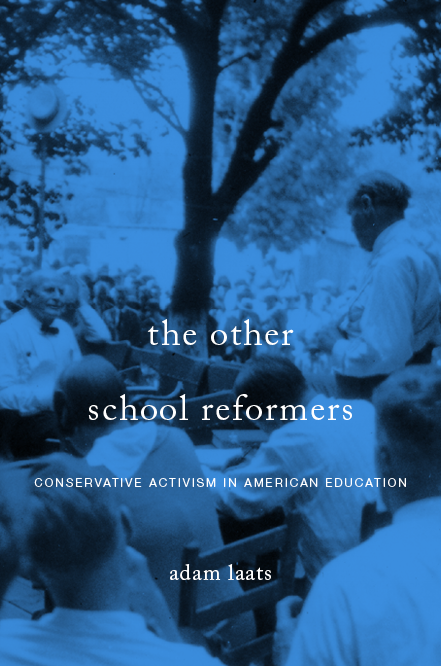
As I’ve argued in an essay in Teachers College Record (subscription required, but summary available), this historical argument about public education has been a mainstay of conservative thinking for at least fifty years.  Different conservative intellectuals have come up with different timelines and key events to explain the demise of high-quality, morally trustworthy public education.

Mohler echoes this intellectual tradition.

He argues that public schools began as locally controlled entities.  Beginning roughly a century ago, however, “progressive” reformers attempted an ideological coup.  Such folks, led by John Dewey, openly proclaimed their intention to turn schools into secular indoctrination camps.

Luckily, Mohler believes, such plans did not accomplish much until the second half of the twentieth century.  At that point, however, most schools were “radically transformed,” separated “from their communities and families.”

The results, Mohler warns, have been sobering:

Those who set educational policy are now overwhelmingly committed to a radically naturalistic and evolutionistic worldview that sees the schools as engines of social revolution. The classrooms are being transformed rapidly into laboratories for ideological experimentation and indoctrination. The great engines for Americanization are now forces for the radicalization of everything from human sexuality to postmodern understandings of truth and the meaning of texts. Compulsory sex education, the creation of “comprehensive health clinics,” revisionist understandings of American history, Darwinian understandings of science and humanity, and a host of other ideological developments now shape the norm in the public school experience. If these developments have not come to your local school, they almost surely will soon.

Is Mohler’s diagnosis correct?  Does his historical analysis match the record?

In this historians’ opinion, Mohler is guilty of cherry-picking and over-emphasizing.  It is demonstrably true that in the early twentieth century an array of school activists and intellectuals, clustered together under the amoebic heading of educational “progressivism” did try to implement wholesale changes in the nature of American public education.  It is also true that the US Supreme Court made decisions in the 1960s that could have revolutionary implications for the religious nature of public education.  Even more, it is true that leading organizations such as the National Education Association call for school policies that might dismay stalwart conservative Protestants. 

But contrary to Dr. Mohler’s conclusions, such historical facts do not add up to a public school system that “entered a Brave New World from which no retreat now seems possible.”

Historians have examined each of these important trends in American public education.  Arthur Zilversmit, for example, looked at the implementation of “progressive” education policies in the middle of the twentieth century.  In spite of earnest, well-funded efforts to revolutionize schooling, Zilversmit found, schools remained largely the same.  Why?  Zilversmit, sympathetic to the “progressive” project, blamed Americans’ “strange, emotional attachment to traditional schooling patterns.” 

How about the claim that the Supreme Court kicked God out of the public schools?  It is true that in 1962 and 1963 SCOTUS banned school-led mandatory Bible reading and prayer.  But as political scientists Kenneth Dolbeare and Phillip Hammond found to their surprise, most communities that prayed before the SCOTUS rulings continued to pray in public schools after them.  

Similarly, political scientists Michael Berkman and Eric Plutzer have argued that local school districts continue to function as local bureaucracies.  These “Ten Thousand Democracies,” according to Berkman and Plutzer, remain responsive to local demands and local values.     

This is bad news for President Mohler’s alarmist argument, but very good news for religious conservatives in the United States.  Most of America’s public schools remain closely connected to majority impulses in their local community.  Concerning hot-button culture-war issues such as prayer, evolution, and sex ed—not to mention broader notions such as school discipline, drug use, promiscuity, and general manners—local communities still control their local public schools. 

This local influence helps explain some stubborn trends that have long frustrated progressives like me.  Why, we ask, is evolution taught only spottily?  Why can’t public-school children learn honest, practical information about sex?  Why are public schools still home to coercive prayer practices?

These are all tough questions. 

But Dr. Mohler’s jeremiad raises even tougher ones:  If American public schools are so very conservative, why do conservative intellectuals deny it so forcefully?  Why don’t America’s conservative intellectuals trumpet the continuing traditionalism of American public education?


The Age of Pedophilia

Are we all Jerry Sanduskys?

That’s the accusation made recently by Anthony Esolen.

Pedophilia, Esolen charges, is not limited to the horrifying cases of the Sanduskys of the world.  Rather, we engage in pedophilia whenever we subordinate the welfare of children to the sexual gratification of adults.

In this logic, divorce is nothing but a socially acceptable form of pedophilia.  Having children outside of wedlock is pedophilia.  Worst of all are the “creeps” at Planned Parenthood (Esolen calls them “Planned Predators”) who teach young children a debased vision of sex.  These “pedophiles of the soul,” Esolen accuses, cruelly introduce

children to the delights of meaningless sex, with cartoons of talking penises and vaginas, of a girl bending over with a mirror to inspect her anus, or a boy in his bedroom abusing himself.

What is that, Esolen asks, if not pedophilia of the worst sort?  Indeed, such “credentialed spiritual pederasts” use the same strategy as old-fashioned child rapists.  They work to separate children from the influence of their parents.  In their sexually aggressive ideology, Esolen writes,

Parents are the enemy. The parents are kept in the dark. The parents are too benighted to know what is best. The parents—even such sporadically responsible parents as our generation has produced—wouldn’t know about how happy it is to be sexually free.

As Esolen must have intended, such accusations are profoundly disturbing.  There is nothing more heinous than real child molesters.  It seems to me to breach the bounds of public civility to accuse the sex-educators at Planned Parenthood of acting like nothing more than “the old man down the street, wheezing and giggling, who likes to show little kids pictures of people masturbating[.]”

But if Esolen’s extreme anger represents the feelings of a broad body of the American public, it certainly helps us understand why sex education has had such a troubled career in America’s public schools.  Indeed, as historians such as Jeffrey Moran have argued, sex ed has often been received with the violence and outrage that Esolen’s essay predicts.

Such outrage makes more sense if we understand the way Esolen hopes to redefine pedophilia.


Who’s the Victim Here?

Is Craig James a bigot?  Or a victim of religious persecution?  Or both?

Can we liberals allow discrimination against bigots?  Or must we fight against discrimination in all its forms?

James has been in the news lately.  He was fired from his job as a Fox News sportscaster.  The reason?  In his run for the US Senate in 2012, James insisted that he would not support same-sex marriage.  Such marriages, James explained, were against his religion.

The Family Research Council, an organization of conservative religious activists, called the firing an example of religious persecution.  “What Fox Sports did,” the FRC warned,

is much worse than censorship. What Fox Sports is doing is demanding conformity on issues that aren’t even relevant to James’s job — then threatening his livelihood when he refuses. That’s not your garden variety viewpoint discrimination; it’s ideological terrorism. And it has to stop.

From the other side of the issue, the Texas Freedom Network defended the firing.  Intelligent people of goodwill can disagree, the TFN argued, if this is a case of religious discrimination.  But whatever we call it, the TFN blogged, it tells us something about the changing cultural climate.  “it’s worth considering,” the TFN pointed out,

that Fox Sports didn’t fire James because of his religious beliefs. They fired him because they thought his intolerant public statements about gay people would hurt their company.

I generally agree with the folks at the TFN.  However, this seems to me to be a very sketchy argument.  Would we defend a restaurant owner who refused service to ethnic minorities because he or she worried having them in the restaurant would hurt business?


Bullies, Schools, Homosexuality, and the Confederate Flag

Who is a school bully?  Can it be a teacher who disciplines students for wearing Confederate flags or for denouncing homosexuality?

That is the question conservative commentator Anthony Esolen asks today on The Public Discourse.

Esolen, Professor of English at Providence College, considers a recent case from Michigan.

In this compellingly tangled case of homosexuality, history, religion, and education, a teacher hoped to fight anti-homosexual attitudes among his students.  This teacher participated in a school event in which teachers and students wore t-shirts opposing anti-gay bullying.  The teacher showed his class a video about anti-gay bullying, then engaged in a discussion about it.  During the discussion, the teacher noticed that one student wore a Confederate-flag belt buckle.  The teacher ordered the student to remove the buckle.  When another student asked about the obvious contradiction between the student’s right to wear the buckle and the teacher’s right to wear the t-shirt, the discussion exploded.  The teacher eventually disciplined both students, one for the buckle, and one for insisting that his Catholic faith forced him to disapprove of homosexuality.

Esolen brings up these snarled issues in all their complexity.  Does a Catholic student have a right to disapprove of homosexuality?  Does a teacher have a duty to discipline dissenting students?  Can a student wear offensive belt buckles or t-shirts?  What ideas are too offensive to be protected in schools?

Also, importantly, Esolen considers whether an economics teacher should be engaged in these sorts of pedagogical discussions.  If teachers are, as Esolen argues, “a group of tutors hired by a group of parents,” shouldn’t those teachers respect parents’ beliefs more rigorously?

Religion? Or Discrimination?

What if I think my religion condemns homosexuality?

The US Constitution says the government must not interfere with my right freely to practice my religion.  Does that mean I have a right to discriminate against homosexuals?

Thanks to liberal watchdog Texas Freedom Network, we see a case from San Antonio that forces us to confront this dilemma.

According to the San Antonio Business Journal, the Texas-based Liberty Institute has complained about a proposed city ordinance in San Antonio.  The proposed ordinance would extend the city council’s non-discrimination rule to include sexual orientation and gender identity.

Conservative Christians have complained that this expanded rule would effectively prohibit them from the free practice of their religion.

Such issues often wend their way through education debates.  For instance, religious conservatives in America have warned against the “homosexual agenda” in public education.  In this CitizenLink video, for example, conservative Christian commentators explain the “sneaky” nature of pro-homosexual ideology in America’s schools.  Conservatives have repeatedly scoured their school libraries and classrooms for books that cram a “gay is okay” message down the throats of unsuspecting schoolkids.

Thinking conservatives have complained that sexual orientation and gender identity are not simply the newest civil-rights issue.  In cities with an anti-discrimination rule, would conservative opposition to homosexuality become illegal?  Would conservative Christians find themselves forced to choose between the free practice of their religion and their observation of the law?

The San Antonio City Council has found itself in the thick of this dilemma.  By proposing a ban on anti-gay discrimination, are they unintentionally proposing a ban on many conservative Christians?  Are they trampling conservative constitutional rights in an effort to protect the rights of homosexuals?


“I Hope You Rot in Hell:” Greetings from a Liberal Fundamentalist

Are there “fundamentalists” of every political and cultural persuasion?  That is, do some people cling to such extreme and unbending worldviews—from the political and cultural left as well as the right—that they lash out at any dissent?  People—religious or not—who cannot tolerate any deviation from the Truth As They Know It?

It seems we have an example of such a thing from the cornfields of Iowa today.

The Sioux City Journal reported recently on a simmering conflict between an evangelical pastor and a gay politician.

Pastor Cary Gordon of Cornerstone World Outreach complained that Human Rights Commissioner Scott Raasch had made hateful and threatening comments a few years back.  At issue, apparently, was The Reverend Gordon’s opposition to Iowa Supreme Court judges who had supported gay marriage.

A few years ago, according to the Sioux City Journal, their disagreement degraded into the following Facebook exchange:

In one comment, Raasch wrote: “You are haters and bigots and you will get what’s coming to you sooner or later. I hope you rot in hell.”

Gordon replied, “I hope you repent of your sins and accept Jesus as your Lord and Savior. I wouldn’t want you or anyone else to go to hell.”

Raasch wrote, “I know Christ and don’t need a snake oil salesman like you to tell me about him. I guess that’s the difference between us because I think there are many people that deserve to burn in hell … including you and your entire family.”

Ouch.

The Reverend Gordon called for Raasch’s removal from the Human Rights Commission.  Someone with such extreme views, Gordon argued, should not be in charge of making rulings on discrimination cases that involve religious issues, as well as issues of race, creed, gender, and sexual orientation.

Raasch has admitted that he made the comments, and apologized for any stress caused.

Is this an example of what we might call “liberal fundamentalism?”  A case where someone feels so morally assured of his own righteousness that he lashes out at dissenters in such an angry way?


Sex Ed: Letting Molesters Have Their Way with Our Kids

Sex ed means giving over our children to theories oozed out of the warped minds of pedophiles and child molesters.

That’s the accusation made recently in the pages of Public Discourse by Miriam Grossman.

It’s no secret that conservatives have long opposed sex ed.  As historians such as Jeffrey Moran and Natalia Mehlman Petrzela have explored, sex and children have always been a touchy combination for Americans.

It’s not surprising.  Sex is a touchy subject for anyone.  Talking about sex with young people has always been fraught with awkwardness, at best.  Even more so when the decisions about what to say and how to say it have become political footballs in educational culture wars.

Grossman’s essay pulls no punches.  She identifies the roots of sex ed in the perverted sexuality of early leaders of the movement.

She calls Alfred Kinsey, for instance, “afflicted at his core. . . . a depraved human being.”

John Money, according to Grossman, formed part of the “incest lobby.”  His career followed a path dictated by the fact that he was “troubled, and he molested young boys.”

What can we expect, Grossman argues, from a field pioneered by such sexual deviants and predatory perverts?  It is no surprise, she says, that sex ed has become a moral horror show.

Talk of using sex ed, or “health” education, to fight disease and reduce teen pregnancy, Grossman believes, is a red herring.  In fact, she insists,

Sex ed is not about preventing disease, it’s about sexual freedom, or better—sexual license. It’s about changing society, one child at a time.

For those of us hoping to understand conservative attitudes about sex education, Grossman’s essay is worth reading in its entirety.  Certainly, she does not speak for all conservatives on this issue, nor does she claim to.  But her vision of the roots of sex ed offers conservatives an understanding of sex ed as a sinister and malicious entity, one that must be opposed root and branch.

After all, if conservatives understand sex ed as a ploy to lure young people into the embrace of leering sexual predators, they will be are understandably reluctant to compromise on the issue.


Being Gay at a Catholic College

Is gay okay the Catholic way?

Religion writer Michael O’Loughlin recently surveyed the experiences of gay students at a variety of Catholic colleges.  The answer, maybe not surprisingly, is that different schools do things differently.

At Chicago’s DePaul University, O’Loughlin found, students can minor in LGBTQ Studies. Students and faculty are out and supportive.

Other schools, such as Washington DC’s Catholic University, have a more mixed record.  Students are gay, O’Loughlin reported, and that’s only sort of okay.

One constant, at Catholic universities as across American culture, is rapid change.

O’Loughlin returned after just a handful of years to his alma mater, St. Anselm College in Manchester, New Hampshire.  When he attended, gay students kept their sexual identity private. Now, the school itself has initiated programs to make all students, explicitly including homosexual students, feel welcomed, loved, and guided.

As some of the comments on O’Loughlin’s essay proved, not all Catholics are okay with this trend.  As “JP” noted,

Can one imagine a group of Catholic adulterers or thieves organizing at a Catholic college in order for their “voice to be heard”? Homosexual acts as well as larceny or adultery are still considered Mortal Sins by the RCC.

Catholic schools are not alone in their struggles with this issue.  As we noted a while back, Brandon Ambrosino shared his experiences with faith and sexuality at the conservative evangelical flagship school, Liberty University.  Just as Catholic colleges have had a range of responses to the issues of student homosexuality, so folks at conservative Protestant schools  have had surprisingly mixed reactions as well.


CSCOPE and the Dustbin of History

CSCOPE is dead.

Anyone who hopes to understand the sort of conservative crusade that killed CSCOPE should draw two lessons from the news.

First: Historians should be invited to more dinner parties.

Second: The question is not why CSCOPE was suddenly targeted, but rather why so many Americans are so deeply suspicious of educational experts.

But before we talk about such things, an update: As reported by the Houston Chronicle and Texas Freedom Network Insider, leading Texas politicians announced a few weeks back that the suddenly controversial curriculum management system would no longer be offering lesson plans for Texas school districts.

CSCOPE had come under attack from conservatives in Texas and around the country as promoting a witches’ brew of “progressive,” “Marxist,” “pro-Islam” ideas for Texas schools.  Liberals such as those at the Texas Freedom Network complained in exasperated tones about an irrational “witch hunt” against lessons that had been used without controversy for years.

What does any of this have to do with the loneliness of historians?  The book I’m now finishing looks at the 20th-century history of this sort of school controversy.  Again and again, conservatives discover that the teaching in their schools has been infiltrated by nefarious ideas such as evolution, socialism, progressivism, or filthy sex and violence.  In each case, once a set of textbooks or curricular program gained attention as an example of such ideas, it was quickly tossed out by conservative activists.

I hate to quote myself, but in this case an historian’s perspective makes this outcome seem predictable. As I noted a few weeks back, “CSCOPE might offer an ideologically balanced, pedagogically efficient way for Texas school districts to streamline their teaching systems.  But once it has acquired the reputation for leftist indoctrination, the writing is on the wall.”

This is why historians should be invited to more parties.  Especially if there is food.  Not because historians can predict the future.  Every case is different. But an historical perspective eliminates much of the surprise of unfolding events.  For those who know the 20th-century history of conservative activism in America’s schools, the anti-CSCOPE crusade seems remarkably predictable.

Another important lesson should be drawn from the premature death of CSCOPE.  The career of CSCOPE illustrates the profound cultural divide at the heart of America’s continuing educational culture wars.   Personally, I sympathize with the liberal critics of the Texas Freedom Network, who noted that many of the attacks against CSCOPE seemed “bizarre” or “paranoid.”  As a parent and citizen, I worry about the exaggerated attacks made on this curricular program.

Such attacks, however, must be understood as an irruption of a profound suspicion among Americans about what any outside interference in public school curricula.  Like other commentators, I am deeply skeptical about claims that CSCOPE was a vast conspiracy to subvert patriotic Christian values in Texas public schools.  But the important question is not why this particular program was targeted for attack after years of controversy-free use in schools. The question, rather, is why so many Texans jumped so quickly to join the anti-CSCOPE bandwagon.

This has been the case with every curriculum controversy in the past.  As historians Charles Dorn[1] and Jonathan Zimmerman[2] pointed out about the Rugg textbook controversy in the 1940s, though the Rugg textbooks were banished, similar books continued to be used widely.

In the Kanawha County blow-up of the 1970s, the same sentiment surfaced.  What had seemed like a humdrum approval process for a new set of reading textbooks became a violent struggle over the content of the curriculum.  In that case as in this, many observers scratched their heads and wondered why these particular books had suddenly become such lightning rods.

The depressing truth is that most Americans are deeply skeptical about the intentions of the people who write the books and lesson plans for our public schools.  With curricular materials such as CSCOPE, the Rugg textbooks, or the Interaction series adopted in Kanawha County, as soon as materials were accused of subversion, many Americans believed it.  As conservative leader Elmer Fike explained about the Kanawha County books, “You don’t have to read the textbooks.  If you’ve read anything that the radicals have been putting out in the last few years, that was what was in the textbooks.”[3]

The sudden outrage against CSCOPE shows us this same dynamic at work.  In Texas as in the rest of our nation, a politically powerful plurality are willing to believe outlandish accusations against relatively bland curricular materials.  Though the books and lessons themselves may be moderate in tone, a significant number of parents and politicians are quick to believe they have set out to destroy America.

Why did CSCOPE meet such a sudden and violent premature death?  Because for generations, a significant proportion of Americans have looked with grave suspicion at the intentions of “experts” who write such classroom materials.  Parents are not surprised to hear that textbooks contain hateful language and shocking subversion.  Such accusations confirm what too many parents already believe.

We will not understand the CSCOPE story, nor the similar stories sure to come in future years, unless we grapple with the fact that many parents maintain an awkward ambivalence toward public education.  Many parents may approve of their local schools, but they feel a need to defend those schools from the control of grasping autocrats at far-flung universities and think-tanks.  At the bitter heart of the CSCOPE saga lodges the uncomfortable truth that Americans do not trust educational experts.


[1] Charles Dorn, “‘Treason in the Textbooks:’ Reinterpreting the Harold Rugg Textbook Controversy in the Context of Wartime Schooling,” Paedagogica Historica 44:4 (August 2008): 477.

[2] Jonathan Zimmerman, Whose America? Culture Wars in the Public Schools (Cambridge: Harvard University Press, 2002), 79.

[3] Quoted in James Moffett, Storm in the Mountains: A Case Study of Censorship, Conflict, and Consciousness (Carbondale, IL: Southern Illinois University Press, 1988), 70.

A Christian Teen Army in Public Schools

“High school Christian teens, Join Us!”

That is the call of a new video promoted by the evangelical Christian group Reach America.

In the video, teenagers ask a series of provocative questions, such as the following:

Why can’t I pray in school?  Why do I have to check my religion at the door?  Why can’t I write about God in my school papers?  Why do I have to tolerate people cursing my God, but I’m not allowed to talk about God and my faith? Why are they taking God out of my history books? Why do they teach every other theory in science besides creation?  Why am I called names because I believe in marriage the way God designed it?

Like many conservative evangelical educational activists, Gary Brown, founder of Reach America, believes that public schools have lost their way.  Beginning with the prayer and Bible SCOTUS decisions in 1962 and 1963, Brown insists, God has been systematically frozen out of schools.  Christian students have been targeted for bullying, indoctrination, and harassment.  Every part of public education is a threat, from pornographic sex education to mandatory dating.

Brown’s answer has been a call for youth engagement.  In the recent video, Reach America teens warn, “People who do not love our God have stolen our country. . . . We are an army.  Christ is our commander. . . . We are in a war for the hearts and souls of our generation.  And we know it.”

This culture-war army can be directed, Reach America promises, by programs such as its new Educational Partnership.  From its headquarters in northern Idaho, Reach America wants to organize a non-school school.  At this “partnership,” students will come to this non-school school every day, September through June.  In the mornings, they will work on academic work.  That work, though, will not come from the non-school, but rather from parent-directed online education or homeschool assignments.  In the afternoons, students will work on the “four Cs:” Christ-Centered Counter-Culture.

So how is this school not a school?  Parents pay tuition.  Students study there.  The program even offers “P.E. and electives.”  Do the Browns avoid calling this a school to avoid legal hassles?  It certainly looks that way.

How big is the program?  Not too big.  According to Brown, twenty-three students are enrolled for the current non-school year.  My guess is that Reach America will attract the attention of scribblers like me with the culture-war rhetoric of this video, but will soon encounter the difficulties that plague every Christian school, even non-school ones.

In any case, the message of the teens’ video is clear.  The way to prevent bullying is to fight back.  As they declare, “America will be one nation under God, again.”