The GOP and the God of Hate

Maybe I was wrong all along. My inbox has been filling up with links to a startling article in yesterday’s New York Times. Is the GOP really under the thrall of violently anti-gay extremists?

https://vimeo.com/129707480

I’ve argued in the past that my fellow secular progressives need to relax. The chance, I’ve said, of a fractious bunch of fundamentalists uniting to do anything more complicated than hosting an end-times bake sale were slim to none. Pre-tribulationists can’t get along with post-tribulationists. Lutherans can’t stand Seventh-day Adventists. Catholics look nervously at all of them.

More important, each side in our continuing culture-war debates tends to exaggerate the clear and present danger presented by the other side. Leftists point to abortion-clinic bombers. Conservatives warn of government jackbooted thugs. In general, I think we all need to remember that these boogiemen are distortions, fantastic bugbears trotted out to demonize the opposition.

But the news from Des Moines has me scratching my head. Kevin Swanson, an Orthodox Presbyterian pastor, hosted leading GOP hopefuls Ted Cruz, Bobby Jindal, and Mike Huckabee at a National Religious Liberties Conference. Swanson has become infamous lately for his repeated calls for homosexuals to be put to death.

Put to death!

According to the New York Times, Governor Huckabee claimed not to know of Swanson’s scary positions. Ted Cruz seemed unruffled. After all, his own father was a featured speaker of the conference.

Is this a simple case of primary extremism? In every election, the far fringes of each party wield outsize influence. We might say that such extremism will expend itself before the primary campaign gets rolling.

Similar claims, after all, have been made of President Obama’s connections with atheist terrorist Bill Ayers. Ayers was a real terrorist. His radical group really did try to bomb people. But he has long since—kinda sorta—denounced violence as a political tactic.

I’m flummoxed. I find it hard to believe that any serious presidential contender would consent to be associated with such a violent extremist.

Shocking Kids to Justice

Is it a good idea? For decades now, progressive teachers have sought to shock children into recognizing their traditional prejudices. Recently, a Kansas teacher ignited some controversy by showing a provocative video. His goal was to shock kids out of their anti-gay mindsets. They are not easy questions: Should teachers intentionally shock and provoke their students in order to make them better people?  It’s easy to see such teachers as heroes when we agree with their goals, but what about when we disagree?

But first, the latest: according to ThinkProgress, Tom Leahy is fighting for his job. Leahy, a high-school teacher from Conway Springs, Kansas, was disturbed by the anti-gay murmurings he noticed among his students. To help show his kids the light, Leahy showed them a short film, “Love Is All You Need.”

The film depicts a world in which heterosexual kids are bullied for their sexuality. One heterosexual girl ends up killing herself.

Outraged parents demanded Leahy’s ouster and the school district complied. At first, Leahy agreed to go, but after an outpouring of support he’s back in his classroom.

I think I would like Tom Leahy. He sounds like an engaged and caring teacher. I, too, was saddened and concerned in my high-school classroom by the nonchalance with which some kids made anti-gay statements. Like Leahy, I hastened to intervene to let kids know that such hateful attitudes, such targeted hostility was not okay.

But is it a good idea to shock kids into enlightenment?

The tactic has a long history. SAGLRROILYBYGTH have probably heard the story of Jane Elliott. In 1968, the story goes, when Martin Luther King Jr. was assassinated, Elliott began an anti-racism activity with her third-graders in Iowa.

Kids with blue eyes were given extra benefits. Kids with brown eyes had to wear fabric collars. Hostility quickly erupted between the two made-up groups of kids. Elliott didn’t let the two groups play together or drink from the same water fountains. She explained that collar-free kids tended to be smarter and better behaved. The next day, she reversed the set-up. Now blue-eyed kids wore the collars and suffered the consequences.

The point was to let white kids experience discrimination, to let them “[walk] in a colored child’s moccasins for a day.”

Are such shock tactics a good idea?

Sometimes, social justice is going to seem shocking. When the US Supreme Court ruled in 1954 that schools could no longer be segregated by race, nothing much changed, because no one in power was willing to ram such shocking change through the system.

Nevertheless, I think we need to remember to give such tactics the smell test. Even after forty-five years, Jane Elliott’s tactics seem harsh and unnecessarily cruel. Her taunting of her third-graders just doesn’t seem right, no matter how noble the goal.

Does Tom Leahy’s activism rise to the same level? It doesn’t seem that way to this reporter. As a former high-school teacher, I found the video he showed to be provocative, but not intentionally cruel to viewers. As far as I know, Leahy did not insult his students or belittle them in public to make his point. He merely showed a thought-provoking video.

What would I say, though, if a teacher pushed kids in directions with which I didn’t agree?  What if a teacher in a public school wanted to lead her kids in prayer?  Or what if a teacher showed a gruesome and intentionally provocative anti-abortion film?

I’m not confident that I would find such teacher activism brave and morally heroic.

Should we shock our students? Every day.

But we need to be very careful about our self-righteousness.  We must remember that our students are in class to be loved, not to be “fixed.”  This has to be true even in cases in which we agree with the moral activism of our teachers.

So how do we know when teachers are engaging in proper thought-provocation, and when they are being moral bullies?

We need to let students know that we are on their side, that we care about them as people even if we want to upset them a little with mind-blowing ideas.

Demonstrating our moral superiority by belittling kids can never be the proper path to a more just society.

Are the Culture Wars History?

I don’t get out much. So when I was invited to participate in a panel at the annual meeting of the History of Education Society, I jumped at the chance. Especially when it gave me the chance to rub shoulders with some nerd all-stars.

Meet me in Saint Looey...

Meet me in Saint Looey…

Our panel will include four authors of books familiar to SAGLRROILYBYGTH. First, Jon Zimmerman will tell us something about global sex ed from his new book, Too Hot to Handle.zimmerman too hot to handle

Then, Natalia Mehlman Petrzela will keep the sex-ed ball rolling while adding in some bilingual ed as she talks about her book, Classroom Wars.petrzela classroom wars

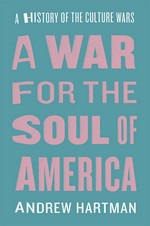
Next, Andrew Hartman will share some insights about education and culture wars from his blockbuster War for the Soul of America.Hartman

Last, I’ll talk a little bit about what it has meant to be “conservative” when it comes to education, from my new book.

What will we talk about? Hard to say until we get there, but the theme that ties these books together is that of educational culture wars. What have Americans (and people worldwide) seen fit to teach their kids about touchy subjects such as sex and God? Who has been allowed to make decisions about school?

One disagreement we might have could be about the winners and losers. If there are such things as educational culture wars, we all have different conclusions about who has won. Jon Zimmerman argues that kids overall—especially in the United States—get very little sex ed, due to consistent activism against it. I think, too, that conservatives have been able to exert veto power over many big educational programs. Both Andrew and Natalia, though, say that by and large progressive ideas have come out the winner in these battles.

What do you think:

  • Are there such things as educational culture wars?
  • If so, are they all in the past?
  • And, maybe most interesting to most people…who won?

Fundamentalist Colleges Save Lives

Maybe they were right. One of the hallmarks of conservative evangelical colleges has always been a clampdown on student behavior. The goal was to protect student morals, but a side benefit seems to have been protecting student health. A new study finds…surprise, surprise…that smoking pot and binge drinking lead to more risky sex among undergrads.

A hundred years ago, conservative evangelical Protestants reeled from the horror stories oozing out of America’s elite colleges. Fundamentalist preachers warned their flocks that colleges in the 1910s no longer protected students’ faith or morals. As a result, fundamentalists founded their own network of rigidly conservative schools. In addition to fundamentalist theology, all of these colleges adopted draconian rules for students: No smoking, no dancing, no drinking…and certainly no unmarried sex.

The view from 1931, Bob  Jones-style.

The view from 1931, Bob Jones-style.

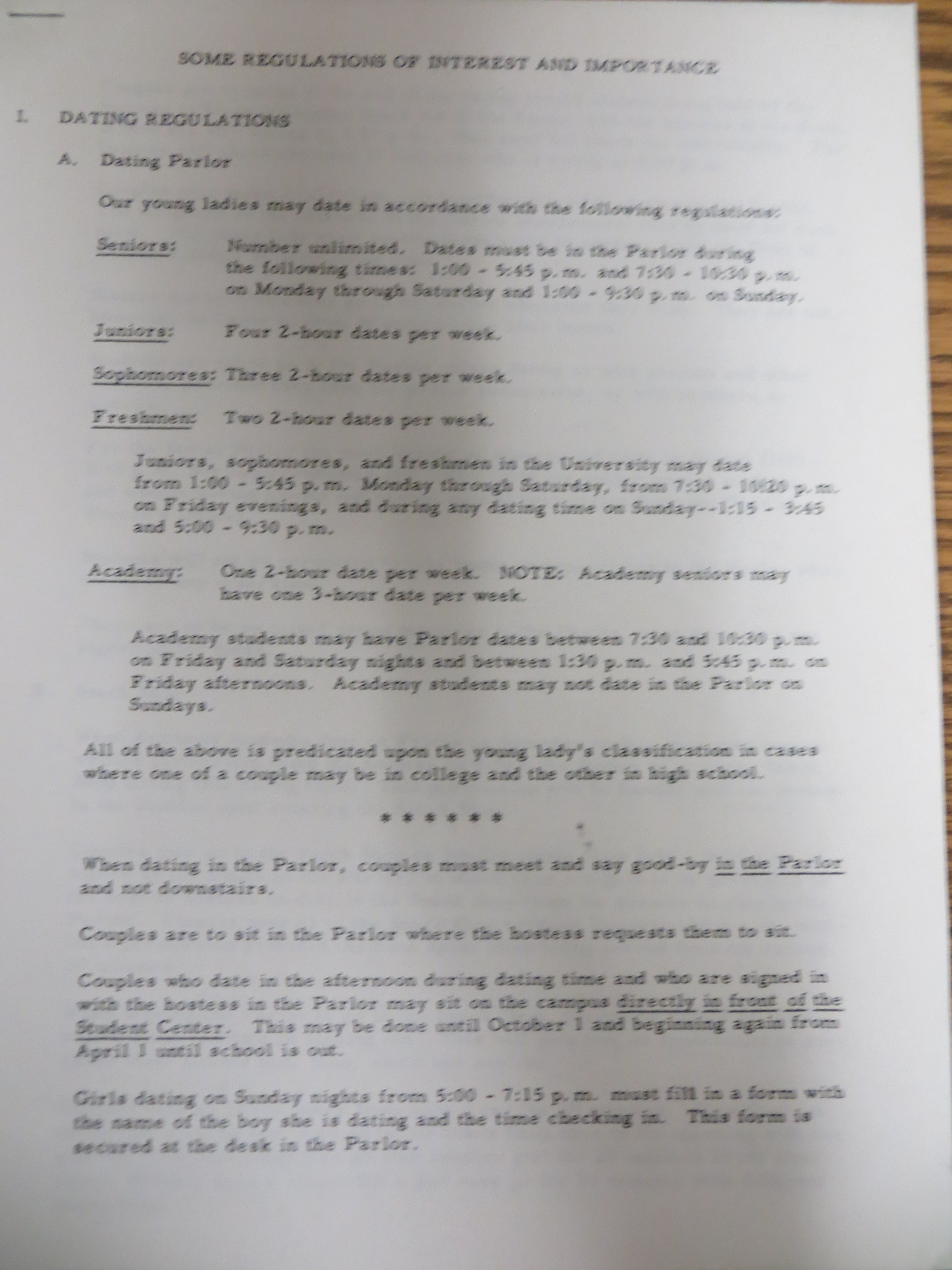
As I work on my new book about the history of these schools, I’m struggling to make sense of these ubiquitous student rules. It’s easy enough to find the paper trail in the archives. At Bob Jones College, for example, founder Bob Jones Sr. placed the burden of avoiding sex on women.

Jones explained his thinking in an open letter from the 1920s:

The Bob Jones College discourages extravagance in dress AND INSISTS UPON MODESTY.

We request our girls to wear simple dresses in classes. We have a laundry where these dresses can be laundered.

The girls in the Bob Jones College voted to wear their dresses two inches below the knee cap. This is short enough for style and long enough for decency.

The girls in the Bob Jones College last year had the reputation of being the most attractive group of girls in the country, and as a whole, they dressed very simply.

There is one regulation which we wish our girls to thoroughly understand. WE DO NOT ALLOW OUR GIRLS TO WEAR EACH OTHERS CLOTHES. The only exception is in the case of sisters.

Bob Jones College was not alone in the effort to control sex by controlling women. One student who attended Wheaton College in the 1920s remembered a similarly strict regime of sexual policing. “Well,” this former student remembered in a 1984 interview,

The control was rather tight. Of course, that was in those days when . . . when the separation of the sexes was very strict, and the . . . the regulations were . . . dress regulations and so forth were quite strict.

Did students find ways to get around these rules? Of course. It’s harder to find, but as I delve into the archives of these colleges I find examples of students being punished for drinking, smoking, attending movies, and, of course, hooking up. One student at Bob Jones College was caught climbing out of his girlfriend’s dorm window at midnight. He said they had been praying together. A student at Wheaton remembered his roommate speaking to his girlfriend through a system of prison wall-taps.

All in all, though, the draconian system of student rules meant a different campus experience than at non-fundamentalist colleges. Over the years, the rules have loosened up, but they remain more restrictive than at other schools.

What has been the result? On the one hand, the system of sexual policing seems to pushed sex on campus into dangerous and degrading directions. Bob Jones University, for example, admitted its terrible and terrifying record of ignoring and even tacitly encouraging sexual abuse and victimization.

But we can’t help but think that stricter rules against drugs and alcohol must do something to protect students, as well. Don’t get me wrong: I’m no apologist for evangelical universities. I’m not evangelical myself; I don’t work at an evangelical college; I don’t dream of a school in which students don’t use drugs or have sex.

However, there seems to be demonstrable evidence that drinking and using drugs leads to risky behaviors. The researchers at Oregon State found direct connections between smoking pot, binge drinking, and unhealthy sexual practices. Students who used more drugs on any given day were more likely to have sex without a condom, for example.

The stricter rules about drugs and sex at evangelical colleges were put in place to protect student morals, not their health. As I’ve argued before, if we want to understand conservative attitudes about sex, we need to shift out of the medical mindset. However, perhaps there has been a positive side-effect.

I would love to see a study like this in which researchers looked at student behavior at a variety of schools. Did school rules against booze and sex discourage risky behaviors? Or did the added illicitness simply push students to take more risks?

Required Reading: Classroom Wars

What should schools teach?  How should they teach it?  Who gets to decide?  These are the questions that keep SAGLRROILYBYGTH up at night, and now we have a great new book to shed light on the infinitely complicated ways they play out in real life.

Natalia Mehlman Petrzela’s new book, Classroom Wars: Language, Sex, and the Making of Modern Political Culture examines battles in California over bilingual ed and sex ed during the 1960s and 1970s.  As Petrzela explains,

This book focuses on bilingual (Spanish-language) and sex education in California in order to understand how grass-roots citizens came to define the schoolhouse and the family as politicized sites during the late 1960s and 1970s.

Full disclosure: Petrzela and I are friends and colleagues.  We’ve worked together for several years now, and we’ll be doing some presentations together in upcoming months at academic conferences about history, education, and culture wars.  Even if we weren’t friends, though, I would love this book.   petrzela classroom wars
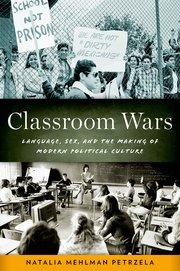
For one thing, Petrzela’s careful examination of California’s educational politics shows us the ways culture-war politics are not somehow “natural,” but rather develop over time due to specific historical circumstances and activism.

For example, as she describes, in the early 1960s bilingual ed had lots of support among conservatives.  Arch-conservative Max Rafferty pushed for it, and even as late as 1968, many California legislators touted bilingual ed as the “American thing to do.”  Soon, however, bilingual education was tied together with leftist radicalism.  Students in 1968 staged huge “blow-out” protests in LA, carrying “Viva la Revolucion!” signs and demanding that all Anglo teachers be fired.  As Petrzela puts it,

In the two years following the BEA’s [Bilingual Education Act] passage and the blowouts [student walkouts], bilingual-bicultural education evolved from a relatively uncontroversial issue that garnered significant bipartisan support to a lightning rod dividing and defining conservatives and liberals.

Among activists, too, we need to be careful before we assume too much.  In the education bureaucracy of California, for instance, Petrzela introduces us to the complicated positions of folks such as Eugene Gonzalez, associate superintendent and chief of the division of instruction.  Gonzalez was close with conservative leader Max Rafferty, and like Rafferty he spoke out against the methods used by radical student protesters.  But he also continued to push for better and fairer education for latino/as in California schools.  Other Mexican-American activists, such as Alfred Ramirez, refused to go along with the protesting students at all.  He pushed Gonzalez to crack down on the Latino protesters and to get rid of bilingual programs entirely.

Nor were California’s educational culture wars a simple, stereotypical battle between progressive teachers and students on one side against conservative activists on the other.  That may often be the case, but as Petrzela recounts, in 1970 conservative teachers in LA founded their own union, the Professional Educators of Los Angeles.  And, though one conservative teacher lamented her position as a “minority among educators,” Petrzela also reveals that students, too, were split.  In at least one case, a group of conservative students gathered to denounce the “leftist-liberal bias” of their teachers.

We also see in these pages a clearer-than-usual vision of what conservative activists wanted.  At root, Petrzela shows us, conservatives felt as if they had too often been frozen out of discussions of sex ed and bilingual ed.  They felt they had not been included, not been consulted.  Many times, conservative activists and parents worried that a blundering school administration was trying to insert itself between parents and children.

When this wasn’t the case, many conservatives did not protest against sex education.  In conservative San Diego County, for example, sex ed was not at all controversial.  Part of the reason was because the teachers had a strong reputation in the whole community as family women with “high moral standards.”  By the end of the 1970s, Petrzela tells us, policy-makers had figured it out.  By then, most sex ed curricula were no longer so ferociously controversial, largely because parents and conservative organizations had been consulted beforehand.

Petrzela also tackles one of the toughest questions of these educational culture wars: Who won?  She argues that over all, over time, progressives tended to score victories.  In about half the cases of controversy over sex ed, Petrzela found, California districts actually expanded their sex ed programs after the blow-ups.

In every case, Petrzela makes her case well that schools matter.  As she puts it,

In the 1960s and 1970s, militant Chicanos in East Los Angeles, suburban housewives in Anaheim, and political aspirants as varied as Max Rafferty and Julian Nava all pinned their hopes on the public schools as the primary institution for cultivating an ethical, informed, moral next generation.

For all of us who want to look beyond the headlines of America’s continuing educational culture wars, this book is a good place to start.


Socialists, Laggards, Perverts, and Baby-Killers

Why does everybody these days thank soldiers for their “service?” Even when the soldiers themselves don’t like it? At least in part, it must be a hangover from Vietnam-War-era culture-war battles, when soldiers were reviled as “baby-killers.” Here’s my question for SAGLRROILYBYGTH: When will teachers get thanked for their service? After all, for decades, teachers have been called names at least as bad as “baby-killers.”

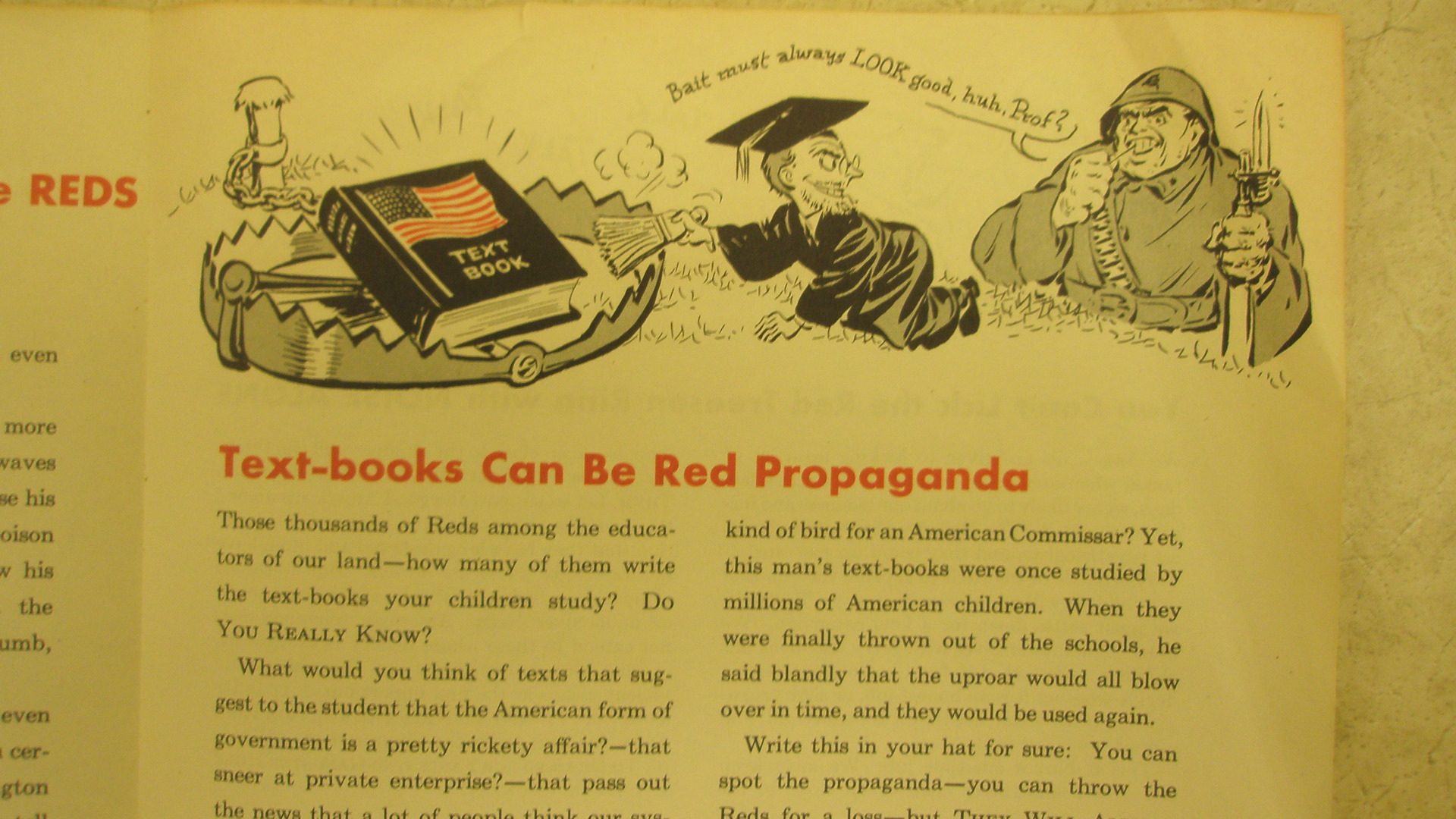
As I described in my recent book, conservative activists have always accused teachers of terrible crimes and treasons. Teachers fill kids’ heads with lies about evolution, atheism, and communism. Teachers subject innocent young kids to mistruths and calumnies about American history and sex. Such accusations were a standard part of culture-war scripts from the 1920s through the 1980s.

Warning!  Commie Teachers!

Warning! Commie Teachers!

In the 1980s, for instance, Mel and Norma Gabler warned that the ranks of the teaching profession were full of “practicing homosexuals” who hoped to attract young children to their ranks. Such teachers pushed for more sex ed because they suffered from a perverted desire to lure children down the path to sexual sin and depravity.

There’s nothing new about this sort of no-holds-barred accusation against America’s teaching force. Back in 1923, anti-evolution activist T.T. Martin warned audiences about the sinister nature of public-school faculties:

under the cowardly sissy plea of ‘Academic freedom,’ [teachers] demand that we, with our taxes, pay their salaries, while they poison our children against the Bible as God’s real Word, and the Saviour as God’s Son who died for our sins to redeem us from all iniquity and send our children out into Eternity without real redemption; hence, to hell.

This week, I’m reading Natalia Mehlman Petrzela’s terrific new book Classroom Wars: Language, Sex, and the Making of Modern Political Culture. Petrzela looks at the ways the fights over sex ed and bilingual ed played out in California between 1960 and 1990. Not surprisingly, she found that teachers were subjected to vicious, unrestrained attacks.

One parent, for instance, excoriated his local school’s teachers, saying they “fill schools with dope and filth and sex” and “teach [students] to make babies so they can kill them” (pg. 123).

Ouch.

As Petrzela relates, however, such extreme accusations were par for the course in culture-war battles over education in California.

So, dear readers, here’s my question for you: When will progressive types begin to thank teachers ostentatiously for their service? After all, it was backlash against the “baby-killer” accusations that led people to start thanking soldiers. Won’t there soon be a similar surge of support for beleaguered teachers? Or is there already and I’m just the last to notice?

We can see some glimmers of it. Progressive bloggers and scholars such as Diane Ravitch, Mercedes Schneider, and Peter Greene make a fetish of valorizing public-school teachers. Will it soon become an article of faith among progressives that teachers are America’s real heroes? Or has it already?

Sex In, Kids Out

Toronto’s Thorncliffe Park Elementary School started its year half empty. Why? Parents were concerned that students would gain knowledge, so they pulled their kids out in protest.

Will Toronto parents trust the public school?

Will Toronto parents trust the public school?

It sounds weird when we say it that way, but it is true. In this case, parents worried that a new sex-ed curriculum imposed by the provincial government would expose kids to too much information, too early. In some ways, the story is a repeat of a familiar culture-war pattern. In others, it shows how things are changing.

First, the facts: Last spring, the Ontario government released its new health curriculum. Outraged parents organized to protest against the content. As one protesting parent put it last spring,

I want my kids to come home from school and play with toys, not their body parts. . . . Why are we introducing these concepts to kids who aren’t even old enough to tie their shoelaces?

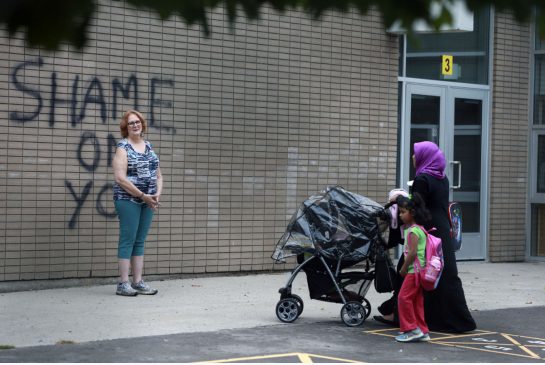
As schools opened this fall, parents continued their protest, nearly emptying one elementary school and holding protest school meetings in a park across the street. An unknown protester spray-painted “Shame On You” on the school building.

In some ways, this protest is playing out the familiar culture-war script we saw throughout the twentieth century. As I argued in my last book, time and again conservative parents insisted on their right to decide what their kids should be taught about sex.

We also see a familiar fight over the terms of the debate. What is actually in the curriculum? Protesters in Toronto have distributed fliers warning that kids are encouraged to have sex, encouraged to masturbate and to exhibit their full anatomy to friends and strangers. Not so, reply the writers of the curriculum. In earlier protests, such as the school boycott in Kanawha County, West Virginia, in 1974-75, protesters distributed similar fliers making similarly inflated claims about the content of controversial textbooks.

Another familiar sight is the undercurrent of traditional pedagogy. Yes, the protesting parents are teaching their children in a park, but they are also imposing a traditional style of teaching. One volunteer teacher, for instance, expressed surprise that the seven- and eight-year-olds in her group had never been taught basic sentence structuring. Not only did she teach her makeshift class without any reference to sex, but she also imposed a more traditional style of teaching grammar.

But Toronto’s school-sex boycott is also different in some ways. Instead of the whitebread “100% American” protests of the twentieth century, this protest largely emanates from the Muslim community. Parents are defending their right to have a say about the curriculum. They are also insisting that school lessons must not conflict with their religious values. In this case, though, those religious values are not the implicit Protestantism that we see so often here in the United States. Rather, in this neighborhood of Toronto, the traditional values being defended are those of Islam.

Keep em innocent...?

Keep em innocent…?

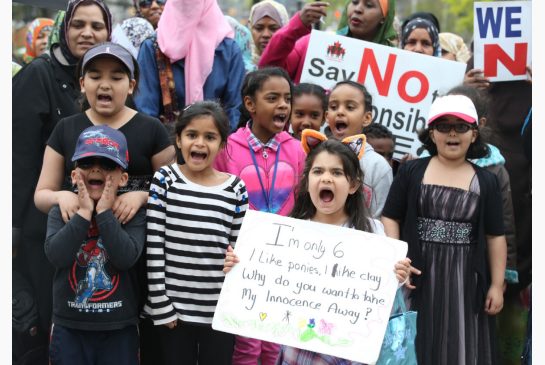
Perhaps most telling, this protest underlines one of the central truths of public schooling. Though it seems weird to say it, parents assume that schools must keep certain forms of knowledge away from their kids. In this case, parents do not say that the sex-ed curriculum is untrue. Rather, they only insist that it is too early for their kids to know such things, or that such knowledge conflicts with their religious values. As this widely circulated photo suggests, protesters want their kids to be kept “innocent” of some forms of knowledge.

What is school for? Not only to spread knowledge, but also to protect certain forms of ignorance.

Conservatives against Kim Davis

Which side are you on?

That’s the question that fuels most of our culture-war animosity. Instead, the question we should all be asking is this: What’s the right thing to do? In the case of same-sex refusenik Kim Davis, some conservative intellectuals and pundits are willing to break ranks and see the bigger picture.

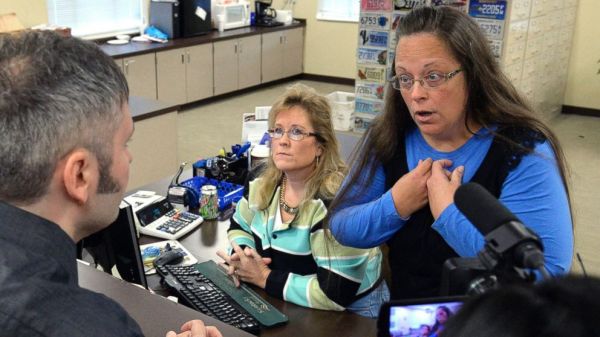
In case you’ve been milking the last warm days of summer and haven’t seen this story, Kim Davis is the Kentucky county clerk who has been jailed and released for her refusal to issue same-sex marriage certificates. Opportunistic conservative politicians such as Mike Huckabee have promoted Davis as a conservative Christian hero, stage-managing Davis’s release as an American triumph, equal parts Christianity Triumphant and Rocky III.

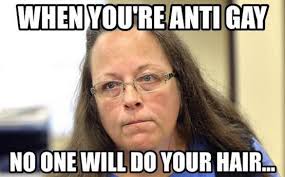
Governor Huckabee’s shameful pandering to frustrated Christian voters should be an embarrassment for every conservative out there. But progressives also could stay a little classier in this case. For those like me on the progressive side of things, the furor and venom over the Kim Davis case burst onto our Facebook feeds like a sweaty middle-school pimple. I don’t agree with Davis’s refusal to do her job, but I also think it is counter-productive and petty to attack Davis’s hairstyle.

Missing the point...

Missing the point…

We could all learn a lesson from a few conservatives who refuse to conform to their culture-war scripts. Fox News anchor Shep Smith, for example, earned the ire of conservative viewers for pointing out the obvious hypocrisy in the case. Critiquing the Huckabee rally, Smith commented,

They set this up as a religious play again. This is the same crowd that says, ‘We don’t want Sharia law, don’t let them tell us what to do, keep their religion out of our lives and out of our government.’

Predictably, conservative Fox News viewers reacted furiously, calling Smith a “puke” and accusing him of “anti-Christian bias.”

But Smith was not alone. Conservative intellectuals also took issue with Davis’s brand of publicity-hogging culture-warriorism. Writing in the pages of The American Conservative, crunchy conservative Rod Dreher warned that Davis had ignored the central point of civil disobedience. Dreher argues,

It’s clear that there are many Christians who support Kim Davis because she’s doing something, even if that something is arguably counterproductive. This is unwise. . . . If the public comes to think of religious liberty as the constitutionally guaranteed right to ignore the Constitution whenever it suits us, the cause of religious liberty — which is guaranteed by the First Amendment — is going to suffer tremendously. Conservatives are supposed to understand the difference between the vice of cowardice and the virtue of prudence. If religious liberty means that even officers of the state can defy the law without consequence, then it makes every individual a potential tyrant.

Writing from the conservative bastion of the Southern Baptist Convention, Russell Moore and Andrew T. Walker made a similar point. While Moore and Walker bemoaned the “judicial overstep” and “government inaction” that led to this situation, they did not excuse Davis’s reckless behavior. “We must recognize,” they note,

the crucial difference between the religious liberty claims of private citizens and government officials. Let us be clear: Government employees are entitled to religious liberty, but religious liberty is never an absolute claim, especially when it comes to discharging duties that the office in question requires. While government employees don’t lose their constitutional protection simply because they work for the government, an individual whose office requires them to uphold or execute the law is a separate matter than the private citizen whose conscience is infringed upon as a result of the law. It means the balancing test is different when it comes to government officials because of their roles as agents of the state. Government officials have a responsibility to carry out the law. When an official can no longer execute the laws in question due to an assault on conscience, and after all accommodating measures have been exhausted, he or she could work for change as a private citizen, engaging the democratic process in hopes of changing the questionable law.

We must be very clear about the distinctions here between persons acting as an agent of the state and persons being coerced by the state in their private lives. If the definition becomes so murky that we cannot differentiate between the freedom to exercise one’s religion and the responsibility of agents of the state to carry out the law, religious liberty itself will be imperiled.

For these brave conservative commentators, agreement with Davis’s opinion of same-sex marriage did not mean an automatic endorsement of Davis’s actions. All of us could learn from their example.

Those of us who consider ourselves progressives should commit to examine every case with the same gimlet eye. Just because we agree with someone’s position in general does not mean we must agree with their actions in every case.

Conservatives should be reminded to differentiate between today’s headlines and the big picture. Civil disobedience is a right and duty of us all, at times. But not every act of civil disobedience is equal, and civil disobedience has never meant simply flouting the laws we don’t like.

More important, we must all be willing to speak up against our own “side” when it is in the wrong. The first question should not be “Which side are you on?” but always “What is the right thing to do?”

The Kids Aren’t Alright…with Transgender

My Fellow Progressives: What if time isn’t on our side? We tend to think that each new generation will get cooler, more tolerant, more progressive. But what about those stubborn conservative kids who consistently disprove our assumptions? A new student protest in Missouri shows once again that young people are not somehow automatically progressive.

Who is the future here?

Who is the future here?

Academic historians learnt this lesson the hard way. Beginning in the 1930s, liberal academics assumed that the fundamentalists of the 1920s had melted away in the glare of modernity. In their liberal imaginations, historians such as Norman Furniss explained that fundamentalism had died away, a vestige of an older, stupider time.

For many liberal historians, the fact that they no longer saw fundamentalists on their campuses or in the headlines of their newspapers proved their case. It backed up their assumptions that the modern world would squeeze out people who embraced a decidedly old-fashioned way of reading the Bible.

Of course, fundamentalists hadn’t died away after the 1920s. Beginning in the later 1950s, evangelists such as Billy Graham brought the fundamentalist tradition back to America’s headlines and center stage. It took a new generation of historians, many of them raised in fundamentalist families, to explain what had happened. Writers such as Ernest Sandeen, George Marsden, and Joel Carpenter demonstrated the continuing strength and vitality of American fundamentalism.

Protestant fundamentalism, these historians showed, was a thoroughly modern phenomenon. In the face of progressive assumptions that people would naturally become more secular and more morally sophisticated, lots of Americans actually became more religious and more firmly moored in Biblical morality.

Progressives today share a similar short-sighted demographic hangover. Many of us, even those of us too young to have lived through the social movements of the 1960s, remember the vibe of youth power. As Andrew Hartman has argued so eloquently in his new book, the ideas of the 1960s fueled much of the later culture war vitriol. In the face of much evidence to the contrary, it was often assumed by 1960s culture warriors (and their successors) that youth was somehow naturally progressive.

Not your father's GOP...

Not your father’s GOP…

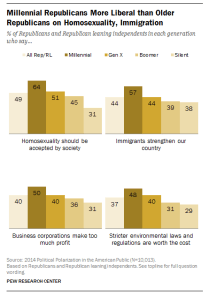
To be fair, my fellow progressives aren’t entirely wrong. We tend to assume that young people will be less anti-gay, less racist, less conservative, and we can point to good poll data to back it up. As Pew reported last year,

in addition to the [Millennial] generation’s Democratic tendency, Millennials who identify with the GOP are also less conservative than Republicans in other generations: Among the roughly one-third of Millennials who affiliate with or lean Republican, just 31% have a mix of political values that are right-of-center, while about half (51%) take a mix of liberal and conservative positions and 18% have consistently or mostly liberal views. Among all Republicans and Republican leaners, 53% have conservative views; in the two oldest generations, Silents and Boomers, about two-thirds are consistently or mostly conservative.

But there’s a big problem embedded in these kids of poll data. Though many young people tend toward more liberal views, there are still enormous percentages of people who buck the trend. The recent protest in Missouri can illustrate the ways young people can and will embrace socially conservative ideas.

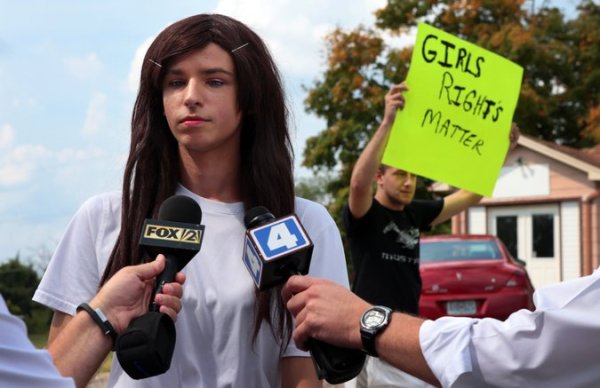
In that case, a transgender high-school senior, Lila Perry, had been allowed to use the girls’ bathroom. Students walked out in protest. The students and their parents, supported by outside groups such as the Alliance Defending Freedom, tend to consider Lila to be still male, in spite of her identification as female. As one activist parent put it, his daughters encountered an “intact male” in the locker room.

In spite of what we might expect, we don’t see in this case progressive young people fighting against the bureaucracy. Instead, the bureaucracy in this case moved quickly to establish a policy protecting the rights of transgender students. In reply, conservative students insisted on the rights of “real” girls to be protected from such students.

If history is any guide, as more young people become progressive, the conservative holdouts will become more firmly attached to their conservative principles. Conservative young people will become more likely to take action. Protests like the one at Hillsboro High School will become more common.

Teachers, Tests, and Gay Marriage

Quick: What do high-stakes tests have to do with gay marriage? Michael Petrilli argues that teachers who discourage students from taking the tests are like government officials who refuse to issue same-sex marriage certificates. Whether you like his argument or not, Petrilli is drawing on a long but ambivalent American tradition.

By now you’ve heard of Kim Davis. She is the county clerk of Rowan County, Kentucky. She has attracted national attention with her refusal to issue marriage licenses to same-sex couples.

Heroically flouting the Constitution?

Heroically flouting the Constitution?

Petrilli, in many ways the leading public voice of market conservatism in education, implies that progressives might not want to be so quick to condemn Davis’s pugnacious policy. After all, Petrilli writes, many progressive teachers these days encourage parents to opt-out of high-stakes tests. Are those teachers similar to Davis? Petrilli asks,

Here the question isn’t whether parents have a right to excuse their children from taking the state assessment. (They almost certainly do.) The issue is whether educators can face sanctions for encouraging parents to engage in an act of civil disobedience. Is that akin to refusing to give the test (which surely is reason for dismissal)? What if they merely inform parents of their rights?

As I argued in my recent book, this argument about the role of teachers has long roots. When it comes to educational culture wars, the winds have blown both ways. When conservatives felt that school law enforced their side, they insisted teachers must obey. When they felt otherwise, they lauded brave teachers who resisted.

Back in the 1920s, for example, William Jennings Bryan knew he had popular opinion on his side. He refused to allow teachers to teach evolution against the wishes of their local communities. As Jennings famously argued back then, “The hand that writes the paycheck rules the school.”

Similarly, when left-leaning teachers from the 1930s through the 1950s were thought to be too friendly to communism, conservative activists insisted on teacher obedience. In 1950s Pasadena, for instance, conservative leader Louise Padelford blasted progressive teachers who sought to drill suggestible students in the need for “social change,” rather than simply teaching “reading, writing, spelling, grammar, arithmetic, history, etc.”

When the shoe is on the other foot, of course, conservatives have praised teachers for bravely resisting the dictates of educational higher-ups. Writing from the Pacific Justice Institute, for instance, Brad and Susanne Dacus have offered teachers a handy guide for safely and legally evangelizing in public schools. Too many teachers, the Dacuses warn, cower before the seemingly invincible might of secularism. “Would you be willing,” they ask,

to take a stand for the sake of the young, innocent children who are bombarded by a pro-homosexual agenda? As a parent, would you be willing to stand up for your child’s right to express his religious views? Many are timid about standing by the Word of God when it has the potential to create a ruckus. Reading through the Gospels reminds us that Christ was not afraid to make a ruckus in the name of truth. The New Testament, especially the book of Acts, focuses on the apostles’ goal to take a stand for the Gospel, regardless of the circumstances. We are not alone in this challenge. Be reminded of the verse in Joshua, which says,

“Be strong and courageous. Do not be afraid or terrified; do not be discouraged, for the Lord your God will be with you, wherever you go.”

To be fair, Petrilli will have none of this argument. He specifically notes, for instance, that public-school science teachers have a responsibility to teach evolution—and only evolution—as science. If they don’t like it, they can resign.

Petrilli’s argument, like those of other conservative activists going back a hundred years, relies on the fact that we Americans aren’t quite sure of what we want teachers to do.

Do we expect teachers to be brave rule-flouters, a la Dead Poets Society?

Or instead to we insist that teachers embody “the rules,” a la Principal Skinner?

The correct answer, of course, is “Yes.” We Americans expect the impossible of our teachers. We count on them to be both daring iconoclasts and sober rule-followers. We depend on them to encourage students to wonder and to inhibit students from wiggling.

So is Michael Petrilli right? Are dissenting teachers like dissenting county clerks? Only half. In the American tradition, teachers do indeed have to embody the rules and respect for the rules. But teachers also have to embody the right moral decisions, even when those decisions go against the rules.