Apocalyptic Academics: Conservatives and the Myth of Outrageous Schools

There it is again!

Today we find yet another example of conservative commentators lambasting the outrageousness of public education.  This firmly ensconced tradition of school-bashing doesn’t make much sense to me.  I would think conservatives would want to promote public education in America as one field in which conservative ideas and ideals have taken firm control.

Today’s example comes from the pages of Public Discourse, in an essay by Professor William Jeynes.  The opening paragraph highlights the terrible activism of public schools:

An inquisitive elementary school student asked his teacher, “Is it wrong to steal?” The teacher replied, “I don’t know. What do you think?” This incident in a major midwestern public school alarmed thousands of parents, and reminded myriad others why they value religious private schools: these schools are usually guided by a moral compass for academics and behavior that public schools patently do not offer.

This notion of vaguely outrageous teaching in America’s vaguely described public schools is a dominant theme of conservative talk about public schooling.

Browsers of conservative media hear about high-school students strip-searched during exams, or teachers rewarded for “stomping” on the American flag.

In all these stories, public schools and their teachers loom as out-of-control dictators, blasting away at traditional morality, patriotism, religion, and common sense.

Nor is this theme a new one among conservative pundits.

In the 1980s, for example, commentator Sam Blumenfeld warned readers that “the neighborhood school is controlled by a national educational and bureaucratic hierarchy completely insulated from local community pressures and answerable only to itself.”[1]

In the 1970s, US Representative John Conlan (R-AZ) worked hard to control what went on in public schools.  Debating House Bill 12851 in May, 1976, Conlan advised,

I think one of the things that perhaps the gentleman from Michigan is not aware of is that there is a significant current in education to teach children that there are no values, there is no right, there is no wrong, that everything is relative, and it all depends upon situational ethics.[2]

As I argued in my 1920s book, conservatives in that decade also insisted on the terrifyingly amoral or immoral dominance of public schools.  For instance, one well-funded insurgent group, the Bible Crusaders, warned that public schools had been taken over by a conspiratorial sect determined “to secretly and persistently work to overthrow the fundamentals of the Christian religion in this country.”[3]

In all these tellings, schools and teachers represent insidious threats to traditional values.  As with Professor Jeynes’ recent warning, a single example, often vague or imprecise, is used as proof of the continuing trend of public schools nationwide. For some reason, conservatives have long tended to exaggerate the perniciousness of public schools.

Of course, this is not only a conservative tendency.  Progressives, too, often hyperventilate over isolated examples of conservative influence in schooling.  As we noted recently, for instance, the specter of creationism often looms much larger in the progressive imagination than it does in actual schools.

In the face of such assertions of apocalyptic academics in public schools, more careful scholarship demonstrates that most teaching fits in with local community values.  Political scientists Michael Berkman and Eric Plutzer have noted that most teachers’ values match those of their school and district.[4]

Of course, there always are and always have been some teachers who flout local values.  But such events are newsworthy precisely because they are unusual.  In general, most teachers prefer to avoid controversy.  Most teachers, like most people, try to fit in.  The notion that teachers and schools are out to demolish the values of their students just doesn’t match experience.

Yet conservatives will presumably continue to trumpet examples of outrageous public-school teaching.  To a non-conservative like me, this does not make sense.  I would think conservatives would rather exaggerate the conservative nature of most public education.  These days, talk about public schooling is dominated by demonstrably conservative themes: privatization, competition, and union-bashing, to name a few.

Wouldn’t it make better strategic sense for conservatives to claim all of these as victories?


[1] Samuel L. Blumenfeld, Is Public Education Necessary?  (Old Greenwich, CT: Devin-Adair, 1981), 4.

[2] Congressional Record, May 12, 1976, pg. 13532.

[3] “The Bible Crusader’s Challenge,” Christian Fundamentals in School and Church 8 (April-June 1926): 53.

[4] Michael Berkman and Eric Plutzer, Evolution, Creationism, and the Battle to Control America’s Classrooms (New York: Cambridge University Press, 2010), 199-200.

Kruse-ing to Conservative Schools

For those of us who follow conservative education policy and ideology, Dennis Kruse of Indiana has been one to watch lately.  Senator Kruse chairs the state senate committee on education and career development.

In December, Kruse attracted our attention with his promise of a new “truth-in-education” bill.  This bill would allow students to question their teachers on any controversial subject.  Teachers would be legally responsible to provide evidence supporting his or her classroom content.

Recently, we discovered a helpful way to track the legislative ambitions of this conservative leader.  The Indiana State Senate website allows anyone to view legislation introduced or sponsored by any legislator.

A review of Kruse’s 2013 activity shows us the educational vision of this particular conservative, at least.  For example, this busy senator has authored bills to support prayer in charter schools, to declare that parents have supreme rights concerning their children, and even to mandate the teaching of cursive in Indiana public schools.

Of course, many of these bills will never see the light of day; many are simply political discussion starters.  But even as such, the vision of America’s schools demonstrated by Senator Kruse’s ambitions can tell us a great deal about what conservatives want out of education.  If somehow Senator Kruse became Supreme Emperor Kruse, we can imagine an education system in which religion played a leading role.  It might also be a school system where students learned traditional skills such as writing cursive.  Parents might be empowered to insist on curricula friendly to their religious backgrounds.

Kruse’s 2013 legislative record also demonstrates the tight connections—among conservatives like Senator Kruse—between educational conservatism and a broader cultural conservatism.  In addition to his school bills, Senator Kruse has supported bills to have mandatory drug testing for all state assistance recipients and to provide every abortion recipient with explicit information about the dangers and risks of abortion.

This tightly bundled conservatism demonstrates, IMHO, the need to understand conservatism broadly.  Too many commentators focus on high-profile issues such as creationism or school prayer in isolation.  By instituting better science standards, for instance, some progressive types think they can derail conservative policy.  Such one-issue reforms will not have much impact unless they recognize that educational conservatism is bigger than any one issue.

So what do conservatives want out of America’s schools?  In the case of Senator Kruse, at least, outsiders like me can see an explicit legislative program.

CSCOPE Blues: Or, How I Learned to Stop Worrying and Love the Curriculum

**Warning: This post contains selections from textbooks that include potentially offensive language.**

Just when conservative Texans thought it was safe to go back to their public schools, they are told that a new curriculum will pervert their children’s values.

The culprit this time is CSCOPE, a curriculum “management system” designed in 2005-2006 and currently used in many Texas school districts.  The goal of the system was to streamline curricular decisions and align classroom teaching with state tests.

Recently, the curriculum has come under conservative fire.  Conservatives in Texas accuse the system of being President Obama’s plan to teach “our children how wonderful socialism is and that communism is even better.”  Nationally, pundits such as Glenn Beck have blasted the teaching system as a smear campaign against the nation’s founders.  The liberal Texas Freedom Network has publicized local attack ads that have accused CSCOPE of delivering “Communist, Marxist, Progressive, Leftist Dogma, Propaganda, and Indoctrination at the expense of taxpayers!”

Tea-Party_CSCOPEad

Source: TFN Insider

The Texas Freedom Network complains that such accusations veer dangerously into the “bizarre” and “paranoid.”  TFN writers point out that many Christian schools in Texas have adopted CSCOPE.  The curriculum system, the TFN argues reasonably, has long been used without a whisper of protest, even in conservative private schools.

Unfortunately for liberals like me and the TFN crew, animosity against CSCOPE is about more than just one set of classroom lessons.  This conservative crusade is about more than just CSCOPE, but involves a long and intractable history of suspicion against curricular systems in general.  Throughout modern American history, conservatives have worried—often with a great deal of justification—that curriculum systems hoped to do more than educate children.  In many cases, curricula have hoped to inject dramatic cultural change into America’s schools.

Many of the accusations, like the newspaper ad from Marble Falls and Burnet, seem outlandish and irrelevant.  But such sentiments often reflect the rightward edge of a widely held notion that school culture seeks to pervert the morals of the young.  In those cases, reasonable protests like that of the Texas Freedom Network do not make much of an impact.  Once a curriculum has become an object of conservative ire, the issue has grown beyond the details of any specific school lessons.  It has become a fight over the cultural control of American schools.

We saw this same dynamic in the 1970s.  When the school district of Kanawha County, West Virginia considered a new set of textbooks, wild rumors spread about the content of those books.  In some cases, distributed fliers included materials that were not in the books under consideration.  One flyer included instructions on the use of condoms from Sol Gordon’s Facts about Sex for Today’s Youth (1973).  In that book—again, not part of the series under consideration—Gordon explained sexual ideas in a frank manner.  The circulated flyer included excerpts meant to highlight this frankness.  “Some ‘street’ words for vagina,” Gordon wrote,

Are ‘box,’ ‘snatch,’ ‘cunt,’ ‘hole,’ ‘pussy.’  It is not polite to say any of these expressions.  However, since they are sometimes used, there is no need to be embarrassed by not knowing what they mean.

Many parents in Kanawha County objected to this sort of language.  The fact—as many liberals protested at the time—the fact that such language did not appear in any of the new textbooks did not change the political discussion.  Conservative parents objected as much to the tendency of school books in general as to the content of any specific books.  As conservative leader Elmer Fike wrote at the time of the controversy, “You don’t have to read the textbooks.  If you’ve read anything that the radicals have been putting out in the last few years, that was what was in the textbooks.”

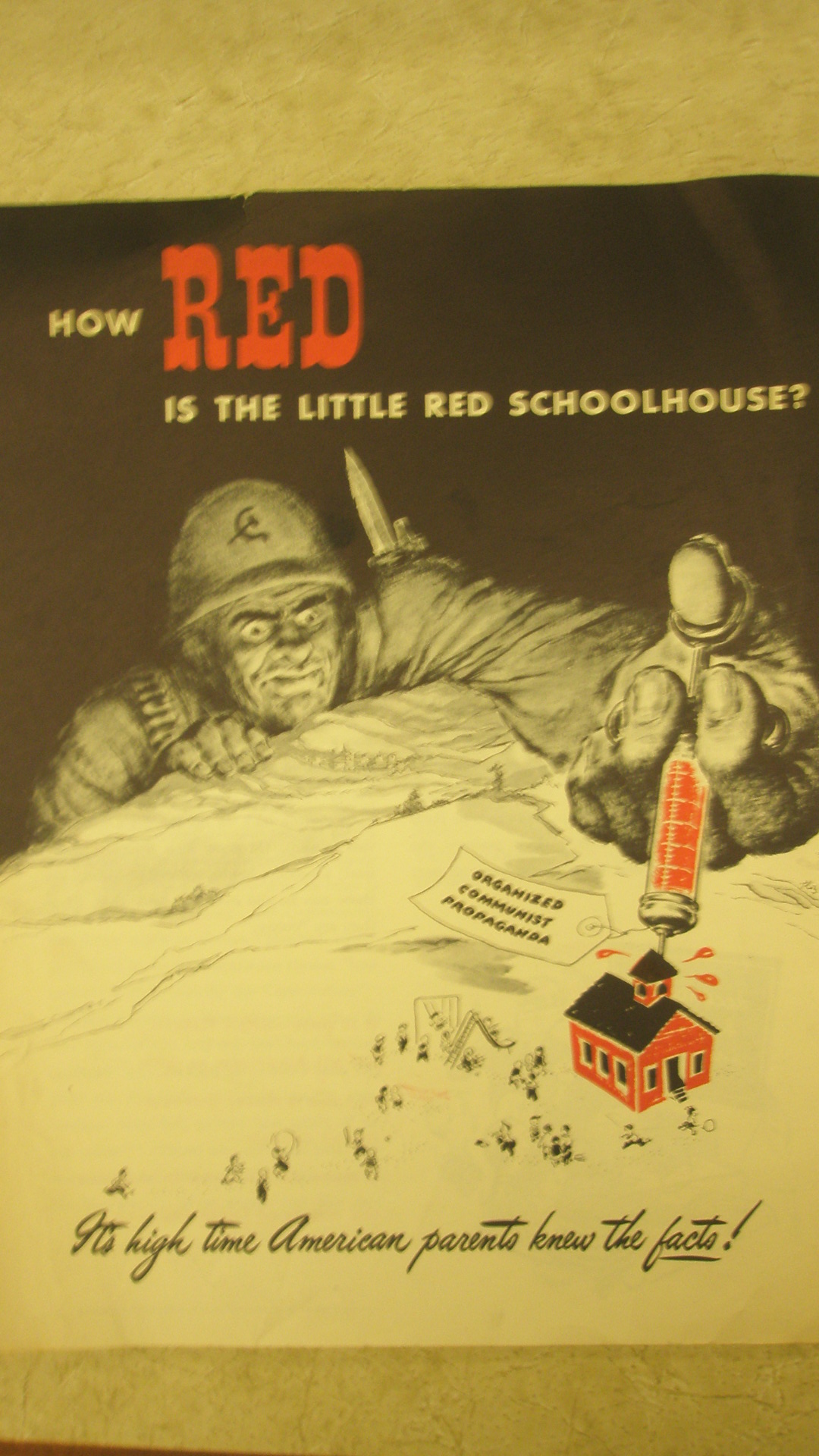
This sense that textbooks and school curricula might set out deliberately to change the morals of young people has a longer history, too.  The source of the cultural danger may have shifted, but at the start of the Cold War conservatives fretted about the threat from subversive communism in school books.  One pamphlet from 1949 Chicago asked, “How Red is the Little Red Schoolhouse?”

Cover imageA decade earlier, Harold Rugg had to defend his popular textbook series from charges of socialist, collectivist subversion.  As Rugg complained, many of his critics had never read the books themselves.  Conservatives, Rugg charged, would say, “I haven’t read the books, but—I have heard of the author, and no good about him” (Rugg, That Men May Understand, 1941, pg. 13).

Seventy-plus years later, Rugg’s books do not seem particularly subversive.  But just as CSCOPE’s critics bundle every anti-American rumor into the Texas curriculum system, so Rugg’s critics blamed him for every anti-patriotic sentiment of the day.

Most important, once school materials get a reputation for left-leaning propagandizing, whether it is Rugg’s books in 1940, or the Interaction series in Kanawha County in 1974, or the CSCOPE materials in 2013, the books seem sure to attract ferocious and effective political attack.  Sometimes, as in the newspaper ad from Marble Falls and Burnet, these attacks seem far-fetched.  But behind even such far-fetched notions lies a germ of uncomfortable truth.

Curriculum developers often DO want to introduce culturally challenging and provocative ideas into America’s schools.  Howard Rugg wanted his books to help along a sweeping “social reconstruction.”  One of the editors of the book series under consideration in Kanawha County dreamed that the controversial books might lead to “further innovations in schooling” [James Moffett, Storm in the Mountains, 1988, pg. 5].

Though CSCOPE insists it is “not designed to show favor toward any special interest group/ organization,” conservative critics can claim some justification for their worries.  For generations, curricula have been introduced to public schools that HAVE hoped to show favor to certain ideas.

CSCOPE might offer an ideologically balanced, pedagogically efficient way for Texas school districts to streamline their teaching systems.  But once it has acquired the reputation for leftist indoctrination, the writing is on the wall.

No matter how fervently the Texas Freedom Network or other supporters might protest, history has shown that in cases like this, among conservatives, school curricula are guilty until proven innocent.

From the Archives: August Heckscher and Conservative Multiculturalism

Could American conservatives embrace their own, distinctly conservative vision of “multicultural” education?

Thanks to Brad Birzer at The Imaginative Conservative, we find a resurrected 1953 argument that forces us to wonder.  This essay, by historian and parks administrator August Heckscher II, insists that true conservatism must never be an “ideology,” but rather

a way of thinking and acting in the midst of a social order which is too overlaid with history and too steeped in values, too complex and diverse, to lend itself to simple reforms. It is a way of thought which not only recognizes different classes, orders, and interests in the social order but actually values these differences and is not afraid to cultivate them.

Heckscher himself could not claim conservative credentials.  He worked in the Kennedy administration and gushed at the progressivism of Woodrow Wilson.  As one conservative commentator complained about Heckscher on the American Conservative, Heckscher was merely “another liberal Democrat explaining to Conservatives politely, but firmly, the need for them to shut up and get out of the way until certain debatable ‘reforms’ are irrevocably in place.”

Yet other conservative thinkers, notably the editors at The Imaginative Conservative and The American Conservative, consider Heckscher’s 1953 polemic worth revisiting fifty years later. Today’s Burkean, traditionalist conservatives were likely attracted by Heckscher’s Burkean, traditionalist definition of true conservatism.

It seems too strange to be a coincidence that Heckscher’s essay came out in the same year as Russell Kirk’s Conservative Mind.  Kirk transformed American conservative intellectual life by promoting this sort of Burkean traditionalism.

Heckscher, like Kirk, insisted that American conservatism must be, and has always truly been, more than simply rock-throwing at government expansion.  True conservatism, Heckscher wrote, would embrace programs such as social security, if those programs were “conceived as a means of strengthening local ties, strengthening the family, and strengthening the true spirit of inde­pendence in the citizens.”

At ILYBYGTH, our attention was drawn to Heckscher’s comments about the nature of truly conservative education.  Heckscher offered a 1950s preview that sounds strangely familiar.  Since the time of Herkscher’s essay, we have become accustomed to “multicultural” ideology in education.  But we generally have not thought of this as a particularly conservative idea.  Here is Heckscher’s vision:

Education in conservatism can come, I suggest, in part from a schooling that makes men aware of the values in a community, and tolerant of their differences. It can come in part, also, from the common everyday discipline of living in an environment where multitudinous groups think in their own ways and set a varying hierarchy of values upon the goods of life. In such a community the doctrinaire approach is impossible. Rationalism cuts athwart the basic understandings which hold all together; and the search for a unique solution would drive men to distraction were it not aban­doned for a spirit of practical accommodation and acceptable com­promise. The diversity with which the citizen learns to live sanely comes by degrees to seem a virtue; and the climax of the wise man’s education is when he turns about and begins consciously to preserve and nourish the institutions in which diversity has been bred. That is the moment, too, in which he becomes a conservative.

Recognizing the value of diversity, in other words, is the sine qua non of truly conservative education.  Since the time of Heckscher’s 1953 essay, “multiculturalism” has earned a negative reputation among many conservative intellectuals.  Many conservatives might line up more happily with Arthur Schlesinger Jr.’s blistering 1990s critique of multiculturalism than with Heckscher’s 1953 endorsement.

But in the context of Heckscher’s Burkean vision, this definition of proper education needs another look.  In the twenty-first century, when we hear a call for “diversity” and a non “doctrinaire” inclusion of “multitudinous groups,” our minds jump first to the sort of “multiculturalism” heralded by scholars such as James Banks.  Banks and other education scholars argued that good education must emphasize the contributions of many different cultural groups.  At its heart, this sort of multiculturalism suggests a radical egalitarianism.  Cultures are different, but all deserve equal respect.  This approach, Banks promised, would not only be good for students of minority ethnic groups, but for all students.  A multicultural curriculum, in this vision, would help overcome America’s history of white Christian hegemony.

Read in the context of his full essay, Herkscher’s call for multicultural education looks much different.  The various voices Herkscher wants to hear are those of different “classes, orders, and interests.”  Herkscher’s conservative multiculturalism does not seek to overcome or diminish those differences between classes and orders, but rather to cherish and promote those differences.

A conservative, Heckscher seems to be saying, learns that every class, every social group, has its intrinsic value as part of a well-ordered society.  Every member of each class must learn to think of himself or herself not primarily as an individual acting in isolation, but as an individual representative of his or her social class.  Harmony comes from valuing the diverse contributions of each group, not by trying to make each group equal.

This is a profoundly different sort of multiculturalism than the explicitly racial vision promoted by later generations of multicultural educators.  The ultimate vision of a harmonious and hierarchical society differs radically from the later multiculturalists’ ultimate vision of an egalitarian utopia. Today’s “multicultural” ideologues might recoil in horror at the notion that education should teach people to see society as a hierarchical structure in which every person must find his or her proper place.

Evidence from Heckscher’s career, too, supports the notion that Heckscher’s multicultural vision differed markedly from multiculturalism’s later incarnation.  As New York City Parks Commissioner between 1967 and 1972, Heckscher applied his vision of social justice in tricky circumstances.  According to his 1997 obituary, Heckscher removed a Black Panthers flag when it had been raised instead of the Stars and Stripes.  Other officials, including the police commissioner, had refused to confront the Panthers, fearing violence.  But Heckscher simply walked alone to the flagpole, took down the flag, and presented it to the African American crowd.  He told them not to put it up again.

Conservatives today might embrace Heckscher’s personal bravery and refusal to truckle to race-based bullying.  But they might also consider the educational ramifications of Heckscher’s 1953 essay.  What would a Burkean multiculturalism look like?  Could students learn to value different groups and classes, not as a way to overcome hierarchy, but as a way to preserve it?

What’s Wrong with School? A Traditionalist Remembers the Bad Old Days

Nostalgia can pack a political punch.  Ronald Reagan promised it was “morning again in America.”  More recently, Tea Party activists have worked at “Taking America Back.”  Even President Obama used nostalgia to infuse his 2012 campaign with some of the energy and verve of 2008.

Recently, one traditionalist essayist has warned of the dangers of nostalgia, especially among conservatives.  At Front Porch Republic, Mark Signorelli reminds readers that going home is often the worst sort of backwards movement.

As I have argued in a Teachers College Record essay, the power of nostalgia among educational conservative thinkers has always been intense.  Lots of different types of conservative intellectuals, from Milton Friedman to Max Rafferty to Henry Morris to Sam Blumenfeld, all based their educational policy arguments on a bedrock assumption that something had gone terribly wrong with American education and culture.  Each of them posited a different educational golden age, before teachers’ unions, or evolution, or progressive education trampled on proper education.

Mark Signorelli doesn’t disagree that the education system in America is terrible.  His mother, a veteran teacher in his hometown school district, suffered repeated harassment for trying to do a good job.  Nor was the experience uplifting for Signorelli as a student.  As he writes,

The schools in my town had problems reaching far beyond the poisonous effects of identity-politics, however.  They are the same problems afflicting schools throughout the country – the disorder in the classroom and the hallways, the narrowing of pedagogical aims to the strictly vocational, the failure to transmit anything resembling our intellectual and artistic heritage.  I do not wish to sound ungrateful; throughout my schooling, I had a number of remarkable teachers, to whose instruction I owe much.  But they, like me, were confined within an aimless system, which had long ago abandoned any responsibility to tend to the moral development of young minds. . . .  It seemed to me as though my teachers had engaged in an extensive conspiracy to rob me of my proper literary patrimony.  But they did teach me the varieties of STD’s.  The situation was exactly the same in the Catholic as in the public schools; I moved between the one and the other throughout my youth, but found little difference between them except for the dress code at the Catholic schools, and their considerably lower rates of assault and battery among the student body.

Signorelli warns that such shoddy educational experiences make nostalgia a dangerous weapon, especially for those traditionalists prone to fetishize “going home.”  If such was the fare on offer in our hometowns, how can we ever justly yearn to go home again?


Required Reading: Meet Tim LaHaye

Do you know Tim LaHaye?

LaHaye

LaHaye

If you’re interested in conservative educational thinking in the United States, you should.

Steve Fouse at AliveReligion recently offered a helpful introduction to LaHaye’s enormous influence among conservative and fundamentalist circles.

As Fouse points out, arguments about conservatism that seek to explain away its popularity miss the boat on LaHaye.  Fouse takes Thomas Frank to task for making such oversimplistic assumptions.  Fouse prefers the explanations of historians such as Darren Dochuk.  Dochuk’s more complex perspective fits better the career of a fundamentalist Renaissance Man like LaHaye.

Fouse notes LaHaye’s wide-ranging interests, from LaHaye’s role in the Institute for Creation Research, to his best-selling apocalyptic novels, to his evangelical sex guides.

Fouse mentions LaHaye’s central interest in educational issues, from sex ed to creationism.  If anything, Fouse downplays the influence LaHaye has had in late twentieth-century educational conservatism.

Fouse could have mentioned, for instance, LaHaye’s role in arguing for increased phonics instruction.  In his 1983 book The Battle for the Public Schools, LaHaye argued that abandoning phonics could be part of a massive conspiracy to “reduce the standard of living in our country so that someday the citizens of America will voluntarily merge with the Soviet Union and other countries in a one-world socialist state”   (46).   Disappearing phonics instruction showed the extent to which Christian America had been undermined.  It served as a canary in the secular coalmine.  “Some modern educators,” LaHaye insisted, “use look-and-say instead of phonics because the material enables them to secularize our once God-conscious school system” (50).

Similarly, Fouse did not mention LaHaye’s ardent activism in favor of more traditionalism in US History instruction.  In LaHaye’s 1987 Faith of Our Founding Fathers, LaHaye argued that the nation had endured a “Deliberate Rape of History” (5). Between 1954 and 1976, LaHaye insisted, a generation of “left-wing scholars for hire” worked for secularizing organizations such as the Carnegie Foundation (6).  Such authors systematically distorted the truth of America’s Christian heritage.  Thus, in order to find the true history of America’s founding, readers needed to look to older books, written by those “closest to the events they describe” (6). LaHaye insisted on the Christian beliefs of the Founding Fathers, demonstrating that “most were deeply religious, all had a great respect for the Christian traditions of the colonies, and all were significantly influenced in their thinking by the Bible, moral values, and their church” (30).

Thanks to Steve for offering his post about this important figure.  All of us who hope to understand conservatism in American education should check it out.


Death, Taxes, … and Teacher Abuse?

School bullying can be tough.  Once kids get the taste of blood, they will often hound their victims mercilessly.  The victims have no place to run, especially in the new world of cyber-bullying.

Anyone who survived middle-school in America knows that the tired old advice to “tell the teacher” is only guaranteed to make it worse.  But what about when the victim is the teacher himself?

A story on National Public Radio this morning details a new law in North Carolina designed to protect teachers from student cyberbullying.

Lisa Miller reported the story of one teacher:

“Chip Douglas knew something was up with his 10th-grade English class.  When he was teaching, sometimes he’d get a strange question and the kids would laugh.  It started to make sense when he learned a student had created a fake Twitter account using his name.

“‘It was awful,’ he says. ‘It had this image of me as this drug addict, violent person, supersexual, that I wouldn’t want to portray.’

“Douglas told the kids he planned to call the police—because under the new North Carolina law, the student behind the tweets could spend a month in jail and pay a $1,000 fine.”

As any educational historian will tell you, Facebook and Twitter aside, there is nothing new to teacher abuse.  In nineteenth-century schools, a prime consideration of teaching prowess was physical prowess.  In those “good old days,” teachers often had to physically overpower their students in order to control a classroom.  As historical Carl Kaestle argued in Pillars of the Republic (New York, 1983, p. 19), many schools in the 1800s required male teachers, since “the older boys were often stronger than [women teachers] were.  It was for this latter reason that female teachers were in many districts employed only during the summer sessions, when the older children were generally working.”

My research for my 1920s book found similar assumptions during that decade.  Perhaps the most intriguing glimpse of teacher abuse came in a little snippet I uncovered in the legislative record for the Florida State House of Representatives for 1923.  Tucked away with all the other proposed bills was this little mystery:

“House Bill No. 747:

“A bill to be entitled An Act to amend Section 5443 of the Revised General Statutes of Florida, relating to the insulting of teachers upon the school grounds. 

“Which was read the first time by its title and referred to the Committee on Education.”

Despite my digging, I couldn’t find out any more about the fate of this odd little bill.  I do know that it was submitted by request, meaning that some Floridian wrote to his or her state representative and asked for a law like this.

Did a teacher suffer insults on school grounds?

Did he or she yearn to prosecute the little brat?  Or brats?

If so, the hapless teacher would have been better off to teach in North Carolina in 2013.

Or maybe not.  The teacher described in the NPR story had to resign.  The law could not protect him after all.

Fundamentalist Homeschoolers Seize Control of American Pop Music!

I am happy to say I don’t know anything about the Jonas Brothers.

I survive the shame of my ignorance by putting them in a mental category along with Hannah Montana, Barney, and all other noxious pop culture targeted at America’s youth.  As far as I am concerned, these are things I do not need to know about.

So imagine my surprise to learn that this pop group has become a leading advocate of school choice.  Imagine my surprise to learn that this leading pop group learned about the world and everything in it from their conservative evangelical Protestant homeschool curriculum.  It appears the Jonas Brothers have been educated with the Accelerated Christian Education curriculum, one of the most ferociously conservative Protestant curriculum choices available.

But let’s start at the beginning.

This morning, I came across a story from the libertarian Reason TV.  The Jonas Brothers headlined a National School Choice Week kickoff event.

Curious as to why such a high-profile pop band would sign up for an event so popular among conservatives, I looked into the Jonas Brothers.  As usual, everyone but me seemed to be already aware of the Jonas Brothers’ deep commitment to conservative evangelical religion.  Slack-jawed comedian Russell Brand, for instance, earned some opprobrium for mocking the Brothers’ virginity pledges.

When I checked out a “Day in the Life of the Jonas Brothers” video, I was surprised to see (check out the video at 3:58) that the homeschool curriculum they used was from Accelerated Christian Education.

Image Source: Accelerated Christian Education

Image Source: Accelerated Christian Education

As I argued a couple years ago in the pages of History of Education Quarterly, among Christian fundamentalist school publishers, ACE stands out for its rigid traditionalism and strict sectarian notions in every subject, from creationism to the religious meanings of the US Constitution.

I have no beef with conservative religious families who choose to use ACE materials to teach their children.

But I am surprised to find that young people educated with such materials have had such a meteoric rise to the peaks of pop culture.  After all, one common theme among conservative educational activists is that American pop culture peddles filth and trash.  Long before the Beatles, long before Elvis, conservatives worried about the sex and loose morals associated with such pop singers as Jimmie Rodgers.

Yet with the Jonas Brothers, we find a group doing very well in the choppy seas of pop music.  As far as I am aware, the Jonas Brothers did not come to fame as a particularly “Christian” music group, but rather as a particularly saccharine tween-idol music group.

Is it fair to say that conservative worries about the anti-Christian nature of American pop culture are overstated?  Or are groups like the Jonas Brothers simply exceptions that prove the rule?

Truth and Science in Louisiana

What is Truth?  The question is as old as Pilate, and still as troublesome.

As anti-creationist activist Barbara Forrest notes in a perceptive article in the Louisiana Coalition for Science blog, anti-evolutionists in that state have made a telling error in their reading of mainstream science education.

In a struggle to impose a two-model evolution/creation curriculum in Central, Louisiana, creationists misquoted the Louisiana Department of Education’s (LDOE’s) 1997 Louisiana Science Framework (LSF).  In that framework document (see page 12), the LDOE offered a carefully worded articulation of the mainstream vision of the nature of science.  As Forrest notes, the LDOE explicitly demanded that true science should be taught “as a human enterprise and a continuing process for extending understanding, instead of the ultimate, unalterable truth.”

When creationists of the Louisiana Family Forum crafted their argument for teaching both creationism and evolution as science, they misrepresented this statement.  The Louisiana Family Forum’s proposed resolution contained the following assertion:

“WHEREAS, the Louisiana Science Content Standards at page 12 indicate that science should be ‘presented as a . . . [ellipsis in the LFF document] continuing process for extending understanding of the ultimate, unalterable truth’(7);”.

As Forrest points out, there is a world of difference between what the Louisiana standards demand and what the LFF said the standards demand.  Forrest notes that this slip could be due either to dishonesty or carelessness.  True enough.

But I think this mistake also tells us a great deal about the yawning chasm that separates the two sides’ understandings of the nature of education.

For science educators such as Barbara Forrest, the notion that a state standards document would define science education as a quest for “ultimate, unalterable truth” seemed immediately, obviously bizarre and suspicious.  That is simply not the way mainstream science educators talk.  Indeed, the paragraph from which that line came says a great deal about mainstream understandings about education.

Here is that paragraph in full:

“The purpose of science education is not for students to memorize the ‘right’ answer, but for them to move along a learning continuum toward a deeper understanding of science concepts and processes.  Current research indicates that it is best for understanding to be constructed actively by the learner.  This learning style offers a new role for the science teacher as a facilitator of learning versus an imparter of knowledge.  Instruction should minimize rote learning and focus on in-depth understanding of major concepts and topics, with students actively exploring those ideas through activities they can relate to their own lives.  Students often work cooperatively in small groups to exchange and critique their own ideas, with the teacher facilitating discussion rather than providing answers.  Science is presented as a human enterprise and a continuing process for extending understanding, instead of the ultimate, unalterable truth.”

Now THAT is the way mainstream education folks talk!  Note the emphasis on teacher as facilitator, the role of student as an active constructor of knowledge.  Note the emphasis on cooperative learning and the de-emphasis on the traditional delivery of information from teacher to student.

This is how many mainstream education researchers understand the process of learning and teaching.  This is NOT the way most conservatives and traditionalists understand education.  Though I don’t know the LFF and certainly can’t speak for them, many conservatives and educational traditionalists have a very different understanding of the nature of education.  For many conservatives, education—whether it’s about evolution, the American Revolution, or any other topic—is precisely about transmitting “ultimate, unalterable truths” from one generation to the next.

So whether the Louisiana Family Forum made a mistake in reading the Louisiana science standards or whether the LFF deliberately misrepresented those standards, the LFF ended up articulating a vision of education much closer to the understandings of most American conservatives.  Education, in the conservative view, must be about “ultimate, unalterable truth” in order to have any meaning at all.


School Wellness Programs: The Latest Frontier in the Culture Wars?

By Natalia Mehlman Petrzela

It was “showdown day” last Tuesday at a packed-to-capacity meeting of the Encinitas, California school board, during which the board faced angry threats of litigation in a heated dispute far afield of those predictable curricular lightning rods, sex education or science instruction. The embattled program is yoga.

Yoga?

In late October, about 60 Encinitas parents approached the board to strenuously oppose an Ashtanga yoga curriculum offered 30 minutes twice weekly to students district-wide. “I will not allow my children to be indoctrinated,” one parent insisted. Another expressed “a deep concern [the District] is using taxpayer resources to promote… religious beliefs and practices” on children “being used as guinea pigs.” Anxieties that opposing parents were forced to “segregate their children” reached fever pitch – one said kids opting out faced ostracism, comparing the situation to Nazi Germany.

As the local and national press has been quick to report, this vocal minority of parents “bent out of shape” or “in a twist” about savasana at school want the program terminated immediately. Their attorney, Dean Broyles, whose firm National Center for Law and Policy, is devoted to defending “faith, family, and freedom,” as well as “traditional marriage” and “parental rights” articulates the core issue as “the EUSD using taxpayer resources to promote Ashtanga yoga and Hinduism, a religious system of beliefs and practices.” The yoga community in Encinitas and beyond has responded fast and furiously, gathering over 2,500 signatures on a petition to preserve the program.

California is no stranger to heated educational controversy – beginning in the 1960s when the state was known (renowned by some, reviled by others) for its breakneck pedagogical innovation, the region became ground zero in some of the nation’s fieriest debates over sex education, character education, ethnic studies and bilingual education.  Such progressivism, conservatives charged, was expensive, immoral, academically unserious, and even un-American. Perhaps worst of all to grass-roots groups like POSSE (Parents Organized to Stop Sex Education) and CPR (Citizens for Parental Responsibility), the emphasis on critical reflection shared by these diverse initiatives undermined parental prerogative to determine their children’s worldview.

Encinitas might just be the perfect theater for a contemporary battle in these culture wars pitting traditionalist parents advocating for “the 3 Rs” against “hippie” pedagogies. The beachfront community embodies the cultural extremes defining California: Encinitas is known as a mecca for kale-eating freethinkers who seek out the diverse yoga practices with local strongholds and the open-minded environment, while surrounding San Diego County remains one of the country’s most politically conservative regions.

But the Encinitas yoga battle is more than just a new skirmish in an old fight waged by familiar combatants; it represents what will likely be a new theater of war in the educational culture wars in the 21st century.

The complaints among conservatives about yoga promoting Hinduism and mysticism are hardly of a piece with recent resistance to Christian Texas cheerleaders reading scripture at football games, as some press accounts have assumed. The rhetoric of the Encinitas parents’ protests may nominally be to free schools of religious influence, but the mission of Broyles’ firm is actually to defend the very principles the Christian cheerleaders espouse. A linchpin of the traditionalist perspective since the 1960s has been that liberals “took God out of schools and put sex [or Chicano studies or black children or the New Math] in,” as said one disgruntled father in the late 1960s. In the Encinitas case, however, the complaint is that there is too much God in the schools, just the wrong deity. This shift speaks to a transformation in how conservatives and liberals envision the appropriate role of spirituality at school… here conservatives position themselves as the defenders of civic secularism, in stark contrast to the stance which first galvanized their movement.

1960s culture warriors of any stripe couldn’t have fathomed the popularity “school wellness” would attain in the last two decades — enfolding not only yoga but also gardening, cooking, exercise, and meditation– and contemporary advocates of such curricula have difficulty understanding how these innocuous initiatives can inspire controversy. The press, the EUSD, and scores of online commenters expressed shock that anyone would suggest, “a little stress-reducing exercise ever hurt anyone,” especially in the context of a much-discussed “obesity crisis.” The Los Angeles Times couldn’t believe the degree of the plaintive parents’ worries, as yoga is regularly practiced in San Diego spots as disparate as the Camp Pendleton naval base and the Jois yoga enclave, which funds the school program. Glamour commented, “most people associated with the controversy are scratching their heads,” quoting similarly incredulous Jois chief executive: “It’s hard to know how to respond to someone who says if you touch your toes, you’re inviting the devil into your soul.”

Onlookers should not be so surprised at the perspectives Broyles raises, and should expect expanding wellness programs to generate more concerns, on the right and left. Encinitas parents are not the first social conservatives to oppose yoga; there’s even a cottage industry of Christian alternatives to the practice. Moreover, historians remind us that yoga’s well-scrubbed image today – think wholesome spectacles such as children doing yoga on the White House Lawn to celebrate Easter – elides the practice’s overtly spiritual and erotic origins. On the other end of the political spectrum, the field of Fat Studies argues the whole “obesity crisis” that provides the rationale for many wellness programs – including that in Encinitas – is fundamentally flawed, based more on our cultural aversion to fat bodies than on any objective health criteria. Michael Pollan, patron saint of the “real food” approach core to so many wellness programs, acknowledges that this new cultural terrain “mixes up the usual categories” even as the origins of the food and wellness movement are the same 1960s impulses that fueled the first round of the polarizing culture wars.

A familiar indignation over squandered tax dollars fuels the frustration of the Encinitas parents, though here it is largely misplaced, as the program is financed by a $533,000 grant from the private non-profit Jois Foundation. If the wellness movement suggests a newly fraught educational politics, so too does this funding situation. Nationwide, budget constraints are making public districts increasingly dependent on private initiative, especially for offerings such as wellness, which despite their popularity are usually deemed as “enrichment” rather than as a core academic need. As outside groups step in to fill curricular gaps and districts have fewer resources to shape these interventions, wellness programs are likely the next theater of battle in our ongoing but evolving educational culture wars… in which the earnest claim of the Encinitas superintendent that “it is just physical activity” sounds ever more naïve.

Natalia Mehlman Petrzela is Assistant Professor of Education Studies and History at Eugene Lang College The New School for Liberal Arts and is also co-founder of HealthClass2.0, a school-based wellness
program (www.healthclass.org). Her forthcoming book on culture wars in education is tentatively entitled SCHOOLED RIGHT: THE EDUCATIONAL ORIGINS OF CONTEMPORARY CONSERVATISM.