The Tough Questions

How do we start?  What about students? …and isn’t it cheating to sneak in a definition after I say I’m not going to impose a definition?
floridagators3

They’ll bite!

Those were some of the smart and tough questions leveled at your humble editor last night after my talk at the University of Florida’s College of Education research symposium.  The edu-Gators (ha) were a wonderful group of scholars to talk with.  I got a chance to hear about their work in schools and archives, then I got to run my mouth a little bit about the culture-war questions that keep me up at night.

The theme of the symposium was “Strengthening Dialogue through Diverse Perspectives.”  Accordingly, I targeted my talk at the difficult challenge of talking to people with whom we really disagree.  I shared my story about dealing with a conservative mom who didn’t like the way I was teaching.  Then I told some of the stories from the history of educational conservative activism from my recent research.
University of Florida

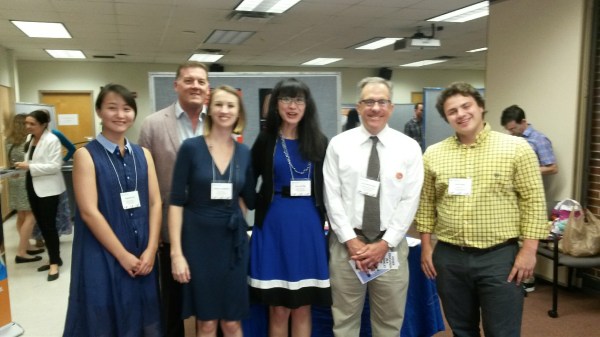
The UF crew…

What has defined “conservative” activism in school and education?  Even though there isn’t a single, all-inclusive simple definition of conservatism—any more than there is one for “progressivism” or “democracy”—we can identify themes that have animated conservative activists.  Conservatives have fought for ideas such as order, tradition, capitalism, and morality.  They have insisted that schools must be first and foremost places in which students learn useful information and have their religion and patriotic ideals reinforced.

Underlying those explicit goals, however, conservatives have also shared some unspoken assumptions about school and culture.  Time and time again, we hear conservatives lamenting the fact that they have been locked out of the real decisions about schooling.  Distant experts—often from elite colleges and New York City—have dictated the content of schools, conservatives have believed.  And those experts have been not just mistaken, but dangerously mistaken.  The types of schooling associated with progressive education have been both disastrously ineffective and duplicitously subversive, conservatives have believed.

That was my pitch, anyway.  And the audience was wonderful.  They poked the argument (politely!) to see if it would really hold.  One student asked a tough question: Given all this history, all this poisoning of our dialogue between conservatives, progressives, and other, how do we start?  A second student followed up with another humdinger: I talked about conservative parents and school board members and leaders, but what about students?  What should a teacher do if she finds herself confronted with a student who has a totally different vision of what good education should look like?  Last but not least, a sharp-eyed ed professor wondered if I wasn’t doing exactly what I promised I wouldn’t do: Impose a definition on “conservatism” by offering a list of defining ideas and attitudes.

How did I handle them?

Well, SAGLRROILYBYGTH, your humble editor did his best, but those are really tough ones.  In general, I think the way to begin conversations with people with whom we have very strong disagreements is to start by looking at ourselves.  Are we making assumptions about that person based on things he or she isn’t actually saying?  Are we seeing them through our own distorted culture-war lenses?

And if students in class disagree with us about these sorts of culture-war principles, we need to remember first and foremost that they are our students.  If a student in my class, for example, is super pro-Trump, I want her to know first and foremost that I welcome her in my class and she is a member of our learning community.  It gets tricky, though, if a student wants to exclude other students based on these sorts of religious and ideological beliefs.

Last but certainly not least, I don’t think it’s unfair to offer themes and ideas that have defined conservatism over the years.  I’d never want to impose those definitions on historical actors, Procrustes-style.  But once we take the time to listen and learn to our subjects, we can and should suggest some things that they have had in common.

On to breakfast with graduate students and a chance to participate in Dr. Terzian’s schools, society and culture colloquium.  Bring on the coffee!
Hello, Florida!

Good morning, SAGLRROILYBYGTH!

Wish me luck–I’m on my way to the Sunshine State.  Thanks to my colleague Sevan Terzian, I’ll be giving a keynote talk at the University of Florida’s research symposium this evening.  I can’t wait.

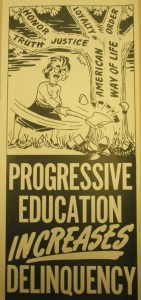
What will I be talking about?  Well, you’ll have to wait until after the talk for a synopsis, but I can tell you that I’ll be using these images from my research into twentieth-century educational conservatism.

Allen Zoll’s attack on progressive education, from Pasadena, 1950

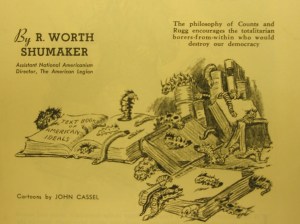
The American Legion warns of treasonous textbooks, 1940

Watch out for communism in your local school, c. 1951

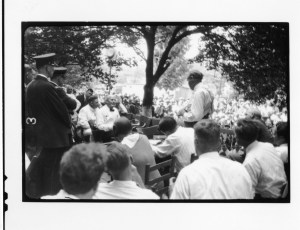
Scopes Trial, 1925

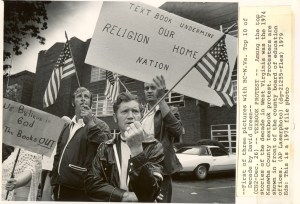
Kanawha County’s protesters, 1974

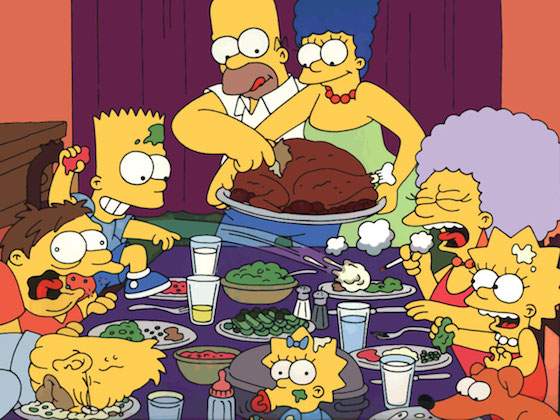
School = Thanksgiving

Ah, Thanksgiving! Our favorite holiday of all. No gifts, no decorations, no sweat . . . just lots of food and friends and football. Your humble editor has retreated to an undisclosed location in scenic upstate New York to share the holiday with family.

simpsonsturkey

PS 101

Before we do, however, we must give in to our unhealthy compulsion to share some Thanksgiving reflections about schooling and culture wars. In the past, we’ve noted the central role Thanksgiving has come to play in those battles. Today, though, we want to point out a more basic connection: Why do we keep having culture wars over the teaching in our public schools? Because those schools are like Thanksgiving itself.

First, a review of our ILYBYGTH reflections about culture-wars and Turkey Day:

Today, let’s consider a more fundamental idea: Thanksgiving gives us a chance to see how public schools really function and why they serve so often as lightning rods for culture-war kerfuffles. Thanksgiving dinner might just be the best analogy for the way our schools work.

Because we know they don’t work the way anyone really wants them to.

For generations, progressive activists and intellectuals have dreamed of schools that would transform society. To pick just one example from my recent book, in the 1930s Harold Rugg at Teachers College Columbia hoped his new textbooks would transform America’s kids into thoughtful authentic small-d democrats. The books would encourage students to ask fundamental questions about power and political transparency. They would help young people see that true social justice would come from a healthy transformation of society, with power devolved to the people instead of to plutocrats.

For their part, generations of conservative activists have tried to create schools that would do something very different. There is no single, simple, definition of “conservatism,” of course, but by and large, as I also argue in my recent book, activists have promoted a vision of schooling as the place to teach kids the best of America’s traditions.

As one conservative intellectual asked during a turbulent 1970s school boycott,

Does not the Judeo-Christian culture that has made the United States the envy of the world provide a value system that is worth preserving?

Other conservatives shared this vision. Max Rafferty, one-time superintendent of public instruction in California and popular syndicated columnist, yearned for a golden age when

the main job of the schools was to transmit from generation to generation the cultural heritage of Western civilization.

Max Rafferty was never satisfied. Schools, he thought, failed in their proper job as the distributor of cultural treasures.

Harold Rugg wasn’t happy either. Neither he nor his progressive colleagues in the “Social Frontier” group ever succeeded in using the schools to “build a new social order.”

Why not? Because schools will not fulfill either progressive or conservative dreams. They are not distribution points for ideological imperatives. They are not outposts of thoughtful civilization scattered among a hillbilly hinterland.

Instead, it will help us all to think about schools as a sort of Thanksgiving dinner. At a Thanksgiving dinner, people of all sorts gather together to eat. Friends, family, co-workers, neighbors. Unless you’re lucky enough to escape to an undisclosed location in scenic upstate New York with only a few beloved family members and a dog, you will likely sit at a table with people with whom you don’t share much in common, intellectually.

In every family, you are likely to find some ardent conservatives and some earnest progressives. You are likely to find strong feelings about issues such as abortion, same-sex marriage, evolution, and etc.

That’s why—until the booze kicks in, at least—most Thanksgiving dinners tend to stick with safe topics. We know we can disagree about football, for example. If my Green Bay Packers lose to the horrible Chicago Bears, my cousin knows he can tease me about that.

But we can’t disagree, out loud, at least, about things that really matter to us. If I have an imaginary uncle, for example, who thinks same-sex marriage means opening the door to pederasty and apocalypse, he knows he can’t tease me about it. Our disagreement on that issue won’t be something we can both just laugh about.

So our Thanksgiving dinner conversations, we hope, stick to fairly humdrum topics.

That might just be the best way to understand our schools, too. In spite of the dreams and hard work of intellectuals such as Max Rafferty and Harold Rugg, schools don’t push one ideological vision or another. At least, they tend not to do it very well or for very long.

Instead, they stick to the smallish circle of ideas that we as a society can roughly agree on.

This is why biology teachers tend not to teach a whole lot of evolution.

This is why health teachers tend not to teach a whole lot of sex.

This is why history teachers tend not to teach a whole lot of history.

There are plenty of exceptions, of course. But that also fits into our Thanksgiving analogy. Every once in a while, someone at Thanksgiving will insist on having it out…whatever “it” is. And our holiday turns into a smack-down, leaving everyone a little bruised and shaken.

Similarly, some teachers and some schools will occasionally push for a better vision of education, a more ideologically pure one. As I examine in my recent book, that is when we get culture-war flare-ups.

So as we sit around our tables and eat birds, let’s reflect on the ways this holiday might be the perfect analogy for schools. They are not change agents or tradition-upholders. At least, they are not only that.

Public schools are, rather, a meeting place in which we all implicitly agree to limit ourselves to non-controversial topics. We agree to keep the most interesting ideas, the most provocative ones, and, sadly, often the most educational ones, off the table.

Students: Customers, Wards, or What?

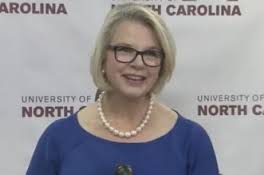
The devil stalks the University of North Carolina. At least, that’s the impression I get when I read the progressive Nation’s description of new system president Margaret Spellings. Of all the damning evidence against Spellings, perhaps the worst thing, for these progressives, is that she referred to students as “customers.” I wholeheartedly agree that good education, healthy education, shouldn’t be understood this way. But I don’t think progressives like me have come up with a better analogy. The only other likely candidate makes us even more uncomfortable.

Margaret Spellings

Sympathy for the Devil…?

Spellings has a long career in education. She has been one of the fiercest and most successful proponents of Milton Friedman’s prescriptions for better schools. If markets are allowed to do their magic, this school of thought explains, much of the dead hand of institutional lethargy will be stripped away.

In the K-12 world, market reformers have pushed vouchers, charters, and “choice,” with a lot of success. During her tenure as Education Secretary, President Spellings famously promoted a similar sort of market approach to higher education. The solutions to university blahs, the Spellings Report explained, lay in a new vision of students as “consumers,” with schools competing for their business.

“In this consumer-driven environment,” the report argued,

Students increasingly care little about the distinctions that sometimes preoccupy the academic establishment. . . . Instead, they care—as we do—about results.

A good college, from this perspective, is one that gives students good financial pay-back for their tuition investment. The “results” for “consumers” should be significant, in terms of higher salaries and better economic prospects for families.

Colleges, the Spellings Report insisted, need to adapt or die. If a for-profit college can deliver marketable skills better and faster, it should be encouraged, not deplored. Such law-of-the-jungle competition would push colleges in the right directions, toward “improving their efficiency.” A good higher-education system, the Spellings Report concluded, would give “Americans the workplace skills they need to adapt to a rapidly changing economy.”

Those of us who don’t like this vision of the proper form and function of higher education are not without alternatives. But for progressives, the primary alternative would not be an improvement.

For long centuries, colleges and universities operated on a very different model, what we might call the “family” plan. Students were not consumers, but rather more like apprentices. They entered into higher education with an understanding that they would be shaped according to the guidance of the school.

As historian Roger Geiger explained so clearly in his recent history of higher education, this system persisted much longer than did the apprentice system for young workers. Well into the nineteenth century, students had very few rights, very few choices to make.

They didn’t like it. As Geiger relates, the 1810s were a far more turbulent decade on American campuses than were the 1960s or 1970s. Indeed, if today’s students at North Carolina don’t like Spellings’s consumer model, they might learn a lesson from their predecessors. In 1799, UNC students held a week-long riot, in which they captured and horsewhipped their unpopular presiding professor. (See Geiger, pp. 116-129.)

What made these students so angry? The family model of higher education insisted on draconian rules for student life, including onerous daily recitals and endless rounds of mandatory chapel services. Students did not “consume” higher education in this family model, they submitted to it.

During the 1960s, student agitation against in loco parentis rules represented a late protest—and a very successful one—against the persisting vestiges of the family model. Students demanded an end to mandatory curfews and even core curricula.

The family model never totally disappeared, of course. Indeed, today’s “safe space” protests are usually built on an implicit assumption that the university will protect and shield students, implying a continuing authoritative family relationship.

In general, though, progressive students, faculty, and administrators don’t like the family model. They don’t want to impose a set of readings or experiences for students. They want students to be empowered to design their own educational experiences, to a large degree.

But if we don’t like the old family model, and we don’t like the new consumer model, what else is there?

As usual, I don’t have answers, only more questions.

  • If we don’t want to think of college students as customers, and we’re not willing to re-impose an authoritarian system, what should we call them?
  • Put another way: If the family model is out, and the consumer model is out, what’s left?
  • What could it mean to think of students as producers, rather than consumers?
  • If the nature of consumption has changed radically in the past fifteen years with online shopping and etc., might it mean something very different these days to call students “consumers”?
  • Is there wiggle room in the consumer model? Think of the differences, for instance, between equipping someone with tested, high-quality gear for a life-long expedition and equipping them with shiny junk they really don’t need.

Are the Culture Wars History?

I don’t get out much. So when I was invited to participate in a panel at the annual meeting of the History of Education Society, I jumped at the chance. Especially when it gave me the chance to rub shoulders with some nerd all-stars.

Meet me in Saint Looey...

Meet me in Saint Looey…

Our panel will include four authors of books familiar to SAGLRROILYBYGTH. First, Jon Zimmerman will tell us something about global sex ed from his new book, Too Hot to Handle.zimmerman too hot to handle

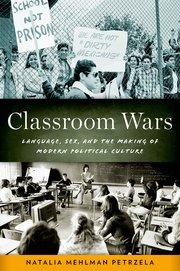
Then, Natalia Mehlman Petrzela will keep the sex-ed ball rolling while adding in some bilingual ed as she talks about her book, Classroom Wars.petrzela classroom wars

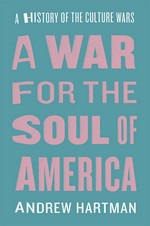
Next, Andrew Hartman will share some insights about education and culture wars from his blockbuster War for the Soul of America.Hartman

Last, I’ll talk a little bit about what it has meant to be “conservative” when it comes to education, from my new book.

What will we talk about? Hard to say until we get there, but the theme that ties these books together is that of educational culture wars. What have Americans (and people worldwide) seen fit to teach their kids about touchy subjects such as sex and God? Who has been allowed to make decisions about school?

One disagreement we might have could be about the winners and losers. If there are such things as educational culture wars, we all have different conclusions about who has won. Jon Zimmerman argues that kids overall—especially in the United States—get very little sex ed, due to consistent activism against it. I think, too, that conservatives have been able to exert veto power over many big educational programs. Both Andrew and Natalia, though, say that by and large progressive ideas have come out the winner in these battles.

What do you think:

  • Are there such things as educational culture wars?
  • If so, are they all in the past?
  • And, maybe most interesting to most people…who won?

A Field Test for Progressive Education

I’ve spent the past few years of my life trying to figure it out.  What has it meant to be “conservative” about American education? It’s not as obvious as it might look. Similarly, it can be extremely tricky to figure out what makes something educationally “progressive.” Peter Greene offers what might be a handy field test.

A test for the tests...?

A test for the tests…?

As SAGLRROILYBYGTH are aware, my recent book argues that an identifiable tradition of “educational conservatism” emerged in the twentieth century. Speaking broadly, educational conservatives mixed free-market structures with Christian morality; they mixed traditional pedagogy with traditionalist social norms. Jesus and phonics, Friedman and fundamentalism. Time and again, conservative activists successfully asserted their right to be heard about textbooks, school rules, and classroom practices.

In recent months, I’ve been expanding my reading list to include more non-conservative arguments about education. One of my favorite progressive anti-testers has been Peter Greene at Curmudgucation.

Greene repeated his argument recently that there is an easy way to find out if any evaluation is authentic. Or, more precisely, he offers a quick way to decide if one is inauthentic:

The hallmark of inauthentic assessment is that it’s easy to cheat, because you don’t have to be good at what you’re allegedly being judged for– you just have to be good at the assessment task which, because it’s inauthentic, consists of faking proxies for the real deal anyway. What it really measures is the proxy-faking skills.

If we want a handy-dandy field guide to progressive education—a notoriously slippery concept to define—perhaps Greene’s warning might help.

We might call classroom practices “progressive” if they fundamentally make it impossible for students to cheat. Not by eagle-eyed watchfulness or elaborate security precautions, but because of the nature of the tasks themselves.

In a traditional classroom, for instance, information is transferred from teacher and textbook to student. The student is expected to incorporate this knowledge. At some point, a “test” will be administered, in which said student repeats back the knowledge. He is measured by how much and how well he repeats back the knowledge.

In a progressive classroom, in contrast, students will not have tests of that sort. Rather, they will be expected to make something, perform something, achieve something. Since the parameters are not set up in advance, it is impossible for a student to cheat.

For instance, if assessment is based on a student’s performance in a research-informed discussion, she is free to bring in as many notes as she wishes. If she is able to use that information in a coherent and convincing way, she will have done well on the project.

In a traditional classroom, methods of cheating are as traditional as the lectures themselves. Students cheat by writing facts on their arms, by copying answers from another student, or by any of an enormous corpus of tried-and-true methods.

Pssst...I find these methods of assessment inauthentic....

Pssst…I find these methods of assessment inauthentic….

Indeed, we might conclude that the overwhelming political support for traditionalist policies such as No Child Left Behind and Race to the Top results from the fact that progressive education has sunk such shallow roots in the United States. Even the most ardent fans of progressive education admit that it is “hard to beat, but also hard to find.”

By and large, progressive education—as classroom practice, not as political decision—has crashed on the reefs of testing. By and large, American parents and voters cling to the notion that “real” education means acquisition of knowledge. We cling to the idea that “real” education can be evaluated by “real” tests.

Is it true? I know SAGLRROILYBYGTH include self-styled progressives as well as self-styled conservatives. Do the “progressives” out there yearn for evaluations that simply can’t be cheated? And do conservatives agree that the heart and soul of real education can be measured with a good test?

Obama-Core?  More like Conserva-Core!

Who’s to blame?  In this year’s ferocious presidential debates, GOP candidates are falling all over themselves to point fingers about the Common Core State Standards.  Jeb Bush, who still supports the standards, has come under withering attack from folks such as Mike Huckabee, who used to.  A new report from the liberal-leaning Brookings Institution lays out the real history of the standards.  It’s true: If we have to assign praise or blame for these standards, we should be looking to the right.

Report author David Whitman does a nice job of detailing the story back to the 1980s. Still, I can’t help but be miffed when he says that this is a “surprising” story, one that “few are familiar with, and even fewer have written about.”  Of course, as SAGLRROILYBYGTH are well aware, your humble editor has been trumpeting this history in these pages and in venues such as Time Magazine.

Conservative intellectuals, too, have done what they can to draw attention to this history.  In the pages of The Weekly Standard, for instance, free-market maven Michael Petrilli has told the story to anyone who will listen.

Such complaints aside, however, Whitman’s report is still worth reading.  He details the history of the Common Core standards themselves.  As he describes correctly, in the 1980s the drive for “high standards” was a leading conservative issue.  As Ronald Reagan’s second Secretary of Education, William J. Bennett pushed hard to make these standards a reality.

In the 1990s, Lamar Alexander continued the conservative push for more rigorous state standards.  Alexander never envisioned increasing federal control of local education.  Rather, he saw these standards as an appropriate way that the federal government could provide help to state governments as they hammered out their education policies.

Whitman also argues convincingly that conservative opposition to the standards is really about something else.  The standards themselves are fairly popular when they are not called “Common Core.”  Whitman blasts conservative politicians for using “the big lie technique” to smear the standards, to create misinformation among the public.  As Whitman cites, many Americans think the standards force children to learn about sex and evolution, when they really don’t.

Make no mistake about it: Whitman’s report is a partisan attack on conservative opposition to the Common Core.  And the SAGLRROILYBYGTH know that I generally don’t go for knee-jerk partisanship.  In this case, however, Whitman has his historical facts straight.

The Common Core was meant to be a conservative initiative.  It was meant to push schools toward more rigorous learning, away from touchy-feely progressive nostrums and toward ol-fashioned book learnin.

Whitman’s liberal glee at pointing out this irony is overdone at times, but his argument is still solid.  The Common Core represents an historic win for educational conservatives.  Why won’t they admit it?  Why do conservatives love to lose when it comes to education policy?

Why Is There a Racial Difference about Standardized Tests?

I just don’t get it. Why do African-American parents and white parents have such a big difference in their attitudes toward standardized testing? The new poll out from Phi Delta Kappa and Gallup reveals some puzzling trends. In general, more white parents would pull their kids out of tests than would African-American parents. Why?

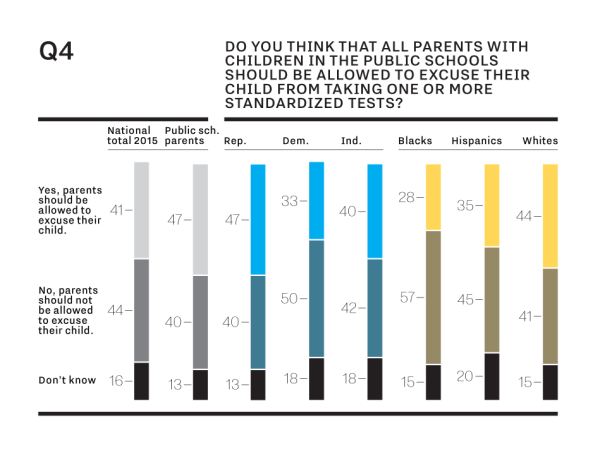
In my new book, I argued that Americans in general retain fairly traditional ideas about schooling and teaching. For many parents, I argued, tests are a common-sense way to measure the effectiveness of schools. In spite of all the attention paid to progressive educational theorists, traditional ideas about testing dominated.  At least, that’s what I argued in my book.  This year’s PDK/Gallup poll makes it harder for me to sustain that argument.Gallup_Q4

This year’s poll asked parents lots of questions about standardized tests. In spite of headlines about families opting out of big tests, most parents do not think that the tests themselves are the most important educational issue.

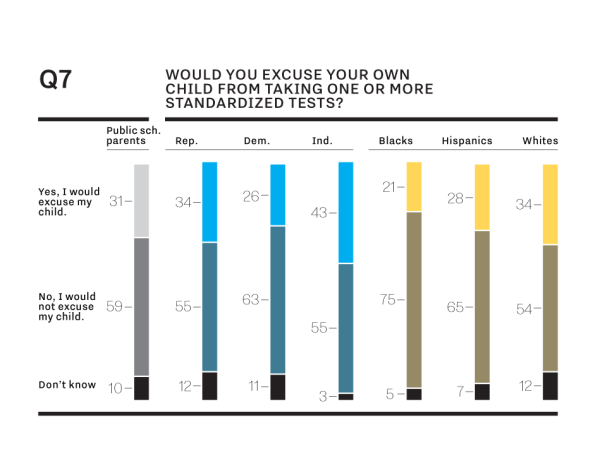
Black parents, however, tended to value high-stakes tests more than white parents. In one question, pollsters asked parents if they should be allowed to pull their kids out of tests. More than half (57%) of black parents said no, compared to only 41% of white parents. When pollsters asked parents if they themselves would pull their kids out of tests, a whopping three-quarters of black parents said no, compared to only 54% of white parents.

Why the difference? We might be tempted to look at this in ideological terms. Perhaps more conservative people in general value testing in general. But that doesn’t fit with the poll numbers either. According to the poll, more Democrats (63%) than Republicans (55%) said they would not excuse their own kids from the mandatory tests. Similarly, more Democrats (50%) than Republicans (40%) thought that parents in general should not be able to excuse their kids from tests.Gallup_Q7

What are we to make of all these confusing results? Of course, we know that “Democrat” doesn’t equal “liberal” any more than “Republican” equals “conservative.” We also know that these majorities are only tendencies, not hard-and-fast rules. But there does seem to be some significant differences in attitudes toward testing between Republicans and Democrats, and between white parents and black parents.

In general, African-American parents seem to value testing more than white parents do. And African-American parents seem less likely to pull their own kids out of big tests.

How can we make sense of this? Is it fair to conclude that African Americans in general have more traditional ideas about schooling than white parents do?

This poll would not be the first evidence of such a trend. As scholars such as Lisa Delpit have argued, African-American children often thrive in fairly traditional, fairly authoritarian classrooms. And, as Theresa Perry and others have argued, African-American culture venerates traditional education.

Hard to say for sure, but it seems as if high-stakes testing is part of a long American tradition. Unlike progressive ideas about building on children’s experiences and making classrooms student-centered, traditional education suggests that children should imbibe knowledge from an authoritative teacher, then demonstrate their mastery of that knowledge on an authoritative test.

Different people have different opinions, of course, but it seems as if African Americans in general value this tradition more than other racial groups do.

Us & Them Visits the Gablers

Who’s in charge of American public education? Some folks say that “progressive” ideas took over education back in the 1930s. John Dewey and his ilk, these folks insist, turned American education in progressive directions. But what about all the ferocious and successful conservative input into what schools teach? In the latest episode of Trey Kay’s Us & Them, Trey looks at the influence of Mel and Norma Gabler since the 1960s.

What Norma says goes...

What Norma says goes…

Trey only has a half-hour to work with, so he couldn’t include the longer historical context. For those in the know, however, Texas’s culture-war battles over textbooks and curriculum go back far longer than the 1960s, and they have changed in bigger ways than he has time to delve into.

Nevertheless, everyone interested in culture wars and education should spend a half-hour with the new Us & Them episode. Trey talks with former Texas board of ed chairman Don McLeroy, as well as with liberal critic Kathy Miller.

Throughout the 1990s and early 2000s, Texas’s fights over textbooks attracted attention nationwide. Conservatives pushed for more traditional visions of American greatness. Liberals fumed that Texas’s culture-war politics doomed schoolchildren to a skewed vision of the past. (For the best introduction to those fights, be sure to check out Scott Thurman’s documentary The Revisionaries.)

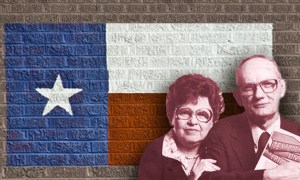
Before those recent battles, however, Mel and Norma Gabler made themselves famous as mom-and-pop culture-war heroes. Beginning in the 1960s, the Gablers insisted on their rights to speak at the hearings of the Texas State Board of Education. They compiled damning lists of factual errors in adopted textbooks. More important, they insisted on revisions to make textbooks more traditional, more religious, and more patriotic.

As you might expect, the Gablers play a leading role in my recent book about conservative educational activism. Long before they waged their gadfly campaign, however, similar culture-war fights roiled educational politics in Texas and elsewhere. Going back to the 1920s, Texas demanded and received special editions of its textbooks. The board demanded the excision of evolution and anti-Southern history. The board only adopted what one publisher in 1926 called “tactfully written” books that did not mess with Texas.

Indeed, when the Gablers became involved, they looked to several existing organizations for guidance and inspiration. As I recount in my book, the first group they looked to was the Texas chapter of the Daughters of the American Revolution. Since the 1920s, the DAR had played a leading role in textbook publishing and culture-war monitoring. In 1951, for example, the Texas DAR mobilized its thousands of members to make sure that schools and textbooks “taught the principles embraced by our forefathers.” That year, the Texas DAR claimed to have sent 1,695 of its members to observe history classrooms across the state.

If we hope to understand culture-war politics, in Texas and elsewhere, we need to be aware of this longer history. We also need to understand the ways 21st-century ed politics have changed. Throughout the twentieth century, conservative activists like the Gablers envisioned themselves as outsiders, charging hard to block the work of a progressive educational establishment. Like the Gablers and the DAR, conservative groups such as the American Legion successfully blocked textbooks they didn’t like.

By the 21st century, however, things had changed. Some conservative intellectuals have argued that dominant efforts in recent education policy, such as the Common Core standards and the No Child Left Behind Act, were actually inspired by conservative ideas and intellectuals. As Michael Petrilli and Frederick Hess of the American Enterprise Institute claimed about NCLB, that law “sketched a vision of reform informed by conservative intuitions and insights.”

Instead of the Gabler-style outsider approach, conservatives these days can claim to have taken over key parts of the educational establishment.

No one can gainsay the enormous influence of the Gablers on educational culture wars in the twentieth century. Everyone who is interested will benefit from listening to the Us & Them episode. Just remember to keep it in historical context!

Conservatives Win US History Fight . . . Again

Why is this so hard to get through our thick skulls? American schooling is not in the hands of progressive teachers and ed-school professors like me. It just isn’t. If we needed any more proof of it, take a look at the College Board’s decision to change its framework for the Advanced Placement US History course. As has always been the case, conservative complaints this time around have been about the implications and tone of classroom materials. My hunch is that many people wouldn’t see what the big deal was about.

Throughout the twentieth century, as I argued in my last book, American conservatives battled—and won—time and time again to control textbooks. Any whiff of progressive ideas was snuffed out before it could become the norm in American classrooms.

A set of progressive social-studies textbooks in the 1930s quickly became libri non grata after conservatives mobilized against it. In the 1970s, another set of progressive textbooks sparked a school boycott in West Virginia that caused a future secretary of education to speak out against progressive-type textbooks.

Now, according to an article in the Washington Post, the College Board has revised its framework for its AP US History class after ferocious conservative complaint. As we’ve discussed in these pages, conservative intellectuals and activists pushed hard to win this prize.

But here’s the kicker: I bet most casual readers of the new framework wouldn’t notice the differences. Now as in the past, the arguments are generally about tone and implication, rather than large-scale differences in content.

In the 1930s, conservative critics of Harold Rugg’s progressive textbooks admitted that most readers probably wouldn’t see the problem. Leading conservative critic Bertie Forbes called the Rugg books “subtly written” so that only an expert could notice the anti-American “insidious implication.” Another anti-Rugg leader warned that Rugg’s books were “very subtle,” not obviously anti-American, but packed with “weasel words” meant to subvert American values.

During the 1970s fight over textbooks, conservatives similarly admitted that a regular patriotic American reader might not see the problem at first glance. But as one conservative leader told an interviewer, the books were all bad, since they had been written with “the attitudes of evolution and all that.” Another conservative admitted that he did not even feel a need to read the actual textbooks. “You don’t have to read the textbooks,” he wrote.

If you’ve read anything that the radicals have been putting out in the last few years, that was what was in the textbooks.

Every time, conservatives have warned, it takes an expert eye to detect the problem with sneaky progressive textbooks.

This time around, too, conservative intellectuals protested against the tone and implication of the new history framework. As a group of leading thinkers wrote in their June protest letter, the rejected history framework

Is organized around such abstractions as “identity,” “peopling,” “work, exchange, and technology,” and “human geography” while downplaying essential subjects, such as the sources, meaning, and development of America’s ideals and political institutions, notably the Constitution. Elections, wars, diplomacy, inventions, discoveries—all these formerly central subjects tend to dissolve into the vagaries of identity-group conflict. The new framework scrubs away all traces of what used to be the chief glory of historical writing—vivid and compelling narrative—and reduces history to a bloodless interplay of abstract and impersonal forces. Gone is the idea that history should provide a fund of compelling stories about exemplary people and events. No longer will students hear about America as a dynamic and exemplary nation, flawed in many respects, but whose citizens have striven through the years toward the more perfect realization of its professed ideals. The new version of the test will effectively marginalize important ways of teaching about the American past, and force American high schools to teach U.S. history from a perspective that self-consciously seeks to de-center American history and subordinate it to a global and heavily social-scientific perspective.

The problem is not that the un-revised new framework didn’t teach US History. The problem, according to conservative thinkers, is that it taught history with a certain attitude, a certain approach.

Is the new framework more conservative? Leading intellectuals seem to think so.

Take the ILYBYGTH challenge: Read the revised framework for yourself. Does it seem “conservative” to you? Where? How? Can you find the differences in tone and approach that conservatives demanded?