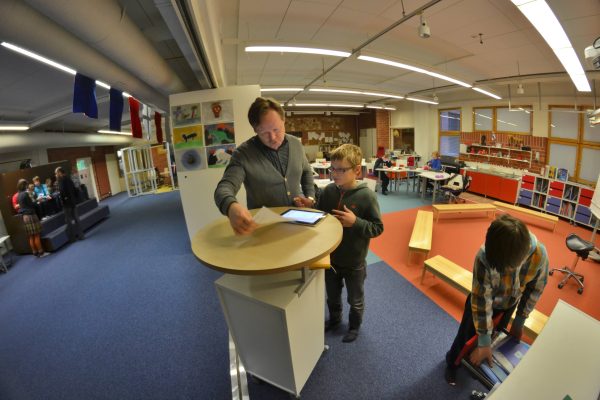
Can You Find the Conservative Education in This Picture?

Gracy Olmstead doesn’t mind tweaking the noses of her fellow conservatives.  She has encouraged them to relax about the dangers of the new(ish) Common Core State Standards, for example.  And now she wants conservatives to embrace Finland’s progressive-education model.

In today’s battles over classroom teaching and school organization, progressives often point to Finland as a guide.  Olmstead wants to claim Finland’s model as one for thinking conservatives.  I’ll admit: I’m stumped.  I can’t find the “conservative” elements Olmstead wants me to see in this picture.

A Conservative Model?

A Conservative Model?

Famously, Finland’s schools shun standardized tests.  Finland’s teachers are an elite cadre of highly trained professionals.  Students in Finland’s schools spend little time cramming or regurgitating information.  Students are encouraged to play, to think, to roam outside the boundaries of classrooms and textbooks.

Most progressives love this model.

Olmstead does too.  She says it embodies the core conservative principle of subsidiarity.  For those of us who haven’t been paying attention to conservative rhetoric for the past couple of years, “subsidiarity” is an old term that has attracted some new conservative devotees lately.  Paul Ryan, for instance, famously invoked the Catholic notion of subsidiarity as the moral justification for his 2012 budget plan.  Though other Catholic intellectuals disputed Ryan’s definition, Ryan used the term as shorthand for Reagan-esque encouragement of localism in government.  The best solutions were those closest to the problems.  Central governments should play only a subsidiary role, tackling issues local folks cannot.

Olmstead finds this principle at the heart of Finland’s school plan.  No centrally imposed curriculum, no dictatorial imposition of one-size-fits-all schooling.  She notes that some conservatives might not like the lack of private options for schooling.  But she does not stress the fact that American conservatives will likely also rebel at the very practices of schooling in Finland.  Olmstead quotes progressive guru Linda Darling-Hammond’s description of Finnish schooling:

In a typical classroom, students are likely to be walking around, rotating through workshops or gathering information, asking questions of their teacher, and working with other students in small groups.

Now, Olmstead’s enlightened conservatism may find this image appealing.  But many American conservatives (not all!) connect traditional classroom practices with effective schooling.  Indeed, one of the constant themes of conservative educational activism throughout the twentieth century, I argue in my upcoming book, has been this connection between traditionalist classroom practice and traditionalist social morality.

I applaud Olmstead’s open-mindedness.  But I wonder how many other conservatives will join her in her embrace of the Finnish model.


A Patriot’s History: The Movie!

What’s a patriotic conservative to do?  So often, history textbooks have been accused of peddling a leftist mishmash of America-bashing and skewed intellectual flag-burning.  As we’ve argued in these pages, for generations conservatives from the American Legion to David Barton have attempted to publish their own history textbooks that tell a more patriotic, more Christian story.

One of the most successful of those textbook efforts has been Larry Schweikert’s and Michael Allen’s 2004 A Patriot’s History of the United States. The book tells the story of the United States in a way that celebrates the triumphs and tragedies of America from a traditionalist patriotic viewpoint.  According to the book’s Wikipedia page, one reviewer from the Heritage Foundation wrote in 2005 that the book centered on a simple premise: “that there are principles and purposes reflected in American history that make this imperfect country worthy of our affection.”  Other reviewers had more hostile opinions.  David Hoogland Noon wrote in the pages of the History Teacher that this book was “written for an audience of the previously converted . . . hardly worth anyone else’s time.”

Via Andrew Palmer at Conservative Teachers of America we see that Schweikert is hoping to turn the book into a movie.  Schweikert has published a four-and-a-half minute trailer.  Tellingly, the dramatic intro promises the film will tell viewers “the history you always knew.”  In other words, the approach of Schweikert and Allen has been to confirm the traditional story of America’s greatness.  Not that this story has been one of unalloyed heroism, Schweikert and Allen might say, but overall the sweep of history has proven the United States to be the greatest nation on earth.

The choice of bits and pieces for this trailer tells us something about the movie’s approach.  First of all, it begins and ends with fireworks.  It includes scenic panoramas of cherry blossoms on the Mall in Washington DC, Ansel-Adams-like vistas of rocky outcroppings, and other traditional American eye candy.  As I watched, I took sketchy notes of some of the featured elements:

  • Happy colonists
  • Heroic suffering in the Revolutionary War
  • Heroic racing in wagons to settle the West
  • The Civil War
  • An Industrial Revolution with awesome achievement
  • D-day and Iwo Jima
  • Immigrants as ardent patriots
  • The Green Bay Packers!
  • Mount Rushmore
  • The Moon Landing
  • Martin Luther King Jr.
  • A jet in Vietnam napalming a field
  • Reagan calling on Gorbachev to tear down this wall
  • Baseball
  • The hockey “Miracle on Ice” of 1980
  • Lots of Fireworks.

Clearly, any movie trailer tells only part of the story.  This one certainly skews toward the positive elements of American history.  Unlike some academic histories, the story of the settling of the West is told as a heroic race to fill in land with settlers, not as the invasion of Europeans and the genocide of the native inhabitants.  As much as what was included, this trailer leaves out some important elements.  I saw no suggestion of race slavery, for example, nor of the systematic extermination of native peoples.

Will conservative teachers and schools embrace the film as conservatives embraced the book?  I don’t see why not.  In my experience, conservative intellectuals don’t want children to read patriotic lies about America’s past, but they do want children to read patriotic truths.  In the case of the American Legion’s 1926 textbook series, for example, as soon as the Legion leadership found out that the book was riddled with errors, the Legion pulled its support.  And as soon as David Barton’s book The Jefferson Lies accumulated accusations of inaccuracy, its original publisher yanked it.

My hunch is that the makers of A Patriot’s History would argue that they do tell the full story of America’s past.  The trailer, for example, did include clips of America’s troubling policy of napalming villages in the Vietnam War.  To be a success, I’m guessing, this film will have to convince conservative audiences of two things.  First, it must seem like a full and true history of these United States.  Second, it must make clear that this country—despite its historical blemishes—is the greatest nation on the earth.

The hard question remains: Would you want your kids to watch it?


Conservative Education for Dummies

How can a conservative person in America be sure her kids are getting a good education?  Relax, says Anthony Esolen in a recent article in the Imaginative Conservative.  It’s easy.  Just follow a few simple steps.

1.) Don’t give up on memorization.

2.) Read good books.

3.) Relax: your kids will get a good education.

Esolen advises conservative parents and school leaders to trust in the natural learning capacities of young people.  Children learn.  If we trust in our instincts, we will help.

One thing that works is to have children memorize things.  Too often, Esolen writes, educators look down their noses at “mere” memorization.  “For fifty years,” Esolen laments, “we have been cowed by the educational ‘experts’ into believing that it is contemptible, simplistic, backward, and ineffectual.”  But memorizing things—whether it’s the multiplication tables or Milton—lies at the heart of education.  Esolen relates the tale of a farmer who memorized Paradise Lost.  This was more than just rote memorization.  This was “getting it by heart,” a process of imbibing a priceless intellectual resource to spark real human-scale education.

What should be the content of this sort of real education?  Esolen wants conservative parents to relax.  There are good books everywhere that can form the base of an effective education.  Too often, Esolen says, educators focus on the crass, the cynical, or even the pornographic in a misguided attempt to expose children to the latest intellectual fads.  Why pervert your children’s minds by assigning Slaughterhouse Five, Esolen asks, when the list of good books is so long and so readily available?  Why not pick from any of the good books all around us:

Heidi, Treasure Island, The Wind in the Willows, The Jungle Book, The Secret Garden, The Yearling, David Copperfield, Silas Marner, Black Beauty, Kim, The Adventures of Robin Hood, Little Women, Oliver Twist, Tom Sawyer, Hans Brinkerthe fairy tales of the Brothers Grimm, and of Hans Christian Andersen.

For older students, pick from

Chaucer, Spenser, Shakespeare, Milton, Keats, Tennyson, Browning, Whittier, Dickinson, Frost, and many more. We have all of the wonderful novels of Jane Austen and Dickens and Eliot and Mark Twain and Walter Scott. There’s the great literature of the western world—Virgil and Dante and Cervantes and Tolstoy.

Relax.  Esolen insists, this process is “not like going to the moon. It is like looking up at the stars.”

If you educate your children this way, Esolen writes, no standardized test will have the power to frighten or dismay them.  They will know more than children educated by the most modern methods.  Indeed, they will know things, and other children will not.

What is a conservative parent to do?  According to Esolen, the answer is clear: Relax.  The tried-and-true methods and content of schooling are still the best.


ILYBYGTH in EdWeek: Progressive Education and the Conservatives Who Love It Too Much

Why do so many conservatives and creationists insist that they want more “critical thinking” in public schools?  In a recent commentary in Education Week, I argue that this trend is part of a longer tradition of anti-authoritarian education.

In the pages of EdWeek, I examine some of the new laws that have rightly been called “anti-evolution” efforts.  They usually are that.  They hope to introduce wiggle room in public-school science classes for creationist students and anti-evolution teaching.  A Virginia bill that recently died a lonely death in committee, for instance, would have insisted that students “develop critical-thinking skills, and respond appropriately and respectfully to differences of opinion about scientific controversies in science classes.”

I think, however, that the conservative impulse to encourage critical thinking among students goes even deeper than the evolution issue.  As I argue in the EdWeek commentary, several other legislative efforts in recent years have allowed students to opt out of school assignments that seem ideologically outrageous to students and parents.

Are these opt-out efforts “progressive?”  After all, they embody the anti-authoritarian ethos at the heart of progressive education.  But they do so for demonstrably conservative purposes.  Has the ideology of school dissent come full circle?

“The Long Game” Is Coming to Binghamton

What do schools teach?  What SHOULD schools teach?  The problem is not that we don’t have an answer to this question.  The problem is that can’t agree on which answer is the right one.

Tomorrow night award-winning documentarian Trey Kay is bringing his latest radio documentary to the scenic campus of Binghamton University in sunny Binghamton, New York.  This work, “The Long Game: Texas’ Ongoing Battle for the Direction of the Classroom,” explores school politics in the Lone Star State.  As ILYBYGTH readers know well, those Texas politics tend to be more exciting versions of the sorts of school fights we hear all over the country: Can cheerleaders use the Bible at public-school football games?  Can textbooks preach a neo-Confederate vision of US History?  Can creationism and evolution jostle along side-by-side in public-school science classes?

long gameThe battles in Texas schools reflect our cultural disagreements over the proper form of public schooling.

Tomorrow evening, Trey will share an excerpt from his earlier documentary, “The Great Textbook War.”  Then we’ll listen to “The Long Game.”  Afterwards, we’ll benefit from Trey’s commentary, as well as that of world-renowned historian Jonathan Zimmerman of New York University.  Binghamton’s own Matt McConn, a recent émigré from Houston public schools, will also join the panel.

Unfortunately, we won’t be web-streaming the event.  But for all those who can make it to the Binghamton area, you are most welcome to attend.  The fun will begin at 6 PM, Thursday, February 27, in University Union room 120, on the campus of Binghamton University.  The event is free and open to the public.  Pre-registration has closed, but everyone is still welcome to come by without registration.

Conservatives: Shut Up and Love the Common Core

What are conservatives to make of the Common Core State Standards?  As we’ve seen, some conservatives hate them.  Some don’t mind them.  Today we see a plea for conservatives to embrace the new standards as the best hope to fulfill long-held conservative school dreams.

In the Burkean pages of The Imaginative Conservative, Kevin T. Brady and Stephen M. Klugewicz argue that the new standards hold promise.   Forget threats that the new standards are a new federal power grab.  Forget worries that the new standards will water down our cultural heritage.  Forget predictions that school children will be forced to memorize Maoist proverbs.

Take a closer look, Brady and Klugewicz write, and conservatives will see plenty to like about the new standards.  The suggested readings include conservative favorites such as TS Eliot, Patrick Henry, GK Chesterton, and none other than Ronald Reagan.

Though some on the political Right have created a “straw man” out of the new standards, Brady and Klugewicz argue that the standards will actually serve to weaken the power of the political Left.  After all, the authors say, “teachers and educational bureaucracies already tend to lean Left.”  Too many teachers are woefully ignorant of true history and traditional literature.  The new standards will force such ideologically slanted teachers to explore the real cultural heritage of Euro-American civilization.

For instance, in order for a teacher to teach students Martin Luther King Jr.’s “Letter from Birmingham Jail,” teachers will need to connect with their heritage.  “In order for [teachers] to understand what King is writing about,” the authors contend,

teachers need to know who the 8thcentury B.C. Hebrew prophets were. They need to know a little about Paul of Tarsus, the Macedonian call, Socrates, Augustine, Thomas Aquinas, Shadrach, Meshach, Abednego, Roman persecutions, the Boston Tea Party, Hungarian freedom fighters, Jesus, Elijah Muhammad, Amos, Martin Luther, John Bunyan, Lincoln, Jefferson, and T.S. Eliot to understand King’s meaning. King spoke to an audience of clergymen and to many others who shared a common educated culture. If teachers do not know these references, they cannot teach this landmark document accurately. Moreover, teachers in Catholic schools are free to ignore the exemplars entirely and use Christian/Catholic texts: Thomas á Kempis, Thomas More, even papal encyclicals. Such a text-based approach ought to please conservatives, who have complained about the trend of “deconstructing” texts and promoting the idea that it is how the student “feels” about a text that is important, not what the text actually says.

We must note that one of the authors seems to have more than academic interest in the success of the new standards.  Kevin Brady owns a company that sells Common-Core aligned materials to schools.  The success of the Common Core will help his own wallet.  That said, the notion that all of America’s schoolchildren should learn a common core of knowledge does have long roots among American conservative educational thinkers.  Long before ED Hirsch, prominent conservative reformers such as Max Rafferty insisted that the way to fix American education is to give every student and every teacher a healthy dose of a common core of cultural knowledge.  And a generation before Rafferty’s leadership, curmudgeonly conservative Albert Jay Nock insisted that real learning should include the “Great Tradition” of learning first and foremost.

For almost a century, then, conservative thinkers and activists have yearned for a common core for America’s school children.  Is the Common Core the fulfillment of these conservative dreams?


Registration Is Open!

You are invited.

In a few weeks, Binghamton University’s Graduate School of Education will be hosting a terrific event.  Documentarian Trey Kay will be sharing his new radio documentary, “The Long Game: Texas’ Ongoing Battle for the Direction of the Classroom.”  You probably remember Trey from his award-winning documentary about the textbook battle in West Virginia, 1974-1975.  In his new work, Trey explores the themes so close to the hearts of ILYBYGTH.  Should schools teach creationism?  Should they teach sex?  If so, how?  And what sorts of history should public-school students learn?  Should students be taught that America is awesome?  Or that the United States has some skeletons in its closet?  There has been no place more interesting than Texas to see these politics in action.

long game

After the listening session, Trey will offer a few comments.  He’ll be joined by the world-famous historian Jonathan Zimmerman of NYU.  ILYBYGTH readers will likely know about Zimmerman’s books, including especially his seminal work Whose America.  In addition, BU faculty member Matt McConn will say a few words.  McConn is new to New York, fresh from a long career as a teacher and school administrator in Houston.

There will even be cookies.

So please come on down if you’re in the Upstate area.  It will take place on Thursday, February 27, at 6 PM, in room G-008 in Academic Building A, on the beautiful main campus of Binghamton University.

We’d love to have you.  The event is free and open to all, but registration is required.  To register, please go to the BU registration site.

Save the Date!

Keep your evening free on Thursday, February 27th.  Here on the beautiful campus of Binghamton University in sunny Binghamton, New York, we’ll be hosting a listening session and panel discussion about Trey Kay’s new radio documentary, “The Long Game: Texas’ Ongoing Battle for the Direction of the Classroom.”

Readers may remember Trey Kay’s earlier award-winning radio documentary, “The Great Textbook War.”  In that piece, Trey explored the 1974-1975 battle over schooling and textbooks in Kanawha County, West Virginia.  In that fight–a fight that is also the subject of a chapter in my upcoming book–conservatives worried that a new textbook series presented students with perverted values and distorted grammar.

In his new documentary, Trey looks at ongoing ideological battles in Texas.  As filmmakers such as Scott Thurman and activists such as Zack Kopplin have demonstrated recently, there has been no better field for exploring cultural conflicts in education than the great state of Texas.

The details of our upcoming February 27 event are not yet finalized, but the general plan is clear.  We’ll be listening to “The Long Game,” then Trey and NYU’s electrifying historian Jon Zimmerman will offer a few comments, followed by a general discussion and Q & A.  I’ll post more details as they come available.

Common Core Poisons the Well

What’s wrong with the Common Core?  According to one conservative scholar, it threatens to take away the very glue that holds our culture together.

As we’ve seen, no one is quite sure what to make of the new Common Core State Standards.  In addition to debates over the efficacy of these new curriculum and assessment tools, progressives and conservatives all argue about whether or not these standards are ideologically dangerous.  Some conservatives say the standards are anti-Catholic.  Others blast them as a “progressive beer bong.”  Still other conservatives defend the Common Core standards as the least bad approach to public schooling.

In a recent speech, historian Terrence O. Moore of Hillsdale College revived another accusation: The Common Core is taking away our great stories.  According to the Christian Post, Moore blamed the new standards for culture-cide.  The standards, Moore insisted, “attempt to take away the great stories of the American people and replace them with the stories that fit the progressive, liberal narrative of the world.”

Too often, Moore concluded, the new standards encourage teachers and students to read about our culture’s great narratives, rather than spending time with the narratives themselves.  As a result, Moore said, the real aim of education is thwarted.  Instead of pushing the Common Core’s goal of “college and career readiness,” real education should push young people to become more human.

In his new book on the subject, Moore spells out his argument in fuller depth.  I admit, I haven’t read the book.  But I wonder if Moore is aware of his ideological genealogy.  In his book, Moore blames “The Story-Killers” of the Common Core standards for turning students away from their rich intellectual heritage.  He offers a “common-sense” solution to the problem.  With the general argument and even the offer of a new common-sense conservative approach to schooling, Moore is reviving the 1960s-era talk of Max Rafferty.

Max Rafferty isn’t a name we hear much in conservative talk about schooling and education, but it should be.  As California’s State Superintendent of Education in the 1960s and as a popular syndicated columnist, Rafferty spelled out many of the ideas that Moore seems to revive.

For example, in a 1963 collection of his newspaper columns, Rafferty complained of the mindless watering down of curriculum.  Students used to read our culture’s great stories, but since the 1930s more and more of them had been brutalized with intellectual pablum.  If you doubted it, Rafferty wrote, just try this experiment: Take any class of students.

suddenly, as though opening an enchanted window upon a radiant pageant, give them the story of the wrath of Achilles. . . .

Watch their faces. . . .

This is teaching.  This is what you trained to do. . . .

Let us say to these diluters of curricula, these emasculators of texts, these mutilators of our past, ‘We have had enough of you.  The world is weary of you. . . . With your jargon of behaviorism and Gestalt and topological vectors and maturation levels, you have muddied the clear waters of childhood long enough.  You have told us to teach the whole child, but you have made it impossible to teach him anything worth learning.  Little by little you have picked the meat from the bones of Education and replaced it with Pablum.  You have done your best to produce a race of barely literate savages.

Just as Moore apparently does in his recent book, Rafferty insisted that the solution for this “utilitarian” nonsense was simple “common sense.”  In a 1964 book, Rafferty laid out his vision of the power of common sense.  “Common sense,” Rafferty insisted,

                told us that the schools are built and equipped and staffed largely to pass on from generation to generation the cultural heritage of the race.

Common  sense took for granted that children could memorize certain meaningful and important things in early life and remember them better in later years than they could things that they had not memorized.

Common sense in recent years believed that putting children of like abilities together for at least a part of their school experience would help them to find their own rate of achievement and advance accordingly.

Common sense, since anyone could remember, had always held that children who did their homework covered more ground in school and learned more than children who didn’t.

Common sense told us that discipline, like good manners, had to be taught to a child over a period of years.

Does Professor Moore know about Rafferty’s arguments?  Or do these ideas just cycle back around for conservative intellectuals?

Max Rafferty’s books used to be widely read.  Not so much anymore.  I wonder if more conservatives would be interested in digging into their own intellectual heritage.

Learning by Discipline

What should schools do with students who behave badly?  Who assault other students?  Who treat teachers disrespectfully?

A new announcement about school discipline from Education Secretary Arne Duncan and Attorney General Eric Holder might drive some conservative pundits to distraction.  Discipline, the two leading officials of the Obama Administration announced yesterday, must be more sensitive to student background and more responsive to individual situations.  Blanket zero-tolerance policies, they proclaimed, lead to worse school discipline, not better.

Those zero-tolerance policies, however, grew out of a groundswell of popular conservative opinion throughout the 1980s and 1990s.  Conservative commentators and activists long complained that schools treated students too gingerly.  Good old-fashioned discipline, some conservative writers insisted, would help return schools to their proper role.  Instead of being places where polite students and teachers cower and wince at the domineering swagger of loud-mouthed punks, schools should be calm and orderly places where infractions of the rules are not tolerated.

Some studies have demonstrated the central importance of a reinvigorated school discipline to many conservative parents in the 1980s.  One Stanford study[1] of two new fundamentalist schools in the 1970s and 1980s found that leaders put bad discipline in public schools as one of their top reasons for opening their own school, right up there with “secular humanism,” “evolution teaching,” and the fact that “kids weren’t learning.”  In a fundamentalist school that opened in September 1974 with a grand total of eleven students, one teacher informed the Stanford researcher that most parents assumed that the fundamentalist school was “solving discipline problems the public schools could not.”

Another study, this one from Temple University in Philadelphia,[2] found that parents listed poor discipline as one of their top reasons for abandoning public schools in favor of private Christian ones.  Nearly 65% of switching parents listed “discipline” as a leading reason for changing schools.  By way of comparison, just over 68% of parents listed “secular humanism” as a primary reason for their switch.

It may come as no surprise that some conservative parents choose Christian schools out of fear of disorderly public schools.  Leading conservative religious writers throughout the 1980s insisted that public schools had utterly abandoned all attempt at imposing discipline.  Jerry Combee, for example, warned readers in a 1979 book,

Without Biblical discipline the public schools have grown into jungles where, of no surprise to Christian educators, the old Satanic nature ‘as a roaring lion, walketh about, seeking whom he may devour’ (I Peter 5:8).  Students do well to stay alive, much less learn.

Similarly, in his 1983 book The Battle for The Public Schools, blockbuster fundamentalist author Tim LaHaye insisted that one of the vital reforms that could save education was a return of traditional discipline.  As LaHaye put it, “We must return discipline, authority, and respect to public schools”

In 1986, conservative Texas school watchdogs Mel and Norma Gabler asked readers, “Why has discipline become so bad that policemen must patrol the halls of many schools?”  The Gablers’ answer was simple:

We were taught that if you plant potatoes, you get potatoes.  If you plant rebellion and immorality in children’s minds by teaching them that only they can decide what is right and wrong, that parents are old-fashioned, and that the Judeo-Christian Bible is a book of fairy tales, then what can you expect?  Garbage in—garbage out!

These conservative critiques of the sorry nature of school discipline were not limited to conservatives of a primarily religious background.  After his turn as Education Secretary under Ronald Reagan, William J. Bennett lamented the sorry state of school discipline.  In his 1994 book Index of Leading Cultural Indicators, Bennett cited a fraudulent but evocative historical comparison:

In 1940, teachers identified talking out of turn; chewing gum; making noise; running in the halls; cutting in line; dress code infractions; and littering [as “top problems”].  When asked the same question in 1990, teachers identified drug abuse; alcohol abuse; pregnancy; suicide; rape; robbery; and assault.

Due at least in part to this widespread sense that American public schools had reached a nadir of weak discipline, many states and school districts imposed variants of “zero-tolerance” policies.  According to these policies, student infractions would be met with an escalating series of ever-harsher punishments, including out-of-school suspensions and reports to police.  Politicians could claim that they were taking action to ensure a no-nonsense disciplinary attitude in America’s schools.

Yesterday’s announcement by Arne Duncan and Eric Holder represents the Obama administration’s repudiation of that zero-tolerance approach.  Though “zero-tolerance” may sound good, Duncan told an assembled crowd at Frederick Douglass High School in Baltimore, “Too many schools resort too quickly to exclusionary discipline, even for minor misbehavior.”  According to the Baltimore Sun, Duncan described a new federal approach that would de-emphasize suspensions and put more emphasis on creating nurturing in-school environments.  Attorney General Holder agreed.  Principals, not police, should be responsible for school discipline, Holder insisted.

Will conservatives care about this shift in school disciplinary policies?  If history is any guide, I’m guessing that conservatives will paint this new policy as yet another soft-headed, over-complicated liberal approach to a simple problem.  Folks such as Eric Holder and Arne Duncan may worry that zero-tolerance policies unfairly target racial minorities, but I’ll be surprised if conservative educational activists don’t complain that such social-science talk only obscures a far more obvious point.

If students misbehave in school, conservatives will likely insist, they should not be allowed to be in school.


[1] Peter Stephen Lewis, “Private Education and the Subcultures of Dissent: Alternative/Free Schools (1965-1975) and ChristianFundamentalistSchools (1965-1990),” PhD dissertation, StanfordUniversity, 1991.

[2] Martha E. MacCullough, “Factors Which Led Christian School Parents to LeavePublic   School,” Ed.D. dissertation, TempleUniversity, 1984.