Bizarre Attacks on Conservatives

Watch out! Conservative ideas might subject you and your family to thuggish home invasions. Even more creepy, conservative ideas might get you erased from your own personal history. As we observe American conservatism from the outside here at ILYBYGTH, we’ve noticed the steady stream of conservative complaints about persecution. Today’s crop of victim alerts, though, rises to a new level of weirdness.

As one sophisticated and good-looking regular reader of I Love You but You’re Going to Hell (SAGLRROILYBYGTH) noted recently, conservatives are not the only ones to emphasize their own status as victims. Patrick asked,

Who doesn’t emphasize their own victimhood these days? Perhaps the question should be why doing so has become an American tradition. One way of looking at it is to point out that we are an optimistic bunch, perpetually hopeful that if we consistently expose unfairness and hypocrisy, we will help solve the problem by raising awareness of it. Why else would the news always be so depressing?

It makes intuitive sense that every side in our tumultuous culture wars would complain loudly about their own suffering. It is the same dynamic as any family squabble. Victims get justice. Aggressors get punished, at least in theory.

Bubbling up from the conservative commentariat this morning we find two new claims to victimhood. In Wisconsin, we hear, conservative activists have been subjected to jackbooted attacks. And one high school has taken steps to erase its memory of one of its conservative graduates.

First, to Wisconsin: David French’s exposé of hardball culture-war politics tells the story of mild-mannered conservative families subjected to brutal attack. In the aftermath of Wisconsin’s Act 10, conservatives have been targeted as part of a concerted campaign to embarrass and humiliate them. In short, according to French, Milwaukee District Attorney John Chisholm pushed a “John Doe” investigation of Wisconsin conservatives.

In this kind of investigation, proceedings are kept secret. Investigators have wide latitude to seize relevant documents. As a result, conservative activists had their homes invaded by terrifying police agents. Doors were pounded on. Floors were stomped on. Children were shaken out of bed. Neighbors gathered and gaped. Conservatives were threatened. Computers and phones were seized. Dogs barked.

As French put it, “For select conservative families across five counties, this was the terrifying moment — the moment they felt at the mercy of a truly malevolent state.”

These raids turned at least one Wisconsin conservative into an outlaw, in her imagination at least. As she explains,

I used to support the police, to believe they were here to protect us. Now, when I see an officer, I’ll cross the street. I’m afraid of them. I know what they’re capable of.

Yikes.

Conservatives targeted for home invasions precisely because of their conservative activism. Police used as intimidation agents, to harass and intimidate political activists. All bluster aside, these are profoundly disturbing charges.

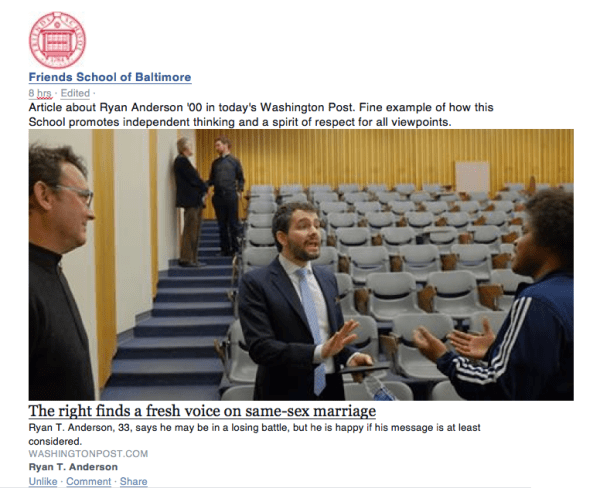
Even more bizarre, though, is the story coming from a Baltimore high school. Ryan T. Anderson, an outspoken opponent of gay marriage, was first lauded, then removed, from his high school’s Facebook page.

Anderson had been the subject of a front-page story in the Washington Post. The article called Anderson a “fresh voice” for traditional marriage.

At first, according to a story in the Heritage Foundation’s Daily Signal, Anderson’s high school posted news of this alumni success on its Facebook page. Later, the school took down the post. Why? In the words of school head Matt Micciche,

I can understand why the belief that Mr. Anderson’s views were being endorsed by the school would be deeply troubling to some members of our community. The nature of these views goes beyond the realm of abstract political ideology and calls into question the fitness of same-sex families to raise children and the right of gay and lesbian citizens to marry the person they love. While Mr. Anderson undoubtedly has the right to express such views, by posting this article we created legitimate confusion as to whether or not they were being validated by the school.

Maybe it is less scary to be removed from Facebook than to have one’s house broken into by aggressive police, but the implications of this Baltimore story are, IMHO, more sinister.
We're proud of our alumni!  Oh, wait...no.

We’re proud of our alumni! Oh, wait…no.

By removing notice of the significant conservative accomplishments of Anderson, his alma mater, in effect, suggested that conservatism is somehow shady, illegitimate, disreputable . . . even shameful.

I don’t say this as an endorsement of Anderson’s ideas. Nor do I claim to understand the intricacies of Wisconsin’s culture-war politics. For those of us trying to understand conservatism and the culture wars, though, both these stories raise important questions:

  • Is it legitimate to oppose same-sex marriage?
  • Do conservatives have a claim to victimhood?
  • Do these strange stories offer proof that conservative thinkers and activists have been uniquely and unfairly persecuted?
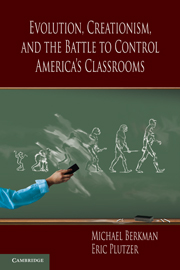
Enablers of Doubt: This Afternoon!

For those of us lucky enough to live in scenic Binghamton, New York, don’t forget that tonight Binghamton University hosts Professor Michael Berkman from Penn State. Tonight’s talk is part of the regular Monday seminar series at the Evolutionary Studies Program.

Professor Berkman will be sharing his new research into the ways pre-teachers learn to avoid and water down evolution education.  These “enablers of doubt,” Professor Berkman argues, do everything they can to avoid ruffling feathers.  Most new teachers, Berkman has found, are more interested in learning ways to control classrooms than in learning the details of scientific theories.

The sophisticated and good-looking regular readers of ILYBYGTH (SAGLRROILYBYGTH) will remember Professor Berkman’s earlier ground-breaking research into the goings-on in science classrooms nationwide.  Along with his colleague Eric Plutzer, Prof. Berkman studied the ways science teachers do and don’t teach evolution.

Required reading for anyone interested in evolution/creation issues

Required reading for anyone interested in evolution/creation issues

For those in the area, come on over to campus.  The talk will take place in Academic Building A, basement room G-008.  It will begin at 5:05 and will include time for a Q&A session afterward.  Admission is free and no registration is required.  The event is open to all.

What Should We Tell Our Kids about Terrorism?

Your humble editor will be participating today (3/12/15) at noon (EST) in a live chat on HuffPost Live about exactly that question.

Sparked by a controversy from a Scottish school, host Nancy Redd will lead a talk about our struggles to determine how to discuss touchy subjects with young people.

Hope all the sophisticated and good-looking readers of ILYBYGTH out there (SAGLROILYBYGTH) can tune in.  Looks like the format welcomes guest comments, too, so be sure to get your two cents in.

Save the Date!

I’ll be giving a talk in scenic downtown Binghamton, New York about my new book. The central question won’t be a surprise to the sophisticated and good-looking readers of ILYBYGTH (SAGLROILYBYGTH): What has it meant to be “conservative” about education in the United States?

The place to be...

The place to be…

The talk will take place on April 21, at 6:30 PM, at the RiverRead Bookstore on Court Street, next to the riverwalk.

For those of you who can’t make it, there are still some good ways to get the gist. First, you can buy the book, you cheapskate.   Second, check out the short interview about it on National Review.

For those lucky enough to live in the Binghamton area, come on down!

Religion, Education, and the Modern University

Why go anywhere else?  Binghamton University is the most exciting school in the universe.  Coming up next Monday, I’ll take part in a panel discussion on our campus radio station about the role of religion in higher education.  Set your radios to 90.5 WHRW, Monday, February 23, at 6:30 to tune in on the action.  Or, for those unlucky few outside of our immediate broadcast area, just point your browser at the streaming feature to listen online.

Where the action is! Monday, February 23, 6:30 PM EST.

Where the action is! Monday, February 23, 6:30 PM EST.

Conservatives, Evolution, and “The Question”

“Do you believe in evolution?”

That’s the question GOP presidential candidates dread. Governor Scott Walker of Wisconsin is the latest to hem and haw his way through an awkward press conference on the subject.

Of course, some GOP contenders have no need to fear. Ben Carson, for example, is a loud and proud young-earth creationist. But other potential nominees have had to dodge, duck, dive, and dip when the question comes up. Bobby Jindal, a former biology major at an Ivy League college, has confessed that he wants his own children to learn evolution. That doesn’t mean schools must teach it, though. Jindal wants “local schools” to decide what’s right for them. And Marco Rubio famously told GQ magazine that he was “not a scientist, man.”

Walker is the latest GOP notable pressured to answer “The Question.” At a London press conference, Walker did his best to avoid it. In the end, though, Walker felt obliged to clarify that he strongly believed that humanity was created by God, and that faith and science are compatible.

It has become such a staple of GOP press conferences that conservative pundits cry foul. Writing in the pages of the National Review, for example, Jonah Goldberg says these evolution questions are a cheap stunt, a way to make conservative candidates squirm. As Goldberg put it,

To borrow a phrase from the campus left, Darwinism is used to “otherize” certain people of traditional faith — and the politicians who want their vote.

As fellow conservative writer Kevin D. Williamson correctly pointed out, leading mainstream scientists will also insist that they don’t “believe in” evolution. Rather, they simply know it; they take it to be the best current explanation and model for understanding the way species have changed and developed.

Yet no matter how you slice it, “the question” has become a defining feature of Republican presidential candidates. Even candidates who seem personally to embrace mainstream evolutionary science are loath to alienate conservative religious voters. For many of those religious voters, evolution has become a moral litmus test, not just a statement of personal belief.

What Do Conservatives Think?

I’ve been dying to know: What will conservatives think of my new book? Will they agree that I’ve tried to take an even-handed approach? Will they protest that I misunderstood the nature of “conservatism?”

Last week we received an encouraging review from a conservative ILYBYGTH reader. Today we read with interest the opinion of a conservative activist who played a leading role in the events described in the book.

Years ago, when I journeyed down to Charleston, West Virginia to research chapter five, Karl Priest was kind enough to take time to talk with me about his memories of the 1974-75 textbook protest. We also talked about his ideas of evolution, creationism, Christianity, and proper education. Since the 1975 protests, Priest has been an educational activist. On his blog, he recently posted a detailed review of my book.

According to Mr. Priest, the book has some good parts, but it also misrepresents the conservative side of the 1974-75 protest. He is consistently kind to me personally, noting that I am “a gentleman and a scholar.” He also concludes by saying,

For anyone willing to study, Dr. Laats’s book provides a comprehensive history of major conservative battles against progressivism.

Mr. Priest also concedes that at some points I capture fairly the thinking of Kanawha County’s conservatives. But he warns that my liberal biases blind me to the truth of the Kanawha County textbook battle. He insists that I “intentionally slurred” the book protesters in the opening of chapter five.

For those who would like to read his detailed critique of my argument, Mr. Priest has added a section to the review in which he moves point by point through the chapter.

Is he correct? In a few cases, I think he makes valid points. For example, he notes that I awkwardly wrote that one protester prayed with a fellow inmate and “saved” him. As Mr. Priest points out, no protester would use such language. The child was saved, but through the power of God, not through the doings of the protester.

More often, however, I think Mr. Priest is blinded by his own partisan interests. I say it with great respect and with gratitude for the time Karl has spent talking with me. In general, however, I think he is overly convinced that the textbook protesters could do no wrong. He assumes too much about the radical nature of textbook supporters.

For instance, he writes that the National Educational Association was not a mainstream group, but rather “an outside left-wing extremist group.” That does not seem a fair statement. The NEA was indeed generally associated with left-of-center politics, but it was entirely within the mainstream of American politics and culture.

As an historian, I have to examine the evidence and come to conclusions about controversial events. Karl is entirely correct that I’m influenced by my own biases, even when I don’t think I am. I encourage readers to check out his review and chime in with their own thoughts.

Feed ‘Em to the Lions!

HT: KP, DW

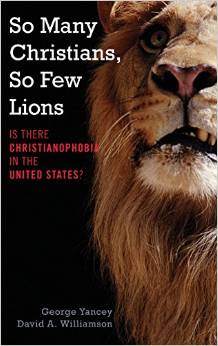
Are Christians persecuted in American culture? Two sociologists say yes. Elite attitudes, David Williamson and George Yancey say, are dominated by a vicious self-righteous “Christianophobia.”

In the pages of the Christian Post, Yancey lays out the argument of his recent book, So Many Christians, So Few Lions. There are plenty of Christians around, they say. But among certain influential elites, they noticed “unnecessary vitriol and fears” about evangelical Protestantism.

Do YOU feel persecuted?

Do YOU feel persecuted?

The problem, Yancey explained, is that this particular form of bigotry does not see itself as bigotry. Anti-Christian elites tend to see themselves as anti-bigots, fighting the forces of religious obscurantism. As Yancey put it, Christianophobes think

Christians are ignorant, intolerant and stupid individuals who are unable to think for themselves. The general image they have of Christians is that they are a backward, non-critical thinking, child-like people who do not like science and want to interfere with the lives of everyone else.

But even worse, they see ordinary Christians as having been manipulated by evil Christian leaders and will vote in whatever way those leaders want. They believe that those leaders are trying to set up a theocracy to force everybody to accept their Christian beliefs. So, for some with Christianophobia, this is a struggle for our society and our ability to move toward a progressive society. Christians are often seen as the great evil force that blocks our society from achieving this progressive paradise.

The authors note that there is also a good deal of bigotry toward atheists. It is the elite status of the anti-Christian bigots, they say, that makes it so troublesome. It is difficult to get elected to public office as an atheist, they note, because so many average voters dislike atheism. On the other hand, Christianophobia might cause Christians to have a harder time winning scholarships and admission to elite universities, where Christianophobes dominate.

Even for non-evangelicals like me, it is easy to see some intuitive truth in these claims. At a big public university like mine, it might be difficult for conservative evangelicals to avoid certain dismissive attitudes among their professors or colleagues.

Poll data also suggests some truth to these anti-Christian claims. Consider the results of a 1993 Gallup poll, for instance, in which 45% of respondents admitted they had a “mostly unfavorable” or “very unfavorable” view of “religious fundamentalists.”  Or a similar Gallup finding from 1989, in which 30% of Americans admitted they would not like to have “religious fundamentalists” as neighbors.

Such poll results, one might object, do not fairly specify the meaning of “fundamentalist.”  The folks answering such questions might have objected to living next door to Osama bin Laden as much as they did to Jerry Falwell.  The 1993 poll, for instance, found that only 25% of respondents had a “mostly unfavorable” or “very unfavorable” view of “born-again Christians” in general.  And in the 1989 poll, even 24% of the respondents who identified themselves as “evangelical” said they would not want to live next door to a “religious fundamentalist.”

Consider also, the work of prominent sociologist D. Michael Lindsay. In his 2007 book Faith in the Halls of Power, Lindsay interviewed hundreds of Christians in influential positions. If these religious folks are our leaders, we might ask, where is the Christianophobia Yancey and Williamson warn against?

Happy Thanksgiving: Our Culture-War Holiday

Ah, Thanksgiving…when families gather to eat birds, watch football, and shout at each other. The Thanksgiving tradition of fighting over issues such as gay rights, abortion, taxes, and school prayer has been hallowed by generations of angry get-togethers. After all, when you put a bunch of people around a table, related only by genetics, and feed them too much tryptophan and wine, culture-war fireworks are bound to happen. Today we’ll share some of the punditry about Thanksgiving culture-war battles we’ve gathered from minutes of browsing the interwebs.

I Disagree with You, but I Respect your Commitment to your Position!

I Disagree with You, but I Respect your Commitment to your Position!

1.) Progressives Use Thanksgiving to Convert Conservatives:

At National Review Online, Katherine Timpf cocks a snook at “ridiculous” progressive suggestions for fixing conservative family members. Progressives, Timpf warns, are out to get conservatives this year. Some progressives threaten to turn the Macy’s parade into a feminist diatribe. Others will blather on about the fact that many Americans don’t celebrate Christmas. Some might seize upon the progressive missionary opportunities of the occasion, buttonholing conservative relatives on the issue of climate change, then following up with an email from the Union of Concerned Scientists. If conservative evangelical or “Tea-Party” relatives try to belittle gay marriage or Obamacare, some progressives advise their minions to take conservatives down with prepared statements from the government or the book of Leviticus. And, of course, just to make sure everyone suffers from indigestion, there is at least one progressive pundit out there advising folks to use Thanksgiving to laud the Common Core.

2.) How to Win a Thanksgiving Argument with Conservative Relatives:

At Policy.mic, Gregory Krieg offers a progressive how-to guide for culture-war arguments. Your conservative “bloviating cousin,” Krieg warns, will certainly bring up some culture-war issues. Krieg offers ways to put conservatives in their places on issues such as the Ferguson riots, Obamacare, Obama’s immigration plans, Bill Cosby’s alleged serial rapes, legalizing marijuana, and more. In each case, we’re told, there are factual, reasonable rebuttals to the sorts of “unreasonable, knee-jerk opinions” conservative relatives will be spouting.

3.) How to Publicly Shame your Conservative Uncle:

From an Iowan progressive, we see a few tips on ways to beat your conservative uncle in holiday arguments. It’s important, progressive Iowan Trish Nelson warns, not to “appear too thoughtful—conservatives may confuse this for weakness.” After pounding your conservative relative with piles of facts to explode his ill-considered myths, Nelson promises,

your conservative Uncle will be roasting in his own myths and half truths, so forgive him if he’s a bit thrown off. Take your time and be patient, let him fully cook, and patiently explain the error of his ways.

4.) Again with the “Crazy Right-Wing” Uncle!

I don’t know why uncles are the repository for conservatism this year, but from the LA Times Joel Silberman offers progressive advice on handling a conservative uncle. Don’t fall for the temptation to be polite, Silberman suggests. It is a “patriotic” act to pick fights with your conservative relatives at Thanksgiving. Why? Because these days we don’t often get a chance to engage with people from the ‘other side’ of culture war issues. [Editor’s Note: Unless, of course, we read and comment in the pages of ILYBYGTH!] To be fair, Silberman is not advising the sort of knock-down, drag-out, drumstick-wielding family kerfuffle that I remember so fondly from my childhood. Instead, he suggests that everyone guide their discussion with “respect and know when to stop, and remember that relationships are more important than righteousness.”

Good advice, and a good place to stop. But just like every Thanksgiving fighter ever, I can’t resist getting in one last word. Instead of preparing arguments to win Thanksgiving showdowns, what if we progressives all spent time learning the best arguments our conservative relatives might make? Certainly nothing is less productive in culture-war battles than sitting back smugly and assuming our mastery of “facts” will soon bring our “myth”-laden opponents to their knees.

Rather, why not take an ILYBYGTH approach? Why not do some homework to learn why intelligent, informed conservatives might hold the positions they hold? Why not assume that people of good will might disagree sincerely on abortion, Obamacare, homosexual rights, evolution, and even the Common Core?

After all, the way to quiet a jerkface loudmouth uncle is not to publicly shame him. Rather, it might be more productive if we all studied the best arguments our culture-war opponents might make. Instead of asking: How can I trounce that argument? What if we asked: Why might someone believe that? Or, most important, what if we asked: How can we enjoy all of our blessings without screaming at each other?

Shelfies IV: Science & Religion Walk into a Bar…

–Guest post by Prajwal Kulkarni

[Editor’s Note: This post continues our series of bookshelf photos.  See contributions from yours truly here and here.  What’s on your shelf?  Send your shelfie to us at alaats@binghamton.edu.]   

Like the last shelfie by Patrick Halbrook, I’m also atypical. I’m a non-religious (but also not an atheist!) former scientist who has much sympathy for creationists. I count numerous evangelicals among the people I care about deeply. Here are a few of the books that have influenced me deeply over the years as well as what’s on my summer reading list. Finally: Thanks Adam for giving me a chance to post my shelfie!

Praj Shelfie

Do YOU Need Evolution?

The classics:

Barbara Herrnstein Smith, Natural Reflections: Human Cognition at the Nexus of Science and Religion (2010) – If you have to read one book science and religion, make it this one. Or rather, Herrnstein Smith explains why these abstract categories don’t do justice to the rich, varied experiences of people’s lives. Deeply, deeply affected my thinking and writing. She helped me articulate why it’s important to focus on scientists and religious people rather than science and religion.

Philip Kitcher, Science, Truth, and Democracy (2003) – Philosopher Philip Kitcher asks us to consider whether the pursuit of scientific truth is always valuable, or whether it entrenches and reifies existing power structures. What I most appreciated is his insistence that this question is empirical as much as it is philosophical.

Sandra Richter, The Epic of Eden: A Christian Entry into the Old Testament (2008) – Sandra Richter weaves together a beautiful metaphor of a disorganized closet to help Christians better understand the Old Testament. It will explain and clarify a lot about the Old Testament for both believers and skeptics. You should consider reading it just to experience her marvelous analogous and lucid explanations. Two things I always struggled with when teaching! My main criticism is that at times she assumed too much background knowledge on the part of her readers.

What I’m reading now:

Lee Strobel, The Case for Christ: A Journalist’s Personal Investigation of the Evidence for Jesus (2013) – I got this book from a friend, and I’m (sort of!) enjoying it so far. Strobel collects an impressive body of research that could have better organized into a more coherent story. His findings are presented as informal interviews with a number of scholars. Despite these misgivings, I am learning a lot.

Gabriel Garcia Marquez, Love in the Time of Cholera (1985): You can’t expect me to only be reading serious books, can you? My wife and I are reading Garcia Marquez’s masterpiece together. One Hundred Years of Solitude is one of my favorite novels, and I look forward to this one as well!

Summer Reading:

Jacob Bronowski, Science and Human Values (1956) – Bronowski’s classic work is almost required reading for anyone interested in science and society. I’m almost embarrassed to admit I haven’t read it yet! While admitting science’s capacity for both good and evil, Bronowski nonetheless aims to show that science can ultimately advance human dignity.

Jason Rosenhouse, Among the Creationists: Dispatches from the Anti-Evolutionist Front Line (2012) – Unlike so many writings on this topic, Rosenhouse spends time getting to know actual creationists. This book is the result of over ten years spent attending creationist conferences and gatherings. Though I suspect he’s much more negative than I would be, I appreciate his approach.

Ronald Numbers, The Creationists: From Scientific Creationism to Intelligent Design (2006) – Numbers (who happens to be Adam’s former thesis advisor!) has written perhaps the single authoritative history on creationism in America. I’ve been told you’re not really in the club until you’ve read this book. I hope to get my membership card before the summer’s over!

Miscellaneous: Settlers of Catan (pictured) and Law and Order reruns (not pictured) will be enjoyed when I’m not reading these books.

About the author: Prajwal Kulkarni holds a PhD in Applied Physics from Stanford.  He blogs about creation, science, and reason at Do I Need Evolution?