Shelfies III: What Do Smart Conservatives Read?

–Guest Post by Patrick Halbrook

[Editor’s Note: This post continues our series of bookshelf photos.  See contributions from yours truly here and here.  What’s on your shelf?  Send your shelfie to us at alaats@binghamton.edu.]   

An avid reader of ILYBYGTH, I am probably atypical in that I read this blog not so I can understand conservatives, but so I can find out how liberals understand me.  So when Adam asked his readers to send in shelfies, I thought it might be beneficial for others to see what conservative Christian educators like myself have been up to lately in our reading habits.  Here’s a sampling of ten books from my shelves that have influenced me over the years, and that anyone interested in unraveling the mysteries of conservative Christian educators would do well to explore.

What's on Your Shelf?

What’s on Your Shelf?

  1. Richard M. Gamble, ed., The Great Tradition: Classic Readings on What It Means to Be an Educated Human Being (2007) – Whether motivated by historical curiosity or a search for wisdom (or both), anyone interested in education will find a rich resource in this 500 page anthology. It features selected writings by Plato and Aristotle, Augustine and Aquinas, Luther and Calvin, Albert Jay Nock and C.S. Lewis, and many more.
  2. John Milton Gregory, The Seven Laws of Teaching (1885)– This book is required reading at the school where I teach. Although its terminology is a bit dated (the principles of pedagogy are described as scientific laws—how 19th century!), the principles are as powerfully applied today. There is an interesting story behind this book. Gregory, a university president in Illinois, wrote this book with Sunday School teachers in mind. Then, in 1917, a new edition was published, stripped of all references to the Bible. The book later became popular among Christian educators, who used the abridged version for years before bring pleasantly surprised to discover an original edition. A new edition was published in 2004 by Veritas Press, with the religious language restored.
  3. C.S. Lewis, The Abolition of Man (1943) – Lewis wrote over sixty years ago, but the problems that he identifies with education sound just as relevant as ever to a good conservative like me. Is there room left, in a world obsessed with progress, for traditional, universal values, or for God? Or, as Lewis argues, do we rid ourselves of these things do our own detriment? The Abolition of Man explicates a philosophy that Lewis explored elsewhere in his fiction, such as in his Space Trilogy.
  4. Louis Berkhof and Cornelius Van Til, Foundations of Christian Education: Addresses to Christian Teachers (1990, from lectures originally delivered and published in 1953) – The writing is a bit dry (okay, really dry), but anyone who wants to understand why some Christians (and Calvinists in particular) insist that education cannot be religiously neutral should consider reading this book.
  5. Francis Schaeffer, How Should We Then Live?  The Rise and Decline of Western Thought and Culture (1975) – Like many evangelicals, I have been enormously influenced by the work of Francis Schaeffer in the way I think about culture. Also like many evangelicals, I disagree with many of his conclusions while still being deeply inspired by the monumental task he took upon himself of evaluating the cultural and intellectual history of the West from a Christian perspective. This book is accompanied by a quirky ten-part video series now available on DVD, parts of which I show to my high school students from time to time.
  6. Joseph Baldaccino, ed., Educating for Virtue (1988) – This book features essays by various conservative authors like Russell Kirk. They mourn many of the developments in education from the past century and focus on restoring the role of moral formation in literature and history classes.
  7. Douglas Wilson, Recovering the Lost Tools of Learning (1991) – Spinning off of Dorothy Sayers’s essay “The Lost Tools of Learning” (1947), this book begat the Classical Christian education movement. In it, Wilson attempts to lay out a philosophy of education which avoids the Scylla of academic rigor without God and the Charybdis of anti-intellectual Christian fundamentalism. Put it on your must-read list if you want to understand current trends in Christian schooling. Wilson’s influence, along with the Association of Classical & Christian Schools (which he helped form) has been profound.
  8. Susan Wise Bauer and Jessie Wise, The Well-Trained Mind: A Guide to Classical Education at Home, 3rd ed. (2004) – First published in 1999, The Well-Trained Mind has become one of the most popular reference works in the homeschooling movement. Bauer is a professor at the College of William and Mary and was homeschooled as a child by her mother, the book’s co-author. Like Douglas Wilson, Bauer owes much to Dorothy Sayers for her paradigm for education. My wife and I, who are homeschooling our own children, are finding this book indispensable. (Readers of ILYBYGTH may be interested to know that tensions have erupted in the homeschooling world over the past few years regarding young-earth creationism, with Bauer on one side and Ken Ham on the other, and with homeschooling conferences being put in the uncomfortable position of having to choose between the two.)
  9. Susan Wise Bauer, The Well-Educated Mind: A Guide to the Classical Education You Never Had (2003) – Writing for adults in this book, Bauer guides her reader through the classics, offering advice along the way on the skills of journaling and of asking critical questions of the texts. I especially enjoyed her historical surveys of the development of various literary genres (including the novel, the poem, autobiography, drama, and history writing). The goal of the book is to help prepare readers to go on to read the classics on their own, many of which she recommends and summarizes to get readers started on their journey.
  10. Robert Littlejohn and Charles T. Evans, Wisdom and Eloquence: A Christian Paradigm for Classical Learning (2006) This book offers a variation on the Classical Christian education theme. Littlejohn and Evans (both Christian school administrators) sum up their philosophy thus: “If we believe that Christian living is the fulfillment in this life of what God intends for human beings—if being a Christian is, in fact, ‘good for us’—then we can legitimately conclude that living in a Christ-influenced society can be good for anyone, even those who do not profess the faith personally. A gracious, articulate citizen who has learned to consider and to communicate within the whole range of human concerns will find it much easier to influence those living in the modern world than will those who have missed this set of skills in their education.”

About the author: Patrick Halbrook teaches at a classical Christian school near Raleigh, North Carolina.  His research interests include the history of Christian education and the intersection of science and religion, and for his master’s thesis he explored the role of the Scopes trial in American memory.  You can reach Patrick at phalbrook@carychristianschool.org.

Binghamton University On Top!

You all can take your college basketball and shove it.  My beloved employer, Binghamton University, has topped the college charts this week in the only way that really matters: annual snowfall.  We Bearcats come in sixth overall, trailing behind only Syracuse, Northern Arizona (?), Montana State, University of Colorado—Boulder, and SUNY Buffalo.

They Couldn't Have This Much Fun with a Mere 85.2 Inches of Snow!

They Couldn’t Have This Much Fun with a Mere 85.2 Inches of Snow!

Don’t get me wrong: students come here for more than the snow.  Binghamton has consistently ranked among the top schools for its combination of academic excellence and affordability.  The university is home to unique and marvelous institutions such as David Sloan Wilson’s EvoS program.  Without leaving snowy Binghamton, it’s possible to meet and greet some of the most exciting minds in the world of evolution/creation debates.

But as I look out my window this spring afternoon at a sheet of ice and crusty snow in my backyard, I realize that such top academic rankings and fancy special programs can only get people to CONSIDER Binghamton.  We STAY for the snow.


Cheap Art for Cheap Conservatives

What do American conservatives hang on their walls?  Fr. Dwight Longenecker argues that too many of them fall for the sentimental hypocrisy of Thomas Kinkade.  Instead, they ought to recognize the sincerity of painters such as Andrew Wyeth.

Speaking in broad brush strokes, the American art scene seems a dangerous place for conservative intellectuals.  Take your pick: urinals on walls, celebrity soup cans masquerading as cutting-edge, a urine-soaked Jesus…what passes for “art” these days often drives conservatives bonkers.

But that is not the grim totality of today’s art scene.  Beyond the Tea-Party politicism of painters such as Jon McNaughton, conservatives can look to a broad array of recognizably conservative themes and artists in recent memory.

Jon McNaughton's "The Forgotten Man"

Jon McNaughton’s “The Forgotten Man”

But beware, warns Fr. Longenecker.  It would be too easy for conservatives to embrace the hypocritical Christianity and on-his-sleeve sentimentality of fakers such as Thomas Kinkade.  Kinkade made his millions peddling paintings of an imagined America, a happy hobbit-land of glowing farmhouses and quaint clustered villages.  Such false nostalgia, Longenecker insists, is a mere distraction from the real themes of thinking conservatism.

Image Source: The Imaginative Conservative

Image Source: The Imaginative Conservative

Better to embrace the harder truths of a painter such as Andrew Wyeth, Longenecker argues.  Wyeth’s America is not as chipper as Kinkade’s, but it has a deeper sensibility.

Image Source: The Imaginative Conservative

Image Source: The Imaginative Conservative

As Longenecker concludes,

If Kinkade illustrates the worst aspects of American conservatism–a sickening sentimentality, shallow prosperity gospel Christianity and ruthless Walmart marketing, Wyeth illustrates an authentic conservatism–rooted in deep personal emotion, an understated faith in goodness, beauty and truth, a concern for value instead of money and a disregard for marketing.


Is the Tea Party Movement Pro Science?

Tea Party, science, and the confessions of a liberal academic…

Conservatives: Flabby & Inbred

Rocky knew it.

When things get easy, people get weak.  The only way to win is to get mad, get hungry . . . get the Eye of the Tiger.

Take that, Liberal America!

Take that, Liberal America!

In a recent interview, Columbia’s Mark Lilla argues that conservatives lost their Eye.  Why?

Just like Rocky, conservatives in the 1970s and 1980s scored major successes.  Not by beating up Mr. T, in conservatives’ case, but by establishing dedicated intellectual institutions.  Those institutions could and did fund conservative research and thinking.

So what’s the problem?  According to Lilla, those plans worked only too well.  Conservatives, he argues,

created institutions that have easy sources of funding and never have to go out and argue with people who disagree with them. It’s made their world inbred, lazy, and self-satisfied. It gets harder and harder to find serious conservative books on the major issues of the day.

Following that Rocky logic, it seems the best tonic for conservative anomie would be a long winter stint out in the woods, working out with cinder blocks and being uncomfortable.


Faith & Physics, Part I

ILYBYGTH is happy to welcome a new series of guest posts from Anna.  Anna blogs about her experiences leaving the fundamentalist subculture at Signs You Are a Sheltered Evangelical.  She holds an M.Sc. degree in Astroparticle Physics and currently lives in Virginia with her fiance Chelsey and a cat named Cat.

As a scientist, it’s a bit awkward for me to confess that I used to be a science denier.  I would never have classified myself as such at the time.  I would have called myself an intelligent, well-educated, critically thinking, aspiring physicist.  Yet I was a fervent believer in 6-day Biblical creation, I staunchly disbelieved global warming, I thought homosexuality was a conscious decision to rebel against God, and I was deeply skeptical of any sort of environmental preservation initiatives, even though I was a devoted nature-lover.  Yep, I was about as bad of a science-denier as they come.

Despite all of this, I cannot think too ill of my younger self for my ignorant beliefs.  Admitting them is uncomfortable, of course, but largely because of misunderstandings in the secular and science communities regarding these sorts of beliefs and the people who hold them.  The prevailing opinion is that science-deniers are stupid, uneducated, unable to think critically, and usually just too stubborn to admit they are wrong.  I certainly am not going to excuse my former beliefs, but  I also do not believe they were a result of stupidity, stubbornness or even a lack of research or study.  The truth behind them is much deeper and more complex than most of my peers realize.  This is why I am writing; I want to chronicle my transition from science-denier to scientist, hopefully helping others understand the anti-science mindset, the actions and attitudes that contribute to it, and the attitudes from my more science-savvy peers that made my transition either easier or harder.

If you are going to follow me on this journey, you will need to know who I am.  My name is Anna.  I am a mathematics instructor at a local career college and I also tutor students privately in higher-level math and physical sciences.  I currently hold a Masters Degree in Astroparticle Physics from Jacobs University.  I earned my Bachelors Degree in Physics from New Mexico Tech (where most of my transition occurred) and before then, I was homeschooled.

From kindergarten through 12th grade, I was taught at home with Christian-based curricula, and socialized in a staunchly fundamentalist Christian sub-culture.  TV and video games were off-limits in my home, secular music was all-but banned until I was 17 or so, and my internet useage was strictly monitored.  My world experience, therefore, was quite limited.  I often laugh among friends that I grew up in the 1800’s, not just because I had to wear ankle-length skirts and waist-length hair for much of my young life, but because community isolation like this was very common 100 years ago.  Indeed, being ignorant or skeptical of competing opinions and viewpoints would not have been considered closed-minded in an age before radio broadcasts, television, internet, cellphones, and national and international travel.  It would have been normal.  Human.  That is how it was for me.

That is not to say that I was unaware of differing opinions or viewpoints.  Rather, my sources for this information were almost exclusively biased.  If I brought home a book from the library that mentioned the Big Bang, my parents would sit me down and explain how the book was wrong.  If I saw an advertisement on a billboard that had a scantily clad woman posed on it, I would be told that it was a sign of the downfall of our nation and that it was wrong.  If I read an article in the newspaper that held a left-leaning political viewpoint, a discussion would be opened about how this viewpoint was wrong.  Without fail, ideas that fell outside of the realm of accepted ideas were dismantled, disproven, argued, or shown in a negative light.  A negative reaction to such ideas then became instinctual.  I lived in a never-silent echo-chamber of my subculture’s worldview.

And yet, through all of this, I was taught to think critically.  Most of my peers were as well.  The ability to rationalize, to argue and debate, to pursue knowledge, and to question authority was considered the peak of achievement and intelligence.  Public speaking and debate were cornerstones of Christian homeschooling culture.  “Never believe everything you read” was often on my mother’s lips.  “Always question.  Find things out for yourself.  Never take someone else’s word for anything.  Learn, grow, challenge.”  That was my mandate… a mandate that eventually led me to rejecting the views that my culture espoused.

Many of my secular peers begin to disbelieve my story at this point, which I find very frustrating.  The stereotypes about science-deniers, fundamentalists, and creationists run so deep that I have been called into question on my own life story.  Some people don’t want to hear that people like me, like my family, like my community can be intelligent.  They don’t want to hear that they encourage critical thinking and discussion.  They want to call into question my family’s motives.  “Obviously, they were just saying things like ‘question everything’ to make themselves feel better.  All they wanted was a mindless drone and a copy of themselves.  They were just lying to you.”

These comments are hard to swallow, because on one hand, I partially agree.  My parents and community leaders certainly did not intend for me to turn out the way I did.  And yet, I assert that they truly believed their motives were honest.  They WANTED me to think, to learn, to question.  They just honestly believed that all of that thinking, learning and questioning would inevitably lead me to validate their opinions.  And unfortunately for them, they were wrong.

And so, before I delve more deeply into the culture of fundamentalist education, before I discuss my studies on creationism, my meetings with Ken Ham, my awkward debates with my college peers, and my sloooooow deconversion from science-denialism, I have a request to make: please listen.  Please believe.  Please be open to seeing me and the people I knew outside of the ignorant-hateful-redneck stereotype.  My experiences and motivations were real, and much more complex than many people outside of that subculture realize.  I am telling my story because I am tired of others (on both sides) thinking they can tell it for me.  So, please respect me in that regard.  Thank you, and I hope you enjoy the ride!

Creationist NBC TV Station in Texas

Is creationism winning? If “the media” embraces creationism, is the writing on the wall for evolution education? Thanks to the SC for his sharp eye on all things creationist…

Thursday Night Lights

Don’t forget: I will be talking on Thursday, September 20th, at 6:30 at RiverRead Books in downtown Binghamton, NY.  I plan to speak briefly about the topic of my first book: Fundamentalism and Education in the Scopes Era.  I’ll try to make the case that we need to understand the school battles of the 1920s if we hope to understand conservative educational activism in the twenty-first century.  After a brief talk, I’d like to open up a discussion about issues such as evolution, religion, and traditionalism in American public schools.

So drop what you’ll be doing and come on down.  There is no need to register or RSVP and the event is free.

Does Loving the Bible Make Americans Racist?

Yesterday on GetReligion Terry Mattingly asked a hard question: “does anyone have any hard evidence that moral conservatives are more likely to be racists?”

Mattingly critiqued a pre-election story on NPR, in which David Cohen, a University of Akron political scientist, opined that President Obama’s race was a factor for many conservative voters.

Mattingly suggests issues such as abortion weigh more heavily on the decisions of “moral conservatives” than do issues of race.

The connection between white religious conservatives and racism is one I’ve been wrestling with lately in a book chapter I’m working on.  In the 1974 school controversy in Kanawha County, West Virginia, white conservative protesters (usually) insisted they were not racist.  Yet their liberal/progressive opponents, including an investigating committee from the National Education Association, usually assumed that they were.

It was a generation ago, to be sure, but in the 1974 controversy, some book protesters did indeed seem to be motivated largely by anti-African American racism.  For instance, the local Ku Klux Klan held sympathy rallies for the conservative protesters.

But other conservative protesters presented what seems to me to be solid evidence for their anti-racist conservatism.  Many religious protesters, such as Karl Priest, Avis Hill, and Ezra Graley, noted the racial balance of their church communities, including African Americans in leadership roles.

More secular protesters such as Elmer Fike noted that conservatives voted in large numbers for a conservative African American candidate for the state legislature, while liberals did not.*

Many liberals dismiss all such conservative claims of anti-racism as mere window dressing.  As we’ve discussed here recently, there is a long tradition among conservatives of using coded language to express racist sentiments in an apparently non-racist way.

What would it take for conservative anti-racism to be taken seriously?  One comment on Mattingly’s essay noted a 2007 PhD dissertation by Inna Burdein at SUNY-Stony Brook, “Principled Conservatives or Covert Racists.”  In her study, Burdein concluded that social conservatives tend to privilege racial considerations, while economic conservatives did not.  In other words, Burdein found that white “moral conservatives”–what we’re calling Fundamentalist America–would tend not to vote for African American candidates.

I don’t think Mattingly would insist that all white “moral conservatives” would vote for an African American President.  Some white conservatives are likely motivated by racism, to some degree.  But I think Mattingly’s question is still very important.  It does not seem that NPR’s story consulted work such as Burdein’s.  Commentators such as David Cohen simply take for granted the preeminence of white racism in conservative politics.

*This claim is reproduced in James Hefley, Textbooks on Trial (Wheaton, IL: Victor Books, 1976), pg. 171.

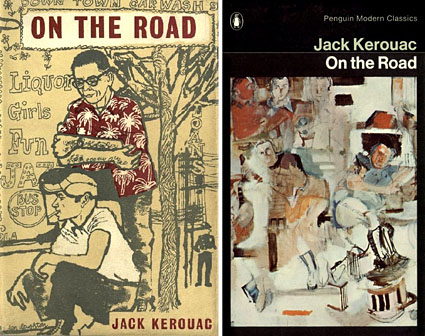
“All I write about is Jesus:” the Case for a Conservative Kerouac

This morning at the American Conservative Robert Dean Lurie makes the case for including Jack Kerouac in the canon of culturally conservative authors.

As Lurie acknowledges, Kerouac’s rambling, drug-, jazz-, sex-, and booze-fueled writing does not usually bring this to mind.  Yet Lurie insists Kerouac is “up for grabs ideologically.”  Kerouac, Lurie writes,

“did indeed go on to lead a wild existence filled with alcohol, drugs, and perpetual shiftlessness; he fled from monogamy as from leprosy. Yet one cannot grasp the soul of Kerouac unless one understands his fundamentally traditional core. He never wished to foment a revolution. He did not desire to change America; he intended to document, celebrate, and, in the end, eulogize it.”

Image Source: Feuilleton, by John Coulthart

I admit I’ve never been a fan.  Years spent teaching English to bright and talented high-schoolers caused me to resent the influence of On the Road.  Too many young people seemed to lean on this book, among others, as proof that writing and thinking did not need to be disciplined or systematic.  More than that, the book always seemed to be too careful and planned in its spontaneity.  A tantrum, not a rebellion.

Lurie argues that we’ll never understand Kerouac if we stop at this surface impression.  The theme of Catholicism permeates Kerouac’s work, yet many readers miss it entirely.  As Lurie notes,

“The influence [of Catholicism] is so obvious and so pervasive, in fact, that Kerouac became justifiably incensed when Ted Berrigan of the Paris Review asked during a 1968 interview, ‘How come you never write about Jesus?’ Kerouac’s reply: ‘I’ve never written about Jesus? … You’re an insane phony … All I write about is Jesus.'”

In the end, Lurie concludes, Kerouac stood out among his Beat colleagues:

“Allen Ginsberg, the poet visionary, pined for utopia and spiritual revolution. William S. Burroughs, the outlaw libertarian, pined for anarchy and gay liberation. Neal Cassady, the exiled cowboy, pined for girls and cars. Jack Kerouac, the mystic, pined for God and home.”