School = Thanksgiving

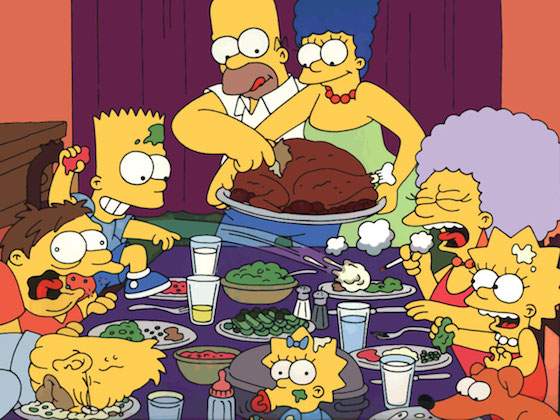
Ah, Thanksgiving! Our favorite holiday of all. No gifts, no decorations, no sweat . . . just lots of food and friends and football. Your humble editor has retreated to an undisclosed location in scenic upstate New York to share the holiday with family.
simpsonsturkey

PS 101

Before we do, however, we must give in to our unhealthy compulsion to share some Thanksgiving reflections about schooling and culture wars. In the past, we’ve noted the central role Thanksgiving has come to play in those battles. Today, though, we want to point out a more basic connection: Why do we keep having culture wars over the teaching in our public schools? Because those schools are like Thanksgiving itself.

First, a review of our ILYBYGTH reflections about culture-wars and Turkey Day:

Today, let’s consider a more fundamental idea: Thanksgiving gives us a chance to see how public schools really function and why they serve so often as lightning rods for culture-war kerfuffles. Thanksgiving dinner might just be the best analogy for the way our schools work.

Because we know they don’t work the way anyone really wants them to.

For generations, progressive activists and intellectuals have dreamed of schools that would transform society. To pick just one example from my recent book, in the 1930s Harold Rugg at Teachers College Columbia hoped his new textbooks would transform America’s kids into thoughtful authentic small-d democrats. The books would encourage students to ask fundamental questions about power and political transparency. They would help young people see that true social justice would come from a healthy transformation of society, with power devolved to the people instead of to plutocrats.

For their part, generations of conservative activists have tried to create schools that would do something very different. There is no single, simple, definition of “conservatism,” of course, but by and large, as I also argue in my recent book, activists have promoted a vision of schooling as the place to teach kids the best of America’s traditions.

As one conservative intellectual asked during a turbulent 1970s school boycott,

Does not the Judeo-Christian culture that has made the United States the envy of the world provide a value system that is worth preserving?

Other conservatives shared this vision. Max Rafferty, one-time superintendent of public instruction in California and popular syndicated columnist, yearned for a golden age when

the main job of the schools was to transmit from generation to generation the cultural heritage of Western civilization.

Max Rafferty was never satisfied. Schools, he thought, failed in their proper job as the distributor of cultural treasures.

Harold Rugg wasn’t happy either. Neither he nor his progressive colleagues in the “Social Frontier” group ever succeeded in using the schools to “build a new social order.”

Why not? Because schools will not fulfill either progressive or conservative dreams. They are not distribution points for ideological imperatives. They are not outposts of thoughtful civilization scattered among a hillbilly hinterland.

Instead, it will help us all to think about schools as a sort of Thanksgiving dinner. At a Thanksgiving dinner, people of all sorts gather together to eat. Friends, family, co-workers, neighbors. Unless you’re lucky enough to escape to an undisclosed location in scenic upstate New York with only a few beloved family members and a dog, you will likely sit at a table with people with whom you don’t share much in common, intellectually.

In every family, you are likely to find some ardent conservatives and some earnest progressives. You are likely to find strong feelings about issues such as abortion, same-sex marriage, evolution, and etc.

That’s why—until the booze kicks in, at least—most Thanksgiving dinners tend to stick with safe topics. We know we can disagree about football, for example. If my Green Bay Packers lose to the horrible Chicago Bears, my cousin knows he can tease me about that.

But we can’t disagree, out loud, at least, about things that really matter to us. If I have an imaginary uncle, for example, who thinks same-sex marriage means opening the door to pederasty and apocalypse, he knows he can’t tease me about it. Our disagreement on that issue won’t be something we can both just laugh about.

So our Thanksgiving dinner conversations, we hope, stick to fairly humdrum topics.

That might just be the best way to understand our schools, too. In spite of the dreams and hard work of intellectuals such as Max Rafferty and Harold Rugg, schools don’t push one ideological vision or another. At least, they tend not to do it very well or for very long.

Instead, they stick to the smallish circle of ideas that we as a society can roughly agree on.

This is why biology teachers tend not to teach a whole lot of evolution.

This is why health teachers tend not to teach a whole lot of sex.

This is why history teachers tend not to teach a whole lot of history.

There are plenty of exceptions, of course. But that also fits into our Thanksgiving analogy. Every once in a while, someone at Thanksgiving will insist on having it out…whatever “it” is. And our holiday turns into a smack-down, leaving everyone a little bruised and shaken.

Similarly, some teachers and some schools will occasionally push for a better vision of education, a more ideologically pure one. As I examine in my recent book, that is when we get culture-war flare-ups.

So as we sit around our tables and eat birds, let’s reflect on the ways this holiday might be the perfect analogy for schools. They are not change agents or tradition-upholders. At least, they are not only that.

Public schools are, rather, a meeting place in which we all implicitly agree to limit ourselves to non-controversial topics. We agree to keep the most interesting ideas, the most provocative ones, and, sadly, often the most educational ones, off the table.
Ignorance: The Heart of Education

I’ve said it before and I’ll say it again: Our educational culture wars are NOT battles between brutish conservatives who want to keep vital information out of the hands of children, on the one side, and scheming progressives on the other, progressives who want to dump information on hapless children, heedless of the moral consequences. Rather, all of us agree that schooling should promote and protect some forms of ignorance among kids. We only disagree on the details.

miseducation

Known unknowns and unknown unknowns…

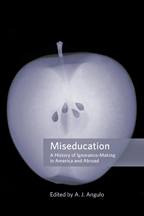
Now at long last we will have a collection of scholarly essays about the history of ignorance and education. Thanks to editor AJ Angulo, a new volume will soon hit the libraries. Miseducation will be published in early 2016 with Johns Hopkins University Press.

As the publisher explains,

Ignorance, or the study of ignorance, is having a moment. Ignorance plays a powerful role in shaping public opinion, channeling our politics, and even directing scholarly research. The first collection of essays to grapple with the historical interplay between education and ignorance, Miseducation finds ignorance—and its social production through naïveté, passivity, and active agency—at the center of many pivotal historical developments. Ignorance allowed Americans to maintain the institution of slavery, Nazis to promote ideas of race that fomented genocide in the 1930s, and tobacco companies to downplay the dangers of cigarettes. Today, ignorance enables some to deny the fossil record and others to ignore climate science.

I was honored to be asked to contribute. In my chapter, I look at the publishing efforts of fundamentalist schools such as Bob Jones University and Pensacola Christian College. How have those textbooks, I wondered, promoted a certain form of knowledge? How have they pushed a certain form of ignorance?

Perhaps more interesting, this volume can encourage all of us to examine the ways schools have not simply distributed knowledge. Any school, any educational project, must also encourage certain forms of ignorance.

It may seem outlandish, but it’s really so obvious it can be hard to see. What would we say if a second-grade teacher showed her students a violent movie such as Saving Private Ryan? Not at all appropriate. Not because it’s a bad movie, but because it’s incredibly violent.

What would we say if a second-grade teacher traumatized her students by taking them on a field trip to a slaughterhouse? Not at all appropriate. Not because it’s not educational, but because there are some truths we want to keep from young people.

It’s obvious to most of us: Some things are not appropriate for young kids to learn in school. Not because they’re not true, but because we want children to remain ignorant of some things. We expect schools to work hard to keep them ignorant of some things.

Angulo’s collection of essays will help examine these questions in new ways. Make room on your shelves!

What Good Teachers Do

It’s a basic premise here at ILYBYGTH: If we want to understand why some parents are so ferociously opposed to evolution or sex ed or ugly history, we have to make an honest and sincere effort to see where they’re coming from. It works for the other side, too. If we hope to figure out why so many progressive teachers and activists are so deeply emotionally mortified by today’s push for teacher measurement, we need to figure out why they feel that way. As usual, the insights of Curmudgucrat Peter Greene offer an eloquent window into that world.

First, a little background. These days, the term “education reform” has come to be dominated by a certain way of thinking. Reformers such as Michelle Rhee and Arne Duncan have advocated a new way of looking at schooling. To oversimplify a little, this “reform” mindset wants to measure student progress at regular intervals. Only by getting hard data about student academic performance, the thinking goes, can we know what educational practices are actually effective.

A big part of this “reform” effort has included a new attitude toward teacher evaluations. In the past—again, speaking very generally—most teachers were evaluated by their school principals or department chairs. As today’s reformers are fond of pointing out, those in-house evaluations tended to sugar-coat their reviews. Almost all teachers turned out to be fantastic.

Reformers asked a fairly simple question: If all teachers were so fantastic, why were so many kids failing to learn?

There was also a fairly obvious follow-up: If we can replace faculty deadwood with effective teachers, our schools will improve dramatically.

Completing the syllogism, reformers implemented programs to use student test scores to measure teachers’ effectiveness. Good teachers could earn more money. Bad teachers could get help, or they could get the boot.

This approach to school reform has proved very powerful politically. It makes sense to a lot of people.

  • Good teachers = good schools.
  • Good schools = good test scores.
  • Good test scores = good teachers.

Yet for the past dozen years, we education-watchers have seen the rise of a new generation of teacher protests. Teachers have tried to explain to themselves and to the general public why this seemingly obvious logic doesn’t fit educational reality.

Most of these teacher-protests have consisted of patient but frustrated explanations of the difficulties with quantifying education success. Teachers feel beleaguered, attacked, demeaned, and misunderstood, they explain.

Such explanations might be helpful for outsiders to understand the tricky policy questions of teacher measurement. But they don’t quite capture the emotional distress many teachers feel. I think it is entirely reasonable for non-teachers to wonder if teachers are just lazy and spoiled. Why don’t teachers buck up—some might ask—and submit to evaluations that are a standard part of every other profession?

This morning we read an essay that might help bridge this gap. Peter Greene did not set out explicitly to deflate the presumptions of value-added reformers. Not in this essay, at least. His description and prescription for extra-curricular advising, though, is something every quantifier should read.

I’m biased, of course, because I whole-heartedly agree with Greene. On the narrow topic of advising as well as the bigger picture of the essential errors of those who seek to quantify good teaching. As always, I invite SAGLRROILYBYGTH to point out those places where my personal bias has led me astray.

Here’s Greene’s advice in a nutshell: teachers who serve as faculty advisors for student projects need to keep their priorities straight. Whether it is planning a prom or a yearbook, students need to be allowed to do the work themselves. They need to be allowed to make mistakes. In essence, students need to be allowed to be inefficient, unprofessional, and maybe even just plain wrong.

Why? Because that, Greene argues, is the essence of learning. As he concludes,

Lord knows, I have failed miserably many times. But I keep working at doing better. There are few things as cool as seeing your students realize their own strength, their own voices. For them to look at a project, a performance, a Thing they have created and to realize that the Thing is them, themselves, taken form in the world and taken a form that is completely in-formed by who they are.

But every time you take a choice or decision away from them, you tell them “Well, this is a thing you can’t do” or “You couldn’t handle it if anything went wrong” and that message just makes them smaller. Don’t give them that message. Don’t lead them to suspect that their voices aren’t legit, can’t hold up, shouldn’t speak out.

Confidence comes with competence, but students aren’t always good judges of their own competence (and in some times and places they don’t have much to judge). But we can help them build both by giving them support and freedom. Maybe you are a genius visionary and students will benefit immensely just by following in your wake and sweeping up the crumbs of your attention and direction. But for the rest of us mortals, giving students the safe space to figure out how they will get things done in the world and still be their best selves will just have to do.

What does any of this have to do with teacher evaluation? It doesn’t, at least not directly. For non-teachers, however, those who don’t understand why some teachers are so steamed by the imposition of value-added measures, it can help immensely.

Greene articulates in this essay two things good teachers do that value-added teacher evaluations make difficult. First, as Greene says, good teachers always work to remind themselves that the focus must be on the students, not the teacher. As Greene puts it, “It’s not about you. Yeah, we can type that out in forty-foot font.”

For good teachers, the continuous struggle is to remember that they themselves are not the main point of their work. Their excellent activities and creative lessons mean nothing if students don’t learn from them.

Value-added measurement pushes teachers to reverse that thinking. Instead of helping teachers with the difficult task of what Greene calls “the vanishing test,” value-added measures push teachers to make their own performance their first worry.

And, of course, there’s a more basic lesson to learn here. Good teachers do things that are both extremely difficult to do and utterly impossible to measure. Good teachers have the wisdom to give students what they need, when they need it. Good teachers put themselves last and students first, even if that means the students fail.

How can a test measure that? How can any number capture that?

Maybe more important, value-added measurement misses a basic and vital part of good teaching. Good teachers must allow students NOT to succeed sometimes. Learning, after all, does not happen by simply adding knowledge to ignorance. Real learning consists of fits and stumbles, mistakes and adjustments. Good teaching, Greene reminds us, is the impossible human task of guiding young people through those infinitely complicated steps.

If a test exists that can measure such things, it can’t be taken with a number two pencil.

Students: Customers, Wards, or What?

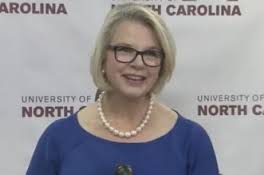
The devil stalks the University of North Carolina. At least, that’s the impression I get when I read the progressive Nation’s description of new system president Margaret Spellings. Of all the damning evidence against Spellings, perhaps the worst thing, for these progressives, is that she referred to students as “customers.” I wholeheartedly agree that good education, healthy education, shouldn’t be understood this way. But I don’t think progressives like me have come up with a better analogy. The only other likely candidate makes us even more uncomfortable.

Margaret Spellings

Sympathy for the Devil…?

Spellings has a long career in education. She has been one of the fiercest and most successful proponents of Milton Friedman’s prescriptions for better schools. If markets are allowed to do their magic, this school of thought explains, much of the dead hand of institutional lethargy will be stripped away.

In the K-12 world, market reformers have pushed vouchers, charters, and “choice,” with a lot of success. During her tenure as Education Secretary, President Spellings famously promoted a similar sort of market approach to higher education. The solutions to university blahs, the Spellings Report explained, lay in a new vision of students as “consumers,” with schools competing for their business.

“In this consumer-driven environment,” the report argued,

Students increasingly care little about the distinctions that sometimes preoccupy the academic establishment. . . . Instead, they care—as we do—about results.

A good college, from this perspective, is one that gives students good financial pay-back for their tuition investment. The “results” for “consumers” should be significant, in terms of higher salaries and better economic prospects for families.

Colleges, the Spellings Report insisted, need to adapt or die. If a for-profit college can deliver marketable skills better and faster, it should be encouraged, not deplored. Such law-of-the-jungle competition would push colleges in the right directions, toward “improving their efficiency.” A good higher-education system, the Spellings Report concluded, would give “Americans the workplace skills they need to adapt to a rapidly changing economy.”

Those of us who don’t like this vision of the proper form and function of higher education are not without alternatives. But for progressives, the primary alternative would not be an improvement.

For long centuries, colleges and universities operated on a very different model, what we might call the “family” plan. Students were not consumers, but rather more like apprentices. They entered into higher education with an understanding that they would be shaped according to the guidance of the school.

As historian Roger Geiger explained so clearly in his recent history of higher education, this system persisted much longer than did the apprentice system for young workers. Well into the nineteenth century, students had very few rights, very few choices to make.

They didn’t like it. As Geiger relates, the 1810s were a far more turbulent decade on American campuses than were the 1960s or 1970s. Indeed, if today’s students at North Carolina don’t like Spellings’s consumer model, they might learn a lesson from their predecessors. In 1799, UNC students held a week-long riot, in which they captured and horsewhipped their unpopular presiding professor. (See Geiger, pp. 116-129.)

What made these students so angry? The family model of higher education insisted on draconian rules for student life, including onerous daily recitals and endless rounds of mandatory chapel services. Students did not “consume” higher education in this family model, they submitted to it.

During the 1960s, student agitation against in loco parentis rules represented a late protest—and a very successful one—against the persisting vestiges of the family model. Students demanded an end to mandatory curfews and even core curricula.

The family model never totally disappeared, of course. Indeed, today’s “safe space” protests are usually built on an implicit assumption that the university will protect and shield students, implying a continuing authoritative family relationship.

In general, though, progressive students, faculty, and administrators don’t like the family model. They don’t want to impose a set of readings or experiences for students. They want students to be empowered to design their own educational experiences, to a large degree.

But if we don’t like the old family model, and we don’t like the new consumer model, what else is there?

As usual, I don’t have answers, only more questions.

  • If we don’t want to think of college students as customers, and we’re not willing to re-impose an authoritarian system, what should we call them?
  • Put another way: If the family model is out, and the consumer model is out, what’s left?
  • What could it mean to think of students as producers, rather than consumers?
  • If the nature of consumption has changed radically in the past fifteen years with online shopping and etc., might it mean something very different these days to call students “consumers”?
  • Is there wiggle room in the consumer model? Think of the differences, for instance, between equipping someone with tested, high-quality gear for a life-long expedition and equipping them with shiny junk they really don’t need.

The One Thing We Know for Sure about Schools…

This week’s National Assessment of Educational Progress (NAEP) scores prove it. When it comes to education, there is one reliable truth out there. It’s not news; any educational historian worth his or her mortarboard could tell you about it.

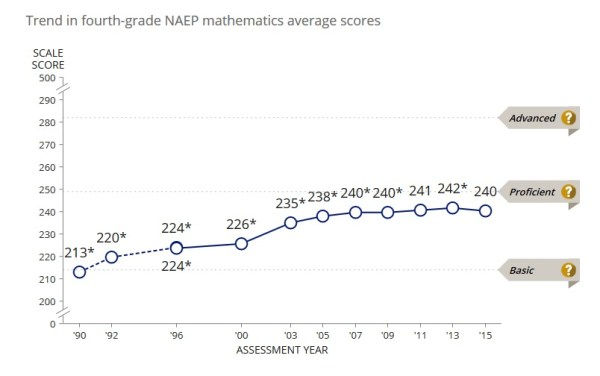
But first, the news: NAEP, the “Nation’s Report Card,” shows stagnant or declining scores in math and reading. A bummer, after fifteen years of emphasis on jacked-up standards and high-stakes testing in public schools.

Up, up, up, ... and down.

Up, up, up, … and down.

Understandably, teacher activists who have derided the latest test-heavy reform efforts have offered bitter I-told-you-sos. The test-hungry reformers have scrambled to explain the decline. Michael Petrilli at the Fordham Institute retreats to the obvious explanation: It’s complicated. It might be due to non-testing factors such as classroom confusion, Petrilli explains. It might be due to the declining economy. Most important, Petrilli says, we need to remember that this decline might be only a “blip,” not a “trend.”

But anyone who knows the first thing about educational history knows it’s simple. There is one reliable constant in American education.

We can see it in bombshell cases such as Brown v. Board of Education (1954). Reformers hoped that ending legal racial segregation in schools could go a long way toward healing racism in this country. Sixty-plus years later, those assumptions seem painfully naïve. Schools are still segregated by race; cities even more so.

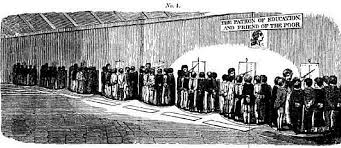
We can see it all the way back in the roots of urban school systems. Two hundred years ago, school reformer Joseph Lancaster promised a new method of organizing schools that would solve America’s poverty problem. Hundreds of low-income students could be educated with a cheap and simple monitorial system.

How schools can save society, 1815.

How schools can save society, 1815.

Guess what? It didn’t work. As long as there have been public school systems in this country, there have been eager reformers who have offered one idea or another as a silver bullet. Each reform, we’ve heard, will be the ticket to healing America’s schools and society. We’ve been told for hundreds of years that America’s schools will FINALLY fulfill their promise to end poverty, fix the economy, and etc. etc.

It’s just not that simple. Today’s round of high-stakes testing made elaborate promises. No Child, we heard, would be Left Behind. Schools, we heard, could now finally fix social inequalities and heal society’s injustices.

Would that it were so.

What we have instead is another reminder of the one thing we can count on in schooling, the one reliable truth about education.

Ready for it?

Here it is: Schools can’t fix society. Schools ARE society.

Ignorance Unto Death

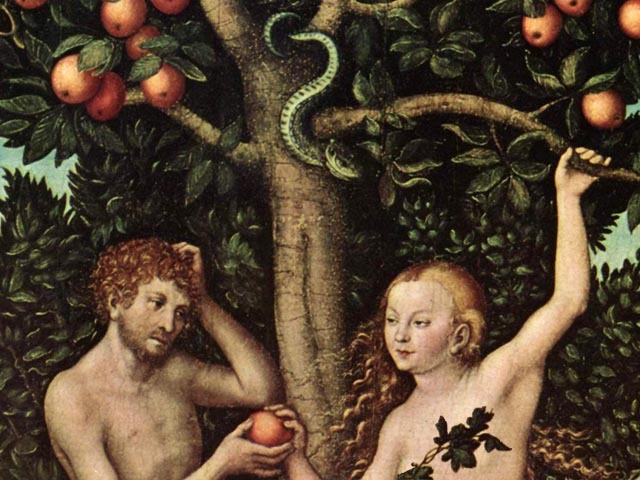
It is a dilemma at the heart of Christian faith: To know or to obey? The original sin of Adam & Eve, after all, was to become as gods by eating from the Tree of Knowledge of Good and Evil. This week, a state supreme court judge in Oregon faced the unenviable task of ruling whether faithful people knew by faith or by fact. Not surprisingly, she punted. Especially in schools and universities, questions of knowledge and faith will continue to bedevil us all. I’m arguing in upcoming books that religious people deserve considerable wiggle room when it comes to requiring knowledge about evolution or US history, but it’s not impossible for policy-makers to be bolder than they have been.

What did you know? And when did you know it?

What did you know? And when did you know it?

In the Oregon case, two parents from a strict religious sect were convicted in 2011 in the death of their infant son David. The boy had been born prematurely. The parents did not call for medical help but rather treated David at home. After nine hours, David died. Were the parents criminally liable for their faith-based failure to get medical help?

Oregon Supreme Court Justice Virginia Linder recently said yes. Sort of.

For our purposes, the most intriguing elements of this case are the tangled web of meanings in this case surrounding faith and knowledge. If the parents “knowingly” allowed their baby to suffer from treatable ailments, according to Oregon law, then they are criminally liable. But they hoped to force the state to prove that they “knew” it. They hoped to force the government to prove that they must know something that they refused to know.

Justice Linder did not decide the big question. Instead, she noted that the parents defended their actions with a different set of knowledge claims. The parents said they did not know the baby was sick. They said he appeared healthy until the very last minute. Doctors disagreed. They said any reasonable person could have discerned that the baby was in severe medical crisis.

In other words, the parents did not claim that they “knew” their faith could save the baby. They said instead that they didn’t “know” he was so very sick. The parents DID insist that the state had to prove that they “knowingly” refused care to their baby. As Linder summarized,

At trial, defendants argued that, because they withheld medical treatment from David based on their religious beliefs, the Oregon Constitution requires the state to prove that they acted “knowingly”—that is, they knew that David would die if they relied on prayer alone and, despite that knowledge, failed to seek medical treatment for him.

Justice Linder affirmed earlier court decisions that the parents were guilty of criminal neglect for their actions. The state, she ruled, did not have to prove that they “knew” of the harm they caused. But she did not decide if the parents must have known something they refused to know.

The complexity of the case shows yet again the durability of questions of knowledge and faith. Can the government insist that parents provide medical care for their children? In Oregon, yes. But can the government insist that parents “knew” their child needed medical care? That is a far more difficult question, and one that this ruling painstakingly sidesteps.

As SAGLRROILYBYGTH are well aware, nowhere do these questions of faith and knowledge clash more regularly and predictably than in the area of education. Can the government require that students “know” evolution? …that kids “know” how to prevent sexual transmitted infections? …that kids “know” how the first humans came to North America?   Also, how have private schools and universities attempted to shield young people from these sorts of knowledge?

Alas, secular progressive types like me cannot relax and claim that public schools should always promote knowledge over ignorance. After all, I agree that certain types of knowledge are not appropriate for certain groups of students. For example, we should teach all children about horrifying historical episodes, such as lynching in the USA or the Holocaust.   But we should not expose young children to gruesome images of charred corpses, sexually mutilated before being lynched. At least, I don’t think we should.

Such images are true. People should know about them. But I do not think seven-year-old children should be exposed to that sort of knowledge. I agree that schools should work to keep young children ignorant about such knowledge, even though I acknowledge that it is true and important.

The difference, in other words, is not that conservative religious people want to keep knowledge from children, while progressive secular folks want to give knowledge to children. The difference is only in what sorts of knowledge we want to shield students from, and how.

As I argue in a chapter in an upcoming book about ignorance and education, we can see these questions starkly exposed in the history of curriculum for private conservative evangelical schools. I looked at US History textbooks produced by Bob Jones University Press and A Beka Book. In each case, from the 1980s to the end of the twentieth century, publishers made claims about historical knowledge in each succeeding edition that were farther and farther afield from mainstream historical thinking.

Know this, not that.

Know this, not that.

In a later edition, for example, a history textbook from A Beka explained that humanity expanded around the globe after the fall of the Tower of Babel. Obviously, that is a very different explanation from what kids would read in a mainstream textbook. Publishers like A Beka hoped to shield students from mainstream knowledge about history by replacing it with an alternate body of knowledge. These textbooks do not simply try to create ignorance by blocking knowledge, but rather try to foster ignorance about a certain sort of knowledge by producing a convincing set of alternate knowledge.

When it comes to evolution, too, questions of knowledge and belief quickly become tangled and tricky. I’m arguing in an upcoming book with co-author Harvey Siegel that students in public schools must be required to “know” evolution. But too many public-school enthusiasts, we argue, have a cavalier attitude about this sort of knowledge. Yes, students must “know” and “understand” the claims of evolutionary theory. But if they choose not to believe them, that is their business.

Perhaps an easier way to make the distinction is to say that public-school students can be required to “know about” evolution. They must be able to explain it correctly. They must be able to describe accurately its main points. But if they think it would harm their religious beliefs to say they “know” that humans evolved via natural selection, then they have the right to insist that they only “know about” it.

It’s not an easy distinction. Nor was it easy for Justice Linder to decide what to say about the Oregon case. Do parents have the right to their religious beliefs? Yes. Can they not know something that everyone else knows? Yes, certainly. Do they have the right to insist on that relative ignorance if it causes palpable harm to others? Not in Oregon.

But this ruling does not decide if the parents in this case “knew” that their faith would save Baby David. It only states that parents do not have the right to insist that the government prove that they knew it.

Sex In, Kids Out

Toronto’s Thorncliffe Park Elementary School started its year half empty. Why? Parents were concerned that students would gain knowledge, so they pulled their kids out in protest.

Will Toronto parents trust the public school?

Will Toronto parents trust the public school?

It sounds weird when we say it that way, but it is true. In this case, parents worried that a new sex-ed curriculum imposed by the provincial government would expose kids to too much information, too early. In some ways, the story is a repeat of a familiar culture-war pattern. In others, it shows how things are changing.

First, the facts: Last spring, the Ontario government released its new health curriculum. Outraged parents organized to protest against the content. As one protesting parent put it last spring,

I want my kids to come home from school and play with toys, not their body parts. . . . Why are we introducing these concepts to kids who aren’t even old enough to tie their shoelaces?

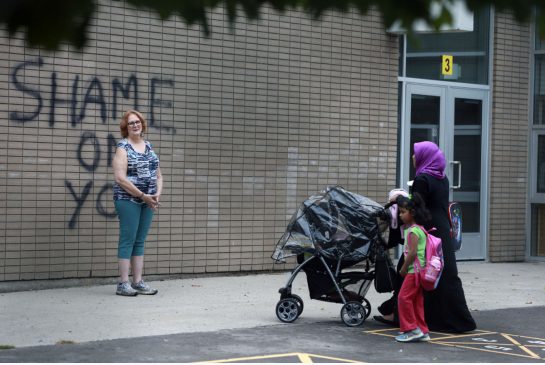
As schools opened this fall, parents continued their protest, nearly emptying one elementary school and holding protest school meetings in a park across the street. An unknown protester spray-painted “Shame On You” on the school building.

In some ways, this protest is playing out the familiar culture-war script we saw throughout the twentieth century. As I argued in my last book, time and again conservative parents insisted on their right to decide what their kids should be taught about sex.

We also see a familiar fight over the terms of the debate. What is actually in the curriculum? Protesters in Toronto have distributed fliers warning that kids are encouraged to have sex, encouraged to masturbate and to exhibit their full anatomy to friends and strangers. Not so, reply the writers of the curriculum. In earlier protests, such as the school boycott in Kanawha County, West Virginia, in 1974-75, protesters distributed similar fliers making similarly inflated claims about the content of controversial textbooks.

Another familiar sight is the undercurrent of traditional pedagogy. Yes, the protesting parents are teaching their children in a park, but they are also imposing a traditional style of teaching. One volunteer teacher, for instance, expressed surprise that the seven- and eight-year-olds in her group had never been taught basic sentence structuring. Not only did she teach her makeshift class without any reference to sex, but she also imposed a more traditional style of teaching grammar.

But Toronto’s school-sex boycott is also different in some ways. Instead of the whitebread “100% American” protests of the twentieth century, this protest largely emanates from the Muslim community. Parents are defending their right to have a say about the curriculum. They are also insisting that school lessons must not conflict with their religious values. In this case, though, those religious values are not the implicit Protestantism that we see so often here in the United States. Rather, in this neighborhood of Toronto, the traditional values being defended are those of Islam.

Keep em innocent...?

Keep em innocent…?

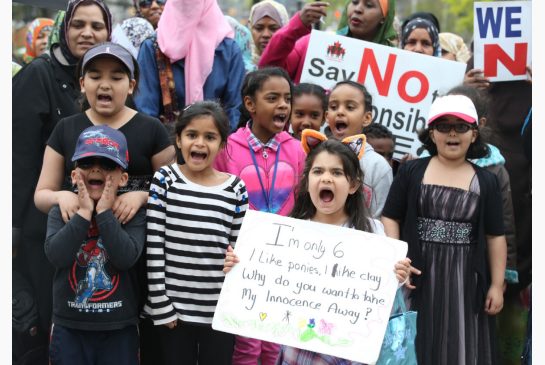
Perhaps most telling, this protest underlines one of the central truths of public schooling. Though it seems weird to say it, parents assume that schools must keep certain forms of knowledge away from their kids. In this case, parents do not say that the sex-ed curriculum is untrue. Rather, they only insist that it is too early for their kids to know such things, or that such knowledge conflicts with their religious values. As this widely circulated photo suggests, protesters want their kids to be kept “innocent” of some forms of knowledge.

What is school for? Not only to spread knowledge, but also to protect certain forms of ignorance.

Here’s Why Public Schools Will Never Eliminate Creationism

If the spotlight-loving science pundit Lawrence Krauss really thinks public schools can eliminate creationism in one generation, he’s off his rocker. But he’s in good company. Through the years, all sorts of writers and activists have made grandiose plans to use public schools for one sweeping reform or another. Unfortunately for them, that’s just not how America’s schools work.

The original bus from hell...

The original bus from hell…

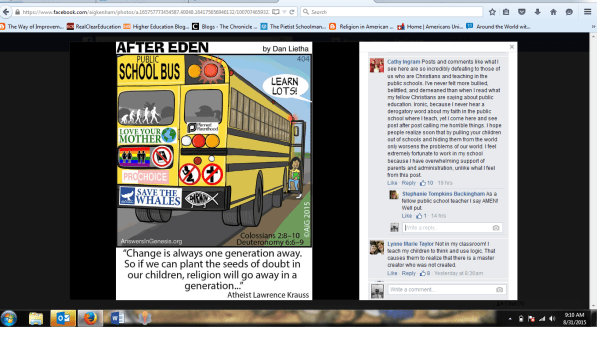
To be fair, in the Krauss quotation pirated here by the young-earth creationist ministry Answers In Genesis, Krauss does not say that this will be a school thing. He only says that we can teach our kids—in general—to be skeptical. Clearly, in the conservative creationist imagination of the folks at AIG, this teaching will take place in the public schools.

This AIG cartoon illustrates the many ideological trends that they think are taught in the public schools. Evolution, homosexuality, abortion, . . . all these ideas are poured down the throats of innocent young Christians in public schools. Furthermore, AIG thinks, Christian belief and practice are banned and ridiculed.*

In culture-war battles like this, both sides made sweeping and incorrect assumptions about public schooling. If the schools teach good science, Krauss and his allies assume, then creationism can soon be eliminated. If the schools teach good religion, AIG thinks, then children will go to heaven, protected from evolution and other skepticism-promoting notions.

As I argue in my recent book, these assumptions are hard-wired into our culture-war thinking. Both progressives and conservatives tend to assume that the proper school reform will create the proper society.

In the 1930s, for instance, at the progressive citadel of Teachers College, Columbia University, Professor George Counts electified his progressive audiences with his challenge. Public schools teachers had only to “dare,” Counts charged, and the schools could “build a new social order.”

Decades later, conservative gadflies Mel and Norma Gabler repeated these same assumptions. Conservative parents, the Gablers warned, must watch carefully the goings-on in their local public schools. “The basic issue is simple,” they wrote.

Which principles will shape the minds of our children? Those which uphold family, morality, freedom, individuality, and free enterprise; or whose which advocate atheism, evolution, secularism, and a collectivism in which an elite governs and regulates religion, parenthood, education, property, and the lifestyle of all members of society?

Professor Counts would not likely have agreed with the Gablers on much. But he would have agreed that the ideas dominating public schools matter. If the wrong ideas leach into the schools, then society will lurch in dangerous directions.

These days, both Professor Krauss and the creationists at AIG seem to have inherited these same assumptions. However, as this screenshot from AIG’s facebook feed demonstrates, public school classrooms are far more complicated places than any of our school activists have allowed. No matter what standards we write about science or religion, public schools will continue to function in ways that represent the wishes of their local community. No matter how daring they are, a few progressive teachers do not have the power to build a new social order.

Similarly, we cannot use schools to eliminate creationism. If we want people to think scientifically, then we need to wage a much broader campaign. We need to convince parents and children that modern evolutionary science is the only game in town.

Because even if we wanted to, we could never ram through any sort of school rule that would be followed universally. Even if public schools officially adhere to state standards that embrace modern evolutionary science, schools themselves will vary from town to town, even from classroom to classroom. The only way to change schools in toto is to change society in toto.

Chicken and egg.

As we see in this facebook interchange, one evangelical teacher claims she teaches with the “overwhelming support of parents and administration.” Another says she teaches her children in public schools to recognize the logical necessity of a creator.

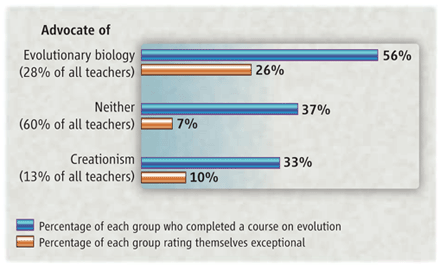
These facebook comments are not anomalies. According to political scientists Michael Berkman and Eric Plutzer, about 13% of public high-school biology teachers explicitly teach creationism. Another 60% teach some form of evolution mixed with intelligent design and creationism.

Not teaching the controversy, avoiding the controversy

Not teaching the controversy, avoiding the controversy

Why do so many teachers teach creationism? Because they believe it and their communities believe it. As Berkman and Plutzer argue, teachers tend to embrace the ideas of their local communities. In spite of the alarmism of the folks at AIG, public schools just aren’t well enough organized to push any sort of agenda. Public schools will never eliminate creationism. They just can’t.

SAGLRROILYBYGTH are sick of hearing it, but I’ll say it again: Schools don’t change society; schools reflect society.

*(Bonus points if you can explain why AIG is against saving the whales!)

Why Schools Can’t Stop Terrorism

Imagine it in reverse: Take a group of 13-year-olds.  Any group, anywhere in the US of A. Have them watch one hour every six months of ISIS propaganda videos.  How many of them do you think will turn into Islamic militants? Pretty close to none, I’d guess. Yet when it comes to SOLVING violent crime, terrorism, STDs, drug abuse, or nearly any other social ill, that is just the sort of approach some well-meaning but poorly informed pundits continue to suggest.

It’s always possible, of course, that some students might find the videos so compelling that they’d join ISIS. But those students would have come from some sort of background that pushed them toward that decision in advance. There’s no way a couple of isolated hours of school videos could CREATE terrorists. The most they could do—in very unusual cases—would be to encourage some kids to follow through on decisions they had already made.

Yet throughout American history, reformers have blithely assumed that they could create any social reform they wanted, simply by slapping one or two hours of mandatory instruction into the public-school curriculum.

An hour of prevention is not a cure...

An hour of prevention is not a cure…

As Jonathan Zimmerman points out in his excellent new book Too Hot to Handle, this sort of mindset is quintessentially American. In the beginning of the twentieth century, for example, the USA and European nations all discovered a social problem. Too many men were visiting prostitutes and coming home with nasty sexually transmitted diseases. European governments responded by making new laws about hygiene and prostitution. American governments, instead, responded by adding mandatory sex-ed to public-school classes. The only way to end prostitution, Americans assumed at the time, was to play the “long game” and educate young people about its dangers.

American readers of a certain age might join me in remembering a similarly silly attempt to eradicate drug abuse in these United States. How? By adding mandatory DARE meetings to classrooms nationwide. (I honestly can’t remember what DARE stood for, since we all only called it “Drugs Are Really Excellent.”)

Now maybe, somehow, somewhere, there have been young people who have seen the light after a forty-five minute presentation in the gym about syphilis or meth. But in general, I think it’s safe to say that such messages can only hope—at the very best—to confirm students in decisions they’ve already made.

How NOT to end drug abuse...

How NOT to end drug abuse…

Yet there are still folks out there who assume that we can make real changes by inserting a class here or there about morals, hygiene, or politics. This week pundit Charles Haynes of the Religious Freedom Center offered a warmed-over recipe for solving our addiction to violence.

What do we do when ISIS and neoconfederates plant head-turning propaganda on the interwebs? Counter it with classes in tolerance and anti-racism. Haynes recommends two curricular add-ons: the Teaching Tolerance program of the Southern Poverty Law Center and Face to Faith from the Tony Blair Faith Foundation.

I’m not opposed to such programs. I don’t know the Face2Faith approach, but I’ve worked with the Teaching Tolerance materials, and they’re good. The problem, rather, is that too many people like Mr. Haynes think that by slapping such one-off workshops into regular public schools, we’ve somehow solved the problem.

It just doesn’t work that way. Education is not a simple commodity that can be packaged and shipped. Just like sex ed or drug-abuse education, educational programs only work if an entire community supports and embodies the desired message. Middle-school kids won’t decide to avoid drugs just because a cop comes to their English class and delivers a half-hour talk and a few coloring books. They will decide to avoid drugs if they come from a community that does not indulge in drug abuse.

Mr. Haynes ends with a stirring appeal:

At a time of growing religious extremism, deep racial divides, and widespread ignorance about “the other,” every school has a civic and moral obligation to counter messages of hate by educating for a more just, tolerant and free society.

Fair enough. But school can’t do it alone. If we want a more just, tolerant and free society, we have to work for a more just, tolerant, and free society. We can’t assume we’ve done our jobs if we’ve shown students a couple of hours of cheerful videos.

Christian School Causes Student to Abandon Creationism

How can parents make sure their children don’t lose their faiths? Enrolling them in religious school is not enough. As a recent story from the BioLogos Forum makes clear, education ranges far beyond schooling. Too many hasty critics, religious and secular alike, have assumed that we can control education by controlling schooling. It’s just not that simple.

This Christian learned to embrace evolution, but not in school...

This Christian learned to embrace evolution, but not in school…

In the pages of the BioLogos Forum, college sophomore Garrett Crawford shared his educational story. Crawford was raised in a conservative evangelical household. He went to a Christian school, one that presumably hoped to shield Crawford’s faith from secularism. While at that school, Crawford relates, he grew curious about the scientific evidence for evolution. After a lot of reading and study, Crawford concluded that he could no longer believe in young-earth creationism. After a lot more reading and study, Crawford concluded that Christian faith does not require a belief in a young earth. It is entirely theologically legitimate, he decided, to accept the science of evolution.

In Crawford’s case, his education took him in directions his school never intended.

Such stories shouldn’t surprise us. After all, with just a moment or two of reflection, we can all think of ways that our “education” has differed from our “schooling.” Yet in all of our tumultuous educational culture wars, pundits rush to make sweeping claims about education based on scanty evidence from schools.

We’ve seen this recently in the pages of the New York Times, when philosopher Justin McBrayer declared–based on data that was not just slim, but positively anorexic–that Our Schools Were Training Amoral Monsters.

Among conservative Christians, too, this tradition of school-bashing has a long history.  In the 1970s, for example, fundamentalist school leader A.A. “Buzz” Baker decried the tendency of many conservative Christians to rush into school-founding for the wrong reasons. In his book The Successful Christian School (1979) Baker warned that too many parents and pastors rushed to open new schools because they thought

Public education has failed! It is failing to provide a good academic education while exposing our children to a godless, secular-humanistic approach to life.

Leading young-earth creationists have long assumed that the best way to protect their children’s faith is by attending creationism-friendly schools. Ken Ham, for example, argued that Christian colleges and universities can lead students astray from true faith when they abandon young-earth thinking. As he put it,

the real issue concerns Christian colleges, universities, and seminaries that break away from the authority of Scripture in Genesis—held to by the majority of scholars up through the Reformation—and teach students that God’s Word doesn’t mean what it says. That’s what makes students doubt the truthfulness of the Bible as a whole, and can be a major reason many of them walk away from the Christian (not “creationist”) faith, as we see happening in our culture today.

From the other side, many secular or liberal critics insist that fundamentalist schools are nothing but indoctrination factories. As friend of ILYBYGTH (FOILYBYGTH) Jonny Scaramanga told the BBC, his fundamentalist schooling experiences were nothing short of “horrendous.” During his sojourn in a fundamentalist school, Scaramanga remembers, he did nothing but recite back theological nostrums. The school was so socially crippling, Scaramanga relates, for the rest of his life he was “always playing catch up.”

Scaramanga’s own case, however, shows that schooling of any sort is only one part of a person’s education. Scaramanga himself has now become a leading voice in the anti-fundamentalist education scene. Like Garrett Crawford, Scaramanga’s education took him in directions that his schooling never intended.

The take-away? Of course we should all care about the way schools operate. Better schools will help produce better educations for all students. At the same time, though, we all need to remind ourselves that formal schooling makes up only one slice—sometimes a small slice—of a person’s education.

How many of us, after all, can say that we came out the way our schools intended?