Schools Can’t Solve Terrorism

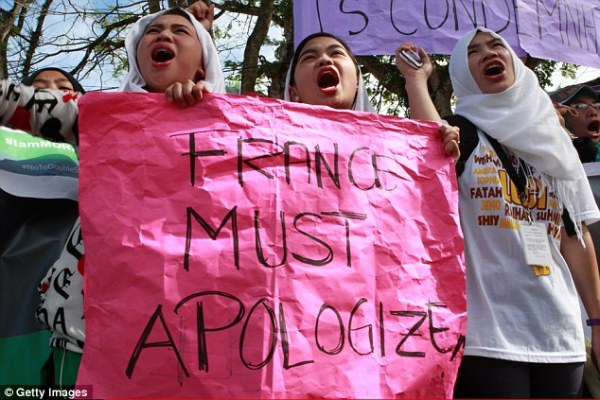
Did you see the story? IMHO, one of the scariest aspects of the murders at Charlie Hebdo was the support given to the shooters by dissident French schoolchildren. Understandably, French society was horrified. Sadly, though, they’ve resorted to an ineffectual tradition of pass-the-buck education reform to address the problem.

We are not all Charlie...

We are not all Charlie…

As reported in the New York Times, significant numbers of kids in French schools refused to honor a moment of silence for the shooting victims. Teacher Eric Bettancourt reported that three-quarters of his class protested in favor of the murderers. One student told Bettancourt that the murders were justified.

What to do?

As have generations of well-intentioned reformers in the USA, the French seem to be engaging in the ineffective and counterproductive symbolic politics of educational culture wars. From now on, the education minister insists, students who sympathize with these kinds of attacks will be punished. About 1,000 teachers will get extra training in the tenets of secularism, or “laicite.” Schools will now have an official day of celebration for laicite. And students will endure a new program of “moral and civic training.”

I don’t know much about French education. But I do know that in the United States, this same impulse toward culture-war educational symbolism has proven useless for generations.

As I argue in my new book (now available), throughout the twentieth century conservative activists have imposed similar cultural symbolism on America’s public schools. If only students recite the Lord’s Prayer and Pledge of Allegiance, many conservatives have felt, society as a whole would magically become more reverent and patriotic.

Progressives, too, share this myopic understanding of the relationship between social norms and educational programs. Ever since the glory days of John Dewey at Chicago’s Lab School, progressives have assumed that putting students into cooperative groups will transform America into a true democracy.

French politicians seem to share these simplistic ideas.

I sympathize. It’s easy to want to do something to fix a bad situation. But slapping new punishments and programs on dissenting schoolchildren won’t do the job.

As have generations of American school reformers, these French fixes assume that opposition to laicite stems, at root, from ignorance, rather than dissent. If students can have an annual assembly in which the benefits of secularism are clearly laid out, reformers might suggest, then anger toward the secular order will wither.

In the American case, some earnest school reformers have had similarly naïve ideas about creationism. As political scientists Michael Berkman and Eric Plutzer argued so convincingly, opposition to evolution does not in fact correlate neatly with ignorance about evolution. Rather, as they put it (emphasis added),

it appears that anti-evolutionists choose not to accept evolution, choose to ignore scientific arguments demonstrating evolution, or express skepticism . . . as a hedge between what they have been taught in school and seen in museums on the one hand, and what they may have heard in church, on the other.

French support for terrorist attacks on Charlie Hebdo does not result from a simple lack of knowledge.  Punishing it will only make it stronger. Canned speeches and skits for schoolchildren will only make dissenting children laugh.

It does not take professional academic studies of education and schools to understand this point.  All it takes is any experience with schools themselves.  If a teacher told you something and you disagreed, how did that make you feel? If she went on to punish you for disagreeing, did that make you likely to agree with her?

The Perfect Valentine’s Day Gift

Nothing says “I Love You” more than a book about conservatism and education in American twentieth-century history. Looks like the timing will be perfect.

How to say "I Love You" (But You're Going to Hell)

How to say “I Love You” (But You’re Going to Hell)

My new book is slated for release in early February. Hard to know how it will be received, but one pre-reviewer has called it “a major rethinking of the history of American education.” Another has added, “it would be flat-out wrong to ignore this important book.” Pshaw. . .

For the sophisticated and good-looking readers of ILYBYGTH, the content might not be surprising. In this book, I try to figure out what it has meant to be “conservative” about education in the United States.  How have issues such as creationism, school prayer, and sex ed developed over the course of the twentieth century?  How are they related?  How have conservative attitudes and strategies changed?  How have they remained the same?

In the early days of my research, I had planned to explore the educational activism of leading conservative groups such as the American Legion and the Institute for Creation Research. I was stuck with two big problems, though.

First, the Legion and other conservative groups remained active throughout the twentieth century. How could I describe different conservatives without rehashing the chronology over and over again? I didn’t want to work from the 1920s to the 1970s in every chapter. What to do?

My second problem was one of definition. How could I choose which “conservative” groups to study? I could copy the method of leading conservative scholars such as Russell Kirk or George Nash and use my selection to make an argument about the definition of conservatism. Both Kirk and Nash picked their subjects to give a particular definition to conservatism. For both writers, being a true conservative has meant being a heroic intellectual battling waves of ignorance and knee-jerk leftism. But I’m no conservative myself, and I wasn’t interested in imposing a flattering (or un-flattering, for that matter) definition on American conservatism. What to do?

Luckily for me, I had some help. At a conference back in 2009, I was describing my research. One of the audience members suggested a new approach. Instead of picking and choosing which activists counted as “conservative,” instead of describing the activism of one group after another, why not do it differently? Why not let conservative activists define themselves? This leading historian suggested that I investigate events, not groups.

That’s what I did. I looked at the four biggest educational controversies of the twentieth century: The Scopes Trial of 1925, the Rugg textbook fight of 1939-1940, the Pasadena superintendent ouster of 1950, and the Kanawha County textbook battle of 1974-1975. In each case, conservative activists and organizations fought for their vision of “conservative” schools. By looking at controversies instead of organizations, I could let conservatives define themselves. And I could move chronologically through the twentieth century without rehashing the stories in each chapter.

Did it work? Now I have to let readers and reviewers be the judge. My goal was to explore what it has meant to be “conservative” in the field of education. I did not want to make the relatively simpler argument that conservatism has really meant X or Y. I did not want to give conservatives a heroic history they could draw upon. Nor did I want to give their enemies a catalog of conservative sins. I’m hoping readers think this approach has worked.

So if you’re looking for that perfect romantic gift, consider The Other School Reformers!

Holiday Reading List

Ho ho ho and all that. Like it or not, the holidays are upon us. For you nerds out there who, like me, view such breaks as a chance to catch up on our nerdy reading, I’ll share my plans for the next ten days.

Who's got time for presents?

Who’s got time for presents?

What are you reading these (holi)days?

BOOKS:

I’ve got three books on my desk. One new, one old, and one in the middle. First, I’m excited to read Christopher Rios’s After the Monkey Trial: Evangelical Scientists and a New Creationism (2014). Rios looks at the emergence of a network of creationist scientists after the 1920s. Next, I’ll be taking another whack at Virginia Brereton’s Training God’s Army: The American Bible School, 1880-1940 (1990). Over the years, I’ve read this book several times. As Brereton puts it in her introduction,

The fundamentalist movement was decidedly an educational movement and most fundamentalists were educators; education was implicit in their overriding objective, which was the evangelization of America and the world. To understand fundamentalists, then, it is absolutely necessary to examine their educational efforts.

Hear, hear! This time around, I’m reading it with an eye to my new book about evangelical higher education between 1920-1980. Last but not least, I want to spend some time with John Rawls’s A Theory of Justice (1971). This is one that I read many years ago as an undergraduate. For so long now I’ve been reading conservative writers and pundits, I feel a need to re-connect with this fundamental statement of liberal ethics.

Top of my stack...

Top of my stack…

ONLINE:

I’ve been putting off Ted Davis’s series at the BioLogos Forum for too long. Davis is the one of the best historians out there for those of us interested in creationism and evolution. His series, “Fundamentalists, Modernists, and Evolution” ran through the summer into this past fall. I meant to read them as they came out, but as usual I fell behind. Thanks to these holidays, I’ll finally take time to read them more carefully.

There have been a couple of longish articles recently about evangelical religion and higher education that I didn’t have time to read yet. In The Atlantic, Laura Turner noted the activism at evangelical colleges about the killings of Michael Brown and Eric Garner. I have high hopes that Turner does not assume that evangelical college students have never engaged in this sort of social activism before. As I’m discovering in my current research, there is a strong tradition at Christian colleges of left-leaning student activism.

Next up, an article that is doubly interesting for anyone who wants to understand evangelical higher education. Esmerelda Sanchez writes in Christianity Today about the experiences of Latina Pentecostals in higher ed. I’ve only read the teaser so far, but it looks as if Sanchez argues that as women, as Latinas, and as Pentecostals, those like her have faced special hurdles in the world of American higher education.

DISSERTATION:

At the far edge of nerdy, I’m looking forward to reading a newly completed dissertation. Just completed at the University of Delaware is Kevin Currie-Knight’s From Laissez-Faire to Vouchers: An Intellectual History of Market Libertarian Thought on Education in Twentieth-Century America. Aside from the peerless Milton Gaither, historians have not taken a close enough look at the libertarian tradition in educational thought in US history. I’m hoping Currie-Knight’s work addresses some key issues of the meanings of markets in the imaginations of ed reformers. For those who don’t have access to a university library, you can always get easy access to dissertations like this at your local public library. Most public libraries have access to interlibrary-loan services, and they can often get you a pdf of any dissertation lickety-split.

That’s my plan. As usual, I won’t be likely to get to all of this in the next week. I’ll try to read all I can as I breeze through the holidays, packed full of candy canes and booze.

What are YOU reading as we say goodbye to 2014?

Does Anyone Actually Read the Index?

My eyeballs are beginning to chafe.  This week, I’m finishing up the index for my new book.  It’s a lot of work, even though I had a gifted grad student do most of the intellectual heavy lifting.

How the sausage gets made...

How the sausage gets made…

So now I’m wondering: Does anyone actually read the index?  I know professional academic historians do.  In fact, that’s one of the first cheap tricks we learn in our PhD programs.  We flip quickly to the back to see what we can glean from the index.  What are the book’s themes?  What are its main ideas?  Its blind spots?

But do any normal people read a book’s index?  Make no mistake, I’m compiling a kick-ass index, whether anyone ever reads it or not.  But I can’t help but wonder if readers will find useful my painstaking distinctions between “authoritarian teaching” and “traditional education.”

Coming soon...

Coming soon…

Will anyone care that I spent so many long hours in a stuffy library teasing out the nuances of “educational conservatism” as opposed to the broader category of “conservatism” in general?


Should the Poor Study Philosophy?

Why do people need an education?  In the memorable words of Chris Farley, kids need to learn a profession, or they’ll end up living in a van, down by the river.

But that’s not the whole picture.  As Scott Samuelson argues in The Atlantic, education must do more than help people get a job; education should help people be more human.  Samuelson raises a question at the heart of conservative educational thinking.

Too often in American educational history, the sort of education Samuelson’s talking about has been reserved for an economic elite.  As historian James Anderson argued in his 1988 book, for example, African Americans have been told time and again to educate their kids for the kinds of jobs they could get: laborers, maids, carpenters, doormen.  It was cruel and a waste of time, well-intentioned white philanthropists insisted, for African American youth to study Latin, Greek, and higher mathematics.  Such things would only expose them to a world in which they could not survive economically.

Samuelson agrees that liberal-arts education has traditionally been reserved for the upper crust.  As he describes,

There are three big reasons for this. First, it befits the leisure time of an upper class to explore the higher goods of human life: to play Beethoven, to study botany, to read Aristotle, to go on an imagination-expanding tour of Italy. Second, because their birthright is to occupy leadership positions in politics and the marketplace, members of the aristocratic class require the skills to think for themselves. Whereas those in the lower classes are assessed exclusively on how well they meet various prescribed outcomes, those in the upper class must know how to evaluate outcomes and consider them against a horizon of values. Finally (and this reason generally goes unspoken), the goods of the liberal arts get coded as markers of privilege and prestige, so that the upper class can demarcate themselves clearly from those who must work in order to make their leisure and wealth possible.

Samuelson insists that America’s tradition of preserving this sort of education for the already privileged gets the equation exactly backward.  In order for a society to remain free, he writes, all members must have the chance to study the basic ideas of freedom and humanity.  As Samuelson puts it,

there are among future plumbers as many devotees of Plato as among the future wizards of Silicon Valley, and that there are among nurses’ aides and soldiers as many important voices for our democracy as among doctors and business moguls.

Samuelson is not making a “conservative” argument, but his essay raises questions of perennial interest to conservative educational thinkers.  What does it mean to be “conservative” about education?  Leading conservatives push both for traditional visions of education that expose students to the great thinkers of our tradition.  But leading conservatives also fight for an education that will improve test scores of low-income students, an education that will leave no child behind.


The Other School Reformers

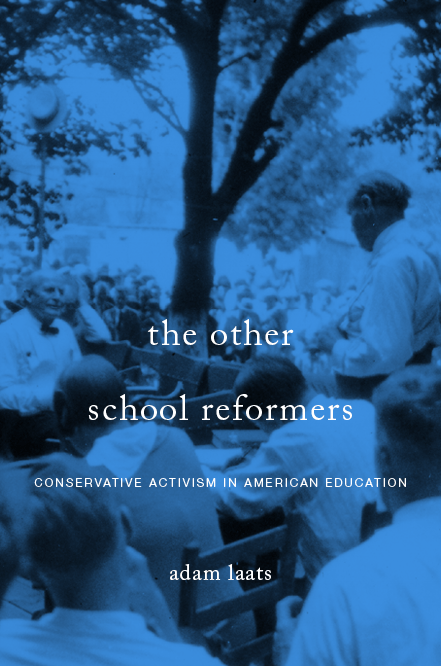
Clear your calendars! We have a release date. The Other School Reformers will be hitting store shelves in February.  I know that’s a long time to wait, so I’m suggesting everyone dress up as their favorite conservative educational activist and camp out outside their local bookstore.

Coming January 2015.

Coming January 2015.

Thanks to the Smithsonian for this terrific cover image.  That’s Clarence Darrow (standing) facing William Jennings Bryan at the Scopes Trial.  In this book, I examine four epochal school controversies from the twentieth century.  In each case, I ask what conservative intellectuals and activists wanted out of schooling.  My goal is to find out what it meant to be “conservative” when it came to education.

The catalog listing just went up.  Here’s how the talented folks at Harvard University Press describe the book:

The idea that American education has been steered by progressive values is celebrated by liberals and deplored by conservatives, but both sides accept it as fact. Adam Laats shows that this widely held belief is simply wrong. Upending the standard narrative of American education as the product of courageous progressive reformers, he calls to center stage the conservative activists who decisively shaped America’s classrooms in the twentieth century. The Other School Reformers makes clear that, in the long march of American public education, progressive reform has more often been a beleaguered dream than an insuperable force.

Laats takes an in-depth look at four landmark school battles: the 1925 Scopes Trial, the 1939 Rugg textbook controversy, the 1950 ouster of Pasadena Public Schools Superintendent Willard Goslin, and the 1974 Kanawha County school boycott. Focused on issues ranging from evolution to the role of religion in education to the correct interpretation of American history, these four highly publicized controversies forced conservatives to articulate their vision of public schooling—a vision that would keep traditional Protestant beliefs in America’s classrooms and push out subversive subjects like Darwinism, socialism, multiculturalism, and feminism. As Laats makes clear in case after case, activists such as Hiram Evans and Norma Gabler, Homer Chaillaux and Louise Padelford were fiercely committed to a view of the curriculum that inculcated love of country, reinforced traditional gender roles and family structures, allowed no alternatives to capitalism, and granted religion a central role in civic life.

Almost makes me want to read it myself.  For me, the next steps will be to review and copy-edit the full manuscript next month.  Then in July I’ll put together the index, with help from a talented graduate student.

School Is Not the Place for Education

What does it mean to be educated?  This morning at The Imaginative Conservative, Steven Jonathan Rummelsburg blasts public schools for punting on this central question.

Rummelsburg relates his long quest to dig into the basic philosophy of public education.  No one he’s asked, he tells us, is able to answer the simple question: What is an education?

Rummelsburg, a veteran public-school teacher himself, asked public-school teachers, students, and administrators.  Most of the respondents, according to Rummelsburg, hemmed and hawed with answers about mastering standards and earning a diploma.  One math teacher, he tells us, paraphrased Steve Forbes.  What is an education?  This teacher answered, “Replacing an empty mind with an open one.”

When he asked his county superintendent’s office, he got a list of four points:

  1. You will get as many definitions of education as the number of people you ask.

  2. To be educated means to have learned enough language and math to be a good citizen.

  3. It is not about the subject being taught, but what the teacher does with her audience. It is all about the student teacher relationship and what she can get them to do.

  4. That is the answer today, the answer tomorrow will be different.

[I assume this was Rummelsburg interpretation of the superintendent’s office’s answers.  The language sounds a little too frank to come from a public official.]

What should the answer have been?  Rummelsburg wants teachers and schools to hew closer to GK Chesterton’s definition of education.  Education must not be thought of as a simple thing, but as a “method.”  It should be a transmission of all that is best in our culture.  The only way to do that properly, Rummelsburg concludes, is to separate out the unfairly conjoined notions of “school” and “education.”

As he concludes,

It is a terrible crime to hand the formation of our children over to an enormous class of uneducated teachers, yet that is what we have done. As it stands, there is nothing redeemable about the public schools or the lies they instil in our children. . . . Let us take our children back and assume our responsibility as their first teachers and teach them as they ought to be taught.

Certainly, Rummelsburg’s argument that today’s public schools have utterly lost their way resonates with intellectuals on both the cultural right and left. And I have a deep sympathy for his insider’s critique of public education. I work with many public-school teachers and administrators, and nothing makes me more pessimistic about our public schools than the number of teachers who choose to homeschool their own children.

But is Rummelsburg’s method sensible? If we can’t get an adequate philosophical definition of education from teachers and school administrators, does that mean that schools are not educating students?

Would this work for other institutions? For example, if I asked everyone who worked in my local supermarket to explain “the market,” would I get a coherent answer? An answer that captured the essence of social and economic exchange? Probably not. But does that mean that my supermarket is not functioning as a market?


Will Creationists Take Half a Loaf?: An Anthropologist’s Response

Guest Post by David Long

David Long is an anthropologist and science educator at the Center for Restructuring Education in Science and Technology at George Mason University.  He is the author of Evolution and Religion in American Education: An Ethnography, based on his PhD dissertation at the University of Kentucky.  The editors asked David to respond to a recent ILYBYGTH post: Will Creationists Take Half a Loaf?

Will historians and philosophers accept that they are not baking or dividing bread?

I conduct research on the American relationship toward science as it plays out in schools.   When I began doing this with professional earnest a few years ago, my intention was much the same as Adam Laats, and many others who work in this area.  Originally, it was my hope that anti-evolution attitudes could be something that we set aside in American life.  Like many scientists and science educators, my unexamined assumption was that knowledge of evolution—as a well-reasoned, scientifically supported argumentation about the state of biological affairs—was something unavoidable.   Science disclosed a truth, and as such public attitudes should come along.

We know this is not the case.  Publics are multiple and working towards different ends. As Adam Laats should know well, the purpose of public schooling in the United States has always been in contention, and there have always been dissenters.  Science as a topic of study has been champion, demon, and utilitarian tool depending on who is reading the message it presents.  More importantly, as I came to see clearly while going to college with creationists as they studied evolution, evolution doesn’t fit within a creationist understanding of the world.  Making it fit changes one’s beliefs.  While this point may prompt quizzical looks, it’s germane to understanding the position Laats and Siegel seem to be holding, and where the weaknesses of that position are.  The conversation I intend to invoke can range wildly across disciplines.  To rein this in, I’ll simply do my gadfly work by commenting on Laats’ assertions toward some better conversation.  Let’s begin:

~ Students in public schools must be taught the best science available. 

This seems like a no-brainer claim about how school should be, except:  We have never had and for the foreseeable future do not have anything close to a teaching force that either knows or is pedagogically effective at teaching “the best science available”. The Devil’s advocate would point out that those who arguably understand the ‘best’ are Ph.D. scientists at the edges of their field. The “best science available” is vast, excruciatingly detailed, and often simply hard to learn.  Scientists rely on science’s authority when looking at the claims of science far afield from their own specialty in ways not unlike the public. Also, what moral warrant do Laats and Seigel draw upon to claim that this ‘must’ be so?  Shouldn’t students have the best of every subject?  A better question for me is why do we not have it currently and how are historians and philosophers fixing this?  I agree with Laats’ intent, but underscore the fact that the pipeline of science teachers is not currently prepared to do so.  It seems odd then to listen to historians and philosophers about a problem whose ‘fix’ lies within science education.  The help is of course welcome, but what practical steps are they taking to improve the concrete situation?

~ Too many scientists and science teachers take this to mean that creationism must be purged from students’ minds. 

As commentary to Laats’ post attested, supported by Berkman and Plutzer, the teaching profession has already produced a pragmatic ‘fix’ to this problem by downplaying evolution where it prompts local political turmoil in schools. Teachers are not well paid, work under a current accountability regime of non-stop, high-stakes standardized testing, and for the science, technology, engineering, and math (STEM) subjects, have an incredibly high professional turnover rate.  Evolution education, from this point of view, is not job no. 1.

For scientists who decry what they perceive as an abandonment of reason in classrooms, the root of their perspectival problem lies in the legacy of positivism which the sciences carry.  The sciences have been fairly slow in acknowledging that the social landscape and playing field of civic discourse has moved on to one that’s strongly post-modern.  Leaving debates about evolution aside, there is likely a bigger issue of general ambivalence toward science which may pose a much greater threat to the health of the enterprise in the coming years.

~ Public schools should tell students nothing about what religious beliefs they should hold.

This statement simply doesn’t correspond with what a critical eye on the political and social content and implicit curriculum of schooling sees.  Many religious and political conservatives reject a form of schooling that has made the policy move to set God aside.  Laats’ and Seigel’s normative position in these regards doesn’t stop creationists from seeing it for what it is—a liberal ideal of church and state separation.  Being mute, or feigning toward a Jeffersonian ideal is a political position—one that tells some conservatives clearly that you are not one of them, nor on the same Godly educational mission.  It’s the same idea of being mute or not regarding marriage equality, abortion, school prayer, etc.  Normative values that we (Laats, etc.) hold aren’t value-neutral.  It also explains a lot of the reasons why many conservatives homeschool their children.

~ In short, the goal of evolution education should be for students to understand or know evolutionary theory, but not (necessarily) to believe it.

What is understanding and what is knowing?   These are epistemological questions.  For me, understanding “inhabits a domain of possibility” as Mark Wrathall describes it, in a way useful for thinking through the logic of many who reject evolution.  For creationists, they cannot imagine a way in which evolution could ever possibly work within the content of their day-to-day lives, for the damage it inflicts on the narrative content of their faith relationship. Seeing it otherwise—in the affirmative—is outside their current domain of possibility.  For those who have come to ‘know’ differently, they are no longer—as a matter of belief—creationists in the way Ken Ham or those like him would hope.  They also, as I show in my book, have incurred social costs in how this new knowledge works within their social lives.  Suddenly being affirmative toward evolution with Grandma and your Youth Group marks you as heretic.

A distinction like Laats and Seigel make may well be a red herring.  A majority of the creationists I have worked with as research participants were excellent test takers and understood the internal logic of evolutionary theory—they just rejected the facticity of it.   The distinction Laats and Seigel draw depends on an overly formal sense of rationalism, which has been shown by Jonathan Haidt and other motivated-reasoning researchers to not be an accurate description of everyday human reason.  The point: Would Laats and Siegel be satisfied with their above distinction if the U.S. were to become radically more creationist?—so much so that public schooling came to outlaw evolutionary theory? Refraining from interrogating belief is easy. Working with students to come to understand the epistemologies they’ve been raised with, and what mediating work those thinking styles do when examining the claims of science is hard.  It is hard work we can’t back away from.

The framing of Laats’ post is instructive, especially in light of my above criticism of historians and philosophers making expert recommendations toward a population that is mostly not listening.  We, through the varieties of American social life, bake the bread that Laats speaks of.  As a nation, we produce creationism as an output of religious tradition, as well as the science educators for whom Laats’ loaf is to be split. But it’s not a clean split—nowhere close to it.  Science teachers sometimes are creationists themselves.  Many more have sympathies far less divisive than the terms of the split.  Most importantly, do historians and philosophers carry moral weight such that they are the bread-breakers?

 

“The Long Game” Is Coming to Binghamton

What do schools teach?  What SHOULD schools teach?  The problem is not that we don’t have an answer to this question.  The problem is that can’t agree on which answer is the right one.

Tomorrow night award-winning documentarian Trey Kay is bringing his latest radio documentary to the scenic campus of Binghamton University in sunny Binghamton, New York.  This work, “The Long Game: Texas’ Ongoing Battle for the Direction of the Classroom,” explores school politics in the Lone Star State.  As ILYBYGTH readers know well, those Texas politics tend to be more exciting versions of the sorts of school fights we hear all over the country: Can cheerleaders use the Bible at public-school football games?  Can textbooks preach a neo-Confederate vision of US History?  Can creationism and evolution jostle along side-by-side in public-school science classes?

long gameThe battles in Texas schools reflect our cultural disagreements over the proper form of public schooling.

Tomorrow evening, Trey will share an excerpt from his earlier documentary, “The Great Textbook War.”  Then we’ll listen to “The Long Game.”  Afterwards, we’ll benefit from Trey’s commentary, as well as that of world-renowned historian Jonathan Zimmerman of New York University.  Binghamton’s own Matt McConn, a recent émigré from Houston public schools, will also join the panel.

Unfortunately, we won’t be web-streaming the event.  But for all those who can make it to the Binghamton area, you are most welcome to attend.  The fun will begin at 6 PM, Thursday, February 27, in University Union room 120, on the campus of Binghamton University.  The event is free and open to the public.  Pre-registration has closed, but everyone is still welcome to come by without registration.

The Most Important Thing Anyone’s Ever Said

What is the most important line in the history of American education?  Something from Ben Franklin?[1]  Frederick Douglass?[2]  Horace Mann?[3]  John Dewey?[4]

According to Bruce Frohnen in the recent pages of The Imaginative Conservative, that honor goes instead to Annette Kirk.  Her line from the 1980s, Frohnen argues, offers traditionalist conservatives and anyone who cares about real education the only thread of hope in the blasted and devastated landscape of American public education.

Conservative intellectuals have long taken a dim view of the state of American education.  Frohnen opens his recent jeremiad with a nod to the terrible state of today’s schools.  “Can public education in the United States be saved?” Frohnen asks.

Given the stranglehold of teachers’ unions over school districts and state legislatures, the constant meddling of an ideologically motivated federal Education Department, the sheer weight of bureaucracy, and the commitment to mediocrity? Perhaps not.

But traditionalists such as Frohnen are not the only ones who tend to throw the school baby out with the modern bathwater.  Leftist historian Michael Katz, for instance, opened a new era of revisionist educational historiography in 1968 with his assertion that schooling in the United States has always been “conservative, racist, and bureaucratic.”[5]  Also from the left, Marxist economists Samuel Bowles and Herbert Gintis denounced American public education in 1976 as a tool of the economic elite.   Libertarian historian Joel Spring famously denounced the cookie-cutter domineering of “The Sorting Machine.”

Frohnen agrees with these folks about the terrible state of public education in the USA.  But it’s hard to imagine Professors Katz, Spring, Bowles, or Gintis agreeing with Frohnen about school’s saving grace.  According to Frohnen, the only glimmer of hope in the last generation has been a line inserted by Annette Kirk into the 1983 blockbuster report A Nation at Risk.

You history nerds out there might think that Frohnen is referring to some of the most famous lines of that report.  Every survey of American educational history, for instance, talks about the reports catchy warning about a “rising tide of mediocrity.”  Most surveys, too, note the apocalyptic edge to the report’s conclusion.  “If an unfriendly foreign power,” the report noted, “had attempted to impose on America the mediocre educational performance that exists today, we might well have viewed it as an act of war.”  Ouch!  Take that, teachers’ unions!

But those memorable lines were not the ones to which Frohnen referred.  No, the most saving line of the report, Frohnen argues, was one inserted by the true conservative Annette Kirk.  In Frohnen’s words, Kirk made sure that the report included the principle that “parents are the first and primary educators of their children.”

Thanks to this perspicacious inclusion, American education has been saved from the worst strangleholds of state-dominated educracy.  Parents in the United States, Frohnen points out, still have the freedom to free their children from the school system entirely.  Homeschooling offers such parents their last best hope of seeing their children truly educated.


[1] “Genius without education is like silver in the mine.”

[5] Michael Katz, The Irony of Early School Reform: Educational Innovation in Mid-Nineteenth-Century Massachusetts (Cambridge, MA: Harvard University Press, 1968), 3.