What Unbroken Leaves Out

**SPOILER ALERT: If you haven’t yet read Unbroken or seen the recent movie, you might want to skip this. But it’s so interesting, you’ll be sorry.**

Unbroken?...or Un-Finished?

Unbroken?…or Un-Finished?

What is the takeaway message from the life of Louis Zamperini, subject of the new film Unbroken? The power of resilience? The unplumbed depths of human courage?

…or is it the healing power of Protestant fundamentalism?

In the pages of World Magazine, Cal Thomas asks an intriguing question: Why did the recent film leave out the central role played in Zamperini’s life by the fundamentalist revival of Billy Graham?

When protagonist Louis Zamperini returned home from his hellish ordeals at sea and in Japanese prison camps, he struggled with alcoholism and depression. As the original book by Laura Hillenbrand makes very clear, Zamperini overcame these demons through fundamentalist faith. After attending a 1949 revival by fundamentalist preacher Billy Graham, Zamperini turned his life around.

This conversion was not an incidental part of Zamperini’s story. Zamperini, we could say, gave America a powerful demonstration of the healing power of a particular brand of fundamentalist Protestantism. But that is not the way celebrity director Angelina Jolie saw it. Thomas wants to know why Jolie left that part out. As Thomas puts it,

it is puzzling why Jolie, who directed the film, and the Coen brothers, who wrote it, left out the most important part of Zamperini’s story.

Not only is Zamperini’s conversion a central part of his life story, it reflects the power of a specifically fundamentalist religion. Some readers may be more familiar with Billy Graham’s later work, when Graham had begun to articulate a kinder, gentler evangelical faith. In the 1940s, however, at the time of Zamperini’s conversion, Graham’s crusades packed a firmly fundamentalist punch. Not just theologically, either, but politically.

In his 1940s campaigns, for instance, the message of conversion was wrapped in a conservative anti-communist package. At the blockbuster Rose Bowl campaign of 1950, for example, theologian Harold Ockenga introduced Graham’s sermon as “The Answer to Communist Aggression.”

And just as Billy Graham was helping Zamperini defeat his demons, Graham insisted on his loyalty to the fundamentalist message. Though later a split developed between the most conservative fundamentalists and Graham’s famous crusades, that split had not yet developed by 1949. At that time, Graham loudly proclaimed his loyalty to the fundamentalist message. In a 1949 letter to staunch fundamentalist leader Bob Jones Sr., for example, Graham called Jones the

model toward which we are patterning our lives. Your counsel means more to me than that of any individual in the nation.

During the late 1940s, Billy Graham remained a staunch fundamentalist partisan. The message that saved Zamperini was not just one of generic Christian healing, but one of specifically fundamentalist rigor. In this one famous case, at least, we can see the ways fundamentalism’s unyielding moral stance pulled a suffering soul out of a personal hell.

We can’t help but echo Cal Thomas’s question: Why didn’t Angelina Jolie include this part? Jolie no longer returns my calls, but I can’t help but think that she might have some aversion toward fundamentalism.

I’m no fundamentalist myself. American fundamentalism has its share of skeletons in its closets, as we’ve explored here at ILYBYGTH. It may be fair to accuse the latter-day followers of Bob Jones Sr., for example, of terrible misconduct. But if we really want to be fair, shouldn’t we also acknowledge the ways that fundamentalism has saved lives?


Should Everyone Be Forced To Learn Evolution?

I admit it. I love evolutionary theory. I think evolutionarily. Like my colleague David Sloan Wilson at Binghamton University, I want to encourage Evolution for Everyone. Does that mean that public schools should force every child to learn evolution? Recently, friend of ILYBYGTH Praj Kulkarni made his case to the 14 billion readers of Dan Kahan’s blog that public schools had no legitimate purpose in shoving evolution down every student’s throat.

I’m a big fan of Kahan’s work. As Kahan argues, much of what people think about evolution reflects who they are more than what they know.

Praj is a big fan, too. But in this recent post, Praj challenges Dan’s notion that our society should insist that every child learn the rudiments of evolutionary theory. As Praj put it,

Not only is it illiberal to insist students profess “belief in” evolution, it may be illiberal to force them to learn it in the first place. It’s not obvious–to me at least–why learning evolution is mandatory.

For folks in the creation/evolution trenches, this might sound like window-dressing for creationism. For decades, as historian Ron Numbers demonstrated so well, creationist pundits have explored disputes between mainstream scientists and philosophers about the nature of evolution. In order to make the case for teaching creation science in public schools, for example, smart creationists have argued that the boundaries of science are not at all clear. And if not, how can public schools rule out one form of (creation) science?

Praj is no creationist. As you’ll see when you read his full post, he’s more interested in figuring out what interest society has in insisting on this particular brand of knowledge for all students. Some things, such as literacy skills or basic mathematics, make a stronger case. Every person in our society needs these things to flourish. Therefore, public schools have a responsibility to provide them.

Does evolution fit into that same category? Praj is most interested in the intriguing possibility: What if it doesn’t?

Dan wants to give Praj an answer. A good answer; one that recognizes the legitimacy of the question. Check out the comments at Cultural Cognition. Do they provide the answer Praj is looking for? Can we offer one?

I Love It When You Call Me Stoopid, Or, Half-Time in the Culture-War Locker Room

HT: DW

Are creationists stupid? The writers of one Saturday Night Live skit think so. The question that’s got us curious this morning, though, is why leading young-earth creationist Ken Ham is so eager to publicize the skit. To this writer, it looks eerily similar to what a coach tells a team in a good half-time speech.

To be fair, the Kat & Garth skit doesn’t say that ALL young-earth creationists are stupid. But this particularly stupid pair of vest-bedecked singin’ idiots happen to be creationists. As the news host threatens to kick them out for their stupidity, they plead, “No, please, we came all the way from the Creation Museum!”

Love the New Album!

Love the New Album!

You might think that the brains behind the Creation Museum itself might want to let this ill-begotten gag fade quietly into the Saturday night. You’d be wrong. Instead, Ken Ham has shared this video with all his many followers. Why? According to Ham, this skit is proof of the besieged nature of authentic Christianity. It proves, Ham writes, that

the mocking of anything Christian in the culture is growing. We see increasing attacks by the secularists on Christianity—they have become so bold now that they’ve been successful in removing crosses, Nativity scenes, and Ten Commandments displays, and have been imposing their own atheistic religion on the culture. Recently, they have been increasingly spreading lies in a propaganda campaign of misinformation about our future Ark Encounter project (and had been doing that in regard to the Creation Museum for many years).

As we’ve seen, this has become part of our culture-war script. Both sides in every contest rush to proclaim their own status as victim. Ham’s Ark Encounter is a good example. Until they were recently scrapped, the project had expected to receive hefty tax breaks. Progressives bemoaned these tax breaks as an example of Kentucky theocracy. The victims, progressives insisted, were Kentucky tax-payers forced to foot the bill for Ham’s fundamentalist building spree.

As with the SNL persecution, Ken Ham insisted that his ambitious Ark Encounter was the underdog. Local newspapers, Ham complained, attacked the project due to their “anti-Christian agenda.”

Why the rush to victimhood? It seems to resemble nothing more than a half-time speech. No team gets psyched up to hear that things are going fairly well and that they should relax. Rather, coaches insist either that they are just on the verge of triumph and one more big push will put them over the top, OR that they are being hammered mercilessly and unfairly and they must unite and focus all their strength.

As Ken Ham told readers in one recent blog post, the successes of a recent atheist billboard campaign proved the need for urgent action. When atheists win, Ham warned,

they have successfully removed the Christian religion and are now imposing their religion of atheism on the culture! Just because they remove a Christian message does not mean there is a neutral situation—there is no neutral position. One is either for or against Christ!

Consider how much less exciting it would be for Ham and other culture warriors to agree that their opponents make good points, but that they respectfully disagree. It is hard to get a good culture-war riled up that way.

Holiday Reading List

Ho ho ho and all that. Like it or not, the holidays are upon us. For you nerds out there who, like me, view such breaks as a chance to catch up on our nerdy reading, I’ll share my plans for the next ten days.

Who's got time for presents?

Who’s got time for presents?

What are you reading these (holi)days?

BOOKS:

I’ve got three books on my desk. One new, one old, and one in the middle. First, I’m excited to read Christopher Rios’s After the Monkey Trial: Evangelical Scientists and a New Creationism (2014). Rios looks at the emergence of a network of creationist scientists after the 1920s. Next, I’ll be taking another whack at Virginia Brereton’s Training God’s Army: The American Bible School, 1880-1940 (1990). Over the years, I’ve read this book several times. As Brereton puts it in her introduction,

The fundamentalist movement was decidedly an educational movement and most fundamentalists were educators; education was implicit in their overriding objective, which was the evangelization of America and the world. To understand fundamentalists, then, it is absolutely necessary to examine their educational efforts.

Hear, hear! This time around, I’m reading it with an eye to my new book about evangelical higher education between 1920-1980. Last but not least, I want to spend some time with John Rawls’s A Theory of Justice (1971). This is one that I read many years ago as an undergraduate. For so long now I’ve been reading conservative writers and pundits, I feel a need to re-connect with this fundamental statement of liberal ethics.

Top of my stack...

Top of my stack…

ONLINE:

I’ve been putting off Ted Davis’s series at the BioLogos Forum for too long. Davis is the one of the best historians out there for those of us interested in creationism and evolution. His series, “Fundamentalists, Modernists, and Evolution” ran through the summer into this past fall. I meant to read them as they came out, but as usual I fell behind. Thanks to these holidays, I’ll finally take time to read them more carefully.

There have been a couple of longish articles recently about evangelical religion and higher education that I didn’t have time to read yet. In The Atlantic, Laura Turner noted the activism at evangelical colleges about the killings of Michael Brown and Eric Garner. I have high hopes that Turner does not assume that evangelical college students have never engaged in this sort of social activism before. As I’m discovering in my current research, there is a strong tradition at Christian colleges of left-leaning student activism.

Next up, an article that is doubly interesting for anyone who wants to understand evangelical higher education. Esmerelda Sanchez writes in Christianity Today about the experiences of Latina Pentecostals in higher ed. I’ve only read the teaser so far, but it looks as if Sanchez argues that as women, as Latinas, and as Pentecostals, those like her have faced special hurdles in the world of American higher education.

DISSERTATION:

At the far edge of nerdy, I’m looking forward to reading a newly completed dissertation. Just completed at the University of Delaware is Kevin Currie-Knight’s From Laissez-Faire to Vouchers: An Intellectual History of Market Libertarian Thought on Education in Twentieth-Century America. Aside from the peerless Milton Gaither, historians have not taken a close enough look at the libertarian tradition in educational thought in US history. I’m hoping Currie-Knight’s work addresses some key issues of the meanings of markets in the imaginations of ed reformers. For those who don’t have access to a university library, you can always get easy access to dissertations like this at your local public library. Most public libraries have access to interlibrary-loan services, and they can often get you a pdf of any dissertation lickety-split.

That’s my plan. As usual, I won’t be likely to get to all of this in the next week. I’ll try to read all I can as I breeze through the holidays, packed full of candy canes and booze.

What are YOU reading as we say goodbye to 2014?

Conservative Warriors and Homosexuality

Where is the line? What can conservatives say about homosexuality that won’t be considered bigotry? The case of Professor John McAdams has lit up the conservative intellectual world with its implications for the eroding respectability of conservative opposition to gay rights and the utterly transformed intellectual environment on US college campuses.

Let’s start with a few caveats. First, full disclosure: I taught one semester at Marquette University, Professor McAdams’s school. I also taught for several years down the street at Marquette High School, which is no longer directly connected to the university. I feel an abiding love for both institutions. More important, I am unapologetically biased in this case. I believe it is legitimate and important to regulate speech in public (and some private) forums, including college classrooms. Hard as it is to hear, some ideas do not deserve to be granted equal status with others. Ideas that dehumanize classes of people are not just as good as other ideas. For instance, if a student in a seminar wants to insist that no white people can possibly understand US history because they are by definition part of an exploitative class, such talk should be ruled out of bounds. It would tend to exclude an entire class of people simply because of their cultural identity. Similarly, if a student wanted to rule that homosexuals were incapable of being moral in their relationships, or that women cannot understand certain concepts, or that non-citizens have no right to be heard in political discussions, such talk should be out of bounds.

Of course, many conservative intellectuals share that basic framework, but they disagree bitterly that traditionalist notions about homosexuality constitute that same sort of exclusionary mentality. In other words, many conservative thinkers agree that public speech shouldn’t be racist or chauvinist, but they disagree that conservative ideas about homosexuality fall into that same category.

The steamroller drive of homosexual rights in recent months and years has put some traditionalist conservatives on edge. A few recent cases have raised hackles among many conservative thinkers. At Mozilla and Gordon College, to cite just two examples, conservative intellectuals attracted instant and furious retribution for statements that have been perceived as anti-gay. In each case, ideas that would have been unremarkable just a few years ago are now taken as beyond the pale of respectable public speech.

In the case of Professor McAdams, college politics and bureaucracy have added new wrinkles into the question of acceptable conservative opinion about homosexuality. In brief, McAdams has been suspended with pay and asked to stay away from campus. Why? He blogged about the statements of a teaching assistant. That TA had told a student that opposition to homosexual marriage would not be considered in a class on ethics. The student complained to Professor McAdams, and McAdams outed the TA on his blog.

As McAdams noted, his support for the student prompted furious condemnation by “leftist academics,” who “demanded our head on a pike.” A group of prominent faculty at Marquette published an open letter on the issue. McAdams’s actions, they write, constituted “harassment and intimidation” of the TA. Other members of the Marquette community, they write, altered their behavior to avoid similar attacks from McAdams.

In the end, McAdams has been suspended with pay. The Fox-News commentariat has had its chance to recoil in horror at the anti-conservative “inquisition.”

There is, of course, more at stake here than intellectual positions about homosexuality and gay rights. We also must consider faculty politics and the unfortunate ways academics learn to teach. How do teaching assistants learn to handle disagreement among students? When does a tenured professor have a duty not to attack publicly a non-degreed teaching assistant? How should faculty respond when a colleague behaves in ways they dislike?

At the center of all these questions, however, is the question of conservatism and homosexuality. Not too long ago, opposition to gay marriage was a common part of our mainstream political discussion. These days, in college seminars, newspapers, technology companies, and public policy, any conservative notion that homosexuals do not have the right to marry one another is often considered rank bigotry.

Is it possible for conservative intellectuals to oppose gay marriage without being branded bigots? Has that culture-war train left the station?

Confronting the Myth of Leftist College Students

I plead guilty. When I was a college student, I debated whether our campus Marxist-Leninist was really leftist enough. I remember feeling honestly surprised back then that so many people clung to their outmoded religious beliefs when the world had so obviously proved them wrong. In short, (cue the dramatic music): I Was a College Leftist. And I admit to a continuing illogical tendency: I tend to think that young people are somehow “naturally” more leftist than older adults. Are they? A scholar recently defended his claims that most college students in reality are conservatives. And not just any sort of conservatives, but a dunderheaded, abrasive, unreflective, Rush-Limbaugh sort.

I don’t think I’m alone. I’m not the only one who assumes college students are somehow naturally inclined to go through a leftist phase. We all know the jokes:

Q: What is a “fiscal conservative?”

A: A college leftist who just got a mortgage.

Q: What is a “social conservative?”

A: A college leftist who just had a daughter.

Before we look at the back-and-forth about students and conservatism, let’s remember our continuing debate about college faculty. As we’ve seen in these pages, Neil Gross has argued that the professoriate really does lean left. And conservatives in Colorado, at least, have mandated that their flagship state university open its halls to at least one staunch conservative.

But what about students? Some conservative writers have worried that conservative students are systematically denied free speech on today’s campuses. Some surveys suggest that faculty look askance at conservative religious students. And pundits often simply assume that conservatism is not allowed to rear its rightist head on most campuses these days.

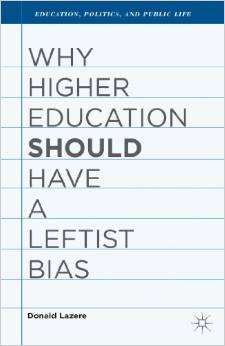
In the pages of The American Conservative, scholar Donald Lazere defended his claims that most college students these days are actually knee-jerk conservatives. Lazere was responding to a harsh critique of his book by political scientist Jonathan Marks. In his book, Why Higher Education Should Have a Leftist Bias, Lazere argued that students needed to be exposed to thoughtful liberalism.lazere

In his original review, Marks pointed to some survey data that seem to undermine Lazere’s central claims. “I don’t know Lazere’s students,” Marks wrote,

but I do know that the Higher Education Research Institute annually conducts a survey of incoming freshmen. That survey shows that more students enter college as self-identified liberals (26.8 percent in 2012) than enter as self-identified conservatives (21.1 percent). Many (47.5 percent) call themselves middle-of-the-road. Seventy-five percent agree that same-sex marriage should be legal. Some 64.6 percent agree that the wealthy should pay more taxes. So much for conservative commonplaces.

Maybe at Marks’s fancy-pants Ursinus College, Lazere responded.

But I taught mainly at California Polytechnic State University, San Luis Obispo, in a rural stretch of Central California; it was originally an ag college, and most of the English courses I taught were lower-division General Education and Breadth requirements for students in majors like Agricultural Management. Many such students resented having to waste their time and money on any general education at all. Does Marks really think that more college students resemble those at Ursinus than those at Cal Poly?

Lazere points out a key problem with many of our studies of college culture. Too often, social scientists look at fairly elite schools and make unsupportable generalizations. Or, more precisely, too often scholars examine elite schools and hasty readers make unsupportable generalizations.

For example, Elaine Howland Ecklund’s study of scientists and religion is often used to “prove” that scientists are ignorant about religion. As Ecklund made clear, however, she only spoke with scholars at elite universities. What about scholars at the kinds of schools most Americans actually attend? Similarly, Amy Binder’s look at student conservatives looked at only two schools, a western public flagship university and an elite eastern Ivy League school. What about the average student at the more representative non-flagship, non-Ivy League college?

Even back in the supposedly radical 1960s, leftist students at elite colleges attracted most of the attention. It was the takeover of the dean’s office at Columbia and shotgun-wielding curriculum changes at Cornell. It was bombings at Wisconsin and Free Speech Movements at Berkeley. What were the “Sixties” like at less elite schools?

After all, there are colleges and then there are colleges. At the colleges I’m currently studying, I certainly find a dominant conservatism during the late 1960s and early 1970s, along with a struggling dissident liberalism.

This leads us to some important questions. Are students more or less conservative at certain types of schools? Specifically, are students more conservative at less-elite schools?

I don’t see any answers in the UCLA Higher Education Research Institute surveys. Those hard-working folks offer lots of information. They break down student responses from all types of schools: public, private, Catholic, HBCU, University, college, and more. But I don’t see any division by selectivity. I don’t see a breakdown of student responses from more elite schools and less elite schools.

To me, Lazere’s central point makes some intuitive sense. Students at less-elite colleges might tend to be more oriented toward cultural conservatism. They might be more inclined to see college as a professional training course first, and a chance to let their freak flags fly second.

Without better data, though, it seems we’ll be left with anecdotes. Are students more conservative the farther we get from the Ivy League?

Does Homeschooling Work?

Can conservative Christian parents protect their children from the corrupt values of public schooling?  That’s the question asked by homeschooling parent Braden Hoelzle.  As reviewed by the peerless homeschooling scholar Milton Gaither, Hoelzle’s published findings don’t really offer us the solid answer we want.

First of all, for all of us interested in questions about homeschooling, Gaither’s blog is a must-read.  Professor Gaither reviews academic research into central questions and offers a quick summary of its value and contribution.

In this case, Gaither examines a 2013 article by Hoelzle.  Hoelzle wondered if homeschoolers can really pass along their values to their children.  He did so by interviewing four adults who were homeschooled.  For those four, the results were mixed.

Please read Gaither’s full appraisal, but in short, Gaither notes that we don’t get the solid research-based answers we want in this article.  Does homeschooling work?  Can parents pass along their values?  Maybe.  Sorta.  But this research doesn’t give us more than what Gaither calls “just four anecdotes.”

Gay + Christian = Celibate: A Long Tradition

What is a gay conservative Christian to do? With plenty of justification, many Americans think that conservative Catholics and evangelicals are anti-gay. A recent article in the Washington Post suggests that homosexual Christians have found a new answer to this conundrum, though those in the know know that there’s nothing new about it.

Michelle Boorstein’s article discusses the spiritual path of bloggers such as Eve Tushnet, whom Boorstein describes as a leader of a

small but growing movement of celibate gay Christians who find it easier than before to be out of the closet in their traditional churches because they’re celibate.

When Tushnet converted to Catholicism, Boorstein describes, she felt as if she were the first gay Christian to choose celibacy. To be fair, neither Boorstein nor Tushnet claims this is brand new.  It is “easier” to be openly gay, Boorstein writes.  But not easy.  As the article discusses, such a decision opens one up to attacks from both sides. Some conservatives hope that God can “heal” homosexuals. Such folks want homosexual Christians to abjure their homosexual identities. From the other side, some gay activists argue that choosing celibacy is a terrible option, a truckling to anti-gay animus among conservatives.

What the article doesn’t examine is the long history of this question among conservative evangelicals. As one might expect, issues of sexuality and sexual attraction have long played a central role at America’s network of conservative evangelical colleges. What should young people do if they feel sexually attracted to their own gender? What should loving Christians tell them in college classes and counseling sessions? In my current round of archival research into the history of these schools, I’m seeing a long tradition of the answer “discovered” by folks such as Tushnet: Gay conservatives can remain true to their religious beliefs and true to their sexual attractions by committing to lifelong celibacy.

Certainly, as Boorstein notes, the language has changed, as have public attitudes. In the past, conservatives did not claim their homosexuality as openly or as proudly. But this does not mean that the celibacy “solution” is at all a new one.

In the 1930s, for example, among the troubles at the Denver Bible Institute was the leader’s insistence that all relationships be “continent.” This leader, Clifton Fowler, was accused of homosexual attractions. Indeed, he was accused of active homosexual sexual relationships. His solution was to insist that all married relationships—apparently all potentially sexual relationships—remain celibate. In that case, the facts were obscured by conflicting accusations on all sides. It seems clear, however, that the celibate “solution” to the perceived dilemma of homosexual attraction among Protestant fundamentalists is nearly as old as American fundamentalism itself.

In a later generation, the language used to discuss homosexuality and celibacy grew slightly more frank, while remaining just as harshly anti-gay. In 1951, a student at Biola College (now Biola University) promised counselors that he would remain celibate. As I read the record, this promise was taken at the time as a satisfactory and traditional “solution” to the problem of gay fundamentalism. Take, for example, the following explanation he offered to his dean:

as to the matter [i.e., homosexuality] that has been at the root of all my grief, I am positive that I am cured. The perverted urge will probably come upon me many times in the future but now that I know giving in to it has cost me all that I held dear, I am certain that I will be enabled to grasp the strength of the Lord to withstand.

Back in 1951, it seems, as in the late 1930s, among these conservative Christians, celibacy seemed an appropriate and acceptable solution to homosexual attractions. The student here did not suggest that being “cured” of homosexuality meant becoming heterosexual. Rather, all he promised was the ability to “withstand” what he called his “perverted urge.”

Continuing into the 1970s, leaders at evangelical schools seemed open to the idea that celibacy could be an acceptable evangelical answer for homosexuals. For instance, in a 1977 interview with Wheaton College’s student newspaper, Wheaton President Hudson Armerding offered this response:

The church should respond in love toward those with homosexuality [sic] tendencies and in humility seek to assist such persons to maintain and develop a life-style that is in obedience to the Word of God.

Armerding did not insist that evangelical homosexuals be “cured” of their sexual identity. Rather, he simply demanded that they find a “life-style”—presumably including celibacy—that went with Armerding’s understanding of God’s Word.

From the 1930s to the 1970s, then, evangelical homosexuals could remain both evangelical and homosexual by living celibate lives. Nor does the notion of celibate homosexuality seem particularly revelatory to evangelical collegians today. Julie Rodgers currently works at Wheaton College as an openly gay celibate Christian. She helps counsel students about sexual issues, among other things.

Certainly, the language these days has changed. Rodgers, for example, openly describes herself as gay. The gay celibate student at Biola College in 1951, in stark contrast, was driven to extremes in his attempt to hide his gay identity. Back in the 1930s, Clifton Fowler never admitted to any homosexual attractions, though there seems ample evidence of it.

Nevertheless, for those in the know, there is nothing new among conservative evangelicals and fundamentalists about the celibate “solution” to homosexual attractions.

Investigative Report: Sex Abuse at Fundamentalist U

HT: DW

Are fundamentalist universities guilty of encouraging sex abuse? Does “purity culture” encourage predators? Does the environment at fundamentalist universities force victims, at best, to suffer in silence and shame?

We don’t have all the answers, but the GRACE report of sex abuse at Bob Jones University offers a few clues. Short answer: BJU is guilty of establishing an idiosyncratic administration and campus culture that punished victims and rewarded loyalty over caring and competence.

I’ve taken some heat in the past for wondering if fundamentalist universities had been targeted unfairly on this subject. Certainly, fundamentalist schools have done a terrible job in handling sexual assault and abuse. But so have secular and liberal schools. Wasn’t it possible, I asked, that the no-drinking, no-partying culture at fundamentalist colleges helped deter some cases of assault? Given the large number of alcohol-fueled assault cases recently, I still think these are fair questions.

In spite of such questions, however, the recent GRACE report paints a damning picture of Bob Jones University. I’ll repeat: I do not think it is fair to assume that conservative schools will somehow automatically do a worse job of handling abuse and assault cases than other schools. However, the GRACE report points to systemic problems at BJU that are likely shared by smaller, less prestigious fundamentalist colleges and schools.

As I see it, BJU has failed in two significant ways. First, it has insisted on a climate in which student complaints of any kind were viewed as a moral failing for the complainer. Second, since the 1930s BJU has maintained a policy of rewarding staff loyalty over any other concern. As a result, leading administrators were woefully—perhaps even criminally—incompetent to deal with student victims of sexual abuse and assault.

I do not make these charges lightly. Nor do I have any personal animus toward BJU or other fundamentalist colleges. But the record is clear.

First, some brief facts of the case. Two years ago, administrators at BJU commissioned an outside study of their response to abuse claims. In itself, this sort of outside examination made a clear break with BJU tradition. The assembled commission, Godly Response to Abuse in the Christian Environment, or GRACE, recently published its findings. BJU’s current leader, Steven Pettit, has apologized for any suffering the university has caused or ignored.

That is a start. The university, in my opinion, has two main faults for which it needs to apologize.

First, the leaders of the school have insisted for decades on one cardinal rule: No “griping.” Students who complain have been consistently treated as disloyal, or at least suspicious. For example, in one statement made by the founder, Bob Jones Sr., on June 19, 1953, Jones advised the BJU community of the first rule: “Griping not tolerated, but constructive suggestions appreciated.”

In practice, the culture at BJU has promoted a suffer-in-silence mentality.

Second, and perhaps more problematic, hiring and promotion practices at BJU have encouraged loyalty above all other factors, including competence. In cases of abuse and assault, this has led to terrible consequences. As the GRACE report documents, administrator Jim Berg handled many abuse reports since 1981. Time after time, Berg demonstrated his lack of preparation. For a while, Berg was unaware of South Carolina’s mandatory-reporting law.

The blame here belongs to more than Berg alone. Berg’s leadership role was the product of an institutional culture that valued loyalty first. Berg’s decisions and professional intuitions were the product of a culture that saw itself as removed from all obligations to the outside world.

The evidence for this loyalty-first culture is abundant. In the same 1953 statement referred to above, Bob Jones Sr. warned faculty that he had an obligation to fire anyone “who is not loyal.” This statement came in the wake of mass resignations at the school in 1952 and 1953.

That was not the only time the school’s leaders made their emphasis on loyalty clear. In 1936, just before another group firing, Bob Jones Sr. warned one faculty member,

First: There must be absolute loyalty to the administration. If something happens in the administration which you do not like, your protest is your resignation. If you stay here you must not under any circumstances criticise [sic] the administration.

The results of such a sustained policy are clear. Those who remained in leadership positions at BJU were rewarded for loyalty first, competence second. In the case of student abuse and assault, such an emphasis left students in the hands of utterly unprepared administrators.

All schools—all institutions—can suffer from incompetence, of course, but the BJU policy of loyalty-first intentionally undervalued professional competence.

It bears repeating that BJU’s current leader has apologized for these faults. As he put it,

I would like to sincerely and humbly apologize to those who felt they did not receive from us genuine love, compassion, understanding and support after suffering sexual abuse or assault …To them I would say—we have carefully listened to your voice. We take your testimony in this report to our hearts. We intend to thoroughly review every aspect and concern outlined in the investigation and respond appropriately.

And, sadly, we must remember that fundamentalist institutions are by no means alone in establishing and protecting cultures of abuse. Other religious groups, such as the Catholic Church, and other colleges, such as Penn State University, have similarly criminal histories.

As it might at those institutions, perhaps the future at BJU and other fundamentalist universities will be brighter than the past.

The Creationist Dream, Part II

What should public-school biology classes look like? A couple days ago, I shared an article from an evangelical magazine, c. 1967. It told a story of a creationist high-schooler who bravely stood up to her evolutionist teacher. As a result, the class put biology aside and had a spontaneous prayer meeting.

As one astute reader noted, it sounded like a fifty-year preview to the new film God’s Not Dead.

Whatever your beliefs about creationism and evolution, there was something dead wrong in the story. Something that just didn’t fit with the ways the creation/evolution battle really works. And this something was besides the hokey language and the Leave-It-To-Beaver creationism.

What was wrong? Was it

  1. No teacher really feels that gung-ho about teaching evolution?
  2. No student really cares that much about creationism?
  3. No parents would encourage their kid to publicly preach that way in a public school?
  4. There would never be that sort of religious revival in a public school? or
  5. A teacher would not likely be that clueless about the religious beliefs of her students?

Let’s take them one by one. In the story, the teacher was a mean-eyed evolutionist. She ridiculed creationist belief, while being stupidly ignorant of the fact that most of her students shared those beliefs. Could a teacher really feel that gung-ho about teaching evolutionism? Well, clearly the character was an utter caricature, but I think it is certainly possible for teachers in 1967 or 2014 to feel a passion for enlightening students with the truth of evolution. I would say that most teachers don’t feel this sort of mission, but some do.

What about number 2? Do any students really feel so intensely devoted to their creationist beliefs that they would risk public humiliation to express them in class? Just as with number 1, I think this would be unusual in the real world, but by no means impossible.

Would parents really encourage their kids to preach in a public school? Some would. Again, not likely in the same Richie-Cunningham tone presented in this story, but I don’t find it beyond belief that parents might want their children to stick up for their beliefs in public schools. Some parents likely encourage their kids to see their public schools as a sort of mission field. And there is a literature out there helping parents help their kids to evangelize properly in their public schools.

Could it work? As number 4 suggests, is this sort of religious revival beyond the possibility for a public school? Not at all. These days, for instance, public-school children are encouraged to meet at the flagpole of their schools one day in September. Just like in the story, this strategy promises “amazing transformations” of students and school culture.See you at the pole

So I agree with the sharp commenters who voted for number 5. It is possible, of course, that a teacher might have no idea that her students shared fervent creationist beliefs. But in general, that doesn’t happen much. As Michael Berkman and Eric Plutzer argued in their book Evolution, Creationism, and the Battle to Control America’s Classrooms, teachers tend to fit in with their communities. As they put it, “traditional districts and cosmopolitan districts tend to hire teachers whose training, beliefs, and teaching practices serve to reinforce or harmonize with the prevailing local culture.”