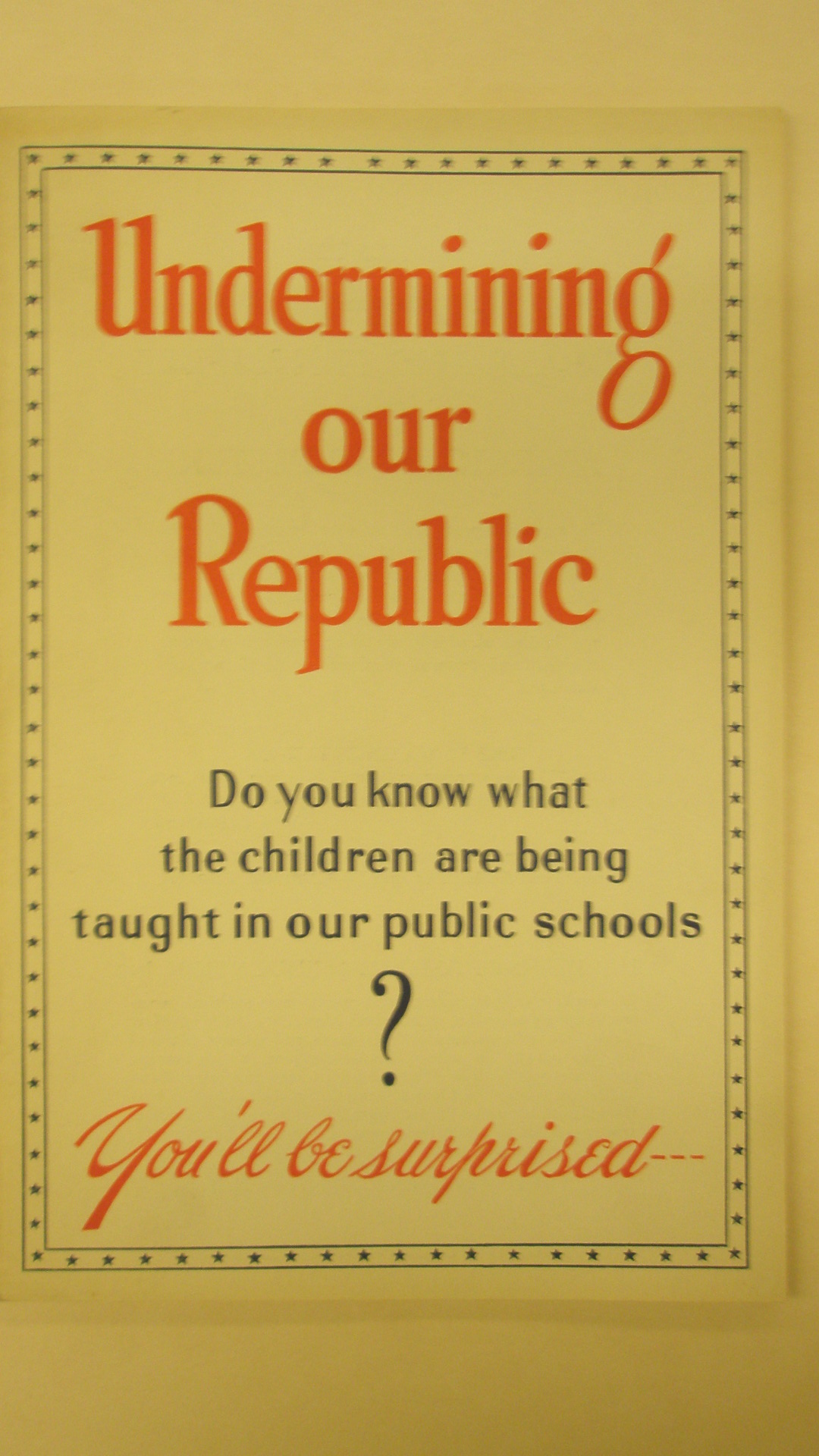
Peddling Ignorance? Or Pushing Knowledge?

Okay, so here’s the question: If a teacher or textbook tries to block children from getting knowledge, is that still education? Or is it instead the deliberate promotion of ignorance?

In the case of US History, conservative textbooks deliberately set out to block children’s understanding of the kinds of historical ideas kids might hear in public school. Does that count as education? How about if the textbook and teacher sincerely believe the truth of what they’re teaching instead?

Here’s why I’m asking: I’ve spent the last couple of days debating these questions with a group of high-power historians and sociologists at the annual meeting of the Social Science Historical Association in scenic Toronto. Just next to the Hockey Hall of Fame.

Our panel was convened by Winthrop University historian AJ Angulo.  It was chaired by Kim Tolley of Notre Dame de Namur University, and joined by Dan Perlstein of Berkeley and Karen Graves of Denison. Andrew Abbott of the University of Chicago offered comments. Professor Anjulo is editing a book about the historical construction of ignorance in American education. The rest of the group has contributed chapters.

My chapter, and the subject of my presentation in sunny Toronto, concerned history textbooks cranked out by Bob Jones University Press and A Beka Book. Both publishers come from the firmly fundamentalist side of conservative evangelicalism. And each of them has produced textbooks that tell a very different story than the one you might find in a public-school textbook.
a beka babel big

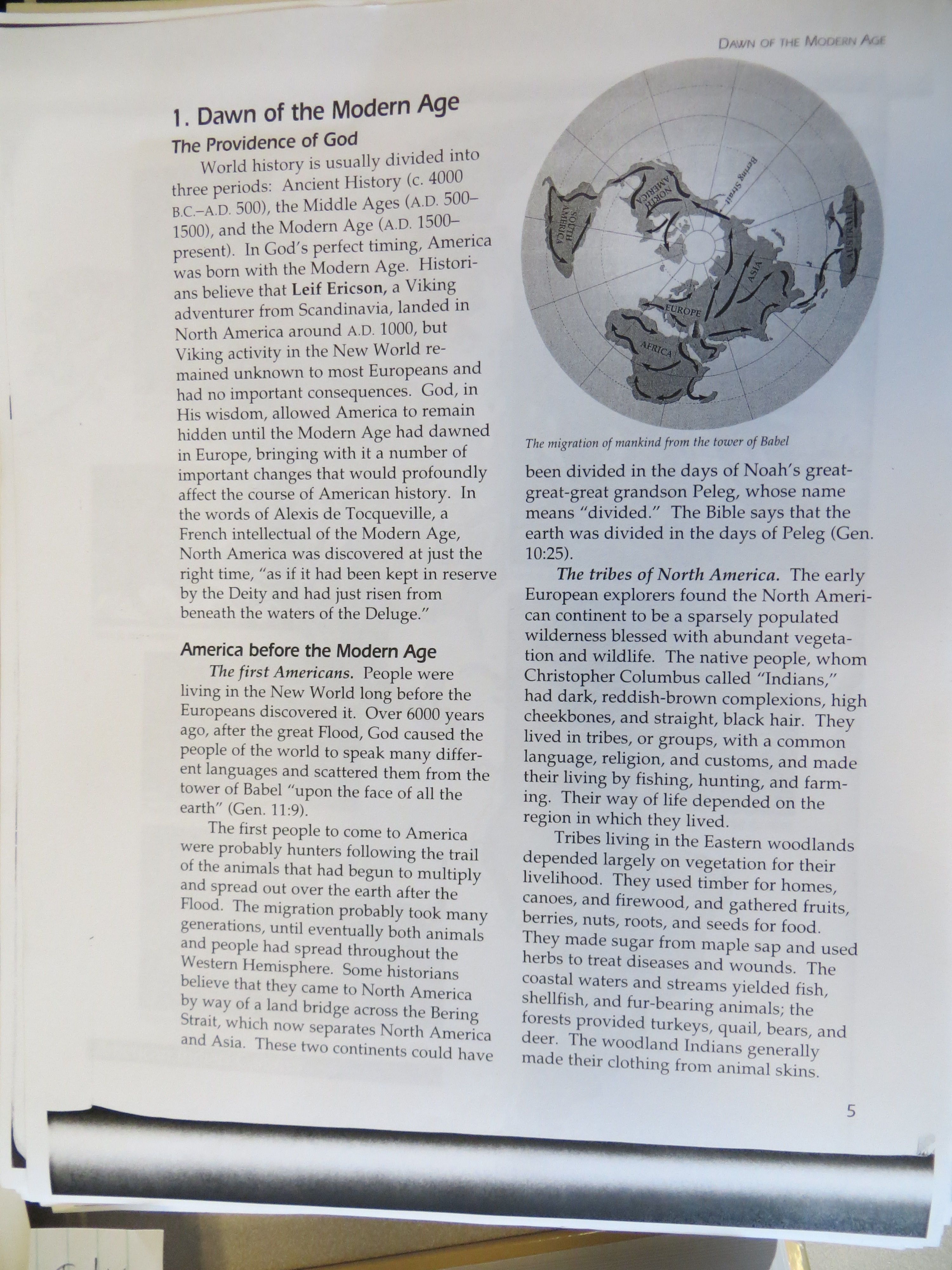
A Beka on where Americans came from

a beka babel detail

The Babel argument, close up

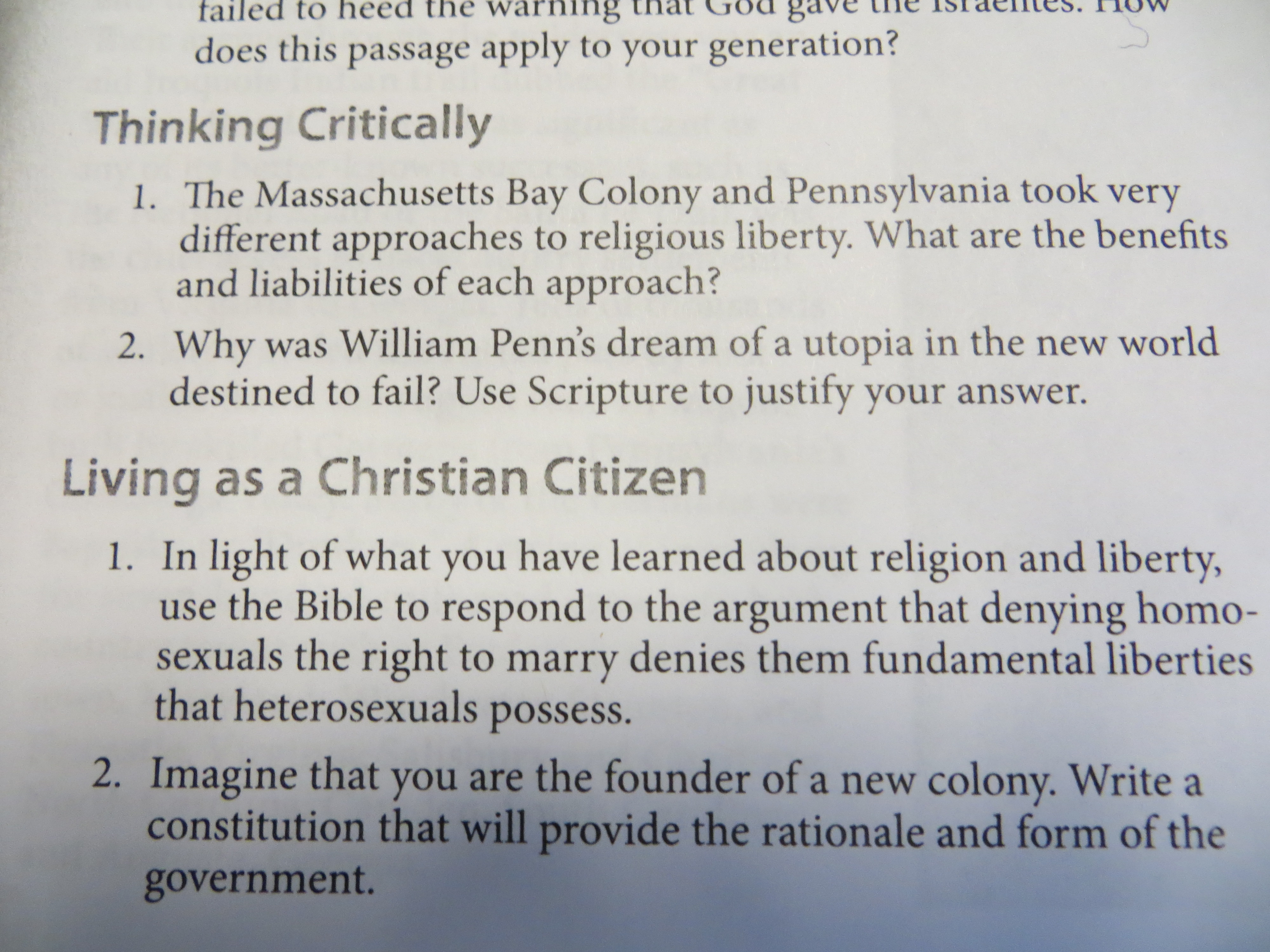
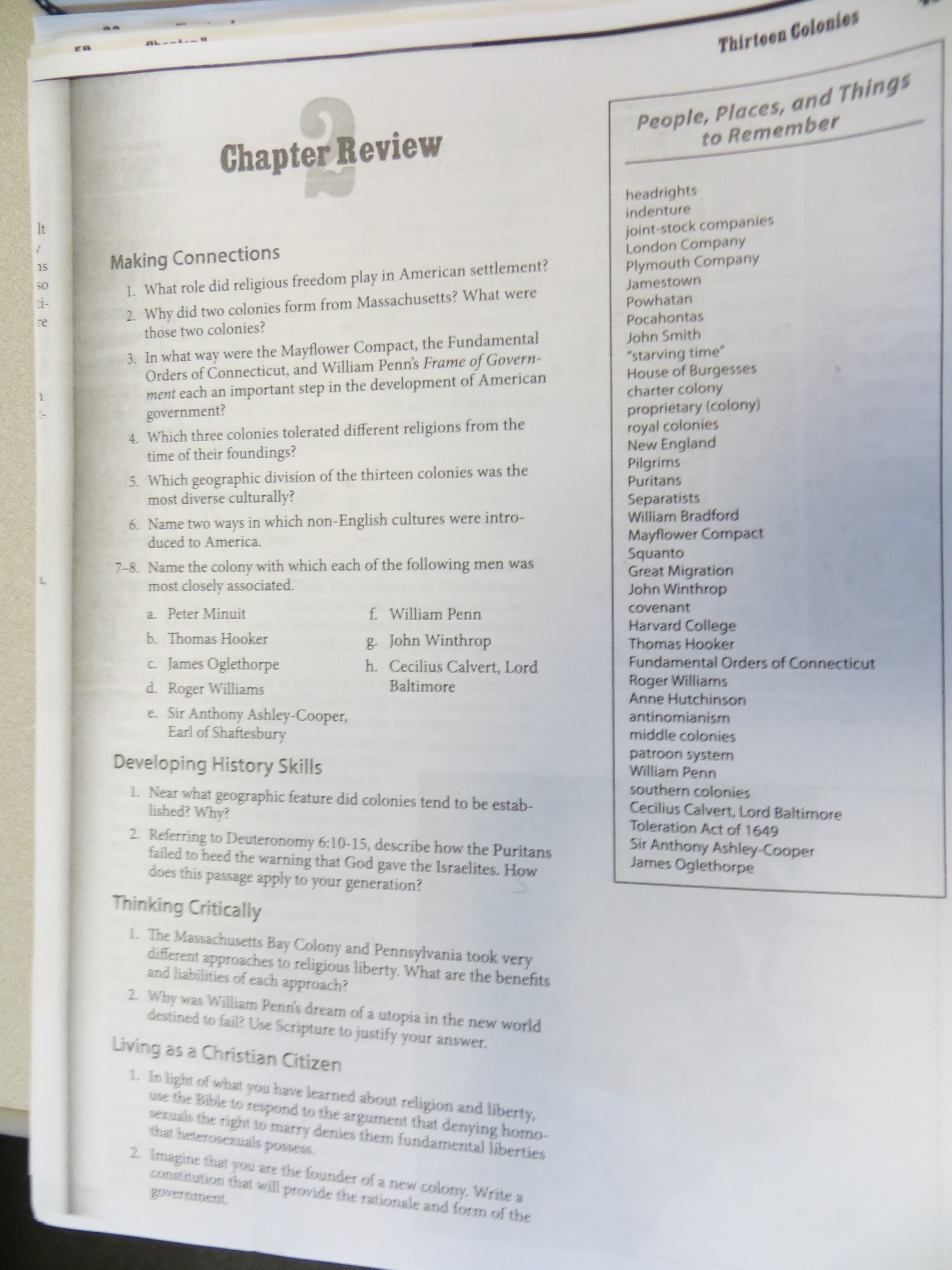
A Beka, for example, explains the origins of humanity in the Americas as the direct result of the collapse of the Tower of Babel. When that happened, people were pushed all over the earth, including into the Americas. And the BJU Press textbook asks review questions you would never find in any public-school history book: How does the early colonial history of the British teach lessons about the biblical morality of gay marriage in today’s world? What can Deuteronomy tell us about the Puritans?

No one doubts that these textbooks tell a very different history from the ones you’d find in a public school. History, in these tellings, is the unfolding of God’s plan over time. Human activity is but a scrabbling, either towards or away from the divine.

And the makers of these books have made no secret of their desire to replace mainstream historical thinking with conservative biblical interpretations. In other words, the entire point of these textbooks is to replace the histories kids might be hearing elsewhere with a profoundly biblical story.

As the faculty of Bob Jones University argued in a 1992 book, there is a “basic difference between Christian and secularist thinking about the human past.” Whereas mainstream or secular historians might hope to teach students to question sources and consider their own biases, BJU’s goal was different. The first goal of teaching history, they wrote, was to help a student “shore up his doctrinal beliefs and reinforce his Christian view of the world.”
BJU press review big

The main ideas, BJU-style

BJU press review detail

A close up: Living as a Christian Citizen

So does this count as the active construction of ignorance? Or is this, rather, simply a different version of what we usually call simply “education”? After all, kids come to public schools filled with historical knowledge, much of it bogus. Many of them get that knowledge from movies such as Forrest Gump. They think that history has been made up of Tom Hanks’ travels though time meeting famous people. Every good history teacher has to try to squeeze out those false historical notions and replace them with better ideas about history.

Activists such as Jonny Scaramanga might blast fundamentalist textbooks as near-criminal impositions of ignorance on hapless kids.  But these textbooks, we could argue, are doing the exact same thing as textbooks in public schools. They are trying to help children block out what they consider to be false knowledge with something they consider more true.

Can we call that peddling ignorance? Even if we think the history is wrong? Or do we have to admit that all education consists of an attempt to push out some kinds of knowledge to replace them with better kinds?
Were the Fundamentalists Right All Along?

Is it time for atheists to celebrate? ThinkProgress calls a recent federal court decision a “major win” for them. In that decision, Oregon’s Judge Ancer Haggerty declared that Secular Humanism deserved to be counted as a religion.

But isn’t that what fundamentalists have been saying for decades? Is this decision really a long-term win for conservative religious folks, who have long argued that secular humanism is a religion? If SH is a religion, it can’t be promoted in public schools. Will fundamentalists be able to use this court decision to demand SH-free textbooks and state standards?

SH SchaefferI take a detailed look at this anti-SH school campaign in my upcoming book. The notion that SH functioned as a religion was popularized among fundamentalists by evangelical intellectual Francis Schaeffer. In his 1982 book A Christian Manifesto, Schaeffer defined SH as a religion that made the terrible error of denying God and making humanity the “measure of all things.”

Mel and Norma Gabler, the school watchdogs who pushed Texas’ schools in profoundly conservative directions during the 1970s and 1980s, denounced SH as a “religion with an anti-biblical, anti-God bent.” Beginning with John Dewey in the 1930s, the Gablers believed, humanists had taken over schools and pushed leftist, amoral ideas on generations of schoolchildren. SH was not a neutral arbiter between religions, the Gablers argued, but rather a pernicious religion of its own. As such, it should not be allowed to do its damning work in public schools.SH Gablers

Tim LaHaye agreed. The blockbuster fundamentalist author argued in his Battle for the Public Schools (1983) that SH taught kids in public schools to be “anti-God, antimoral, antifamily, anti-free enterprise and anti-American.” By 1980, LaHaye wrote, humanism had achieved a “stranglehold” on the US government. As LaHaye put it,

Public education today is a self-serving institution controlled by elitists of an atheistic, humanist viewpoint; they are more interested in indoctrinating their charges against the recognition of God, absolute moral values, and a belief in the American dream than they are in teaching them to read, write, and do arithmetic. I call these people humanist educrats.

SH LaHayeThis claim among fundamentalists has become ubiquitous over the years. Conservatives insist that public schools are only interested in freezing out real religion. False religions, especially SH, receive special treatment. Kids in public schools, fundamentalists insist, are not actually in a neutral environment. They are, instead, effectively in an SH madrasah.

So here’s the $64,000 question: will last week’s federal court ruling fuel this fundamentalist fire? In coming years, will fundamentalist activist groups be able to prove their claims about SH and schools by citing Judge Haggerty’s argument?

It will help to look at the specifics of the case. In this case, an SH prisoner complained that he was being treated unfairly. He had demanded similar privileges for his SH group to those given to a list of religious groups. If Catholics, Shias, Sikhs and Druids could have special meeting times, Secular Humanists should too.

The judge agreed. In Haggerty’s words, “Secular Humanism is a religion for Establishment Clause purposes.” That is, as far as the Constitution is concerned, the government cannot favor any one religion over another. Judge Haggerty pointedly noted that his decision was in line with earlier court decisions that differentiated between Secular Humanism in general and organized groups of Secular Humanists who demanded equal treatment. It does not matter if SH in general is a religion. Those who claim equal privileges to religious groups deserve them.

So, in short, the judge did not decide that SH was or was not a religion. His decision was based on the notion that any religion or non-religion deserves equal treatment by the government. But here’s my hunch: For the coming few decades, fundamentalist pundits will refer to this case as proof that SH is a religion. They will ignore the niceties of Judge Haggerty’s decision. We might even see a re-do of the Mozert v. Hawkins County case from the 1980s. In that case, fundamentalist parents insisted that school textbooks pushed the religion of SH on their trusting children.

A new generation of fundamentalist activists might take heart from this decision. It is proof, fundamentalists might conclude, that they’ve been right all along.

School Politics Cracks the Race Wall

The unions like the one on the left...

The unions like the one on the left…

Who backs market reforms of schools? Conservatives, of course, and rich people. Oh, and African American voters. The race for superintendent of public instruction in California is suggesting a dramatic realignment of electoral politics. But those conservative dreams might not be warranted.

As we’ve explored in these pages (here and here, for example), white conservatives have long dreamed of shaking off their racist reputations. In school politics, it seems those efforts have finally begun to bear fruit.

It has not been easy. The conservative, or, to be more precise, the more conservative candidate for New York City mayor tried to woo non-white voters with similar school appeals. That candidate, Joe Lhota, blasted Bill de Blasio for his opposition to charter schools. Such schools, Lhota insisted, were the only educational hope for “minorities and inner city children, and children of immigrants.”

In New York City, it didn’t fly. But the race in California is much different. According to the San Jose Mercury News, one candidate for superintendent has cobbled together a coalition of super-rich backers and conservative voters, plus Latino and African American support.

That candidate, Marshall Tuck, is running neck-and-neck with the establishment choice, incumbent Tom Torlakson. Tuck’s success is built on his appeal to both the rich and the poor. The teachers’ unions have spent plenty to support Torlakson, but Tuck has still managed to outspend them, thanks to his deep-pocketed backers among the usually conservative California business elite.

Non-white voters like Tuck’s plan. According to a recent poll, Tuck leads by 38% among African American voters and 13% among Latinos. Why? One expert thinks that such voters want more charter schools, more vouchers, and less power for teachers’ unions.

Could this be the realignment conservatives have long been dreaming of? A chance to appeal to the conservative feelings among non-white voters? A chance to split off non-whites from the clutches of the Democratic Party and get them voting Republican on issues such as gay rights, abortion, and school choice?

After all, there have been similar epochal realignments in electoral politics. Most famously, FDR managed to convince African Americans to vote Democrat. Since the days of Abraham Lincoln, African Americans had been solidly Republican. Or, more recently, Reagan wooed “lunchpail” Democrats to the side of the GOP.

Could we be on the verge of a similar realignment? One in which conservative non-white voters ditch the Democrats in favor of the more conservative GOP? And if so, will school politics lead the charge?

There are a couple of things that should temper the hopes of conservative poll watchers. First, this California race is non-partisan. Both candidates are Democrats. So conservative African Americans and Latinos can vote for the more conservative candidate without abandoning the party of FDR and LBJ.

Second, though Tuck is the candidate with the more conservative positions, he’s not calling himself that. Instead, as with much of school politics, Tuck is calling his marketization plan the side of “school reform.” And his election fund, filled by mega-rich donors, officially calls itself “Parents and Teachers for Tuck.”

In this case, non-white voters seem to like the market idea that conservatives have long promoted. But they like it when it comes in a Democratic Party wrapper. They like it when it is called the progressive choice, not the conservative one.

Will non-white voters soon flock to the conservative banner? Maybe, but this race shows they might only do so if conservatism calls itself something else.

Forget the Intelligent Designer: What about Creationist Graphic Designers?

[Thanks to JS for PACE materials.]

Ken Ham is right again.  I’m no creationist, much less a young-earth type, but Mr. Ham’s Answers In Genesis organization has done it again.  As they did with their museum, AIG has managed to overcome the traditional stylistic weirdnesses of creationist outreach.

Weird science, but good-looking graphics...

Weird science, but good-looking graphics…

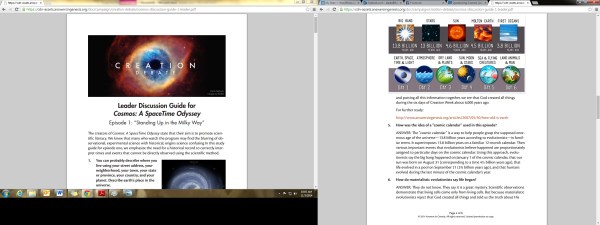
Ham has bragged recently about the high-class materials his group has cranked out.  In answer to the new version of Cosmos, Answers In Genesis has produced classroom materials to rebut the claims of the popular science show.  As Ham put it,

The AiG graphics department and publications team did a great job designing Questioning Cosmos. Its full-color glossy pages are packed with illustrations, questions for discussion, and detailed answers and explanations to help parents, teachers, and youth group leaders teach young people (and adults!) how to discern what observational science is presented in the Cosmos series and what material is best described as an evolutionary infomercial.

Even those of us who want more evolution taught in public schools must admit that Mr. Ham is right.  The anti-Cosmos materials don’t look any different than mainstream school texts.  Just as Answers In Genesis has done with its museum, this outreach effort has erased some of the obvious outward signs of the non-mainstream nature of creationist science.

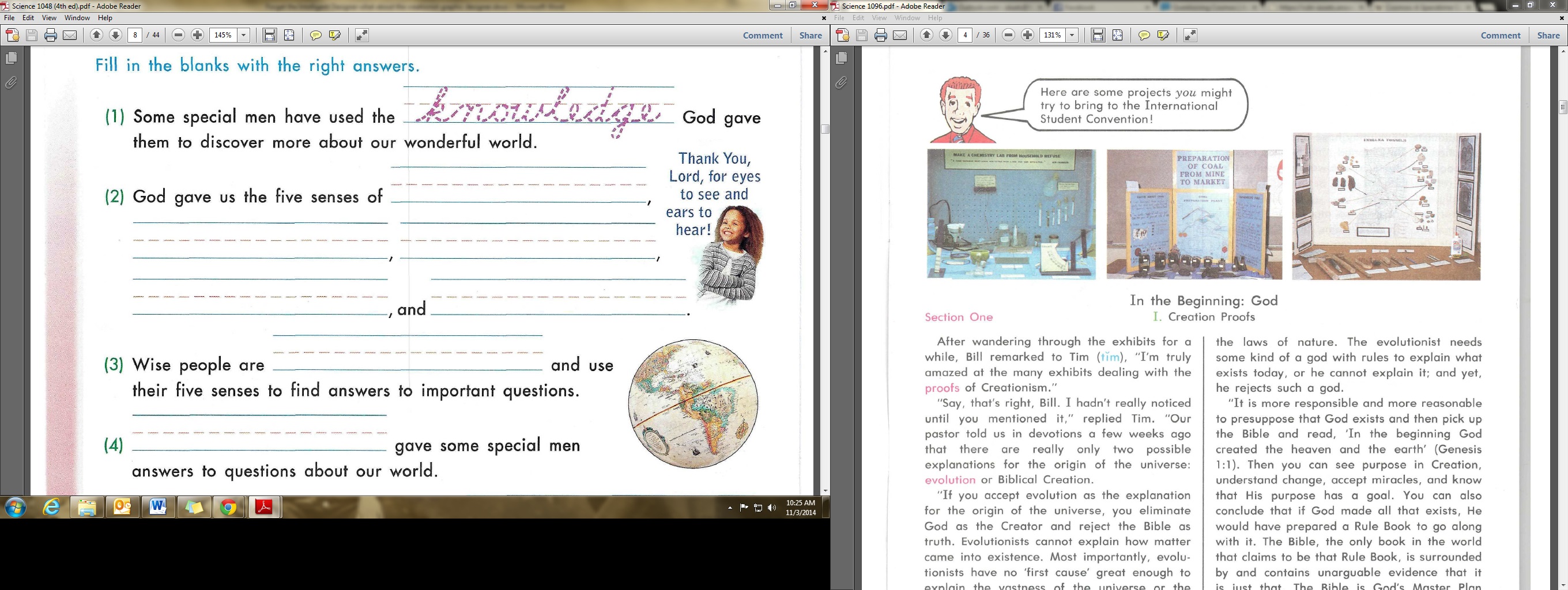
It used to be easy.  Creationists used to produce school materials that looked hokey, weird, old-fashioned.  Consider just a few samples from Accelerated Christian Education.  As these pictures show, not only is the science much different from mainstream science, but the workbooks themselves seem obviously out of date.  The graphics are weird, the comics are jerky, and the lettering looks homemade.

Creation science used to look as if it were created in six days...

Creation science used to look as if it were created in six days…

Creation science books used to LOOK different...

Gee whillikers!

That’s just not the case with AIG’s anti-Cosmos materials.  The graphic design is very similar to the production values we’d expect from mainstream school materials.  And that matters more than we might think.  Parents, school administrators, and, most important, children tend to judge books by their covers.  The shoddy production values of cheap creationist pamphlets used to make them less attractive.

In the case of Answers In Genesis, mainstream science-ed materials can no longer count on such weak and ugly competition.

I Don’t Know What to Believe…

I don’t even know what to know, or what knowing means, or what believing might mean.  The good news is that I’m not alone.  No one seems sure of these things, especially not when it comes to touchy subjects like evolution. But I’m still confident of our argument that the best approach to teaching evolution is to encourage a separation in science classrooms of the need for students to KNOW evolution from the need for students to BELIEVE evolution.

It’s a tricky distinction, and I’m sympathetic to criticism that it may not make a real difference.

Some recent survey results make me wonder if this distinction might not even be a workable one in public schools. In the blog of the National Center for Science Education, the prolific Josh Rosenau notes the results of some survey work from the University of Alabama. In short, the researchers found that the more college students accepted evolution, the more they knew about it. Now, this confounds claims by cultural-cognition guru Dan Kahan that “knowing” evolution says more about who you are than about what you know. It is more a measure of belief than of knowledge.

For a mild-mannered historian like me, these conflicting survey results leave me scratching my head. Not only are we not sure if people need to “believe” evolution to “know” it, but we’re not even sure if we “know” that “believing” and “knowing” go together!

But I can’t just throw up my hands and go back to the archives. This question of knowledge and belief is central to all of us who care about evolution education. In my upcoming creation/evolution book with talented and stylish philosopher Harvey Siegel, we argue that public schools must teach evolution, but they must teach it in a way that separates claims of knowledge and belief.

Because there is one thing I do know, as a historian: Creationism is a religiously driven belief system. It is not exactly science, but this whole foofaroll about evolution education stems from the fact that creationism is a religiously driven belief system with claims to scientific legitimacy.

When it comes to educational policy, we have to make a delicate distinction that is usually lost in all the hot air. Creationists’ claims to scientific legitimacy do not carry any weight outside of their own religious circles. But that does not mean creationists do not have a right in the public square to believe in their own scientific legitimacy.  It means creationists have a right to public schools that do not force them to perform religious acts. Since affirming the truth of mainstream evolutionary thinking would be a religious act for many creationist students, public schools need to be more careful about insisting on such things.

In practice, in public schools, this means we face a situation that makes everyone unhappy. Creationism has no legitimate claim to a place in public-school science curricula, since it is derived from religious beliefs. But public-school science classes (and history classes, and math classes, and literature classes and gym classes) have no right to push creationist students to engage in religious acts, either.

Rather, to be more precise, public schools may teach ideas that tend to denigrate religious ideas. Schools shouldn’t do so casually or glibly, but if there is an important reason, they may do so. However, public schools may not force (or even encourage) students to engage in the (possibly) religious act of denigrating creationism themselves. In short, public schools CAN expose students to ideas students find religiously offensive. But public schools CAN’T ask students to do religious acts. If affirming the truth of evolution is a religious act, then public schools cannot insist upon it, or even imply that such an affirmation is desirable.

Creationists may hate this conclusion. Since the 1920s, anti-evolutionists and creationists have insisted that their beliefs are better science, true science. In court case after court case, however, experts have demonstrated the intellectual paucity of this belief. Creationists may not admit it, but they might recognize that their claims to scientific legitimacy don’t convince people outside of their own religious circles.

And for public education, that’s enough. My religious beliefs do not carry weight—as religious beliefs—in public schools. Even if my religious beliefs insist that they are better science. Or history. Or literature. Or physical education.

But traditional science-ed types will also hate this conclusion. As a set of religious beliefs, creationism is entitled to special consideration in public schools. Though the case law is somewhat mixed on this point, the moral case is compelling: Children of any religious or cultural background must be made welcome in every public school. Their beliefs may be challenged by the curriculum, but students cannot be asked to perform religious acts in those public schools. And acts that might not seem religious to me might be religious to religious people, or even to an imaginary “objective observer.”

Conservative Christians have had mixed results trying to make this case in court. Perhaps most famously, in 1987’s Mozert v. Hawkins, an appellate court ruled that conservative parents could not ban curricular materials they found offensive. The conservative parents had argued that textbooks with references to occult practices, evolution, and impolite children infringed on their rights to religious liberty. The books, the parents believed, hurt their children’s ability to freely practice their religion.

The constitutional complexity in this case was demonstrated by its tortuous path through the court system. One district court judge agreed with the parents on one point: textbooks that say there are multiple ways to worship God really are teaching religious content. In the end, the appellate court disagreed.

Other federal courts have made this difficult point. In another case from Tennessee, Wiley v. Franklin (1979), the court decided that

if that which is taught seeks either to disparage or to encourage a commitment to a set of religious beliefs, it is constitutionally impermissible in a public school setting.

The rub in these cases, it seems to me, is that courts have trouble defining the boundaries of religion. The final ruling in Mozert relied on the fact that the conservative children didn’t have to do or say or affirm anything about religion. They were only exposed to ideas that their parents considered offensive.

And that seems telling for our case here. Though I may find it a simple statement of fact, the notion that there are many paths to religious salvation has profound religious implications for many people. And though I may find it a simple statement of fact, the notion that the earth is bajillions of years old has profound religious implications for many people. Public schools should expose students to these ideas. But public schools cannot force creationist students to engage in the religious act of agreeing with these ideas.

The fact that affirming evolution is not a religious act for me does not mean it is not a religious act for anyone. For many creationist students, saying that evolution is true is a religious act. Schools can’t insist upon it. But understanding the basic concepts of evolution is not. Public schools must insist upon that.

Though this post is already too long, let me add one caveat. This argument does not agree with creationists’ insistence that evolution is a religion. Rather, it simply says that evolution is an idea that some religious people consider religious. This is a hugely important distinction.

Public schools cannot force students to do religious things. For many students, affirming that evolution is true would be a religious act.

At the same time, public schools must teach the best available knowledge. In science classes, the modern evolutionary synthesis is an example of that sort of knowledge.

So here is our goal: Separate out our demands on students. It is not as complicated as it may seem. Adding two or three little words can do it. Instead of asking students to say, “The earth is millions of years old,” we ask students to say, “Scientists say the earth is millions of years old.”  Instead of asking students to say, “Humans evolved from other forms of life,” we ask students to say, “According to scientists, humans evolved from other forms of life.”

Do I know that this will work? No, but I believe it will help.

How Far Should the Creationist Purge Go?

Is a creationist historian worse than a socialist one? That’s the question science pundit Jerry Coyne is not asking. But he should be.

The 1941 report from the Guardians of American Education. Does Prof. Coyne really want to join this team?

The 1941 report from the Guardians of American Education. Does Prof. Coyne really want to join this team?

Like a lot of people, I’m a fan of Jerry Coyne. His tenacious attacks on all things religious are witty and smart. But in this case, his historical short-sightedness has caused him to blunder into dangerous terrain.

Here’s the story: In his continuing campaign against creationism, Coyne and his allies have singled out the creationist activism of Professor Emerson T. McMullen. McMullen teaches history classes at Georgia Southern University. Based on Coyne’s evidence, it does seem as if McMullen injects a good deal of proselytization into his classes.

McMullen teaches classes about the history of science and evolution. And, as one student noted in her evaluation, he gives extra credit if students attend religious films. As she warned, “most of it is trying to convert you, but hey, free points!”

Coyne and his allies in the Freedom From Religion Foundation wrote to the administration of Georgia Southern. They urged GSU to “investigate” McMullen’s teaching. They did not object to teaching about religious views, especially in a history class, but they did object to McMullen’s practice of pushing those views on students.

This presents us with a difficult question: How far do we want to go in purging creationists from college faculties? We agree that McMullen’s teaching seems to cross over into preaching. But there are a couple of ominous historical parallels that Professor Coyne seems to dismiss too breezily.

So, first, as Coyne and Co. acknowledge, there is no constitutional ban on teaching religion in publicly funded schools. As Justice Tom Clark made clear in his landmark 1963 opinion in the Schempp case,

Nothing we have said here indicates that such study of the Bible or of religion, when presented objectively as part of a secular program of education, may not be effected consistently with the First Amendment.

As Justice Clark specified, and as Professor Coyne acknowledged, the issue is not the teaching of religion, but the preaching of religion. As subsequent SCOTUS rulings have specified, public schools must not lend their imprimatur to religious preaching by either students or teachers. McMullen seems to be doing more than teaching about creationism. He appears to be using his authority as a teacher—dispensing grades and extra credit—to encourage students to repeat creationist-friendly ideas.

Does this mean we should actively “investigate” all such teaching? That universities have a constitutional duty to get rid of any professors or classes that move from teaching about religious ideas to preaching the ideas themselves? I think not, for two reasons.

First, university teaching is fundamentally different from K-12 teaching. The SCOTUS decisions about teaching and preaching have mostly dealt with younger students at public schools. Though Georgia Southern is a school that receives tax funding, its status as a university makes it a substantially different case from a high school, middle school, or elementary. The main issue in the Schempp verdict was that school prayer was something students could not evade. Such students were coerced, in effect, into listening to preaching. If, like the young Schempp himself, they have a pass to leave the classroom during prayers, they are still singled out by that action.  In contrast, students in college have enormous freedom to select classes. The faculties, in most cases, are much broader and more diverse. In most public high schools, students are assigned to a teacher without much input. In college, on the other hand, students put together their own schedules.

More important, Coyne doesn’t seem to grasp the tradition he would be joining if his McMullen campaign were successful, though Coyne nods to the importance of academic freedom. As I detail in my upcoming book, conservatives have conducted similar campaigns against leftist professors for decades. I doubt Professor Coyne wants to open up universities to allegations and investigations of ideologically suspicious professors.

In 1941, for example, a group of conservative leaders from the American Legion and the Advertising Federation of America teamed up to encourage Coyne-like investigations of college professors. Their main target was Professor Harold Rugg of Teachers College, Columbia University.

Should we guard the gate?

Should we guard the gate?

As the Guardians of American Education, they investigated Rugg’s teaching. They polled students and obtained copies of syllabi and course descriptions. One of Rugg’s courses, they alleged, featured what they called the “denial of certain natural and inalienable rights of man.” They gave specific examples of the way Rugg used his position as a professor to proselytize. On page 59 of Rugg’s syllabus for a course in Educational Foundations, for instance, Rugg pushed students to “admit the far too rottenness in our social, political, and financial life.”

Is this the sort of club Professor Coyne wants to join? In his earlier campaign against Eric Hedin at Ball State, Coyne alienated allies such as PZ Myers and Larry Moran. Both Moran and Myers thought that Coyne had gone too far in ignoring the sometimes-uncomfortable need to respect academic freedom. And that case was stronger than this one, since Hedin was teaching intelligent design as if it were mainstream science.

So, back to our main question: How far do we want to go to punish professors for their views? What should we do?

The purge is not the right approach. Instead, we should follow the model of Portland parents. When secular parents found out about preaching in an after-school club, they did not shut the club down. They couldn’t. The “Good News Club” had every constitutional right to do what it was doing. But the Portland parents realized that free speech and academic freedom cut both ways. They conducted a campaign to warn their fellow parents about the activities of the Good News Clubs.

That should be our model here. We do not want to slide into witch hunts and creationist-baiting. We do not want to encourage universities to investigate and purge faculty for their beliefs. Instead, we can let students at Georgia Southern know what goes on in McMullen’s classes. The publicity campaign should not be targeted at the administration of Georgia Southern, but rather at its students.

How far do we want to go in purging professors? In this case, Coyne goes too far.

Creationism Comes to College Campus

Quick: what university would you think most likely to host a big creationism conference? Bob Jones? Liberty? Cedarville? How about Michigan State?

Viviane Callier of the American Association for the Advancement of Science’s Science Insider reports that, yes, Michigan State will be hosting a big creationist conference this weekend. The Origin Summit will host four speakers about such issues as the Evolution-Hitler connection and the weakness of the Big Bang Theory. The organizers have invited MSU philosopher Robert Pennock to debate and targeted MSU’s Richard Lenski. So far, Lenski and Pennock have ignored them.

Powered by the Gish Gallop?

Powered by the Gish Gallop?

Pennock, also known as “Darwin’s Border Collie” (get it?), has been a leading anti-creationist voice in the academy. Most famously, his expert testimony in the Dover Intelligent-Design case tore apart the scientific pretensions of ID theorists. And Lenski has attracted attention for his long-term evolution study using E. Coli bacteria.

It seems that the organizers of the Origin Summit targeted Michigan State as the home of such prominent anti-creationists. After all, one of the four morning workshops promises to explain specifically how Lenski’s research will bear no fruit.

But that’s not what the organizers will tell you. At least, it’s not what they told Viviane Callier. Mike Smith, the group’s executive director, said they planned to host similar meetings at pluralistic campuses nationwide. The target, Smith explained, is the student body. Many of them may never have heard the message of creationism. “Once students realize they’re created beings,” Smith told Callier, “and not the product of natural selection, they’re much more open to the Gospel, to the message of God’s love & forgiveness.”

This is what Smith’s group describes as their “backdoor strategy.” Too many students, the group warns, have been “brainwashed with the Darwinian dogma while the state refuses any mention of Creation whatsoever.” Their plan is to let students hear the creation gospel, hoping that “many, for the first time ever, [will discover] that the Bible is true.”

The question everyone’s asking is this: How will Michigan State scientists respond? Should they inform students of the scientific baselessness of creationist claims? Or should they use humor to deflate the conference? So far, the MSU community has decided that the best response is no response.

Lenski hopes the “summit” will turn out to be nothing more than “another forgettable blip in the long history of antiscience, antievolution screeds.” And best of all, the university itself has welcomed the meeting. As one official put it,

Free speech is at the heart of academic freedom and is something we take very seriously. Any group, regardless of viewpoint, has the right to assemble in public areas of campus or petition for space to host an event so long as it does not engage in disorderly conduct or violate rules. While MSU is not a sponsor of the creation summit, MSU is a marketplace of free ideas.

Hear, hear! There is nothing violent or threatening about this meeting. There is no reason any pluralist university should not welcome such dissenting ideas into their communities.

Only Religious Colleges Can Still Do It

Higher-ed types have a deskful of crises to pick from.  There’s the sexual-assault crisis, the student-debt crisis, the MOOC crisis.  One of the biggest of these crises doesn’t seem to attract its share of attention, though it threatens a bigger transformation of higher education than any of the rest.  And when it comes to this crisis, Christopher Noble of Asuza Pacific University suggests that only religious college might have the solution.

The crisis we’re talking about is the crisis in the humanities.  As Noble notes in the Chronicle of Higher Education, fewer and fewer students are signing up as English majors, or philosophy majors, or history majors.  The reasons aren’t too hard to find.  These days, a college degree is an increasingly expensive document.  And young people want to make sure that their work will turn into a well-paid job.  That’s not a guarantee with an English degree, the way it might be with a chemistry degree or engineering degree.

But Noble offers a ray of hope.  Many secular students these days are fully literate in a verbal culture, not a print culture.  For such students, Noble reflects, the humanities might rightly seem “obsolete.”  But this is not true of conservative religious students.  Those students, Noble argues, are hard-wired to embrace the humanities.  As Noble puts it,

Suppose . . . that there existed a large group of middle-class and upper-middle-class prospective customers in the educational marketplace who shared an intense prior commitment, consciously or not, to the obsolete textual worldview. That group of customers already believes, before ever setting foot in a classroom, that a ragamuffin set of ancient texts, a collection of dissonant poetic voices in unfamiliar languages, holds the key to human meaning.

Suppose further that those customers come to learn how much humanistic study will improve their facility with ancient texts. Envision consumers for whom hermeneutical skill and ancient wisdom, rather than technical expertise, constitute the nonnegotiables of a college education. Imagine a “people of the book” in the era of the book’s demise. Such is the condition of observant Muslims, Jews, and Christians in developed countries today.

Could it be true?  Could conservative religious colleges provide not only a religious haven, but a haven for the humanities?  If so, as Professor Mark Bauerlein of Emory University has pointed out, we’ll have to recognize the painful historical irony.  Bauerlein concludes with some satisfaction that many secular humanities professors are in fact

aggressively secular,  hostile to any expression of faith outside church and home. . . . If the humanities spring from a religious impulse, or at least need it to thrive, then the irreligious, irreverent postures of humanities professors are suicidal.

Certainly, following this logic, it seems that secularizing scholars might have eaten their own tails.  But is that really the case?  Aren’t there plenty of wholly secular reasons why some students will continue to embrace the humanities?

In my case, my interest in vigorously secular thinkers led me backwards.  Because I wanted to understand Sartre, I had to read Heidegger.  And because I wanted to understand Heidegger, I went back to Hegel.  And Hegel didn’t make much sense until I had spent time with Kant, Descartes, and Spinoza.

In my case, at least, none of my appetite for studying the humanities came from a religious impulse.  Not consciously, at least.  Am I the odd duck?  Or are Bauerlein and Noble simply hoping against hope for some ratification of their love for conservative religious colleges?

Rubio’s College Fix: Make Students Profitable

Vouchers. Charters. Conservatives these days like to offer “market” solutions to school problems. In the pre-run-up to the 2016 presidential contest, Florida Senator Marco Rubio is offering a market fix for college students: Sell shares in yourself.

Of course, not every conservative is a free-marketeer. “Traditionalist” conservatives (for good examples, check out the Imaginative Conservative or the American Conservative) decry the dehumanizing effect of ruthless commodification. But there has been a long tradition in these United States of tying traditional values to an apotheosis of the free market.

In education, the most influential voice for marketization has been the late Milton Friedman. As he remembered in the 1980s, when he started advocating vouchers, it was “far out of the mainstream.” But by the twenty-first century, such market ideas had become dominant. Parents should all have the right to choose the right school for their children, Friedman insisted. The only reason they could not, he wrote, was because self-interested teachers’ unions had seized control of education and forced an “excess of conformity.”

Rubio’s plan expands on this principle. In a recent talk organized by the National Journal, Rubio worried that the “American dream” of college education has become unaffordable for many. The danger, Rubio warns, is an increasing opportunity gap between those who have advanced education and those who do not. His plan will help narrow that gap by making it possible for everyone to go to college. Our “new economy,” he says, is still working with a higher-ed system built for the “old economy.”

Sell yourselves, students...

Sell yourselves, students…

Tuition costs have shot up far faster than the rest of the economy. Students from less-affluent backgrounds have been forced out of college, or saddled with impossibly huge debt burdens. Colleges are getting fat on these hefty tuition bills, largely financed by federal student loans. And, according to Senator Rubio, many “high-skilled, high-paying industries suffer from a shortage of labor.”

His solution? Among other ideas, Rubio wants students to sell shares in themselves. Instead of borrowing a fixed amount, students could promise investors, say, four percent of their earnings for ten years after graduation. Students might end up paying far more than they borrowed. Or they might pay less. But that is all part of the promise and peril of the market.

As Rubio notes, this will pusher higher education in “practical” directions. It will push students to pursue “the right degree, geared toward the right industry.” Not a lot of investors will jump at the chance to invest in a philosophy major. But students in “engineering, health services and education,” Rubio thinks, will be a good bet.

There are plenty of conservatives, I think, who would be aghast at this marketization plan. The purpose of education, many conservatives insist, is to humanize.

Rubio’s brand of conservatism is different. He wants to let the market work its magic.

Christianity Kicked Out of Public Universities

Ball State University doesn’t want any more attention. It has been the subject of a nationwide campaign by pundits who were shocked—shocked!—to hear that one professor spoke kindly of intelligent design. But my current work in the archives at the Billy Graham Center at Wheaton College shows me just how dramatically things have changed in the past fifty years.

You may remember the intelligent-design case. In mid-2013, Eric Hedin was accused of larding his class with religious content. The Wisconsin-based Freedom From Religion Foundation complained, and eventually Ball State’s president announced that religious ideas must not be taught as part of science classes.

Hedin’s use of religious themes became objectionable for two reasons. Mainly, observers complained that he was presenting religious ideas as if they were scientific. But Ball State University was also criticized as a public school using taxpayer dollars to favor one religious group.

According to Jerry Coyne, when Ball State President Jo Ann M. Gora made her announcement that religious ideas should not be taught as science, she emphasized both of these notions. Intelligent design should not be taught as science, Gora told the Ball State community, since

Intelligent design is overwhelmingly deemed by the scientific community as a religious belief and not a scientific theory. Therefore, intelligent design is not appropriate content for science courses.

But Gora specified that even if such religious ideas were taught as part of humanities courses, they must only be taught as ideas, not as dogma. That is, even non-science classes could not teach religious ideas as true, but only as history or literature. As Gora put it,

Discussions of intelligent design and creation science can have their place at Ball State in humanities or social science courses. However, even in such contexts, faculty must avoid endorsing one point of view over others. . . . As a public university, we have a constitutional obligation to maintain a clear separation between church and state. It is imperative that even when religious ideas are appropriately taught in humanities and social science courses, they must be discussed in comparison to each other, with no endorsement of one perspective over another.

Things have changed. As I’ve dug through the archives here at the Billy Graham Center, I’ve come across an intriguing historical coda to the Eric Hedin story. These days, professors at Ball State may not teach religious ideas as science. They may not even teach any single religious idea as history or literature.

But as late as 1957, Ball State University—like many other public universities—taught evangelical Protestantism explicitly and purposefully. Many public colleges, especially teachers’ colleges, had entire programs devoted to what was usually called “Christian Education.” In these courses, public-school students could learn the basics of evangelical proselytization, usually under the heading of learning to be “Sunday School” teachers. Most typically, students were women who hoped to begin or enhance their careers as part-time religious educators.

The current logo hints at this heavenly history...

The current logo hints at this heavenly history…

In some cases, today’s public colleges used to be religious or denominational schools. That doesn’t seem to be the case with Ball State. It claims to have always been part of the government system.

Not only did universities such as Ball State teach courses in spreading the evangelical Gospel to children, but they also accepted transfer credits from unapologetically fundamentalist seminaries. In my archival work, I’ve found several examples of students using their credits from the Winona Lake School of Theology to advance their degrees at public universities like Ball State and the University of Georgia. Even the state of California apparently accepted Winona Lake credits toward public-school teaching certificates.

At the time, Winona Lake School of Theology was a firmly fundamentalist summer school. It was going through an ugly separation from the Fuller Theological Seminary over Fuller’s alleged drift away from Biblical inerrancy. Now defunct, the Winona Lake school refused to go along as Fuller Seminary moved into a more ecumenical attitude.

And in 1957, teachers could use their credits from this religious school to complete their religious program in Christian Education at Ball State University. Though there is too much heated rhetoric about God being “kicked out” of American public education, this example shows us how things really have changed over the past decades.

In 2013, the president of Ball State had no problem announcing that her university must not favor one religion over another; as a public school it must not teach religion, though it can and should teach about religion. But as late as 1957, Ball State and other public universities found it unexceptional to teach entire programs in Christian evangelism. Ball State had no problem taking credits from a fundamentalist seminary, since both programs taught similar course content.

More evidence that we are not just replaying every old culture-war script. Things really have changed.