Revolution Is (Not) Coming to a Classroom Near You!

Time for conservatives to freak out? No, not really, but you wouldn’t know it if you only read the Chicken Little-ism of Gilbert T. Sewall in the American Conservative. As have conservatives for a full century now, Sewall makes a fundamental mistake when it comes to American education.

Why is Sewall freaking out? It seems California has introduced a new curricular requirement to its public schools. Soon, to graduate from high schools Californians will have to complete an Ethnic Studies class. What will it mean? According to Sewall, it will be nothing less than

a revolutionary storm sweeping through educational leadership in the nation’s legislatures and metro school districts.

Except…it won’t. Of course it won’t. For good or ill, no single curricular requirement can have that much impact on the goings-on in America’s classroom.

What is Sewall worried about? As he describes,

Ethnic Studies is the “disciplinary, loving, and critical praxis of holistic humanity.” It is the study of “intersectional and ancestral roots, coloniality, hegemony and a dignified world where many worlds fit.” It “critically grapples with the various power structures and forms of oppression, including, but not limited to, white supremacy, race and racism, sexism, classism, homophobia, islamophobia, transphobia, and xenophobia.” . . .

“The foundational values of Ethnic Studies are housed in the conceptual model of the ‘double helix,’” the text professes, “which interweaves holistic humanization and critical consciousness.” The proposed course of study, while promising to help with the “eradication of bigotry, hate, and racism” and the promotion of “socio-emotional development and wellness,” seems intended mainly to stir ill will and delegitimize the nation’s white majority. The conviction that malign U.S. wealth and power exist at the expense of certified underdogs undergirds the entire document.

So, should conservatives panic? For that matter, should progressives celebrate? No and no. Why not? A little background: As I argued in my history of American educational conservatism, conservatives have long assumed that progressive school rhetoric reflected a revolutionary new reality in America’s classrooms. It doesn’t and it never has.
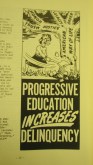
Zoll, Progressive Education Increases Delinquency

How to panic, c. 1949.

Consider, for example, the alarmist language of 1940s pundit Allen Zoll. Zoll was a hard-right hack who managed to build a mailing list of many respectable thinkers and activists. In his pamphlets, he snipped a few bits of progressive-ed language and baked them into an apocalyptic meringue for his readers. Consider this snippet from Progressive Education Increases Delinquency:

The tragic and terrifying thing about all this [progressive education] is that it represents not merely rebellion against a moral code, but denial that there can be any binding moral code.  It is a fundamental revolution in human thinking of the first order: it is mental and ethical nihilism.  If it goes on unchecked, it will mean not merely tragedy for millions of individuals, it will mean the disintegration and final extinction of the American society.

We don’t even need to argue that progressive classroom methods will do no such thing. All we have to do this morning is point out that such progressive methods never had anything near the influence Zoll assumed they did. Like many of his conservative allies, Allen Zoll read a few progressive pamphlets then told his many readers that those ideas reflected a terrifying new revolutionary reality in America’s classrooms.

They didn’t then and they don’t now. Think about it: If changing a curriculum could have sweeping revolutionary changes in the ways people think, we would have long ago have abolished both racism and radical young-earth creationism.

Exhibit A: When it comes to creationism, as political scientists Michael Berkman and Erik Plutzer noted, state standards for teaching evolutionary theory are generally pretty good. But that doesn’t mean that people are really learning evolutionary theory in schools. Obvs.

Exhibit B: As for racism, historian Zoe Burkholder argued that anti-racist academic activists such as Franz Boas and Margaret Mead had some real success introducing anti-racist materials in the New York City curriculum, way back in the 1940s. Did that mean that racism was eliminated? Sadly, no.

The point here is not that anti-racist or pro-evolution curriculum is a bad idea. Personally, I agree that every student should be exposed to such ideas. But just adding an idea to a mandated curriculum does not now and has not ever resulted in sweeping changes in the things people actually learn in school.

For me and my progressive friends, that can come as a sad and sobering wake-up call. For some conservatives, like Gilbert Sewall, it should come as a heavy dose of reassurance.

Because unlike what Sewall predicts, this change in California curriculum does not herald the destruction of traditional values or hierarchies. California, regardless of what Sewall says, has not really “abandon[ed] teaching and learning in favor of political indoctrination.”

For what it’s worth, I sympathize with Sewall. No one would read his article if he said, “I don’t like this change but it’s not really that big of a deal.” As have conservative pundits for a century now, Sewall chose to inflate the real danger in order to attract anxious readers.

However, this kind of educational alarmism is a problem. It leads readers to conclude that something profound has gone horribly wrong with America’s schools. Even when they see counter-evidence with their own eyes, Americans tend to listen to the unfounded panic-mongering of writers like Sewall instead of calmer, boringer voices.
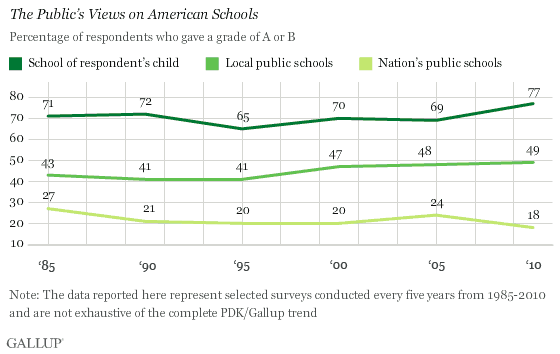
gallup local schools

People LIKE the schools they know.

What should we do instead? It’s not easy, but it is obvious. Instead of browsing through state mandates, we should get to know real schools. We should visit local schools, attend school-board meetings, and talk with teachers and neighbors about what happens on a day-to-day basis. If more people did that, there would less panic and more pragmatism in every discussion of public education.

I Guess I Owe Bill Nye an Apology

Sorry, Bill. You were right. I was wrong. Back when you agreed to debate radical creationist Ken Ham, I thought you couldn’t possibly do any good. Like a lot of other nerds, I thought that merely explaining the basics of mainstream science was necessary, but not sufficient. I didn’t think Nye’s presentation–no matter how good it was–could deter any radical creationists from preferring their own brand of fundamentalist science.

marty sampson ken ham

…turns out there are still people out there who just haven’t heard about real science.

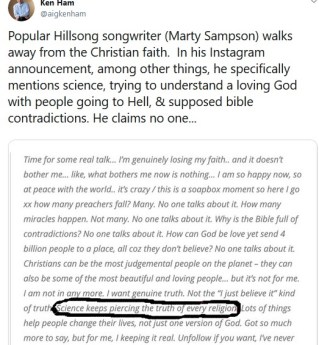
Looks like I was wrong in at least one case. This morning, Ken Ham lamented the defection of an evangelical music star. I don’t know anything about Marty Sampson or Hillsong, but apparently one of the reasons Sampson gave for giving up on evangelical religion was because of mainstream science. As Sampson announced,

Science keeps piercing the truth of every religion.

Five years ago, when Nye agreed to beard Ham in the creationists’ lions’ den, I thought he was making a strategic mistake. I thought Nye misunderstood the nature of radical American creationism. As I wrote at the time,

Bill Nye’s assumption that young-earth creationism represents a lack of scientific knowledge is more than just an embarrassing ignorance on Nye’s part. The educational and political tasks in cases of naïve non-knowledge are worlds apart from the educational and political tasks in cases of intentional or constructed non-knowledge. In the case of evolution education, if creationists were simply unaware of evolutionary science, then outreach programs would have a good chance of success. The task would be simply to spread information. But in reality, evolution education must recognize that many students and families are not simply ignorant, but resistant to this form of knowledge. Educational efforts must strive first to understand the reasons for this resistance. Only then can evolution educators hope to develop effective strategies to teach evolution.

But…I guess in at least this one case, a creationist Christian really DID find the truths of mainstream science compelling. Marty Sampson appears to have converted away from conservative evangelicalism–at least in part–due to his exposure to mainstream scientific ideas. And if this famous creationist is feeling this way, I’m guessing there are plenty more among the rank and file who are moving more quietly away from radical creationism and conservative evangelical religion.

I Love You but You Didn’t Do the Reading

Think things would slow down in August? Me, too. But turns out they didn’t. We’ve got stories this week about professors fired for breaking into student protests, the case for and against free college, the real deal with the Ark Encounter, a gruesome anniversary, the conservative evangelical response to the recent grisly mass murders, and more. Read on…

Why was this faculty member at Johns Hopkins fired for breaking into a student protest? At IHE.

I’m not an idiot; I know that as a person who demographically ticks all the ‘oppressor boxes,’ I would have to be severely punished for opposing such a group.

Will tuition-free college heal America’s economic inequality?

Ninety-six percent of Finland’s higher education resources are public, but its attainment rate — the proportion of citizens ages 25 to 34 with a degree beyond K-12 education — is less than 45 percent, placing it 25th among OECD countries. South Korea-based higher education, on the other hand, gets about 36 percent of its funding from the government and achieves a 70 percent attainment rate, the highest among OECD countries, according to the report.

public college IHEForget science and Jesus for a second: Are the radical creationists at the Ark Encounter bringing tourist dollars in to their region?

If Ham’s post were a paper written by a University of Dayton student in one of my first-year classes, I would have written this at the bottom of the paper:

Failure to provide substantive evidence to back your claims, and a dismaying tendency to resort to ad hominem attacks. This is not acceptable for a university-level paper. Revise and resubmit.

Remembering August, 1945: How was Nagasaki picked as the second target? At AA.

nagasaki mushroom cloud

What do conservative Christians say about the most recent mass shootings? The ILYBYGTH position: You don’t have to agree with these explanations, but if you want to understand America’s culture wars, you need to understand why so many people DO agree with them.

When babies are aborted, the Christian Right rarely talks about praying for the woman who had the abortion. They rarely offer “thoughts” to the families who suffer through such a decision. Instead, they attempt to solve the problem of abortion by passing legislation, organizing grass-roots campaigns, proposing new bills and electing political candidates who will appoint federal justices who share their interpretation of the Constitution and the Bill of Rights.

Hundreds of pastors attend Liberty’s political rally, at CBN.

Meanwhile, the Southern Baptist Convention’s Russell Moore holds out against white racism and Christian nationalism, at Newsweek.

Racism is Satanism in my view, because it’s the idolatry of the flesh—and a sense of superiority and dominion over other people. That can manifest itself in neo-Nazi movements in Germany, in racist memes on Facebook or in left wing anti-Semitic posts and movements around the world as well. . . . The church is not a political action committee and should never be a means to any earthly end. Church has a much bigger mission than that.

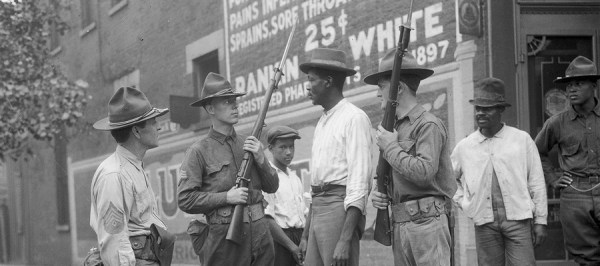
The centenary of “Red Summer’s” race riots, at HNN:

almost every instance of racial violence in 1919 began with white people organizing to attack African Americans for specific purposes: to drive them from jobs and homes, to punish or lynch them for alleged crimes or insults against whites, to block black advancement. In Chicago, for example, white gangs carried out home invasions to drive black residents from houses in previously all-white neighborhoods. To call such actions “riots” minimizes their overtly racist intent and overlooks the instigators.

red summer
How to wipe out domestic terror:

Congress should pass the Stop Harmful and Abusive Telecommunications Expression Act (Stop HATE Act), a complementary piece of legislation that would identify how social media and online forums have accelerate the spread of hate speech and white supremacist ideology.

history tells us that this country, now numbering 327 million, blessed with so many resources and so much brainpower, can overwhelm a few thousand creeps and potentially violent criminals. Just as we snuffed out anarchists, fascists, and leftist radicals over the past century, so, too, can we snuff out these new evildoers.

How to teach: Keep it interesting, at CB. Mummies and sharks, not “captions” and “generally applicable skills.”

Another widespread belief among educators is that history and non-hands-on science are inappropriate for young children. That, too, is not supported by the evidence — including the anecdotal evidence from Ms. Williams’ classroom. The fact is, history is a series of stories. And kids love stories. The same is true for science topics that don’t lend themselves to hands-on activities.

Will Senator Warren’s career as a teacher help or hurt her chances? At TC.

It’s a risk. Schoolmarm, after all, is a derogatory descriptor, one that was deployed against Hillary Clinton, also a former law professor, and one that flicks at the well-worn stereotype of the stern lady who can force you to recite your times table.

warren teaching at Penn early 1990s

Sen. Warren doing her teacher thing at Penn, early 1990s.

For Christians, A Stark Choice: Falwell or Moore?

Just as hundreds of evangelical pastors converge on Liberty University for a mega-political rally, the SBC’s Russell Moore is asking them to renounce racism and Christian nationalism. What will white evangelicals choose?

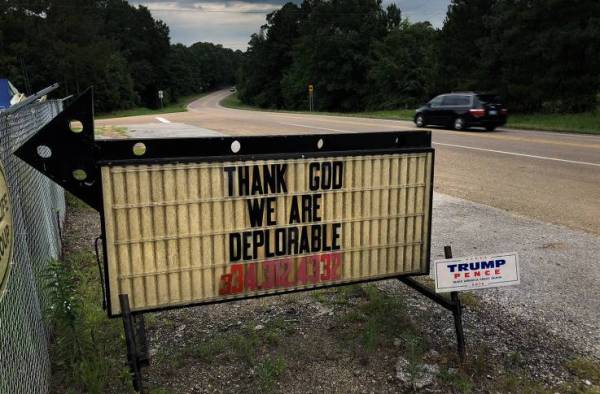
thank god we are deplorable trump pence

What will 2020 bring?

There hasn’t been much mystery about the recent politics of Liberty’s Jerry Falwell Jr. His in-your-face Trumpism has been pretty extreme even for white evangelicals. In the long tradition of his father’s Liberty University, this week’s workshops will help evangelical pastors connect their cultural conservatism to their political activism. As CBN described,

Most Conservative Evangelicals see a culture spiraling out of control and drifting further away from Judeo-Christian principles. They are well aware of America’s spiritual roots and it was pastors, especially back in the Revolutionary War period, that led the way speaking out boldly from the pulpit on the moral and cultural issues of the day. This effort is clearly an attempt to see a new generation of pastors step up.

Meanwhile, the Southern Baptist Convention’s Russell Moore was telling Newsweek that evangelical Christianity has to fight against racism and nationalism. Yes, Moore noted, evangelical Protestants and other conservative Christians have had to defend themselves against unfair charges of bigotry and prejudice.

But Trump’s aggressive racist appeals are dangerous. As Moore noted,

racism is not a social or political issue. Racism is Satanism in my view, because it’s the idolatry of the flesh—and a sense of superiority and dominion over other people. That can manifest itself in neo-Nazi movements in Germany, in racist memes on Facebook or in left wing anti-Semitic posts and movements around the world as well.

Plus, Moore pointed out that religious people have a complicated relationship to political action. As he put it,

The church is not a political action committee and should never be a means to any earthly end. Church has a much bigger mission than that. Christians should be engaged in the world around them, including in their callings as citizens. The fortunes of the church don’t rise and fall with whoever’s winning and losing in the political arena. But then I will find myself sometimes even on the same day preaching to, say, a group of younger church planters. And making the point you can’t withdraw from the public arena and still love thy neighbor. You have responsibilities as citizens.

Will anyone listen? I guess the more precise question is this: How many white evangelicals will listen? How many will ask themselves if Trumpism really represents their vision of a just society, or if “making America great again” is code for a cynical, secular nostalgia that doesn’t really reflect evangelical values?

My hunch is that most white evangelical voters will continue to make decisions on a long list of factors. Some will be attracted to the Falwell-ish machismo of Trump’s angry white rhetoric. Others will be put off, but still choose Trump as the lesser of two evils. A few might decide that Trump’s racist appeals put him over the edge of moral acceptability, even if they don’t like the Democratic alternative.

Radical Creationists Fall into the Poetry Trap

Want to understand American creationism? Then don’t dig into Charles Darwin or even Bill Nye. The key to American creationism isn’t science, not even its peculiar “zombie” science. No, to understand radical American creationism, we need to look instead to poetry and the fundamentalist impulse.

Here’s the latest: today’s leading radical creationist Ken Ham recently defended his young-earth position against charges of flat-earthism. As Ham bemoaned,

now it’s not just atheists arguing the Bible teaches a flat earth—it’s some Christians, too, who’ve sadly fallen for flat-earth arguments and now believe that’s what the Bible teaches. But does it?

No, it doesn’t. Now, flat earthers will frequently bring up poetic passages, such as verses from Psalms or Job, and say those verses teach a flat earth because phrases like “ends of the earth” or references to a setting sun appear. But those passages are poetry—by definition poetry is filled with literary devices such as metaphors, similes, and figures of speech. The biblical text is meant to be interpreted naturally, according to the genre. And poetry is clearly intended to be understood within the context of abundant literary devices that are not meant to be taken so woodenly and literally (i.e., God does not literally lie us down in green pastures as per Psalm 23:2).

For those who know the history of American creationism, Ham’s use of the “poetry” defense must seem either brutally cynical or woefully ignorant. Here’s why: Back in the 1950s, fundamentalist Protestant scholars tried to move away from Ham’s preferred sort of radical young-earth creationism. They wanted to remain creationists, but they didn’t want to be bound to scientifically outlandish notions such as a 6,000-year-old earth or a literal world-wide flood.

How did they interpret the creation passages in Genesis? You guessed it: as poetry.

Most influentially, Bernard Ramm argued in his 1954 book The Christian View of Science and Scripture that simple young-earth creationism made a huge theological mistake. As Ramm wrote,

If the theologian teaches that the earth is the center of the solar system, or that man first appeared on the earth at 4004 BC, or that all the world was submerged under water at 4004 BC and had been for unknown millennia, he is misinterpreting Scripture and bringing Scripture into needless conflict with science.

When the Bible describes creation, Ramm argued, it was speaking poetically, in popular, accessible language. Such language, Ramm thought, did not “theorize as to the actual nature of things.” Rather, it explained God’s role as a personal, engaged Creator in poetic language that people everywhere could understand.

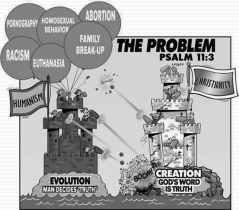
AIG fortress cartoon

For radical creationists, the problem with evolution is what it supports…

The modern American radical-creationist movement was born as an attempt to directly refute Ramm’s ideas. John Whitcomb Jr. and Henry Morris set out in their blockbuster creationist hit The Genesis Flood to prove that Genesis was not poetry, but history.

As always, though, poetry is in the eye of the beholder. How were conservative evangelicals supposed to choose where to draw the line? How were they supposed to decide if talk about a flat earth was meant to be read poetically or literally? Or passages about a world-wide flood? Or the age of the planet?

In the end, the answers came down to something besides science or even theology. For Whitcomb and Morris in the 1960s and 1970s, or Ken Ham today, insistence on a literal young earth and literal world-wide flood is not a scientific decision or a theological one, but rather a very popular kind of draw-the-line-ism, a fundamentalist promise that traditional beliefs must be protected at all costs.

For example, when John Whitcomb Jr. and Henry Morris made their first case for radical young-earth creationism, they insisted that there were only two ways to see the world—young-earth creationism or “evolutionism.” On the creationist side stood Jesus and the Scriptures. On evolution’s side were only “ancient idolatries or primitive animism or modern existentialism or atheistic communism!”

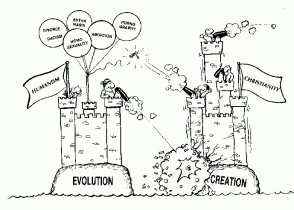
AIG foundations

Supporting evolution, for Ken Ham, means supporting abortion and homosexuality.

Throughout his long career, Henry Morris insisted that only a rigid, literalistic, radical creationism stood between true religion and a host of pernicious ideas. In The Long War Against God, for example, Morris warned that a poetic reading of Genesis would mean an endorsement of “premarital sex, adultery, divorce, and homosexuality” as well as ”Unrestrained pornography. . . . [and] Prostitution, both male and female.” Don’t forget, Morris warned, that “evolutionary thinking” lead to “abortionism.” And the Holocaust. As well as, presumably, cannibalism, not to mention “the modern drug crisis (rock music, peer pressure, organized crime, etc.)”

When Henry Morris insisted on reading Genesis as literal rather than poetic, he wasn’t making a theological statement. He was not making a scientific statement. Rather, Morris was appealing to America’s fundamentalist impulse, the desire of many conservative Christians to draw the line somewhere.

For Morris and his erstwhile protégé Ken Ham, the threat of evolution isn’t really theological or scientific. Rather, as Ham never tires of repeating, evolutionary thinking is the foundation of a host of modern social ills, from abortion rights to LGBTQ rights; from youthful disrespect to internet pornography.

I can’t help but wonder if Ham is aware of the long history of his poetry defense. Does he know that Bernard Ramm used the same argument against his mentor’s radical young-earth beliefs? Does Ham just not care? Or, rather, does he understand that his followers don’t really care about science or theology, they are just looking for someone to tell them where to draw the line, where to take up a fundamentalist defense of traditional values?

God and Guns: Conservative Christians and the Latest Round of Mass Murder

What have conservatives had to say about the latest mass murders? Whatever your personal religion or politics, it’s fair to say that you don’t really understand America if you don’t understand the immense appeal of the statements below. Of course, conservatives have lots of different opinions, but here is a collection:

“There is a spiritual war over this country,” he said. “When you see things that take place like you saw last night in El Paso and Dayton, it’s nothing but the devil. The guns didn’t do this; people did this full of the devil and they were demon-possessed and these people are being used as pawns in this elite, deep state game to control this country, to take the guns away, to take any freedom away that we’ve got.”

“Listen to me,” McDonald added. “It’s not just about the guns, it’s about your ability to worship. It’s all tied together, because if they can take your guns away, they can take your ability to worship God away and they are trying to do everything in one swoop.”

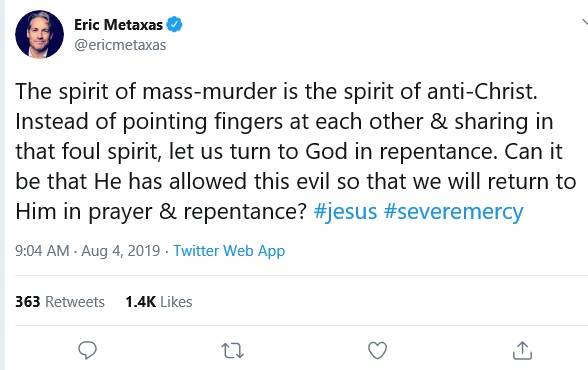
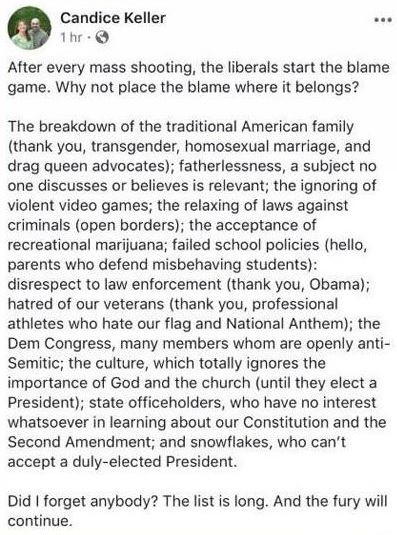
Candice Keller mass shootingsIt has long been one of the toughest dividing lines in America’s culture wars. After storms and diseases, prominent right-wing preachers have long blamed left-wing cultural trends. For those of us on the left, these fulminations have seemed bizarre, hateful, and incredibly out-of-touch politically.
It might just be the best measure of where people stand in culture-war politics. When you read explanations of tragedies, when do you nod? When Beto O’Rourke blames them on guns and Trump? Or when Eric Metaxas blames the AntiChrist?

I Love You but You Didn’t Do the Reading

Here are a few stories for your beach reading. What do the radical creationists say to the flat-earthers? What do politically liberal Christians say about Trumpism? Why do some conservatives think colleges have grown more racist? All that and more…

What do Christians have to say about “Christian Nationalism?” At RNS.christians against christian nationalism

Christian nationalism demands Christianity be privileged by the State and implies that to be a good American, one must be Christian. It often overlaps with and provides cover for white supremacy and racial subjugation. We reject this damaging political ideology and invite our Christian brothers and sisters to join us in opposing this threat to our faith and to our nation.

Radical creationists resort to poetry to prove they aren’t flat-earthers. At AIGKHB.

It’s not just atheists arguing the Bible teaches a flat earth—it’s some Christians, too, who’ve sadly fallen for flat-earth arguments and now believe that’s what the Bible teaches. But does it?

No, it doesn’t. Now, flat earthers will frequently bring up poetic passages, such as verses from Psalms or Job, and say those verses teach a flat earth because phrases like “ends of the earth” or references to a setting sun appear. But those passages are poetry—by definition poetry is filled with literary devices such as metaphors, similes, and figures of speech. The biblical text is meant to be interpreted naturally, according to the genre. And poetry is clearly intended to be understood within the context of abundant literary devices that are not meant to be taken so woodenly and literally (i.e., God does not literally lie us down in green pastures as per Psalm 23:2).

Guess what? Rich people have advantages in school. The latest non-surprise: Affluent students tend to get more time on tests. At NYT.

From Weston, Conn., to Mercer Island, Wash., word has spread on parenting message boards and in the stands at home games: A federal disability designation known as a 504 plan can help struggling students improve their grades and test scores. But the plans are not doled out equitably across the United States.

In the country’s richest enclaves, where students already have greater access to private tutors and admissions coaches, the share of high school students with the designation is double the national average. In some communities, more than one in 10 students have one — up to seven times the rate nationwide, according to a New York Times analysis of federal data.

Race and Man at Yale. New conservative National Association of Scholars report critiques Yale’s segregationist practices, at NR.

Yale’s segregationist practices have been in place for a generation before today’s students were born. Yet 40 years of neo-segregation seems to have increased, rather than decreased, racial resentment.

Is Professor Wax a “repugnant” racist? Or a perfect example of why we have tenure? It’s both, at CHE.

Many have described Wax’s case as a difficult test of academic freedom and its limitations. It’s not. Tenure and academic freedom, as we currently understand them, were literally created in response to another prominent scholar’s getting canned for making inflammatory statements on race and immigration.

Florida man: No evolution in public schools, at FCS.

I won’t support any evolution being taught as fact at all in any of our schools.

The GOP just got a little bit whiter. The last black Republican in the House of Reps is retiring, at NYT.

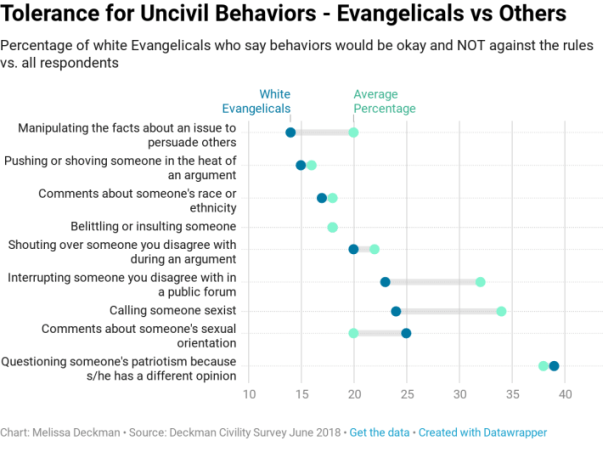
For white evangelicals, the question of “civility” in politics is…complicated. At RIP.

RIP civility scoreRemember John Allen Chau? The aggressive missionary killed last year at an isolated island in the Pacific? Outside Magazine offers a gripping new portrait.

John stuck to his belief that it was his duty to go to North Sentinel. The islanders were damned to “eternal fire” if they never heard the Gospel, and as an outdoorsman with a knack for making friends in new places, John was one of the few souls in Christendom who could save them. It felt ordained, John said, like God was calling him. Patrick [John’s father] believed his son was deceiving himself. This wasn’t just about helping the Sentinelese or obeying God. This was about John’s Messiah complex. He described his son as a victim of fantasies, fanaticism, and extremism.

What is the nation’s largest non-profit charter-school network up to? Moving from “no excuses” classrooms to “joyful” ones. At Chalkbeat.

Did a recent commission mistake the causes of racial disparities in school discipline? One member says yes, at WE.

The commission purports to find, however, that “students of color as a whole, as well as by individual racial group, do not commit more disciplinable offenses than their white peers.” According to the commission, they are simply punished more. Readers are left to imagine our schools are not just occasionally unfair, but rather astonishingly unfair on matters of discipline.

The report provides no evidence to support its sweeping assertion and, sadly, there is abundant evidence to the contrary. For example, the National Center for Education Statistics surveys high school students biennially. Since 1993, it has asked students whether they have been in a fight on school property over the past 12 months. The results have been consistent. In 2015, 12.6 percent of African-American students reported being in such a fight, while only 5.6 percent of white students did.

Why Do White Reformers Keep Making This Obvious Mistake?

It seems like it should be obvious. Yet news from KIPP—the nation’s largest non-profit charter-school network—shows that this simple idea is still very difficult for well-meaning school reformers to understand. Why has it taken decades for today’s “visionaries” to learn this centuries-old lesson?

https://www.youtube.com/watch?v=AzWicLyDTkw

Here’s the latest: According to Chalkbeat, the KIPP network shared some powerful mea culpas at its recent 25-year anniversary meeting. Historically, the schools have tended to attract middle-class white teachers to work with lower-income non-white students. And the KIPP tradition included a “no-excuses” type of classroom management. Students—at times—were required to maintain a rigid silence, marching single-file through hallways, enduring silent lunches, and generally submitting to a harsh-seeming disciplinary scheme.

In many cases, KIPP discipline insisted that non-conforming students be publicly humiliated. After twenty-five years, some of KIPP’s leaders are admitting that such systems don’t work. As Chalkbeat explained,

KIPP was among several charter networks to pioneer a “no excuses” approach to student discipline. That philosophy emphasizes classroom order and obedience in a bid to minimize distraction and raise students’ academic achievement — and has been heavily criticized for largely being meted out to students of color by white educators. Over the last decade, KIPP has walked back some of its earlier practices, notably a punishment known as “the bench,” where students were made to sit apart from their peers, sometimes wear a different colored T-shirt, and remain silent outside official class time.

Turns out, such practices can be effective in the short term. But they build up hostility and anger. They turn school into yet another place for low-income kids to resent and resist. And KIPP is hoping to end its use of public humiliation as a standard practice. As KIPP CEO Richard Barth told Chalkbeat,

“There are practices that we did in the beginning that we out-and-out abhor.” . . . “There were mistakes.” The charter network is still focused on providing “safe and structured environments,” he added, but “that’s very different than processes that shame kids.”

As SAGLRROILYBYGTH are aware, I’m currently up to my eyeballs in research about America’s first broad attempt at urban school reform. Two hundred years ago, well-meaning white “visionaries” pioneered KIPP’s journey away from humiliation-as-a-tool.

In the early 1800s, London reformer Joseph Lancaster promised he had figured out a way to solve the problems of poverty. By reforming urban schools, he promised he could educate the hordes of children who thronged the streets of London. Instead of beating students into submission, Lancaster enthused, middle-class white teachers could simply humiliate them. Lancaster’s favorite tool was the “birdcage,” “cradle,” or “basket.”

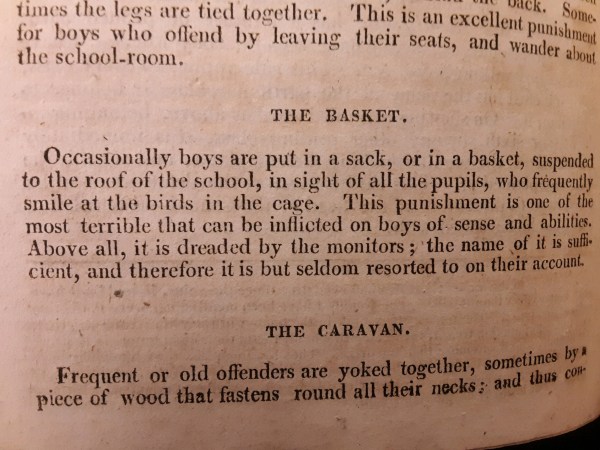
1810 punishment the basketIn the 1810 edition of his school-reform manual, Lancaster described this technique:


Occasionally boys are put in a sack, or in a basket, suspended to the roof of the school, in sight of all the pupils, who frequently smile at the birds in the cage. This punishment is one of the most terrible that can be inflicted on boys of sense and abilities.

Even Lancaster acknowledged that this extreme form of public humiliation was “terrible,” but it worked. As one enthusiastic teacher wrote to Lancaster in 1812, suspending kids from the ceiling could work wonders with classroom management. As this teacher put it,

When they first came, they were like so many wild donkeys of the Common, for they did not care for any thing; I threatened them with the cradle, but that, did no good. So I got the Head of them, put him in, and gave him a bit of a rocking: well! He begged and prayed for me to take him out, and he would not swear nor talk again, upon that condition I let him out & he has kept his word ever since; it took such an effect on all the Boys, that I have never had to punish one since: so, out of a set of wild donkeys, they are made a set of good behaved orderly children.

Just like KIPP’s leaders, however, Lancaster’s followers found out that public humiliation was not a good long-term strategy. By 1817, manuals of the Lancasterian system no longer advocated “the basket” or other tools of public humiliation. Instead, they moved to a simpler system of merits and demerits.

Why? Because when Lancasterian schools resorted to public humiliation, students stopped coming. Turns out people don’t like being publicly humiliated. Back in the early 1800s, especially, African-American students and families refused to have their children subjected to the same sorts of punishments that slave-owners had used on southern plantations.

It doesn’t seem like it should be a difficult notion to grasp, yet for two hundred years school leaders have had to “discover” this truth anew. Which leads us to our question for today: Why is it so difficult for reformers to understand that public humiliation is not a good strategy?

I Love You but You Didn’t Do the Reading

Covering the bases this week: Stories about evangelical higher ed, campus free speech, megachurch abuse scandals, and more. Thanks to everyone who sent in stories and tips.

Liberty U student journalist condemns Falwell’s “culture of fear,” at WaPo.

What my team and I experienced at the Champion was not an isolated overreaction to embarrassing revelations. It was one example of an infrastructure of thought-control that Falwell and his lieutenants have introduced into every aspect of Liberty University life.

Mr. Young’s story from Liberty U is heart-wrenching, but it is not new. The dictatorial style of Jerry Falwell Jr. is not an innovation, but rather only a sad flowering of a poisonous fundamentalist flower.

More from Professor Amy Wax. The Penn Law professor is under fire again for “repugnant” statements, allegedly saying, “our country will be better off with more whites and fewer nonwhites.” At IHE.

An evangelical mega-church reopens after a sex-abuse scandal, at RNS.

[One victim] doesn’t think there’s anything church leaders can say to make the controversy go away. At least not yet.

“I’m just really feeling like they have one last chance kind of to make this right,” she said.

New York’s campaign against Hasidic schools raises tough questions, at EducationNext:

How much authority should the city and state have to impose the government’s vision of an education on a religious minority that would prefer to be left alone? How much power should parents have to send their children to schools that emphasize religious subjects at the expense of topics such as science or math? Does society have a responsibility to ensure that all children receive an education that enables them to participate in democracy and the workplace? And who determines the answers to these questions—parents, politicians, courts, bureaucrats, advocacy groups, or some complicated combination thereof?

Growing up Helter Skelter: LAT interview with the son of Charles Manson.

From the not-learning-our-lesson department: Feds release series of anti-vaping videos, at CNN.

https://www.youtube.com/watch?v=3pXs2sipKy4

A peek into the ugly politics of school funding. Ohio governor vetoes a last-minute sneaky provision to save rich Clevelanders from paying high school taxes, at Cleveland.com.

Michigan school principal sues district for “anti-white” discrimination, at MLIVE.

Blick’s lawsuit alleges that Ann Arbor school district officials “maintain a custom, policy and practice of: treating Caucasian and nonminority administrators disparately and less favorably than similarly situated African-American and minority administrators; subjecting Caucasian and nonminority administrators to hostility and harassment in the workplace based on their race; accelerating the promotion and advancement of African-American and minority administrators at the expense, and to the detriment, of Caucasian and nonminority administrators.”

When Loyalty Means Dictatorship: The Latest Sad Story from Liberty U

It is not a happy time to be a Flame. Former student editor Will E. Young offered a blistering expose of the school’s “atmosphere of fear” in the Washington Post. Unfortunately, Young’s experience at Liberty was not a shocking departure from the history of evangelical higher ed, but rather just a new development of an ugly tradition. As Young asks plaintively,

How can a college education stifle your freedom of thought?

Unfortunately, Jerry Falwell Jr.’s dictatorial antics are nothing new. Whether Falwell realizes it or not, he is only the latest fundamentalist school leader to bolster his authority at the cost of his school’s intellectual and spiritual integrity.

Bob jones sr

Falwell adopts the Bob Jones leadership mantra: “My Way or the Highway”

Young was student editor at the Liberty student paper and experienced the full pressure of the administration’s heavy-handed regime of censorship. His faculty advisor required him to preview articles and killed any story that made Liberty or its leader Jerry Falwell Jr. look bad.

As Young explained,

when my team took over that fall of 2017, we encountered an “oversight” system — read: a censorship regime — that required us to send every story to Falwell’s assistant for review. Any administrator or professor who appeared in an article had editing authority over any part of the article; they added and deleted whatever they wanted. Falwell called our newsroom on multiple occasions to direct our coverage personally, as he had a year earlier when, weeks before the 2016 election, he read a draft of my column defending mainstream news outlets and ordered me to say whom I planned to vote for.

Such censorship is not new for Liberty. As we’ve seen, in recent years Liberty’s censorship has grown stricter. As I argued in Fundamentalist U, this kind of leader-focused absolutism has a long and sad tradition in evangelical higher ed. It is not a quirk of Falwell or Trumpism, but rather it is the result of the definitional problem of interdenominational evangelical higher education. Without a single, clearly defined religious orthodoxy to defend, institutions such as Liberty, Bob Jones University, and many others developed a top-down, leader-centric institutional structure. In short, lacking a denominational orthodoxy or hierarchy, some fundamentalist school leaders adopted a bitter, angry “my-way-or-the-highway” approach.

Back in the 1930s, when “fundamentalism” was still finding its legs as an institutionalized religious movement, leaders of fundamentalist colleges such as Wheaton and Bob Jones faced a dilemma. They had no universally agreed-upon definition of fundamentalism, yet they were charged with teaching fundamentalism and maintaining a purely fundamentalist campus.

buswellpres

Buswell at Wheaton.

Different schools reacted differently. Wheaton ended up with a confusing spread of institutional authority. Early President J. Oliver Buswell found out the hard way that he could not simply dictate policy at Wheaton. When Buswell tried to embrace a vision of fundamentalism that meant full separation from non-fundamentalist Protestants, he was summarily fired.

At the same time, Bob Jones Sr. pioneered the kind of fundamentalist leadership that is on display today at Liberty University. All faculty members were required to agree with every jot and tittle of Jones’s beliefs. One faculty member was fired in 1938 for “hobnobbing” with students. As this fired faculty member wrote in an open letter, he had worked at two other evangelical universities in his career,

two of them orthodox. (But not obnoxious.) My loyalty was never questioned . . . . It simply never occurred to me that I was not free to express my opinions and I did express them. How was I to know that loyalty meant dictatorship?

It might never have been crystal clear what “fundamentalism” meant, but at Bob Jones College (later Bob Jones University), it always meant whatever the leader said it meant. Any disagreement, any “griping,” meant a fast ticket out the door, with a furious gossip campaign among the fundamentalist community to discredit the fired faculty member.

Mr. Young’s story from Liberty U is heart-wrenching, but it is not new. The dictatorial style of Jerry Falwell Jr. is not an innovation, but rather only the sad flowering of a poisonous fundamentalist flower.